

Most players obsess over GTO study while ignoring the single highest-EV decision they make every session: where to sit. Table selection is the practice of choosing which game to play based on opponent quality and table dynamics.
It is not flashy. It does not look like skill. But a mediocre player with exceptional table selection will outrun a strong player who ignores it, session after session, year after year.
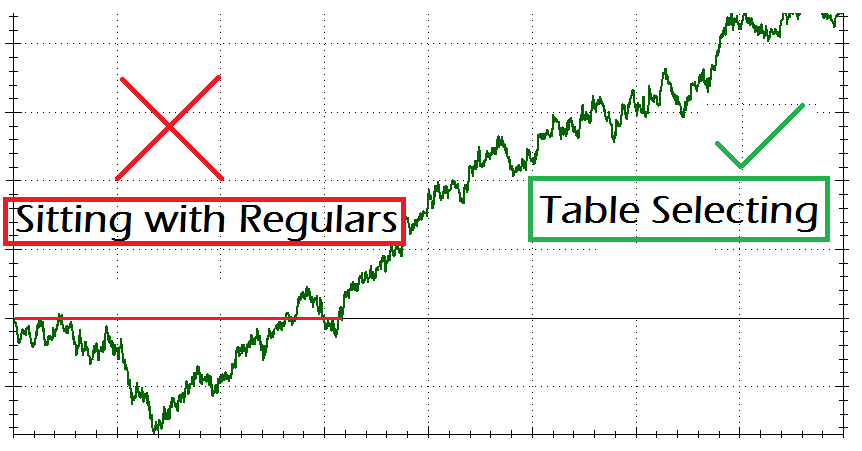
Your win rate depends on two variables: how well you play and how badly your opponents play. Most players spend 90% of their improvement effort on the first variable and ignore the second entirely.
This guide covers lobby statistics, player profiling, seat selection, format differences, and when to leave a table. Table selection compounds over thousands of sessions. It turns marginal winners into significant earners.
Why Table Selection Matters More Than Skill Improvement
Consider two grinders spending 50 hours on poker improvement. The first studies GTO, drills solvers, watches training videos, and refines preflop charts. With serious dedication, they might improve their win rate by 1 to 2 bb/100.
The second grinder spends those same 50 hours identifying soft games, building a database of weak players, and positioning themselves at tables full of fish. Their effective win rate improves by 5 to 10 bb/100.
The math is simple but brutal. At $10NL, rake typically eats roughly 8 bb/100. You need to beat the player pool by at least 8 bb/100 just to break even after rake.

Table selection transforms the entire equation. A marginal winner at a tough table becomes a significant winner at a soft table without changing a single aspect of their game. You do not need to study more. You do not need to grind harder. You need to sit at better tables.
Documented data confirms this. Tracking software shows recreational players losing at rates between 20 and 40 bb/100. Those losses do not go to the rake. They go to players like you, but only if you are at the right table.
The math is clear
How to Read Lobby Statistics for Table Selection
Most online poker rooms display table-level statistics in the lobby. Three numbers matter most, and learning to read them ensures you never waste another session at a table full of regs.
Players Per Flop Percentage
This statistic is the table-level proxy for average VPIP. It tells you what percentage of dealt hands result in players seeing the flop. This single number reveals the looseness of your entire table.
Below 20% means a tight table full of regulars. Everyone is folding preflop. The pots will be small and the competition fierce. Avoid these tables.
Between 20% and 30% indicates an average table with some recreational players mixed in. Above 30% signals a soft table with multiple loose players. Prioritize these.
Above 40% represents an extremely soft table. Sit immediately. Tables this loose appear rarely and do not last long.
Average Pot Size
A high average pot size tells you players are putting money into the pot with weak holdings. A table with 35% players per flop and a high average pot size is ideal: loose players who also put money behind their mistakes on later streets.
One caution: a high pot size with a low players-per-flop percentage might reflect two aggressive regulars battling each other. Always check both metrics together. The combination matters more than either number alone.
Hands Per Hour
Tables with recreational players often run below 70 to 80 hands per hour at 6-max. Fish take longer to act, they chat in the box, and they sit out randomly.
A table running 60 hands per hour instead of 90 is a feature, not a bug. You want the fish, not maximum volume.
| Statistic | What It Measures | Good Sign | Red Flag |
|---|---|---|---|
| Players/Flop % | Average looseness | Above 30% | Below 18% |
| Average Pot Size | Money going in weak | 15+ big blinds | Under 8 big blinds |
| Hands/Hour | Table speed | Below 75 (fish present) | Above 90 (all regs) |
| Wait List | Demand for seats | 2+ waiting (likely soft) | Empty (regs avoid it) |
How to Identify Weak Players Online and Live
Table selection is only as good as your ability to spot the fish. Lobby statistics get you to the right table. Player profiling keeps you there and ensures you actually exploit the weak players at your game.
Online Player Identification
HUD statistics are the gold standard. Target players with VPIP above 40% and PFR below 10%. These players see too many flops and rarely raise, meaning they call with weak holdings and fold to aggression infrequently. A WTSD (Went to Showdown) percentage above 30% confirms a calling station who pays off hands they should not.
Without a HUD, non-HUD tells are everywhere. Short stack buyers who consistently buy in under 50 big blinds and never reload are almost always recreational. Single-tablers are typically weaker than multi-tablers.
The mobile device icon next to a username signals a casual player on their phone. Odd bet sizing (minbets, pot-sized bets on every street, bizarre amounts) reveals a player without a structured strategy. Frequent preflop limping is one of the most reliable fish indicators online.
Tag every recreational player you identify with a color code. Most poker clients support permanent player notes. This compounds over thousands of sessions
. When you log in six months later, you already know which players are weak and which seats to target.
Live Player Identification
At a live table you have zero HUD data, but behavioral tells are everywhere. Chip handling is revealing: recreational players fumble chips, stack them unevenly, and splash the pot.
Conversation topics matter. Players discussing sports, work, or vacation plans are usually at the table for entertainment, not profit.
Stack management reveals intent. Fish buy in short, never top up, and play scared when short-stacked. A player with 30 big blinds who folds to aggression is losing money.
A regular would reload immediately. Drink orders correlate with loose play. Multiple alcoholic drinks throughout a session predict wider ranges and weaker discipline.
| Indicator | Online Sign | Live Sign |
|---|---|---|
| Buy-in Amount | Under 50bb, no reload | Short stack, never tops up |
| Play Speed | Slow, uses full time bank | Takes long, asks dealer questions |
| Bet Sizing | Minbets or pot-size only | Odd amounts, string bets |
| Table Count | Single-tabling | N/A (always one table live) |
| Emotional State | Chat box outbursts | Visible frustration, sighing |
| Focus Level | Mobile icon, sitting out | Phone use, watching TV screens |
- VPIP above 40% with PFR below 10% is your primary online target for table selection
- Short stack buyers who never reload are almost always recreational players
- Tag every fish you find with color codes; your database becomes a long-term edge over years of grinding
- Chip handling and conversation reveal live player type immediately
- Preflop limping from any position is the single most reliable fish indicator
- Mobile device icons at online tables signal recreational players
Seat Selection: Where You Sit Matters as Much as Where You Play
You found a soft table. Now pick the right chair. A bad seat at a great table can erase your edge entirely.
The concept is straightforward: you want position on the weak players and position against the strong ones. Identify the weakest player at the table and sit directly to their left.
This is called the Jesus Seat. You see their action before you decide on nearly every hand. You can isolate them with raises knowing they play weak ranges. You control the dynamic with positional advantage.
If there is an aggressive regular at the table, position them on your right so you act after them. This neutralizes their aggression because you always see their bet before committing chips.
Money flows in a specific direction at poker tables. In a full ring game, chips tend to move clockwise. The player to the left of the action has the most profitable seat because they close the action with the most information.
Your ideal seat map: weak players on your right so you have position on them frequently; tight regulars across from you where you rarely need to play against them; aggressive players on your right so you see their action first.
The worst possible seat is having an aggressive regular directly on your left while the fish sit across the table where you rarely have position on them.
If you cannot get the ideal seat, wait. Most poker rooms let you choose your seat or join a waiting list for a specific position. Patience here pays off in bb/100 over thousands of hands.
Position is everything
Table Selection by Game Format
Cash Games
Cash games offer the most control over table selection. Lobby stats are visible before you commit. You can sit, observe, and leave within minutes if the game does not meet your standards.
The key principle is quality over quantity. Multi-tabling players should open 2 to 3 tables at soft games rather than 8 tables at random. Four tables with consistent fish beats twelve tables of regulars for hourly rate.
Tournaments
Table selection is limited in MTTs because seating is typically random. However, late registration gives you a form of table selection. You can register late and scan the lobby for tables with short stacks and recreational players.
Table change requests exist at most major sites. Use them when your table tightens up or the fish bust out. In live tournaments, watch for table breaks that move you to softer tables.
Sit & Go and Spin & Go
Individual table selection is minimal in SnGs and Spins because seating is automatic. Site selection replaces table selection in these formats.
Play on platforms with the largest recreational player pools. Time-of-day selection matters more here than anywhere else.
Play during peak recreational hours (evenings and weekends) to maximize fish frequency. Check VIP-Grinders rakeback deals to find the best sites for soft games.
- Cash games: check lobby stats before sitting; leave when fish leave
- MTTs: use late registration to scout tables; request table changes when needed
- SnGs/Spins: focus on site selection and peak playing hours instead of table selection
- Multi-tabling: fewer tables with fish beats more tables with regs for hourly rate
- All formats: track which sites and time slots produce the softest games for you
When to Leave a Poker Table
Knowing when to leave is as important as knowing where to sit. Many players stay too long at tables that have gone bad, grinding out losses against tough lineups when softer games are available.
When the primary weak player at your table stands up or busts out, reassess immediately. If the remaining players are all competent, your edge just disappeared. Leave and find another game. Do not stay hoping another fish arrives.
Table composition can shift even without a single player leaving. If two regulars fill empty seats, the table went from soft to tough. Monitor the lobby continuously. Track the replacements when players depart.
Your mental state matters. If you are tilting, frustrated, or unfocused, no amount of table selection saves you. Leave the session entirely. Come back when your head is clear.
After 2 to 3 hours at the same table, your reads become stale and opponents have adapted to your patterns. Moving to a fresh table resets the dynamic.
If you have lost 3 or more buy-ins at a table, a table change or session end can be more profitable than grinding back at the same seat.
- The weakest player at the table leaves or busts out
- Two or more regular players fill previously empty seats
- You have been at the same table for 3+ hours and opponents are adjusting
- You feel tilted, frustrated, or mentally unfocused
- You have lost 3+ buy-ins and remaining players have your number
Advanced Table Selection Strategies
Multi-site strategy multiplies your available game pool. Deposit on 3 to 4 poker sites within your market and check the lobbies of each before committing to a session.
The site with the softest tables that day gets your volume. VIP-Grinders offers exclusive rakeback deals that make multi-site play even more profitable.
Optimal playing times follow recreational player schedules. They play evenings after work (6pm to midnight local time) and weekends.
Holiday periods including Christmas, New Year, and major sporting events spike recreational traffic. Track your results by day and time to find your most profitable windows.
Stake-specific table selection requires adjusting your standards. At microstakes ($2NL to $10NL), fish are abundant but rake is brutal. You need 2 to 3 recreational players at your table just to overcome the rake.
At small stakes ($25NL to $50NL), fewer fish populate each table, but they play for higher stakes and make bigger mistakes. One whale can fund your entire session.
At mid-stakes ($100NL to $200NL), table selection becomes critical. Most players are competent, and without a clear fish, your edge is razor thin after rake.
Starting your own tables works during off-peak hours. Open a new table and sit alone. Recreational players prefer joining existing tables with open seats rather than waiting for full games. You attract fish by being the first to sit.
Table selection software automates the process. Tools like TableScan Turbo and PokerTracker table finder scan lobbies, flag tables with known fish from your database, and alert you when soft games open.
The initial setup takes 30 minutes and saves hundreds of hours over a year. Use poker calculators alongside these tools to optimize your game further.
Conclusion
Table selection is the highest-ROI activity in poker. No training course, coaching session, or solver subscription matches the bb/100 impact of sitting at the right table.
Start immediately. Open your poker client, check 3 to 4 tables before sitting, look at players-per-flop and average pot, tag every fish you encounter, and sit to their left. Multi-site play expands your game pool. Evening and weekend sessions increase fish frequency across all platforms.
If your current table goes bad, move. Do not grind it out against regulars when softer games exist elsewhere. The opportunity cost of staying at a tough table is enormous.
Table selection is not a one-time decision. It is a continuous process that runs throughout every session. Every time a player leaves, reassess.
Every time you move to a new table, evaluate the lineup. This habit separates professional grinders from recreational players. For more poker strategy content, keep building your edge one table at a time.
Frequently Asked Questions About Table Selection
What is table selection in poker?
Table selection is the process of choosing which poker game to join based on the quality of your opponents. The goal is to sit at tables with the most recreational or weak players, giving you the highest possible win rate. Strong table selection can add 5 to 10 bb/100 to your results without any change in your actual playing ability.
How do I find fish at online poker tables?
Check the lobby statistics first. Look for tables with a players-per-flop percentage above 30% and a high average pot size. Once seated, use a HUD to identify players with VPIP above 40% and PFR below 10%. Without a HUD, look for short stack buyers, single-tablers, mobile device icons, and players who limp frequently preflop. Tag every fish you find for future sessions.
What lobby stats should I look at for table selection?
The three most important lobby stats are players-per-flop percentage, average pot size, and hands per hour. Players per flop above 30% indicates a soft table. A high average pot size confirms players are putting money in with weak holdings. Low hands per hour (below 75 at 6-max) often signals recreational players who take longer to act.
Where should I sit at a poker table?
Sit directly to the left of the weakest player at the table. This position gives you the advantage of acting after them in most hands, allowing you to isolate them with raises and control pot size. If an aggressive regular also sits at the table, try to have them on your right as well. Avoid seats where strong players have position on you.
How does table selection affect my win rate?
Table selection has a larger impact on win rate than almost any other factor. At $10NL, rake costs roughly 8 bb/100. Against a table of regulars, your pre-rake edge might be 2 to 4 bb/100, making you a net loser. Against a table with 2 to 3 recreational players, your pre-rake edge can reach 15 to 20 bb/100, making you a solid winner. The difference between a good and bad table is often 10 or more bb/100.
When should I leave a poker table?
Leave when the primary fish at your table busts out or leaves and the remaining players are all competent. Also leave if your mental state has deteriorated due to tilt, fatigue, or frustration. After 2 to 3 hours at the same table, consider moving because opponents have likely adapted to your tendencies.
Is table selection considered bum hunting?
Some players use the term negatively, but table selection is a fundamental part of profitable poker. Every professional player practices game selection. The goal is to maximize your hourly rate, and playing against weaker opponents is the most effective way to do that. Recreational players are at the table to have fun and would be playing regardless of who else is seated. Table selection is smart bankroll management, not exploitation.