

Limit Hold’em Strategy: How to Adapt from No-Limit 2026
In Limit Hold’em (LHE), every bet and raise is a fixed amount set by the stake. You cannot shove all-in, you cannot overbet, and you cannot size a bluff big enough to force a fold. That one rule changes the hands you play, the streets that matter, and how you make money.
This guide covers exactly how to adjust.
- How the fixed betting structure works and what it changes
- Which starting hands gain and lose value compared to No-Limit
- Why the turn is the most important street in Limit Hold'em
- The six mistakes NL players make when switching to Limit
For the No-Limit rules this guide builds on, see our Texas Hold’em rules and strategy guide.
These are the six differences that matter most when you sit down at a Limit table.
| Concept | No-Limit | Fixed-Limit |
|---|---|---|
| Bet sizing | You choose any amount up to your stack | Fixed: small bet preflop and on the flop, big bet on the turn and river |
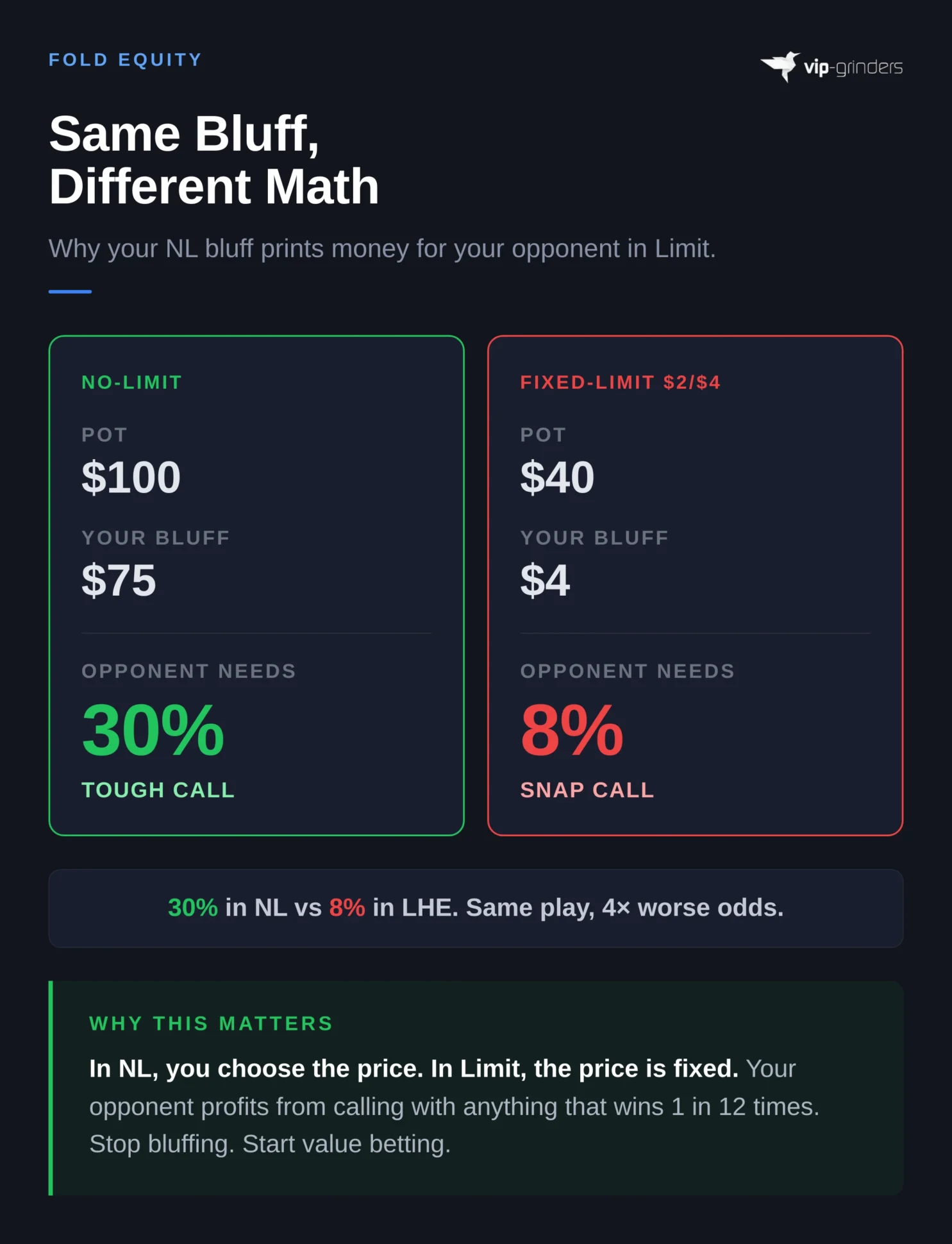
| Fold equity | High: large bets force folds | Low: opponents call getting 6:1 or better |
| Implied odds | High: you can win a full stack | Low: bets are capped, payoffs are small |
| Profit source | Big pots and stack-offs | Thin value: one extra bet per hand, thousands of times |
| Most important street | River | Turn (the bet doubles and fold equity peaks) |
| Bankroll standard | 30 to 50 buy-ins | 300 big bets |
At a $2/$4 table, every bet and raise is $2 preflop and on the flop, then $4 on the turn and river. For the middle ground between Fixed-Limit and No-Limit, see our Pot-Limit Hold’em guide, where the pot sets the betting ceiling. Raises are capped at four per round (one bet plus three raises) when three or more players are in the pot, but uncapped heads-up.
NL gives you a bet sizing decision on every action. LHE removes it. Fold equity is too low to push opponents off their hands, so the game becomes about hand reading and pot odds.
Starting Hands That Gain and Lose Value
| Hand Type | Examples | NL | LHE | Why |
|---|---|---|---|---|
| Big Broadway | A♠ K♦ A♥ Q♦ K♥ Q♥ | Strong | Stronger | Win at showdown often, no stack risk |
| High pairs | A♠ A♥ K♥ K♦ Q♠ Q♥ | Premium | Premium | Same power, less stack risk |
| Small pairs | 4♠ 4♥ 6♦ 6♣ | Playable (set value) | Weak | Cannot win a stack when you hit |
| Suited connectors | 8♠ 7♠ 7♥ 6♥ | Playable | Weak | Draws pay less when bets are capped |
| Trap hands | A♠ 10♦ K♥ J♣ Q♦ 10♠ | Marginal | Dangerous | Dominated hands leak small bets constantly |
In NL, you play 4♠ 4♥ from the button hoping to flop a set and stack someone for 100bb. In LHE, flopping that set wins you a few extra big bets, not a full stack. The implied odds that justify small pair and suited connector calls in No-Limit collapse when bets are capped.
Hands like A♠ 10♦, K♥ J♣, and Q♦ 10♠ look playable but regularly run into better kickers. You flop top pair, you call down because the bets are cheap, and you lose a few big bets to A♠ K♥ or A♥ Q♦ every time. Over thousands of hands, these trap hands cost more than any single bad beat.
LHE pots go multiway far more often than NL pots because the fixed raise rarely prices anyone out. Against three or four callers, big pairs like A♠ A♥ lose relative strength because more opponents means more chances to get outdrawn. Hands that make the nuts (top pair top kicker, nut flush draws) gain value in multiway pots because the pot grows larger and you collect more bets when you win.
NL preflop ranges reward playability and drawing potential. LHE rewards raw showdown strength above both.
Why the Turn Is the Most Important Street
The flop uses the small bet. The turn and river use the big bet, which is where most of your profit and most of your mistakes happen.
Flop (Small Bet Street)
Bet for value and protection with top pair or better. The small bet is cheap enough that most opponents call, so charge draws immediately rather than slow-play. Check-raising is more common in LHE than in NL because the fixed size means a failed trap costs you less.
One play unique to LHE is the free card raise. If you hold a draw in position, raise the flop bet: your opponent will often check to you on the turn, letting you check behind and see the river without paying a big bet. With A♥ 10♥ on a K♥ 7♥ 3♣ flop, that raise costs one extra small bet but saves one big bet on the turn.
Turn (Where LHE Games Are Won and Lost)
The bet doubles. Opponents who called a $2 flop bet now face $4. Raising the turn for value with strong made hands is the single most profitable play NL players miss when they switch to Limit.
You hold A♥ K♦ on a K♥ 9♣ 4♠ 2♦ board. An NL player might check this turn for pot control. At a Limit table, bet it: every checked turn with a strong hand is a missed big bet you cannot recover.
River (Thin Value)
If your hand wins more than half the time against what your opponent would call with, bet. A wrong value bet and a missed value bet cost exactly the same: one big bet. Over thousands of hands, the player who bets thinner on the river wins.
The concept is the same as thin value betting in NL, but the bar is lower in LHE because the fixed size caps your risk.
You hold A♥ J♦ on a J♠ 8♥ 5♣ 3♦ 2♠ board after betting the flop and turn. A pair of Jacks with an Ace kicker beats most hands your opponent would call with here: weaker Jacks, pocket pairs below a Jack, missed draws. Bet: if you are behind you lose one big bet, but checking costs the same amount in missed value every time they would have called.
Six Mistakes NL Players Make in Limit
These six mistakes cost the most money when NL players switch to Limit. Most come from habits that stop working when bets are fixed, especially aggressive bluffing.
- 1Bluffing too often. One bet into a 10-bet pot gives your opponent 10:1 odds. They only need to be right 9% of the time to profit from calling.
- 2Missing bets with strong hands. Every checked street is a missed bet you cannot recover. In NL you check to trap for stacks, but in LHE the fixed bet size means trapping barely adds to the pot.
- 3Chasing draws without direct odds. Implied odds are small in LHE because bets are capped. If the pot is not offering the right price right now, fold.
- 4Overplaying small pairs and suited connectors. These hands need implied odds to be profitable, and LHE does not provide them. Tighten these categories from every position.
- 5Skipping the turn raise. When you hold a strong made hand on the turn, raise. The doubled bet builds the pot faster than any other action in Limit and charges opponents the maximum for drawing.
- 6Using NL bankroll rules. 30 buy-ins works for NL cash games. LHE needs 300 big bets because forced showdowns create longer, grinding swings.
Frequently Asked Questions
Is Limit Hold'em easier than No-Limit?
The fixed structure removes bet-sizing decisions but adds forced-showdown complexity. You cannot push opponents off hands, so reading ranges and extracting thin value matter more. Different game, not an easier one.
What is the 4-bet cap?
Most rooms cap betting at four bets per round in multiway pots: one bet plus three raises. When only two players remain in the hand, the cap is usually removed and raises are unlimited.
What bankroll do I need for $4/$8 Limit Hold'em?
The standard rule for LHE is 300 big bets. At $4/$8 the big bet is $8, so you need $2,400. At $2/$4 that number is $1,200, and at $10/$20 it rises to $6,000.
Is Limit Hold'em still played?
Yes. PokerStars, ACR, and Ignition spread LHE cash games online. Bellagio and the LA cardrooms (Commerce, Bicycle) run regular live games. The WSOP awards two LHE bracelets each year, most recently won by Ian Johns at the 2025 $10,000 LHE Championship.
Is Limit Hold'em part of HORSE?
Yes. HORSE rotates through Hold’em, Omaha Hi-Lo, Razz, Seven-Card Stud, and Stud Hi-Lo Eight-or-Better. The “H” in HORSE is Limit Hold’em, not No-Limit. Most WSOP mixed game events and live cardroom rotations use Limit, so learning LHE prepares you for every mixed game that includes Hold’em.