Bet Sizing in Poker: A Street-by-Street Guide 2026
Every bet you make in poker sends a price signal. Too small and you give draws the right odds to call, let medium hands see cheap cards, and leave value on the table with your strongest holdings. Too large and you fold out the worse hands you wanted to pay you, bloat the pot with marginal holdings, and make your bluffs more expensive than they need to be.
The correct bet size is never about your hand in isolation. It is about the board texture, your opponent’s tendencies, the stack-to-pot ratio, and whether you are playing a cash game or a tournament. Getting this decision right on every street is worth more bb/100 than any other single skill at stakes below NL500.
This guide covers preflop open-raise, isolation, 3-bet, and 4-bet sizing with exact numbers by position and format. It then walks through flop sizing by board texture (including multiway pots and 3-bet pots), turn barrel sizing, and river value bet sizing. It also covers how sizing changes in tournaments at different stack depths, how to adjust against four common opponent types, and the six most expensive sizing mistakes that quietly drain win rates.
What Bet Sizing Controls
Every bet size you choose affects three things at once, and understanding all three is what separates a player who picks sizes by feel from one who picks them by logic.
The first is the pot odds you offer your opponent. A half-pot bet gives them 3:1 odds (requiring 25% equity to call), while a pot-sized bet gives them 2:1 (requiring 33%). Your bet size directly determines whether their draw or bluff-catcher can profitably continue, and the pot odds guide covers how to calculate these thresholds for any size.
The second is fold equity. Larger bets fold out more hands, which makes bluffs more effective but also narrows your opponent’s continuing range to stronger holdings. Smaller bets fold out fewer hands, which keeps weaker hands in the pot and makes value bets more profitable against a wider range.
The third is stack-to-pot ratio (SPR) on future streets. Every bet you make on the flop changes the pot size and your remaining stack, which sets the price for the turn and then the river. Choosing a size on any one street without considering what it does to future streets is one of the most common leaks in poker.
These three levers interact on every decision. A small flop bet offers generous odds (bad for denying draws) but preserves a high SPR for future streets (good for maneuvering). A large flop bet denies equity effectively (good against draws) but compresses the SPR so that turn and river decisions become committal (risky with marginal hands).
Preflop Sizing
Preflop is the one street where bet sizing follows clear, memorizable rules. The numbers below work across online and live cash games and tournaments. Once you memorize them, every preflop decision becomes faster and more consistent.
Open-Raise Sizing by Position and Format
Modern poker has moved away from the old “3x from every seat” standard. The trend across stakes and formats is smaller opens, with adjustments based on position and game type. The table below gives you the starting numbers.
| Format | UTG / MP | CO | BTN | SB |
|---|---|---|---|---|
| Online cash (100bb) | 2.5x | 2.5x | 2.25x to 2.5x | 3x |
| Live cash ($1/$2 to $5/$10) | 3x to 4x | 3x | 2.5x to 3x | 3x to 4x |
| MTT deep stacked (40bb+) | 2.2x to 2.5x | 2.2x | 2x to 2.2x | 2.5x to 3x |
| MTT mid stacked (20bb to 40bb) | 2x to 2.2x | 2x to 2.2x | 2x | 2.2x to 2.5x |
Two patterns stand out. First, live opens are larger because live opponents call wider preflop: a 2.5x raise at a live $1/$2 table often gets four callers, turning your positional edge into a multiway coin flip. Raising to 3x or 4x prices out the weakest hands and gets you closer to heads-up pots where skill matters most.
Second, the small blind raises larger in every format. You are guaranteed to play out of position against the big blind if they call, so a bigger raise compensates for that disadvantage by either winning the blinds outright or building a pot where your larger preflop investment justifies postflop aggression.
Below 20bb in tournaments, open-raising no longer makes sense for most hands. The decision simplifies to shove or fold. For push/fold charts and specific ranges by stack depth, see the MTT strategy guide.
Adjusting for Limpers
When one or more players limp in front of you, your raise needs to increase to price out the limpers and the players behind them. The standard adjustment is your normal open plus 1bb per limper.
| Limpers Ahead | Online Cash (2.5x base) | Live Cash (3x base) |
|---|---|---|
| 0 (no limpers) | 2.5bb | 3bb |
| 1 limper | 3.5bb | 4bb |
| 2 limpers | 4.5bb | 5bb |
| 3 limpers | 5.5bb | 6bb |
| 4+ limpers | 6bb (cap) | 6bb to 7bb (cap) |
With four or more limpers (common in live games), the isolation raise tops out around 6bb to 7bb. Going larger commits too much of your stack preflop with hands that play best postflop. If your isolation raise is not folding enough limpers at 6bb, the answer is usually to tighten your isolating range rather than to size up further.
3-Bet and 4-Bet Sizing
A 3-bet (re-raise over an open raise) follows a different formula depending on whether you are in position or out of position against the original raiser.
- In position: 3x the open raise. If the open is 2.5bb, your 3-bet is 7.5bb. This size puts pressure on the opener while keeping the SPR high enough to maneuver postflop.
- Out of position: 3.5x to 4x the open raise. If the open is 2.5bb, your 3-bet is 9bb to 10bb. The larger size compensates for the positional disadvantage by building a pot where you can more easily get stacks in by the river.
- Squeeze (with callers in between): 4x to 5x the open raise. Callers between you and the opener have already shown a willingness to see a flop, so your raise needs to be large enough to fold them out. Add roughly 1x per caller.
For the full breakdown of which hands to 3-bet with and when to 3-bet light, see the 3-bet strategy guide.
A 4-bet (re-raise over a 3-bet) is simpler: the standard size is 2x to 2.5x the 3-bet. At 100bb stacks, a typical 4-bet lands between 20bb and 25bb, which commits roughly a quarter of your stack preflop. At that point, a postflop shove becomes the natural next step if your opponent calls.
A 5-bet at 100bb stacks is almost always an all-in. There is not enough room to raise and then fold after putting 40%+ of your stack in.
Short-Stack Preflop Adjustments
As stacks get shorter, preflop sizing compresses because each bet represents a larger percentage of the effective stack.
| Effective Stack | Open-Raise | 3-Bet | Notes |
|---|---|---|---|
| 60bb to 100bb | 2.25x to 2.5x | 3x IP / 3.5x OOP | Standard sizing. Full postflop play. |
| 30bb to 60bb | 2x to 2.2x | All-in or fold | A 3-bet at 35bb puts enough in that folding to a 4-bet is costly. Either shove or do not 3-bet. |
| 20bb to 30bb | 2x (min-raise) | All-in | Open small to steal, but any resistance means shove or fold. |
| Below 20bb | All-in or fold | All-in | No room for standard raises. Push/fold only. |
The key threshold is 30bb. Above it, you have room for a standard open and a postflop plan. Below it, any 3-bet is a stack commitment (shove or do not re-raise), and trying to 3-bet to 8bb with a 25bb stack and then folding to a shove is one of the most expensive tournament sizing errors.
Flop Sizing
The flop is where bet sizing has the widest range of correct options. Depending on the board texture, the right c-bet can be anywhere from 20% pot to 80% pot. The key variable is how the board interacts with both players’ ranges, not the strength of your specific hand.
For when to c-bet versus when to check back, see the continuation betting guide. For check-raise sizing specifically, the check-raising guide covers the 2.5x to 3.5x multiplier system. This section covers the sizing decision after you have already decided to bet.
Small Bets on Dry Boards (25% to 33% Pot)
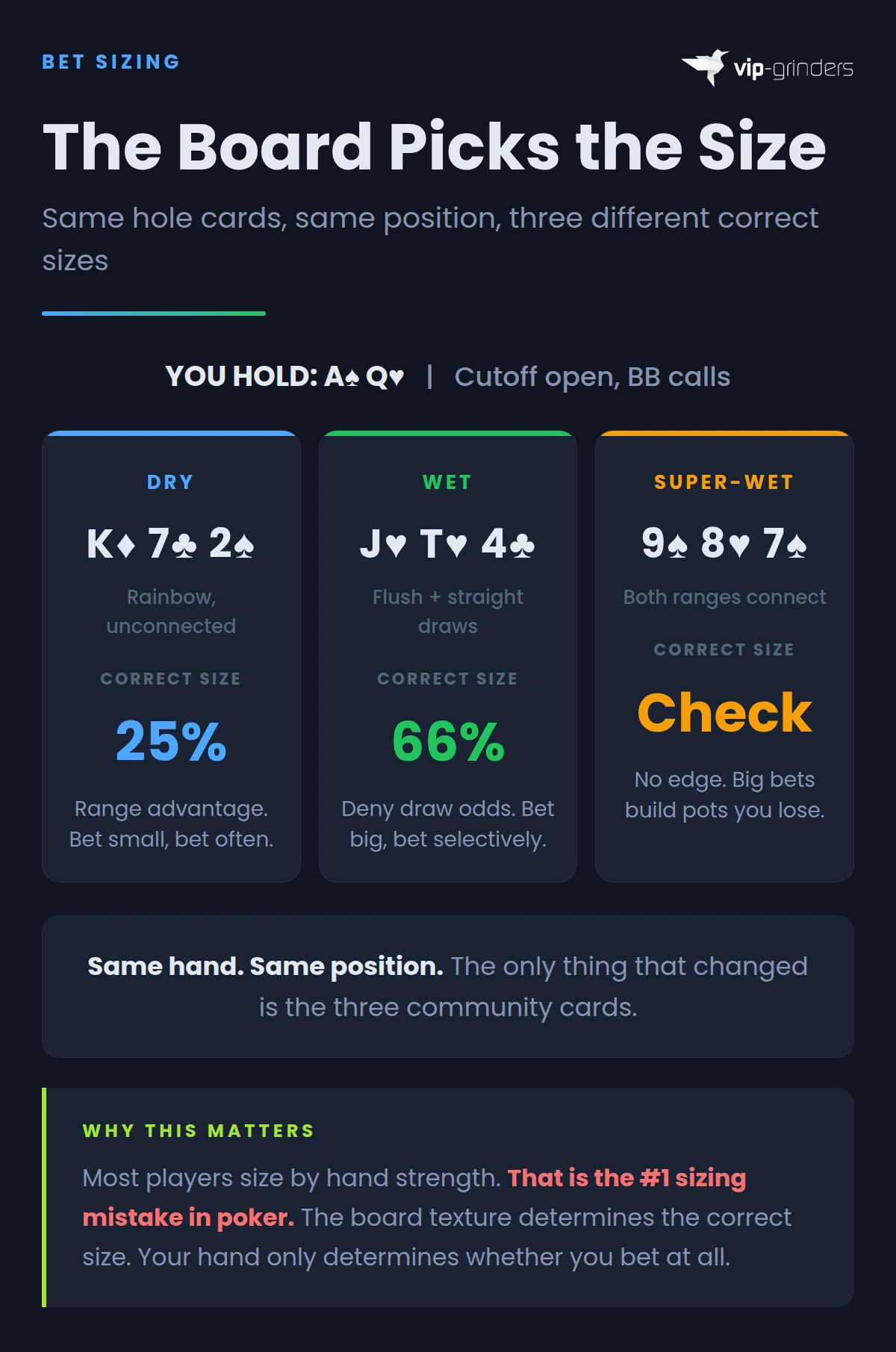
A dry board is one with few or no draws: rainbow texture, unconnected cards, and little chance your opponent hit a strong hand. Boards like K-7-2 rainbow, A-5-3 rainbow, or Q-8-2 with one suit are classic dry textures.
On these boards, the preflop raiser has a significant range advantage. You can bet a high percentage of your range (70% to 80% of hands) because your opponent’s calling range mostly consists of medium pairs and weak top pairs that cannot handle much pressure. A small bet of 25% to 33% pot accomplishes three things at once:
- 1It extracts value from a wide range of worse hands. Opponents call small bets with hands they would fold to a half-pot bet: pocket pairs below top pair, ace-high, and backdoor draws.
- 2It makes your bluffs cheap. When you bet 25% pot as a bluff, you risk 1 unit to win 4. Your bluff only needs to work 20% of the time to break even.
- 3It controls the pot size for future streets. A 33% pot flop bet keeps the SPR high enough that you still have room to make meaningful decisions on the turn and river.
The heuristic is simple: if you would c-bet 70%+ of your range on this board, bet small. You are not trying to protect a specific hand. You are using your range advantage to bet frequently at a price that rarely gets punished.
Large Bets on Wet Boards (66% to 80% Pot)
A wet board has multiple draws available: flush draws, straight draws, or both. Boards like J-T-8 with two hearts, 9-7-6 two-tone, or K-Q-9 with a flush draw are wet textures where equity runs close between both ranges.
On these boards, small bets are a mistake because they give draws correct odds to continue. A player holding a flush draw has roughly 35% equity on the flop, and if you bet 25% pot, they need just 17% equity to call. You are literally paying them to chase.
Sizing up to 66% to 80% pot denies correct odds to most draws and forces your opponent to pay a steep price to see the turn. The equity denial guide covers which hands benefit most from this protection bet and the EV math behind it. The trade-off is that you bet fewer hands at this size, with your range becoming more polarized: strong made hands and draws as semi-bluffs, while medium hands check. For how polarized versus merged ranges interact with bet sizing, see the poker ranges guide.
| Board Texture | Example | Recommended Size | Why |
|---|---|---|---|
| Dry rainbow | K-7-2 rainbow | 25% to 33% pot | Range advantage. Bet often, bet small. |
| Semi-dry (one draw) | A-9-4 with one suit | 40% to 50% pot | Some draws exist. Mid-size balances value and protection. |
| Wet (two draws) | J-T-8 two-tone | 66% to 80% pot | Many draws. Deny odds and polarize. |
| Monotone | 9-6-3 all spades | 33% to 50% pot or check | Flush already possible. See “wetness parabola” below. |
The Wetness Parabola
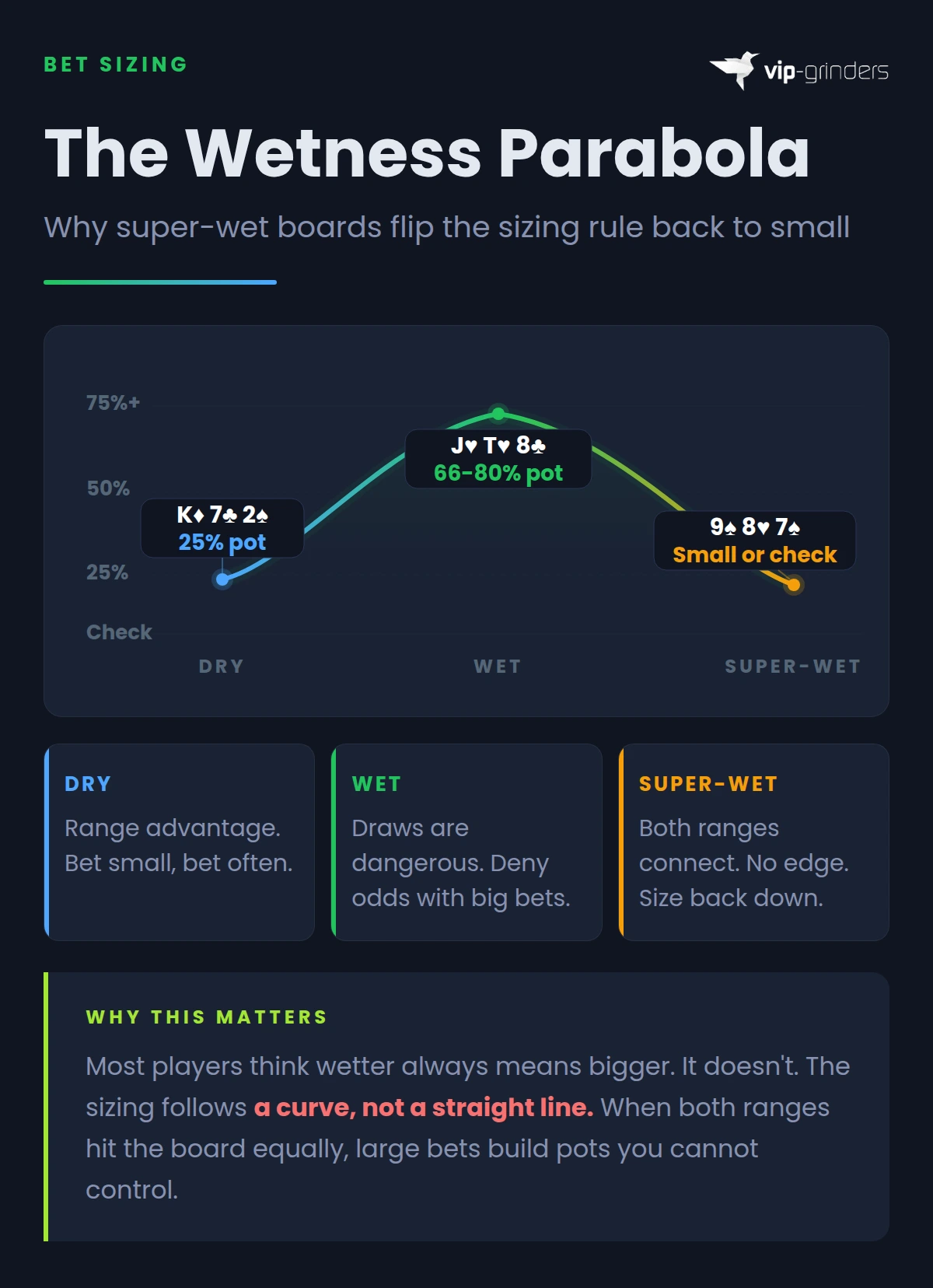
Here is a pattern that trips up even experienced players. As boards get wetter, the correct bet size goes up. But at a certain point, the board becomes so connected that neither player has a clear range advantage, and the correct sizing flips back to small or to checking.
Think of it as a curve: on one end, dry boards want small bets, and in the middle, wet boards want large bets. On the far end, extremely wet boards (monotone flops, three-to-a-straight like 8-7-6, or boards where both ranges connect heavily) want small bets again or no bet at all.
The reason is range distribution. On J-T-8 two-tone, the preflop raiser still has more overpairs and big aces, but on 8-7-6 with two suits, the big blind’s calling range connects just as heavily with 9x, 5x, suited connectors, and sets. Neither player has a clear advantage, which means large bets risk building a pot you cannot control.
Sizing in 3-Bet Pots
In 3-bet pots, the pot is already inflated and the SPR is typically 3 to 5 instead of 10 to 15. This compression changes everything about flop sizing. The correct c-bet in a 3-bet pot is 25% to 40% pot, significantly smaller than in single-raised pots.
Two reasons drive the smaller size. First, a 33% pot c-bet in a 3-bet pot is already a meaningful amount of chips because the pot started larger. A 33% bet into a 22bb 3-bet pot is ~7bb, roughly the same absolute size as a 75% bet into a 9bb single-raised pot.
Second, the lower SPR means that any flop bet followed by a turn bet puts both players close to commitment. There is no room for three streets of large bets. A small flop c-bet followed by a turn shove is often the natural geometric progression, which means the flop bet only needs to set up one more street of action.
Multiway Pot Sizing
With three or more players seeing the flop, two things change about bet sizing. Your betting range tightens because the probability that at least one opponent has a strong hand increases with each additional player. And your bet size increases because you need to charge multiple draws and deny correct odds to a wider collective range.
The general rule: add 10% to 15% pot per extra opponent beyond heads-up. If you would bet 50% pot heads-up on a semi-wet board, bet 60% to 65% in a three-way pot and 70% to 75% in a four-way pot.
| Players in Pot | Sizing Adjustment | Betting Range |
|---|---|---|
| Heads-up (2 players) | Standard (25% to 80% by texture) | Wide (high frequency) |
| 3-way | +10% to 15% pot vs heads-up | Tighter (top pair good kicker+) |
| 4-way or more | +20% to 30% pot vs heads-up | Tight (two pair+ or strong draws) |
The biggest multiway mistake is using the same frequency and size you would heads-up. Betting 33% pot into four opponents with middle pair is not a value bet. It is a donation to the player behind you who has top pair and was waiting for someone to build the pot.
Turn Sizing
The turn is where sizing mistakes cost the most money. On the flop, a bet that is 15% too small is a minor leak. On the turn, the same error gives your opponent the right price to draw out on you or lets them see a free river with a hand they should have been forced to fold.
The reason is simple: there is only one card left to come. Any draw that was getting a good price on the flop becomes even more dangerous if you undersize the turn, because your opponent is now one card away from completing it.
The 66% Pot Minimum
On the turn, 66% pot is the floor for most bets. Below that threshold, you give too many draws correct odds to call and you fail to build a pot large enough for a meaningful river bet.
The math makes this clear. A flush draw on the turn has roughly 18% equity (9 outs with one card to come), and a 50% pot bet offers 3:1 odds (requiring 25% equity to call). That is technically enough to deny the draw on raw equity, but once you factor in implied odds, a 50% pot bet becomes borderline profitable for your opponent.
At 66% pot, the price jumps to 2.5:1 (requiring 28.5% equity), which pushes most draws below breakeven even with implied odds. This is why solver output consistently uses 66% pot or larger on the turn across most board textures.
| Turn Bet Size | Odds Offered | Equity Needed to Call | Flush Draw (18% equity) |
|---|---|---|---|
| 33% pot | 4:1 | 20% | Profitable call with implied odds |
| 50% pot | 3:1 | 25% | Borderline (depends on implied odds) |
| 66% pot | 2.5:1 | 28.5% | Unprofitable call for most stacks |
| 75% pot | 2.3:1 | 30% | Clear fold for the draw |
There is one exception: when your range is merged (betting medium-strength hands for thin value rather than polarizing between the nuts and air), a smaller turn bet of 40% to 50% pot can be correct. The goal in merged spots is to get called by worse one-pair hands, not to deny draws, and the value betting guide covers when thin value sizing is right.
Delayed C-Bets and Probe Bets
Not every turn bet follows a flop bet. Two specific turn betting lines have their own sizing conventions.
A delayed c-bet happens when you raised preflop, checked back the flop, and now bet the turn. The standard size is 50% to 66% pot. You checked the flop to control the pot or to trap, and now you are re-entering the hand with a bet that looks like considered strength rather than a continuation of automatic aggression.
A probe bet happens when the preflop raiser checks the flop and you bet the turn from out of position. The sizing is similar: 50% to 66% pot. You are exploiting the information that the preflop raiser did not want to c-bet (which caps their range), and your size should reflect that you are targeting their medium holdings, not trying to blow them off a strong hand.
Both lines share the same principle. After a flop check from one side, the turn bet is an information-adjusted play that targets capped ranges. Mid-range sizing matches the strategic goal: apply pressure without overcommitting.
Planning Turn Sizing Around SPR
Your turn bet does not exist in isolation. It is the middle step in a three-street plan that started on the flop and ends on the river. Choosing the right turn size means looking at what is behind you (the pot you built on the flop) and what is ahead (the river bet you want to make).
Here is how different flop sizes set up different turn and river decisions at 100bb effective stacks in a single-raised pot (starting pot ~7bb).
| Flop Bet | Pot After Flop Call | Remaining Stack | Turn Bet (66% pot) | Pot After Turn Call | River Stack Left | River SPR |
|---|---|---|---|---|---|---|
| 33% (~2.3bb) | ~11.6bb | ~94bb | ~7.7bb | ~27bb | ~86bb | ~3.2 |
| 50% (~3.5bb) | ~14bb | ~93bb | ~9.2bb | ~32.4bb | ~84bb | ~2.6 |
| 66% (~4.6bb) | ~16.2bb | ~92bb | ~10.7bb | ~37.6bb | ~81bb | ~2.2 |
| 75% (~5.25bb) | ~17.5bb | ~91bb | ~11.5bb | ~40.5bb | ~80bb | ~2.0 |
The key number is the river SPR. When it falls between 1 and 2, a river shove is a natural bet size (roughly pot-sized to 2x pot). When it falls above 2, a river shove becomes a large overbet that only works in specific spots covered in the river sizing section below.
The practical rule: if you plan to bet all three streets, your flop and turn sizes should leave a river SPR between 0.8 and 2.0. This range gives you a natural river shove or a comfortable 75% to 100% pot value bet without an awkward leftover stack. You can use our SPR calculator to run these numbers before each session for your most common preflop scenarios.
River Sizing
The river is the street where sizing has the highest impact per decision. There are no more cards to come, your opponent’s range is at its most defined, and the pot is at its largest. Every bb of sizing error on the river costs more than the same error on the flop or turn.
River bets split into three categories based on what you are trying to accomplish. Each one has a different sizing range and a different strategic goal.
Polarized Value Bets (75% to 100% Pot)
When you reach the river with a strong hand and your opponent’s range contains enough worse hands that will call, the standard value bet is 75% to 100% pot. This sizing extracts close to the maximum from hands that are good enough to look you up but not strong enough to raise.
The 75% pot default works in most spots because it sits at the sweet spot between two opposing forces: a smaller bet gets called more often but wins less per call, while a larger bet wins more per call but gets called less often. Population data from solvers shows that 75% pot produces the highest total EV across the widest range of opponent types at low and mid stakes.
When to push to 100% pot:
Block Bets and Small River Bets (20% to 40% Pot)
A block bet is a small river bet, typically 20% to 40% pot, made with a medium-strength hand. The name comes from its primary function: blocking your opponent from making a larger bet that would put you in a difficult spot.
Block bets serve two purposes depending on the situation:
- Thin value extraction: you have a hand like second pair that beats some calling hands but loses to most raising hands. A small bet gets called by worse (third pair, ace-high) while keeping the pot small enough that a raise does not cost you too much.
- Inducing bluff-raises: against aggressive opponents who interpret small bets as weakness, a block bet with a strong hand can trigger a raise that you snap-call. This is an advanced line that works only against opponents who attack perceived weakness.
The key to block bets is knowing when they backfire. Against passive opponents who never raise rivers, a block bet with a medium hand is pure thin value and works well. Against aggressive opponents who raise small bets frequently, a block bet turns your medium hand into an expensive bluff-catcher, and checking and calling is usually better.
| River Sizing | When to Use | What It Accomplishes |
|---|---|---|
| 20% to 40% pot (block bet) | Medium hand, passive opponent, static board | Thin value from worse hands, controls pot size |
| 50% to 66% pot (standard) | Strong hand, elastic opponent who folds to large bets | Keeps calling range wide, solid EV per bet |
| 75% to 100% pot (polarized) | Very strong hand or bluff, any opponent type | Maximum value or maximum fold pressure |
| Above 100% pot (overbet) | Nut advantage + capped opponent | Covered in the overbetting section below |
When Standard Sizing Becomes an Overbet
If you followed the geometric sizing plan from the flop and turn sections above, your river bet will usually land between 50% and 120% pot depending on how aggressively you built the pot on earlier streets. When the math puts your natural river bet above 100% pot, you have crossed into overbet territory.
This is not a problem: it means your earlier sizing was designed to build maximum pressure. But overbets require three conditions to be correct: nut advantage, a capped opponent, and range advantage on the final board. Firing a river overbet without all three is one of the most expensive mistakes in poker.
The overbetting guide covers the three conditions that license an overbet, geometric planning from flop to river jam, bluff-to-value ratios by size, and how to defend when you face an overbet yourself.
Tournament Sizing Adjustments
Everything above applies to cash games where every chip is worth the same amount. In tournaments, two forces change the sizing math: shrinking effective stacks as blinds increase, and ICM pressure that makes chips worth different amounts depending on your stack relative to the prize pool.
The preflop section already covered open-raise sizes by stack depth. This section covers what changes postflop in tournaments and how to adjust near the bubble and at final tables.
Postflop Sizing with Short and Medium Stacks
In cash games, you almost always start a hand with 100bb. In tournaments, you spend most of your time between 20bb and 60bb, which compresses the number of streets you can bet before committing your stack.
| Effective Stack | Typical Flop SPR | Streets of Betting | Sizing Approach |
|---|---|---|---|
| 60bb to 100bb | 8 to 15 | Three (flop, turn, river) | Same as cash. Full street-by-street plan. |
| 35bb to 60bb | 4 to 8 | Two (flop + turn or turn + river) | Bet flop, shove turn. Or check flop, bet turn, shove river. |
| 20bb to 35bb | 2 to 4 | One or two | C-bet commits a large chunk of your stack. Bet/fold is rarely correct. |
| Below 20bb | Below 2 | One (shove) | Preflop is the decision point. Postflop is automatic. |
The core difference from cash: c-bet sizing drops to 25% to 33% pot more often in tournaments because the SPR is already low enough that even a small bet commits a meaningful portion of your stack. A 33% pot c-bet at 40bb effective in a single-raised pot is roughly 3bb to 4bb. That is enough to set up a natural turn shove without overcommitting on the flop.
At 25bb to 35bb, many flop decisions simplify to check or shove. A standard 50% pot c-bet followed by a fold to a raise wastes chips you cannot afford to lose. Either your hand is strong enough to go with (check/shove or bet/call), or it is not (check/fold).
Bubble and ICM Sizing
Near the money bubble, ICM pressure changes how opponents respond to bets. Medium stacks tighten up dramatically because busting before the payout costs them more in prize equity than the chips they would gain by calling and winning.
This creates two sizing adjustments.
- Bluff sizing can be smaller. On the bubble, medium stacks fold to bets they would call in a cash game. A 40% to 50% pot bluff that would need 60% folds in cash gets 70%+ folds on the bubble because opponents cannot afford to risk their tournament life with a marginal hand.
- Value sizing should stay standard or decrease slightly. The hands that would call your value bet (top pair, overpairs) are exactly the hands medium stacks fold under ICM pressure. Sizing up for value on the bubble often just folds out everything except the hands that beat you.
The biggest bubble sizing mistake is using the same bet sizes you would at the start of the tournament. A player who bets 75% pot for value on the bubble gets fewer calls than someone who bets 50% pot, because ICM makes opponents fold hands they would normally look you up with.
Final Table Pay Jump Adjustments
At a final table, every elimination means a pay jump for everyone still alive. This creates a second wave of ICM pressure similar to the bubble, but the adjustments depend on who you are betting against.
- Betting into a short stack: they are desperate and may call wider than normal because folding only delays elimination. Size your value bets the same as cash (66% to 75% pot) and reduce bluffs.
- Betting into a medium stack: they are trying to ladder into the next pay jump. Smaller bluffs work well (40% to 50% pot) because they overfold to protect their position. Value bets should size down slightly to get called.
- Betting into the chip leader: the chip leader faces the least ICM pressure at the table. They can call wider because losing a pot does not threaten their position. Use standard cash-game sizing and avoid small bluffs that they will pick off.
| Opponent Stack | Value Bet Sizing | Bluff Sizing | Why |
|---|---|---|---|
| Short stack (below 15bb) | 66% to 75% pot (standard) | Reduce frequency, not size | They call wide out of desperation. Bluffs fail more often. |
| Medium stack (15bb to 40bb) | 50% to 66% pot (slightly smaller) | 40% to 50% pot (smaller works) | ICM makes them fold hands they would call with in cash. |
| Chip leader | 66% to 75% pot (standard) | Standard or avoid | Low ICM pressure. They call at near cash-game frequencies. |
The MTT strategy guide linked in the preflop section covers the full tournament arc from early stages through final table play. This section is specifically about how sizing changes when ICM enters the picture, not about which hands to play or when to get aggressive.
Sizing by Opponent Type
Every sizing rule in this guide is a default. Defaults work against unknown opponents and in balanced play. But most opponents at low and mid stakes are not balanced. They have patterns, and once you identify those patterns, adjusting your sizing prints money that theory-only players leave behind.
The four profiles below cover the vast majority of opponents you will face. Each one tells you how to shift your sizing preflop and postflop based on what they do wrong.
Against Calling Stations
Calling stations call too much with too wide a range. They do not adjust based on your bet size, which makes them inelastic. This is the easiest opponent type to size against.
- Preflop: raise larger for value (3x to 4x instead of 2.5x). They call the same range regardless, so a bigger raise with premium hands builds a larger pot from the start.
- Postflop: size up with value hands to 75% to 100% pot on every street. They pay off the same regardless of size, so maximize what you extract. Cut your bluffs to near zero.
- River: go for the maximum. If you have any hand that beats their likely calling range, bet big. The only sizing mistake against a station is betting too small.
Against Tight and Passive Players
Tight players fold too much, especially to bets they rarely face. They are elastic: their calling range shrinks sharply as your bet size increases.
- Preflop: standard opens work fine. They fold their weak hands regardless of whether you raise 2.5x or 3x.
- Postflop: size down for value to 40% to 50% pot. A large bet folds out the exact hands you want to call (weak pairs, ace-high). A smaller bet keeps those hands in and still extracts value.
- Bluffs: bluff more often, not bigger. A 40% pot bluff against a tight player folds them out just as effectively as a 75% pot bluff, and it costs you less when they happen to have a strong hand.
Against Aggressive Regulars
Good aggressive players fight back. They raise your bets, float flops to attack later streets, and adjust their frequencies within a session. Sizing against them is about avoiding patterns more than exploiting weaknesses.
Against Limper-Heavy Tables (Live)
Live low-stakes tables often have three to five limpers in every pot. The sizing adjustment is entirely preflop: your goal is to thin the field so you play postflop with a positional advantage against fewer opponents.
- Preflop: use the limper table from the preflop section (base raise + 1bb per limper, capped at 6bb to 7bb). If that size still gets four callers, tighten your range rather than sizing up further.
- Postflop: once you are heads-up or three-way after a larger preflop raise, use standard postflop sizing. The pot is already inflated from the bigger preflop bet, so a 50% pot c-bet is already a meaningful amount of chips.
Quick Reference: Sizing Adjustments by Opponent
| Opponent Type | Preflop Adjustment | Value Bet Sizing | Bluff Sizing |
|---|---|---|---|
| Calling station | Raise larger (3x to 4x) | 75% to 100% pot (size up) | Rarely bluff. When you do, size does not matter. |
| Tight/passive | Standard (2.5x) | 40% to 50% pot (size down) | Bluff more often with smaller sizes (40% pot) |
| Aggressive regular | Consistent (same size every hand) | Standard (66% to 75% pot) | Standard. Mix sizes to stay unpredictable. |
| Limper-heavy table | Base + 1bb per limper (cap 6bb to 7bb) | Standard once heads-up postflop | Standard once heads-up postflop |
For broader opponent profiling beyond sizing, including how to pick the most profitable tables and seats, see the cash game strategy guide.
The 6 Most Expensive Sizing Mistakes
Most sizing leaks are invisible because they do not cause dramatic losses in any single hand. They cost fractions of a big blind per decision, which compounds over thousands of hands into the difference between a winning and a breakeven player. These are the six errors that show up most often in hand history reviews.
- 1Using the same size on every board. Betting 66% pot on K-7-2 rainbow and 66% pot on J-T-8 two-tone ignores the single most important sizing variable: board texture. Fix: use the board texture table from the flop section. Small on dry, large on wet, small again on super-wet.
- 2Betting too small on wet flops. A 33% pot bet on a two-tone connected board gives flush draws and straight draws correct odds to chase. You are paying your opponents to outdraw you. Fix: on boards with two or more draws, start at 66% pot minimum.
- 3The half-pot turn habit. Many players default to 50% pot on every turn. That size gives flush draws borderline profitable calls with implied odds and fails to build a pot large enough for a meaningful river bet. Fix: 66% pot is the floor for most turn bets.
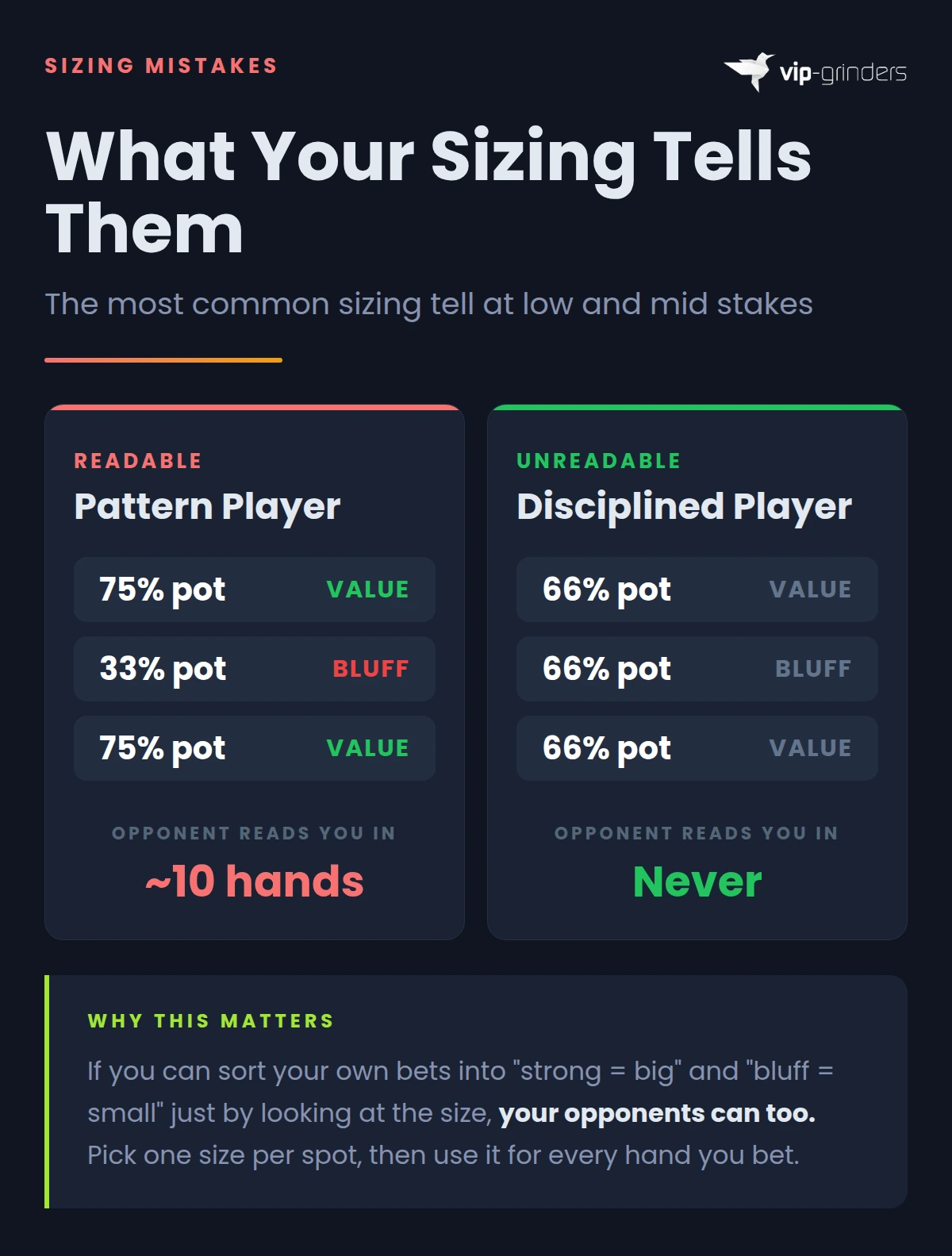
- 4Sizing by hand strength instead of range. Betting big with strong hands and small with bluffs is the most common tell at low stakes. Any observant opponent picks up the pattern within one session. Fix: choose your size based on the board and the situation, then use that same size for all hands you bet in that spot.
- 5Ignoring stack depth preflop. Opening to 2.5x with 25bb in a tournament wastes 10% of your stack on a raise that does not commit you to the pot. If you fold to a 3-bet after putting in 10%, you have burned chips for nothing. Fix: below 20bb, shove or fold. Between 20bb and 30bb, min-raise and be prepared to call a shove.
- 6Using cash-game sizing in tournaments. A 3x open that works perfectly at 100bb in a cash game is too large at 40bb in a tournament. It commits too much of your stack preflop and leaves awkward SPR for postflop play. Fix: use the stack-depth tables from the preflop and tournament sections. Smaller stacks need smaller opens.
Mistake number four deserves extra attention. At stakes above NL100, opponents start watching your sizing patterns closely: if your 75% pot bets are always value and your 33% pot bets are always bluffs, they will fold to the big bets and call the small ones. The fix is to pick one size per spot (based on board texture and range, not hand strength) and use it for both value and bluffs.

Frequently Asked Questions
What is the standard bet size in poker?
There is no single standard size. The correct bet depends on the street, the board texture, and your opponent. On dry flops, 25% to 33% pot is standard. On wet flops, 66% to 80% pot. On the turn, 66% pot is the minimum for most spots. On the river, 75% pot is the default value bet. Preflop opens range from 2x to 4x depending on position, format, and stack depth.
How much should you raise preflop?
In online cash games at 100bb, open to 2.5x from most positions and 3x from the small blind. In live cash games, raise to 3x to 4x because opponents call wider. In tournaments, open to 2x to 2.5x depending on stack depth. Add 1bb per limper when isolating, and cap isolation raises at 6bb to 7bb.
What is a good c-bet size?
It depends on the board texture. On dry, disconnected boards (like K-7-2 rainbow), bet 25% to 33% pot with a high frequency. On wet, draw-heavy boards (like J-T-8 two-tone), bet 66% to 80% pot with a narrower range. In 3-bet pots where the SPR is already low, bet 25% to 40% pot regardless of board texture.
How big should a 3-bet be?
In position, 3-bet to 3x the original open raise. Out of position, 3-bet to 3.5x to 4x the open raise. When squeezing over an open and one or more callers, size up to 4x to 5x and add roughly 1x per extra caller between you and the opener.
Should you bet big or small on the flop?
The board tells you. Dry boards with few draws favor small bets (25% to 33% pot) at high frequency because you have range advantage and there is little to protect against. Wet boards with flush and straight draws favor large bets (66% to 80% pot) because you need to deny correct odds. Super-wet boards where both ranges connect equally circle back to small bets or checks because neither player has a clear edge.
What is the 2.5x rule in poker?
The 2.5x rule refers to the standard online preflop open-raise size of 2.5 times the big blind. It replaced the older 3x standard because smaller opens risk less with weak hands while building a similar pot when called. The 2.5x size is a default for online cash games at 100bb. Live games and tournaments use different sizes based on opponent tendencies and stack depth.
How do you size river value bets?
The default river value bet is 75% pot, which produces the highest expected value across most opponent types at low and mid stakes. Against inelastic opponents (calling stations) who call the same range regardless of size, push to 100% pot. Against elastic opponents (tight regulars) who fold to large bets, size down to 50% to 66% pot. Block bets of 20% to 40% pot work for medium-strength hands against passive players.
Why do professional players bet small?
Pros bet small on boards where they have a range advantage and want to bet at a high frequency. A 25% to 33% pot bet on a dry board like A-8-3 rainbow lets them profitably c-bet with most of their range, including air. The small size also keeps the pot controlled for future streets and makes their bluffs cheap. They bet large on wet boards where equity denial matters more than frequency.
Does bet sizing change in tournaments?
Yes. Preflop opens shrink as stacks get shorter: 2x to 2.2x at 20bb to 40bb, and shove-or-fold below 20bb. Postflop c-bets are smaller (25% to 33% pot) because SPR is already compressed. Near the money bubble, bluff sizing can decrease because ICM pressure makes opponents fold wider, while value bet sizing should stay the same or decrease slightly to get called.
What is geometric bet sizing?
Geometric sizing means choosing bet sizes on each street so that your stack naturally reaches all-in on the river without an awkward final bet. The idea is to plan backward from the river: decide how much you want to bet on the last street, then work out what flop and turn sizes get you there. For example, betting 33% pot on the flop, 66% pot on the turn, and 75% pot on the river builds the pot smoothly across three streets at 100bb stacks.