Table of content
Published 2026.04.20
17 min read
Why trust VIP-Grinders?
Affiliate Disclosure
For 10+ years, our gambling experts have tested poker, casino and sports-betting sites independently. We double-check every bonus, promotion and stat and update pages regularly - see our Editorial Guidelines for the full details.
Transparency Note: If you signup through our links, we may earn a commission at no extra cost to you, which helps us keep our content high-quality and independent. If you like our content, we would be happy if you support our work by using our affiliate links.

Rakeback Explained: What Rakeback Is and How It Works 2026

Rakeback is a rebate on the rake you pay a poker room, returned to you as cash, tournament tickets, or loyalty points. A player who generates $1,000 in rake on a 30% deal receives $300 back. That return happens on every hand you play, for as long as the account exists.

The reason rakeback matters is that rake is the single largest fixed cost in online poker. Every guide on win rate, bankroll, and profitability assumes a rakeback context, but few actually explain what rakeback is, how it’s calculated, or why two players at the same room can receive very different rebates for the same volume.

This guide covers six things: where rakeback comes from, the four ways rooms calculate what you’re owed, the four structural types of rakeback deals, the difference between gross and net rake, how rakeback compares to other rewards, and how payouts actually land in your account. No filler, no theory for its own sake.

Skill level: Beginner. This guide assumes you understand what rake is at a basic level. If you do not, start with what rake is and how rooms charge it. The poker strategy hub organizes every guide by skill level if you need a starting point.

Where Rakeback Comes From: The Two Sources

Rakeback reaches your account through two channels, and most players only know about one of them. Understanding both is what separates a 10% default rebate from a 40% tracked deal on the exact same hands.

The first source is the poker room’s own VIP program. Every major room runs some form of loyalty system that returns a percentage of your rake as points, cash, or tickets. These programs are automatic: open an account, play hands, receive the default rebate.

The second source is an affiliate-tracked deal. Affiliates negotiate enhanced rakeback terms with poker rooms and pass the difference to players who register through their tracking link. Your account is flagged at signup, and the higher rebate applies from the first hand you play.
A few facts about this two-channel mechanic matter regardless of which source delivers your rakeback:

  • The two sources can stack in some programs and replace each other in others, depending on the room's terms.
  • Rakeback is paid out of the same rake pool regardless of which channel delivers it.
  • The percentage changes by channel. The underlying mechanic does not.
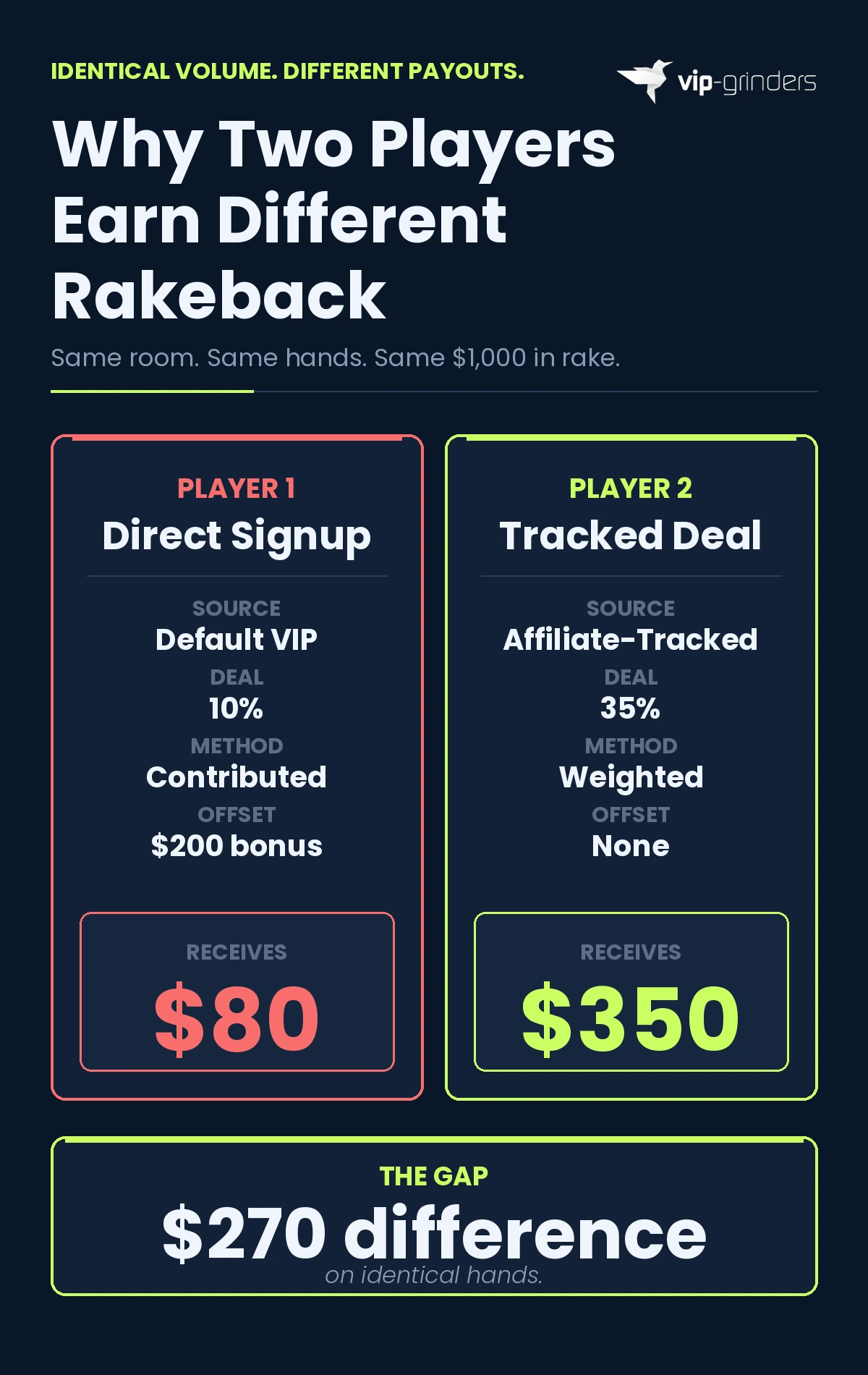
Infographic comparing two online poker players at the same room generating $1,000 in rake, with Player 1 on a direct signup at 10% with a $200 bonus offset receiving $80 and Player 2 on a tracked deal at 35% weighted with no offset receiving $350, showing a $270 gap on identical hands
Four variables compound into a $270 gap on identical hands.

What matters most is that tracking is locked at registration. Players who sign up without an affiliate code almost never get retroactively upgraded, which is why the decision of how to register matters more than any strategy decision you make afterward.

How Rakeback Is Calculated: The Four Methods

Once rake leaves the pot, the room has to decide how much of it “belongs” to each player. That decision is the rakeback calculation method, and it can change your monthly rebate by 30% or more without any change in how you play. Most players never learn which method their room uses, which is why identical volume can produce very different payouts at different rooms.

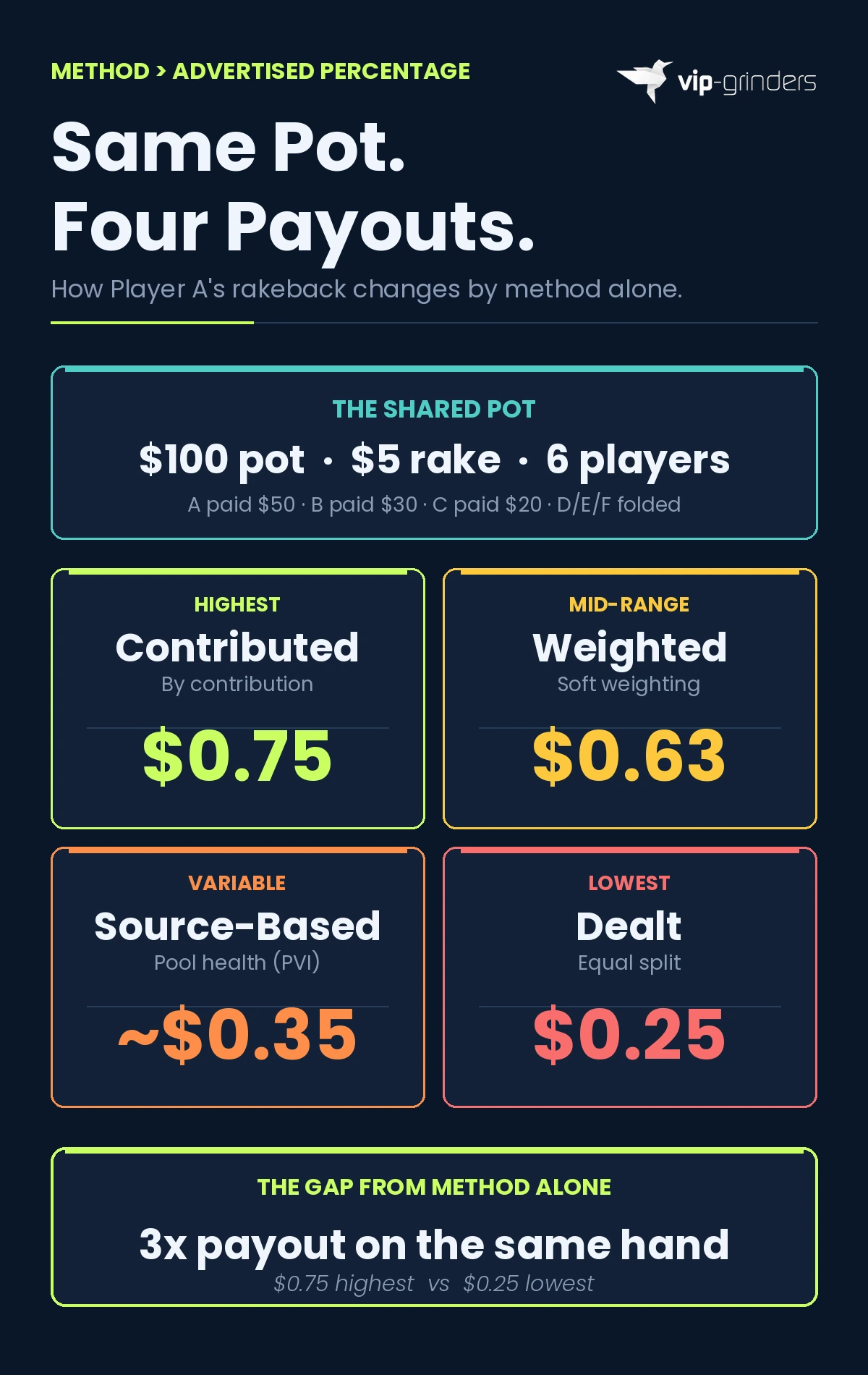
Four methods dominate online poker today. To compare them directly, every example below uses the same pot: $100 total, $5 in rake, six players dealt in, three players reached the flop. Player A contributed $50 to the pot, Player B contributed $30, Player C contributed $20, and Players D, E, and F folded preflop.

1. Contributed Rakeback

Under the contributed method, rake is attributed only to players who put money into the pot. Your share is proportional to how much you personally contributed, and players who fold preflop pay nothing.

In the example pot, Player A’s share is $2.50 (50% of the rake), Player B’s share is $1.50 (30%), and Player C’s share is $1.00 (20%). Players D, E, and F are credited with $0 because they contributed nothing. At a 30% rakeback deal, Player A receives $0.75 back on this single hand, Player B receives $0.45, and Player C receives $0.30.

Contributed rakeback rewards aggressive play and penalizes nitty folders. It is the standard at most modern poker rooms because it most accurately reflects who actually paid the rake.

2. Dealt Rakeback

Under the dealt method, rake is divided equally among every player who was dealt a hand, regardless of whether they saw the flop or folded immediately. The attribution is the same for everyone at the table.

In the example pot, all six players are credited with $0.83 in rake each (one-sixth of $5), including the three who folded preflop. At a 30% rakeback deal, every player receives $0.25 back on this hand even though only three of them put money in the pot.

Dealt rakeback is unusual today but it still appears in some legacy programs. It heavily rewards tight players who fold most hands preflop: a nit at a 6-max table receives the same rakeback credit as the loose player next to them, despite paying a fraction of the actual rake.

3. Weighted Contributed Rakeback

The weighted contributed method sits between the other two. Rake is split across everyone dealt in, but the split is weighted toward players who contributed more to the pot. Folders still receive a small share, but active players receive most of the credit.

In the example pot, Player A might receive credit for $2.10 (42% of the rake), Player B $1.30, Player C $0.90, and the three folders might split $0.70 between them ($0.23 each). Exact weights vary by room and are rarely published publicly.

Weighted contributed rewards a mix of play styles. It softens the nit-vs-aggressor gap of pure contributed rakeback while still giving meaningful credit to the players who actually built the pot.

4. Source-Based Rakeback (PVI and Similar Models)

Source-based rakeback is the newest method and the most controversial. Your rebate is calculated not from your share of the pot but from whether the money in the pot came from winning players or losing players. The room classifies each player’s rake as either “ecosystem-positive” (money from losing players) or “ecosystem-neutral” (money from winning players), and pays rakeback accordingly.

GGPoker’s Player Value Index (PVI) is the best-known implementation. A winning regular whose rake mostly comes from their own deposits receives a lower effective rakeback percentage than a losing recreational player who generated the same nominal rake from fresh money. The calculation happens behind the scenes, so two players at the same stake with identical volume can receive meaningfully different rebates.

The method exists to protect the recreational player pool from being harvested by high-volume winners. It is divisive among grinders but increasingly common at rooms with mass recreational traffic.

Which Method Your Room Uses Matters More Than the Advertised Percentage

Two rooms advertising “30% rakeback” can deliver very different real-world payouts depending on which method they use. Your own play style amplifies the gap:
  • Tight regulars: earn substantially more under dealt or weighted contributed than under contributed.
  • Winning players: earn substantially less under source-based than under any other method.

The advertised percentage is only the headline number. The method is what determines what actually reaches your account.

For grinders building volume targets around rakeback, this is the first thing to check when evaluating a deal. The method is usually documented in the room’s VIP terms, though source-based weighting is often opaque by design. For how the method should shape your bankroll, format selection, and table count, see our guide on how rakeback changes your poker strategy.

Infographic showing how the same $100 pot with $5 rake produces four different rakeback payouts for Player A at a 30% deal, with Contributed paying $0.75 as highest, Weighted paying $0.63 as mid-range, Source-Based paying approximately $0.35 as variable, and Dealt paying $0.25 as lowest, demonstrating a 3x payout gap from method alone
Same hand, same rake. The method decides whether you get $0.25 or $0.75.

The Four Types of Rakeback Structures

The calculation method tells you how your share of rake is measured. The structure tells you how that share gets paid back. Most poker rooms use one of four structural types, and each one rewards a different kind of player.

1. Flat Rakeback

A flat rakeback deal pays the same percentage of your rake regardless of volume, stake, or time of month. If the deal is 30% flat, every $1,000 in rake returns $300, whether you played 5,000 hands or 500,000.

Flat deals are the most predictable structure available. Low-volume players benefit because they receive full value from the first hand. High-volume players give up potential upside because there is no tier to climb into for bonus rebates.

2. Tiered VIP Rakeback

Tiered VIP systems assign players to rank levels based on monthly volume, with each tier paying a higher effective rakeback percentage. A new player might start at 15% and progress through tiers at 20%, 30%, and 40% as their monthly rake increases.

The ceiling is higher than flat rakeback, but so is the required volume. Players who do not hit a tier in a given month fall back to the base rate. This structure favors grinders with stable high volume and penalizes inconsistent play schedules.

3. Progressive Rakeback

Progressive rakeback combines tier progression with monthly resets or cumulative unlocks. The rebate percentage climbs as you generate rake within the month, then resets at the start of the next period. Some programs add permanent tier upgrades that persist across months as long as minimum activity is maintained.

Progressive structures reward consistency but penalize mid-month drop-offs. A player who generates $800 in rake across 25 days earns a higher effective rebate than the same player generating $800 in the first 5 days and then stopping.

4. Hybrid and Ecosystem-Protection Models

Hybrid structures blend two or more of the above, often with an ecosystem-protection weighting. A typical hybrid might pay 25% flat to all players plus an additional variable percentage based on losing-player contribution to your rake pool.

Ecosystem-protection models exist to keep recreational traffic in the game. They deliver less rakeback to high-volume winners and more to losing players, which extends the recreational pool’s survival time at a given stake. Grinders often receive smaller rebates under hybrid structures, but the games themselves stay softer for longer.

Comparing the Four Structures

The four structures trade off predictability, ceiling, and volume requirement differently. The table below shows how each compares on the dimensions that matter most.

StructurePredictabilityCeilingVolume RequiredBest Fit
FlatHighFixedNoneLow to medium volume
Tiered VIPMediumHighHigh and steadyDedicated grinders
ProgressiveLowHighHigh and consistentDaily grinders
Hybrid / EcosystemVariableVariableAnyRecreational and mixed pools

The right structure for any player depends on two things: how much volume they actually produce each month, and how predictable their play schedule is. A player firing 5,000 hands one week and 0 the next will lose value in a progressive structure that rewards consistency. A player grinding 40,000 hands a month with clockwork regularity will leave money on the table with a flat deal.

Net Rake vs Gross Rake: What Your Percentage Actually Applies To

The advertised rakeback percentage and the cash that actually lands in your account are often different numbers. The gap comes from how your rake is counted before the percentage is applied, and it catches most players off guard the first time it happens.

Gross Rake (MGR)

Gross rake, often called Monthly Gross Rake (MGR), is the total rake you generated in a period before any adjustments. If you played hands where $1,200 in rake was taken from pots you contributed to, your MGR for that period is $1,200.

This is the number rooms use when advertising rakeback percentages. “30% rakeback” typically means 30% of MGR.

Net Rake (After Offsets)

Net rake is what remains after the room deducts the value of any bonuses, promotional tournament dollars, or site-funded deposit boosts you received during the period. If your $1,200 MGR is offset by a $200 bonus clearing against your rake, your net rake for rakeback purposes is $1,000.

At a 30% deal, that $200 offset reduces your payout from $360 to $300. The headline percentage did not change. The base it applies to did.

Why This Gap Exists

Rooms fund bonuses out of the same rake pool that funds rakeback. Paying full rakeback on top of a cleared bonus would mean the room pays twice for the same rake. The offset prevents that double-dip.

For players stacking a deposit bonus with a rakeback deal, this is the single biggest reason the math in a calculator rarely matches the first month’s actual payout. Once bonuses clear, the offset disappears and the nominal percentage reasserts itself.

Rakeback vs Cashback, Bonuses & Loyalty Points

Poker rooms offer several reward types that look similar on the surface. Rakeback, cashback, bonuses, and loyalty points all return money or value to the player, but each one works on a completely different mechanic. Confusing them leads to either double-counting rewards you’re not actually stacking, or missing value you could be claiming.

The Four Reward Types Side by Side

The table below shows what each reward is based on, when it pays out, and which player it tends to favor.

Reward TypeBased OnWhen You Receive ItBest For
RakebackRake you generatedRecurring (daily, weekly, or monthly)Consistent volume players
CashbackLosses you tookRecurring, usually weeklyRecreational and losing players
Deposit BonusDeposit amountOne-time, released as you clear rakeNew accounts and infrequent depositors
Loyalty PointsRake or activityAccumulated, redeemed for prizesPlayers who value store items over cash

How They Interact

Which rewards stack and which compete comes down to how the room funds each one.

  • Rakeback + cashback: rarely stack. Both are rake-pool funded, so rooms usually offer one or the other.
  • Rakeback + deposit bonus: stack in most programs, but the bonus reduces the rakeback base while clearing. Once the bonus clears, the full percentage returns.
  • Rakeback + loyalty points: almost always stack because they come from different accounting buckets. Whether points are worth claiming depends on the room’s store conversion rate.

Which One Is Most Valuable

For active grinders, rakeback almost always wins. The payout is predictable, recurring, and paid as cash or cash-equivalent. Cashback is mathematically inferior for any player with a positive win rate because it only pays out on losing sessions. Bonuses are one-time. Loyalty points usually convert at a discount. Rakeback is the only reward type that scales linearly with volume forever.

How and When Rakeback Gets Paid

The rakeback mechanic ends with the actual payout, and this is where rooms vary the most. Two players at the same room with the same deal can experience very different cash flows depending on payout cadence, format, and whether a claim step is required.

Payout Cadence

Rakeback lands in your account on a schedule set by the room, not by you. Three cadences dominate the market:

  • Daily: small amounts deposited every 24 hours. Common at crypto-first rooms and ecosystem-protection programs.
  • Weekly: balance credited once a week, usually on a fixed day. The most common cadence at major rooms.
  • Monthly: one lump sum at the end of the month. Typical for tiered VIP programs where the tier has to settle before payout.

Faster cadences help bankroll management because the cash compounds into your playing roll sooner. Slower cadences lock more value into a single date, which can matter if you are moving up stakes mid-month.

Payout Format

Rakeback rarely arrives as straight cash. The typical formats are cash balance (withdrawable immediately), tournament tickets (usable only for buy-ins), bonus dollars (released as you clear more rake), or store credit (convertible into branded items at a discount to cash value).

Cash is the most valuable format because it carries no usage restriction. Tickets and bonus dollars are worth less in practice than their face value because they force you into a narrower range of games. Store credit is the weakest because the conversion ratio is usually set against the player.

Automatic vs Claim-Required

Some rooms deposit rakeback without any action from the player. Others require you to manually claim the payout through a dashboard button or a ticket request, and unclaimed amounts may expire after a set period.

Knowing which model your room uses matters. A grinder losing $50 a month to expired unclaimed rakeback has turned a 30% deal into an effective 27% deal without realizing it.

How to Get Rakeback (and Where to Compare Deals)

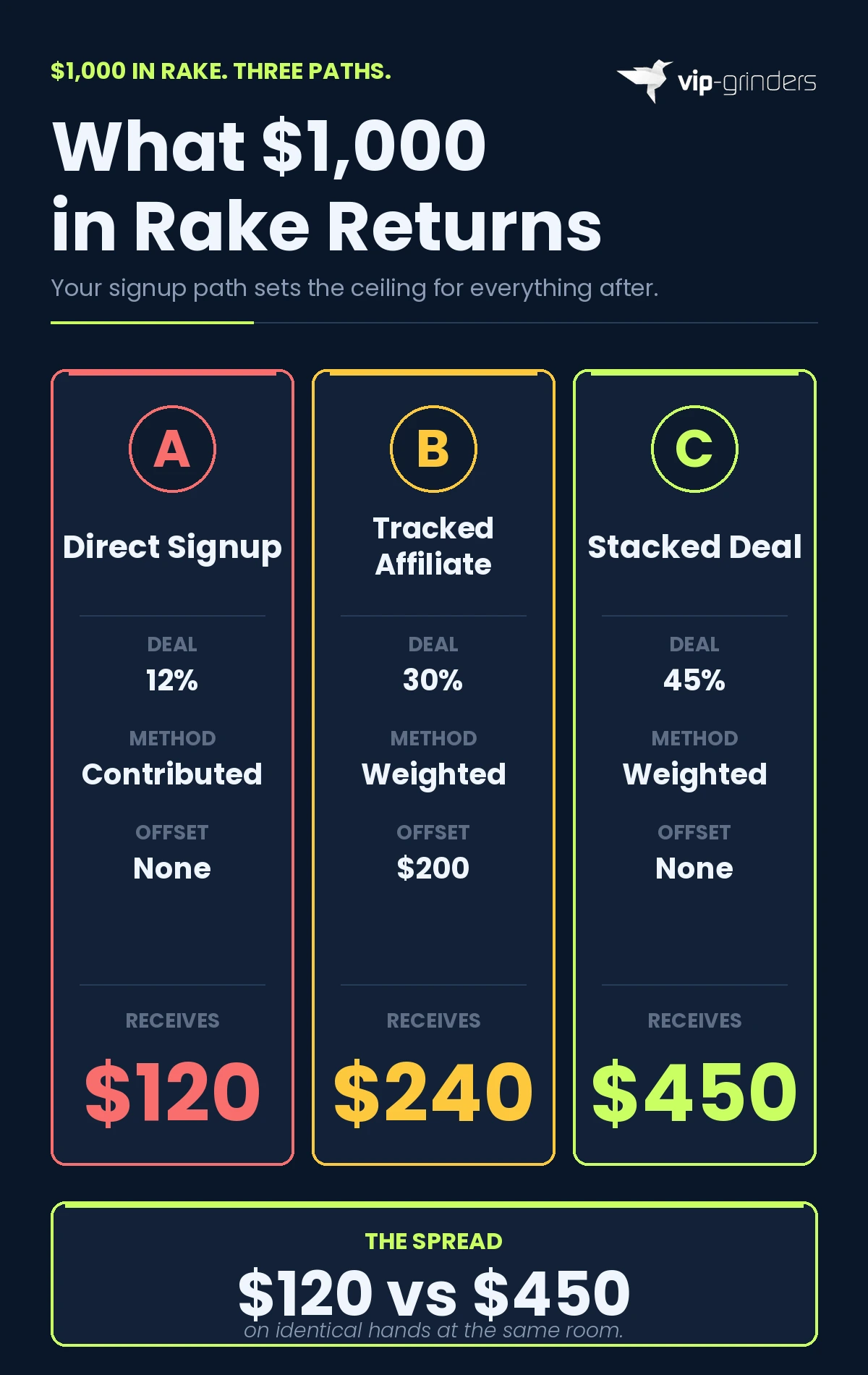
Three paths lead to rakeback, and the path you choose at signup determines how much you earn for the life of the account.

  • 1Sign up directly with the room: the default VIP program applies automatically, typically returning 10% to 15% through points or cashback.
  • 2Sign up through a tracked affiliate link: the affiliate's negotiated rate replaces or stacks on top of the default, often reaching 30% to 60%.
  • 3Combine both where possible: some rooms allow a tracked affiliate deal to stack with the VIP program's points and store rewards for additional value.

Registration tracking relies on cookies set when you follow an affiliate link, which is why existing accounts almost never convert retroactively. The decision happens once, at signup.

To see which rooms are currently offering the best tracked deals, check our current rakeback deals comparison. To estimate what a specific deal would return at your volume, our rakeback calculator runs the math on any deal percentage against any monthly rake figure.

Infographic comparing three signup paths for $1,000 in generated rake, with direct signup at 12% Contributed with no offset returning $120, tracked affiliate at 30% Weighted with a $200 bonus offset returning $240, and stacked deal at 45% Weighted with no offset returning $450, showing a $120 to $450 spread on identical hands at the same room
$120 to $450 on identical hands. The signup path sets the ceiling.

Frequently Asked Questions

Is rakeback taxable?

In most jurisdictions that tax gambling winnings, rakeback is treated as gambling-related income and counts toward your taxable earnings from poker. Specifics vary by country and sometimes by state or region, so the treatment depends on your local tax authority. Keep monthly statements from your room as part of your poker session records regardless of jurisdiction.

Is rakeback the same as cashback?

No. Rakeback is based on rake you generate (paid whether you win or lose), while cashback is based on losses you take (only paid during losing sessions). A winning player receives rakeback on every hand and cashback on none of them. The two are usually mutually exclusive at the same room because both come from the rake pool.

Do all poker rooms offer rakeback?

Almost every major online poker room offers some form of rakeback through a VIP or loyalty program, though the effective percentage varies widely (from under 10% at default rates up to 60% or more through tracked affiliate deals). A small number of smaller or newer rooms offer no rakeback at all, which is usually a sign of either very soft games funded by recreational traffic or low overall liquidity.

Can I transfer rakeback tracking to an existing account?

In most cases, no. Affiliate tracking is set by a cookie at the moment of registration, and existing accounts are almost never upgraded to tracked status retroactively. The exceptions are rare and usually involve accounts that have been inactive for extended periods, which some rooms treat as eligible for re-registration. If you signed up without an affiliate code and want a higher deal, the fastest path is usually a new account on a different room.

How do I verify I am receiving rakeback correctly?

Most rooms publish a rakeback or VIP dashboard showing accumulated rake, current tier or progress, and scheduled payouts. Cross-check the rake figure against your own tracking software (PokerTracker, Hold’em Manager, or similar) once a month. Discrepancies are rare but do occur, and they are usually resolved through a support ticket with the room or a message to your affiliate contact.

Does unused rakeback expire?

It depends on the structure and format. Cash rakeback credited to your balance rarely expires. VIP points, tournament tickets, and store credits often do, sometimes after 30 or 90 days. Tiered programs usually reset tier progress monthly, meaning any unclaimed tier benefits disappear at the cutoff. Always check the room’s VIP terms for specific expiration windows on each reward type.