

What is Rake in Poker? Caps, Structures & Win Rate Impact 2026
Most poker players have no idea what rake actually costs them. At NL10, rake can eat more than half your winnings before you ever see profit. At NL50, it routinely costs 4 to 6 big blinds per 100 hands, which is enough to turn a technically winning player into a losing one.
Rake is the fee the poker room takes out of every pot (or buy-in) to keep the game running. Every structural decision in online poker flows from rake math: which stake to play, which room to sign up at, whether grinding is profitable, and whether your rakeback deal is strong enough to matter. Most guides explain rake as a percentage and stop there, which is exactly why most players never understand what it’s really costing them.
Here is what this guide covers:
- Three rake methods online rooms use and why the one your room picks changes what you pay
- How caps reshape the effective rate and why the advertised percentage is almost never what you actually pay
- Cash game vs tournament rake and the no flop no drop rule
- The real cost in bb/100 at every stake from NL10 to NL500 and why micro stakes are nearly unbeatable without rakeback
What Rake Actually Is (And Why Every Pot Has It)
Rake is the fee the poker room charges to host your game. Every time you sit down at a cash table or register for a tournament, a small cut of the action goes to the site running the software, paying the support staff, and funding the bonuses and promotions you see in the lobby. That cut is rake, and you pay it whether you win or lose the hand.
The reason rake exists in poker but not in casino games comes down to who you are playing against. At blackjack or roulette, the house is your opponent and the house edge built into the rules is how the casino makes money. At poker, players play against each other, so the room has no edge in the game itself and rake is how it gets paid.
There are two ways rake shows up, depending on what you play:
A simple comparison shows where rake fits in the broader gambling landscape:
| Game Type | Who You Play Against | How the House Makes Money |
|---|---|---|
| Poker (cash games) | Other players | Percentage rake from each pot |
| Poker (tournaments) | Other players | Fixed fee inside the buy-in |
| Blackjack / Roulette | The casino | House edge built into game rules |
| Sports betting | The sportsbook | Vig (margin built into the odds) |
The Three Ways Online Rooms Charge Cash Game Rake
Not every poker room calculates rake the same way. Three methods dominate the online market, and the one your room uses changes how much rake you personally pay based on how you play. A tight player pays far less under one method than another, even at the same stake and the same table.
Understanding which method applies to your games is the first step to knowing what rake actually costs you. The three methods are percentage of pot, dealt rake, and weighted contributed rake.
1. Percentage of Pot
The most common method, used by virtually every major online room at cash tables. The room takes a fixed percentage (usually 3% to 5%) of the total pot at showdown, capped at a maximum amount that scales with the stakes.
A quick example at $0.50/$1 NLHE with a 5% rate and a $3 cap:
- $20 pot: 5% of $20 = $1.00 in rake.
- $60 pot: 5% of $60 = $3.00 in rake (cap reached).
- $200 pot: still $3.00 in rake (cap holds, effective rate drops to 1.5%).
This is the simplest model to understand, but it has a quirk most players miss: once the cap is hit, the effective rake percentage drops sharply. The full mechanics of how caps reshape the math are covered in the next section.
2. Dealt Rake
Under dealt rake, every player who is dealt into a hand pays an equal share of the rake, regardless of whether they see the flop or fold preflop. If the room takes $2.00 in rake from a 6-handed pot, each of the 6 players is assigned $0.33 of that rake, even the ones who folded their hands in the first 5 seconds.
This method is mostly used for calculating rakeback attribution, not for determining how much comes out of the pot (the pot amount is still set by the percentage method). A player who folds 80% of their hands before the flop still generates “dealt rake credit” on every hand they are dealt into, which is one reason some rakeback programs favor tight players.
3. Weighted Contributed Rake
Weighted contributed is the most player-favorable method for tight, disciplined players. Your share of the rake is proportional to how much money you personally put into the pot. If you fold preflop, you pay zero rake on that hand, no matter how big the pot gets.
A worked example makes this clear. Three players reach showdown in a $100 pot at a 6-handed table:
| Player | Contribution to Pot | Share of Rake (Weighted) | Share of Rake (Dealt) |
|---|---|---|---|
| Player A (winner) | $40 (40%) | $1.20 (40% of $3) | $0.50 (1/6 of $3) |
| Player B | $40 (40%) | $1.20 (40% of $3) | $0.50 (1/6 of $3) |
| Player C | $20 (20%) | $0.60 (20% of $3) | $0.50 (1/6 of $3) |
| Players D, E, F (folded preflop) | $0 | $0 each | $0.50 each |
Under weighted contributed, the three folders pay nothing. Under dealt rake, they each pay the same $0.50 as the active players. For a tight regular who folds 75% of their hands preflop, weighted contributed rake can reduce their effective rake cost by 20% to 30% over a large sample.
Now that you understand the three ways rake is charged, the next question is what changes the rate you actually pay: the rake cap.
How Rake Caps Actually Work (The Most Misunderstood Part)
If you only remember one thing from this guide, make it this: the rake percentage your room advertises is almost never what you actually pay. The cap is why. Once a pot crosses the cap threshold, the effective rake drops, sometimes dramatically, and this single mechanic does more to shape real rake cost than any other factor.
A rake cap is the maximum dollar amount the room will take from a single pot, no matter how big the pot gets. A room running 5% rake with a $3 cap will never take more than $3 from any pot at that stake, even if the pot grows to $500 or $5,000.
Caps scale with stakes. A cap of $0.50 at NL10 becomes $3 at NL50, $5 at NL200, and climbs from there. The important pattern is that caps do not scale linearly with stakes, which creates the single biggest difference in effective rake cost between stake levels.
The Cap Curve: Why Effective Rake Drops as Pots Grow
When a pot is small, 5% rake means exactly 5%, but once the pot grows past the cap the effective percentage starts shrinking. A $3 cap on a $60 pot is exactly 5%, while the same $3 cap on a $200 pot is only 1.5%.
This is the cap curve, and most players never see it laid out in numbers. At $0.50/$1 NLHE with 5% rake and a $3 cap:
| Pot Size | 5% of Pot | Actual Rake Taken | Effective Rake % |
|---|---|---|---|
| $10 | $0.50 | $0.50 | 5.00% |
| $30 | $1.50 | $1.50 | 5.00% |
| $60 | $3.00 | $3.00 | 5.00% (cap reached) |
| $100 | $5.00 | $3.00 | 3.00% |
| $200 | $10.00 | $3.00 | 1.50% |
| $400 | $20.00 | $3.00 | 0.75% |
Every pot below $60 pays the full 5%. Every pot above $60 pays less, and the bigger the pot, the smaller the effective rate. A $400 pot at this stake pays only 0.75% in rake, which is six times cheaper than a $30 pot at the same table.
Why Caps Matter More at Low Stakes
The lower the stake, the smaller the cap, and the more often the cap applies as the upper limit on what you pay. But there is a second effect that most players miss: at low stakes, the average pot size rarely gets big enough to push past the cap, so you end up paying near the full 5% on almost every hand.
At high stakes, the opposite happens. Pots routinely cross the cap, so effective rake shrinks fast. A grinder at $5/$10 NLHE might average closer to 1% to 2% effective rake, while a grinder at $0.05/$0.10 is paying close to the full 5% on virtually every hand they play.
This is one of the two reasons moving up stakes feels like a win rate boost even when your skill level has not changed. The other reason is simpler: bigger stakes mean a bigger dollar edge per hand for the same bb/100 rate. Caps just happen to amplify that effect.
What Cap Numbers Actually Look Like by Stake
Caps vary by room, but the pattern below is representative of what most major online rooms use for 6-max NLHE tables:
| Stake | Typical Rake % | Typical Cap | Cap Reached at Pot Size |
|---|---|---|---|
| NL10 ($0.05/$0.10) | 5% | $0.50 | $10 |
| NL25 ($0.10/$0.25) | 5% | $1.50 | $30 |
| NL50 ($0.25/$0.50) | 5% | $3.00 | $60 |
| NL100 ($0.50/$1) | 5% | $5.00 | $100 |
| NL200 ($1/$2) | 5% | $5.00 | $100 |
| NL500 ($2.50/$5) | 5% | $5.00 | $100 |
Notice what happens at NL200 and above: the cap stays at $5 even though the stakes keep climbing. A $200 pot at NL500 still pays only $5 in rake, which is 2.5% effective and half what you pay at NL50. This is why high-stakes rake is so much cheaper in effective percentage terms.
Caps are the single most important mechanic to understand when comparing stakes, rooms, or formats. The advertised rake rate is only half the story, and the cap changes the real cost more than any other variable on the table. For a side-by-side breakdown of which rooms offer the cheapest structures across stakes, see poker rooms with the lowest rake.
The No Flop, No Drop Rule (And Its Edge Cases)
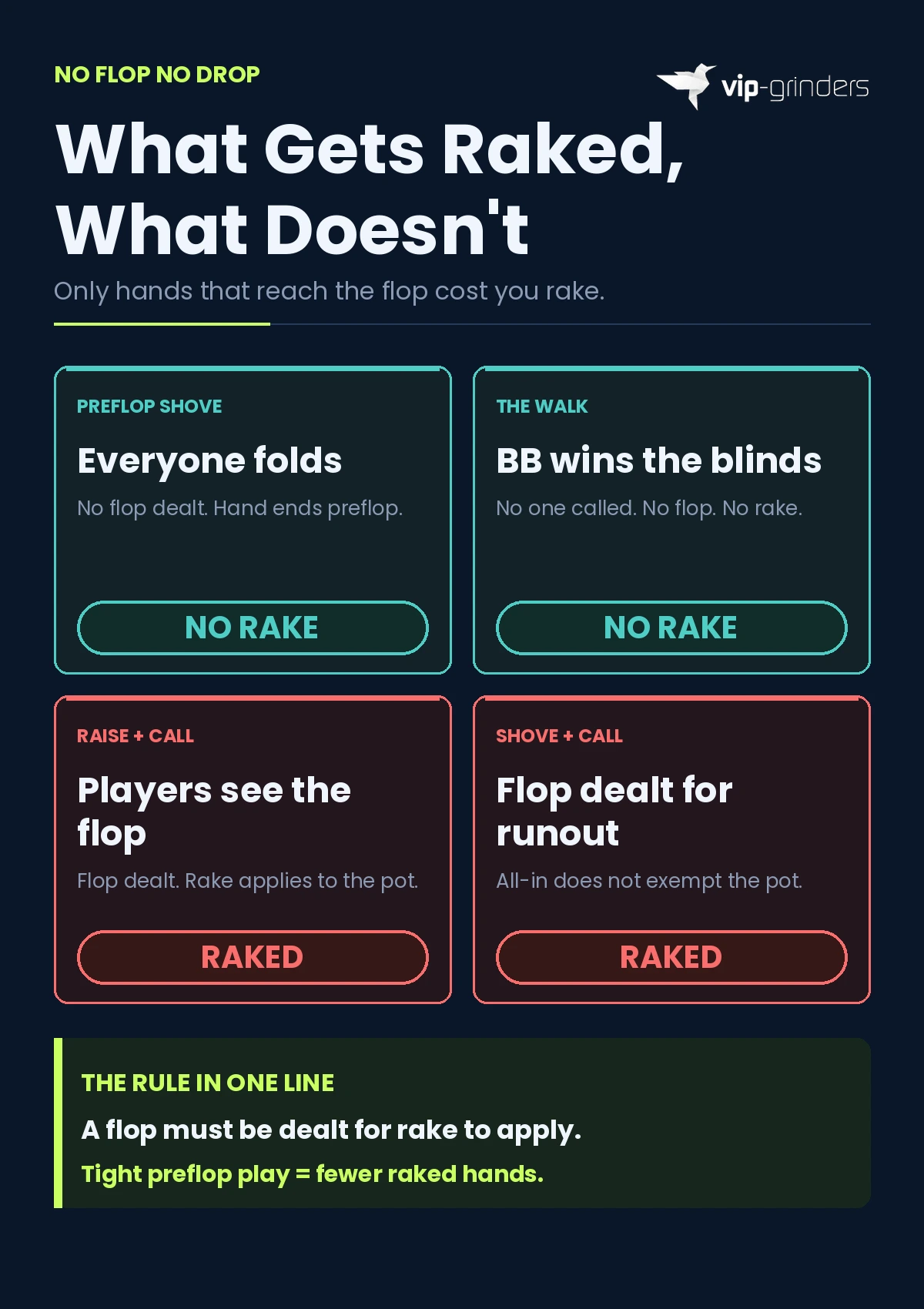
Here is one of the few rules in poker that works in your favor: if a hand ends before the flop, the room takes no rake. This is known as no flop, no drop, and it applies at virtually every licensed cash game online. Four scenarios cover almost every hand you will ever play, and only two of them cost you rake.
The rule exists for a reason. Rake is calculated as a percentage of pots that reach the flop, and a hand that ends preflop never produces a rakeable pot in the first place. Sites could technically charge a per-hand fee to cover preflop action, but almost none do, because the reality is that preflop-only hands generate no risk or operating cost for the room.
What counts as a hand “ending before the flop” sounds obvious but catches some players off guard. A few edge cases are worth knowing:
- Preflop all-ins where nobody calls: if you shove and everyone folds, no flop is dealt and no rake is taken. The same applies if the action ends at a 3-bet or 4-bet with no caller.
- Preflop all-ins that get called: if you are all-in preflop and someone calls, the flop is dealt (for the runout) and standard rake applies. Being all-in does not exempt the pot from rake.
- Walks: when everyone folds to the big blind preflop, the hand ends with no flop. No rake.
- Straddled pots: a straddle does not change the rule. If the straddled pot ends preflop, no rake is taken, same as any other hand.
The practical effect is that the more often you fold preflop, the less rake you pay per orbit. This is part of why tight play carries an underrated cost advantage at low stakes, where rake is a heavier percentage of your edge. A player who folds 75% of their hands preflop sees rake on only a fraction of the hands they are dealt into, which can add up to meaningful savings over hundreds of thousands of hands.
Cash Game vs Tournament Rake: Two Completely Different Systems
Everything covered so far applies to cash games, where rake is a percentage of each pot. Tournament rake works on a completely different model, and the difference matters because the same dollar of buy-in produces very different rake cost depending on which format you play.
In a tournament, the rake is a fixed fee baked into your entry. You see it in the buy-in display: a tournament advertised as $10 + $1 means $10 goes to the prize pool and $1 is the room’s fee. That $1 is the rake, and it is charged once, at the moment you register, regardless of how the tournament plays out or how long you last.
The Tournament Fee as a Percentage of Buy-in
The way to compare tournament rake across buy-in tiers is to look at the fee as a percentage of total buy-in: a $10 + $1 tournament has a 10% fee, a $100 + $9 has 9%, and a $500 + $30 has 6%. The pattern is consistent across most online rooms: smaller buy-ins carry higher percentage fees, and the percentage shrinks as buy-ins grow.
| Buy-in Tier | Typical Format | Fee as % of Total Buy-in |
|---|---|---|
| Micro ($1 to $5) | $2 + $0.20 / $5 + $0.50 | 9% to 10% |
| Low ($10 to $25) | $10 + $1 / $20 + $2 | 9% to 10% |
| Mid ($50 to $100) | $50 + $5 / $100 + $9 | 8% to 9% |
| High ($200 to $500) | $200 + $15 / $500 + $30 | 6% to 7% |
| Nosebleed ($1,000+) | $1,000 + $50 / $2,500 + $100 | 4% to 5% |
Low-stakes tournament grinders pay close to 10% of every buy-in as rake. That is a heavier cost than most players realize. A player firing 200 tournaments a month at $5 + $0.50 pays $100 in rake that month, and almost nothing about tournament structure makes it easier to beat that drag compared to cash.
SNGs and Spin & Gos Use the Same Model
Sit & Gos and Spin & Gos follow the same model as multi-table tournaments: a fixed fee baked into each buy-in. Because SNGs and Spins have much smaller buy-ins and much faster game times, the fee percentage often hits harder in practice.
A $5 SNG with a $0.25 fee looks like a cheap 5% rake rate, but SNGs finish in 10 to 20 minutes, so a grinder playing 4 tables fires roughly 12 to 15 per hour at $0.25 each. Over a 3-hour session that adds up to $9 to $11 in pure fees on a buy-in base of $180 to $225. Effective rake per dollar wagered ends up comparable to cash, not cheaper.
The Real Cost of Rake in bb/100
Most guides tell you the rake percentage and stop there, but that number alone is meaningless for planning whether a stake is beatable. What you actually need is rake cost expressed in big blinds per 100 hands (bb/100), the standard unit for measuring poker win rate. Once rake is in bb/100, you can compare it directly to your win rate and see whether the stake is winnable at all.
A quick definition for first-time readers: bb/100 is the number of big blinds you win or lose per 100 hands played. A 3 bb/100 winner at NL50 earns $1.50 per 100 hands before variance. Rake works the same way: at NL50 it costs roughly 4 to 6 bb/100, which is $2 to $3 in dead money you pay out every 100 hands no matter how well you play.
How to Convert Rake Into bb/100
The rough formula is simple:
Rake cost in bb/100 = (average rake per hand in $) ÷ (big blind size in $) × 100
At NL50 ($0.25/$0.50), big blinds are $0.50. If your average rake per hand is $0.02, that translates to $2 in rake per 100 hands, or 4 big blinds per 100 hands. That is your effective rake drag, the flat cost you pay on top of whatever variance the cards produce.
For a quick estimate without the math, run your numbers through our rakeback calculator.
Worked Examples by Stake
The numbers below are typical ranges for 6-max NLHE cash games at major online rooms. They assume the percentage-of-pot method, standard cap scaling, and an average pot size representative of the stake. Your exact number will vary by room and by how tight or loose you play, but the ranges are accurate within a half bb/100 for most grinders.
| Stake | Rake / Cap | Avg Pot (in bb) | Rake Cost (bb/100) | What a Winning WR Looks Like |
|---|---|---|---|---|
| NL10 | 5% / $0.50 | 18 to 22bb | 8 to 10 bb/100 | 5 to 7 bb/100 |
| NL25 | 5% / $1.50 | 16 to 20bb | 6 to 8 bb/100 | 4 to 6 bb/100 |
| NL50 | 5% / $3.00 | 14 to 18bb | 4 to 6 bb/100 | 3 to 5 bb/100 |
| NL100 | 5% / $5.00 | 12 to 16bb | 3 to 4 bb/100 | 2 to 4 bb/100 |
| NL200 | 5% / $5.00 | 11 to 14bb | 2 to 3 bb/100 | 1.5 to 3 bb/100 |
| NL500 | 5% / $5.00 | 10 to 12bb | 1 to 2 bb/100 | 1 to 2 bb/100 |
The Unbeatable Zone
Look carefully at the last two columns: at NL10, rake costs 8 to 10 bb/100 while a winning player typically earns 5 to 7 bb/100 at the table. Rake is higher than the best table edge you can realistically sustain. Without rakeback, most solid players at NL10 are net losers after rake even if they play well enough to beat their opponents.
This is the “unbeatable zone,” the stakes where rake alone exceeds the skill edge available in the game. It tightens at NL25 and finally flips at NL50, where a solid winner starts to outpace rake on table performance alone. Ignoring rake is one of the most expensive poker mistakes at low stakes, which is why so many beginners grind micros for months and never see real profit even when their fundamentals are correct.
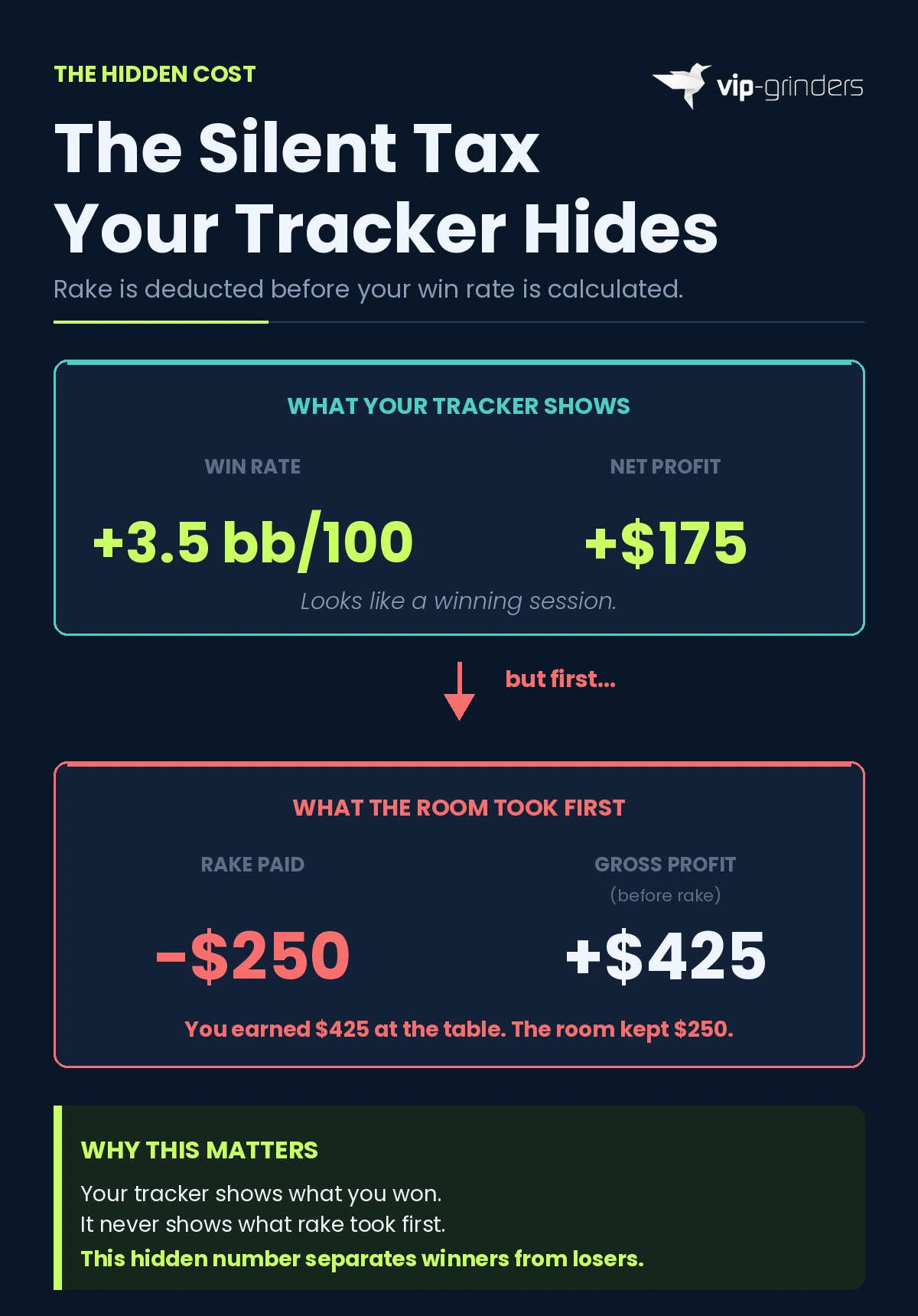
A typical NL50 grinder shows the math clearly: a +$175 profit over 10,000 hands looks solid in the tracker, but hides the $250 in rake the room already took.
Understanding what rake costs is step one. Reducing it is step two: for tracked deals with higher rates than default, see our exclusive rakeback deals.
Frequently Asked Questions
What does rake mean in poker?
Rake is the fee the poker room charges to host the game. In cash games, it is a small percentage of every pot that reaches the flop (typically 3% to 5%, capped at a fixed dollar amount). In tournaments, it is a fixed fee baked into your buy-in, shown as the second number in a “$10 + $1” format.
How much rake do online poker sites charge?
Most major online poker rooms charge 5% rake on cash games with caps that scale by stake, from around $0.50 at NL10 to $5 at NL200 and above. Tournament fees range from 9% to 10% of the buy-in at low stakes down to 4% to 5% at high-stakes events. Your effective rake percentage is almost always lower than the advertised rate because of how caps work, especially at mid and high stakes.
What is a rake cap in poker?
A rake cap is the maximum dollar amount a poker room will take from a single pot, regardless of pot size. A 5% rate with a $3 cap means rake is 5% of pots up to $60, then flat $3 on every pot larger than that. This mechanic makes bigger pots significantly cheaper in effective rake percentage, which is why moving up stakes reduces your rake drag.
What is no flop, no drop?
No flop, no drop is the universal online cash game rule that no rake is taken if the hand ends before the flop. Walks, preflop all-ins where nobody calls, and hands that end at a 3-bet or 4-bet with no caller all produce zero rake. The more often you fold preflop, the fewer hands you pay rake on.
How is tournament rake different from cash game rake?
Tournament rake is a fixed fee baked into your buy-in, charged once at registration and shown in the “$10 + $1” format. Cash game rake is a percentage of each pot, charged continuously as you play. The two cannot be compared directly by percentage alone because cash rake depends on how many hands reach showdown, while tournament rake is a flat known cost.
How much does rake cost me per month at NL10?
At NL10, rake typically costs 8 to 10 bb/100, which is $0.80 to $1.00 per 100 hands played. A grinder playing 40,000 hands per month at NL10 pays roughly $320 to $400 in rake, which almost always exceeds what a winning player earns from table play alone at that stake. This is why rakeback is essentially mandatory for profitable grinding at micro stakes.
Can I play poker without paying rake?
Not at any real-money site. Every licensed poker room charges rake because it is the room’s primary revenue source. What you can do is reduce your effective cost through a tracked rakeback deal that rebates a percentage of what you pay, combined with choosing a room that runs lower caps at your stake level.