

Table Selection in Poker: How to Find the Most Profitable Games 2026
Table selection is the single highest-impact skill most poker players never practice. A Hand2Note study of winning regulars found that their EV jumped from 0.3 bb/100 at reg-only tables to 5.5 bb/100 the moment one recreational player sat down. That is a bigger win rate swing than any postflop concept, any solver drill, or any preflop chart can deliver.
The math behind that number is simple. At NL10, rake costs roughly 8 bb/100, so a solid reg beating the pool by 3 bb/100 before rake is actually losing 5 bb/100 at a table full of other regulars. Add one fish who loses at 20 to 40 bb/100 and the entire table’s economy changes: that player’s losses fund everyone else’s win rate.
Here is what this guide covers:
- The three lobby stats that sort tables into "sit" or "skip" in 60 seconds
- How to identify weak players using HUD stats and behavioral tells
- Seat selection: where to sit relative to the fish and why it matters
- Room-level selection, format choice, and peak-hour timing
- How your rakeback deal changes which marginal tables are still worth sitting
Every number below is cross-checked against our cash game strategy guide and our rake in poker guide so nothing contradicts what you have already read on the site.
Why Table Selection Adds More bb/100 Than Any Strategy Adjustment
Most grinders spend their study time on solver work, range construction, and postflop theory. Those skills matter, but their return is small compared to the simple act of choosing where you sit. A useful comparison: 50 hours of GTO study adds roughly 1 to 2 bb/100, while 50 hours improving your table selection process adds 5 to 10 bb/100.
Your win rate does not come from the cards you play: it comes from the mistakes your opponents make. At micro and low stakes, a typical recreational player loses between 20 and 40 bb/100 over a large sample, and that money flows directly to the winning players at the table. The closer you sit to the source, the more of it you collect.
Here is what that looks like in practice for a NL50 grinder playing 4 tables over 100 hours in a month.
| Approach | Est. Win Rate | Monthly Table Profit | Time Spent Selecting |
|---|---|---|---|
| Sit at first available table | 1 to 2 bb/100 | $300 to $600 | 0 minutes per session |
| Scan lobby, pick softest table | 3 to 4 bb/100 | $900 to $1,200 | 2 to 3 minutes per session |
| Full selection (lobby + HUD + seat + re-check every 30 min) | 5 to 6 bb/100 | $1,500 to $1,800 | 5 to 10 minutes per session |
The gap between “first available” and “full selection” is $900 to $1,200 per month at NL50 on just 4 tables. That is the difference between poker being a hobby that costs you money and a side income that pays real bills. The rest of this guide shows you how to execute each step of that selection process.
For how this connects to your actual dollars per hour after rakeback, see the hourly rate guide.
How to Read the Lobby: The Three Stats That Matter
Every poker lobby shows basic stats for each table. Most players glance at them and sit wherever there is an open seat. The ones who actually read those numbers before sitting down gain a measurable edge before they play a single hand.
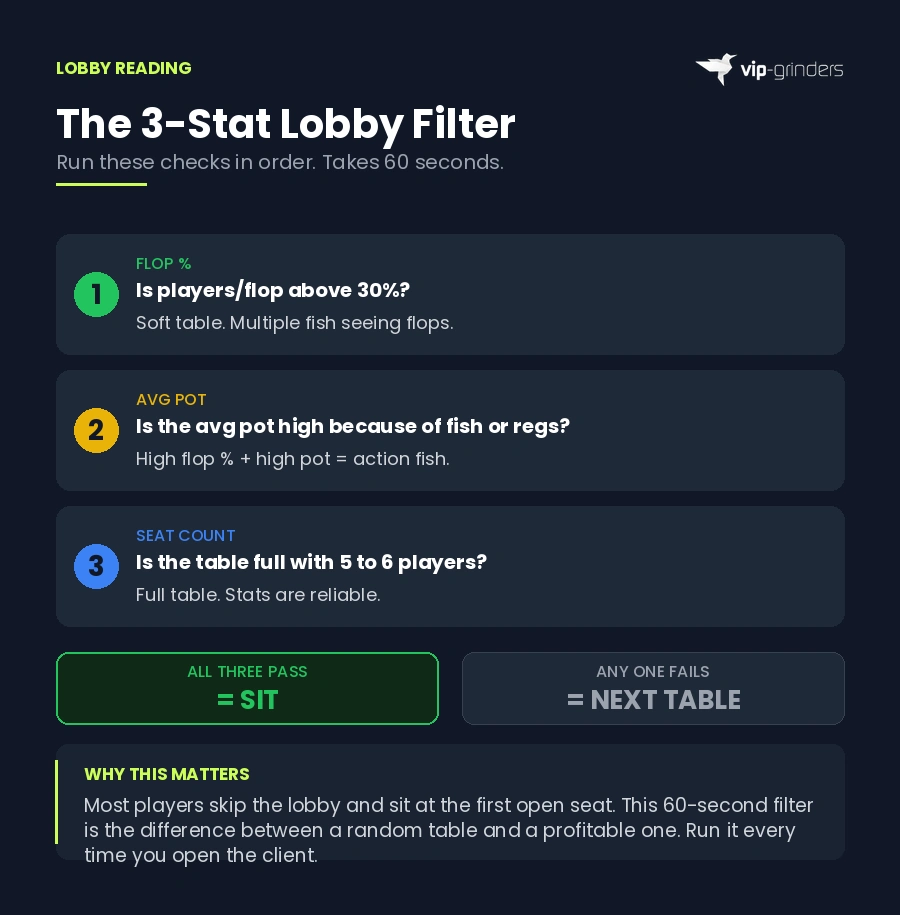
Three stats do most of the work. You do not need to analyze every column in the lobby. Learn what these three mean, memorize the thresholds, and you can sort a full lobby into “worth sitting” and “skip” in under 60 seconds.
Players Per Flop (%)
This is the most important number in the lobby. It tells you what percentage of dealt players see the flop on average. A higher number means more players are entering pots with weak hands, which means more money flowing into pots you can win with solid play.
| Players/Flop % | What It Means | Action |
|---|---|---|
| Below 20% | Tight, reg-heavy table. Most pots are heads-up or stolen preflop. | Skip this table unless you have specific reads on a weak reg. |
| 20% to 29% | Average online table. Mix of regs and one or two loose players. | Acceptable if nothing better is available. Check seat position. |
| 30% to 39% | Soft table. Multiple players seeing flops with weak holdings. | Good table. Sit down and look for the best seat. |
| 40% and above | Very soft. Likely two or more recreational players at the table. | Priority seat. This is the table you want. |
These thresholds are for 6-max tables. Full ring (9-max) naturally runs about 5 percentage points lower because more players fold before the flop, so adjust accordingly: 25%+ is good at a 9-max table.
Average Pot Size
Average pot size tells you how much money goes into each hand. A large average pot paired with a high players/flop percentage is the strongest signal of a soft table: lots of players putting lots of chips in with weak hands.
But a large average pot with a low players/flop percentage is a warning sign. That combination usually means aggressive regulars are 3-betting and 4-betting each other in heads-up pots. The pots are big, but the money is flowing between strong players, not from fish to regs.
Hands Per Hour
Hands per hour tells you how fast the table is playing. A normal 6-max table deals 70 to 80 hands per hour. Anything significantly below that can mean players are timing out on decisions, which often indicates distracted recreational players on mobile devices.
One caveat from the PokerListings lobby stat analysis: an unusually high hands per hour count can mean the table was recently short-handed (3 or 4 players). Short-handed tables deal faster, but the dynamic changes completely once the table fills up. Do not assume a high HpH means fast, action-heavy play, so check the player count first.
How to Use All Three Together
The fastest lobby read combines all three stats in a single scan.
- 1Sort the lobby by players/flop % (highest first). This puts the softest tables at the top.
- 2Check average pot size on the top 3 to 5 tables. High players/flop + high avg pot = priority. High players/flop + small avg pot = still good (passive fish who limp and call).
- 3Glance at hands per hour to confirm the table is full and active. Skip tables with abnormally high HpH and only 3 to 4 seated players.
- 4Sit at the best available table and choose your seat using the seat selection rules covered later in this guide.
The entire process takes 60 to 90 seconds. That is less time than most players spend reviewing a single hand history, and it produces a bigger impact on their monthly results.
How to Identify Weak Players Using HUD Stats
Lobby stats tell you which table to sit at; HUD stats tell you which player at that table is putting money in your pocket. If your room allows tracking software, the two numbers that matter most are VPIP (voluntarily put money in pot) and PFR (preflop raise percentage). Together they classify every opponent at your table within 40 to 100 hands.
VPIP measures how often a player enters a pot voluntarily (not counting the forced blinds). PFR measures how often they raise preflop rather than limping or calling. The gap between these two numbers is the tell: a large gap means the player calls a lot but rarely raises, which is the signature of a weak, passive recreational player.
For setup, configuration, and the exact stats to display, see our Holdem Manager 3 review or the PokerTracker 4 walkthrough.
Player Classification by VPIP and PFR
The table below shows the ranges for 6-max No-Limit Hold’em. These are population averages across micro and low stakes.
| Player Type | VPIP | PFR | Gap | What They Do |
|---|---|---|---|---|
| Tight nit | 0 to 15 | 0 to 12 | Small (0 to 5) | Only plays premium hands. Easy to avoid and exploit when they bet big. |
| Solid regular | 21 to 26 | 18 to 22 | Small (3 to 5) | Tight, aggressive. Competent. Your profit comes from other players, not this one. |
| Loose passive fish | 40+ | Under 10 | Large (30+) | Calls too much, rarely raises. This is your primary target at the table. |
| Loose aggressive rec | 40+ | 20 to 30 | Medium (15 to 25) | Plays many hands and raises often. High variance but very profitable to play against. |
| Whale | 50+ | Under 10 | Very large (40+) | Plays most hands dealt, almost never raises. The most profitable opponent in any pool. |
The player you are looking for has a VPIP above 40 and a PFR below 10. That gap of 30+ points means they enter pots constantly but almost never take the lead with a raise. They are calling stations who pay off your value bets, chase draws without the right price, and rarely put you in tough spots with aggression.
How Many Hands Before You Trust the Numbers
HUD stats are only useful if the sample is large enough to be reliable. A player showing 60/5 after 12 hands could be a tight reg who happened to pick up three big pairs in a row. The reliability thresholds are straightforward.
- 40 hands: directional read. A VPIP above 50 at this sample is a strong signal even though the exact number is noisy. Enough to start adjusting your strategy.
- 100 hands: reliable for VPIP and PFR. At this point you can confidently classify someone as a fish, reg, or nit based on their numbers.
- 300+ hands: trustworthy for postflop stats like aggression factor, went-to-showdown %, and fold-to-cbet. These secondary stats need bigger samples because they measure less frequent events.
What to Do When HUDs Are Banned
Several popular rooms do not allow HUD software, including CoinPoker, Bovada/Ignition, and any site with anonymous tables. At these rooms, you lose the ability to tag players by their stats, but that does not mean table selection disappears. It means the method changes.
The next section covers how to spot weak players using behavioral tells instead of numbers. For rooms with anonymous tables, the absence of HUDs is itself a selection signal: these rooms attract more recreational players precisely because they feel protected from being tracked, which often makes the overall player pool softer than rooms where HUDs run freely.
Spotting Weak Players Without a HUD
Not every room allows tracking software, and live poker never does. But recreational players leave visible clues in how they behave at the table, both online and in person. Learning to read these signals lets you identify your targets at any room, any format, and any stake without a single data point from a HUD.
Online Tells (No HUD Needed)
You can spot these within the first two orbits of sitting down at a new table.
- Open-limping preflop: regulars almost never limp. A player who limps into pots instead of raising is almost always recreational. Two or more limpers at a table is a strong soft-table signal.
- Min-betting or odd bet sizes: experienced players size their bets as a percentage of the pot. A player betting $0.37 into a $5 pot or min-raising every hand does not understand sizing.
- Playing on a mobile device: many lobbies show a mobile icon next to players using the app. Mobile players are more likely to be casual and less likely to be running multiple tables.
- Sitting with a short stack: a player who buys in for 40 or 50 big blinds instead of the full 100 usually does not understand bankroll concepts. This is not a guarantee (some short-stack strategies exist), but at micro and low stakes it is a reliable tell.
- Playing only one table: regulars multi-table to maximize volume. A player on a single table is more likely to be playing for fun. Some rooms show how many tables a player is on.
- Timing out frequently: a player who consistently uses most of the time bank on simple decisions is often distracted or inexperienced. Regulars make routine decisions quickly.
Live Poker Tells
At a live table you have even more information available because you can see the person sitting across from you. These behavioral reads are not about Hollywood-style “soul reads.” They are about pattern recognition that separates recreational players from regulars within the first few hands.
- Chip handling: experienced players stack their chips neatly in standard denominations. Recreational players tend to have messy, unsorted stacks and fumble when making bets.
- Buy-in amount: a player who sits down with the minimum buy-in at a live table is usually either on a budget or unfamiliar with standard practice. Both signal a recreational player.
- Social behavior: players who are chatting, ordering drinks, watching sports on the TV, or clearly at the casino for a night out are almost always playing for entertainment. Quiet, focused players wearing headphones are more likely to be regulars.
- Asking the dealer questions: if a player asks about basic rules (bet sizes, hand rankings, blind structure), they are new to the game. That is the player you want at your table.
None of these tells are 100% reliable on their own, but when two or three appear together the signal is strong. A player on their phone, buying in short, and open-limping into every pot is almost certainly recreational. Adjust your strategy accordingly: bet bigger for value, bluff less, and let them make the mistakes.
For a full breakdown of recreational player types and how to adjust your postflop play against each one, see our guide to identifying and exploiting fish.
Seat Selection: Where to Sit Relative to the Fish
Finding the right table is step one; choosing the right seat is step two. Two players with identical skill at the same table will have different win rates depending on where they sit relative to the weakest player. The player who acts after the fish gets to see their action before committing chips, which translates into more profitable decisions.
The Jesus Seat
The ideal seat puts the loosest, weakest player directly to your right. Poker players call this the “Jesus Seat” because it feels like a gift. When the fish is on your right, three things happen every orbit.
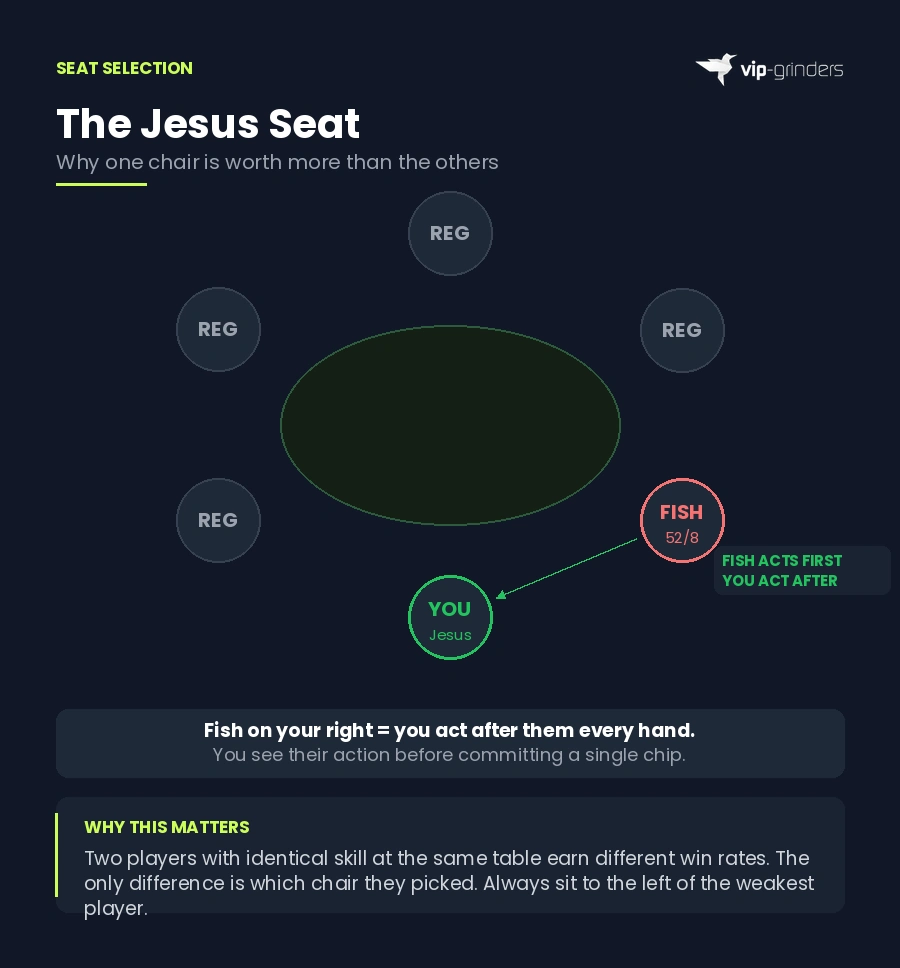
- You act after them on every street: you see whether they limp, call, raise, or check before you make your decision. That information is worth real money on every hand.
- You can isolate them preflop: when they limp, you raise to play a heads-up pot in position against the weakest player at the table. This is one of the highest EV plays available at low stakes.
- You control pot size: acting last in position lets you build pots when you have strong hands and keep pots small when you are marginal. Against a fish who calls too much, pot control is especially valuable.
What About the Players on Your Left?
The seats to your left matter too, because those players act after you. The best case is tight, passive regulars on your left. They fold a lot, rarely 3-bet, and let you steal blinds and isolate the fish without interference.
The worst case is an aggressive, competent regular directly to your left. They will 3-bet you frequently when you try to isolate, squeeze you out of pots with the fish, and make your positional advantage harder to use. If this happens, you have two options: change seats so the aggressive player is on your right instead, or change tables entirely.
When to Wait for the Right Seat
If the only open seat at a soft table puts you out of position against the fish (they are on your left or across the table), it is still usually worth sitting down. A soft table with a bad seat is better than a tough table with a perfect seat. But keep the seat-change option open.
Most online rooms let you join a waiting list for a specific seat at a table you are already playing. Sit down in whatever seat is open, start playing, and join the wait list for the seat directly to the right of the weakest player. When it opens, move immediately.
In live poker, ask the floor for a table-change button or a seat-change button. The floor will move you when the right seat opens up, and most recreational players do not even know this option exists.
Table Selection by Format
Not every poker format lets you choose your table. In regular cash games, you have full control over where you sit, but in Zoom, you join a player pool and the software assigns you a new table every hand. In MTTs and Spins, your table is random and you have no control over who you face.
Understanding which formats allow selection and which do not changes how you spend your time. If you have a strong table selection process, regular cash games reward that skill more than any other format. If you prefer volume and speed, fast-fold formats trade selection for hands per hour.
The matrix below maps every major format against the selection tools available and the alternative lever you should pull instead.
| Format | Table Selection Possible? | What You Can Control | Alternative Lever |
|---|---|---|---|
| Regular cash (6-max / 9-max) | Yes, full control | Lobby stats, HUD, seat choice, table switches | This is where selection skill pays the most. |
| Zoom / Rush / SNAP | No | Which stake and pool to join | Volume and rakeback. Selection is traded for speed. |
| MTTs | No (tables are random) | Which tournaments to enter, late reg timing | Field softness, overlay hunting, schedule selection. |
| Spin and Go / Lottery SNG | No | Which buy-in level to play | ROI and rakeback. Pure volume play. |
| PLO cash | Yes, full control | Same as NLHE cash, but benchmarks differ | 50%+ players/flop is normal in PLO. Adjust thresholds upward. |
| Live cash | Partial | Table change requests, seat change buttons | Behavioral reads replace lobby stats entirely. |
Why This Matrix Matters for Your Format Choice
If you are deciding between regular cash and Zoom at the same stake, your table selection skill is the tiebreaker. A player who spends 5 minutes per session scanning the lobby and re-checking every 30 minutes will earn significantly more at regular tables than at Zoom, because that effort produces zero return in a fast-fold pool.
The flip side is also true. If you do not table-select at all (you sit at the first open table and never move), Zoom actually produces a better hourly rate than regular cash for most players, because the hand volume compensates for the missing selection edge. Our fast-fold strategy guide covers the exact win rate and volume tradeoffs for that decision.
For Spin and Go players, table selection does not exist at all: your edge comes entirely from push/fold execution, ROI, and your rakeback deal. But room-level selection (which site to play on) and timing (when to play) still apply, and those variables are format-independent.
Room-Level Selection: Which Sites Have the Softest Games in 2026
Table selection starts before you open the lobby. The room you play on determines the player pool you are selecting from, and some pools are structurally softer than others. A NL50 table on a site with casino-driven traffic plays nothing like a NL50 table on a legacy network where the same 15 regulars sit every evening. Our poker traffic data ranks 36 networks by player count monthly, which is the starting point for this decision.
This is the level of selection that no competitor guide covers, but it can matter as much as choosing the right table within a single lobby. A player who grinds NL25 on a tough European network might already be a winning NL50 player on a softer room. Choosing the right room is sometimes the highest-EV move available.
What Makes a Room Soft or Tough
Three factors drive the difference in player pool quality between rooms.
- Traffic source: rooms that feed poker traffic from a casino or sportsbook player base are consistently softer. Players who deposit to bet on football and then try a few poker hands are not studying solvers.
- Recreational protection policies: rooms that use anonymous tables, ban HUDs, or cap the number of tables per player keep recreational players at the tables longer. That protection is good for you because it keeps the fish in the pool.
- Reg density: smaller rooms can go either way. Some have almost no regulars at low stakes, which makes games very soft. Others have a tight group of strong regs fighting over the same few recreational players.
Room-by-Room Breakdown for 2026
The table below summarizes the key traits of major rooms from a table selection perspective. Softness ratings are based on player pool composition at low and mid stakes.
| Room | Traffic Source | Rec Protection | Low/Mid Stake Softness | Selection Note |
|---|---|---|---|---|
| GGPoker | Mixed (poker + casino) | Built-in HUD only, PVI penalties on big winners | Moderate to soft | Largest traffic pool. Asian recreational players during GMT afternoon. |
| WPT Global | Casino + sportsbook crossover | No third-party HUDs | Soft | Strong Asian recreational pool. SNG average VPIP around 48%. |
| BCPoker | Casino crossover (BC.GAME) | BC Shield anti-bot, no HUDs | Soft | Casino-driven traffic at every stake. Crypto-first with fast payouts. |
| CoinPoker | Crypto community | Anonymous tables, no HUDs | Soft | Growing player base. Anonymous tables keep rec players comfortable. |
| Bovada / Ignition | Casino + sportsbook | Anonymous tables, 4-table cap, no HUDs | Very soft | Strongest recreational protection in the industry. No table selection tools, but the pool itself is soft. |
| PokerStars | Poker-first | Third-party HUDs allowed | Tough at equivalent stakes | Largest reg population. Best for players who want volume and liquidity over softness. |
Notice the pattern: rooms that protect recreational players (anonymous tables, HUD bans, table caps) tend to have softer pools. The tradeoff is that you lose your own selection tools at those rooms. But when the entire pool is softer, you need less precision in your selection because even a random table is likely to have recreational players on it.
For players deciding between rooms, the combination of pool softness and rakeback deal is usually the deciding factor. A room with slightly tougher games but a 40% tracked deal can produce higher total income than a softer room with 10% default rewards, because the rakeback compounds across every hand you play.
For how room selection connects to your move-up decision, our guide to moving up stakes covers why switching rooms instead of moving up is sometimes the higher-EV play.
When to Play: Peak Hours and Seasonal Patterns
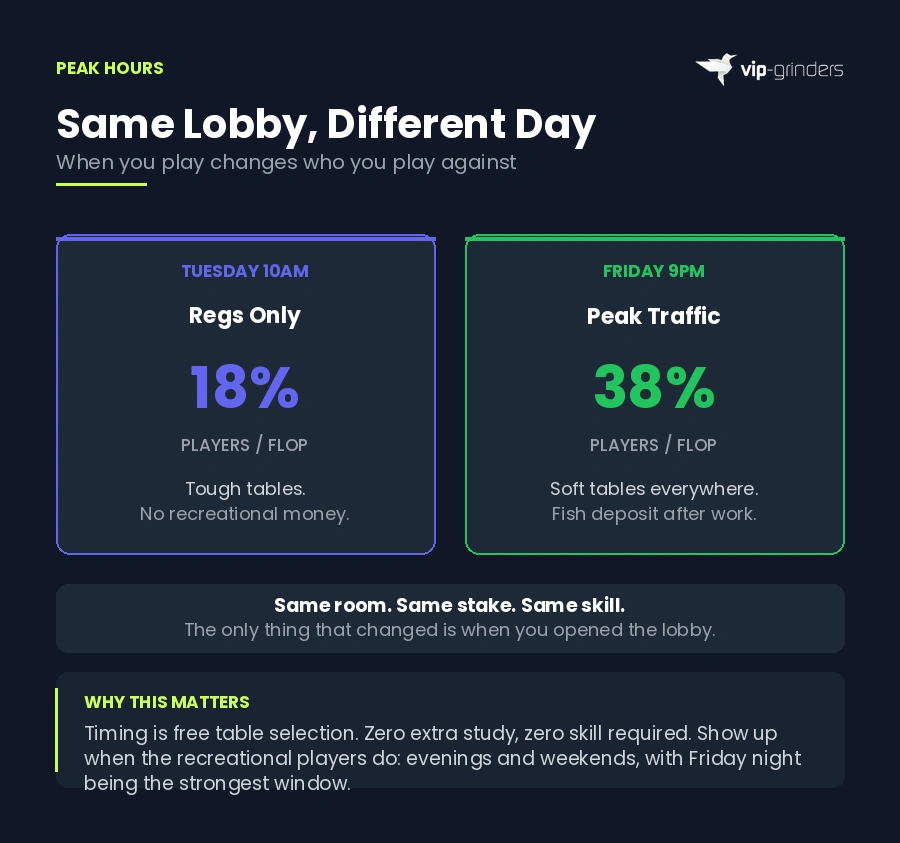
The time you sit down matters almost as much as where you sit. Recreational players follow predictable schedules: they log on after work, play on weekends, and disappear during holidays, while regulars fill the gaps. If you can shift even one or two hours toward peak recreational traffic, your win rate improves without changing a single thing about your game.
Peak Hours by Region
The table below shows when cash game traffic peaks across the four major player regions. All times are converted to UTC so you can compare across time zones.
| Region | Peak Window (UTC) | Peak Window (Local) | Strongest Day |
|---|---|---|---|
| Western Europe | 18:00 to 23:00 UTC | 7pm to midnight CET | Friday evening |
| North America (East) | 23:00 to 04:00 UTC | 7pm to midnight EST | Friday and Saturday |
| Asia / Pacific | 10:00 to 16:00 UTC | 6pm to midnight SGT/HKT | Weekends |
| Latin America | 00:00 to 05:00 UTC | 9pm to 2am BRT | Friday and Saturday |
The single strongest window across global networks is Friday evening in Western Europe (roughly 19:00 to 23:00 UTC). This is when the largest number of recreational players are online at the same time. PokerListings traffic data from 2026 confirms that the industry-wide trough hits between 05:00 and 08:00 UTC, when Europe is asleep and US traffic has dropped off.
How to Use This if You Can Only Play 3 Hours a Day
If your schedule is limited, aim for the overlap between European and early North American traffic. The window from 21:00 to 00:00 UTC catches the tail end of European peak and the start of US East Coast prime time. That 3-hour block consistently has the softest tables on any room with international traffic.
If you play on a room with strong Asian traffic (GGPoker, WPT Global), the GMT afternoon window (10:00 to 16:00 UTC) is a second soft spot that most European and American grinders miss entirely.
Seasonal Patterns
Online poker traffic follows a clear annual cycle. The busiest months are November through February, when people spend more time indoors and major tournament series (like WCOOP and holiday specials) drive deposits. The quietest months are June through August, when recreational players go on holiday and outdoor activities compete for their time.
The practical takeaway is simple: play more hours in winter and fewer in summer if you want to maximize the quality of your tables. A grinder who adds 20 hours per month during November through January and cuts 20 hours during July and August is playing the same annual total but capturing significantly more value from softer seasonal traffic.
For how session timing connects to your total monthly income, the is online poker profitable guide covers what realistic monthly numbers look like at each stake.
Rakeback Changes Which Tables Are Worth Sitting
This is the angle no other table selection guide covers, and it is the one most relevant to VIP-Grinders readers. Your rakeback deal does not just add money on top of your table results. It changes which tables are mathematically worth playing in the first place.
A player with no rakeback deal needs to beat a table by at least 1 to 2 bb/100 after rake for it to be worth sitting. A player with a 35% deal can sit a table where their expected edge is close to zero and still profit, because the rakeback income from generating rake turns a break-even seat into a winning one.
The Marginal Table Decision
The table below shows a common situation: you have scanned the lobby, the best tables are full, and the only open seat is at a table that looks average. Should you sit or wait? The answer depends on your deal.
| Expected Table Edge | Rakeback at 0% | Rakeback at 15% | Rakeback at 25% | Rakeback at 35% | Verdict |
|---|---|---|---|---|---|
| +2 bb/100 | +2.0 | +3.5 | +4.5 | +5.5 | Sit at every deal level. |
| +1 bb/100 | +1.0 | +2.5 | +3.5 | +4.5 | Sit at every deal level. |
| 0 bb/100 (break-even) | 0.0 | +1.5 | +2.5 | +3.5 | Skip at 0%. Sit at 15%+. |
| Negative 1 bb/100 | Negative 1.0 | +0.5 | +1.5 | +2.5 | Skip at 0% and 15%. Sit at 25%+. |
| Negative 2 bb/100 | Negative 2.0 | Negative 0.5 | +0.5 | +1.5 | Skip at 0% and 15%. Marginal at 25%. Sit at 35%+. |
The effective rates in the table assume roughly 10 bb/100 in rake generated (typical for NL25 to NL50 at 6-max). At higher stakes the rake per 100 hands is lower, so the rakeback boost shrinks slightly. At micro stakes the rake is higher, so the boost is even larger.
Read the table from left to right for your deal percentage. A player with a 35% tracked deal can profitably sit tables where they expect to lose 1 to 2 bb/100 at the felt, because the 3.5 bb/100 coming back in rakeback turns that loss into a net positive. A player with no deal needs every table to be clearly profitable before sitting down.
What This Means in Practice
Two players open the same lobby. The soft tables are full and one average table has an open seat. Player A has no deal and correctly skips it, but Player B has a 35% tracked deal and correctly sits down, because the table is profitable for them even though it looks marginal.
Over a month, Player B plays 20 to 30 more hours than Player A from these marginal-table decisions alone. That extra volume generates extra rakeback, which compounds into faster bankroll growth. The deal does not just add income on top: it expands the number of profitable tables available to you.
For the full math on how your deal changes your effective win rate, bankroll requirements, and format decisions, see the rakeback and strategy guide.
When to Leave a Table
Knowing when to leave is worth just as much as knowing where to sit. Many grinders find a soft table, build a profit, and then stay for three hours after the table has gone reg-heavy because leaving feels like quitting. It is not quitting: it is the same selection skill that put you at the table in the first place, applied in reverse.
The rule is simple: re-evaluate your table every 30 minutes. Open the lobby, check if a softer table has appeared, and look at who is still sitting at your current one. If the conditions that made you choose this table no longer exist, move.
Specific Triggers to Leave
Leave the table when two or more of these are true at the same time.
- The fish left: the recreational player who made this table worth sitting has stood up or gone broke. Without them, you are now at a reg-heavy table with a fraction of the edge you sat down for.
- Two regs filled the empty seats: a table that started with three recreational players and now has five regulars is a completely different game. The money has left and the competition has arrived.
- You have lost 3+ buy-ins: this is not always a sign the table is bad. But it is a signal to re-evaluate honestly. If the losses came from coolers and the fish is still there, stay. If you are tilting or the table dynamic has shifted, leave.
- You have been at the same table for 3+ hours: after three hours, your focus drops and the other regulars have built reads on your tendencies. Even if the table is still soft, a short break and a fresh table resets both problems.
- You are losing focus: checking your phone between hands, auto-piloting decisions, or feeling impatient with the pace. These are signs your decision quality is dropping, and every bad decision costs more than the marginal value of staying.
- A softer table appeared in the lobby: this is the easiest trigger to act on and the one most players ignore. If your lobby scan shows a table with 40%+ players/flop and your current table is at 22%, move.
The biggest mental trap is feeling “invested” in a table because you have been there for a while or because you lost money you want to win back. That instinct keeps you at bad tables longer than you should be. Treat every 30-minute check as a fresh decision: if you would not sit down at this table right now as a new arrival, you should not stay at it either.
For how to manage the emotional side of leaving (especially after losses), the mental game guide covers tilt types and session-ending triggers in detail.
Common Table Selection Mistakes
Most of the money lost to bad table selection is not lost because players lack knowledge. It is lost because they skip the process, cut corners, or let habits override what the lobby is telling them. Every mistake below is something the reader now has the tools to fix.
- Sitting at the first open table: this is the most expensive habit in online poker. Sixty seconds of lobby scanning separates a random table from a profitable one. The difference is worth hundreds of dollars per month.
- Staying because you want to win it back: the table does not owe you anything. If the fish left and you are down two buy-ins against regulars, staying to recover is not a strategy. It is tilt with a polite name.
- Playing off-peak hours because they fit your schedule: grinding at 10am on a Tuesday when only regulars are online is the same as voluntarily choosing the toughest games available. Even shifting one hour toward evening traffic can improve your table options.
- Running 8 random tables instead of 4 selected ones: more tables means more hands per hour, but if half of those tables are reg-heavy, you are diluting your edge for volume. Four carefully selected tables with at least one fish each will produce a higher total hourly rate than eight random ones.
- Choosing Zoom over regular tables for convenience: Zoom is faster to set up and requires zero table selection. But if you have the skill to select tables (and after reading this guide you do), regular cash rewards that skill with a measurably higher win rate.
- Ignoring room-level selection: playing on the same site you registered at five years ago without checking whether softer rooms exist is a form of autopilot. The room comparison table earlier in this guide exists for exactly this reason.
- Never re-checking the lobby mid-session: a table that was soft an hour ago can turn reg-heavy in minutes when recreational players leave. A 30-second lobby scan every 30 minutes catches these shifts before they cost you money.
Every one of these mistakes is a missed opportunity, not a strategic error. The player who avoids them is not playing better poker. They are playing the same poker in better conditions, which is the entire point of table selection.
Frequently Asked Questions
How much does table selection add to my win rate?
A Hand2Note study found that winning regulars earned 0.3 bb/100 at tables with no recreational players and 5.5 bb/100 when at least one fish was present. For most grinders at micro and low stakes, consistent table selection adds 3 to 5 bb/100 compared to sitting at random tables. The existing VIP-Grinders data and multiple independent sources support a 5 to 10 bb/100 total uplift when combining lobby scanning, HUD reads, seat selection, and session timing.
What lobby stats should I look for when choosing a table?
The most important stat is players per flop percentage. Above 30% is a good table at 6-max, above 40% is very soft. Pair that with average pot size: high players/flop plus high average pot means action and weak players. High average pot with low players/flop usually means aggressive regulars, so avoid those tables.
Is table selection possible in Zoom or fast-fold poker?
No. In Zoom, Rush, SNAP, and other fast-fold formats, you join a player pool and the software assigns you a new random table every hand, so table selection does not exist. The tradeoff is higher hand volume, which compensates through rakeback, but if you have strong selection skills, regular cash tables will always produce a higher win rate than fast-fold at the same stake.
Do professional poker players really table-select?
Yes. Every serious cash game professional spends time choosing tables before sitting down and re-evaluating during sessions. At mid and high stakes, where the difference between a soft table and a tough one can be 5+ bb/100, skipping selection is the same as voluntarily cutting your hourly rate in half. The only pros who skip it are high-volume fast-fold grinders who trade selection for volume and rakeback.
Should I play on multiple poker sites for better table selection?
Yes, if your bankroll supports it. Signing up at 3 to 4 rooms gives you access to multiple lobbies and lets you pick the softest tables across all of them at any given time. Different rooms also peak at different hours depending on their player base. The main consideration is keeping your bankroll properly managed across sites and making sure each room has a tracked rakeback deal.
Is it worth waiting for a good table instead of playing immediately?
Almost always yes. Waiting 5 minutes for a seat at a table with 35%+ players/flop produces more profit over a 2-hour session than sitting immediately at a 18% reg-heavy table. The exception is if your total available playing time is very short (under 30 minutes), in which case any table is better than no table, but for sessions of an hour or more, patience at the lobby pays for itself many times over.
How do I table-select on sites with anonymous tables?
On rooms like Bovada, Ignition, and CoinPoker where you cannot see player names or use HUDs, you rely on lobby stats (players/flop, average pot size) and in-game behavioral tells (limping, min-betting, short stacks, slow play timing). The good news is that anonymous rooms tend to have softer pools overall because recreational players feel protected, so even without precise player tracking, your average table quality is higher than on HUD-friendly sites.
What is the best time of day to play online poker?
The softest games run during evening hours in each region’s local time, roughly 7pm to midnight. The single strongest window across global networks is Friday evening in Western Europe (19:00 to 23:00 UTC). The toughest hours are early morning UTC (05:00 to 08:00) when only regulars are online. If you play on a room with Asian traffic, the GMT afternoon window (10:00 to 16:00 UTC) is a second soft spot most Western grinders miss.