

Moving Up Stakes in Poker: When You’re Ready & How to Adjust 2026
Most players move up too early. They run hot over 5,000 hands, see a win rate that looks solid, and jump to the next stake with half the bankroll they need. Two weeks later they’re back where they started, minus the confidence they had before the shot.

The fix is a system built on data, not feelings. A specific win rate threshold over a real sample size, a bankroll number that matches the math, and a pre-committed rule for moving back down. Players who check all four boxes stay at the new level, and players who skip any of them usually don’t.
Here is what this guide covers:
- Win rate thresholds by stake with a readiness checklist you can use before every move-up
- Sample size you actually need and why 5,000 hands proves nothing
- Rake compression math showing how higher stakes cost less to play
- Rakeback acceleration with a worked two-player comparison
- Six transition adjustments for your first 20,000 hands at the new stake
Every number below is cross-verified against our cash game strategy guide and our variance guide so nothing contradicts what you’ve already read on the site.
How to Know When You’re Ready to Move Up
The question isn’t whether you’re winning. The question is whether you’ve proven you’re winning over a sample large enough to mean something, with a bankroll deep enough to survive the transition. Three conditions must all be true before you sit at the next stake.
Condition 1: A Proven Win Rate
You need a win rate above the “move-up ready” threshold for your stake, measured over at least 30,000 hands (50,000+ is better). If your bb/100 is positive but tiny, you’re beating the rake and not much else. That edge will not survive the tougher population at the next level.
A win rate of 2 bb/100 at NL25 over 40,000 hands is a real signal. A win rate of 8 bb/100 at NL25 over 4,000 hands is noise. The Variance Simulator shows you how reliable your win rate really is: plug in your numbers, and if the worst-case scenario still shows a loss, you haven’t proven an edge yet.
Condition 2: Enough Bankroll
The standard rule is 30 buy-ins of the next stake, plus a 10 buy-in shot reserve. That means 40 total buy-ins earmarked before you play a single hand at the higher level.
For a player moving from NL25 to NL50, that’s $2,000 (40 × $50). These numbers aren’t arbitrary: at 30 buy-ins with a 3 bb/100 edge, the risk of going broke before recovering is roughly 8%, but at 20 buy-ins that risk jumps to 36%.
The full table of bankroll requirements by stake and risk tolerance is in our bankroll management guide.
Condition 3: A Written Move-Down Rule
Before you sit at the new stake, write down the exact bankroll number that sends you back. The standard trigger is 20 buy-ins of the new stake. If your roll drops to that line, you move down immediately: no “one more session,” no “I’ll make it back tomorrow.”
This has to be decided in advance because you will not make it rationally in the moment. After three losing sessions at a new stake, every player’s instinct is to keep playing and recover. That instinct is how bankrolls disappear.
The Readiness Checklist
All six points must be “yes” before you move up. If any single one is “no,” stay at your current stake until it flips.
- 130,000+ hands at your current stake (50,000+ preferred).
- 2Win rate above the move-up ready threshold for your level (see table in the next section).
- 330 buy-ins of the next stake in bankroll, plus a 10 buy-in shot reserve.
- 4At least one 15 buy-in downswing survived without tilting off or quitting.
- 5Rakeback deal of 25%+ at your room (if lower, upgrade before moving up).
- 6Move-down trigger written on paper: drop back at 20 buy-ins of the new stake.
The downswing test is easy to overlook. If you’ve never experienced a real downswing at your current stake, you haven’t been tested. A 15 buy-in dip is a normal event for a 3 bb/100 winner inside 30,000 hands, and surviving one without changing your game proves you can handle the swings that will hit harder at the next level.
The rakeback check is the one most grinders skip. A 35% deal adds direct monthly income that shortens the timeline to reach the next buy-in threshold. Players grinding without a tracked deal are building their roll slower than they need to.
Win Rate Thresholds by Stake: What “Beating the Game” Actually Means
A positive win rate is not the same as a move-up-ready win rate. Breaking even after rake at NL10 means you have basic skills. It does not mean those skills will survive the population shift at NL25, where opponents fold less to continuation bets, 3-bet more aggressively, and punish sizing mistakes you got away with at the lower level.
The table below shows what winning looks like at each stake. “Strong winner” is an above-average regular who crushes the level. “Move-up ready” is the minimum edge with a realistic chance of surviving at the next stake, while “not ready” means your rate is too thin to absorb the compression.
| Stake | Strong Winner | Move-Up Ready | Not Ready Yet | Population Note |
|---|---|---|---|---|
| NL2 | 10 to 15 bb/100 | 5 to 8 bb/100 | 1 to 4 bb/100 | Mostly complete beginners. High rake relative to pot size. |
| NL5 | 7 to 10 bb/100 | 4 to 6 bb/100 | 1 to 3 bb/100 | First regulars appear. Fewer players limp-calling every hand. |
| NL10 | 6 to 8 bb/100 | 3 to 5 bb/100 | 1 to 2 bb/100 | Regs use basic HUD stats. Passive fish still common. |
| NL25 | 5 to 6 bb/100 | 3 to 4 bb/100 | 1 to 2 bb/100 | First real difficulty spike for most players. |
| NL50 | 4 to 5 bb/100 | 2 to 3 bb/100 | 0 to 1 bb/100 | Regs study solvers. Exploitable players are rarer. |
| NL100 | 3 to 4 bb/100 | 2 bb/100 | 0 to 1 bb/100 | Edges are thin. Table selection becomes critical. |
| NL200 | 2 to 3 bb/100 | 1 to 2 bb/100 | 0 bb/100 | Reg-heavy pools. Rakeback and volume matter as much as skill edge. |
These numbers describe online 6-max cash games across standard player pools, measured over 50,000+ hands at 2 to 6 tables. If you play Zoom or other fast-fold formats, subtract roughly 1 to 2 bb/100 at every level because table selection is removed from the equation.
Why Your Win Rate Will Drop When You Move Up
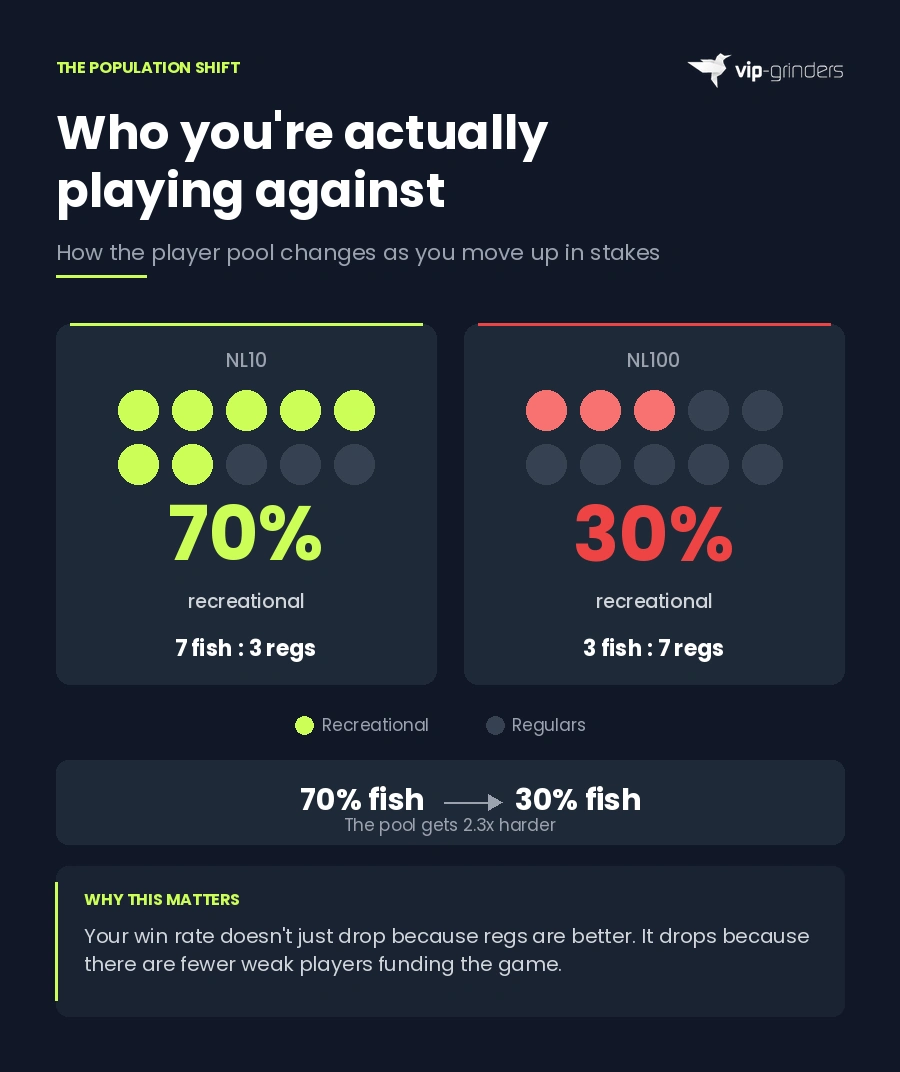
Every stake jump compresses your edge. The players who were making mistakes at NL25 either fixed those mistakes by the time they reached NL50 or went broke trying. The population that remains at the higher level is smaller, tighter, and more aware of the same exploits you used to beat the lower stake.
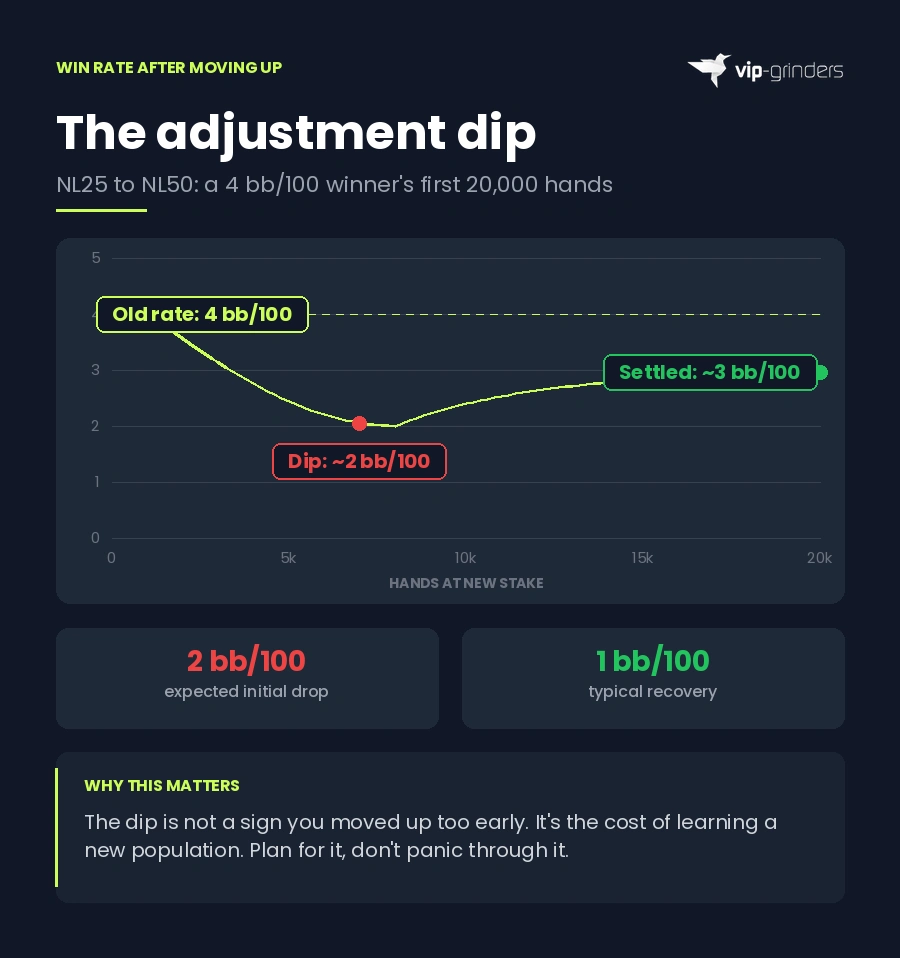
A practical planning rule: expect your win rate to drop by roughly 2 bb/100 in your first 20,000 hands at the new stake. Some of that drop is real (tougher opponents), and some is adjustment friction (unfamiliar dynamics). After 20,000 hands, most players recover about 1 bb/100 as they adapt.
To use the table: find your current stake, check your bb/100 over at least 30,000 hands, and see which column you fall into. If you’re in the “move-up ready” range or higher, cross-check the other five points on the readiness checklist. If you’re in the “not ready” column, the next step is identifying your biggest leaks, not moving up.
Why Sample Size Matters More Than Win Rate
A strong win rate over a small sample is the most dangerous number in poker. It feels real and looks like proof, but the math says otherwise. At 10,000 hands, a player showing 5 bb/100 could just as easily be a long-term loser running above expectation.
The reason is variance. Your observed win rate after any number of hands is your true win rate plus or minus a noise factor that shrinks slowly as you play more. For the full math behind this, see our variance guide.
How the Noise Shrinks
The table below shows how much your observed win rate can deviate from your true rate at different sample sizes, assuming a standard deviation of 85 bb/100 (typical for 6-max cash).
| Hands Played | Margin of Error (95%) | What This Means |
|---|---|---|
| 5,000 | ± 24 bb/100 | A 5 bb/100 result could be anywhere from losing 19 to winning 29. Essentially random. |
| 10,000 | ± 17 bb/100 | Still too wide. A “winning” player could easily be break-even or worse. |
| 30,000 | ± 10 bb/100 | Directional read. A 5 bb/100 result rules out being a big loser, but doesn’t confirm a strong edge. |
| 50,000 | ± 7.5 bb/100 | Practical move-up threshold. A 4 bb/100 result likely means you’re a real winner. |
| 100,000 | ± 5.3 bb/100 | Strong confidence. Your observed rate is close to your true rate. |
At 5,000 hands, the noise is so large that your results are almost meaningless. This is exactly where most players make the move-up mistake: they see a big number on a small sample and treat it as evidence.
The Minimum Sample Before Moving Up
The floor is 30,000 hands: below that, you don’t have enough data to distinguish a real edge from a hot streak. At 30,000 hands with a 4 bb/100 observed rate, the 95% range runs from roughly negative 6 to positive 14. That’s wide, but it rules out being a massive loser, which is the minimum bar for a move-up.
The preferred threshold is 50,000 hands, where a 4 bb/100 result narrows the range enough to give real confidence. If you can afford the extra volume before moving up, take it. The information is worth more than the two or three weeks it costs.
The Variance Simulator (linked in the readiness checklist above) runs this calculation for your exact win rate and standard deviation. Plug in your numbers before making the move-up decision. If the worst-case scenario still shows a loss, add more hands.
How Rake Drops When You Move Up (And Why It Matters)
Every poker room charges the same rake percentage across stakes: usually 5% of every pot. What changes is the cap, the maximum amount the room can take from a single hand. That cap shrinks relative to the big blind as you move up, so higher stakes cost you less rake per 100 hands even though the percentage never changes.
This matters because rake compression works in your favor. Part of the win rate you lose to tougher opponents at the next stake gets handed back through lower effective rake. Most players never calculate this.
Effective Rake by Stake
The table below shows how the rake cap translates into an approximate bb/100 cost at each level. These are estimates across major rooms for 6-max cash with 4+ players at the table.
| Stake | Typical Cap | Cap in Big Blinds | Effective Rake (est. bb/100) |
|---|---|---|---|
| NL2 | $0.30 | 6 bb | 8 to 12 bb/100 |
| NL5 | $0.50 to $1.00 | 4 to 8 bb | 7 to 10 bb/100 |
| NL10 | $1.00 | 4 to 5 bb | 6 to 9 bb/100 |
| NL25 | $1.50 to $2.50 | 4 bb | 5 to 8 bb/100 |
| NL50 | $2.00 to $3.00 | 2.5 to 3 bb | 5 to 7 bb/100 |
| NL100 | $2.50 to $5.00 | 1.25 to 2.5 bb | 4 to 5 bb/100 |
| NL200 | $3.00 to $5.00 | 0.75 to 1.25 bb | 2 to 4 bb/100 |
The pattern is clear: a micro-stakes player at NL2 pays roughly 4 to 6 times more rake per big blind than a player at NL200. It’s a structural tax that makes low stakes harder to beat than the weak competition suggests.
What This Means for Your Move-Up Math
Each stake jump from micros into low and mid stakes returns roughly 1 to 3 bb/100 in reduced rake. That recovery is already baked into the win rate compression estimates above.
A player winning 5 bb/100 at NL25 expects roughly 3 bb/100 at NL50 after the population difficulty increase, but the rake at NL50 costs about 1 to 2 bb/100 less than at NL25. The net compression is closer to 1 bb/100 than 2 bb/100, which means the move is more viable than it looks on surface win rate alone.
This is one of the strongest arguments for moving up when you’re ready: the game gets harder, but it also gets cheaper to play. For the full breakdown of how rake works across formats and rooms, see our rake in poker guide.
How Rakeback Accelerates Your Move Up
Rakeback is not just a bonus: it’s a direct addition to your win rate that shortens the time between stake jumps. Two players with identical skill, volume, and win rates will reach the next stake at completely different speeds depending on their deal. This is the single most overlooked factor in the move-up decision.
The Math: Two Identical Players, Two Different Deals
Take two NL25 regulars, both winning 3 bb/100 over 50,000 hands, both playing 40,000 hands per month across 4 tables. Both need to grow their bankroll from $1,500 (60 buy-ins of NL25) to $2,000 (40 buy-ins of NL50) before moving up.
Their pre-rakeback monthly profit is the same:
40,000 hands × 3 bb/100 × $0.50 per bb = $600 per month.
Now add rakeback. At NL25 with 40,000 hands, each player generates roughly $250 to $350 in monthly rake depending on the room and how many pots go to showdown.
- Player A (15% default deal): earns roughly $40 per month in rakeback. Total monthly growth: $640. Reaches $2,000 in roughly 18 to 20 days.
- Player B (35% tracked deal): earns roughly $95 per month in rakeback. Total monthly growth: $695. Reaches $2,000 in roughly 15 to 16 days.
The difference is about 3 to 4 days of grinding. That gap widens at every stake because the absolute rake generated per hand increases as the blinds get bigger. At NL50 and above, a 35% deal versus a 15% deal can shave a full week off every move-up cycle.
Rakeback Also Pads Your Effective Win Rate
Another way to think about it: rakeback directly increases your bb/100 after accounting for rake. A player with a 3 bb/100 pre-rakeback win rate at NL25 and a 35% deal gets roughly 2 to 2.5 bb/100 added back, pushing the effective rate to 5 to 5.5 bb/100.
That higher effective rate does two things at once. It builds the bankroll faster, and it makes the move-up less risky because your cushion above break-even is thicker. A 5.5 bb/100 effective winner at NL25 has a much wider margin of safety at NL50 than a 3.4 bb/100 effective winner with a default deal.
This is why the readiness checklist includes a 25%+ rakeback deal as a requirement. If your current deal is below that, upgrading it before you move up is the highest-EV action available: zero extra hands, zero extra study, immediate improvement to your bankroll growth.
For the full breakdown of how rakeback should influence your game selection, volume targets, and format choices, see our rakeback and strategy guide.
Your Room Matters: Ecosystem-Aware Stake Selection
NL50 on one site is not the same game as NL50 on another. The stake label tells you the blind size, not who’s sitting at the tables. A crypto poker room with casino-driven traffic will have a softer NL50 player pool than a legacy European network where the same 12 regulars sit every day.
Three Factors That Shift Difficulty Between Rooms
- Player pool source: rooms that feed poker traffic from a casino or sportsbook player base tend to have softer tables at every stake. Players who deposit to bet on football and then try a few poker hands are not studying solvers.
- Reg-to-fish ratio: smaller rooms can go either way. Some have almost no regulars at low stakes, which makes the games extremely soft. Others have a small pool of strong regs fighting over the same few recreational players.
- Anonymous tables: rooms that hide usernames or rotate seating make it harder for regulars to target weak players. That protects recreational players and keeps the ecosystem softer for longer.
How to Use This Before Moving Up
Before you move up on your current room, check the player pool during your usual hours. If every table has the same familiar screen names, that’s a reg-heavy pool. Compare that to a softer room’s equivalent: if it also offers a better rakeback deal, you get easier games and more money back at the same time.
The practical move for many grinders is not “move up on the same site” but “move up on the site where the move-up is easiest.” The stake at which you become a winning player is not fixed. It depends on where you play.
Your First 20,000 Hands at the New Stake
The move-up decision is only half the job. Most players who fail at a higher stake don’t fail because they lack the skill: they play the new stake exactly the way they played the old one, without adjusting for a population that punishes different mistakes. The first 20,000 hands are an adjustment window, not a performance test.
Your goal is not to crush the stake immediately. Your goal is to learn how the new population plays, identify where your current strategy needs updating, and protect your bankroll while you figure it out.
Six Adjustments for the Transition
- 1Drop to 1 or 2 tables. You played 4 or 6 tables at the old stake because you knew the population. At the new level, you need full attention on every decision. Add tables back only after 5,000 hands with a stable read on the new pool.
- 2Tighten your open-raise range by about 5%. Cut the weakest hands you were opening from the cutoff and button until you have population reads. The hands that were barely profitable at the old stake are likely break-even or worse here.
- 3Increase value bet sizing by 10% to 15%. Players at the next stake call thinner than you expect. The fish who remain at higher stakes tend to be calling stations with money to burn, not the passive nits you saw at micros. Bet bigger for value when you have it.
- 4Reduce river bluff frequency. Until you know which regulars fold to pressure and which ones call down light, cut your river bluffs by roughly half. Over-bluffing regs who actually call is the most common leak for players who just moved up.
- 5Rebuild your note files from scratch. Population tendencies change between stakes. The reads you built at NL25 do not transfer to NL50. Start fresh: tag every regular and recreational player in your first 50 sessions and build a new profile for the pool.
- 6Review every session in your tracker. Flag hands where you felt uncertain or uncomfortable. Those are the spots where your old-stake autopilot broke down, and they are your highest-value study material.
Why Most Players Over-Bluff When They Move Up
The most common adjustment mistake deserves its own explanation. Players move up and assume the new population is tougher, which it is. They then conclude that tougher opponents require more aggression and more bluffs to beat, which is wrong.
At NL50 and NL100, regulars call down wider than the NL25 population because they’ve been trained by players making exactly this mistake. The regs have already adapted to the wave of over-bluffing movers. Your counter-adjustment is to bluff less, not more, until your reads confirm which opponents actually fold.
This is also where the mental game becomes critical. The urge to “prove yourself” at the new stake leads to forcing plays that weren’t in your strategy at the old level. Stick to what was working, adjust gradually based on data, and let the first 20,000 hands be an information-gathering period rather than a performance showcase.
When to Add Tables Back
After roughly 5,000 hands at 1 or 2 tables, you should have basic population reads on the most active regulars in your time zone. At that point, add one table at a time. If your focus stays sharp and your decisions feel confident, add another after 2,000 to 3,000 more hands.
The target is to reach your normal table count (usually 4 to 6 for most online grinders) by the 15,000 to 20,000 hand mark. If you’re still struggling with decisions at 10,000 hands, that’s a signal to stay at fewer tables longer, not a signal to force the volume.
For a structured approach to finding the right table count for your skill level and format, our hourly rate guide covers how table count, win rate, and rake interact to determine your actual dollars per hour.
When to Move Back Down (And Why It’s Not Failure)
Moving down is not a setback. It’s a pre-planned, mechanical event that protects your bankroll so you can take another shot later. The players who treat it as failure are the same ones who stay too long, bleed through their roll, and end up two levels below where they started.
The difference between a successful mover and a failed one is almost never skill. It’s whether they had a rule written down before they sat at the new stake, and whether they followed it.
The Hard Rule: 20 Buy-Ins
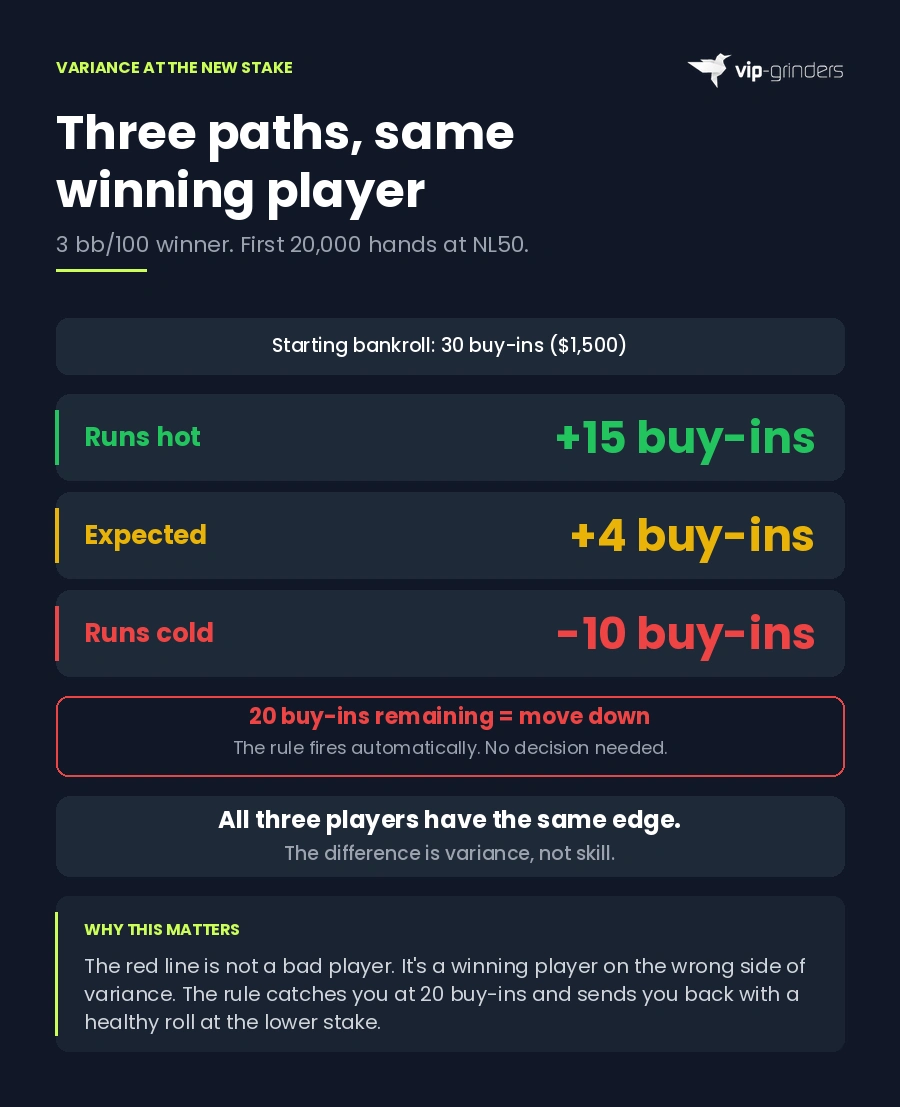
If your bankroll drops to 20 buy-ins of the new stake, move down immediately. No exceptions, no “one more session,” no switching to a different table hoping the games are softer.
At 20 buy-ins with a 3 bb/100 edge, the math is brutal: you have roughly a 36% chance of going broke before your edge recovers the losses. At 30 buy-ins, that risk drops to 8%. That 10 buy-in gap is the difference between a recoverable dip and a coin flip on your entire bankroll.
The Shot-Taking Partition
A smarter structure than “move my whole roll up” is to partition your bankroll before the shot. Earmark a fixed amount as your shot fund and keep the rest at your current stake.
- Example: you have $4,000 total. You earmark $1,000 (10 buy-ins of NL100) as your shot fund. The remaining $3,000 stays as your NL50 roll.
- If the shot fails: you lose the $1,000 shot fund and drop back to NL50 with $3,000 (60 buy-ins). You’re still well-rolled for your base stake.
- If the shot works: you grow the shot fund past 30 buy-ins of NL100 ($3,000) and the move-up becomes permanent. Merge the funds and set a new move-down trigger.
The partition removes emotion from the decision entirely. When the shot fund hits zero, you’re automatically back at the lower stake with a healthy roll. When it grows past 30 buy-ins, you’re automatically promoted.
Use the Bankroll Calculator to model different partition sizes and see how each one changes your risk of ruin at the new stake.
Why Moving Down Is a Winning Play
Every successful player in the history of online poker has moved down at some point. It’s built into the structure of the game. Variance guarantees that even strong winners will hit stretches where their bankroll shrinks below the threshold for the stake they’re playing.
The players who move down quickly, rebuild, and take another shot within weeks are the ones who eventually stay at the higher level. The players who fight it, refuse to drop, and grind through on a short roll are the ones who end up starting over from scratch.
The Move-Up Roadmap: NL2 to NL200 Step by Step
Everything in this guide collapses into one reference table. Save it and check it before every move-up decision.
| Current Stake | Move-Up Ready bb/100 | Min. Sample | Bankroll to Move Up | Move-Down Trigger | Est. Effective Rake |
|---|---|---|---|---|---|
| NL2 → NL5 | 5 to 8 | 30,000 hands | $200 (40 × $5) | $100 (20 × $5) | 7 to 10 bb/100 |
| NL5 → NL10 | 4 to 6 | 30,000 hands | $400 (40 × $10) | $200 (20 × $10) | 6 to 9 bb/100 |
| NL10 → NL25 | 3 to 5 | 30,000 hands | $1,000 (40 × $25) | $500 (20 × $25) | 5 to 8 bb/100 |
| NL25 → NL50 | 3 to 4 | 50,000 hands | $2,000 (40 × $50) | $1,000 (20 × $50) | 5 to 7 bb/100 |
| NL50 → NL100 | 2 to 3 | 50,000 hands | $4,000 (40 × $100) | $2,000 (20 × $100) | 4 to 5 bb/100 |
| NL100 → NL200 | 2 | 50,000 hands | $8,000 (40 × $200) | $4,000 (20 × $200) | 2 to 4 bb/100 |
The minimum sample increases from 30,000 to 50,000 hands at the NL25 to NL50 transition because that’s where the first real difficulty spike hits. Below NL25, 30,000 hands is enough because the populations are loose and your edge is larger.
The bankroll column uses the 40 buy-in standard from the readiness checklist (30 buy-ins plus a 10 buy-in shot reserve). The move-down trigger uses 20 buy-ins of the new stake. Both are mechanical rules: no judgment calls, no “maybe one more session.”
The effective rake column shows why the climb gets easier as you go. By the time you reach NL100 and above, the rake burden is less than half of what you were paying at micros. That means a larger share of every pot you win stays in your stack.
What Comes After NL200
This guide stops at NL200 because the dynamics above that level change in ways that don’t fit a general guide. NL500 and above have smaller player pools, more solver-trained regulars, and edges that depend heavily on specific opponent reads rather than population tendencies.
If NL200 is your target, the roadmap above gives you everything you need. If you want to go higher, the foundation is the same (proven edge, sufficient roll, pre-committed rules) but the execution becomes more personalized and less formulaic.
Frequently Asked Questions
How many buy-ins do I need to move up in poker?
The standard rule is 30 buy-ins of the next stake, plus a 10 buy-in shot reserve, for a total of 40 buy-ins. For example, moving from NL25 to NL50 requires $2,000 (40 × $50). At 30 buy-ins with a 3 bb/100 edge, the risk of going broke before recovering is roughly 8%. At 20 buy-ins, that risk jumps to 36%.
What win rate do I need to move up from NL25 to NL50?
A move-up-ready win rate at NL25 is 3 to 4 bb/100 over at least 30,000 hands (50,000+ preferred). That rate needs to be measured post-rake. Expect your win rate to drop by roughly 2 bb/100 in your first 20,000 hands at NL50, so a 3 bb/100 winner at NL25 should plan for roughly 1 bb/100 initially at NL50 before adjustments and rakeback.
How many hands should I play before moving up?
The minimum is 30,000 hands at your current stake. Below that, variance makes your observed win rate unreliable. At 10,000 hands, a player showing 5 bb/100 could easily be a break-even or losing player running above expectation. The preferred threshold is 50,000 hands, which narrows the margin of error enough to give real confidence in your results.
Should I move up if I'm break-even but have rakeback?
Generally no. Rakeback pads your effective win rate, but it doesn’t create an edge over opponents that will survive at the tougher next stake. A break-even player with 35% rakeback is profitable at the current level, but moving up means facing stronger opposition with no skill buffer, so focus on improving your pre-rakeback win rate first and let rakeback accelerate the bankroll growth once you hit the move-up threshold.
Is it better to move up on a softer site or grind my current room?
It depends on the player pool. A 3 bb/100 winner at NL25 on a tough European network might already be a winning NL50 player on a softer crypto room with casino-driven traffic. Before committing to the next stake on your current site, compare the player pool at your target stake across different rooms. If a softer room also offers a better rakeback deal through a tracked affiliate, you get easier games and more money back at the same time.
How often should I take shots at the next stake?
There is no fixed schedule. Take a shot when all six points on the readiness checklist are “yes.” If the shot fails and you drop back, rebuild your bankroll to the 40 buy-in threshold before trying again. Most players who follow the partition model (earmarking a fixed shot fund while keeping the rest at the lower stake) can take another shot within 3 to 6 weeks of a failed attempt.
What is the biggest mistake players make when moving up?
Over-bluffing. Players assume tougher opponents require more aggression and more bluffs. In reality, regulars at NL50 and above have adapted to this pattern and call down wider than the NL25 population. The correct adjustment is to bluff less until your reads confirm which specific opponents actually fold to pressure. The second most common mistake is refusing to move back down when the bankroll drops below 20 buy-ins of the new stake.
Does moving up work differently for Spin and Go or MTT players?
Yes, the core logic (proven edge, sufficient bankroll, pre-committed move-down rule) is the same, but the numbers change. Spin and Go players typically need 150 buy-ins to move up and 75 to trigger a move down because the format has higher variance than cash games. MTT players need 200 to 300 tournament entries to establish a reliable ROI, with bankroll requirements measured in average buy-ins rather than single table stakes, and the roadmap in this guide is built for cash game grinders specifically.