

The Most Expensive Mistakes in Poker and How to Fix Them 2026
Every poker player has leaks. The difference between a losing player and a winning one is not talent or natural ability. It is knowing which mistakes cost the most money and fixing them in the right order.

This guide ranks 12 of the most expensive mistakes by their actual cost, measured in bb/100. That stands for big blinds won or lost per 100 hands, and it is the standard way poker players and tracking software measure performance. The numbers come from named sources: Hand2Note database studies, PokerTracker analyses, and published coaching data, not opinions or guesses.
Whether you play cash games, tournaments, or Spins, at least three of these mistakes are in your game right now. Here is what this guide covers:
- Table selection and seat positioning and why it is the most expensive leak in poker
- Preflop hand selection data from Hand2Note and PokerTracker databases
- Rake and rakeback math showing the hidden cost most players never calculate
- Mental game and tilt with the 9 bb/100 coaching case study
- Postflop auto-piloting and how to fix c-bet and sizing leaks
The table below ranks all 12 mistakes by cost. Each section after it breaks down the data, shows you how to spot the leak, and links to the fix.
All 12 Mistakes and What They Cost
| # | Mistake | Typical Cost |
|---|---|---|
| 1 | Skipping table selection | 5 to 8 bb/100 |
| 2 | Playing too many hands preflop | 5 to 15+ bb/100 |
| 3 | Ignoring position | 3 to 8 bb/100 |
| 4 | Ignoring rake | 5 to 12 bb/100 at micro/low stakes |
| 5 | Playing without a rakeback deal | 2 to 4 bb/100 |
| 6 | No bankroll management | Entire bankroll (career ending) |
| 7 | Calling without pot odds | 2 to 5 bb/100 |
| 8 | Letting tilt go unchecked | 0.5 to 9 bb/100 |
| 9 | Thinking in hands, not ranges | 2 to 4 bb/100 |
| 10 | Not tracking results | Makes every other leak invisible |
| 11 | Misusing aggression | 2 to 5 bb/100 |
| 12 | Auto-piloting postflop decisions | 2 to 4 bb/100 |
Each mistake is explained below with the data behind the number, how to spot it in your own game, and the fastest way to fix it.
Mistake #1: Skipping Table Selection
This is the most expensive mistake on the list because it happens before you play a single hand. Most players open their poker client, sit at the first available table, and start grinding. They never check lobby stats, never move seats, and never ask whether the table is actually worth their time.
The data says that decision alone swings your win rate by 5 to 8 bb/100.
What the Data Shows
Volodymyr Sabanin published a database study on the Hand2Note blog in March 2024, tracking winning regulars with an EV win rate of 5 bb/100 or higher across large sample sizes. The results were clear.
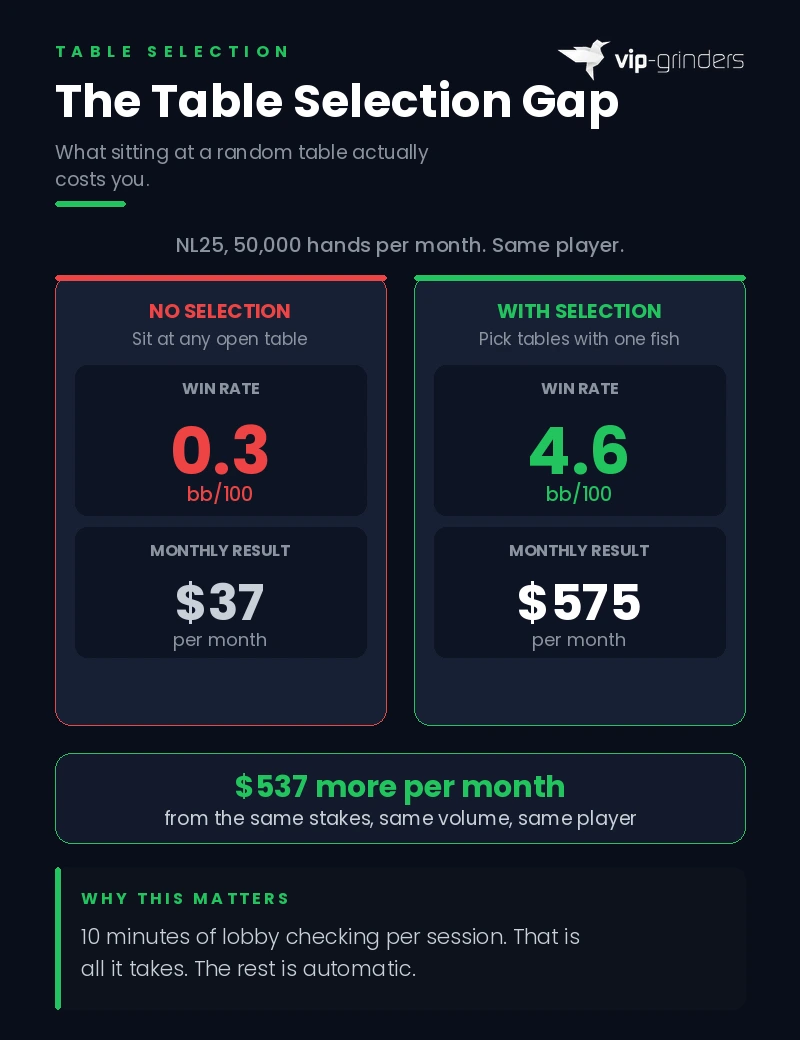
- No fish at the table: regulars averaged 0.3 bb/100. Barely breaking even after rake.
- One fish at the table: regulars jumped to 4.6 bb/100. That single weak player added over 4 bb/100 to everyone else's results.
- Two or three fish at the table: regulars reached 7.7 bb/100. Nearly 26x the win rate of a table with no weak players.
A “fish” in this study was defined as any player with a VPIP above 50%. VPIP stands for Voluntarily Put money In Pot: it measures the percentage of hands a player chooses to play. A VPIP of 50% or higher means someone is playing half or more of all hands dealt to them, which is far too loose to be profitable.
The Seat That Doubles Your Win Rate
The same Sabanin study measured how your position relative to the fish changes your results. Sitting to the left of a 50%+ VPIP fish (meaning you act after them on every postflop street) produced 15 bb/100. Sitting to the right (acting before them) dropped to 6.6 bb/100.
That is a +8.4 bb/100 difference from one chair. Same player, same skill level, same table. The only variable was the seat.
What This Looks Like in Practice
Imagine you grind NL25 for 50,000 hands in a month. At a table full of regulars, your win rate is 0.3 bb/100. That translates to 150 big blinds of profit, or roughly $37 over the entire month.
Now picture the same 50,000 hands, but you spend 10 minutes each session checking lobby stats and picking tables with at least one fish. Your win rate jumps to 4.6 bb/100. That is 2,300 big blinds, or $575.
Same stakes, same volume, same player. The only thing that changed was where you sat.
How to Spot It
You open your poker client and sit at whatever table has a seat available. You have never filtered the lobby by “players per flop” or average pot size. If someone asked you how many recreational players were at your table last session, you would not be able to answer.
How to Fix It
Before joining any table, check the lobby stats. Look for tables with a “players per flop” percentage of 35% or higher and above-average pot sizes. Both signals suggest recreational players are in the game.
If your poker client supports player notes or colour tags, mark every fish you identify so your database compounds over thousands of sessions.
For the full breakdown of lobby filters, seat selection, and multi-site strategy, see our table selection guide. To understand fish behaviour patterns and which of their mistakes to target, see how to spot and exploit weak players.
Mistake #2: Playing Too Many Hands Preflop
This is the leak that every poker player starts with and many never fully fix. Playing too many hands feels natural because folding is boring and every hand looks like it could be a winner. But the math is brutal: every hand you play outside your optimal range costs you money, and those small losses add up across thousands of hands.
The cost ranges from 5 to 15+ bb/100 depending on how far above optimal your VPIP sits.
What the Data Shows
Nathan “BlackRain79” Williams analysed millions of hands from his PokerTracker database and published the results on blackrain79.com in October 2019. His findings on VPIP (the percentage of hands you voluntarily play) were specific.
- The biggest winners at 6-max tables clustered around a VPIP of 21 with a PFR of 18. PFR stands for Pre-Flop Raise: it measures how often you raise before the flop rather than just calling.
- At full ring (9-max) tables, winning players sat around VPIP 15 to 18.
- Players with a VPIP above 40 could not win consistently in either format, regardless of their postflop skill.
What This Looks Like in Practice
A player with a VPIP of 35 at a 6-max table (a table with six players instead of the standard nine) is playing roughly one out of every three hands dealt. That means they are opening or calling with hands like K7 offsuit from middle position, J5 suited from late position, and Q3 suited one seat before the button. Those hands look playable in the moment, but they consistently lose money postflop because they miss the board often and make weak pairs with bad kickers when they do connect.
Compare that to a player with a VPIP of 21. They are folding those marginal hands and waiting for spots where their starting cards give them a real edge. Over 30,000 hands at NL10, that difference can be worth $150 to $400 depending on how loose the weaker player runs.
The gap between “I sometimes play too many hands” (VPIP 28) and “I play way too many” (VPIP 40+) is the difference between a small leak and a bankroll killer.
How to Spot It
Open your tracking software and check your VPIP. If you play 6-max and your number is above 26, you are likely playing too many hands. If it is above 30, this is almost certainly your most expensive leak.
You can also check it by position: your VPIP from early positions like UTG and UTG+1 (the first and second seats to act preflop) should be significantly tighter than your VPIP from the button.
How to Fix It
Start with a baseline of 21/18 (VPIP/PFR) for 6-max games and adjust from there as you gain experience. The fastest way to tighten your preflop game is to study starting hand charts broken down by position. Our ranges guide includes 13×13 hand matrix visuals and explains how to build, read, and adjust your ranges based on table conditions.
Mistake #3: Ignoring Position
Position is the single biggest structural advantage in poker, and most players barely think about it. Where you sit relative to the dealer button determines how much information you have when you make your decision. Players in late position (closer to the button) act after most opponents, while players in early position act first and fly blind.
This advantage is worth 3 to 8 bb/100 depending on how badly you misplay it.
What the Data Shows
In a standard 6-max game, a player in early position (UTG) should open roughly 12% of hands. A player on the button should open roughly 40%. The button plays more than 3x as many hands as UTG, and the reason is purely informational: acting last on every postflop street lets you make better decisions with weaker holdings.
Volodymyr Sabanin’s Hand2Note analysis of top regulars (players with an EV win rate of 5 bb/100 or higher) found that their win rate from the cutoff (the seat directly before the button) averaged 29 bb/100. If your own cutoff win rate is significantly lower than that, position is costing you money.
What This Looks Like in Practice
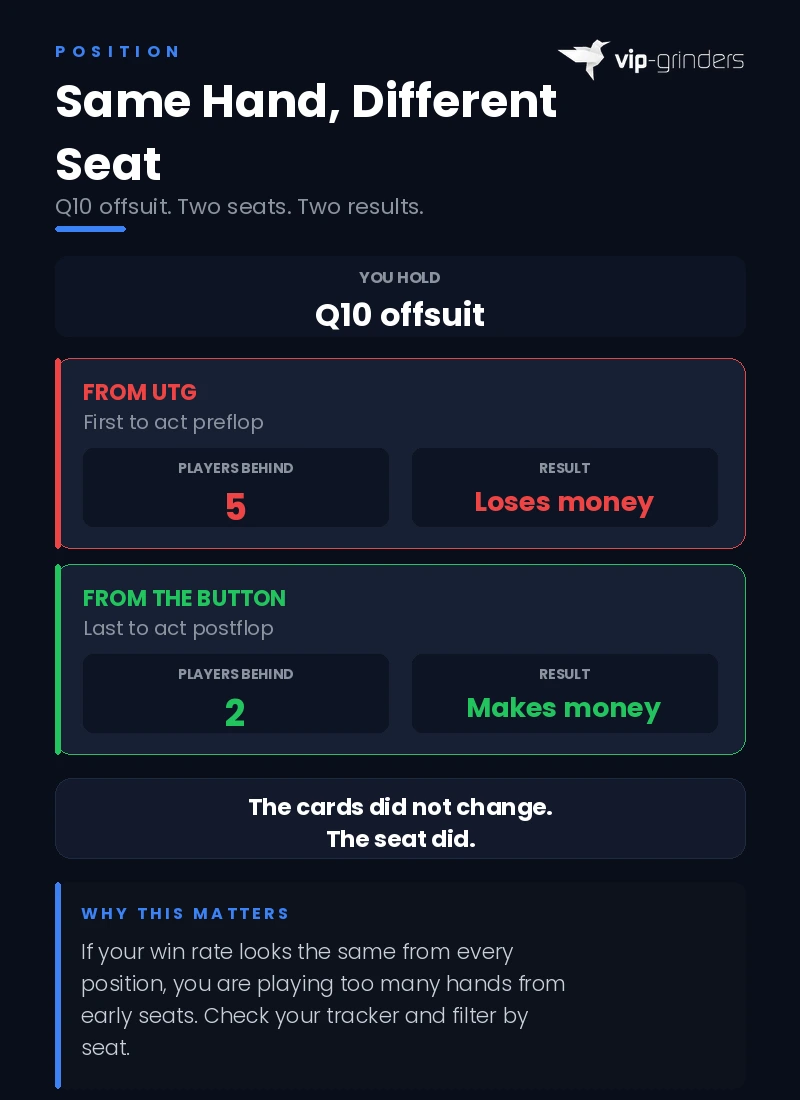
A player who ignores position opens the same hands from every seat, playing Q10 offsuit from UTG with the same confidence as from the button. From UTG, that hand faces five players still left to act, any of whom could hold a stronger hand and put them in a tough spot postflop. From the button, the same hand only needs to get past two players in the blinds and gets the advantage of acting last on every street.
The result: Q10 offsuit from UTG loses money over thousands of hands. The same hand from the button makes money. The cards did not change but the seat did.
How to Spot It
Check your tracking software and filter your win rate by position.
- Your win rate looks roughly the same from every seat instead of showing a clear pattern of losses from the blinds and profits from late position.
- Your cutoff and button results are not dramatically higher than your early position numbers.
- You have never checked which position makes you the most money and which one costs you the most.
How to Fix It
Tighten your range significantly from early positions and widen it from late positions. As a starting point, open roughly 12% to 15% of hands from UTG and 35% to 45% from the button. Our position guide includes full 6-max and 9-max seat maps with recommended opening ranges for every spot at the table.
Mistake #4: Ignoring Rake
Rake is the fee the poker room takes from every pot or tournament entry, and it comes directly out of your winnings. Most players know rake exists but never calculate how much it actually costs them. That blind spot turns marginal winners into net losers without them ever realising what happened.
The cost at micro and low stakes online is 5 to 12 bb/100. At live tables, the damage is just as real.
What the Data Shows
The numbers vary by stake and format, but every source tells the same story: rake is the biggest silent cost in poker.
- Online micro stakes (NL2 to NL10): players pay 8 to 12 bb/100 in rake on average. At NL25 to NL50, that drops to 6 to 8 bb/100. At NL100 and above, it falls below 4 bb/100.
- Online mid stakes (NL100 6-max): Tom ‘Tombos21’ Boshoff’s analysis on r/Poker_Theory (covered by GipsyTeam in December 2025) found that each player at an NL100 6-max table loses an average of 7.3 bb/100 to the house.
- Live $1/$2: Steve Selbrede’s PokerNews study (February 2019) tracked nearly 1,000 hands across four Las Vegas card rooms and found the average player loses 5 big blinds per hour purely to rake. At $2/$5, that figure was 2.8 BB per hour.
To put this in perspective: a player beating NL10 at 4 bb/100 before rake is actually losing money if their room charges 10 bb/100 in rake. Their real win rate is minus 6 bb/100. They feel like a winner but the numbers say otherwise.
What This Looks Like in Practice
A NL25 grinder plays 40,000 hands in a month at a room charging 8 bb/100 in rake. That is 3,200 big blinds going to the house, which equals $800. If the player’s win rate before rake is 5 bb/100 (a solid result), they earn 2,000 big blinds or $500, leaving them down $300 for the month despite playing well.
The same player at a room with 6 bb/100 rake pays $600 instead of $800. That $200 difference is the same as improving their actual poker skill by 2 bb/100, except it takes zero study time.
How to Spot It
You have never looked up your poker room’s rake structure. You do not know the rake cap at your usual stakes. You have never compared your room’s rake to other sites where you could be playing.
How to Fix It
Start by checking your room’s rake page and calculating your approximate rake in bb/100 at your usual stake. Then compare it to at least two other rooms that spread your format. Our rake explained guide breaks down every major rake structure, cap, and calculation method so you can see exactly what you are paying.
Mistake #5: Playing Without a Rakeback Deal
Mistake #4 showed you how much rake costs. This mistake is about not recovering any of it. Rakeback is a percentage of the rake you generate that gets paid back to you, usually weekly or monthly, because poker rooms share revenue with affiliates who pass it on to players.
If you registered directly at your poker room without using an affiliate code, you are leaving 2 to 4 bb/100 on the table.
What the Data Shows
The math connects directly to the rake numbers from Mistake #4. Take a standard NL50 grinder playing 50,000 hands per month at a room charging 7 bb/100 in rake. That is 3,500 big blinds going to the house, or $1,750 per month.
- With no rakeback deal: all $1,750 goes to the room. Your win rate after rake is whatever you earn at the table minus the full 7 bb/100.
- With a 30% rakeback deal: you recover $525 per month (30% of $1,750). That is 2.1 bb/100 added back to your effective win rate.
- Over a full year: that 30% deal returns $6,300. A 35% deal returns $7,350. The only requirement is signing up through the right link.
What This Looks Like in Practice
Consider a player with a pre-rake win rate of 6 bb/100 at NL50. After 7 bb/100 in rake, their net result is minus 1 bb/100, which means a strong player is losing money. Over 50,000 hands, that is a $250 loss.
Now add a 30% rakeback deal. They recover 2.1 bb/100, pushing their effective win rate to plus 1.1 bb/100. The same 50,000 hands now produce a $275 profit instead of a $250 loss.
Rakeback turned a losing month into a winning one without changing a single decision at the table.
How to Spot It
You signed up at your poker room by going directly to their website. You have never entered an affiliate or invitation code during registration. If you check your room’s cashier or rewards page and see no rakeback percentage or VIP cashback listed, you almost certainly do not have a deal.
How to Fix It
If you already have an account without a deal, some rooms allow you to add an affiliate code after registration. Contact the room’s support or reach out to the affiliate directly to check. For new accounts, always sign up through a tracked link before making your first deposit.
Our rakeback and strategy guide explains how rakeback should influence your bankroll management, format choice, and volume targets. For a full list of tracked sign-up codes with the best available percentages at every major room, see our exclusive rakeback deals.
Mistake #6: No Bankroll Management
Bankroll management (BRM) is the practice of only playing stakes your poker bankroll can support through normal losing stretches. Your bankroll is the total amount of money you have set aside exclusively for poker. A “buy-in” is the amount you bring to a single cash game session or pay to enter a tournament, typically 100 big blinds at a cash table.
This mistake does not cost you a few bb/100. It costs you your entire bankroll and forces you to reload or drop stakes.
Why It Matters
Even strong players go on brutal losing runs. A solid cash game regular beating NL50 at 5 bb/100 can still lose 15 to 20 buy-ins in a single week without making a single strategic error. That is normal variance, and the question is whether your bankroll can absorb it.
If you sit down at NL50 with a total bankroll of $500 (10 buy-ins), one standard downswing wipes you out. If you have $2,500 (50 buy-ins), the same downswing is uncomfortable but survivable. The math does not care how good you are: it only cares whether you have enough buy-ins to stay in the game.
Bankroll management is not about how well you play. It is about staying in the game long enough for your edge to show.
What This Looks Like in Practice
A player deposits $200, starts playing NL25 ($25 buy-in), and runs it up to $600 over a good week. They feel confident and move to NL50. After three losing sessions totalling 12 buy-ins ($600), they are back to zero.
They had no plan for when to move up, no rule for when to move back down, and no separation between poker money and spending money.
A player with proper BRM would need 30 buy-ins ($1,500) before attempting NL50 and would drop back to NL25 if their roll fell below 25 buy-ins. That structure turns the same downswing from a career-ending disaster into a temporary setback.
How to Spot It
- You play stakes where one bad session puts your entire bankroll at risk.
- You move up after a winning streak and move down only after going broke.
- You withdraw after every winning session, keeping your roll permanently small.
How to Fix It
Set a minimum buy-in count for every format you play and never sit at a stake where your bankroll falls below that number. Our bankroll management guide includes recommended buy-in tables for cash games, MTTs, SNGs, and Spins by stake level. The poker bankroll calculator lets you input your current roll, win rate, and format to see exactly which stakes you can sustain.
Mistake #7: Calling Without Pot Odds
Pot odds compare the price of your call to the size of the pot you can win. They tell you the minimum percentage of the time your hand needs to win for the call to be profitable. If your equity beats that threshold you call; if it does not, you fold.
Most players at low stakes call based on hope rather than math, and it costs them 2 to 5 bb/100.
How Pot Odds Work (Short Version)
The calculation is simple: divide the amount you need to call by the total pot after your call goes in. If your opponent bets $50 into a $100 pot, the total pot after you call is $200 ($100 pot + $50 bet + your $50 call). Your pot odds are $50 / $200 = 25%, meaning you need to win at least 25% of the time.
To estimate how often your hand wins, count your outs (cards left in the deck that complete your draw) and multiply by 2 on the turn or by 4 on the flop. This is called the Rule of 4 and 2. A flush draw has 9 outs: 9 × 4 = 36% equity on the flop, or 9 × 2 = 18% on the turn.
What This Looks Like in Practice
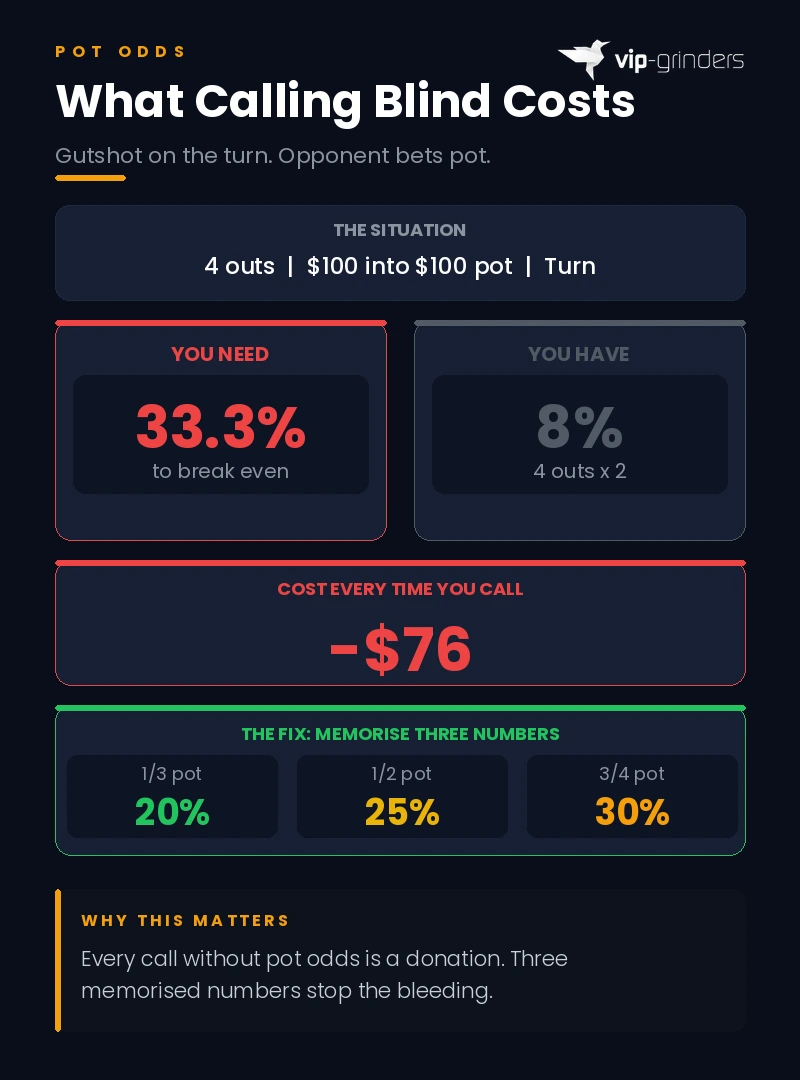
You hold a gutshot straight draw on the turn with 4 outs. Your opponent bets $100 into a $100 pot. The total pot after your call would be $300, so you need $100 / $300 = 33.3% equity to break even.
Your equity with 4 outs on the turn: 4 × 2 = 8%. You are nowhere close to the 33.3% threshold. Every time you make this call you lose an average of $76, and over hundreds of similar spots those losing calls add up fast.
Compare that to the same bet but with a flush draw (9 outs). Your equity on the turn is 9 × 2 = 18%, which is still below 33.3%, so folding is correct against a pot-sized bet on the turn. Many players call here because “I might hit my flush,” but the math says they need the pot to be much bigger or the bet to be much smaller.
How to Spot It
- You call bets because your hand might improve without ever counting outs or comparing them to the price.
- You chase draws against large bets and feel surprised when the math says your calls are losing money.
- You have never memorised the three most common equity thresholds: 20% for a third-pot bet, 25% for a half-pot bet, and 30% for a three-quarter-pot bet.
How to Fix It
Memorise those three thresholds and you will make correct calling decisions in most spots without doing any math at the table. For the full calculation method, reference tables, and worked examples across preflop, flop, and river, see our pot odds guide. You can also run specific hands through our free pot odds calculator during post-session review to train your intuition.
When the pot odds say fold but you expect to win extra money on future streets if you hit, that is where implied odds come in. They can sometimes justify a call that raw pot odds do not support, especially with deep stacks and concealed draws.
Mistake #8: Letting Tilt Go Unchecked
Tilt is any emotional state that causes you to deviate from your best strategy. Most players think of tilt as rage after a bad beat, but it also includes frustration from running cold, anxiety about a downswing, and overconfidence after a big win. All of these shift your decisions away from logic and toward impulse.
The cost ranges from 0.5 to 9 bb/100 depending on severity and how long it goes unaddressed.
What the Data Shows
Jared Tendler, the most widely cited mental game coach in poker, estimated in a 2011 PokerStrategy.com Q&A session that tilt costs the average player between 0.5 and 2 bb/100 depending on format. For heads-up players, the figure runs higher because every decision is magnified.
The upside of fixing tilt is just as striking. Tendler’s coaching case with player Liz “RikJamesB1atch” Herrera (documented in his book The Mental Game of Poker) showed her win rate climbing from 3 bb/100 to nearly 12 bb/100 over a million hands at stakes up to $50/$100. The primary area of improvement was her mental game, not her technical strategy.
That is a 9 bb/100 swing from one area of work.
What This Looks Like in Practice
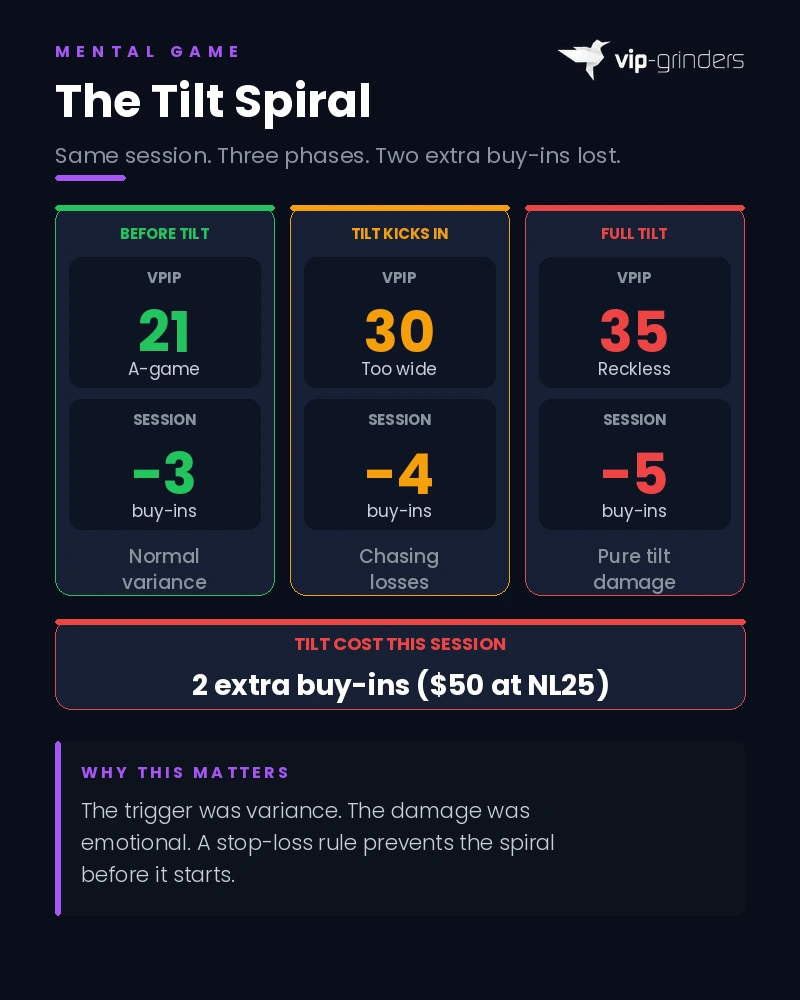
A player grinds NL25 with a normal VPIP of 21. After losing three buy-ins in 45 minutes to bad runouts, their frustration builds. They stop folding marginal hands. Their VPIP creeps to 30, then 35. They start calling 3-bets (re-raises before the flop) with weak holdings because folding feels like giving up.
Over the next hour they lose two more buy-ins, not from bad luck but from bad decisions driven by emotion. Their session result goes from minus 3 buy-ins (normal variance) to minus 5 buy-ins (variance plus tilt). Those extra 2 buy-ins are pure tilt damage, and they happen every time the player does not recognise the trigger and stop.
How to Spot It
- You play longer sessions after losing because you want to win it back.
- You move up stakes after a bad session or find yourself angry at specific opponents.
- Your VPIP or aggression stats spike noticeably in the second half of losing sessions compared to the first half.
How to Fix It
Tendler identifies seven types of tilt: entitlement, injustice, hate-losing, mistake, running-bad, desperation, and revenge. Each type has a different trigger and a different fix. Knowing which one affects you most is the first step toward controlling it.
Our mental game guide covers all seven types with prevention techniques, session planning strategies, and a process for building emotional control over time. When tilt spills into how you treat opponents and dealers, it becomes an etiquette problem that damages both your reputation and your table’s profitability.
Mistake #9: Thinking in Hands, Not Ranges
A range is the full set of hands a player could hold in a given situation. When you face a bet and ask “does my opponent have Ace King?”, you are thinking in single hands. When you ask “what hands would my opponent play this way, and how many combinations of each are there?”, you are thinking in ranges.
Single-hand thinking leads to guesswork. Range thinking leads to math. The difference is worth 2 to 4 bb/100.
Why Ranges Matter
A “combo” is one specific combination of two cards. Ace King offsuit (AKo) has 12 possible combos because there are four Aces and four Kings, and each Ace can pair with three Kings of a different suit. Ace King suited (AKs) has only 4 combos, so a player who thinks of “AK” as one hand is treating 16 different combos as a single entity, which makes it impossible to estimate how likely their opponent is to hold it.
This matters most on the river when you have to decide whether to call or fold against a big bet. If you think “he might have a set,” that sounds scary, but counting reveals there might only be 3 possible set combos while 15 or more combos of missed draws could be bluffs. Range thinking tells you to call; single-hand thinking tells you to fold.
What This Looks Like in Practice
The board reads K♠ 9♥ 5♦ 2♣ 7♠ and your opponent has bet every street and now shoves the river. You hold K♦ Q♥ (top pair, strong kicker) and your first instinct is “they must have a set or two pair,” but how many combos actually exist? Pocket 9s, 5s, and 2s give 9 total set combos, and K9, K5, and K2 add a handful of two-pair combos.
Now count the hands that missed: flush draws that bricked, straight draws that never got there, and overcards that tried to bluff you off the pot. If those missed combos outnumber the value hands, calling is correct regardless of how scary the shove feels.
How to Spot It
- You think in terms of one specific hand your opponent might hold rather than assigning them a full range.
- You fold strong hands because one scary possibility crosses your mind.
- You never count how many combos of bluffs your opponent could hold in a given spot.
How to Fix It
Start by practising combo counting away from the table. Pick a board, assign your opponent a plausible range, and count the combos of value hands versus bluffs. The poker equity calculator lets you plug in specific ranges and see exactly how your hand performs against them, and over time this process becomes intuitive.
Mistake #10: Not Tracking Results
This mistake does not have a bb/100 cost of its own. It is worse than that: it makes every other mistake on this list invisible. Without tracking software, you cannot check your VPIP, filter your win rate by position, or measure your rake cost, so you end up fixing leaks based on feel instead of data.
If you have read this far and recognised yourself in any of the previous nine mistakes, tracking is how you confirm which ones are actually costing you money.
Why It Matters
Every diagnostic in this guide depends on having a hand history database. The VPIP check from Mistake #2 and the position filter from Mistake #3 both require a tracker. The rake calculation from Mistake #4, the tilt detection from Mistake #8, and the combo counting from Mistake #9 all become guesswork without recorded data.
There is also a subtler problem: without tracking, you cannot tell the difference between a genuine leak and normal variance. A player who loses 10 buy-ins over 15,000 hands might be playing terribly or might be running below expectation in a perfectly normal way. Only a database combined with a variance simulator can answer that question.
What This Looks Like in Practice
A player grinds NL25 for three months and feels like they are roughly breaking even. They have no tracking software, so they judge their results by their account balance. Some weeks are up, some weeks are down, and the overall trend is unclear.
If they installed PokerTracker or Hand2Note and reviewed those same three months, they might discover their VPIP is 31 (Mistake #2), their UTG win rate is minus 15 bb/100 (Mistake #3), and their river call efficiency is terrible (Mistake #7). Three specific, fixable leaks that were completely invisible without data.
How to Spot It
- You do not know your win rate in bb/100 over any meaningful sample.
- You cannot name your three most profitable and three least profitable situations.
- You judge sessions by whether you finished up or down rather than by whether you made correct decisions.
How to Fix It
Install PokerTracker 4, Hold’em Manager 3, or Hand2Note. All three offer free trials and import your hand histories automatically from most major poker rooms. Even on sites that ban HUD overlays during play, you can still use these tools to review your hands after each session, which is where most of the study value comes from.
Log at least 10,000 hands before drawing conclusions about your leaks. Anything less and variance will distort the picture. Our variance guide explains why sample size matters, and the poker variance simulator lets you plug in your win rate to see the full range of possible outcomes.
Mistake #11: Misusing Aggression
Aggression is the engine of winning poker. Betting and raising forces opponents to make difficult decisions and builds pots when you are ahead. But aggression only works in the right spots: misusing it means either bluffing players who never fold or failing to bet for value when you have the best hand.
Both sides of this leak cost 2 to 5 bb/100.
Bluffing the Wrong Opponents
A bluff is only profitable if your opponent folds often enough to cover the times they call and you lose. If you bet $50 into a $100 pot, your opponent needs to fold at least 33.3% of the time for the bluff to break even. Against an aggressive regular who folds 60% of the time in that spot, your bluff prints money.
Against a calling station who folds 5% of the time, the same $50 bluff loses you an average of $42.50 per attempt. Run that 50 times over a month and you have burned over $2,000 on bluffs that never had a chance. Calling stations are value targets, not bluff targets.
Missing Value When Ahead
The opposite mistake is equally expensive but less visible: you hold top pair with a strong kicker on the river. The board is dry and your opponent has been calling every street, but instead of betting for value you check because “they might have hit something.” Your opponent checks back with second pair and you win the pot, but you left $30 to $50 on the table.
Do that three or four times per session across hundreds of sessions and the lost value adds up to thousands of dollars per year. Every bet your opponent would have called that you did not make is money you chose not to collect.
How to Spot It
- Your bluffs get called more often than they work, but you keep firing them into the same opponents.
- You recognise that certain players never fold but continue bluffing them instead of switching to value bets.
- You frequently check back strong hands on the river and win at showdown without extracting a final bet.
How to Fix It
For the bluffing side, learn the break-even fold percentages for common bet sizes and start matching your bluff targets to opponents who actually fold. Our bluffing guide covers the math, the four highest-EV bluff spots, and the five most common mistakes.
For the value side, default to betting the river with any hand you expect to beat more than half of your opponent’s calling range. Our value betting guide explains thin value, how to size for maximum extraction, and when checking back is genuinely correct.
Mistake #12: Auto-Piloting Postflop Decisions
Auto-piloting means making the same play in the same spot every time without adjusting for the board, the opponent, or the situation. It is the default mode for players who multi-table too many games, play while distracted, or simply have not studied postflop strategy in detail. The decisions feel automatic because they are: the player is running a script instead of thinking.
This leak costs 2 to 4 bb/100 and shows up most clearly in two areas: continuation betting and bet sizing.
Continuation Betting on Autopilot
A continuation bet (c-bet) is a bet made on the flop by the player who raised before the flop. It is one of the most common postflop actions in poker. The problem is that many players c-bet every flop regardless of the board texture or their opponent’s tendencies.
On a dry board like K♠ 7♦ 2♣, c-betting with most of your range makes sense because few draws exist and your opponent will miss often. On a wet board like 8♠ 9♠ 7♥, c-betting with weak hands is often a mistake because your opponent connects with this board far more often and your bluffs get called or raised.
A player who c-bets 80% to 90% of flops is giving away money on the boards where checking is correct. A player who never c-bets is giving up free value on the boards where a bet would get called by worse hands.
Using One Bet Size for Everything
The second auto-pilot pattern is always using the same bet size. A player who bets half pot on every street in every situation is ignoring the fact that different boards, different opponent types, and different hand strengths all call for different sizing.
A small bet (25% to 33% pot) works well on dry boards for thin value and cheap bluffs. A large bet (66% to 100% pot) works better on wet boards where you need to charge draws and protect your equity. Using one size for both situations means you are either overbetting dry boards (getting folds when you want calls) or underbetting wet boards (giving opponents correct odds to chase).
How to Spot It
- Your c-bet percentage is the same regardless of whether the board is dry or wet.
- You use the same bet size on every street in every situation without adjusting for the board or your opponent.
- You find yourself clicking the bet button without considering what your opponent's range looks like on this specific board.
How to Fix It
Start by separating boards into two categories: dry (few draws, unconnected cards) and wet (flush draws, straight draws, connected cards). On dry boards, bet smaller and more often. On wet boards, bet larger but more selectively.
Our continuation betting guide covers when to c-bet and when to check based on board texture, range advantage, and opponent type. The bet sizing guide explains how to choose the right size street by street for both value and bluffs.
Conclusion: Fix One Leak at a Time
Every mistake on this list has a specific cost and a specific fix. The worst thing you can do is try to fix all 12 at once. Pick the one that costs you the most, work on it until the numbers in your tracking software confirm it is fixed, then move to the next one.
For most players at low and mid stakes, that starting point is Mistake #1 (table selection) or Mistake #2 (playing too many hands). Those two leaks affect every single session and carry the highest bb/100 cost on the list.
If you are not sure where to begin by format, these three guides will point you in the right direction:
- Cash game players: our cash game strategy guide covers stake-specific adjustments, session structure, and the most common leaks by level.
- MTT players: our tournament strategy guide walks through every stage from registration to final table, including stage-by-stage adjustments and payout structure math.
- Spin players: our Spin & Go strategy guide covers push/fold charts, bankroll rules for high-variance formats, and strategy adjustments for three-handed play.
Frequently Asked Questions
What is the most common mistake in poker?
The most common mistake is playing too many hands preflop. Data from Nathan “BlackRain79” Williams’ PokerTracker database shows that the biggest 6-max winners cluster around a VPIP of 21, while players above 40 cannot win consistently regardless of their postflop ability.
What are poker leaks?
A poker leak is any recurring mistake that costs you money over time. Leaks can be strategic (calling without pot odds), structural (ignoring position or rake), mental (tilt), or operational (not tracking results). Every player has them, and the goal is to identify and fix the most expensive ones first.
How do I find my biggest poker leak?
Install tracking software like PokerTracker 4 or Hand2Note, log at least 10,000 hands, and filter your results by position and action type. The spot with the worst bb/100 number is your most expensive leak. Common starting points include checking your VPIP, your positional win rates, and your river call efficiency.
What does bb/100 mean in poker?
bb/100 stands for big blinds per 100 hands and is the standard measurement for poker win rates. A player winning 5 bb/100 earns an average of 5 big blinds for every 100 hands played. At NL25, where the big blind is $0.25, that equals $1.25 per 100 hands.
How much does tilt cost in poker?
Mental game coach Jared Tendler estimates tilt costs the average player between 0.5 and 2 bb/100. In severe cases, the damage can reach 9 bb/100 or more. Tendler’s coaching case with player Liz Herrera showed a win rate improvement from 3 bb/100 to nearly 12 bb/100 after focused mental game work.
Is playing too many hands really that expensive?
Yes. Hand2Note database data shows that players with a VPIP of 50 to 60% lose at minus 42 bb/100, and players above 70% VPIP lose at minus 73 bb/100. Even a moderate excess (VPIP of 30 instead of 21 at 6-max) can cost 3 to 8 bb/100 over a large sample.
Do these mistakes apply to tournaments or just cash games?
All 12 mistakes apply across formats. Table selection, hand selection, position, tilt, and tracking matter in cash games, MTTs, SNGs, and Spins. The specific numbers may shift (for example, bankroll requirements are higher for tournaments due to greater variance), but the underlying concepts are the same.
What tracking software should I use to find my leaks?
The three most widely used options are PokerTracker 4, Hold’em Manager 3, and Hand2Note. All three import hand histories automatically, provide detailed filters by position, action type, and opponent, and offer free trials. Even on sites that ban HUD overlays, you can still use these tools for post-session review.