

MTT Strategy: Tournament Poker from Registration to Final Table 2026
Tournament poker is the only format where your chip stack changes value on every hand. A 50 big blind stack at the start of an MTT plays nothing like a 50 big blind stack on the bubble. Stack depth, payout structure, and rising blinds shape every decision, which is why MTT strategy requires its own playbook.

This guide walks through the full tournament arc from the first hand to the final table, built for standard freezeout and re-entry MTTs. Separate guides cover bounty formats, Sit & Gos, and Spins.
Here is what this guide covers:
- How to read a structure sheet and pick the right MTT for your edge
- Stage-by-stage strategy from early levels (100bb+) through middle stage stealing to short-stack shove/fold
- Bubble, ITM, and final table adjustments with ICM pressure at each phase
- MTT bankroll rules by field size and common mistakes that kill ROI
What Makes MTTs Different from Cash Games and SNGs
Every strategic decision in a multi-table tournament traces back to three facts that do not apply in cash games: your stack is shrinking in real terms as blinds rise, the chips you hold are worth less than their face value because of the payout structure, and once you bust (or use your last re-entry) the session is over. Miss any of these and you will play MTTs like a cash game with a timer, which is the single most expensive mistake recreational tournament players make.
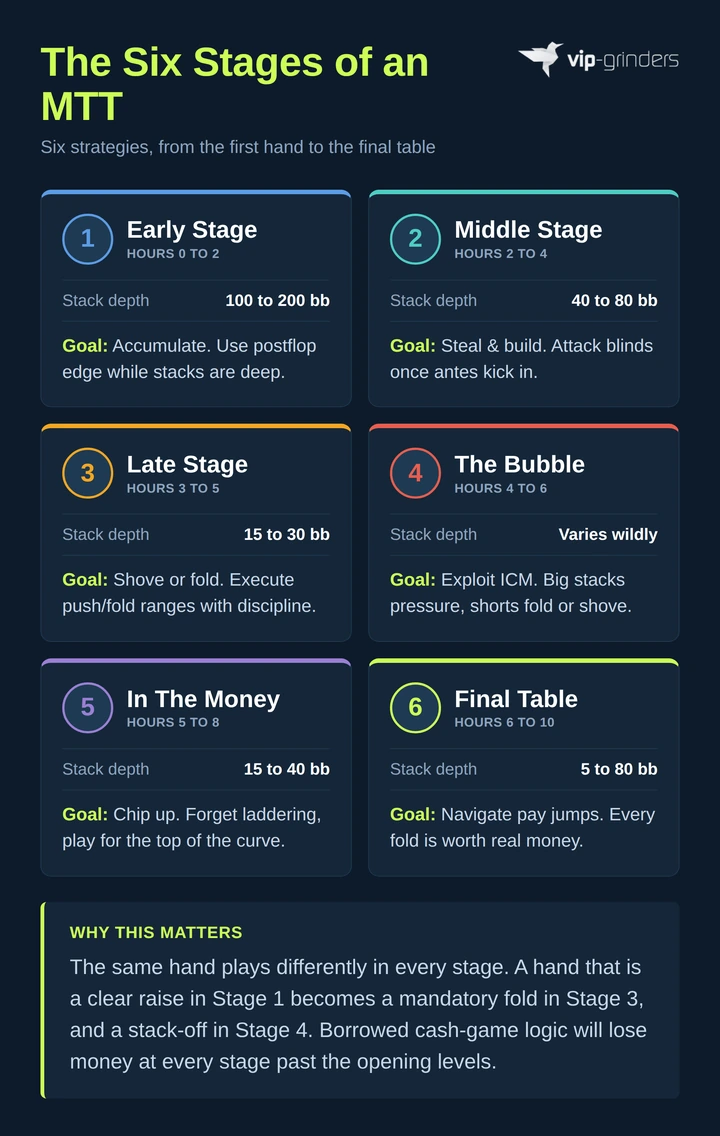
The shrinking-stack dynamic is the easiest to see. You start a typical MTT with 100 to 200 big blinds and enough room for standard postflop play, but within three to four hours survivors are sitting on 15 to 40 big blinds where most decisions are preflop. The same hand that was a routine 3-bet in level 2 becomes a stack-off at level 12.
The payout structure is the harder concept. Unlike a cash game where every chip is worth exactly one dollar, MTT chips do not convert linearly to prize money, because the money jumps at the top of the payout ladder distort chip value. This is what the Independent Chip Model measures, and it is why folding hands you would stack off with in a cash game is often correct deep in an MTT.
The table below shows how these differences play out across the three most common online formats. MTTs sit in the middle on stack depth but dominate on variance and complexity, which is why they require their own approach rather than borrowed cash-game habits.
| Factor | MTT | Cash Game | Sit & Go / Spin |
|---|---|---|---|
| Starting stack | 100 to 200bb | 100bb (you reload) | 25 to 50bb |
| Stack depth over time | Shrinks to 15 to 40bb | Stays at 100bb+ | Reaches shove-or-fold in minutes |
| Chip value | Non-linear (ICM applies) | 1 chip = real money | Non-linear near payout jumps |
| Session length | 3 to 10+ hours | You decide when to stop | 5 to 45 minutes |
| Re-entry option | Sometimes (freezeout or re-entry) | Always (reload anytime) | Buy another game |
| Primary skill | Stage-by-stage adjustments, ICM | Postflop depth, table selection | Push/fold accuracy |
| Variance | Extreme (top-heavy payouts) | Moderate (steady win rate) | Very high (small samples) |
| Hours to break even on skill | 500+ tournaments | 50,000+ hands | 5,000+ games |
For the full MTTs vs Spins breakdown across variance, bankroll, and rakeback, see our MTTs vs Spin & Gos comparison.
Three practical implications come out of this comparison:
- MTT bankroll requirements are far higher than cash game requirements: variance is top-heavy, most of your return comes from rare deep runs, and the samples needed to measure real ROI are unforgiving.
- Postflop skill matters less than in cash: you spend most of the tournament at stack depths where decisions are preflop, so push/fold accuracy outweighs deep-stacked river play.
- Stage-by-stage adjustment is the single biggest edge: the ability to shift strategy as your stack and the tournament phase change separates breakeven MTT players from consistent winners.
The rest of this guide walks through how your strategy should shift at each stack depth and tournament phase, starting with the decision you make before the cards are even dealt: whether to register in the first place.
Reading a Tournament Structure Before You Register
Most MTT players click register without ever opening the structure sheet, and this is a mistake. The structure tells you how much play you will get for your buy-in, how fast blinds will force action, and whether the tournament suits your style and schedule. Two MTTs with identical buy-ins can play completely differently depending on starting stack, level length, and late registration rules.
The three numbers that matter most are starting stack in big blinds, blind level duration, and late registration window. Everything else (ante structure, payout percentages, field size estimates) builds on top of those three.
Starting Stack and Blind Levels
Starting stack is usually expressed in chips, but the number you actually care about is how many big blinds that represents at level 1. A 20,000 chip stack with 50/100 blinds is 200bb, while the same 20,000 chips with 100/200 blinds is only 100bb. Deeper starting stacks reward postflop skill and give stronger players more time to exploit weaker opponents.
Blind level duration sets the pace. A 12-minute level MTT plays nothing like a 30-minute level MTT, even if both start with the same stack. Shorter levels compress the strategic window and push the tournament toward push/fold sooner.
| Structure Type | Starting Stack | Level Duration | Avg Length | Best For |
|---|---|---|---|---|
| Deep stack | 200bb+ | 20 to 30 min | 8 to 12 hours | Strong postflop players who want maximum edge realization |
| Regular | 100 to 150bb | 10 to 15 min | 4 to 7 hours | Most online grinders, balanced skill vs time commitment |
| Turbo | 50 to 100bb | 5 to 8 min | 2 to 4 hours | Push/fold specialists, high-volume grinders, mass re-entry players |
| Hyper-turbo | 25 to 50bb | 2 to 4 min | 30 min to 2 hours | Shove-or-fold specialists, variance-tolerant players |
The practical question is not “which structure is best” but “which structure fits my edge.” A postflop-focused player is leaving money on the table in a hyper-turbo where 90% of decisions are preflop jams, and a high-volume grinder who wants to fire 15 MTTs in a session cannot play four deep stack events at once. Match the structure to your strengths and your schedule.
Late Registration Windows
Late reg is the period at the start of an MTT during which new players can still buy in. Online it typically runs for the first 60 to 120 minutes or until the end of a set level. Understanding the window matters for two reasons.
First, late registering changes your effective starting stack. If you join a 200bb-start tournament two hours in, you are likely sitting down with 40 to 60bb while the leaders have 150bb+. Your strategy needs to be ready for that from hand one.
Second, late reg decisions are often misunderstood. Registering in the final 10 minutes of a 2-hour window when you would arrive with 25bb is rarely +EV unless the field is extraordinarily soft. The math on when late reg actually makes sense gets its own breakdown in our upcoming late registration guide, but the short version is this: the later you register, the softer the field needs to be to justify the smaller effective stack.
Freezeout vs Re-Entry vs Rebuy
The final structural variable is how many bullets you can fire. A freezeout gives you one life: bust and you are done. Re-entry tournaments let you buy back in during the late reg period with a fresh starting stack, and rebuy events let you add chips at specific intervals (usually when you drop below the starting stack).
Each format shifts early stage strategy. In freezeouts, protecting your stack carries real value because you cannot replace it, while in re-entry events early stage play can be looser because busting is not the end of your tournament. In rebuys, the math changes again because multiple bullets are expected and players who refuse to rebuy often leave equity on the table.
Structure dictates strategy before a single card is dealt. Pick tournaments that match your edge, check the late registration rules before you commit, and know going in whether you have one shot or several.
Early Stage Strategy: Playing Deep at 100bb+
The first few levels of an MTT are where most recreational players fold their way into trouble. They treat the early stage as a “wait for premiums” phase, burn 20% to 30% of their stack to blinds and antes, and then have to shove marginal hands in level 8 because they never built a cushion. The correct approach is the opposite: early levels are the only time you have enough chips to play real postflop poker, and that means using your edge while it still exists.
Why “Tight and Wait” Fails in MTTs
In a cash game, folding for an hour costs you nothing because the blinds do not increase. In an MTT, folding for an hour costs you a measurable percentage of your stack and lets rising blinds close the window for skilled play. The deeper you are, the more your postflop ability matters, and the deeper you are is the only time that ability gets tested.
Playing tight early also surrenders the table to aggressive opponents who are willing to build stacks. By level 4, those players have 150bb to 200bb while the nits are sitting on 80bb wondering how they got short without playing a hand. The goal of the early stage is not survival: it is accumulation while stacks are deep enough for your edge to matter.
Opening Ranges by Position When Deep
At 100bb+ your opening ranges should look similar to a 6-max cash game: tight from early position, widening as you get closer to the button, and opening even wider in the cutoff and button against passive blinds. The key difference from cash is that MTT early stage tables often contain recreational players who overcall, under-3-bet, and play badly postflop. That profile rewards opening wider for value, especially from late position.
Building correct ranges is its own discipline, and we cover the full process in our poker ranges guide. For early stage MTT play, three principles override everything else:
- Position matters more than card strength at this depth: a marginal hand in position against a weak player is more profitable than a medium pair out of position against a solid regular.
- 3-bet with a polarised range: mix value hands (QQ+, AK) with suited connectors and low suited Aces that play well postflop when called, rather than flatting everything and playing bloated multiway pots.
- Isolate limpers aggressively: if a recreational player open-limps, raise to 4x or 5x from late position with a wide range to get heads-up in position against a capped hand.
Re-entry format changes the math slightly. In re-entry events you can afford to take a few more coin-flip spots because busting does not end your tournament, and many strong regulars play the first bullet aggressively knowing they have a second in reserve. In freezeouts, the same hands play more cautiously because one bad stack-off ends your session.
Three Common Early Stage Mistakes
The leaks that cost the most EV in levels 1 to 4 are not the obvious ones. Bad beats and coolers happen to everyone. The mistakes that separate losing recreational players from winning regulars are almost always strategic, and almost always fixable in one session.
- Limping into pots instead of raising: limping surrenders initiative and invites multiway pots where your equity is harder to realize. If a hand is worth playing, it is worth raising.
- Playing too many hands out of position: calling 3-bets from the blinds or flatting raises from early position with speculative hands puts you in spots where even a correct decision often loses money against a competent opponent.
- Stacking off with one pair at 100bb+: top pair top kicker is a strong hand at 40bb, but at 150bb deep it is rarely worth your tournament life. Know when to pot control and fold to heavy action.
Fixing these three leaks alone will add meaningful EV to every tournament you play at this stack depth. The goal of early stage is not to double up on one big hand: it is to make 15 to 20 small +EV decisions that compound into a comfortable stack by the time antes kick in and the middle game begins.
Middle Stage Strategy: Antes, Stealing and Stack Building
The middle stage of an MTT begins when antes kick in, usually around level 5 or 6. This is the phase where most of your tournament equity is built or lost, because stacks are still deep enough to manoeuvre but every pot now contains extra dead money that changes the incentive structure on every hand. Players who fail to adjust their opening ranges and stealing frequency once antes appear leave enormous amounts of EV on the table.
How Antes Change Every Opening Range
Before antes, a standard pot contains only the small blind and big blind: 1.5bb of dead money. Once antes are in play at most online structures, every player at the table posts a small fraction of a big blind as a “big blind ante” (typically 1bb posted by the player in the big blind seat covering all players). This effectively adds another full big blind to the pot before any action, bringing dead money to 2.5bb.
That extra big blind is larger than it looks. Your open-raise is now risking less to win more, which mathematically widens every position’s profitable opening range. A button open that was marginal at 100bb without antes becomes clearly profitable once antes kick in.
Stealing Frequency by Position and Stack Depth
Stealing blinds is the engine of middle stage chip accumulation. Every uncontested pot you pick up adds 2.5bb to 3bb to your stack, and those pots compound fast. A player who successfully steals three extra hands per orbit at a 9-handed table gains roughly 8bb per orbit in dead money alone, which is enough to maintain stack depth even when your cards go cold.
The table below shows baseline stealing frequencies at the two most common middle-stage stack depths, assuming the blinds are playing a standard defending strategy. Widen further against tight players who overfold, and tighten up against loose defenders who call or 3-bet too much.
| Position | 60bb to 100bb | 40bb to 60bb | Notes |
|---|---|---|---|
| Cutoff | ~28% | ~32% | Widen against a passive button behind you |
| Button | ~45% | ~52% | The highest-EV position at any stack depth |
| Small Blind | ~32% | ~38% | Shift to a raise-or-fold strategy, avoid limping |
These percentages are baselines, not rules, and the real edge comes from reading the specific players in the blinds. A big blind who folds 70% of the time against steals is printing money for any player who opens 60% from the button, while a big blind who 3-bets 15% of the time forces you to tighten up and include more value hands in your opening range.
Open-Raise Sizing by Stack Depth
Sizing matters more in the middle stage than it does deep, because every chip you invest represents a larger percentage of your remaining stack. The correct size balances two goals: keeping the pot manageable when you are called, and giving yourself room to fold when you get 3-bet shoved on.
| Stack Depth | Standard Open | Why |
|---|---|---|
| 80bb+ | 2.2x to 2.5x | Small sizing is fine because you have room for postflop play and multiple streets of action |
| 50bb to 80bb | 2x to 2.2x | Reduce sizing to avoid committing too much preflop when you still need to see flops |
| 30bb to 50bb | 2x (min-raise) | Min-raising keeps you from pricing yourself in to call a 3-bet shove with marginal hands |
| Under 30bb | Shove or fold territory | Raise-fold lines become mathematically bad; covered in the next section |
The biggest sizing mistake at this stage is using the same 2.5x open at 40bb that worked at 100bb. A 2.5x open at 40bb commits 6.25% of your stack preflop, and if you get 3-bet shoved on for your remaining 38bb, you are often priced in to call with hands you never wanted to stack off. Reducing to a min-raise solves the problem without reducing the fold equity of your open by much.
3-Bet Adjustments as Stacks Shrink
The single most important 3-bet adjustment in an MTT is recognizing when stacks drop below the threshold where polarised 3-betting stops working. At 100bb deep, a 3-bet bluff with 54s is profitable because postflop playability compensates. At 50bb the same bluff loses money because there is not enough room behind, and below 30bb most 3-bets should simply be all-in because a non-shove 3-bet commits you to calling any 4-bet.
The transition from polarised to linear to all-in is one of the most commonly missed MTT adjustments. Regulars who never update their 3-bet range get exploited by opponents who notice they are always 3-betting for value below 60bb and start folding hands like AQ and JJ. For the complete breakdown including value-to-bluff ratios, sizing by stack depth, and position-by-position ranges, see our 3-bet ranges, sizing and bluff math guide.
Building the Stack You Need for the Bubble
Middle stage play is not just about surviving until the money: it is about building the stack you need to apply pressure when the bubble approaches. A player who reaches level 10 with 60bb has options, while a player who reaches level 10 with 25bb is already locked into survival mode and will miss most of the bubble-stage opportunities that deep stacks can exploit.
The practical target for most MTTs is to exit the middle stage with at least 35 to 40 big blinds, ideally more. Getting there requires consistent aggression, disciplined sizing, and the willingness to take marginal spots when position and opponent tendencies justify them. Tight passive play during antes is how you end up short with no fold equity exactly when you need it most.
Late Stage and Short Stack Play: When Math Takes Over
Somewhere between level 10 and level 14 in a typical online MTT, your stack crosses the threshold where standard raise-call-fold poker stops working. Below 25 big blinds, most decisions become binary: shove or fold. Below 15 big blinds, the decision tree collapses almost entirely to preflop math, and the difference between a winning MTT player and a losing one comes down to executing that math correctly under pressure.
The 20bb Threshold and Why It Matters
At 20bb, a standard 2x open commits 10% of your stack preflop. If you get 3-bet shoved on, you are often priced in to call with hands that have no business stacking off. This is the point where raise-fold lines start losing money, because the pot odds you give yourself when facing a reshove are too good to fold but your equity when called is too thin to profit.
The solution is to shift your entire preflop strategy. Below 20bb, most hands you want to play should go in preflop as open-shoves, resteals, or folds. Mixing in a few min-raises with your strongest hands (to induce action from opponents who read your min-raise as weakness) is fine, but the default assumption at this depth is: if the hand is not strong enough to go all-in, it is probably not strong enough to play.
Open-Shove Ranges from Late Position
The table below shows a simplified baseline for open-shoving from the button in a 6-handed MTT once you reach shove-or-fold territory. These ranges assume no ICM pressure, and they tighten significantly near the bubble or a final table pay jump. Cutoff ranges, ICM-adjusted shove charts, and the full push/fold math belong on our dedicated ICM and push/fold guide.
| Stack | Button Shove Range | Baseline Hands |
|---|---|---|
| 15bb | ~28% | 22+, A2s+, A7o+, K9s+, KTo+, Q9s+, QJo, J9s+, T9s |
| 10bb | ~48% | 22+, A2s+, A2o+, K2s+, K7o+, Q5s+, Q9o+, J7s+, J9o+, T7s+ |
Notice how wide the button range gets at 10bb. At this depth, the dead money in the blinds plus antes makes shoving hands like K7o and J9o clearly profitable even when called by a reasonable range. Folding these hands is one of the most common leaks at low and mid stakes MTTs, and fixing it alone adds measurable EV across thousands of tournaments.
Resteal Ranges: 15bb to 25bb
Restealing is the art of 3-bet shoving over someone else’s open-raise when your stack is too short to call and see a flop. Done correctly, it is one of the highest-EV plays in tournament poker because it combines fold equity (your opponent folds a lot) with live equity (your hand has decent showdown value when called).
Three conditions make a resteal profitable:
- The opener is raising a wide range: late position opens (cutoff, button, small blind) include many hands that cannot call a jam. Early position opens from a tight player are much harder to resteal against.
- Your stack has real fold equity: a 25bb resteal creates enough pressure to fold out hands like AJ and 99. A 40bb resteal only folds out the very bottom of the opener's range and usually loses money.
- The players behind you fold often: if there is a loose big blind who snap-calls every shove, your fold equity is reduced and the resteal loses value.
At 20bb, a standard resteal range from the big blind against a button open is roughly 88+, ATs+, AJo+, KQs, and occasionally suited Broadways as bluffs. That range tightens as your stack shrinks toward 15bb (because there is less fold equity at the margin) and widens as it climbs toward 25bb (because the reward for folding the opener out is larger relative to the risk).
Calling a Shove vs Shoving Yourself
One of the harder short-stack decisions is whether to call an all-in or wait for a better spot to shove yourself. The math rarely favors calling. Your fold equity when calling is zero, which means you need pure equity to overcome the pot odds, and in most 15bb to 25bb spots your opponent’s shoving range has enough equity against marginal calls to make them losing plays.
A simple rule of thumb: if you would not shove the hand yourself from that position, you should probably not call a shove with it either. Calling A10 offsuit against a button jam feels correct because “Ace-ten is a strong hand,” but against a typical shoving range of 40%+ from the button, A10o only has about 56% equity, and the pot odds usually require closer to 40% to 45% to break even. The small profit margin disappears as soon as you factor in the value of preserving your stack for a better spot.
Bubble Play: Where Tournaments Are Really Won
The bubble is the period just before the money begins, when a single elimination separates every remaining player from a cash prize. It is also where stack sizes reshape every decision, because short stacks tighten up to survive while big stacks can apply heavy pressure without risking their own tournament life. This asymmetry is what turns bubble play into the highest-leverage phase of an MTT for anyone with chips to spend, and the most expensive phase for anyone who played passively through the middle stage.
The stack-by-stack playbook, ICM-adjusted shove ranges, big stack exploitation frameworks, and short-stack survival math all get their own dedicated breakdown in our poker bubble strategy guide. What matters for the MTT arc is understanding that the bubble is where passive play gets punished hardest, and where the stack you built in the middle stage converts into real tournament equity.
In-the-Money Play and Pay Jump Navigation
The moment the bubble bursts, the dynamic at every table shifts. Short stacks who were folding everything to survive suddenly start shoving wide, medium stacks who were laddering for a min-cash now want to accumulate chips for a real run, and big stacks lose some of the leverage they had during the bubble because survival no longer carries the same weight. The shift happens fast, and players who keep running the bubble playbook lose chips to opponents who have already adjusted.
The strategic question in the money is no longer “how do I survive” but “where does the real equity live.” In most MTT payout structures, the top three or four places contain 50% to 70% of the total prize pool, with first place often paying 100x your buy-in compared to a min-cash return of 1.5x to 2x. This math is why accumulating chips to reach the final table adds far more equity than laddering one spot at a time from 500th to 200th.
Making that switch in practice is harder than it sounds. The adjustment window is short, typically the first orbit or two after the money. Watch for these three signals that the table dynamic has changed:
- Short stacks start jamming: players who folded everything on the bubble suddenly open-shove from any position.
- Medium stacks fight back: they stop avoiding confrontation and start re-shoving over your opens.
- Table VPIP jumps 10 to 15 points: the overall action level increases visibly within the first orbit.
When you see two of those three signals, stop stealing with marginal hands and tighten your opening ranges until the new equilibrium settles.
Final Table Strategy: Closing Out the Run
Reaching the final table is where all the work from the previous stages either pays off or slips away. The decisions from the first elimination to heads-up carry larger dollar consequences than every earlier phase combined, because pay jumps at this stage can increase your guaranteed payout by 30% to 100% per elimination.
The defining feature of final table play is that pay jumps dominate every decision. Unlike the middle of a tournament where chip accumulation is king, the final table rewards careful pay jump navigation: short stacks who survive outperform their raw chip equity, and big stacks must balance aggression against the cost of donating chips. This is where ICM pressure reaches its peak and where the aggression that built your stack needs to recalibrate.
Heads-up dynamics, deal-making math, ICM-adjusted calling ranges, and hand-by-hand pay jump strategy get their own dedicated breakdown in our final table strategy guide. For the MTT arc, the takeaway is simple: the players who final-table consistently are the ones who know exactly when to slow down and when to press.
MTT Bankroll and Variance Reality
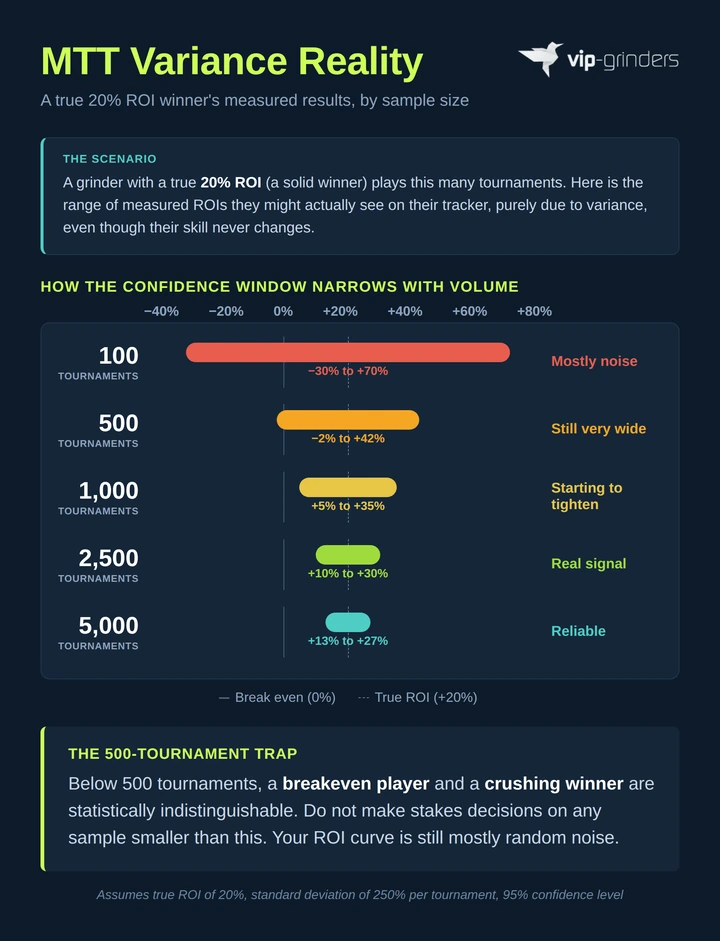
MTTs have the highest variance of any mainstream poker format. A solid winning player can go 100+ tournaments without cashing, lose half their bankroll over a “normal” downswing, and still be playing optimal poker the entire time. We cover the full math in our poker variance guide, but three MTT-specific facts matter most:
- 100+ tournament cashless streaks are normal: a player who cashes 15% of the time will still experience stretches of 100 or more tournaments without a cash over a grinding career. This is not a sign of a leak. It is math.
- 150-buy-in downswings happen to winning players: even at a solid 20% ROI, downswings of 150 buy-ins or more appear regularly over a yearly sample. Plan your bankroll around this reality, not around your best week.
- You need 500+ tournaments before your ROI means anything: below that sample, your results are dominated by variance. Judging your game on a 50-tournament sample is the fastest way to tilt yourself into a bad decision.
MTT Bankroll Rules by Field Size
Because MTT variance scales with field size, your bankroll requirement should too. The standard guideline below covers most online grinders, but the right number depends on your ROI, your field preferences, and whether poker is your primary income.
| Field Size | Conservative Bankroll | Standard Bankroll | Aggressive Bankroll |
|---|---|---|---|
| Small field (under 500 runners) | 200 buy-ins | 150 buy-ins | 100 buy-ins |
| Medium field (500 to 2,000) | 300 buy-ins | 200 buy-ins | 150 buy-ins |
| Large field (2,000 to 5,000) | 400 buy-ins | 300 buy-ins | 200 buy-ins |
| Mega field (5,000+) | 500+ buy-ins | 400 buy-ins | 300 buy-ins |
Our poker bankroll management guide covers the full system including mixed-format bankrolls and shot-taking rules. Build your bankroll around the largest field sizes you regularly play, not the smallest.
For grinders who cannot self-fund these requirements, poker staking is the standard alternative. Use our free MTT variance calculator to model your own downswing projections before setting your bankroll target.
For overlay hunting, room rotation, and building your weekly schedule around the softest fields, see our MTT overlay guide.
Five MTT Mistakes That Kill Your ROI
Every MTT grinder makes mistakes. The ones that separate losing players from winning ones are rarely the flashy cooler hands or the bad beats that stick in memory: they are the small, repeated strategic errors that compound silently across hundreds of tournaments. The five below are the highest-cost MTT-specific leaks we see in the grinders we work with, and every one of them is fixable inside a single session once identified.
- 1Late-registering with no plan: registering in the final 10 minutes of a late reg window while sitting down with 20bb is rarely +EV unless the field is extraordinarily soft. Most grinders who late-reg heavily are actively leaking EV on tournaments they should have skipped entirely.
- 2Passive play on the bubble: folding into the money with a big or medium stack is the most expensive mistake in MTTs, because it surrenders the exact moment where aggression pays the most. The players who ladder into min-cashes season after season are bleeding out the real money at the top of the payout curve.
- 3Autopiloting push/fold without reading opponents: memorizing shove charts and then applying them against every opponent regardless of tendencies leaves massive EV on the table. A nit in the big blind lets you shove wider than baseline, and a maniac forces you to tighten up. Ignore the reads and you are playing every opponent like a solver.
- 4Overvaluing ICM at the wrong time: ICM pressure matters on the bubble and at the final table, but in the middle of the money where pay jumps are small and the field is still large, ICM-tight play just ladders you into mediocre finishes. Know when ICM actually applies and when chip accumulation is the correct goal.
- 5Playing without a tracked rakeback deal: the most expensive mistake on this list is the one that happens before your first hand. Signing up at a room without an affiliate code means receiving default rewards (often 10% to 15%) when tracked sign-ups lock in 25% to 50% at the same rooms. Across a grinding year, this single mistake costs more than every other leak on this list combined.
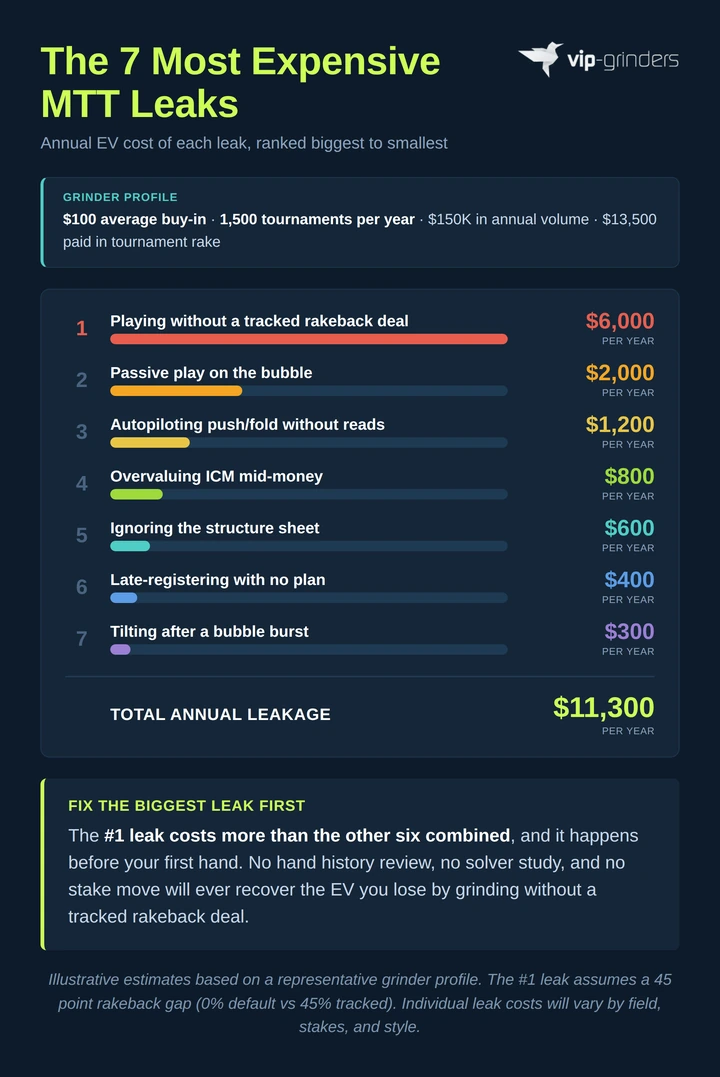
Fixing one leak at a time is the correct approach. Trying to patch all five at once leads to information overload and no measurable improvement in any of them. Identify the mistake that costs you the most EV right now (for most grinders it is either the bubble leak or the rakeback leak), fix it over the next 500 tournaments, then move to the next one on the list.
Frequently Asked Questions
Is MTT poker still profitable?
Yes, but only for players who treat it as a serious discipline rather than a hobby. MTT fields at low and mid stakes remain soft enough for technically sound grinders to post 15% to 30% ROI, especially on crypto-friendly rooms and platforms with heavy casino crossover traffic. The players who struggle are the ones who ignore bankroll rules, skip rakeback deals, or try to grind without a long-term plan. With the right room selection, tracked rakeback, and disciplined study, MTT grinding is as profitable in 2026 as it has been at any point in the last decade.
How many buy-ins do I need for MTTs?
The standard guideline is 150 to 300 buy-ins depending on field size and your ROI. Small-field tournaments (under 500 runners) can be grinded with 150 buy-ins, medium fields (500 to 2,000) require 200 to 300, and large or mega fields (2,000+) need 300 to 500. Conservative grinders who rely on poker income should lean toward the higher end of these ranges, while players with outside income can operate more aggressively. Our bankroll management guide covers the full framework including shot-taking rules and format-specific adjustments.
What stack depth should I shove from in MTTs?
Open-shoving from late position becomes the default below 15 big blinds, and by 10bb nearly every playable hand should go in preflop as a shove rather than a raise-fold. Above 15bb you still have room for min-raises with strong hands and polarised 3-bets with premiums and bluffs, but the line between raise-fold and shove-or-fold territory is roughly 20bb for most positions. Below that, raise-fold lines mathematically start losing money because the pot odds you give yourself when facing a reshove are too good to fold comfortably.
When is late registration +EV?
Late registration is +EV when the field is soft enough that the reduced effective stack is outweighed by the weaker opposition. Registering into a 200bb start when you will sit down with 60bb is almost always fine because 60bb still allows meaningful postflop play. Registering in the final minutes of a late reg window when you will arrive with 20 to 25bb is rarely profitable unless the field is exceptionally weak, because you start in shove-or-fold mode with no room to build a stack. Our upcoming late registration guide covers the specific EV math at different blind levels and structures.
How do I study MTTs without a solver?
You do not need a solver to improve at MTTs. The highest-ROI study tools for tournament players are ICM trainers like ICMizer and Holdem Resources Calculator, which let you drill push/fold spots at specific stack depths until the correct action becomes automatic. Pair that with hand history review filtered for your biggest losing spots (usually bubble play and short stack decisions), and you will fix more leaks in a month than most grinders fix in a year of passive solver study. Solvers are useful for deep-stack postflop refinement, but they are not where your biggest MTT gains come from.
Should I play MTTs or Spins?
It depends on your schedule, bankroll, and tolerance for variance. MTTs offer larger top prizes and reward stage-by-stage adjustments, but they require multi-hour sessions and suffer from extreme cashless stretches. Spins produce faster volume, shorter sessions, and steadier rake generation, but the variance per game is even higher and the skill edge lives almost entirely in preflop push/fold accuracy. Grinders with limited evening hours often prefer Spins, while players who enjoy long sessions and final table pressure gravitate toward MTTs. Many serious grinders play both depending on the day.
How long before my MTT results start reflecting my actual skill?
At minimum 500 tournaments to identify major leaks, and closer to 1,500 to 2,000 tournaments before your ROI becomes statistically reliable. Below 500 tournaments, your results are dominated by variance to the point where both big upswings and brutal downswings can happen to players of nearly any skill level. Judging your game on a 50 or 100 tournament sample is one of the fastest ways to tilt yourself into bad decisions about stakes, volume, or whether to keep playing at all.
How much rakeback can I get on MTTs through VIP-Grinders?
Specific rakeback percentages vary by room, buy-in level, and current promotions, but VIP-Grinders players typically receive 25% to 50% effective rakeback at major rooms compared to the 10% to 15% default rewards offered to untracked sign-ups. That gap represents thousands of dollars per year for active MTT grinders, paid on top of tournament winnings without requiring any strategic improvement. Our rakeback deals page lists every partner room and the exact terms available to tracked accounts.