


Texas Holdem Hands: Analyzing Texas Holdem Hands That Defined Poker

Foxen vs. Mateos: Complex Tournament Hold’em Hands
This hand, played at the Poker Go Cup final table with five players remaining, features two elite high-stakes professionals: Alex Foxen and Adrian Mateos. The dynamics of their decision-making in this pot and strategic adjustments offer a masterclass in tournament poker, blending theory, ICM considerations, and live reads at an advanced strategy level.
Overview
- Situation: Final table, five players left.
- Action: Folded to Foxen in the small blind (about 3 big blinds effective stack), who opens with a raise slightly over 3BB.
- Mateos defends from the big blind.
Pre-Flop Dynamics
Foxen’s raising range at this stack depth and position is heavily weighted toward strong pocket pairs and broadway cards, with some medium-strength suited hands mixed in, a standard yet slightly conservative approach influenced by ICM pressure.
Mateos’s big blind defense tends toward calling or folding—with occasional three-bets involving the strongest hands or blockers to disrupt Foxen’s opening range. This defensive posture is largely dictated by his stack-to-pot ratio and final table payout considerations.
The solver confirms both players’ pre-flop actions as optimal within an ICM-influenced context, noting these slight conservatisms relative to chipEV as rational and sensible.
Flop Action: C-Bet and Draw Calling
The flop brings Ace-high, and Foxen continuation bets—a classic play leveraging his range advantage and position. Mateos, holding a gutshot straight draw, calls.
The solver endorses this approach for both players, recognizing Foxen’s c-bet as a standard range-firing move to charge draws and weaker top pairs, while Mateos’s call makes sense to pursue his equity with the gutshot.
Turn: Slow Play and Counterattack
With the deuce of diamonds on the turn, Foxen opts to check, going to a pot-control line with Ace-high but no additional draws. This cautious approach aligns with solver recommendations, which suggest checking 100% of similar Ace-high hands.
Mateos, facing this check, bets with his gutshot, a play that the solver rates as viable but mixable—meaning both betting and checking are acceptable depending on exact hand ranges and strategic balance.
Foxen’s call here is mixed in solving terms: logical given his showdown-value holding, but nuanced given the block of opponents’ potential bluffs.
River: The Pivotal Hero Call
The river pairs the deuce, and Foxen checks, and Mateos bets about 80% of the pot. At this point, the solver diverges, indicating Mateos should mostly refrain from bluffing here, as most weaker combinations have been played out or fold pre-river. The river bet becomes one of the rare spots where human intuition and dynamic reasoning enter prominently.
Mateos’s bluffing range would ideally include hands with blockers (cards that reduce Foxen’s folding range), such as certain spades, while avoiding weaker blockers like Ace-high or King-high that reduce fold equity.
Foxen’s hero call, ultimately correct, cannot be strictly confirmed by the solver but is a demonstration of high-level tournament thinking:
- Considering Mateos’s betting sizing and possible multiple bet sizes.
- Recognizing block cards in his hand and narrowing Mateos’s range.
- Trusting player tendencies and live tells beyond solver output.
Alternative Scenario Considerations
If Mateos mixed more sizing options on the river, Foxen’s calling range could widen. Against a different opponent or in a lower ICM pressure spot, Foxen might fold, showing the contextual nature of hero calls. Variations in Mateos’s perceived bluff range composition (more or fewer missed draws) would shift fold equity and call frequency considerations.
4 Strategic Takeaways
- Pre-flop play highlights ICM’s subtle influence near final tables, fostering slightly tighter open ranges and selective defense.
- Flop and turn lines illustrate pot control and measured aggression calibrated to hand ranges and draw potentials.
- The river hero call exemplifies the integration of game theory, blockers analysis, opponent tendencies, and live reads often critical in close final-table decisions.
- This hand underscores that theoretical solver paths serve as foundations, but top pros add layers of psychological insight and risk assessment for margin gains.
Persson vs. Antonius: Monster Texas Holdem Hands
This $1,978,000 pot between Eric Persson and Patrik Antonius, streamed live during a $1,000/$2,000 no-limit cash game with a $2,000 ante. The hand is a perfect example of what happens when bulldozer force fails against cool decision making.

Pre-Flop: Range Definition and Positional Awareness
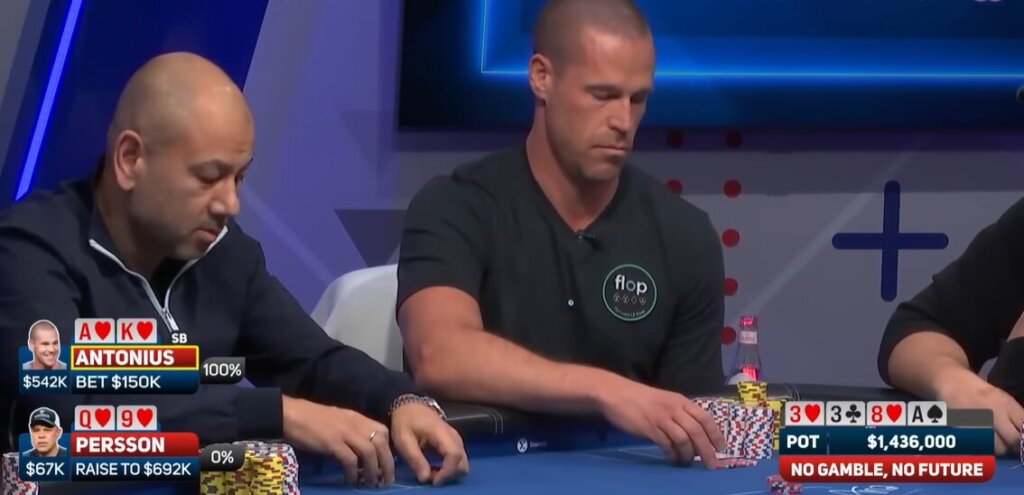
Persson opens from the hijack with Qh9h to $7,000. Rob Yong calls on the button with Ac2c. Antonius three-bets from the small blind with AhKh, a premium hand, but sizes it somewhat small to $30,000 to get action. His sizing, while seemingly loose, is deliberate — inviting calls from sticky players (like Persson) and building a large pot. Persson quickly calls despite being out of position, revealing his willingness to gamble and apply pressure post-flop.
Flop and Early Post-Flop Play: Draw vs. Draw Dynamics
The flop is 3h3c8h, giving both Persson and Antonius flush draws. Yong folds to Antonius’s continuation bet of $40,000. Persson snap-raises to $140,000, representing an over-pair. Antonius’s decision to three-bet the flop to $250,000, is an example of leveraging implied odds, knowing if he hits his heart, Persson is likely to pay him off. Persson calls.
Explosive Ace on the Turn
The turn As locks up the hand for Antonius, who knows he is only losing at this point to pocket 8s, or trip 3s (highly unlikely given the action so far.) With about a 1.16:1 stack-to-pot ratio, Antonius leads for $150,000, balancing his line between value and protection.
Persson makes an all-in move (reckless or fearless or both?) for $692,000 effective, applying maximum pressure in a pot already nearing a million chips.
Antonius calls and wins the hand before the river is dealt, as Persson’s hand is dead.
Strategic Insights and Takeaways
- Positional Pressure and Range Balancing: Antonius’s small sizing preflop reflects a strong understanding of inducing calls and maintaining pot control versus sticky opponents.
- Aggression in Draw vs. Draw Scenarios: Persson’s snap raise on the flush-draw-heavy flop exemplifies a high-risk, high-reward approach.
- Turn and River Play Reflect High-Level Range Considerations: Antonius’s turn lead and Persson’s shove reflect the delicate balance of value betting, bluff deterrence, and pot sizing under extreme pressure.
- Non-Results Oriented Thinking: It’s hard to praise Persson’s line — but some have commented that Antonius would have had a much tougher decision with an unsuited AK, even on the turn.
Alternative Scenarios and Hypotheticals
Had Antonius folded a strong hand like kings, or been better light on the flop, the outcome could have reversed dramatically. Persson’s aggression might have won if opponent ranges were calibrated differently or if blocker effects favored his holding more convincingly. The line played exemplifies elite decision-making where the expected value is prioritized over variance-heavy results.
Garrett Adelstein vs. Robbi Jade Lew: THAT J♣4♥ Holdem Hand still Talked about in 2026
This Texas Holdem hand is arguably the most controversial and dissected hand in recent poker streaming history. It was played on Hustler Casino Live during a high-stakes cash game, generating a pot of over $200,000. Garrett Adelstein, a top-level professional known for his analytical prowess and aggression, faced off against Robbi Jade Lew, a recreational player thrust into the spotlight due to this hand’s outcome.
Hand Action Breakdown
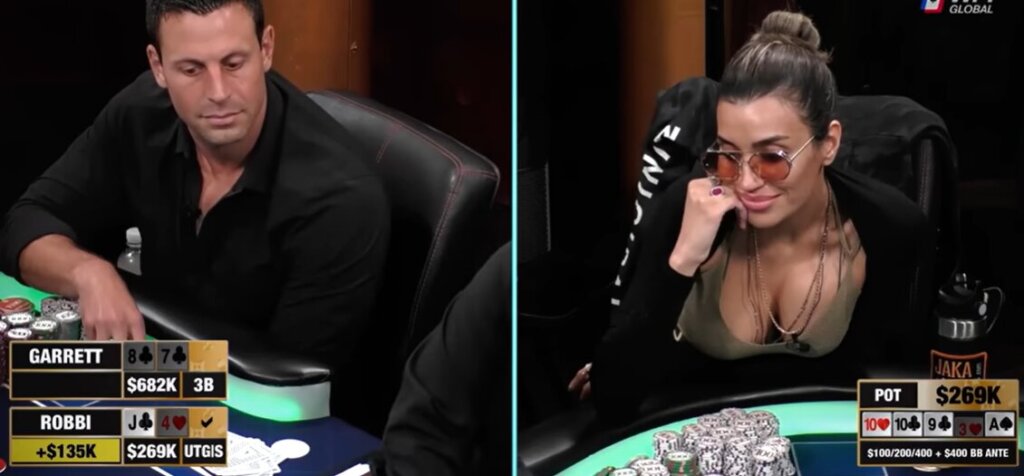
Pre-Flop: Garrett Adelstein is dealt 8c7c, a dynamic suited connector with significant postflop playability. Robbi Jade Lew holds Jc4h
Jc4h, a hand traditionally considered very weak and marginal. Garrett raises from the small blind to $3,000. Robbi calls from the straddle position, which many experienced players would fold this hand, but calling is not strictly incorrect due to potential implied odds in a deep-stacked game with a tricky opponent.
Flop: ThTc9c
Garrett flops an open-ended straight flush draw. Robbi has Jack-high, with only backdoor draws, on a paired board.
Garrett bets $2,500 into a $9,200 pot. Robbi calls, at this point planning to bluff on a later street, with potential backdoor draws.
On the 3h Turn, Garrett bets $10,000. Here Robbi responds with a min-click to $20k. Garrett responds by moving all-in, a strong semi-bluff or value bet considering his extensive outs. Then things get weird…

Robbi’s Call:
Robbi calls the massive all-in shove for her last $109K with Jack-high. The call breaks with all conventional poker logic and creates a moment where viewers and pros alike question the rationale.
River and Outcome:
The players agree to run the river twice. Both runouts do not improve Garrett’s draw, awarding Robbi a miraculous pot victory. Emotional reaction from Garrett ranges from initial acceptance to frustration and suspicion.
Strategic and Psychological Analysis
Garrett’s Line: His bet sizing and aggression throughout are solid plays for maximizing fold equity on draws in a deep-stacked environment. The move to an all-in shove post-flop to leverage maximum pressure is textbook aggressive play. To have called with mathematical calculation, Robbi would have had to put Garrett on exactly the kind of hand he had, and even then, it’s a questionable call with a river to come.
Robbi’s Play – Twilight Zone of Poker Theory:
Conventional wisdom dictates a fold with Jack-high facing such pressure. Debate still rages online as to whether Robbi misread her hand or simply made an audacious bluff catcher call.
The call generates controversy to this day around skills, ethics, and cheating allegations.
Meta Considerations:
- The game streaming live magnifies every decision, inviting strange dynamics and decisions under pressure, beyond a typical cash game.
- Garrett’s later investigations, including accusations of cheating involving a production crew member, color the narrative around this hand.
- Analysis by pros and fans alike continues to alternately defend or criticize Robbi’s call, with no consensus.
Hand Breakdown: Hellmuth vs. Dwan
This hand from the sixth season of Poker After Dark pits the all-time tournament bracelet leader Phil Hellmuth against the aggressive legend Tom Dwan in a deep stacked, high-pot scenario. The hand offers a study in pre-flop aggression, post-flop hand reading, and polarised river decisions under pressure.
Pre-Flop Action
Eli Elezra (Cutoff): Opens with 9K to 3.5 big blinds — a loose opening range typical in live games. Phil Hellmuth (Button): Raises to 13.5 big blinds with 9h7s. Tom Dwan (Small Blind): Responds with a cold 4-bet to 40 big blinds with J♥T♥. This sizing polarizes his range and aims to isolate.
Elezra folds, Hellmuth calls the 4-bet despite holding a speculative hand, thinking Dwan’s range is wide and can be exploited.
Flop: QhTd7d
Post-Flop Decisions
The pot is about $34,200. Both Dwan and Hellmuth check the flop, unusual given Hellmuth’s pre-flop aggression. Hellmuth’s check suggests a desire to control pot size with middle pair and backdoor draws.
Turn: Ts
Dwan bets $27,600 on the turn, a polarized bet: either a strong value hand or a bluff. Hellmuth calls quickly. The quick call telegraphs a desire to see showdown cheaply, trying to discourage Dwan from betting on the river.
River: 5s
Bluffed Endgame and Hero Call
The pot stands around $89,500. Dwan fires a large $119,975 all-in bet, a shove representing severe aggression aimed to fold out better hands. Hellmuth spends several minutes deliberating before making the hero call.
Strategic Perspective and Analysis
- Hellmuth’s Pre-Flop Call: Risky, given the position and stack-to-pot ratio. Against a polarized 4-betting range by Dwan, folding might have been more standard, or 5-betting all-in if Hellmuth was sure Dwan had air.
- Flop and Turn Checks/Calls: Dwan keeps his range wide and balanced.
- River All-In Bet: Dwan leverages table image and polarized range representation. His bet size corresponds closely with both strong hands and bluff polarities.
- Hero Call: Requires deep insight into opponent tendencies, range weighting, and psychological pressure. Hellmuth’s call isn’t purely mathematical but a blend of reads, faith in bluffs, and prior dynamics. He was wrong, but given Dwan’s aggression, Hellmuth might have been right some of the time. But a call is marginal in any case.
Texas Holdem Hands FAQs
What can we learn from analyzing historic Texas Hold'em hands?
Studying historic hands like Foxen vs. Mateos or the famous J4 hand offers insights into the intersection of poker theory and live reads, showing how expert players balance solver logic with psychological factors and risk assessment.
How does ICM influence pre-flop strategy near final tables?
Near final tables, ICM pressure leads players like Foxen and Mateos to adopt slightly tighter opening and defending ranges, balancing chip preservation with selective aggression to maximize payout equity.
How do pros handle draw-heavy flops in large pots?
In the Persson vs. Antonius hand, we see aggressive betting and three-betting on flush draw flops to build pots and leverage fold equity, balancing value extraction with bluff deterrence, which requires exceptional range and tree analysis.
What strategic concepts does the Persson vs. Antonius hand illustrate?
The hand is an example of positional pressure, nuanced range balancing, and dynamic pot control amidst massive implied odds, reflecting the blend of mathematical poker and psychological warfare at high stakes.
How did Garrett Adelstein’s and Robbi Jade Lew’s J4 hand challenge conventional poker wisdom?
Robbi’s call with Jack-4 offsuit against Adelstein’s massive bluff challenged theory norms, sparking debates about skill, reads, and ethics in streamed poker. It highlights how unexpected plays can create lasting poker lore and controversy.
Why is studying these hands crucial for serious poker players?
Analyzing these key hands bridges theory and practical application, teaching players how to adapt ranges, manage risk, interpret opponents, and confidently make tough calls in high-stakes scenarios.