

MTT Overlay Strategy: How to Find and Profit from Poker Tournament Overlays in 2026
An overlay happens when a poker tournament’s guaranteed prize pool is larger than the money collected from entries.

If a tournament guarantees $10,000 but only 350 players enter at $20 each, the remaining $3,000 comes out of the poker room’s pocket. That $3,000 is the overlay, and every player in the field gets a share of it for free.
For MTT (multi-table tournament) grinders, overlays are one of the few structural edges that exist before the first card is dealt. They lower your effective rake, boost your per-tournament expected value, and stack on top of your rakeback deal to reduce the real cost of every buy-in. The catch is that most players never learn how to find them consistently.
Here is what this guide covers:
- What a poker overlay is, how to calculate your equity boost, and the overlay percentage that matters most
- Why overlays happen and the predictable weekly patterns that repeat across rooms
- How to find overlay tournaments before late registration closes
- How overlay equity stacks with your rakeback deal to slash your effective cost
- The mistakes that turn a good overlay into wasted money
For the full tournament strategy arc from registration to final table, see our MTT strategy guide.
What Is an Overlay in Poker?
Every poker tournament advertises a guaranteed prize pool (often shortened to GTD). That number is the minimum amount the room promises to pay out, regardless of how many players enter. If enough players register and the total collected exceeds the guarantee, the prize pool simply grows.
If too few players enter and the total collected falls short, the room covers the difference. That difference is the overlay.
Quick formula: overlay = guaranteed prize pool minus (entries × prize pool contribution per entry). If the result is positive, the room is losing money and every player in the field benefits.
To understand how overlays work, you need to know how a tournament buy-in is split. A tournament listed as “$20 + $2” charges you $22 total: the $20 goes into the prize pool and the $2 is the room’s fee (the rake). Only the $20 portion counts toward reaching the guarantee.
Overlay Calculation: A Worked Example
Take a $20 + $2 tournament with a $10,000 guaranteed prize pool. The room needs 500 entries at $20 each to cover the guarantee without losing money (500 × $20 = $10,000). Those 500 entries are the break-even point.
Now say only 350 players register. Here is what happens:
| Component | Calculation | Amount |
|---|---|---|
| Prize pool contribution per player | $22 buy-in minus $2 rake | $20 |
| Total collected from 350 entries | 350 × $20 | $7,000 |
| Guaranteed prize pool | Advertised by room | $10,000 |
| Overlay | $10,000 minus $7,000 | $3,000 |
| Break-even entries needed | $10,000 ÷ $20 | 500 players |
| Entries short of break-even | 500 minus 350 | 150 players |
The room loses $3,000 on this tournament. Every one of the 350 players benefits, because the prize pool is 43% larger than what their combined entries would have funded on their own.
Overlay vs Added Money vs Freerolls
Three terms get confused regularly. They are related but not the same.
- Overlay: unintentional. The room set a guarantee hoping to attract enough entries to cover it. When the field falls short, the overlay is the gap the room absorbs as a loss.
- Added money: intentional. The room deliberately adds extra cash to the prize pool as a promotional incentive, on top of whatever players contribute. The effect on your equity is identical to an overlay, but the room planned for the cost.
- Freeroll: a tournament with no buy-in and a real prize pool. Every freeroll is technically a 100% overlay because players contribute nothing and the entire prize pool comes from the room.
How to Calculate Your Overlay Equity Boost
Knowing that an overlay exists is step one. Knowing what it is worth to you personally is step two: the overlay dollar amount tells you how much the room is losing, while the per-player equity boost tells you how much each seat in the field gained before a single hand is played.
Overlay Equity in Four Steps
Every overlay calculation follows the same sequence. Using our $20 + $2 tournament with a $10,000 GTD and 350 entries:
- 1Calculate break-even entries: divide the guarantee by the prize pool contribution per player. $10,000 ÷ $20 = 500 entries needed.
- 2Calculate overlay dollars: subtract total collected from the guarantee. $10,000 minus (350 × $20) = $3,000 overlay.
- 3Calculate per-player equity boost: divide the overlay by the number of entries. $3,000 ÷ 350 = $8.57 per player. That means every seat in the field starts with $8.57 in extra equity on top of what their buy-in purchased.
- 4Calculate effective rake after overlay: you paid $2 in rake but received $8.57 in overlay equity. Your effective rake is $2 minus $8.57 = minus $6.57. Negative rake. The room is paying you to play.
That negative rake figure is not a gimmick. It is the cleanest way to understand what an overlay actually does for a grinder: in a normal tournament you pay $2 in rake and receive nothing back, but in an overlay tournament the room’s shortfall can erase your rake entirely.
Overlay Percentage: The Number That Matters Most
Raw overlay dollars can be misleading. A $5,000 overlay sounds bigger than a $500 overlay, but if the first is on a $100,000 GTD (5% overlay) and the second is on a $2,000 GTD (25% overlay), the smaller dollar amount is far more valuable per player.
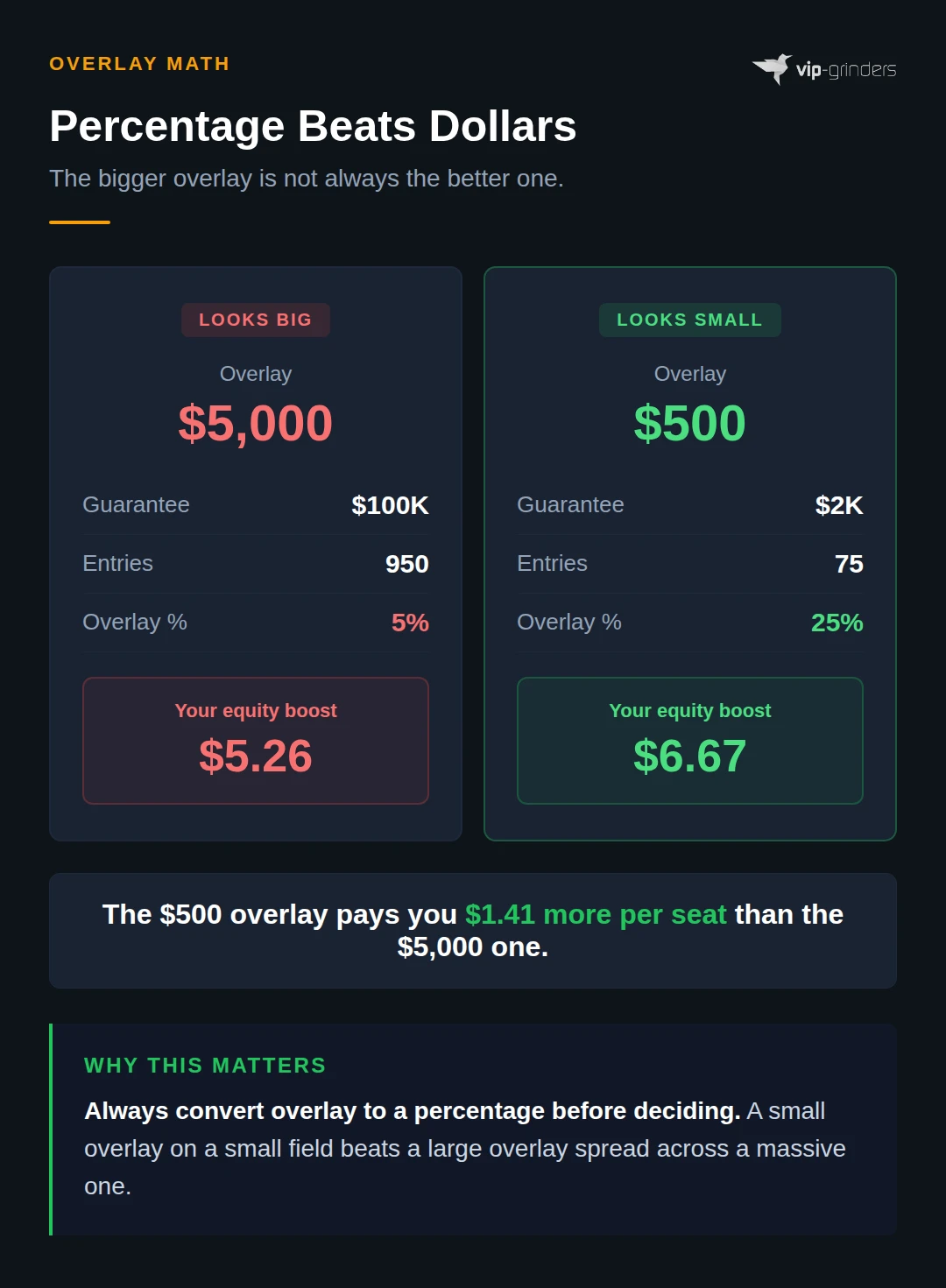
Always convert to a percentage: overlay ÷ guarantee × 100. The table below shows what each overlay percentage level means in practice.
| Overlay % | What It Means | Grinder Action |
|---|---|---|
| 0% | Prize pool met or exceeded the guarantee. No overlay. | Standard tournament. Play if it fits your schedule. |
| 1% to 5% | Small shortfall. Slightly better value than a fully funded event. | Worth noting but not worth changing your schedule for. |
| 5% to 15% | Meaningful equity boost. Your effective rake drops significantly. | Register if the format and field suit your game. |
| 15% to 30% | Strong overlay. Effective rake is near zero or negative. | Prioritize this tournament over non-overlay alternatives. |
| 30%+ | Rare. The room is absorbing a large loss. | Register immediately. This is the best EV spot in your schedule. |
Effective Rake After Overlay
The table below shows what happens to your per-player cost at different overlay levels on a $20 + $2 tournament ($2 rake per entry). The equity boost column is what the overlay returns to each player. Effective rake is your real expense after the overlay is subtracted.
| Overlay % | Overlay on $10K GTD | Entries | Equity Boost per Player | Rake Paid | Effective Rake |
|---|---|---|---|---|---|
| 0% | $0 | 500 | $0.00 | $2.00 | $2.00 |
| 5% | $500 | 475 | $1.05 | $2.00 | $0.95 |
| 10% | $1,000 | 450 | $2.22 | $2.00 | Negative |
| 20% | $2,000 | 400 | $5.00 | $2.00 | Negative |
| 30% | $3,000 | 350 | $8.57 | $2.00 | Negative |
A key takeaway from this table: even a modest 10% overlay erases the rake entirely on a mid-stakes tournament with standard fees. Below that, a 5% overlay still cuts your effective rake roughly in half. The overlay percentage and your buy-in’s rake level both matter.
For a full breakdown of how rake is calculated across cash games and tournaments, see our guide to poker rake.
Why Do Overlays Happen
Overlays are not random. They follow predictable patterns tied to how poker rooms set guarantees, when they schedule tournaments, and how large their player pool is. Understanding the causes helps you anticipate where overlays will appear before they show up in the lobby.
Aggressive Guarantees and New Series Launches
Poker rooms set guarantees as marketing tools. A $500,000 GTD headline attracts registrations, media coverage, and new sign-ups. When the room overestimates demand and sets the guarantee higher than the field can support, the result is an overlay.
This happens most often during new series launches. A room running its first major festival has no historical data to calibrate guarantees, so it sets ambitious numbers to compete for attention. The first edition of a series is where the largest overlays tend to appear.
Schedule Conflicts and Competing Events
When two or more rooms run large guaranteed events at the same time, the player pool splits. Neither tournament gets the full field it expected, and one or both end up with an overlay.
This is common during major live festival weeks. When the WSOP or EPT is running, online traffic drops because thousands of regulars are playing live. Rooms that do not adjust their guarantees downward eat overlays for the entire series.
Off-Peak Timing and Niche Formats
Tournament traffic follows predictable daily and weekly cycles. Peak hours are evenings and weekends in the room’s primary market (typically Europe for GGPoker and PokerStars, North America for ACR and Ignition). Tournaments scheduled outside those windows draw smaller fields.
A $10,000 GTD that fills easily at 8pm on Sunday might struggle to reach half its guarantee at 10am on Tuesday. The guarantee stays the same, but the available player pool shrinks. Niche formats like PLO (Pot Limit Omaha), Short Deck, or high buy-in turbos face the same problem: the player pool is a fraction of the NLHE (No Limit Hold’em) pool, and guarantees set for NLHE traffic rarely translate.
Small Network Player Pool Volatility
Large networks like GGPoker or PokerStars have millions of registered players and can absorb a slow night without producing an overlay. Smaller networks and standalone rooms have thinner player pools, which means their guarantees are more vulnerable to fluctuations in traffic.
A room with 5,000 active tournament players might set a $20,000 GTD that fills comfortably on a good night and falls 30% short on a slow one. That volatility is where consistent overlay hunters find their edge, because the same tournaments on the same rooms produce overlays on a recurring weekly pattern.
High Buy-Ins with Shallow Player Pools
As buy-ins climb, the number of players who can afford to enter shrinks. A $5 tournament with a $2,000 GTD might attract 600 entries easily. A $500 tournament with a $200,000 GTD needs 400+ entries from a much smaller pool of players who can stomach that buy-in level.
High buy-in overlays are rarer than micro and low-stakes overlays in raw frequency, but when they happen the dollar amounts are much larger. The biggest overlays in poker history have all been high buy-in events where the room overestimated how many players would register at $1,000+ price points.
- Predictable causes: off-peak time slots, small network traffic dips, niche format schedules, recurring weekly events that historically miss their guarantee. These repeat and can be tracked.
- Semi-predictable causes: new series launches, schedule conflicts with live festivals, aggressive guarantees during promotional pushes. These happen on known dates but the overlay size varies.
- Unpredictable causes: server issues, last-minute schedule changes by competing rooms, unexpected drops in regional traffic. These cannot be anticipated and are found only by checking lobbies in real time.
How to Find Overlay Tournaments
Most grinders know what an MTT overlay is but never systematically look for one. The players who profit from overlays consistently are not lucky. They check the same places, at the same times, using the same process every session.
Track Tournament Lobbies Before Late Registration Closes
The only reliable way to confirm an overlay is to check the lobby while late registration is still open. Every major poker client shows the current number of entries and the guaranteed prize pool side by side. If entries multiplied by the prize pool contribution per player falls short of the guarantee, an overlay is forming.
The best time to check is 15 to 30 minutes before late registration closes. At that point, the field is mostly locked in and you can calculate a realistic overlay estimate. Checking too early gives a misleading picture because hundreds of late-reg entries can flood in during the final minutes and erase the shortfall.
Where Overlays Appear Most Often
Overlays cluster around specific room types, event types, and schedule slots. The table below summarizes the patterns that repeat week after week across online poker.
| Where to Look | Why Overlays Happen Here | Overlay Frequency |
|---|---|---|
| Smaller networks and standalone rooms | Thinner player pools cannot always fill ambitious guarantees | Common |
| Weekday morning and early afternoon events | Most recreational players are at work. Fields shrink by 30% to 50% vs peak hours. | Common |
| Monday and Tuesday night schedules | Weakest traffic days of the week on most networks | Common |
| PLO, Short Deck, and other niche format MTTs | Player pool is a fraction of NLHE. Guarantees often set for NLHE-level traffic. | Common |
| First edition of a new tournament series | No historical data to calibrate guarantees. Rooms overshoot to attract attention. | Occasional |
| Major series low-tier events ($1 to $25 buy-ins) | Headline events draw traffic away from side events in the same series | Occasional |
| High buy-in events ($200+) on mid-sized rooms | Not enough players at that price point to meet the guarantee | Occasional |
| Weeks when a major live series is running (WSOP, EPT) | Online traffic drops as regulars travel to play live | Occasional |
The most reliable approach is to multi-room. Grinders who hold accounts at three or four rooms with tracked rakeback deals can scan multiple lobbies each session and cherry-pick whichever tournament has the best overlay that day.
Time Slots and Weekly Patterns
Overlay frequency follows the same weekly rhythm on almost every network. The pattern is driven by recreational player availability, which peaks on weekends and drops mid-week.
- Highest overlay probability: Monday through Wednesday, morning and early afternoon slots (before 4pm in the room’s primary time zone). These are the sessions with the smallest player pools and the same guarantees as peak hours.
- Moderate overlay probability: Thursday and Friday daytime slots, and late-night events (after midnight) on any day. Traffic is building toward the weekend but has not peaked yet.
- Lowest overlay probability: Saturday and Sunday evening prime time. This is when recreational players are most active, fields are largest, and guarantees are almost always met or exceeded.
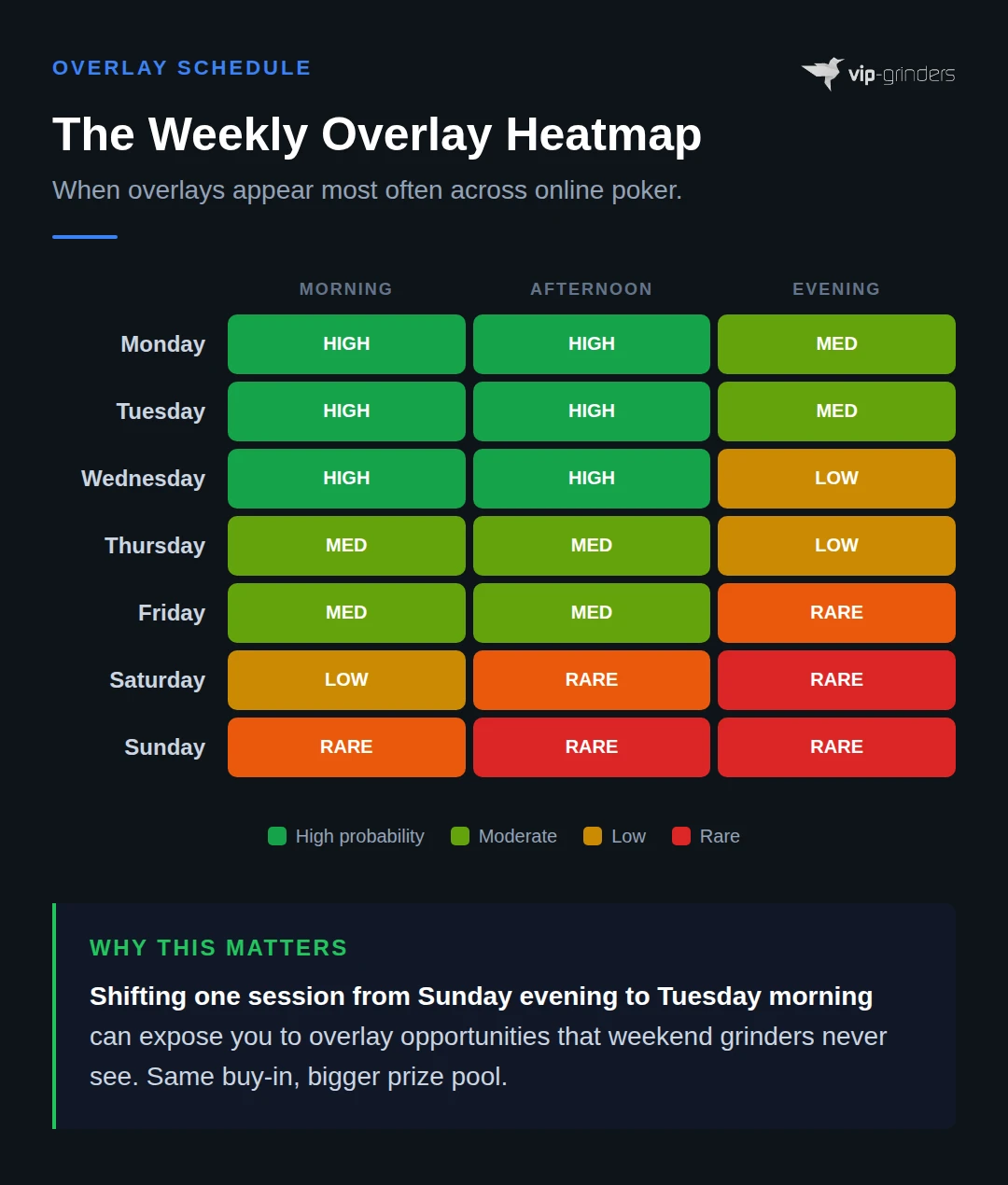
The practical takeaway is straightforward: if your schedule allows it, shifting even one or two sessions per week from Sunday evening to Tuesday morning can expose you to overlay opportunities that weekend grinders never see. For a deeper look at how table and tournament selection affects your bottom line, see our dedicated guide.
The Late Registration Decision
Late registration is where overlay math gets tricky. Every new entry during late reg adds money to the prize pool, which shrinks the overlay in real time. A tournament showing a $2,000 overlay with 30 minutes of late reg remaining might have zero overlay by the time registration closes, because the final wave of entries filled the gap.
When Late Reg Makes Sense in Overlay Tournaments
Late registering an overlay tournament is worth it when two conditions are met. First, the overlay is large enough that even after the expected last-minute entries reduce it, a meaningful equity boost remains. Second, the stack you receive by entering late is deep enough to play real poker.
A practical rule: if the overlay is above 15% with 20 minutes of late reg remaining, registering is almost always correct because even a heavy final wave of entries rarely erases more than half of a large shortfall. If the overlay is below 5% with significant late reg time left, the final entries will likely close the gap entirely and you gain nothing.
- Register now: overlay above 15% with late reg closing in under 20 minutes. The equity boost is large enough to survive the final entry wave, and waiting longer risks missing the window entirely.
- Wait and re-check: overlay between 5% and 15% with 30+ minutes of late reg remaining. Monitor the entry count every 10 minutes. If the overlay holds steady or shrinks slowly, register in the final 10 minutes. If entries are flooding in, skip it.
- Skip: overlay below 5% with significant late reg time remaining, or the starting stack you would receive is below 15 big blinds. At that depth you are in pure push/fold mode with no room to use a skill edge, and the overlay is likely to disappear before registration closes.
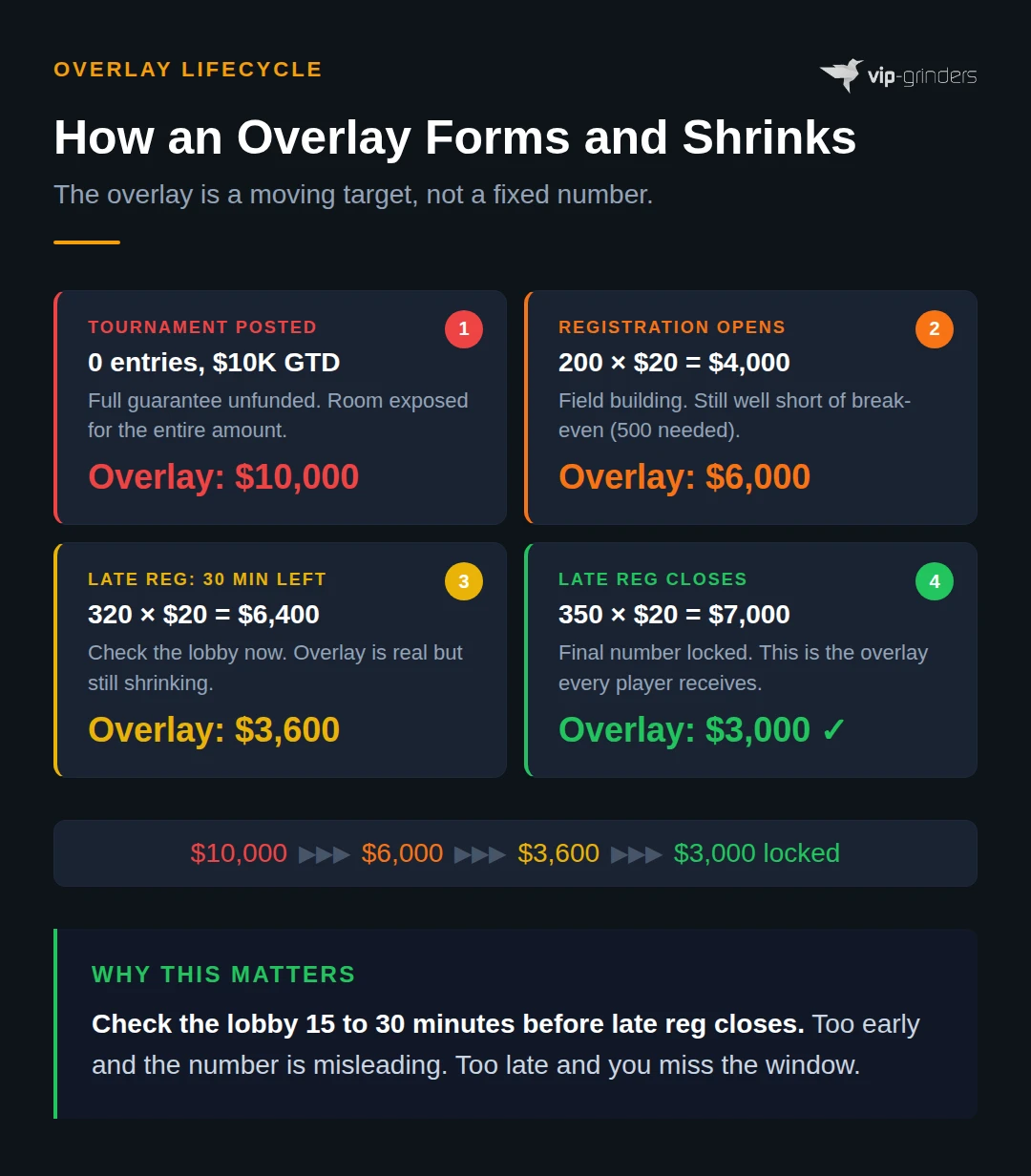
One detail most players miss: late registration entries reduce the overlay but also soften the field. Late-reg players tend to be recreational or action-oriented, which means the remaining field after late reg closes is often weaker than the field that registered on time. That softer opposition is a second source of value on top of whatever overlay remains.
For how bubble strategy changes based on whether you entered on time or late-registered with a shorter stack, see our bubble strategy guide.
Stacking Overlay Equity with Rakeback
Overlay and rakeback are both forms of rake reduction: the overlay gives you extra prize pool equity, and your rakeback deal returns a percentage of the rake you paid. When both apply to the same tournament, the combined effect can make your effective cost per event significantly lower than the buy-in suggests.
Most grinders think about overlay and rakeback as separate things. Overlay hunters look for shortfalls in the lobby while rakeback grinders focus on their deal percentage and volume targets. The players who earn the most from tournaments stack both layers together and treat them as a single number: total rake reduction per event.
How the Math Stacks
Take our $20 + $2 overlay tournament with 350 entries and a $3,000 overlay. You already know the overlay gives you an $8.57 equity boost. Now add your rakeback deal on top.
| Rakeback % | Rake Paid | Rakeback Return | Overlay Boost | Total Value Back | Effective Cost |
|---|---|---|---|---|---|
| 0% (no deal) | $2.00 | $0.00 | $8.57 | $8.57 | $13.43 |
| 15% (default rewards) | $2.00 | $0.30 | $8.57 | $8.87 | $13.13 |
| 25% | $2.00 | $0.50 | $8.57 | $9.07 | $12.93 |
| 35% | $2.00 | $0.70 | $8.57 | $9.27 | $12.73 |
| 50% | $2.00 | $1.00 | $8.57 | $9.57 | $12.43 |
The effective cost column is what the tournament actually costs you after overlay and rakeback are applied: buy-in ($22) minus total value back. At a 50% rakeback deal with this overlay, your $22 tournament effectively costs $12.43. You are playing a $10,000 GTD event for roughly half price.
Why This Matters for Tournament Selection
A tournament that looks marginal on raw ROI (return on investment) can become clearly profitable once overlay and rakeback are stacked. A grinder breaking even at the tables on a 35% rakeback deal is already a winning player after rakeback alone. Add a 10% overlay on top, and that same session produces meaningful profit per event.
This is also why playing on multiple rooms with tracked deals matters more for overlay hunters than for any other type of grinder. A player with accounts at three rooms can compare lobbies, find the best overlay, and collect rakeback on whichever room they play that session. A player locked into a single room without a deal misses both edges entirely.
For how your rakeback percentage should influence which formats you play and how many tables you run, see our rakeback and strategy guide. For the basics of how rakeback is calculated across different deal structures, see our rakeback explained guide.
What an Overlay Does Not Change
Overlays add value before the tournament starts. Once you are seated and the cards are dealt, the overlay has already done its job. Two things that grinders frequently get wrong about overlay tournaments deserve their own section because the mistakes are expensive.
Overlay Does Not Reduce Variance
A 30% overlay does not make you 30% more likely to cash. You still face the same field, the same blind structure, and the same 80% to 85% chance of finishing out of the money in a standard MTT. The overlay increases your expected value per entry but does nothing to change the distribution of your results.
A grinder who plays 100 overlay tournaments will still experience the same cashless streaks, the same 20 buy-in downswings, and the same sample-size noise as a grinder playing 100 non-overlay tournaments at the same stakes. The difference shows up in the long run: after thousands of events, the overlay grinder’s bankroll graph sits slightly higher. But on any given night, you can still bust every tournament you enter.
Overlay Does Not Change Your Strategy
Your ranges, bet sizing, ICM (Independent Chip Model) adjustments, and bubble play should be identical in an overlay tournament and a non-overlay tournament. The overlay adds equity at registration. It does not change the math of any decision once the cards are in the air.
Players who loosen up “because it is an overlay” are burning the equity boost they received for free. Playing wider preflop, calling all-ins lighter, or gambling more postflop because the tournament “cost less” is the fastest way to turn a positive-EV overlay into a losing session.
For how ICM shapes your decisions from the bubble onward, see our ICM guide. For bankroll rules that apply to overlay and non-overlay tournaments equally, see our bankroll management guide.
Biggest Poker Overlays in History
The largest overlays in poker have all come from the same pattern: a room set an aggressive guarantee on a high buy-in event and the field fell short. These examples show what overlay looks like at scale and confirm that even the biggest rooms in the industry miscalculate regularly.
| Event | Year | Guarantee | Entries | Overlay |
|---|---|---|---|---|
| Seminole Hard Rock Poker Open Main Event | 2014 | $10,000,000 | 1,499 | $2,505,000 |
| PokerStars Big Blowout Main Event | 2020 | $5,000,000 | 37,673 | $1,230,000 |
| PokerStars Sunday Million 10th Anniversary | 2016 | $10,000,000 | 44,017 | $1,200,000 |
| GGPoker GGMasters 6th Anniversary Freezeout | 2024 | $10,000,000 | 59,480 | $1,790,000 |
The Seminole Hard Rock overlay in 2014 remains the most famous case in live poker. The room guaranteed $10M for a $5,300 buy-in event in an era when South Florida had never hosted a field that size. Only 1,499 players entered, leaving a $2.5M shortfall that the casino absorbed entirely.
Online, GGPoker’s GGMasters 6th Anniversary in 2024 holds the record. The $10M guarantee attracted 59,480 entries but still fell $1.79M short. After accounting for the rake GGPoker collected from those entries, the room’s actual net loss was closer to $1.1M, but the prize pool shortfall paid to players was the full $1.79M.
The common thread across all four examples is ambition exceeding demand. Every overlay on this list happened because the operator set a headline guarantee designed to attract attention, and the field did not materialize at the expected level. For grinders, these events are a reminder that the biggest overlays happen at the highest buy-ins, where the gap between the room’s expectations and reality is widest.
Frequently Asked Questions
What is an overlay in poker?
An overlay is the difference between a tournament’s guaranteed prize pool and the total money collected from player entries. If a tournament guarantees $10,000 but entries only contribute $7,000, the poker room covers the remaining $3,000. That $3,000 is the overlay, and it benefits every player in the field by increasing the prize pool beyond what buy-ins alone would have funded.
How do I calculate overlay value?
Follow four steps. First, divide the guarantee by the prize pool contribution per player to find the break-even entries. Second, subtract the total collected (entries times contribution) from the guarantee to find the overlay dollars. Third, divide the overlay by the number of entries for your per-player equity boost. Fourth, subtract that equity boost from the rake you paid to find your effective rake after the overlay.
Are overlays still common in 2026?
Yes, but they are concentrated in specific spots rather than spread evenly across all schedules. Off-peak time slots (weekday mornings, Monday and Tuesday nights), niche formats (PLO, Short Deck), smaller networks, and the first edition of new tournament series produce the most consistent overlays. Major rooms like GGPoker and PokerStars rarely overlay their peak-hour flagship events, but their lower-tier weekday tournaments and series side events regularly fall short of their guarantees.
Which poker sites have the most overlays?
Smaller networks and standalone rooms produce overlays most frequently because their player pools are thinner and more vulnerable to traffic fluctuations. Major rooms produce overlays less often in percentage terms, but when they do the dollar amounts are much larger due to their higher guarantees. Grinders who hold accounts at multiple rooms with tracked rakeback deals can compare lobbies each session and enter whichever tournament has the best overlay that day.
Does an overlay tournament increase my expected value?
Yes. The overlay adds extra money to the prize pool that was not funded by player entries. Every player in the field receives an equal share of that extra equity. The per-player boost is calculated by dividing the total overlay by the number of entries. On a $20 + $2 tournament with a $3,000 overlay and 350 entries, every player gains $8.57 in expected value before a single hand is played.
Should I late register an overlay tournament?
It depends on the overlay size and the remaining late registration window. If the overlay is above 15% with under 20 minutes of late reg left, registering is almost always correct. If the overlay is below 5% with significant late reg time remaining, last-minute entries will likely close the gap and you gain nothing. Also consider the starting stack you receive: if you would enter with fewer than 15 big blinds, the shorter stack limits your ability to use a skill edge.
Does playing for an overlay change my strategy?
No. The overlay adds equity at registration, not during play. Once you are seated and cards are dealt, your ranges, bet sizing, ICM adjustments, and bubble play should be identical to any other tournament. Players who loosen up or gamble more because the tournament is an overlay are burning the equity boost they received for free.
Are freerolls technically overlays?
Yes. A freeroll has no buy-in, so players contribute nothing to the prize pool. The entire prize pool comes from the room, making every freeroll a 100% overlay event. The practical difference is that freerolls attract very large fields of low-skill players, so the competition level is weaker but the per-player equity is also very small relative to a buy-in event with a meaningful overlay.
Can a poker site cancel a tournament to avoid an overlay?
Most poker rooms include a clause in their terms allowing them to cancel or restructure tournaments. In practice, cancellations to avoid overlays are extremely rare on reputable sites because the reputational damage far outweighs the financial loss. If a room regularly cancelled tournaments when guarantees were not met, players would stop trusting their advertised numbers and traffic would drop further.
Does overlay affect ICM calculations?
No. ICM calculates the dollar value of your chip stack based on remaining stacks and the payout structure. The overlay inflates the total prize pool, which means every player’s ICM equity is higher in absolute dollars, but the relative ICM math between players stays the same. Your calling ranges, shoving ranges, and bubble factor are not affected by whether the prize pool was funded by entries or topped up by the room.