

ICM in Poker: How the Independent Chip Model Shapes Every Decision 2026
In a cash game, a chip worth $1 is always worth $1. In a tournament, that same chip changes value with every player who busts, every pay jump you pass, and every stack that grows or shrinks around you. ICM (the Independent Chip Model) is the math that tracks that shift: it converts your chip stack into real-money equity based on stack sizes and the payout structure.
The core insight is counterintuitive: a chip you lose is always worth more than a chip you gain. That asymmetry rewires nearly every decision near the money bubble, at final tables, and in satellite tournaments. Hands you would snap-call in a cash game become clear folds, and shoves that print money in chip EV become costly mistakes in dollar EV.
Here is what this guide covers:
- The ICM formula and a worked three-player example showing chip EV vs dollar EV
- Risk premium and bubble factor tables so you know when ICM kicks in and how hard
- Stack size adjustments for big, medium, and short stacks, plus the postflop shifts most players skip
- Satellite and PKO modifications that change calling and shoving ranges
- Eight costly ICM mistakes and the calculator tools to study them
What Is ICM in Poker?
ICM (Independent Chip Model) is a mathematical formula that converts a tournament chip stack into its real-money equity, using each remaining player’s stack size and the payout structure to estimate how often a player will finish in each paid position. In practical terms: it tells you what your stack is actually worth in dollars right now.
The model is built on the Malmuth-Harville algorithm, originally a probability method for predicting finishing orders in horse races (David Harville, 1973), adapted for tournament poker by Mason Malmuth in 1987. It remains the foundation of every major ICM calculator today.
ICM takes three inputs and outputs a single dollar figure for every player at the table:
- Players remaining in the tournament
- Each player's chip stack
- The payout structure (how much each finishing position pays)
That dollar figure is your tournament equity: the amount of prize money your stack is “worth” at that moment. ICM only applies to tournaments. In cash games, every chip is worth exactly its face value at all times.
Chip EV vs Dollar EV: The Core Asymmetry
In a tournament, chips are not worth their face value. A player with half the chips in play does not own half the prize pool, and a player who doubles their stack does not double their equity. The relationship between chips and dollars is curved, not linear.
Three players remain in a $100 prize pool tournament with payouts of $50 for first, $30 for second, and $20 for third. Here are their chip stacks and what ICM says each stack is worth:
| Player | Chips | Chip % | $EV (ICM) | $EV % |
|---|---|---|---|---|
| Alice | 500 | 50% | $38.39 | 38.4% |
| Bob | 300 | 30% | $32.75 | 32.8% |
| Carol | 200 | 20% | $28.86 | 28.9% |
Alice holds 50% of the chips but only 38.4% of the money. That 11.6% gap is ICM at work. Carol holds just 20% of the chips but 28.9% of the money because even the smallest stack has a real probability of finishing second or third and collecting those payouts.
What Happens When Alice Doubles Up
Now imagine Alice wins an all-in against Carol and busts her. Carol collects $20 (third place). Alice now has 700 chips (70%) and faces Bob heads-up with 300 chips (30%) for the remaining $80 in prizes.
| Player | Chips Before | Chips After | $EV Before | $EV After | Change |
|---|---|---|---|---|---|
| Alice | 500 | 700 | $38.39 | $44.00 | +$5.61 |
| Bob | 300 | 300 | $32.75 | $36.00 | +$3.25 |
| Carol | 200 | 0 | $28.86 | $20.00 | −$8.86 |
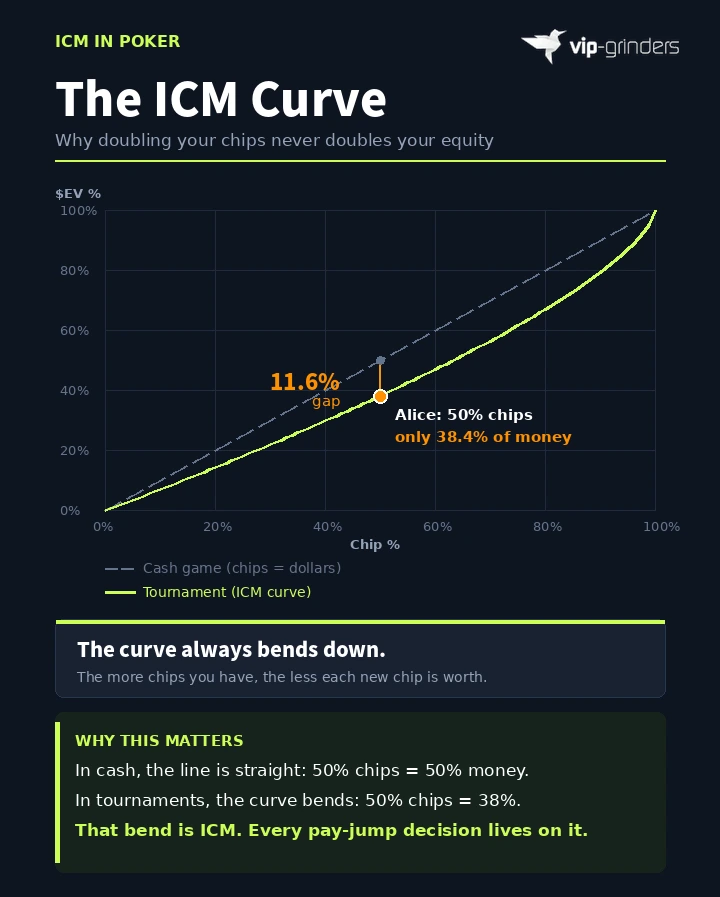
Alice gained 200 chips (a 40% increase in her stack) but only $5.61 in equity (a 14.6% increase in dollar value). Bob did nothing and gained $3.25 simply because a competitor was eliminated. Carol lost $8.86 in equity but Alice only captured $5.61 of that: the remaining $3.25 went to Bob for free.
This is the ICM rule: every chip you risk is worth more than every chip you stand to gain. The bigger the gap between first-place and last-place payouts, the stronger this effect becomes.
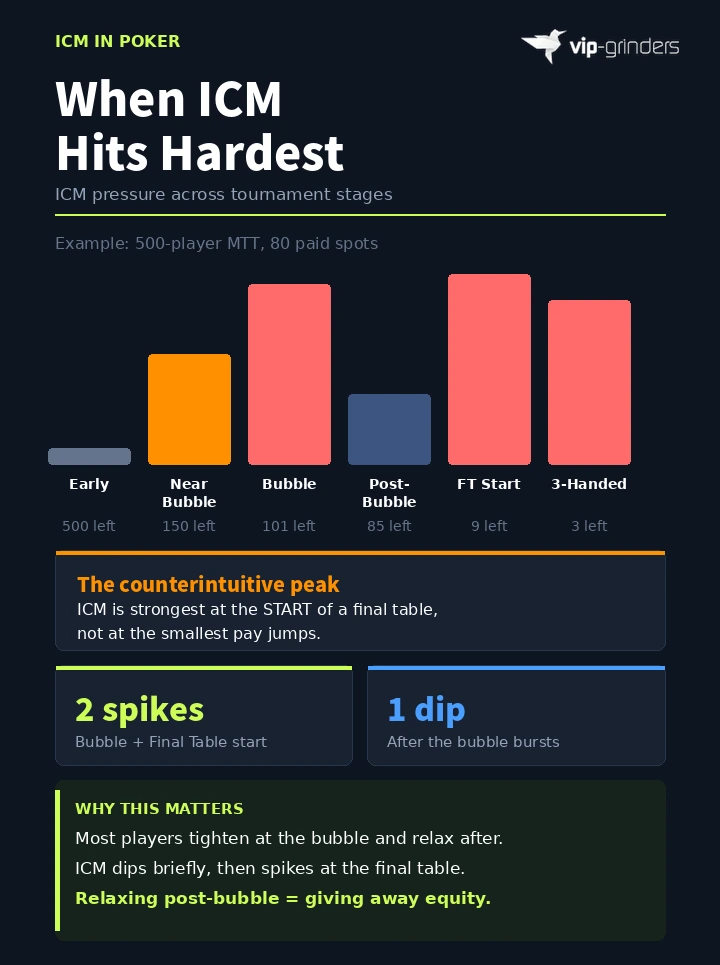
A 52% equity all-in call that is always profitable in cash can be a clear losing play in a tournament once ICM is factored in. The chips you lose cost more in real dollars than the chips you win.
When Does ICM Start to Matter?
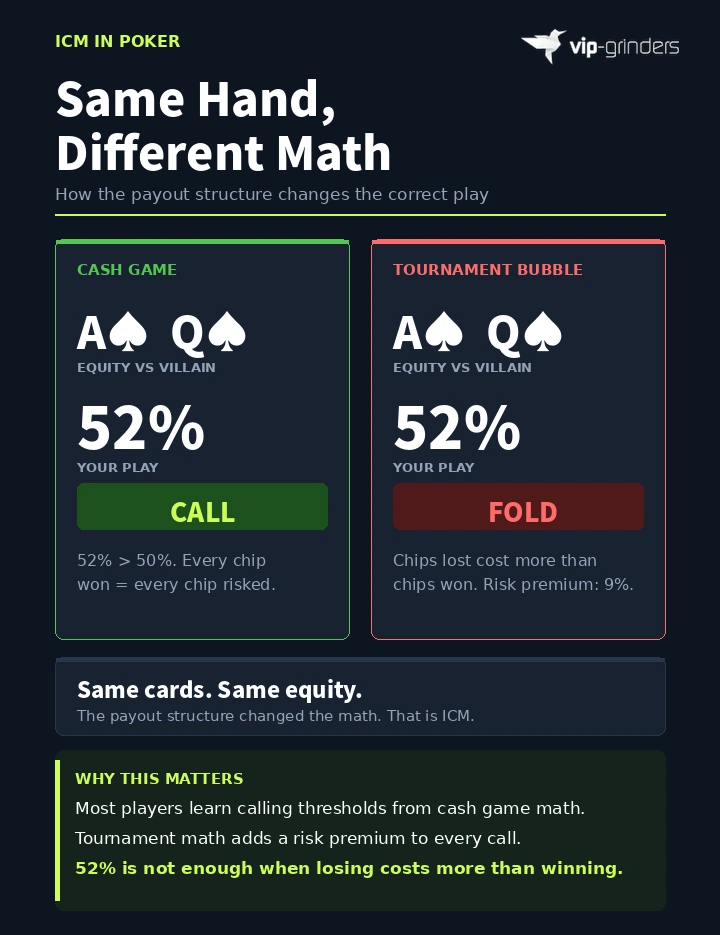
ICM pressure does not switch on like a light. It builds gradually across a tournament, starting near zero in the early levels and peaking at the final table. Knowing where you are on that curve tells you how much weight to give ICM in any decision.
In the first few levels of a large-field MTT, ICM is practically irrelevant. With 500 players remaining and 80 paid spots, busting in 499th place is no different from busting in 300th. Your chips are effectively worth their face value, and playing for chip EV is correct.
ICM starts to bite once roughly half the field has been eliminated. At that point, the remaining players are close enough to the money that each additional bust moves everyone meaningfully closer to a payout. The effect is small at first but accelerates as the bubble approaches.
The ICM Pressure Curve
The zone of maximum ICM pressure sits between 2x and 3x the bubble. In a tournament paying 100 spots, this means ICM is at its strongest when 200 to 300 players remain. Every elimination creates real dollar shifts, and the stacks most affected are the medium ones: too big to ignore, too small to survive a bad all-in.
On the exact bubble (101 players left, 100 get paid), ICM peaks for medium stacks. Short stacks are often committed, big stacks can exploit everyone because calling their shoves risks tournament life, and medium stacks are caught in between. Our poker bubble strategy guide breaks down exactly how each stack size should play this phase.
Final Table: The Counterintuitive Peak
Most players assume ICM pressure is highest at the smallest pay jumps. The opposite is often true. ICM pressure is frequently strongest at the start of a final table, not when pay jumps are smallest, because that is where the largest absolute dollar gaps between finishing positions exist.
Once the final table shrinks to three or four players, ICM pressure per decision increases again because the pay jumps are enormous relative to the remaining prize pool. The lowest-pressure point is often mid-final-table (6th to 5th place). For the complete stage-by-stage breakdown, see our final table strategy guide.
Risk Premium and Bubble Factor
Two terms make ICM actionable at the table: risk premium and bubble factor. Both quantify the same thing from different angles: how much extra equity you need to justify a call when chips lost cost more than chips gained.
Risk Premium
Risk premium is the extra equity percentage you need above the chip EV break-even point to justify a call under ICM. In a cash game, a call that needs 37.5% equity to break even needs exactly 37.5%. In a tournament near the bubble, that same call might need 47% equity: that 9.5% gap is the risk premium.
The premium exists because ICM penalizes losses more than it rewards gains. The closer you are to a pay jump and the more players remain who could bust before you, the higher the premium climbs.
- Early tournament: risk premium is near zero. Chip EV and dollar EV are almost identical.
- Near the bubble: risk premium ranges from 5% to 15% depending on your stack size relative to the field.
- Final table: risk premium can exceed 20% for medium stacks facing all-ins from bigger stacks.
- Satellites: risk premium can be so high that folding pocket Aces preflop becomes correct in specific spots.
Bubble Factor
Bubble factor is a multiplier that expresses the ICM cost of losing versus winning a pot. A bubble factor of 1.0 means ICM has no effect (cash game equivalent). A bubble factor of 2.0 means every chip you lose costs twice as much in real dollars as every chip you gain.
If your bubble factor is 1.5, you need 1.5 times the equity a cash game player would need. A cash game call requiring 33% equity becomes a tournament call requiring roughly 50%.
| Situation | Typical Bubble Factor | What It Means |
|---|---|---|
| Early tournament | 1.0 to 1.1 | Almost no ICM effect. Play for chip EV. |
| Approaching bubble | 1.3 to 1.8 | Tighten calling ranges. Fold marginal spots. |
| On the exact bubble | 1.5 to 2.5 | Medium stacks fold hands they would call in cash. |
| Final table (medium stack) | 1.8 to 3.0 | Major pay jumps make every pot high-stakes. |
| Satellite (near seats) | 5.0 to 10.0+ | Survival is everything. Fold almost anything. |
Risk premium tells you how much extra equity you need. Bubble factor tells you the multiplier on your losses. Both rise and fall together across the same tournament stages.
For how ICM pressure changes your defending ranges from the big blind specifically, see our big blind defense guide, which covers how fold equity increases when opponents face high bubble factors.
How to Adjust by Stack Size
ICM does not affect every player equally. Your stack size relative to the other stacks determines how much pressure you face and how you should respond.
Big Stack (Chip Leader)
The chip leader is the tournament bully, and ICM is the weapon. Every opponent faces a higher bubble factor against you because losing to you can mean elimination. The correct adjustment is to open wider, 3-bet wider, and target medium stacks: our MTT strategy guide covers the exact ranges at each late-stage depth.
Medium Stack
The hardest spot in any tournament. You cannot bust the big stack, you cannot afford to bust yourself, and every player at the table knows it. The correct adjustment is to tighten your preflop ranges, avoid marginal all-in spots, and wait for situations where you have a clear edge.
Short Stack
Paradoxically, the most free position at the table. Once your stack drops below 10 to 12 big blinds, your ICM pressure actually decreases because you have so little equity left to protect. The correct adjustment is to shove wider than most players expect, precisely because your bust matters less to the table than a medium stack’s bust.
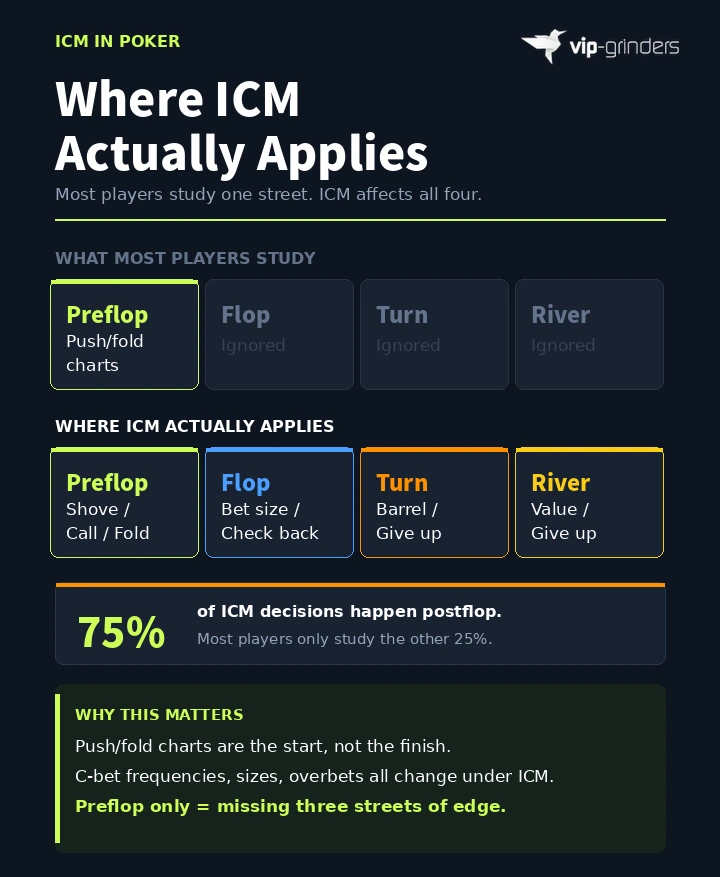
Postflop ICM: The Layer Most Players Ignore
Most ICM education stops at preflop push/fold decisions. But ICM changes how you play after the flop too. When you run the same spot in a solver with ICM turned on versus off, the differences are striking.
C-Bet Frequencies Drop
Under normal chip EV conditions, a solver might recommend betting the flop around 47% of the time in a single-raised pot. Under final-table ICM pressure, that same spot drops to around 25%. Checking more often preserves your stack: our continuation betting guide covers the full breakdown by spot.
Bet Sizes Drift Downward
ICM pushes optimal bet sizes smaller across all streets. Flop bets shift from 66% pot toward 33% pot, and turn and river bets shrink similarly. Smaller bets risk fewer chips while still accomplishing strategic goals like denying equity and extracting thin value.
When ICM pressure is high, your postflop game should shift toward smaller bets, more checking, and fewer big pots. Equity denial bets (small bets designed to fold out draws cheaply) become more valuable than large value bets because they accomplish the goal at lower risk.
ICM in Satellites and PKO Tournaments
Standard MTTs have a graduated payout structure where first place pays the most. Two popular formats break that structure in ways that dramatically change how ICM works.
Satellites: Where ICM Goes Extreme
In a satellite awarding 10 equal packages, every player who finishes in the top 10 receives exactly the same prize. There is zero incentive to accumulate chips beyond what you need to survive. This flat payout structure pushes bubble factors to extreme levels, routinely exceeding 5.0 and climbing past 10.0 for medium stacks.
The key principle in satellites is survival equals victory. For a complete guide to satellite-specific strategy, see our Sit and Go strategy guide, which covers similar flat-payout dynamics.
PKO / Bounty Tournaments
Progressive Knockout tournaments add a bounty layer on top of the standard payout structure. When you eliminate someone, you collect half their bounty immediately. This bounty reduces bubble factors because the immediate cash reward partially offsets the ICM risk of losing chips.
- Bounties act as a counter-ICM force. They incentivize calling wider (not tighter) because the immediate cash reward partially compensates for the ICM risk of losing chips.
- Bubble factors drop below 1.0 in some PKO spots, meaning you should actually call wider than you would in a cash game. This happens when the bounty value is large relative to the pot.
- The bigger your accumulated bounty, the more opponents target you. A large bounty on your head means other players have extra incentive to call your shoves, which reduces your fold equity.
PKO tournaments require looser calling ranges than standard MTTs in spots where a bounty is at stake. For knockout-specific adjustments, see our bounty tournament strategy guide.
Final-Table Deals: Chip Chop vs ICM Chop
When a final table agrees to split the remaining prize pool instead of playing it out, the method used to divide the money matters.
| Method | How It Works | Who Benefits |
|---|---|---|
| Equal Split | Divide remaining pool equally among all players | Short stacks (they get more than their equity) |
| Chip Chop | Divide proportionally to chip counts | Big stacks slightly (ignores payout curve) |
| ICM Chop | Use ICM $EV to calculate each player’s share | Most mathematically fair for all |
How to Evaluate a Deal
Most deal structures do not award the full remaining prize pool via ICM chop. A percentage (commonly 10% to 20%) is left on the table to be played for by the eventual winner. Each player locks in their ICM share of the larger portion and then plays for the remainder with reduced pressure.
When someone proposes a deal, plug the chip counts and payout structure into an ICM calculator before agreeing to anything. If the proposed split gives you less than your ICM equity, decline or renegotiate.
One common mistake: accepting a deal based on “feel” without running the numbers. Any free ICM calculator takes 30 seconds and can be the difference between a fair deal and a costly one.
The Eight Most Costly ICM Mistakes
Most ICM errors come from applying cash game logic to tournament spots where the math works differently.
Mistakes 1, 4, and 8 are the most common at low and mid stakes, and mistake 1 costs the most per occurrence because it happens multiple times per tournament.
ICM Limitations: What the Model Gets Wrong
ICM assumes every player at the table is equally skilled. It treats chip stacks as the only input, ignoring the fact that a world-class pro with 20bb has a very different expectation than a recreational player with the same stack. ICM also consistently undervalues the chip leader, who can bully opponents and force medium stacks into defensive positions.
ICM also ignores three structural factors that affect every hand:
- Position: ICM does not know whether you are on the button or under the gun. A player about to act last for three hands has a structural advantage that the model ignores.
- Blind level: ICM treats a 20bb stack the same whether blinds are about to increase or stay flat for another hour. In reality, a stack that is about to shrink to 15bb after a blind increase is worth less than ICM suggests.
- Future game dynamics: ICM calculates a snapshot of the current moment. It does not account for what happens in the next hand, the next orbit, or the next blind level. It cannot model table draws, seat changes, or player tendencies.
Two newer models attempt to fix some of these gaps:
- Future Game Simulation (FGS): simulates future hands and blind progressions instead of taking a single snapshot. This produces more accurate equity estimates for deep-stacked spots where many hands remain to be played. ICMIZER 3 and GTO Wizard both support FGS.
- Dependent Chip Model (DCM): adjusts for skill differences between players by weighting chip stacks with a skill modifier. Less widely available in consumer tools but used in academic poker research.
For most players, standard Malmuth-Harville ICM remains the right tool. FGS and DCM are improvements at the margins, but the core model gets the big decisions right in the vast majority of tournament spots.
ICM Tools Compared
Studying ICM without a calculator is like studying pot odds without knowing your outs. Four tools cover the full range of ICM study needs.
| Tool | ICM Support | PKO | FGS | Price | Best For |
|---|---|---|---|---|---|
| ICMIZER 3 | Up to 2,500 players | Yes | Yes | ~$15 to $80/mo | MTT and PKO specialists |
| Holdem Resources Calculator | Up to 256 players | Limited | No | ~$100 one-time | SNG grinders |
| GTO Wizard ICM | Full postflop solver | Yes | Yes | Included in subscription | Postflop ICM study |
| SnapShove | Push/fold only | No | No | Free / ~$30 | Quick preflop reference |
For MTTs and PKOs, ICMIZER 3 is the industry standard with fields up to 2,500 players and FGS support. For SNG grinders, Holdem Resources Calculator offers one-time pricing and fast final-table calculations. For postflop ICM, GTO Wizard is the only consumer tool that solves with ICM factored in.
SnapShove is a free mobile push/fold reference but uses chip EV rather than true ICM: treat it as a starting point, not a final answer.
For reviews and setup guides, see our poker tools hub. For integrating solver study into your routine, see our GTO and solvers guide.
Live ICM Heuristics (No Calculator at the Table)
At a live final table, you cannot run an ICM calculator between hands. Three shortcuts get you close enough to avoid the biggest mistakes.
These shortcuts are guardrails, not replacements for proper ICM calculations. The core principle behind all three: when in doubt at a live final table, the conservative decision is usually closer to correct than the aggressive one.
Run any spot through our Final Table ICM Calculator afterward to see the actual numbers.
Frequently Asked Questions
What does ICM stand for in poker?
ICM stands for Independent Chip Model. It is a mathematical formula that converts tournament chip stacks into real-money equity by estimating how often each player will finish in each paid position, based on stack sizes and the payout structure.
How is ICM calculated?
ICM uses the Malmuth-Harville algorithm. It takes three inputs (players remaining, each player’s chip stack, and the payout structure) and runs every possible finishing order weighted by probability. Each player’s probability of finishing first equals their chip percentage. Conditional probabilities determine second, third, and so on. The total across all finishing positions is that player’s dollar equity.
Does ICM apply to cash games?
No. ICM only applies to tournaments and sit and gos where a payout structure exists. In cash games, every chip is worth exactly its face value at all times. There is no finishing order, no pay jumps, and no reason for chip values to change.
When does ICM matter most in a tournament?
ICM pressure builds once roughly half the field is eliminated and peaks between 2x and 3x the bubble. It is also very strong at the start of a final table (where the largest absolute dollar gaps exist between finishing positions) and at its most extreme in satellite tournaments with flat payout structures.
What is the difference between chip EV and dollar EV?
Chip EV treats every chip as equally valuable, the same way cash games work. Dollar EV ($EV) uses ICM to convert chips into their real-money value, which accounts for the fact that chips lost cost more than chips gained in a tournament. A play can be profitable in chip EV and unprofitable in dollar EV at the same time.
Should I fold pocket Aces because of ICM?
In standard MTTs, almost never. In satellites with flat payouts, yes, in specific spots. If you have a comfortable stack, two shorter stacks are all-in against each other, and one of them busting guarantees your seat, folding Aces is correct because calling risks a guaranteed prize for chips you do not need. This only applies in satellite formats with equal payouts for all qualifiers.
What is an ICM chop at a final table?
An ICM chop is a deal where remaining players split the prize pool according to each player’s ICM equity rather than playing it out. It is the most mathematically fair method because it accounts for the curved relationship between chips and dollars. Most modern tournaments use ICM chop as the default when players agree to a deal, often leaving 10% to 20% of the pool for the eventual winner.
What are the best ICM calculators?
The four main tools are ICMIZER 3 (the industry standard for MTTs and PKOs, supports FGS and fields up to 2,500 players), Holdem Resources Calculator (best for SNGs, one-time purchase), GTO Wizard (the only tool that solves postflop ICM), and SnapShove (free push/fold reference, but uses chip EV rather than ICM). For most players, ICMIZER 3 or GTO Wizard covers everything needed.