

Bounty Tournament Strategy: PKO, Mystery Bounty & Knockout Guide 2026
In a bounty tournament, you win cash every time you eliminate an opponent. That cash comes on top of the regular prize pool, which means every all-in decision carries a second layer of value that does not exist in standard tournaments. The math for calling, shoving, and folding changes because of it, and players who ignore the bounty component leave significant money behind.

Three bounty formats dominate online and live poker today: Standard Knockout (KO), Progressive Knockout (PKO), and Mystery Bounty. Each one uses a different payout mechanic, and each one requires different strategic adjustments. A play that prints money in a PKO can be a clear mistake in a Mystery Bounty, and vice versa.
Here is what this guide covers:
- How each bounty format works: Standard KO, PKO, and Mystery Bounty
- How to convert a bounty into chip value for accurate pot odds calculations
- How your calling ranges change by tournament stage and stack size
- When to late-register (or skip late-reg) depending on the format
- The five most common bounty tournament mistakes and how to avoid them
If you are new to tournament poker entirely, start with our MTT strategy guide first.
What Are Bounty Tournaments and How Do They Work
A bounty tournament is any poker tournament where part of the buy-in goes into a separate bounty prize pool. When you eliminate a player, you receive a cash reward from that pool on top of whatever you earn from the regular prize structure. The result is two sources of income in a single event: the standard payout for finishing high, and direct cash for every opponent you knock out.
This changes the fundamental math of tournament poker. In a standard MTT, the only way to profit is to survive deep into the payout structure, but in a bounty tournament you can profit from a single elimination even if you bust shortly after. That shifts calling ranges, shoving ranges, and how you think about risk at every stage.
Three formats, three different strategies. The correct play in one bounty format can be a costly mistake in another. The comparison table later in this section breaks down all three side by side.
Standard Knockout (KO)
In a Standard Knockout tournament (also called KO or SKO), every player has a fixed bounty on their head for the entire event, typically equal to half the buy-in. In a $20 KO tournament, $10 goes to the regular prize pool and $10 becomes the bounty. If you eliminate someone, you receive their full $10 bounty in cash immediately.
The bounty stays the same dollar amount from the first hand to the last. It does not grow. If you eliminate three players, you collect three separate $10 payments regardless of when those knockouts happen.
- Bounty allocation: typically 50% of the buy-in goes to bounties, 50% to the regular prize pool.
- Payout mechanic: you receive the full bounty in cash instantly when you eliminate a player. Nothing rolls onto your own head.
- Bounty trend: fixed in dollar terms throughout the tournament. However, the bounty loses chip-equivalent value as stacks grow deeper into the event.
Standard KOs are the simplest bounty format and the easiest to adjust for. The bounty is a known, fixed number, so you just add it to the pot when calculating whether a call is profitable.
Progressive Knockout (PKO)
A Progressive Knockout tournament works differently. When you eliminate someone, you receive 50% of their current bounty in cash. The other 50% gets added to your own bounty, making you a more valuable target for everyone else at the table.
This is where the term “progressive” comes from: bounties grow as eliminations happen. A player who knocks out three opponents early has a much larger bounty on their head than someone who has not eliminated anyone. The eventual winner collects their own remaining bounty plus the runner-up’s, which is why first-place prizes in PKOs can be significantly larger than in standard MTTs.
Here is how the splitting works in practice. Suppose you enter a $22 PKO where $10 goes to the bounty pool. Every player starts with a $10 bounty on their head.
- 1You eliminate Player A (who has a $10 starting bounty). You receive $5 in cash (50% of their $10 bounty). Your own bounty grows from $10 to $15 (your original $10 + the other 50%).
- 2You then eliminate Player B (who also has a $10 starting bounty). You receive another $5 in cash. Your bounty grows from $15 to $20.
- 3If someone now eliminates you, they receive $10 in cash (50% of your $20 bounty) and add $10 to their own bounty.
Two important terms to know. The listed bounty is the total amount on a player’s head ($20 in the example above after two knockouts). The direct bounty is the cash you actually receive for eliminating them, which is always half the listed bounty ($10 in this case), and this is the number you use when calculating pot odds.
Most PKOs use a 50/50 allocation (half the buy-in to bounties, half to the regular prize pool), but some sites run different ratios. PokerStars has offered PKOs with 66% and even 100% of the prize pool in bounties, and the higher that percentage, the more aggressively you need to adjust your calling ranges.
Mystery Bounty
In a Mystery Bounty tournament, the bounty pool exists but no bounties are paid during the early phase of the event. The tournament plays as a standard freezeout (a regular tournament phase with no bounties active) until a set threshold is reached. In most online events this is the money bubble; in many live events it is Day 2.
Once that threshold is crossed, every knockout triggers a random prize draw. The eliminating player receives a bounty pulled from a pre-set distribution, and the values can range from small (near the buy-in amount) to massive (sometimes 100x or even 1,000x the buy-in). The WSOP Mystery Millions, for example, uses a $1,000 buy-in and the top envelope pays $1,000,000.
- Bounty allocation: typically 30% to 50% of the buy-in. WSOP Mystery Millions uses roughly 30% ($300 of $1,000). Most online events on PokerStars and GGPoker use 50%.
- Payout mechanic: random envelope draw from a fixed distribution. You do not know the value before calling. Most envelopes pay near the minimum; a few pay enormous prizes.
- Non-progressive: unlike PKO, nothing rolls onto your own head after a knockout. The incentive is purely to hunt opponents, not to protect your own growing bounty.
The key strategic implication is that you cannot know the bounty value before you make your decision. You might draw a minimum envelope or the top prize from the same pool, so the correct approach is to use the average bounty value (total remaining bounty pool divided by remaining players) as your input when calculating pot odds. Strategy based on hoping for a big envelope is mathematically wrong and will cost you money over time.
Format Comparison Table
| Attribute | Standard KO | PKO | Mystery Bounty |
|---|---|---|---|
| Bounty allocation | 50% of buy-in | 50% (some events 66% or 100%) | 30% to 50% |
| When bounties pay | Every elimination | Every elimination | After bounty phase only |
| Payout mechanic | Fixed cash per KO | 50% cash, 50% added to your bounty | Random envelope draw |
| Bounty grows? | No | Yes (compounds) | No |
| ICM pressure | Slightly reduced | Significantly reduced | Significantly reduced (when active) |
| Variance | Lower than MTTs | Lower than MTTs | Higher than MTTs |
| Late-reg? | OK but not ideal | Avoid | Recommended |
| Best for | Beginners | Volume grinders | High-variance players |
This table is the quickest way to understand the core differences. If you only remember one thing from this section, remember the late-registration row: the correct approach is the exact opposite in PKO (avoid it) versus Mystery Bounty (embrace it). The reasons why are covered in full later in this guide.
The Core Math: How Much Is a Bounty Worth?
The single most important skill in bounty tournaments is knowing how much a bounty is actually worth in chips so you can add it to your pot odds calculation. In a standard MTT, you compare the pot size to the cost of calling and figure out how much equity (your chance of winning the hand) you need. In a bounty tournament, you do the same thing but add the bounty value to the pot before calculating.
The tricky part is converting the bounty from dollars into chips. The formula below handles that conversion.
The Chip Conversion Formula
To convert a bounty from dollars into chips, you need two numbers: the total chips in play across the entire tournament, and the total remaining prize pool in dollars. The ratio between them tells you how many chips each dollar is worth.
Chips per dollar = Total chips in play / Total remaining prize pool
Once you have that number, multiply it by the direct bounty (the cash you would actually receive for the knockout, NOT the listed bounty). The result is the bounty’s value in chips, which you add to the pot.
Here is a concrete example. A PKO tournament has 150 entries with 5,000 starting chips each. The buy-in is $22 with $10 going to the bounty pool and $10 to the regular prize pool (plus $2 rake).
- 1Total chips in play: 150 × 5,000 = 750,000 chips.
- 2Total remaining prize pool: 150 × $10 = $1,500 (regular prize pool only; the bounty pool is separate).
- 3Chips per dollar: 750,000 / $1,500 = 500 chips per dollar.
- 4Direct bounty value: the opponent has a $10 starting bounty. Your direct bounty (50%) is $5. In chips: $5 × 500 = 2,500 chips.
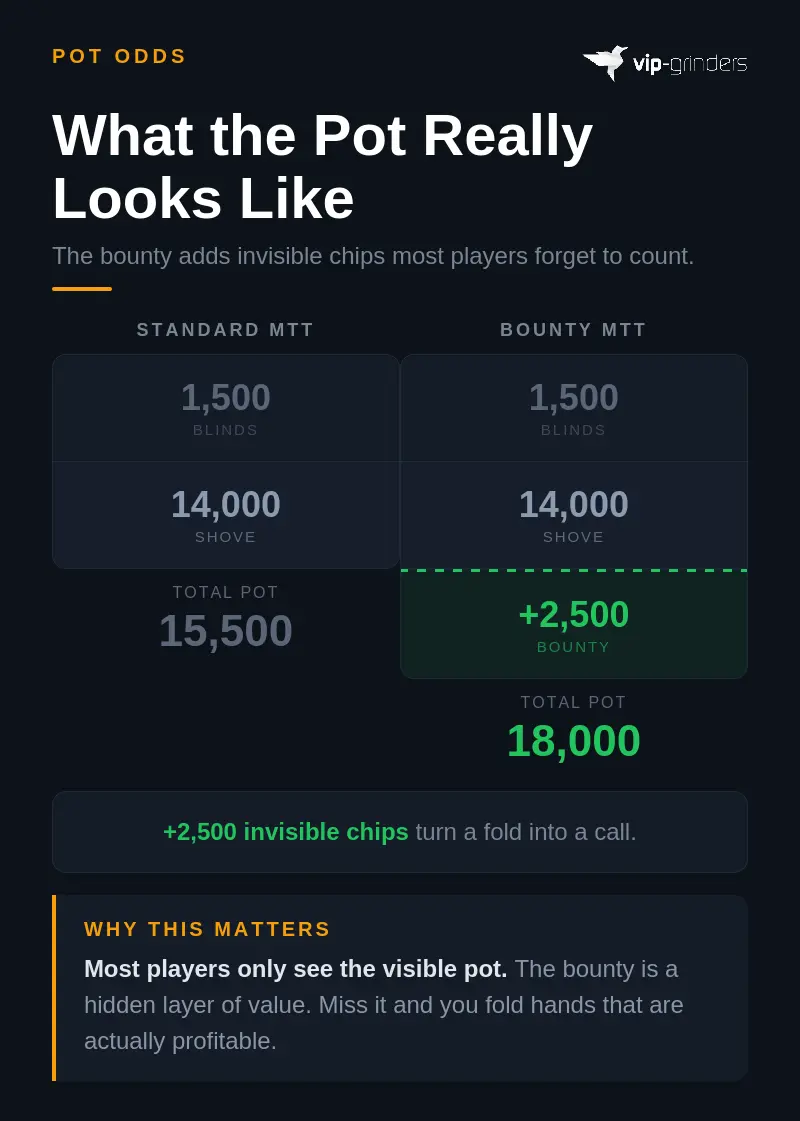
So when this opponent shoves and you are deciding whether to call, you add 2,500 chips to the pot before doing your equity math. That is half a starting stack of extra value sitting in the pot that does not exist in a standard MTT. This is exactly why calling ranges in bounty tournaments are wider than in regular events.
The 1/3 Starting Stack Rule (PKO Quick Math)
The chip conversion formula is precise, but doing the full calculation at the table takes time. There is a faster shortcut that works well enough for in-game decisions at the start of a standard 50/50 PKO.
At the beginning of a PKO, a starting bounty is worth roughly one third of a starting stack in chips.
The math behind this shortcut: in a 50/50 PKO, the direct bounty is 25% of the total buy-in (half of the 50% bounty allocation). The full chip conversion formula gives a slightly higher figure, but for quick in-game decisions, one third is close enough.
- Example: 5,000 starting stack, $10 starting bounty ($5 direct). The bounty is worth roughly 1,666 chips, which is one third of 5,000.
- In practice: if an opponent shoves for 10 big blinds early in a PKO and you cover them, mentally add roughly 3.3 big blinds of bounty value to the pot before deciding.
- Limitation: this rule works best in the early levels of a 50/50 PKO. As the tournament progresses and bounties compound, the ratio shifts. The full chip conversion formula is more accurate in later stages.
Average Bounty Value in Mystery Bounties
Mystery Bounty tournaments require a different approach because you do not know what any individual envelope is worth until you open it. The correct mathematical input is the average bounty value: divide the remaining bounty prize pool by the number of remaining players.
Average bounty = Remaining bounty pool / Remaining players
Here is an example. A $200 Mystery Bounty event with 1,000 entries has a $100,000 bounty pool (50% allocation), and the bounty phase activates when 100 players remain. At that point, your average bounty per knockout is $100,000 / 100 = $1,000 per elimination.
That $1,000 average is what you use in your pot odds calculations, not the top envelope and not the minimum. The actual envelope you draw is random, but across many tournaments your results will converge on the average. Any strategy that chases the big prize or plays scared because most envelopes are small will lose money over time.
Worked Example: Calling an All-In With a Bounty
Putting it all together. You are in the big blind of a PKO tournament with blinds at 500/1,000, and the cutoff shoves for 14,000 chips (14 big blinds). You cover them, their listed bounty is $10 (starting bounty), and you hold J♥ 9♥.
| Step | Calculation | Result |
|---|---|---|
| 1. Pot without bounty | SB (500) + BB (1,000) + shove (14,000) = 15,500. Call cost = 13,000. | 13,000 / 28,500 = ~46% equity needed |
| 2. Add bounty to pot | Direct bounty = $5 × 500 chips/$ = 2,500 chips. New pot = 18,000. | 13,000 / 31,000 = ~42% equity needed |
| 3. Compare | J♥ 9♥ vs 14bb CO shove range = ~38% to 42% equity. | Without bounty: fold. With bounty: profitable call. |
The bounty turned a losing call into a break-even or slightly winning one. Across thousands of tournaments, these marginal calls add up to a significant edge for players who account for the bounty and a significant leak for players who do not.
How Bounties Change Your Calling Ranges
Now that you know how to convert a bounty into chips, the next question is: how much wider should you actually call? The answer depends on the stage of the tournament, whether you cover the opponent or they cover you, and what percentage of the buy-in went into the bounty pool. This section gives you the specific numbers.
In a standard MTT with no bounty, you typically need somewhere between 43% and 50% equity to call an all-in depending on the pot odds and ICM situation. In a bounty tournament, that threshold drops because the bounty adds extra value to the pot. The bigger the bounty relative to the pot, the lower your equity threshold goes.
Equity Threshold by Tournament Stage
The bounty has its biggest impact early in the tournament when stacks are small relative to the bounty’s chip value. As the tournament progresses and stacks grow deeper, the bounty becomes a smaller percentage of the total pot, and its impact on your calling threshold shrinks.
The table below shows approximate equity thresholds for calling an all-in when you cover the opponent in a 50/50 PKO with starting bounties.
| Stage | Without bounty | With bounty (50/50 PKO) | Equity drop |
|---|---|---|---|
| Early (starting stacks) | ~45% to 50% | ~33% to 37% | 12 to 15 points |
| Middle (20 to 40 BB avg) | ~44% to 48% | ~36% to 40% | 8 to 10 points |
| Late (10 to 20 BB avg) | ~43% to 46% | ~40% to 43% | 3 to 5 points |
The “equity drop” column is the key takeaway. Early in a PKO, the bounty reduces your required equity by 12 to 15 percentage points, which is enormous. Hands like K8 suited, Q9 suited, and pocket fives become clear calls against a shove that you would fold in a standard tournament.
By the late stages, the equity drop shrinks to just 3 to 5 points. The bounty still matters, but it no longer turns clear folds into calls. It mostly turns close folds into close calls.
Covering vs Being Covered
Not every bounty situation is equal. Whether you can win the opponent’s bounty depends entirely on who has the bigger stack.
- You cover the opponent: if your stack is bigger than theirs, you can eliminate them and win the bounty. The full equity drop applies. Call wider.
- The opponent covers you: if their stack is bigger than yours, you cannot eliminate them even if you win the hand. You get zero bounty value from this call. Use standard MTT calling ranges.
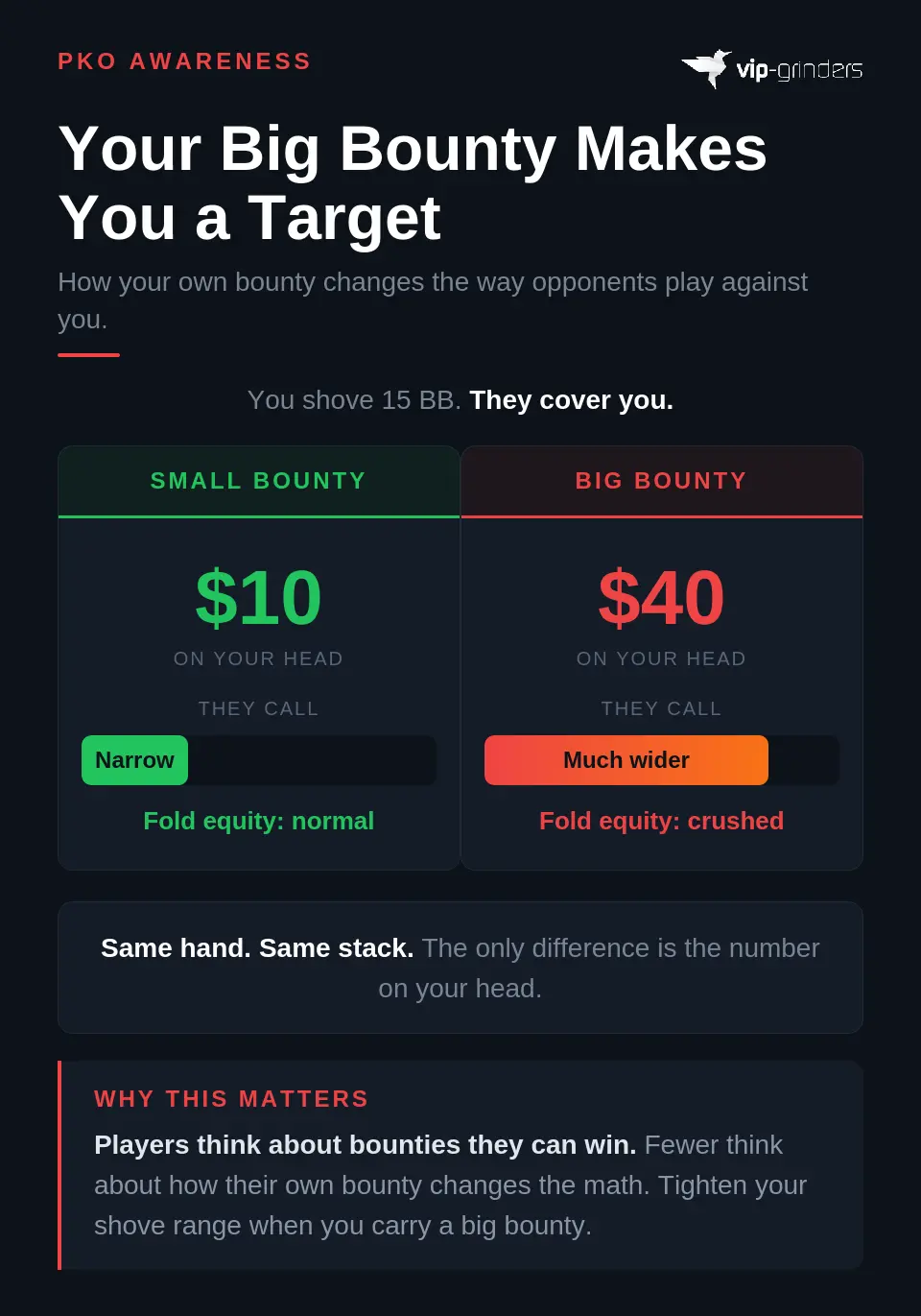
- Important flip side: when you are the short stack, the opponent who covers you is incentivized to call YOU wider because your bounty is in play for them. This means your shoves get called more often, so tighten your shoving range slightly when covered by a large stack.
This asymmetry is one of the most misunderstood parts of bounty tournaments. Many players call too wide when they do not cover the opponent (no bounty to win) and shove too wide when they are the short stack (getting called lighter than they expect). Understanding which side of the equation you are on before every decision is critical.
Bounty Allocation Sensitivity
Not all bounty tournaments use a 50/50 split, and the percentage of the buy-in that goes to bounties directly affects how much wider you should call. A 25% bounty allocation barely changes your ranges. A 100% allocation changes them dramatically.
| Bounty allocation | Example format | Early-stage equity drop | Strategic impact |
|---|---|---|---|
| 25% | Some live KOs | 5 to 7 points | Slight loosening only |
| 30% | WSOP Mystery Millions | 7 to 9 points | Moderate loosening |
| 50% | Standard PKO | 12 to 15 points | Major range widening |
| 66% | PokerStars special PKOs | 16 to 19 points | Very aggressive calling |
| 100% | PokerStars all-bounty PKOs | 20+ points | Near-any-two when covering |
Most strategy articles assume a 50% allocation and stop there. In practice, you should check the allocation before registering because it determines how aggressively you need to adjust. A 30% Mystery Bounty plays much closer to a standard MTT than a 66% PKO, even though both are bounty tournaments.
How Bounties Reduce ICM Pressure
In a standard MTT, every chip you risk near the bubble or at the final table is subject to ICM (the Independent Chip Model). ICM says your chips are worth less per unit the more you have, which makes calling all-ins expensive because you risk more in tournament equity than you stand to gain. This is covered in full in our ICM guide.
Bounty tournaments change this dynamic because the bounty prize pool operates on chip-EV: every dollar you win from bounties is worth exactly one dollar regardless of your stack size. If you eliminate someone and collect $50 in bounty cash, that $50 is yours no matter how many chips you have.
- Regular prize pool: still subject to ICM. Calling is expensive in tournament equity terms.
- Bounty pool: chip-EV. Every bounty dollar is worth the same regardless of stack size.
- The result: the bounty layer pulls against the ICM layer, reducing the overall pressure to fold and survive. This is why bounty tournament bubbles play noticeably looser than standard MTT bubbles.
PKO Strategy Stage by Stage
PKO is the most strategically complex bounty format because the bounty value changes throughout the tournament as eliminations compound. The correct approach in the early levels is different from the middle stages, which is different again from the bubble and final table. This section breaks down each stage.
Early Levels: Do Not Punt for Starting Bounties
The 1/3 rule from the previous section tells you that starting bounties are worth significant chip value. That is true. But it does not mean you should call every shove in the first level just because a bounty is in play.
Your tournament life in the early stages has enormous future value. If you double up early, you become the covering stack at your table, which means every opponent’s bounty is in play for you. If you bust chasing a starting bounty with a marginal hand, you lose all of that future potential for a $5 cash payment.
- Good early call: you cover the opponent, you hold a suited broadway hand or a pocket pair (K9 suited, Q10 suited, small pairs), and the shove is 15 big blinds or less. The bounty pushes a marginal spot into profitable territory.
- Bad early call: you cover the opponent but hold a weak hand (K3 offsuit, 85 offsuit) against a 30 big blind shove. The bounty adds value, but not enough to overcome the massive equity deficit.
- The real early-game edge: focus on building a stack that covers the table. Every opponent you cover is a potential bounty you can collect. Stack building is more valuable than chasing any single starting bounty.
Middle Stages: Become the Covering Stack
The middle stages of a PKO (roughly 20 to 40 big blinds average) are where strong players build their edge. At this point, some players have been eliminated and their bounties have flowed upward to the players who knocked them out. The table now has a mix of starting bounties (players who have not eliminated anyone) and compounded bounties (players who have).
Your priority is to be the biggest stack at your table as often as possible. When you cover every opponent, every pot you contest has bounty value attached to it. When you are the short stack, none of those bounties are available to you.
- Target the short stacks: players with 10 to 15 big blinds are in shove-or-fold mode. If you cover them, every all-in confrontation carries bounty value on top of the pot. Isolate these players when you have reasonable holdings.
- Avoid unnecessary risks against big stacks: if another player covers you, they have the bounty incentive to call you wider. Getting into a flip against a bigger stack means you risk your tournament and your accumulated bounty with no bounty reward if you win.
- Watch for large bounties: a player who has knocked out three or four opponents may have a listed bounty of $40 or more in a $22 PKO. Covering and eliminating that player is worth $20 in direct cash. Factor that into your decision to call or iso-raise.
Bubble Play in PKOs
In a standard MTT, the bubble is where most players tighten up dramatically. The pay jump from zero to a min-cash is the biggest percentage increase in the payout structure, which makes calling all-ins expensive in ICM terms. For a complete breakdown, see our tournament bubble strategy guide.
In a PKO, the bubble still matters, but the bounty layer reduces the survival incentive. If you cover a short stack on the bubble and can win their bounty by calling, the bounty value partially offsets the ICM cost. Covering stacks on a PKO bubble can call wider than they would on a standard MTT bubble, which creates a dynamic that works in both directions.
- If you are the big stack on the bubble: you can apply enormous pressure. Short stacks know you are calling wider because of the bounty, which means they cannot shove as light as they would against a standard MTT big stack. You win more pots uncontested and collect bounties when called.
- If you are a short stack on the bubble: your fold equity is lower than in a standard MTT because big stacks are incentivized to call. Tighten your shoving range compared to a vanilla bubble. You need stronger hands to compensate for the fact that you will get looked up more often.
Final Table and Heads-Up in PKOs
At a PKO final table, bounties are at their largest, with some players carrying listed bounties worth 5x or 10x the starting bounty. These compounded bounties make final table pots extremely valuable, and the math shifts toward more aggressive play than at a standard MTT final table. For general final table principles, see our final table strategy guide.
- Heads-up bounty: when two players remain, the winner eliminates the runner-up and collects 50% of their bounty in cash, then also collects their own entire remaining bounty. In a $22 PKO with 150 entries, the winner’s total bounty payout alone can exceed $500.
- Deal-making warning: most ICM deal calculators do not include bounty value. Deals that look fair on paper may undervalue the chip leader’s position. If you are the chip leader with a large bounty on every remaining opponent, be cautious about accepting deals that only account for the regular prize pool.
Mystery Bounty Strategy
Mystery Bounty tournaments play fundamentally differently from PKOs because the bounty pool is inactive for the first phase of the event and randomized once it activates. This means the correct strategy shifts dramatically at a single point in the tournament: the moment bounties turn on. Understanding each phase is critical because a mistake in timing costs more than a mistake in hand selection.
Phase 1: The Freezeout (Play Standard MTT Poker)
Before the bounty phase activates, there is zero bounty value in the tournament: no envelopes, no cash for knockouts, nothing. This phase plays exactly like a standard freezeout MTT. Use your normal opening ranges and standard tournament adjustments.
- Do not widen ranges early: the bounty pool does not exist strategically until the threshold is crossed. Every decision should be evaluated purely on regular prize pool equity and ICM.
- The one exception is stack building: if you accumulate chips during the freezeout, you enter the bounty phase as a covering stack. Every opponent you face after activation has a bounty you can win. Players who build large stacks in Phase 1 have a structural advantage in Phase 2.
Phase 2: Bounty Activation (Aggression for Covering Stacks)
The moment bounties activate, the math changes instantly. Every knockout now carries an average bounty value that can be worth multiple buy-ins in some structures. Covering stacks should shift to significantly more aggressive play.
Recall the average bounty formula from earlier: remaining bounty pool divided by remaining players. In many online Mystery Bounty events, this average starts at 3x to 5x the buy-in the moment the bounty phase begins. That is enough extra value to turn many standard folds into clear calls.
- If you cover opponents: widen your calling and shoving ranges aggressively. The average bounty adds so much value to the pot that hands like K7 suited, Q8 suited, and low pocket pairs become profitable calls against short stack shoves.
- If you are a short stack: your situation is worse than in a standard MTT. Bigger stacks are calling you wider because of the bounty incentive. Tighten your shove range and look for spots where multiple big stacks are fighting each other instead of targeting you.
- Prioritize covering: if two tables are available and one has three short stacks you cover, that table is significantly more profitable. Table selection (where available) becomes a direct source of EV in the bounty phase.
The Disappointment Effect (When Big Envelopes Are Pulled)
One of the most common mistakes in Mystery Bounty tournaments happens after the largest envelopes are drawn and publicly announced. Players hear that the top prize is gone and immediately tighten up, feeling like the remaining envelopes are not worth fighting over.
This reaction is emotionally understandable but mathematically wrong. The average bounty value barely changes when one large envelope is removed from a pool of hundreds. The payout distribution is heavily weighted toward the minimum values, so removing the top prize has a smaller effect on the average than most players assume.
- The edge: if half the table tightens up while you maintain the same wide calling ranges, you are exploiting their incorrect adjustment. This is one of the most reliable edges in Mystery Bounty tournaments.
Late Stages and Final Table in Mystery Bounties
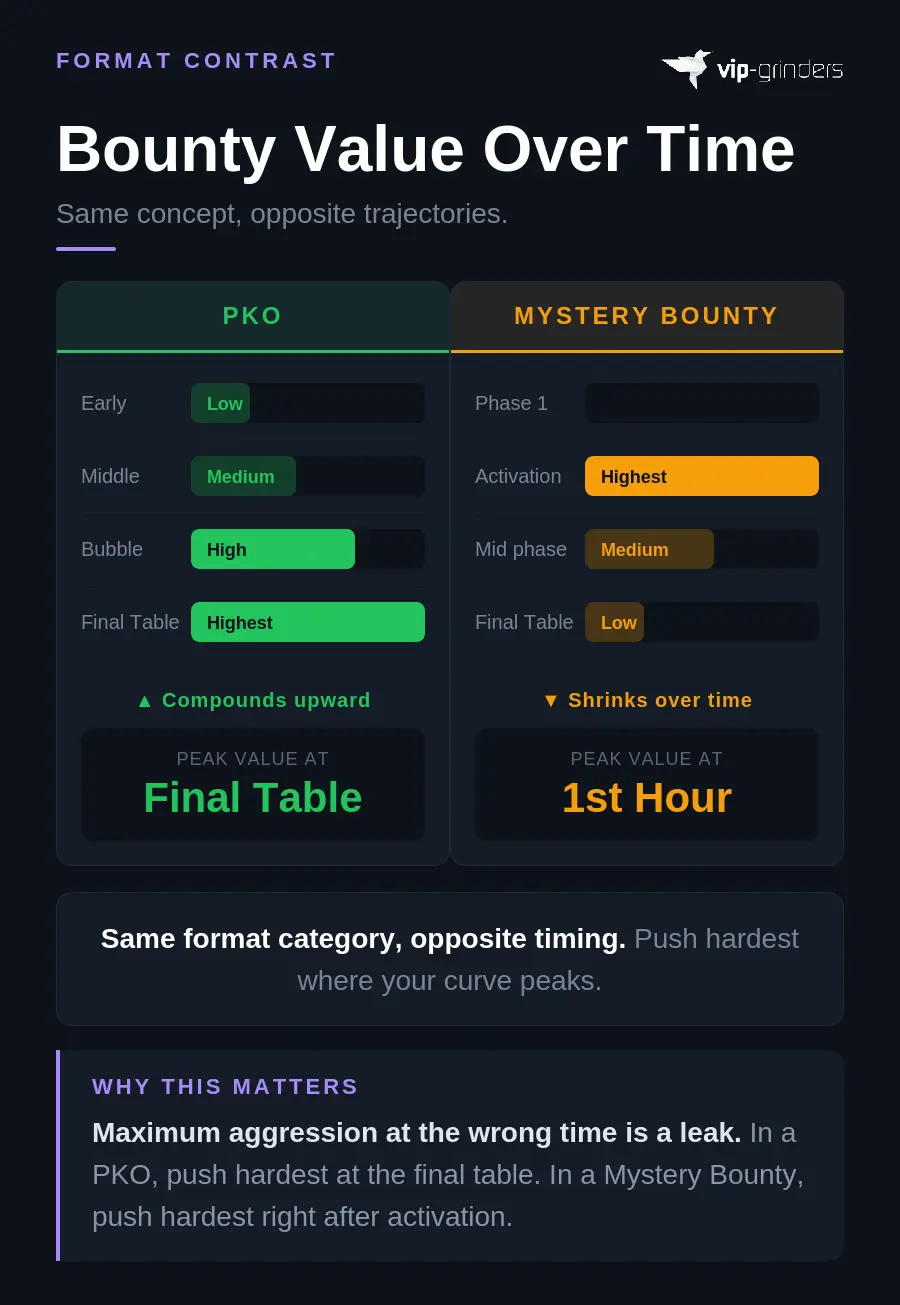
As the field shrinks in a Mystery Bounty, the average bounty value per knockout decreases because envelopes are being pulled from the pool with every elimination. Unlike in a PKO where bounties compound and grow larger, Mystery Bounty value trends downward over time.
This means the late stages and final table of a Mystery Bounty play closer to a standard MTT than the early bounty phase. ICM pressure returns to near-normal levels because the bounty layer is shrinking. Players who were correctly aggressive in Phase 2 should gradually tighten their ranges as the field gets smaller and the average envelope value drops.
- Early bounty phase (100 players remaining): maximum aggression when covering. Average bounty is at its highest.
- Mid bounty phase (30 to 60 players): average bounty has dropped but is still meaningful. Play aggressively when covering but begin respecting ICM more.
- Final table (9 or fewer): the remaining bounty pool is small. Strategy converges toward standard MTT final table play with only a minor bounty adjustment.
This downward trend is the exact opposite of PKOs, where bounty value increases as the tournament progresses because of compounding. In a PKO, the final table is where the biggest bounty payouts happen, but in a Mystery Bounty, the biggest payouts happen in the first hour after activation. Understanding this contrast is the key to adjusting between formats.
Late Registration in Bounty Tournaments
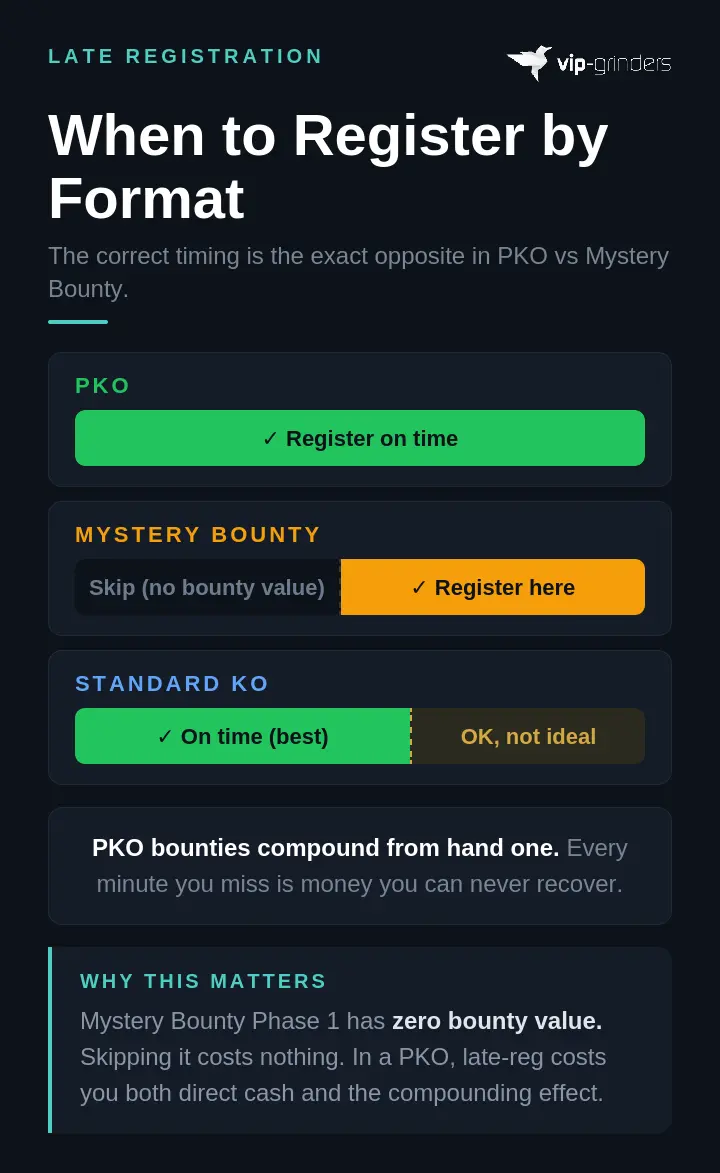
Late registration strategy is one of the clearest differences between bounty formats, and getting it wrong costs real money. The correct approach in a PKO is the exact opposite of the correct approach in a Mystery Bounty. This section explains why.
PKO: Why You Should Almost Never Late-Reg
Every bounty that gets paid out before you sit down is a bounty you can never win. In a PKO, bounties also compound: early eliminations grow your own bounty, which increases the value of future pots you contest. By late-registering, you forfeit both the direct cash and the compounding effect.
- On-time player: registers a $22 PKO, eliminates two opponents in the first hour, collects $10 in direct cash, bounty grows from $10 to $20.
- Late-reg player: starts with a $10 bounty, a below-average stack, and zero bounty earnings. The gap is significant and it never closes.
The only exception is if the alternative is not playing at all. A late-registered PKO is still better than no PKO. But if you have the choice, register on time.
Mystery Bounty: Late-Reg Close to the Bounty Phase
Mystery Bounty tournaments flip this logic. The pre-bounty freezeout phase has zero bounty value. If you can skip this phase and register close to when bounties activate, you avoid the dead period and enter when every elimination is worth real money.
Dara O’Kearney, co-author of the most widely cited PKO strategy book, explicitly recommends this approach. You sacrifice some chip equity by entering with a below-average stack, but you gain by skipping a phase where your expected bounty earnings are zero.
Bankroll Management for Bounty Formats
Bounty tournaments affect your bankroll requirements because each format has a different variance profile. The immediate cash payouts in KO and PKO formats smooth your results compared to standard MTTs, but Mystery Bounty adds an extra layer of randomness that pushes variance higher. Your bankroll should reflect these differences.
| Format | Recommended bankroll | Why |
|---|---|---|
| Standard KO | 80 to 100 buy-ins | Fixed cash per KO smooths results slightly vs standard MTTs |
| PKO | 75 to 100 buy-ins | Immediate cash + compounding reduces variance further |
| Mystery Bounty | 100 to 150 buy-ins | Envelope RNG adds variance on top of normal MTT swings |
| Standard MTT (comparison) | 100 to 150 buy-ins | No bounty smoothing; top-heavy payouts drive high variance |
Five Common Mistakes in Bounty Tournaments
Most bounty tournament losses come from the same handful of errors repeated across formats. Each one feels justified in the moment and costs real equity over time.
- Calling any two cards because a bounty is in play. The bounty widens your ranges, it does not eliminate them. You still need 33% to 40% equity in most spots. Calling with 8-3 offsuit because you cover the opponent is burning money.
- Ignoring your own bounty size in PKOs. If you have knocked out several players, your listed bounty is large. Opponents who cover you are incentivized to call you wider than normal. Adjust your shoving range tighter when you are carrying a big bounty and facing a bigger stack.
- Treating all bounty tournaments the same. A 50% PKO plays very differently from a 30% Mystery Bounty. Check the allocation percentage before you register and adjust your strategy to match.
- Late-registering a PKO. You forfeit compounding opportunities and direct bounty cash. Unless the alternative is not playing, register on time.
- Tightening up after the big mystery bounty envelope is drawn. The average bounty value barely changes. Players who tighten here are giving away EV to the players who stay aggressive.
The VIP-Grinders Edge for Bounty Grinders
Bounty tournaments generate rake the same way any other MTT does, and that rake contributes to your earnings through rakeback deals. PKO grinders in particular benefit from the format’s lower variance: more consistent results mean more consistent volume, which means steadier rakeback accumulation over time.
- Tracked from day one: through VIP-Grinders, your account is tracked with access to exclusive freerolls and personal support for rakeback optimization.
- Best sites for bounty grinders: GGPoker Bounty Hunters, PokerStars Bounty Builders, and ACR Mystery Bounty Venoms all offer strong bounty schedules with rakeback through our deals.
Players who grind bounty formats without a tracked rakeback deal are leaving money on the table. Combining the strategy in this guide with a strong rakeback setup is the highest-EV approach. Check our MTT overlay guide for finding soft-field tournaments that stack on top of your bounty and rakeback earnings.
Frequently Asked Questions
What is a PKO in poker?
PKO stands for Progressive Knockout. It is a tournament format where part of the buy-in goes into a bounty pool. When you eliminate a player, you receive 50% of their current bounty in cash and the other 50% is added to your own bounty. Bounties grow (progress) as eliminations happen, which is why the format is called “progressive.”
What is a Mystery Bounty tournament?
A Mystery Bounty tournament is a format where bounties are not paid during the early phase. Once a set threshold is reached (usually the money bubble or Day 2), every knockout triggers a random prize draw from a fixed pool. Bounty values range from small amounts near the buy-in to massive prizes that can be 100x or more the entry fee.
How does bounty splitting work in PKO?
When you eliminate a player in a PKO, you receive 50% of their current listed bounty as immediate cash. The remaining 50% is added to your own bounty, making you a bigger target. The eventual tournament winner collects their own remaining bounty plus the runner-up’s remaining bounty in the heads-up finish.
Are bounty tournaments higher or lower variance than standard MTTs?
It depends on the format. Standard KO and PKO tournaments have lower variance than regular MTTs because the immediate bounty cash payments smooth your results. Mystery Bounty tournaments have higher variance because the random envelope draw adds an extra layer of luck on top of normal tournament variance.
Should I late-register a PKO?
No, unless the alternative is not playing at all. Every bounty paid out before you sit down is money you cannot win, and you also miss the compounding period where your own bounty grows. Register on time whenever possible.
Should I late-register a Mystery Bounty?
Yes, ideally as close to the bounty phase activation as possible. The pre-bounty freezeout phase has zero bounty value, so skipping it and entering near the bounty threshold lets you start playing when every knockout is worth real money.
How much bankroll do I need for PKO tournaments?
A bankroll of 75 to 100 buy-ins is reasonable for PKO grinders. The immediate cash payouts from bounties reduce variance compared to standard MTTs, which means you can sustain the same volume with a slightly smaller bankroll. For Mystery Bounty events, use 100 to 150 buy-ins because envelope RNG increases variance.
What is the disappointment effect in Mystery Bounty?
The disappointment effect is when players tighten up after the largest mystery bounty envelope is drawn and announced. This is a mistake because the average bounty value barely changes when one large prize is removed from a pool of hundreds. Players who maintain their aggression after the big draw gain an edge over those who slow down.
What is the best bounty format for beginners?
Standard Knockout (KO) is the simplest format. Bounties are fixed, paid in full on every elimination, and do not compound. The strategic adjustment is straightforward: add the bounty value to the pot and recalculate your pot odds. Once comfortable with KOs, move to PKOs which require understanding the progressive mechanic.
Do bounty tournaments count toward rakeback?
Yes. Bounty tournament buy-ins generate rake the same way standard MTTs do. The rake portion contributes to your VIP or rakeback program at whatever site you play. PKO grinders benefit especially because the lower variance supports more consistent volume, which means steadier rakeback accumulation.