

Big Blind Defense: Frequencies, 3-Bet Ranges & Rake Math 2026
You face a raise from the big blind more often than from any other position at the table. In a 6-max game, it happens roughly once every six hands. Over a 500-hand session, that is 80+ decisions where getting it wrong by even a few percentage points compounds into real money lost.
The big blind is the only position where you have already committed chips before seeing your cards. You are getting a discount on calls, which means you should defend wider than most players think. But playing out of position postflop with a capped range punishes loose calls, so the real answer sits between those two extremes.
For the other side of blind battles, our small blind strategy guide covers SB-specific defaults.
Here is what this guide covers:
- Defense frequencies by opener position and open size, with a table for quick reference
- 3-bet vs flat decisions and which hands belong in each category
- Rake adjustments by stake that show exactly how much to tighten at micros
- Postflop defaults for facing c-bets, check-raising, and multiple barrels from OOP
- Five BB defense mistakes that cost low and mid-stakes grinders the most bb/100
Why the Big Blind Is the Most Expensive Seat
The big blind is a forced loss. You post 1bb every orbit before seeing your cards, and you play every postflop pot from the worst position at the table. The benchmark for a good cash game regular at NL50 to NL200 is losing between −15 and −25 bb/100 from the big blind.
The goal is not to win from the big blind. It is to lose less than the 1bb you posted. Every hand you defend profitably, every 3-bet bluff that picks up the pot, and every well-timed check-raise narrows that gap.
- Frequency: You sit in the big blind roughly 16.7% of all hands in 6-max. No other single position accounts for this much of your total sample.
- Leverage: Improving your BB win rate by just 5 bb/100 (for example, from −30 to −25) translates to roughly 0.8 bb/100 overall. At NL100, that is an extra $80 per 10,000 hands from one positional fix.
How Wide to Defend: Frequencies by Opener Position
How wide you defend depends on the price the pot is offering, who opened, and how big they made it.
The Price You Are Getting
When the button opens to 2.5bb, the pot is 4bb (your 1bb + SB’s 0.5bb + the open) and you need to call only 1.5bb more. That is 2.67:1, roughly 27% equity to call profitably. No other position gets this discount because no other position has money already invested.
But raw pot odds overstate how wide you should actually defend. Two forces pull in the opposite direction.
- Equity realization: Playing out of position without the initiative means you cannot convert all of your raw equity into actual profit. Solvers show that BB realizes roughly 70% to 85% of its raw equity depending on hand type and board texture. Suited connectors realize well. Offsuit junk realizes poorly.
- Rake: Every pot you see a flop in gets taxed. At microstakes, that tax can erase the thin margin on bottom-of-range calls entirely. The rake section below covers this in detail.
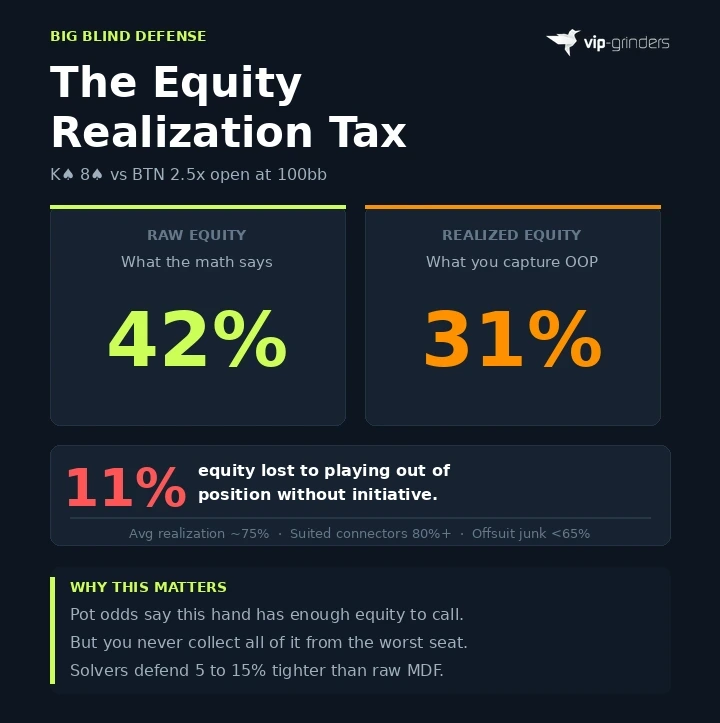
The result: solvers defend 5 to 15 percentage points tighter than pure MDF would suggest. If raw math says defend 65%, the real number after equity realization and rake is closer to 50% to 58%.
Defense Frequency Table
The table below shows how wide to defend based on who opened and what size they used. These numbers assume 100bb deep, 6-max cash, moderate rake (NL50 to NL200). At higher stakes shift 3% to 5% wider, and at microstakes shift 3% to 5% tighter.
| Opener | Size | Defend % | 3-Bet % | Flat % |
|---|---|---|---|---|
| BTN | 2bb | 58 to 64 | 12 to 14 | 46 to 50 |
| BTN | 2.5x | 52 to 58 | 11 to 13 | 41 to 45 |
| BTN | 3x | 33 to 38 | 9 to 11 | 24 to 27 |
| CO | 2.5x | 40 to 48 | 8 to 10 | 32 to 38 |
| HJ | 2.5x | 32 to 38 | 6 to 8 | 26 to 30 |
| LJ/UTG | 2.5x | 25 to 30 | 4 to 6 | 21 to 24 |
| SB | 2.5x | 55 to 62 | 13 to 16 | 42 to 46 |
| SB | 2bb | 60 to 68 | 14 to 17 | 46 to 51 |
The pattern: the later the opener’s position, the wider your defense. Against a UTG open (top 12% to 15% of hands), your K7o is crushed. Against a BTN open (top 40% to 50%), your K7o has real equity.
The average online player folds roughly 40% to 45% of their big blind facing a button open. Solver-optimal defense against a 2.5x BTN open is closer to 52% to 58%. That 10% to 15% gap is pure profit for the opener.
3-Bet or Call? The Decision Matrix
Every hand you defend faces a second question: 3-bet or flat call? Players who flat hands they should 3-bet give up fold equity preflop and end up in bigger pots OOP without the lead. Players who 3-bet hands they should flat turn playable implied-odds hands into high-variance coin flips.
When to 3-Bet from BB
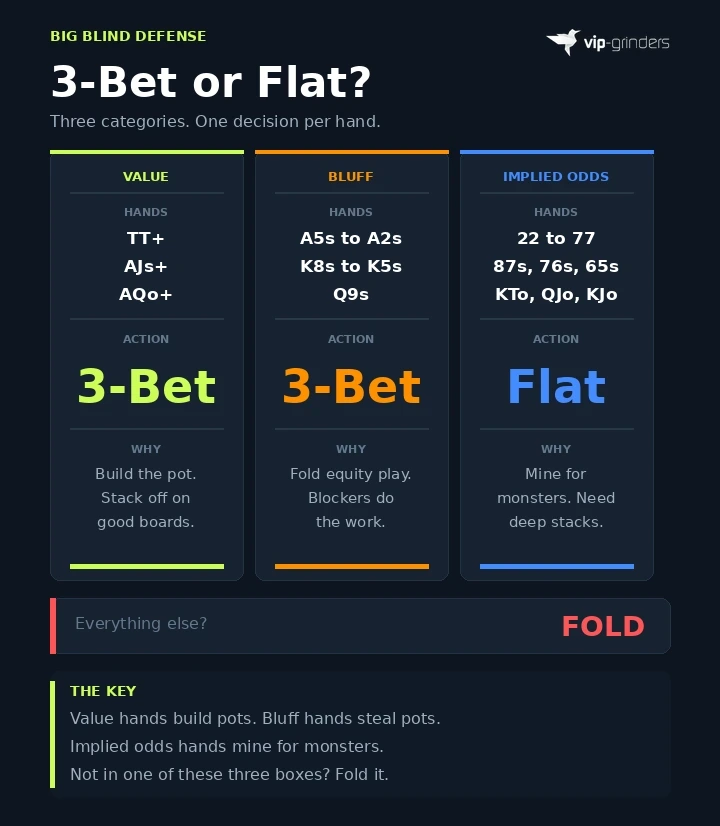
Your 3-bet range from the big blind should be polarized at 100bb: strong value hands at the top and blocker-heavy bluffs at the bottom.
| Category | Hands | Why |
|---|---|---|
| Pure value | TT+, AJs+, AQo+ | Build a pot, stack off on good boards |
| Blocker bluffs | A5s to A2s | Block AA/AK, nut flush backup |
| Secondary bluffs | K8s to K5s, Q9s | Block KK/KQ, low frequency vs LP |
Against a BTN open, this adds up to roughly 12% to 14% of all hands. Against UTG, it drops to 4% to 6% because UTG’s range is stronger and your bluffs get called or 4-bet more often.
3-bet bluffs from BB work because of fold equity. Most openers fold 55% to 65% of their range to a 3-bet. For the full theory on building 3-bet ranges across all positions, see our 3-bet strategy guide.
When to Flat
Hands that flat from the big blind share three traits: good implied odds, they flop well in single-raised pots, and they play poorly in 3-bet pots OOP.
- Small pairs (22 to 77): Set-mining hands. They flop a set roughly 12% of the time and win large pots when they do. In a 3-bet pot they face too much pressure on overcards without enough equity to continue.
- Suited connectors (87s, 76s, 65s): These hands make straights, flushes, and two-pair combos that are disguised against the opener's range. They need implied odds to be profitable, which means they work best at deeper stacks (80bb+) where you can win a big pot when you connect.
- Suited gappers (T8s, 97s, 86s): Similar logic to suited connectors but slightly weaker. These enter your flatting range primarily against BTN and CO opens where the opener's range is wide enough that your equity holds up.
- Broadway hands (KTo, QJo, KJo): Too strong to fold at the price BB is getting, but too weak to 3-bet OOP. They make top pair often enough to call one or two streets but face tough kicker decisions in big pots.
If a specific opponent folds to 3-bets more than 70% of the time, increase your bluff frequency from BB. A 10bb 3-bet into a 4bb pot breaks even at about 69% folds, so at 70%+ the play is profitable with any two cards. Against opponents who call or 4-bet more than 50%, cut the bluffs and 3-bet only for value.
How Rake Changes Your Defending Range
Every pot you see a flop in gets taxed, and that tax hits the big blind harder than any other position because you defend more often than anyone else. For a full breakdown of rake structures and calculation methods, see our rake explained guide.
| Stake | Rake (bb/100) | Defend Adjustment |
|---|---|---|
| NL10 | ~9 to 10 | 8% to 10% tighter |
| NL25 | ~7 to 8 | 5% to 7% tighter |
| NL50 | ~5 to 6 | 3% to 5% tighter |
| NL100 | ~3.5 to 4 | 2% to 3% tighter |
| NL200 | ~3 to 3.5 | Near baseline |
| NL500+ | ~2 to 2.5 | Baseline or wider |
The lower the stake, the tighter you defend. A hand like J4s vs a BTN open is a profitable defend at NL500 where rake is negligible. At NL10 it is a losing call because the rake eats the thin margin.
If you play through a room that offers rakeback, part of that tax comes back: a 30% deal at NL50 effectively drops your rake from ~5.5 bb/100 to ~3.8 bb/100, closer to NL200 levels. Players who sign up without a rakeback deal are playing a structurally tighter game than they need to. Check our rakeback deals to make sure you are not leaving value on the table.
Postflop Play After Defending from BB
Defending correctly preflop is only half the battle. What you do after the flop determines whether those calls actually show a profit. The challenge: you are out of position without the initiative, which means villain controls sizing, tempo, and information on every street.
Defending vs C-Bets by Sizing
A common mistake from the big blind is calling c-bets too often against large sizings. The bigger the c-bet, the more you fold. This is not weakness: it is math.
| C-Bet Size | Fold % | Continue % |
|---|---|---|
| 33% pot | 30% to 35% | 65% to 70% |
| 50% pot | 38% to 43% | 57% to 62% |
| 66% pot | 42% to 48% | 52% to 58% |
| 75% pot | 45% to 52% | 48% to 55% |
| 100% pot | 52% to 58% | 42% to 48% |
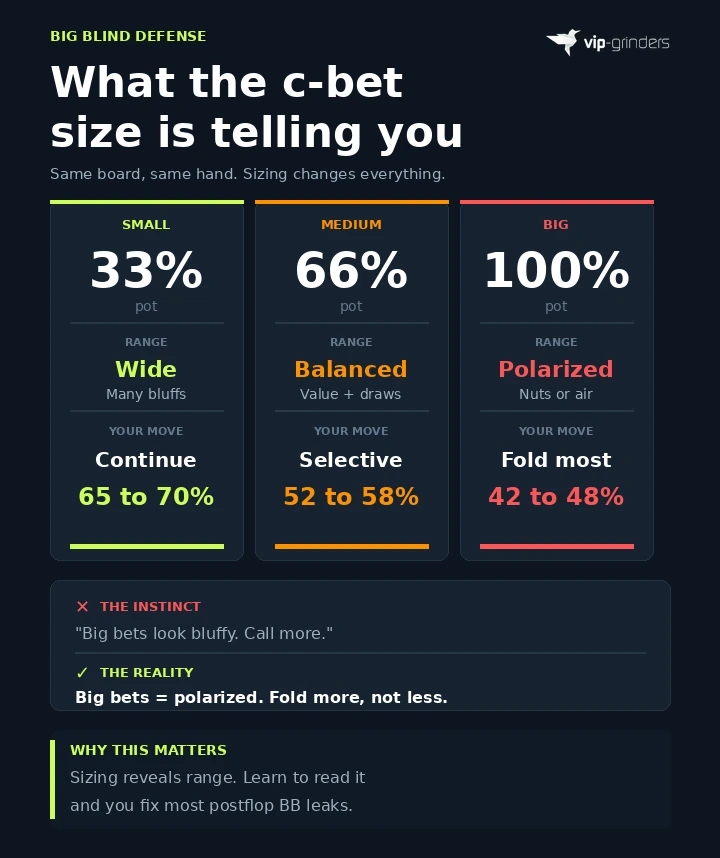
A 33% pot bet only needs to work 25% of the time, so villain c-bets very wide and you continue against most of that range. A pot-sized bet means villain is polarized toward strong hands and big draws. For the full picture from the aggressor’s side, see our continuation betting guide.
Check-Raise Frequencies by Board Texture
The check-raise is your most powerful postflop weapon from the big blind. Frequency shifts dramatically based on board texture.
| Board | Example | CR % | Why |
|---|---|---|---|
| Low connected | 7-5-3, 8-6-4 | 13 to 23 | BB has nut advantage |
| Mid paired | 9-9-4, 7-7-2 | 10 to 15 | BB has trips more often |
| High dry | A-K-7, K-Q-2 | 5 to 8 | Raiser connects better |
| Monotone | J-8-3 all spades | 8 to 12 | BB has more flush combos |
At shorter stacks (40bb), check-raise frequency increases because the raise becomes a jam that puts maximum pressure on the raiser. For the full check-raise system, see our check-raising guide.
Facing Multiple Barrels
When the preflop raiser c-bets and then fires again on the turn, use these hand-class heuristics as a starting point.
| Hand Class | Streets | Notes |
|---|---|---|
| Two pair+ | 3 | Go to showdown. Raise turn or river for value. |
| Top pair, good kicker | 2 | Call flop + turn. Fold river vs large bets. |
| Top pair, weak kicker | 2 | Call flop + turn. Fold most rivers. |
| Second pair | 1 to 2 | Call flop. Continue turn only if card + sizing are favorable. |
| Bottom pair / draw | 0 to 1 | Call flop if priced in. Fold turn unless you picked up equity. |
These are starting points, not fixed rules. Board texture and opponent tendencies override default heuristics every time.
Stack Depth and Tournament Adjustments
Everything above assumes 100bb deep cash game stacks. In tournaments, stack depths change constantly and ICM pressure adds a second layer of math on top of every decision.
| Depth | Defense | 3-Bet | Postflop |
|---|---|---|---|
| 100bb | Wide flatting (suited, connected) | Polarized: TT+, AJs+, AQo+ for value; A5s to A2s as bluffs | Play all streets. Implied odds intact. |
| 40bb | Tighter flatting, cut weak gappers | Linear: AJo, KQs become 3-bet/call. Fewer bluffs. | Check 100%. More check-raises. One raise often commits. |
| 20bb | Shove or fold (minimal flatting) | Jam: 22+, A2s+, A7o+, K9s+, KTo+, 56s+ | Almost no postflop. Flat = committed. |
The cutoff for most implied-odds hands is around 30 to 35bb. Below that depth, small pairs, suited connectors, and suited gappers lose their primary source of value and should be removed from your flatting range.
Two tournament-specific forces reshape your defense range on top of stack depth.
- Antes widen your defense: When antes are in play, the preflop pot is larger before anyone acts. That gives BB a better price on calls and makes defending wider correct. In a typical 9-handed MTT with a big blind ante, the pot contains roughly 2.5bb before the open, compared to 1.5bb in a cash game. That extra dead money justifies defending 3% to 5% wider than the cash game baseline.
- Bubble and pay jump pressure tighten your defense: Near the money bubble or at a final table with steep pay jumps, the cost of busting exceeds the chips you lose. A medium stack in the big blind facing an all-in from a big stack should fold hands they would call with in a cash game, because the survival equity of staying in the tournament outweighs the pot odds.
Within 3 to 4 eliminations of a major pay jump, tighten your BB defense by 10% to 15%. Fold suited gappers, weak broadways, and bottom pairs you would normally defend. Once the bubble bursts or you pass the pay jump, return to standard frequencies.
Five Common BB Defense Mistakes
Most BB defense leaks fall into five categories. Fix even two and your big blind win rate improves by several bb/100.
- 1Over-folding preflop. Population data shows the average player folds 40% to 45% of their big blind facing a button open. Solver-optimal fold rate is closer to 36% to 48% depending on the open size and rake. Every percentage point you over-fold is profit you hand directly to the opener.
- 2Under-3-betting. Most players 3-bet 6% to 8% from BB. Solvers recommend 11% to 14% against late-position opens. The gap means you are flatting hands that should be re-raised, giving up fold equity and letting the opener see cheap flops in position.
- 3Calling too wide in raked games. At NL10 and NL25, the effective rake is high enough to eliminate the thin margin on bottom-of-range calls. If you are using defense frequencies from a rake-free solver at microstakes, you are calling too wide.
- 4Not adjusting for the opener. Defending 55% against every position is a common leak. Against UTG, 55% is way too wide. Against the button, 55% might be slightly tight. Your defense must scale with the opener's range.
- 5Donk-betting too often. Solver donk-bet frequency in single-raised pots is near zero on most boards. If your database shows a donk-bet stat above 5%, you are leading into the preflop raiser on boards where checking is more profitable.
The common thread: BB defense errors almost always come from using one fixed strategy instead of adjusting for rake, position, sizing, and opponent type.
Frequently Asked Questions
How often should I defend the big blind?
Against a 2.5x button open at 100bb deep, defend roughly 52% to 58% of hands in a raked cash game and 45% to 55% in a tournament without antes. With antes, shift 3% to 5% wider. Against earlier positions, tighten significantly: 25% to 30% against UTG, 32% to 38% against HJ.
Should I 3-bet or call from the big blind?
It depends on your hand type. Strong value hands (TT+, AJs+, AQo+) should 3-bet to build a pot. Blocker-heavy bluffs (A5s to A2s, suited kings) should 3-bet to generate fold equity. Hands with good implied odds but poor 3-bet playability (small pairs, suited connectors, suited gappers) should flat call.
How does rake affect big blind defense?
Rake hits BB defense harder than any other positional decision because you defend so frequently. At NL10, effective rake is roughly 9 to 10 bb/100, which means you should defend 8% to 10% tighter than a rake-free solver suggests. At NL200+, rake drops to around 3 bb/100 and you can defend near solver baseline. Rakeback recovers part of this tax and lets you defend slightly wider.
What hands should I defend with from the big blind vs a button open?
At 100bb deep with moderate rake, defend with all pocket pairs, all suited aces, suited kings down to K5s, suited queens down to Q8s, suited connectors down to 54s, suited gappers down to 86s, and most broadway combos (KTo+, QJo, KJo). The weakest offsuit hands in this range (Q8o, J9o, T9o) are close to break-even and can be folded at high-rake stakes or against tight openers.
Is it correct to fold the big blind?
Yes, often. Against an UTG open from a tight regular, folding 70% to 75% of your range is correct. Folding is not a leak. Over-folding against wide late-position opens is the leak. The key is adjusting your fold rate by who opened and how big they made it.
How does big blind defense change in tournaments?
Two forces push in opposite directions. Antes make the pot bigger before anyone acts, which widens your defense by 3% to 5%. But bubble pressure and pay jump ICM tighten your defense by 10% to 15% near significant payout thresholds. At short stacks (20bb and below), flatting almost disappears and your defense becomes shove-or-fold.
Should I donk-bet from the big blind?
Almost never. Solver outputs show donk-bet frequency near zero on most flop textures in single-raised pots. The only boards where a small donk-bet has merit are low, connected flops (7-5-3, 8-6-4) where BB’s range has a nut advantage. Even there, the frequency is under 15%.
What is MDF and how does it apply to big blind defense?
MDF (Minimum Defense Frequency) is the percentage of your range you must continue with to prevent your opponent from profiting by bluffing with any two cards. Against a 66% pot bet, MDF is roughly 60%. But MDF overstates how wide you should actually defend from the big blind because it does not account for equity realization losses from playing OOP. In practice, solvers defend 5 to 15 percentage points tighter than raw MDF suggests.