

What Is a Fish in Poker? How to Spot & Exploit Weak Players 2026
A fish is a weak or inexperienced poker player who consistently makes costly mistakes. They call too much, bluff at the wrong times, ignore position, and pay off value bets that a stronger player would fold. Fish are the primary source of profit for every winning grinder at every stake.
If you cannot identify them at your table, you are probably leaving money behind or, worse, you are the one being targeted.
Here is what this guide covers:
- The six fish types you will encounter online and live, with HUD stat ranges for each
- Stats and behavioral patterns that flag each type without a HUD
- Exploitative adjustments per type: preflop sizing, postflop strategy, and bluff frequency
- The seven mistakes regulars make against fish and how to fix them
- Fish-to-reg ratio thresholds that tell you when a table is worth sitting
If you already know how to spot fish and want to learn where to find tables full of them, our table selection guide covers lobby reading, seat positioning, and session timing. This page picks up after you have taken your seat: identifying which type of fish is at your table, and then playing every hand against them for maximum value.
What Is a Fish in Poker?
A fish is any player who loses money consistently because of fundamental strategic errors. The name comes from the predator/prey dynamic at the table: fish feed the ecosystem, sharks profit from their mistakes. You will also hear them called recreational players or recs, but the concept is identical: someone putting money into pots without a sound strategic reason.
Fish lose money for a handful of specific, repeated reasons.
- Play too many hands, especially from early position.
- Call without the right price when the pot is not offering enough to justify chasing (a concept called pot odds).
- Ignore position and play the same hands from every seat.
- Rarely raise for value and almost never fold once chips are in.
- Never adjust. A fish who calls too much on Monday calls too much on Friday. That is exactly what makes them profitable.
Fish density varies by stake and format. At online micro stakes ($0.01/$0.02 through $0.05/$0.10), roughly 40% to 60% of players at any table are recreational, but at $0.25/$0.50 and above that drops to 15% to 25%. Live $1/$2 games tend to have the highest concentration because casino foot traffic brings casual players who would never open a poker client.
Knowing where fish play helps you pick the right games. But the real edge comes from identifying which type of fish is sitting across from you.
The Six Types of Fish (and How to Tell Them Apart)
Not all fish play the same way. A player who calls every bet is a completely different problem than one who raises every hand, and treating them the same is one of the most common mistakes regulars make. The adjustments that print money against a calling station will lose money against a maniac.
The table below uses four stats from tracking software (called a HUD) that many online players display next to each opponent’s name. Here is what each one measures:
- VPIP = how often a player puts money in preflop. Higher = looser.
- PFR = how often they raise preflop. Higher = more aggressive.
- AF = aggression factor (bets and raises divided by calls).
- WTSD = how often they reach showdown after seeing the flop. Higher = calls too much.
For comparison, a solid regular at 6 max typically shows:
- VPIP 22 to 28
- PFR 18 to 22
- AF 2 to 3
- WTSD 24 to 28
Anything far outside those ranges tells you something is off. If you do not use a HUD, focus on the Behavior column in the table below instead.
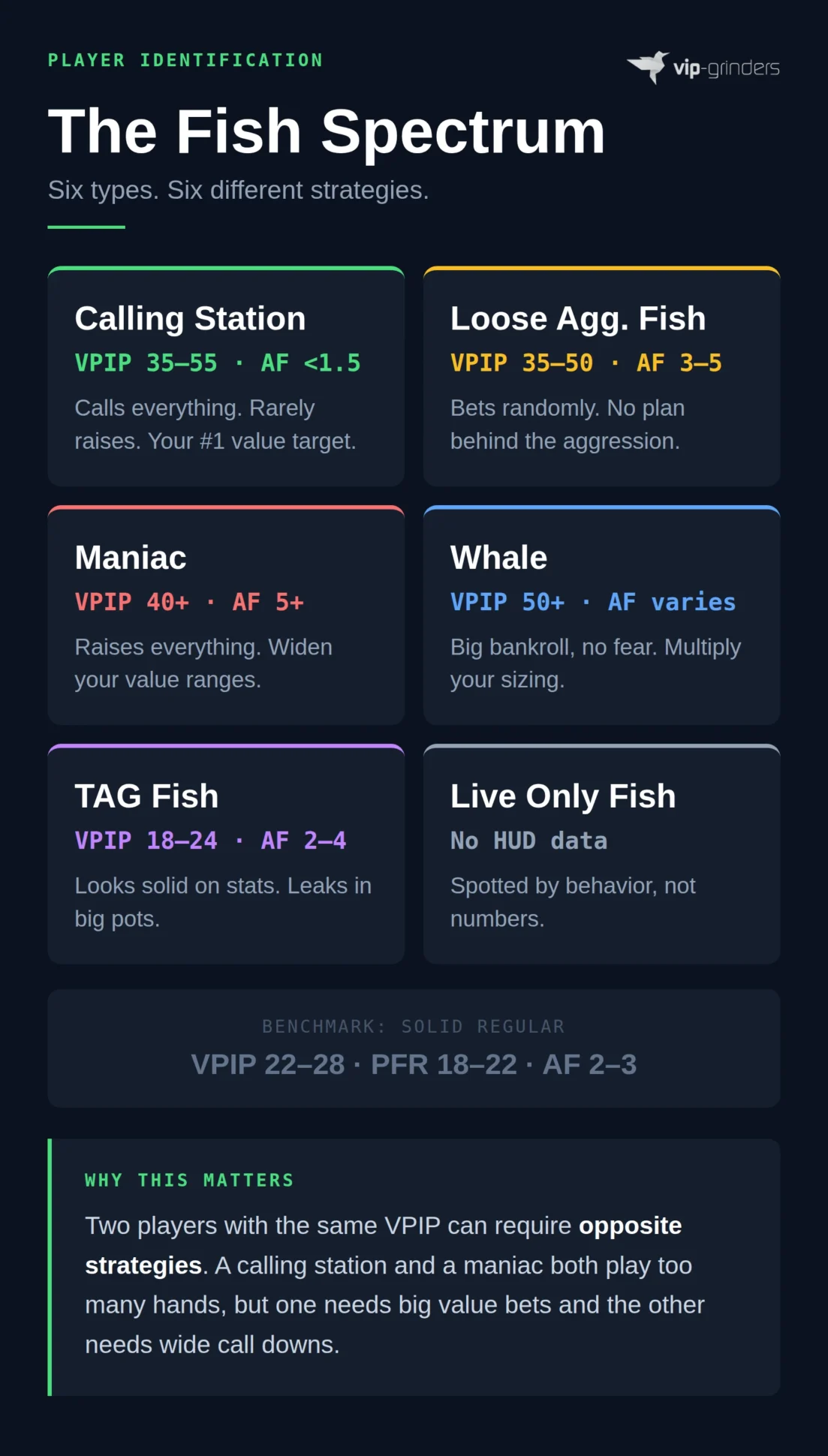
| Fish Type | Behavior | VPIP | PFR | AF | WTSD |
|---|---|---|---|---|---|
| Calling Station | Limps, calls every street, rarely raises | 35 to 55 | 4 to 12 | <1.5 | 33+ |
| Loose Aggressive | Bets big with random hands, bluffs often | 35 to 50 | 20 to 35 | 3 to 5 | 28 to 32 |
| Maniac | 3-bets constantly, shoves light, plays any two cards | 40+ | 30+ | 5+ | Varies |
| Whale | Reloads constantly, happy to gamble for big pots | 50+ | 5 to 25 | Varies | 30+ |
| TAG Fish | Looks solid on stats but leaks in specific spots | 18 to 24 | 14 to 20 | 2 to 4 | 22 to 26 |
| Live Only Fish | Spotted by physical tells, not stats | N/A | N/A | N/A | N/A |
Calling Station (Loose Passive)
The most common and most profitable fish type. Calling stations play too many hands and almost never fold once they put chips in the pot. They limp preflop, call raises with weak holdings, and chase draws to the river regardless of price.
Their VPIP sits between 35 and 55 but their PFR stays below 12. That gap is the signature: they want to see flops but they do not want to build pots themselves. You will sometimes hear them called “ATM machines” because extracting value from them is almost mechanical once you know the pattern.
Loose Aggressive Fish
These players also enter too many pots, but unlike calling stations, they bet and raise frequently with hands that do not justify the aggression. Their sizing is often random: min bets on one street, pot sized overbets on the next.
The key difference from a skilled loose aggressive regular is that a loose aggressive fish does not have a plan. A good player with this style bets certain board textures for specific reasons, but a loose aggressive fish just clicks buttons. Their AF reads 3 to 5 with a VPIP above 35, which means lots of bets but no logic behind them.
Maniac
A maniac is a loose aggressive fish turned up to the extreme. VPIP above 40, PFR above 30, 3-bet frequency above 12%. They raise preflop with nearly any two cards, bet aggressively on every street, and shove at the first opportunity.
Maniacs are high variance but extremely profitable to play against if you adjust correctly. Many regulars tighten up too much against maniacs when the correct response is to widen your value ranges.
Whale
A whale is a fish with a large bankroll and no concern for losing it. They play loose (VPIP 50+), reload without hesitation, and treat poker as entertainment, not a competition. Whales appear most often in live high stakes cash games but also show up at online mid stakes.
The difference between a whale and a regular calling station is stack depth and bet tolerance. A calling station at $0.05/$0.10 will call your $5 river bet, while a whale at $5/$10 will call your $500 river bet with the same hand strength. Adjust your sizing upward accordingly.
TAG Fish
The hardest fish to spot. A TAG fish looks solid on the HUD: tight VPIP, reasonable PFR, decent aggression. Their stats could pass for a winning regular at first glance.
The leaks show up in specific situations, not in overall numbers.
- They bluff on all three streets against players who never fold.
- They make scared folds on the river against obvious bluffs.
- They refuse to fold an overpair on coordinated boards.
You identify TAG fish through showdown hands, not through stat profiles. Watch how they play when the pot gets big, because that is where their mistakes surface.
Live Only Fish
Some fish only appear in live cardrooms and home games. They have no online stats to analyze, so you identify them entirely through physical behavior. Common signs include fumbling chips, asking “how much is the bet?”, buying in for odd amounts, and talking about their “favorite hand.”
Live fish tend to be extremely passive preflop (live 3-bet averages are roughly 4% versus 8% online). When a live fish 3-bets you, they almost always have a premium hand. Adjust accordingly.
How to Identify a Fish Online
Online poker gives you two ways to spot fish: HUD stats (if the site allows tracking software) and behavioral patterns you can observe without any tools. Both methods work. The best players use both together.
Using HUD Stats
If your poker room allows a HUD, identifying fish takes seconds. You already know the stat ranges from the table above. Here are the five fastest filters to flag a fish in your database or at the table:
- VPIP above 35 in 6 max (above 28 in full ring). This is the single strongest fish indicator.
- PFR to VPIP ratio below 0.5. This means they call far more than they raise, which is the signature of a calling station.
- AF below 1.5 with VPIP above 30. Low aggression plus loose play = near certain passive fish.
- WTSD above 32. They go to showdown too often, which means they call too much on every street.
- Limp percentage above 15% from any position. This is a near perfect fish indicator on its own. Strong players almost never limp.
Without a HUD
Many poker rooms now restrict or ban HUD software entirely. GGPoker uses anonymous tables and PokerStars has limited hand history access. If you play on these sites, you need to spot fish using what you can see in the lobby and at the table.
- Short stack buy ins (under 50bb). Recreational players often buy in for the minimum or an odd amount like 37bb.
- Single tabling. Regulars multi table. A player on one table is usually playing for fun.
- Mobile device icon. Many poker clients show whether a player is on a phone. Mobile players are overwhelmingly recreational.
- Open limping from early position. Strong players raise or fold. Limping under the gun is one of the clearest fish signals in poker.
- Min betting the river. Regulars almost never use minimum bet sizing on the river. A min bet usually means a weak player who "wants to see where they are at."
- Posting blinds out of position when joining a table mid round instead of waiting for the big blind.
If you multi-table and cannot watch every seat manually, a HUD with automated tagging closes the gap. The Player X-Ray module covered in our DriveHUD 2 review flags fish, nits, and loose 3-bettors in real time based on their stat profile, well before you have the 200+ hands needed for VPIP and PFR to stabilize.
How to Identify a Fish in Live Games
Live poker has no HUD. You identify fish entirely through what you see and hear at the table. The good news is that live fish are usually much easier to spot than online fish, because their behavior is visible from the moment they sit down.
Physical and Behavioral Tells
The Live 3-Bet Rule
One stat worth memorizing: live 3-bet frequency averages roughly 4%, compared to about 8% online. This means live players 3-bet half as often as online players. When a recreational live player 3-bets you, they almost always have a premium hand (Aces, Kings, Queens, or Ace King).
The practical adjustment is simple: if you are at a live $1/$2 table and a passive player raises your open, then re-raises when you 3-bet, fold everything except your strongest hands. Live fish do not bluff in 3-bet pots. This single adjustment will save you multiple buy-ins per month at low stakes live games.
For more on how live $1/$2 difficulty compares to online stakes and the strategic adjustments that matter most, see our cash game strategy guide.
How to Exploit Each Fish Type
Identifying the fish is step one; step two is adjusting your strategy to take maximum advantage of their specific mistakes. The default rule against any fish is simple: bet big for value, bluff rarely, isolate preflop, and play in position. Everything below is a refinement of that baseline for each type.
vs Calling Stations (Loose Passive)
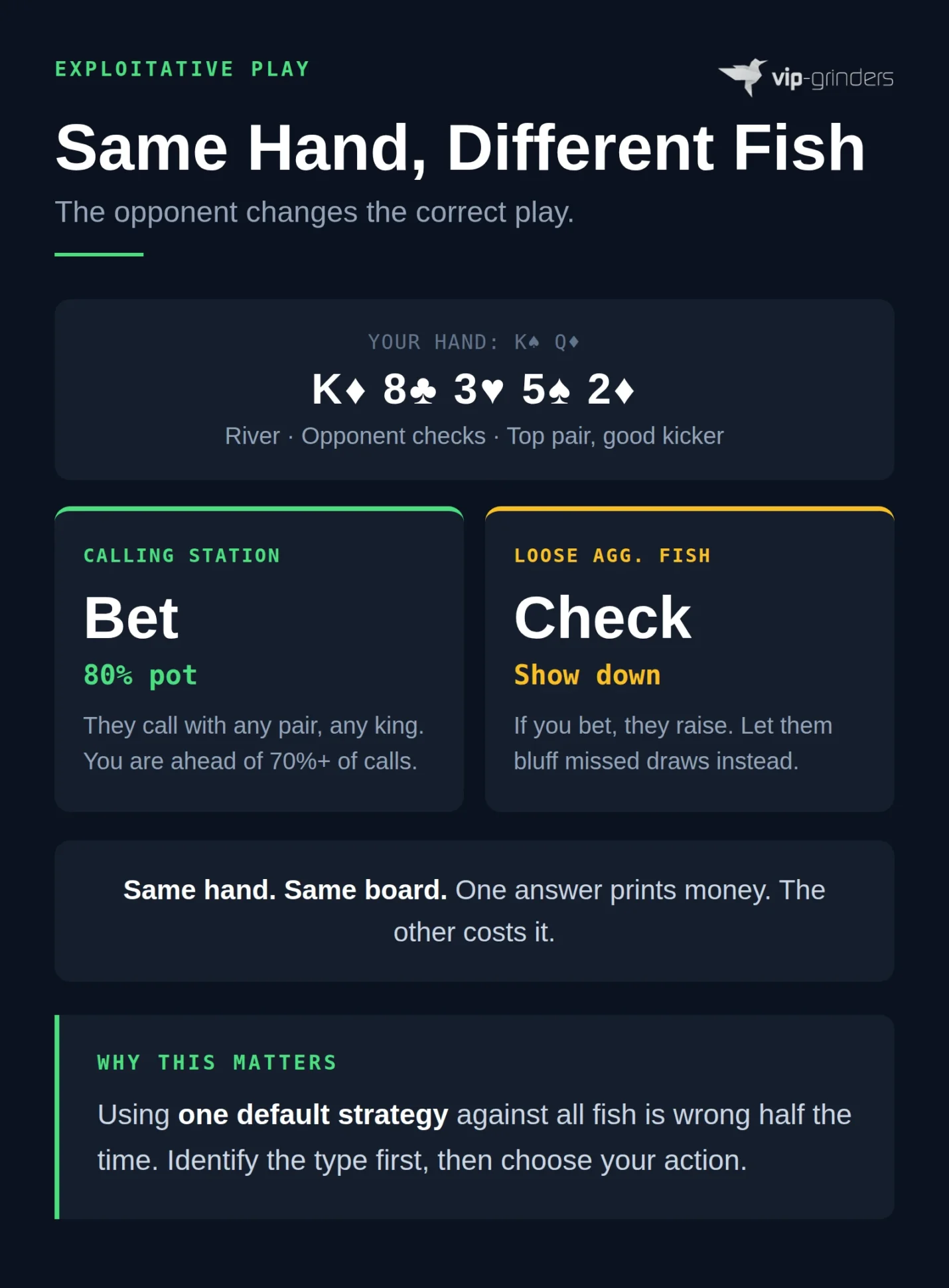
Calling stations are the easiest fish to exploit because their mistake is the most predictable: they call too much and fold too little. Your entire strategy against them is built around one idea: make them pay for that habit.
Preflop:
- Isolation raise to 4 to 5 big blinds plus 1 big blind per limper when you are in position. An isolation raise means raising over a limper to get heads up against the fish. Out of position, size up to 5 to 6 big blinds plus 1 per limper.
- Widen your iso raising range with hands that make strong top pairs and overpairs. Suited broadway hands (two high cards of the same suit like KQs or AJs), big Aces, and medium to high pocket pairs are ideal. For how to build these ranges, see our poker ranges guide.
Postflop:
- Value bet thinner than normal. Top pair weak kicker is worth betting for value on all three streets (flop, turn, river) on dry boards (boards with no flush or straight draws like K 7 2 rainbow). Second pair is often a river value bet when draws have missed. For the full math behind thin value, see our value betting guide.
- Size your value bets at 75% to 100% pot on the river. Fish do not adjust to sizing. The hand they call for 50% pot is the same hand they call for 90% pot. For street by street sizing principles, see our bet sizing guide.
- Cut your bluff frequency to near zero on rivers against players with WTSD above 33. They call too often for bluffs to be profitable.
- Never slow play. Their range is full of weak top pairs and second pairs that will call a bet but will not build the pot for you. Checking a set on the turn leaves a full pot sized bet on the table.
vs Loose Aggressive Fish
The adjustment against loose aggressive fish is the opposite of what works against calling stations. Instead of betting for value, you let them do the betting for you.
- Tighten your preflop calling ranges out of position. Their wider raising range punishes loose calls.
- Call down with medium strength hands (like top pair or an overpair) on safe boards rather than raising. Let them barrel into your made hands.
- Trap with strong hands on wet boards. Check overpairs (a pocket pair higher than any card on the board) and sets to let their aggression do the work.
- Do not bet if you plan to fold to a raise. If you bet and they raise, you need a plan for that raise before you put chips in. Either bet with the intention of calling a raise, or check and let them lead.
For how continuation bet (c-bet) frequency and checking strategies shift against aggressive opponents, see our continuation betting guide.
vs Maniacs
Maniacs put you in the most uncomfortable spots, but the adjustment is surprisingly simple: widen your value ranges and let them hang themselves.
- Widen your 3-bet and 4-bet value ranges. Hands like 99, AJs, and KQs become value 4-bets at 100 big blinds deep (the standard cash game stack) against a true maniac. For range construction, see our 3-bet strategy guide.
- Keep the pot small with medium hands. Check back middle pair or weak top pair on the turn to keep the pot manageable and invite a river bluff.
- Do not enter sizing wars on high card boards unless you have a very strong hand. Maniacs will size up to pressure you. Let them do it when you have the goods.
vs Whales
The strategy against whales is identical to calling stations with one key difference: multiply your sizing. Whales call 100% to 150% pot bets with the same frequency they call 50% pot bets because they are not price sensitive. Your job is to get maximum chips in when you have the best hand.
- Seat to the whale's left if they are passive (so you act after them and control the pot).
- Seat to their right if they are aggressive (so they act on your strong hands and build the pot for you).
Fish in PLO and Short Deck
Two other formats deserve a quick note because fish bleed money even faster in them.
In Pot Limit Omaha, fish lose faster because hand equities run closer together and the variance is higher. A fish who calls too much in NLHE will call even more in PLO, where every flop looks like it connects with their four card hand. For a full breakdown of PLO adjustments, see our PLO strategy guide.
In Short Deck, fish consistently overvalue flush draws without realizing that flushes beat full houses in that format. They also underestimate how common straights are when the deck is compressed. Both mistakes create profitable spots for regulars who understand the adjusted hand rankings.
Seven Mistakes Regs Make Against Fish
Knowing how to exploit fish is only half the equation. The other half is not sabotaging yourself in the process. These seven mistakes cost regulars real money at every stake, and most players do not realize they are making them.
- Bluffing players who never fold. If their WTSD is above 32 (or they call every bet at a live table), your river bluffs are burning money. Against calling stations, bluff frequency should drop to near zero. For the math behind when bluffs are actually profitable, see our bluffing guide.
- Slow playing strong hands. Checking a set or two pair on the turn to "trap" a fish gives them a free card and costs you a full pot sized bet. Fish will call your bets with weak hands. Let them.
- Sizing value bets too small. Many regulars bet 30% to 40% pot on the river because they are afraid of "scaring the fish away." Fish do not adjust to sizing. Bet 75% to 100% pot and they call at the same rate.
- Trying to balance your range. Balancing means mixing value bets and bluffs so your opponent cannot tell which one you have. This only matters against players who are paying attention. Fish are not. Pure exploitation beats balance every time against a weak player.
- Avoiding multiway pots. The standard advice is to tighten up in multiway pots. But when two of the three other players are fish, multiway pots with premium hands are some of the highest expected value spots in poker.
- Tilting after bad beats. Fish will hit their hands sometimes. A calling station who chases a flush draw and gets there on the river did not outplay you. They got lucky. If you let one bad result change how you play the next 10 hands, the damage from tilt will cost more than the bad beat. Our mental game guide covers how to manage this.
- Folding the river too often when a draw completes. When the obvious flush or straight card hits the river and a fish bets, many regulars fold automatically. But fish do not always have the draw. Many of their river bets on scary cards come from second pair or a missed draw they are turning into a bluff. Do not give them credit they have not earned.
Beyond the strategic cost, how you treat fish at the table matters just as much. Berating a recreational player for a bad call is one of the fastest ways to kill a profitable game. Our poker etiquette guide covers why keeping weaker players comfortable protects both your reputation and your bottom line.
Fish to Reg Ratio: When a Table Is Worth Playing
Your win rate depends more on who is at your table than on how well you play. A solid regular at a table full of other regulars will break even or lose to rake. The same player at a table with two or three fish can win 8 to 12 big blinds per 100 hands at micro and low stakes.
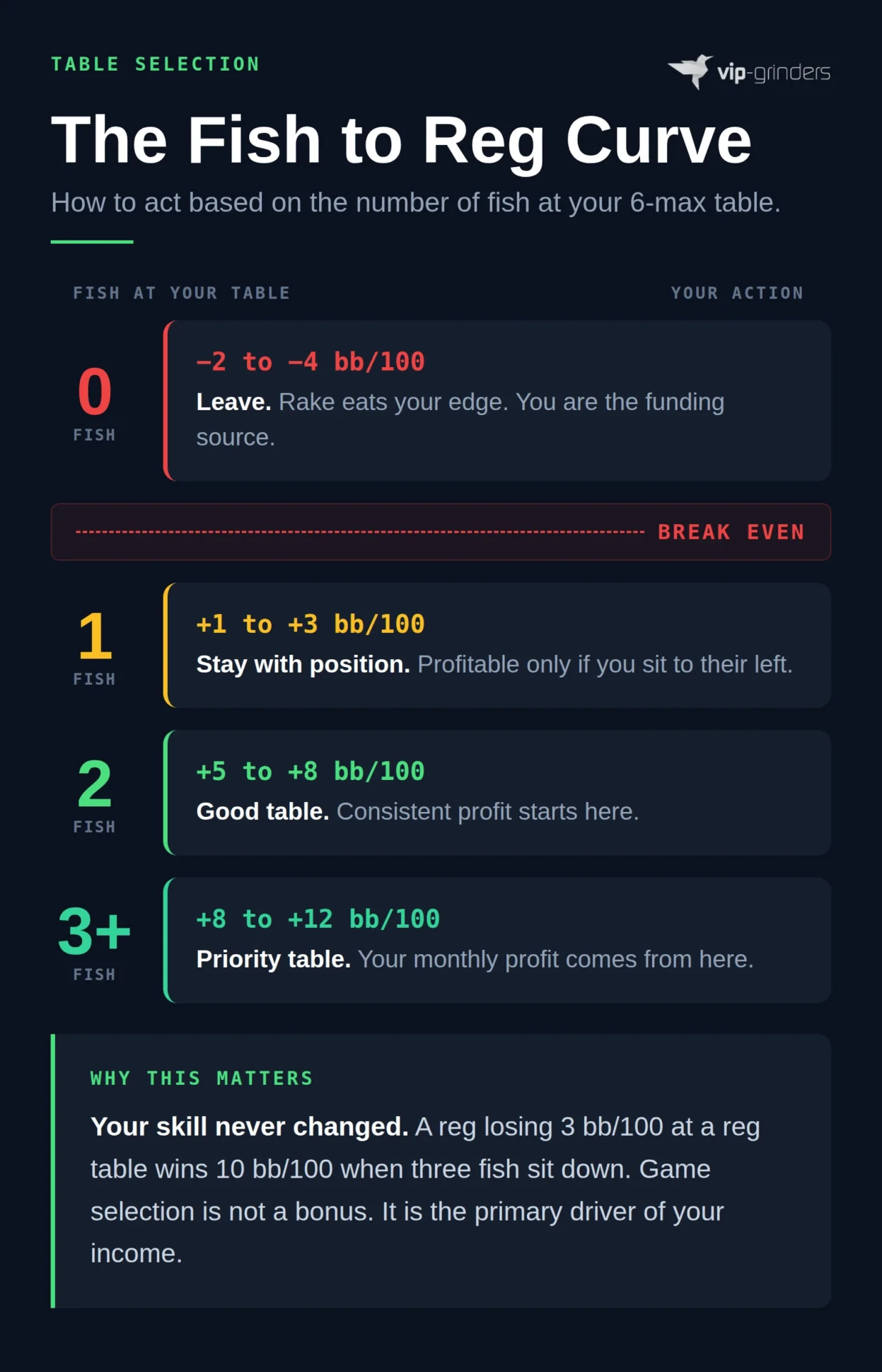
| Fish at the Table (6 max) | Expected Outcome | Action |
|---|---|---|
| 0 fish | Negative win rate after rake | Leave and find a better table |
| 1 fish | Marginal, especially without direct position | Stay only if you are seated to their left |
| 2+ fish | Strong positive win rate (8 to 12 bb/100 realistic) | This is where your profit comes from. Stay. |
This is why game selection matters more than studying another solver drill. You can be the sixth best poker player in the world, but if the other five players at your table are the top five, you are the fish. For a deeper look at how the fish to reg ratio connects to your monthly results, see our guide on whether poker is still profitable.
Frequently Asked Questions
What VPIP makes someone a fish?
In 6 max No Limit Hold’em, a VPIP (voluntarily put money in pot) above 35 is the clearest fish indicator. In full ring (9 or 10 players), the threshold drops to about 28. VPIP measures how many hands a player enters, so a high number means they are playing far too many starting hands to be profitable long term.
Should I bluff a fish?
It depends on the type of fish. Against calling stations (players who call too much and rarely fold), bluffing is almost always a losing play. Against loose aggressive fish and maniacs, you should bluff less often than normal but you do not need to eliminate bluffs entirely, because their aggression sometimes forces them to fold. The safest default: bluff fish far less than you bluff regulars.
What is the difference between a fish and a whale?
Both are weak players who lose money, but a whale has a much larger bankroll and is willing to lose significant amounts without changing how they play. A fish at $0.05/$0.10 might lose $20 in a session. A whale at $5/$10 might lose $5,000 in the same timeframe. The strategic adjustment is the same (value bet relentlessly), but your sizing should be much larger against a whale because they are not sensitive to bet size.
Are there fish at mid stakes and above?
Yes, but fewer. At $0.25/$0.50 and above, recreational players make up roughly 15% to 25% of the player pool compared to 40% to 60% at micro stakes. Fish at higher stakes tend to be wealthy recreational players (whales) or players who moved up too quickly without improving their game. They are rarer but extremely profitable when you find them.
How do I spot fish on anonymous poker sites?
On sites where player names are hidden (like GGPoker’s anonymous tables), focus on behavioral patterns instead of stats. Short stack buy ins (under 50 big blinds), open limping from early position, min betting the river, playing from a mobile device, and single tabling are all strong indicators of a recreational player. You will not have a long term database on them, so every session starts fresh.
Is it wrong to call someone a fish?
The term is common in poker culture but many players and poker rooms prefer softer language like “recreational player” or “fun player.” Whatever you call them, treating weaker players with respect at the table is both good sportsmanship and good strategy. A fish who feels welcome at the table keeps coming back. A fish who feels bullied leaves, and takes your profit with them.