

PioSolver Review 2026: Is the GTO Solver Worth $249?
PioSolver has been the gold-standard CFR-based GTO solver since 2015, used by every serious mid stakes and-up grinder we know. In 2026, the Pro license costs $249 and Edge costs $475, with a free evaluation version still available for testing.
It remains the most powerful customizable solver on the market, but only if you grind NL100 and above and have the hardware to run it. Below that, you are paying for compute power you cannot recover.

Our Pio Solver review covers Pro vs Edge differences, real hardware benchmarks, the honest comparison against GTO Wizard, and the break-even math for your stakes.
What Is PioSolver and How Does It Work?
At its core, PioSolver is a postflop GTO solver built on the CFR algorithm (Counterfactual Regret Minimization). It calculates Nash-equilibrium strategies for any heads-up no-limit hold’em spot you input, returning frequencies for bet sizing, raising, calling, and folding.
PioSolver is a study tool, not a trainer or a drilling app. You build a tree, run a solve, and read the output. For the foundation context on solver theory and why GTO matters in 2026, see our guide to GTO and solvers.
How CFR Solvers Build a Nash Equilibrium
CFR works through iteration. The solver simulates the same situation millions of times, tracking how often a different action would have produced a higher expected value.
After enough iterations, the strategy converges to an unexploitable equilibrium, meaning neither player can improve their expected value (EV) by deviating.
The solver reports this convergence as a percentage. Most grinders stop solving at 0.5% to 1% exploitability to achieve a usable result.
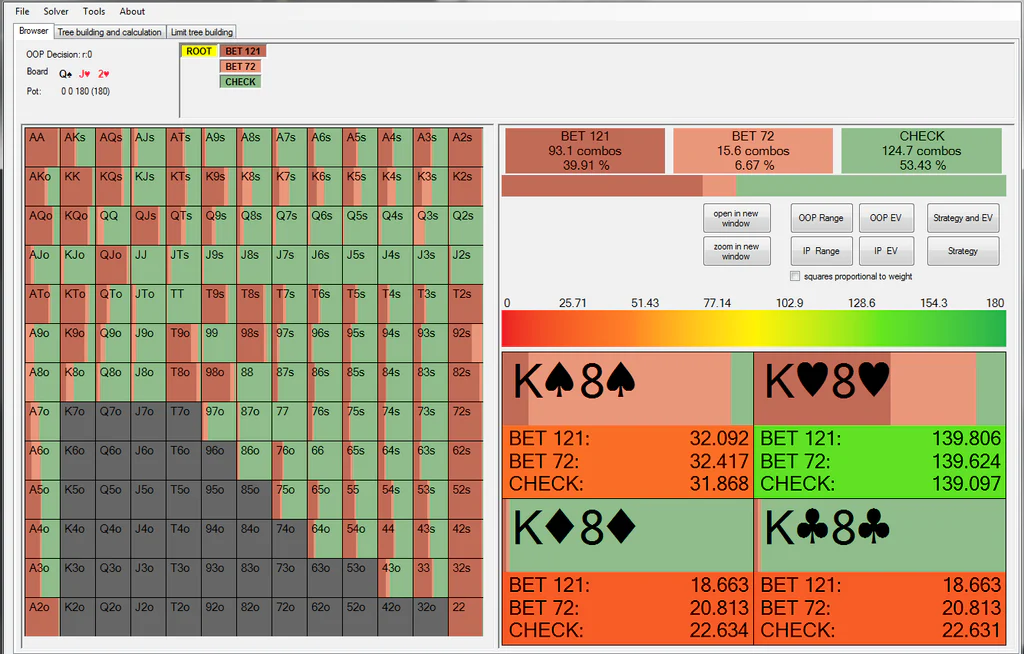
The output is a raw strategy table. You see exactly how often a 6h7h-suited connector check-raises a 2c5d8c flop after defending the big blind versus a button raise.
A solver is a poker tool that builds the answer. A trainer drills you on memorizing it. The solver gives you the spot, the frequencies, and the EV breakdown. GTO Wizard takes pre-solved spots and quizzes you on them inside a browser.
Mid stakes grinders typically use both: Pio for custom spot exploration, then a trainer to embed the patterns.
Pros and Cons
Here is the verdict in one box, with detail in the sections that follow.
Pro
- Most powerful customizable GTO solver
- $249 Pro tier breaks even fast at NL100 stakes
- Node locking and aggregation reports unmatched elsewhere
- One-time purchase with no subscription creep
- Used daily by every serious mid-stakes-and-up grinder we know
Con
- Hardware bill often larger than the software bill
- Interface design has not modernized since 2018
- Not viable below NL50 from a break-even standpoint
- PLO and multi-way pots handled poorly vs MonkerSolver
- Edge preflop solver requires Threadripper-class hardware
PioSolver Versions: Free, Pro, and Edge Compared
The current options include two paid licenses and a free trial version. The Basic tier was discontinued in version 3.0.
Basic Tier Discontinued
| Version | Price | Postflop | Preflop Solver | Best For |
|---|---|---|---|---|
| Free | $0 | 2 example flops only | No | Hardware compatibility test |
| Pro | $249 (one-time) | Unlimited custom trees | No | Postflop study at NL100+ |
| Edge | $475 (one-time) | Unlimited custom trees | Yes | Preflop solving, multi-street tree work |
Free Tier (Evaluation Version)
The free version limits you to two preset flops. You cannot input your own board.
Its purpose is to verify that the software runs on your machine before you buy it. We treat it as a 30-minute installation test, nothing more.
Pro Tier ($249): Features and Limits
The Pro version unlocks unlimited postflop solving on any board you input. You build the tree, set the bet sizes and ranges, and run the solver. There is no preflop solver or automated tree building.
Pro is the right tier for about 80% of buyers. If you only study postflop spots from hands you’ve already played, Pro has you covered. Hardware specs and benchmarks are in the next section.
Edge Tier ($475): When the Preflop Solver Pays Off
Edge adds a preflop solver and an upgraded tree builder for multi-way scenarios. The preflop solver opens up areas that Pro cannot access, such as full preflop ranges versus specific opponent strategies and opening ranges from any position with custom rake.
Edge only earns its $226 premium if you actually solve preflop trees. Most grinders never do.
- 16 threads / 16GB RAM: minimum viable for Pro postflop work
- 32 threads / 32GB RAM: sweet spot for serious postflop study
- 64 cores / 64GB RAM: required for Edge preflop solving
- AVX2 instruction set: non-negotiable on every supported CPU
- Standard SSD: fine for storage, NVMe is not required
Hardware Requirements
Most reviews skip the actual numbers. Don’t buy PioSolver before reading this section.
The official PioSolver product comparison docs give baseline thresholds. Real-world performance is a little more complex.
Minimum Specs for Pro (16-thread, 16GB RAM)
Pro runs on a modern, 16-thread CPU, such as an Intel i7-13700 or an AMD Ryzen 7 7700, with 16 GB of RAM. AVX2 instruction support is required.
With these specifications, a typical postflop turn spot takes 8 to 14 minutes to solve. A full game tree including the river takes 25 to 45 minutes. This is reasonable for overnight study.
Recommended Specs for Edge Preflop Solving (64GB+ RAM)
Edge preflop solves are a whole other ball game. The official recommendation is 64+ cores and 64 GB of RAM. This is Threadripper Pro and Epyc territory.
A full six-max preflop solution with reasonable accuracy takes four to eight hours on this hardware. On a 16-thread workstation, the same solve takes 24 hours or fails to converge. Buying the Edge version without Threadripper-class hardware is a waste of money.
Solving Time Benchmarks by Spot Type
| Spot Type | 16-thread / 16GB | 32-thread / 32GB | 64-core / 64GB |
|---|---|---|---|
| Single flop, 0.5% exploit | 3 to 5 min | 1 to 2 min | under 1 min |
| Postflop turn spot | 8 to 14 min | 4 to 7 min | 2 to 3 min |
| Full postflop tree | 25 to 45 min | 12 to 20 min | 6 to 10 min |
| Preflop 6-max solve | 24+ hr or fails | 12 to 18 hr | 4 to 8 hr |
Core Features: Job Queue, Aggregation Reports, Node Locking
PioSolver does ship with a basic built-in trainer, but the interface is clunky and the pacing is poor. Use Pio for solving and a dedicated drilling tool for memorization. The three features below are what serious grinders actually use the software for.
Job Queue: Solving Overnight Without Wasted Time
The Job Queue feature allows you to stack and run solves sequentially. Build 30 spots in the evening, queue them, and leave.
The next morning, each solve will be complete and saved. This is how most serious players use the software. Running spots one at a time manually wastes the tool.
Aggregation Reports: Reading 1,000+ Flops at a Glance
Aggregation reports compress thousands of flops into pattern data. After solving 1,755 flops, you might ask, “What percentage of the time does the BB defender check-raise on dynamic boards versus static boards?”
This type of meta-strategy insight is what separates serious students from spot-by-spot players. Reading them takes practice. Start with 100-flop subsets before scaling up.
Node Locking: Building Exploitative Strategies vs Specific Pools
Node locking enforces a fixed strategy at a specific decision node. For example, you could lock the villain to fold 80% of the time on triple-barrel rivers, and then resolve.
PioSolver then returns the maximally exploitative strategy (MES) against that locked behavior.
This is how you turn a GTO solver into an exploit factory against specific player pools. Build the population read first, then translate it into node locks for building correct hand ranges against the pool.
- Job Queue: stack 30 solves overnight, review the next morning
- Aggregation Reports: compress 1,000 flops into one strategy table
- Node Locking: force villain frequencies, then build the exploit
- Tree Editor: custom bet sizings beyond the default 33/66/100
- Range Browser: check exact hand frequencies inside any combo
PioSolver vs GTO Wizard
We have used both daily for over a year.
Speed and Accuracy
GTO Wizard’s pre-solved AI database finds spots with 0.22% exploitability in under six seconds. PioSolver builds custom solves to your exact specifications but takes minutes to hours.
Speed versus customization is the trade-off. GTO Wizard is faster for any spot in their library. PioSolver is better suited for custom rake structures, non-standard bet sizing trees, and population-specific node-locked exploits.
Pricing Models: One-Time Purchase vs Subscription
PioSolver is a one-time purchase: $249 for Pro and $475 for Edge. This includes lifetime use with no recurring charges.
A GTO Wizard subscription costs between $39 and $89 per month for AI-tier access. Two years of GTO Wizard is equivalent to a Pro license. Three years gets you an Edge license and the necessary hardware.

The break-even depends on how long you study. Two-year-plus serious students save money on PioSolver. Casual users who study three months at a time and quit save money on GTO Wizard.
Bottom line: pick PioSolver if you have the hardware, study consistently, and need custom tree work. Pick GTO Wizard if you want speed, a clean UI, and zero hardware investment.
Hands-On Testing: What We Found After 30 Days
We tested PioSolver Pro on a 12-core, 32 GB RAM workstation over the course of 30 days of structured study. Three scenarios anchored the test:
One was a 3-bet pot OOP versus a button open. Second, a single-raised PLO sample (not Pio’s strength). The third scenario was a BTN versus BB war on Q-high paired flops.
The average solving time was 11 minutes for full turn trees and 38 minutes for full game trees. One preflop test on Pro yielded a hardware error after two hours, which is expected since preflop is Edge territory.
Insight #1
BB defender check-raise frequency on paired Q-high flops collapsed below 8% in our solves. Most live players check-raise at 12 to 15% in those spots.
That is a fold-equity hole worth exploiting, and one we cross-checked against the minimum defense frequency calculator.
Insight #2
3-bet pot OOP small c-bet at 25% pot outperformed half-pot at every stack depth we tested. The conventional half-pot c-bet is leaving EV on the table in modern trees.
Insight #3
Aggregation reports flagged a meta-pattern in our river decisions. We over-bluffed by 6 to 8% across the entire study set.
Overall, the interface still feels antiquated. The buttons are arranged awkwardly, the tree builder requires keyboard shortcuts that most users won’t bother to learn, and the visualization options haven’t been updated since 2018.
We suggest pairing PioSolver with the workflow documented in our Holdem Manager 3 review for hand replay, use PioSolver only for the solve itself, and view aggregation reports in a separate spreadsheet.
Is PioSolver Worth $249?
At NL100, $249 is 2.5 buy-ins. An improvement of 1 BB/100 EV at 100K hands per month recovers the cost in under three months. Most players play more than that.
At NL50, the same $249 represents five buy-ins. You need a larger BB/100 gain over the same volume or to play more hands. It’s still recoverable, just slower.
At NL25 and below, the math doesn’t add up. Sub-NL50 grinders typically have larger leaks that the solver does not address. A game-theory edge is irrelevant against opponents who don’t bet for value with a second pair.
Run your own variance and EV math through our free poker calculators before deciding.
| Stake | Cost in BB | Hands Needed at +1 BB/100 to Break Even |
|---|---|---|
| NL25 | 996 BB | ~100,000 hands |
| NL50 | 498 BB | ~50,000 hands |
| NL100 | 249 BB | ~25,000 hands |
| NL200 | 124 BB | ~12,500 hands |
The verdict: buy Pro if you grind NL100+ with at least 50K hands per month. Buy Edge only if you have Threadripper-class hardware and serious preflop study goals. Below NL50, save the money and start with GTO Wizard or GTO+.
Best PioSolver Alternatives in 2026
The solver market is now dominated by a small group of major players. Here are the other options we still recommend.
| Tool | Price | Best For | Hardware Needs |
|---|---|---|---|
| PioSolver Pro | $249 one-time | Custom postflop NLHE | 16+ threads, 16GB RAM |
| GTO Wizard | $39 to $89 / month | Browser-based study | None (cloud) |
| GTO+ | $75 one-time | Budget postflop | 8 threads, 8GB RAM |
| MonkerSolver | €499 one-time | PLO and multi-way | 32+ threads, 64GB RAM |
| Simple Postflop | $200 one-time | Declining usage | 16 threads, 16GB RAM |
GTO Wizard is perfect for students who want immediate answers without spending money on hardware.
GTO+ is the budget pick. For $75, you get a working postflop solver, but the tree-building is weaker and the convergence slower. It’s a good fit for folks on the lower end of NL100 who want some solver experience without the full Pio commitment.
MonkerSolver is the go-to choice for PLO and multi-way pots, where PioSolver’s three-way tree handling falls short. If you grind PLO or play multi-way games, MonkerSolver is the way to go at €499.
Simple Postflop has lost market share. It’s been solid for years, but development has slowed. We don’t actively recommend it in 2026.
How to Get Started: Buying, Installing, First 3 Hours
The only legit place to buy it is the official PioSolver store. Avoid resellers, key marketplaces, and any seller offering Pio at a discount.
If you get a license key from a secondary market, you could lose access. You won’t be able to get that license key back.
Installation and License Activation
The installer is a 200 MB download for Windows only. Mac users can run it through Parallels or Boot Camp. Linux users can use Wine, though results may vary.
Activation uses your purchase email address. The license is bound to one machine. To move to a new computer, submit a transfer request through PioSolver support. Requests are typically processed within 48 hours.
The First Sim Every New User Should Run
Open the standard 100bb cash game tree at NL100 rake. Set BTN open to 2.5x, BB defends with the standard range. Solve to 0.5% exploitability.
Compare the output to your default tree from memory. Where the solver bets bigger, smaller, or with different frequency than your default, those are your immediate study targets.
Frequently Asked Questions About PioSolver
PioSolver vs GTO Wizard: which is better?
GTO Wizard is faster for pre-solved spots and has a cleaner browser-based UI. PioSolver wins for custom rake structures, node-locked exploits, and aggregation reports across thousands of flops. Two years of GTO Wizard equals a Pio Solver Pro license; three years equals Edge.
Can I use PioSolver while I am playing?
No, this is a study tool only. Using any solver during live or online play is real-time assistance (RTA) and is banned at every major poker site. Accounts caught running RTA are permanently closed and balances seized.
Does PioSolver work for PLO or multi-way pots?
PioSolver handles heads-up NLHE well but multi-way pots and PLO trees poorly. For PLO or three-way spots, MonkerSolver at 499 euros is the better tool. Pio remains the standard for heads-up postflop NLHE study.