

Session Management: When to Play, When to Stop & How to Plan in 2026
Session management is how you structure your poker playing time: when you sit down, how long you play, when you stop, and how you schedule the week. Most players never plan any of this: they open the client whenever they feel like it, play until they are tired or tilted, and log off without a structure. That habit costs real money.

A 2021 study published in Frontiers in Psychiatry tracked 23 regular online poker players across 588 sessions over 28 days. Sessions played while sleep deprived (awake for 16 or more hours) showed significantly higher tilt (p = 0.006), more hands played per session (p = 0.010), and worse financial results (p = 0.015). A p-value below 0.05 means the result is very unlikely to be random chance, and all three of these are well below that bar.
In plain English: playing tired is not just suboptimal. It is measurably destructive to your win rate.
Here is what this guide covers:
- Optimal session length by format with recommended ranges and hands-per-hour benchmarks
- Stop-loss rules including Phil Galfond's Default Rules for when to quit
- Pre-session warm-up and post-session cool-down routines
- Peak traffic windows by network and time zone
- A sample weekly schedule for online grinders with study days built in
The session length table below gives you starting ranges for every format. Each section after it adds one layer to your session plan.
How Long Should a Poker Session Be?
There is no single answer because session length depends on the format you play, how many tables you run, and whether you are playing online or live. The table below uses standard abbreviations: NLHE is No-Limit Hold’em, PLO is Pot-Limit Omaha, SNG is Sit & Go, and MTT is Multi-Table Tournament. The recommended ranges are based on what experienced grinders and coaches across the poker community consistently agree on.
| Format | Recommended Length | Hands Per Hour (approx.) | Notes |
|---|---|---|---|
| NLHE Cash (1 table) | 2 to 4 hours | 60 to 80 | Lowest fatigue. Good for focused study sessions. |
| NLHE Cash (4 tables) | 1.5 to 3 hours | 240 to 320 total | Break every 90 minutes. Fatigue scales with tables. |
| Fast-Fold / Zoom | 1 to 2 hours | 200 to 250 per table | Highest decision rate online. Fatigue hits early. |
| PLO | 1.5 to 3 hours | 50 to 70 | Four hole cards means more complex decisions. |
| Spin & Go | 1 to 2 hours (blocks) | Varies by multiplier | Play in blocks of 10 to 20 games, then break. |
| SNG (9-max) | 60 to 90 minutes per game | 40 to 60 | Fixed duration. Plan by number of games. |
| MTT | Set by tournament length | 30 to 50 (depending on stage) | Register only if you can play the full expected duration. |
| Live Cash | 2 to 6 hours | 25 to 30 | Slower pace allows longer sessions. |
These ranges shift by format because each one demands a different level of focus per hand. For the fastest format and how it affects session planning, see our fast-fold and Zoom strategy guide.
Why Shorter Sessions Often Produce Better Results
Every poker decision drains a small amount of mental energy, and over time the quality of those decisions drops. Psychologists call this decision fatigue: the more choices you make in a row, the worse each one becomes. In poker terms, you start calling when you should fold, bluffing in spots that do not make sense, and missing information you would normally catch.
A player who grinds for 6 hours straight does not play 6 hours of good poker. They play 2 to 3 hours of strong decisions followed by 3 to 4 hours of gradually worsening ones. For most online grinders, two focused 2-hour sessions with a break in between will produce better results than one continuous 4-hour block.
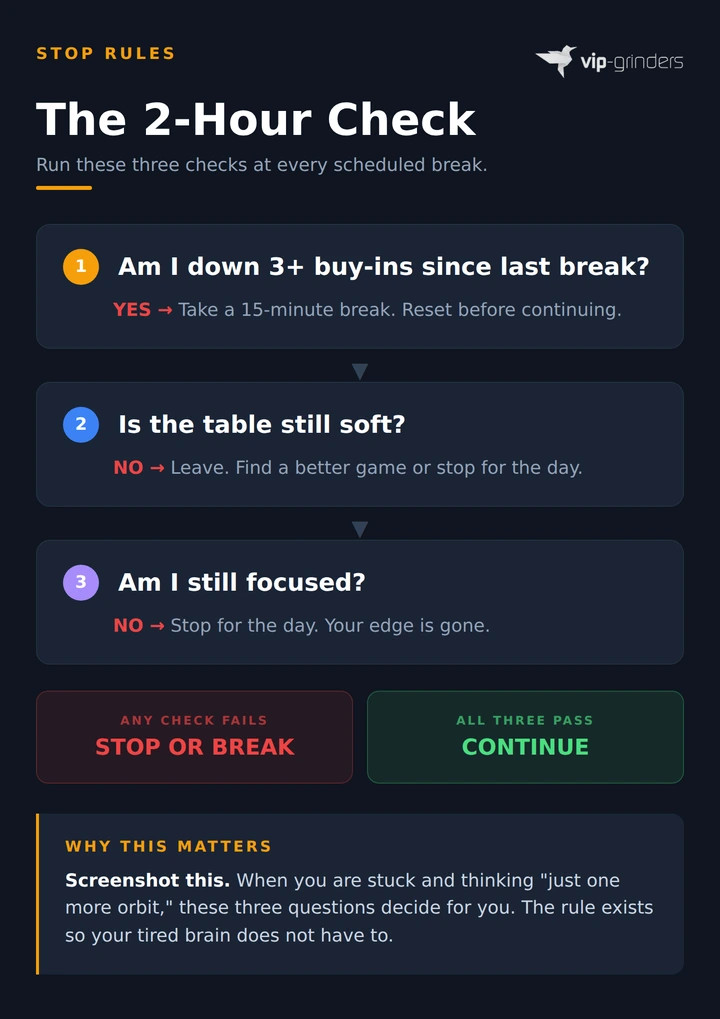
The 2-hour rule: if you have been playing for 2 hours without a break, your decisions are already getting worse whether you notice it or not. Break first, then decide if you want to continue.
How Table Count Changes Everything
The more tables you play at once, the faster you burn through your mental energy. A single-table session at 70 hands per hour puts 140 hands in front of you over two hours. A four-table session at the same pace puts 560 hands in front of you: four times the mental effort.
If you are new to multi-tabling, start with shorter sessions and add length only after your decision quality stays consistent throughout.
Stop-Loss Rules: When to Quit a Session
A stop-loss is a pre-set loss limit that tells you when to stop playing. You decide the number before you sit down, when your thinking is clear. When you hit that number during a session, you close the tables: no exceptions, no “one more orbit.”
The reason stop-losses work is simple: they remove a decision from the worst possible moment. After losing several buy-ins in a row (a buy-in is the amount of money you bring to a table), most players are already tilted whether they realize it or not. A stop-loss takes the “should I keep playing?” question off the table entirely.
Recommended Stop-Loss by Format
| Format | Per-Table Stop | Per-Session Stop |
|---|---|---|
| NLHE / PLO Cash | 3 buy-ins at one table | 5 buy-ins total |
| Spin & Go | n/a | 5 buy-ins |
| SNG | n/a | 8 buy-ins |
| MTT | n/a | Set a registration budget before the session starts |
These numbers come from a widely cited set of guidelines published by PokerStrategy.com. They are starting points, not fixed laws: a player with strong emotional control can extend them slightly, while a player who tilts easily should tighten them. For a full breakdown of how many buy-ins you need per format, see our bankroll management guide.
Phil Galfond’s “Default Rules”
Phil Galfond, one of the most respected high-stakes players in poker history, published a set of session rules in his 2023 article “Become a World-Class Quitter” on philgalfond.com. He calls them “Default Rules” because you set them before you play and follow them by default unless you have a strong, specific reason not to.
- 1Quit anytime you are down 10 buy-ins in a single session.
- 2Take a short break every time you lose 3 buy-ins.
- 3Take a break every 2 hours, regardless of how the session is going.
- 4Re-evaluate the game quality every 2 hours. If the table has gotten tougher, leave.
What makes these rules powerful is that they cover both losses and time. Most players only think about stop-losses in terms of money. Galfond adds time-based resets (every 2 hours) and game-quality checks, which catch the sessions where you are not losing but are slowly playing worse without noticing.
Never Quit Because You Are Winning
Stop-losses protect you from playing badly, but there is no equivalent reason to stop playing well. If the game is good, you are focused, and you are winning, leaving the table “to protect your profit” is a leak.
Your career is one continuous session across thousands of hours, and a single day’s result is statistical noise.
Locking in a win feels satisfying, but it does not change the math: the chips you won are already yours. The profitable spot you leave behind is real money you chose not to make. For a deeper look at why short-term results are misleading, see our guide on variance and downswing math.
The Pre-Session Warm-Up (10 Minutes)
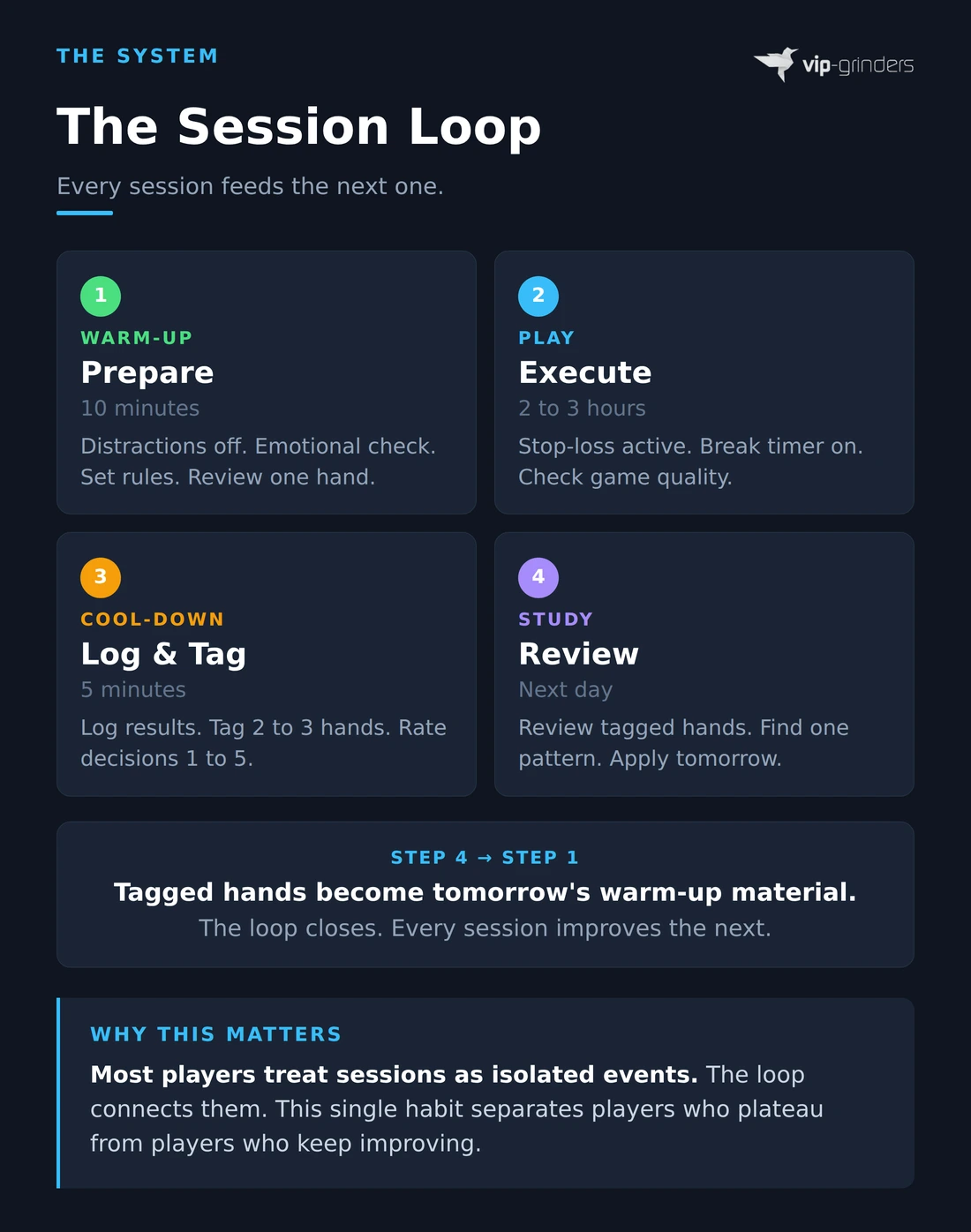
Starting a session without any preparation is called “cold-starting,” and it is one of the most common leaks across all formats. You sit down, get dealt a tricky spot in the first five minutes, and make a bad decision because your brain was still in “checking email” mode. A short warm-up routine fixes this by getting you into a focused state before any money goes in.
The routine below takes about 10 minutes. It is not a ritual or a superstition. It is a checklist that forces you to answer four questions before you open a single table.
- 1Clear distractions: close every browser tab you do not need, silence your phone, and set a do-not-disturb timer for the length of your planned session. If you multi-table, your screen real estate matters. Anything that is not poker should be gone.
- 2Emotional check-in: ask yourself three questions. Am I tired? Am I angry or stressed about something outside of poker? Am I chasing losses from a previous session? If the answer to any of these is yes, either shorten your planned session or skip it entirely.
- 3Set your session rules: write down (or say out loud) four things before you start. The format you are playing, the number of tables, your planned session length, and your stop-loss. Having these locked in advance removes the temptation to drift.
- 4Review one hand: open your tracker or hand history and pick one hand from your last session that you flagged for review. Spend 2 minutes thinking through the decision. This primes your brain for analytical thinking instead of autopilot.
The warm-up is not about perfection. It is about catching the sessions you should not be playing before they cost you money. If you follow nothing else from this guide, the emotional check-in alone will save you buy-ins every month.
When to Play: Peak Traffic and Soft Games
Timing your sessions matters because the player pool changes throughout the day. During peak hours, recreational players (casual players who deposit for fun rather than grinding for profit) flood the tables, but during off-peak hours the ratio flips and you face a higher percentage of regulars (experienced players who grind for profit). Playing at the right time can improve your effective win rate without changing a single thing about your strategy.
General Timing Rules
- Evenings and weekends have the softest fields on every network. Recreational players log in after work and on days off.
- Sunday is the single best day for MTTs. Every major network runs its biggest guaranteed tournaments on Sunday.
- January and post-holiday weeks produce traffic spikes. New Year’s resolutions and returning casual players push player counts up across every room.
- Summer (June through August) is the lowest-traffic period for most networks. Cash game traffic drops roughly 15% to 20% compared to winter peaks, based on historical PokerScout tracking data.
Peak Hours by Network
The table below shows approximate peak cash game windows for the largest online poker networks. CET is Central European Time (most of Europe) and ET is Eastern Time (US East Coast). These windows shift by 30 to 60 minutes depending on the day and season, so treat them as guidelines rather than exact schedules.
| Network | Peak Cash (CET) | Peak Cash (ET) | Notes |
|---|---|---|---|
| GGPoker | 19:00 to 01:00 | 13:00 to 19:00 | Largest player pool. January 2025 record: 13,157 concurrent cash seats. |
| PokerStars | 21:00 to 01:15 | 15:00 to 19:15 | Most consistent traffic across all stakes. |
| 888poker / WPN | 22:00 to 02:00 | 16:00 to 20:00 | US-facing peak runs later in the evening. |
| iPoker | 20:00 to 00:00 | 14:00 to 18:00 | European-heavy network. Thin at off-peak hours. |
The worst window for most networks is 03:00 to 07:00 CET (roughly 21:00 ET to 01:00 ET). This is when the player pool is smallest and the regulars-to-recreational ratio is at its worst. If you find yourself grinding at 4am because you could not sleep, that is exactly the type of session the pre-session emotional check-in is designed to catch.
For help reading lobby stats and spotting which specific tables have the weakest players, see our table selection guide.
Scheduling Sessions Around Rakeback and Promotions
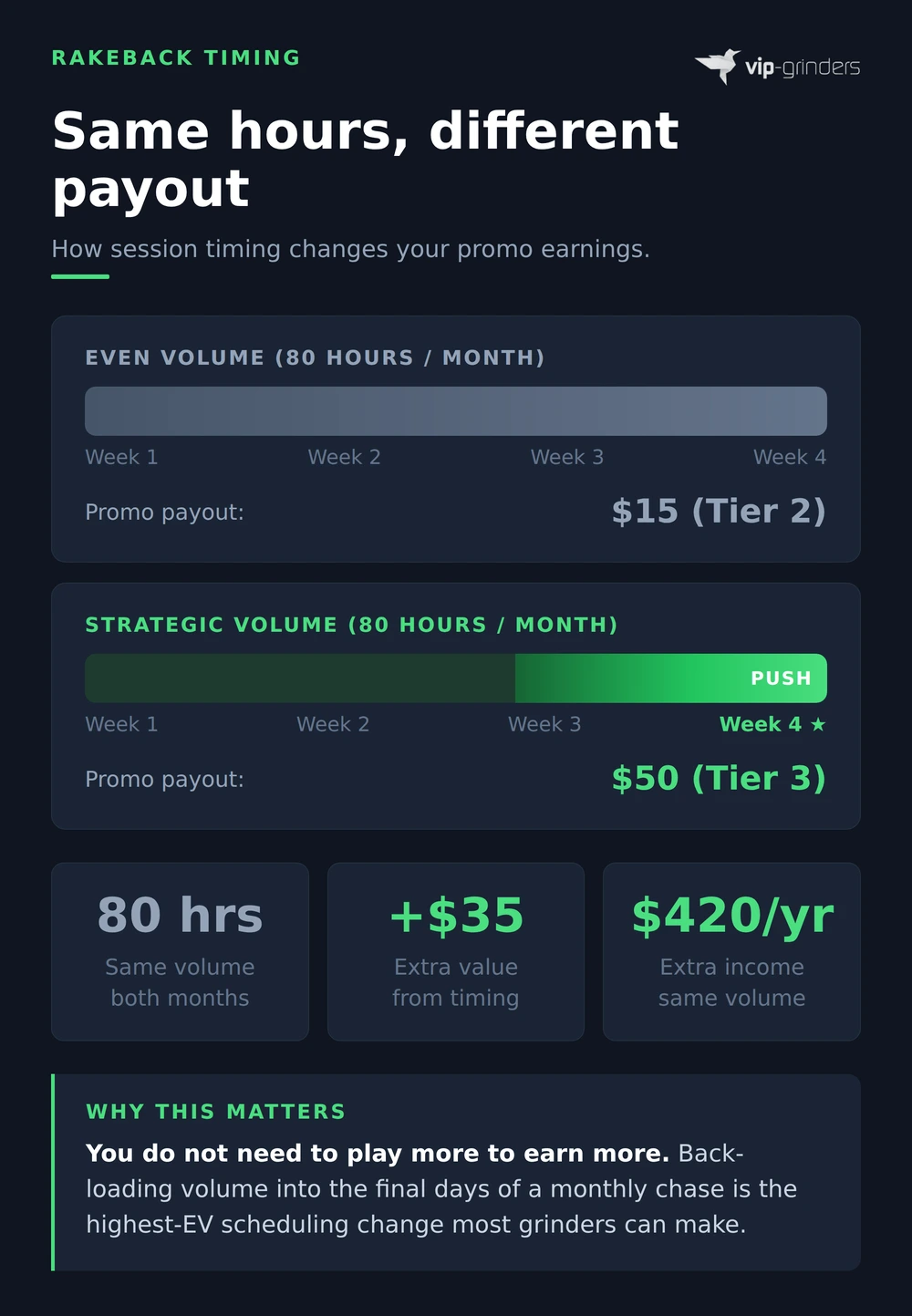
If you are already planning to play 15 to 20 hours per week, the question is not whether to play. It is when. Scheduling your sessions to overlap with active rake races, leaderboard windows, and monthly chase deadlines can add 5% to 15% to your effective return without changing anything about your actual poker strategy.
How This Works in Practice
Most poker rooms run monthly or weekly promotions that reward players based on the rake (the small fee the room takes from each pot) they generate during a specific period. If you concentrate your volume during those windows instead of spreading it randomly across the month, you earn the same rake but qualify for larger promo payouts.
- Rake races and leaderboards: these pay out based on your ranking among other players during a set period (usually a week or a month). Pushing extra volume in the final days of a leaderboard can jump you one or two tiers and significantly increase your payout.
- Monthly chases: some rooms offer escalating rewards based on total monthly volume. Missing a threshold by a small margin means leaving the entire bonus for that tier on the table. Plan your weekly schedule with these cutoffs in mind.
- Sunday majors and series events: the biggest MTT guarantees run on Sundays and during special series weeks. Blocking out these dates in advance ensures you have the time and energy to play them well.
A Simple Example
A NL25 grinder generating $150 per month in rake who times sessions to finish strong in a monthly chase can pick up an extra $30 to $50 in promo value. Over a year, that adds up to $360 to $600 in extra income from the same volume of play.
For a full list of rooms with tracked deals and active promotions, see our rakeback deals page.
The Post-Session Cool-Down (5 Minutes)
The cool-down is where long-term improvement happens. Most players close their tables and immediately move on, which means every mistake they made disappears from memory by the next session. Five minutes of structured logging fixes this and feeds directly into tomorrow’s warm-up.
- 1Log the session: record the format, duration, number of tables, and buy-ins won or lost. A simple spreadsheet or your tracker’s built-in session notes work fine. Over time, this data shows you which days, times, and formats produce your best results.
- 2Tag 2 to 3 hands for review: pick hands where you were unsure of the correct play, not just the biggest pots. Mark them in your tracker or write down the hand number. These become your warm-up material for the next session.
- 3Rate your decision quality from 1 to 5: this is separate from your profit or loss. A session where you lost 3 buy-ins but played every hand well is a 5. A session where you won 2 buy-ins but made sloppy calls is a 2. Tracking this over weeks reveals patterns that pure results tracking misses.
The connection between the cool-down and the warm-up is what makes the system work as a loop. Tonight you tag three hands, and tomorrow you review one of them during your warm-up. That single habit builds more skill over time than grinding extra volume with no review.
For more on how session data connects to your long-term profitability, see our hourly rate guide.
A Sample Weekly Schedule for Online Grinders
Theory is useful, but most players need to see what a real week looks like before they can build their own. The schedule below is designed for a player grinding NL25 with 4 tables, targeting roughly 20 hours per week. It is timed around European evening peaks and includes one full study day with no play.
| Day | Time (CET) | Hours | Focus |
|---|---|---|---|
| Monday | 20:00 to 22:30 | 2.5 | NL25 Cash (4 tables) |
| Tuesday | Study day | 1 | Review tagged hands. No tables. |
| Wednesday | 20:00 to 22:30 | 2.5 | NL25 Cash (4 tables) |
| Thursday | 21:00 to 23:00 | 2 | Spins or SNGs (format variety) |
| Friday | 20:00 to 23:00 | 3 | NL25 Cash (4 tables) |
| Saturday | 19:00 to 23:00 | 4 | NL25 Cash + 1 MTT |
| Sunday | 18:00 to 23:00 | 5 | MTTs + Cash (softest fields of the week) |
Total: ~19 playing hours + 1 study hour across 7 days.
This is a template, not a prescription. Adjust the days, times, and formats to match your timezone, your network, and your life outside of poker. The principle stays the same: put your longest sessions on the softest days, protect at least one study day per week, and never schedule more hours than you can play at full focus.
For a complete breakdown of how much volume you need to hit a specific income target, see our guide on making $1,000 a month grinding online poker.
Common Session-Management Mistakes
These four mistakes are specific to the timing and structure layer of poker. They are not about strategy at the table. They are about the decisions you make before, during, and after your sessions that quietly drain your win rate.
- Letting today’s profit or loss decide when you stop: quitting after a win “to lock it in” or chasing after a loss “to get back to even” are both driven by emotion, not math. Your stop rules should be set before the session starts and followed regardless of results.
- Playing past your stop-loss because the game feels soft: this is the single most expensive session leak. The game may be good, but after five lost buy-ins your decision quality is not. A soft table will still be there tomorrow.
- Grinding at 3am because you cannot sleep: the Hamel et al. study cited in the introduction showed that sessions played 16+ hours after waking produced significantly worse results. Late-night sessions also overlap with the worst traffic window (03:00 to 07:00 CET), meaning you are playing badly against the toughest fields.
- Never scheduling a study day: volume without review is just repeating the same mistakes at a higher speed. Even one hour per week spent reviewing tagged hands will improve your game faster than adding five extra grinding hours.
Frequently Asked Questions
What is session management in poker?
Session management is how you plan and control your poker playing time. It covers when you start a session, how long you play, what rules trigger you to stop, and how you schedule your week. The goal is to make sure you are always playing during your best mental hours, against the softest fields, and within the limits your bankroll and focus can support.
How long should a poker session last?
It depends on the format and how many tables you play. For online cash games with 1 to 4 tables, 1.5 to 3 hours is a good starting range. Spin & Go players should work in blocks of 10 to 20 games. MTT players need to plan for the full expected tournament duration before registering.
Should I use a stop-loss in poker?
Yes. A stop-loss is a pre-set number of buy-ins you are willing to lose before closing your tables: 3 per table or 5 per session for cash games, and 8 per session for SNGs. Setting this number before you sit down removes the decision from the moment when your judgment is most likely compromised.
What is the best time to play online poker?
The softest fields appear during evening hours in the timezone where your network has the most players. For European networks, that is roughly 19:00 to 01:00 CET. For US-facing rooms, the peak is around 16:00 to 20:00 ET. Weekends are softer than weekdays, and Sunday is the best single day for tournaments across every major room.
Should I quit a session if I am winning?
No. If the game is good and you are still focused, every hand you leave behind is expected profit you are choosing not to take. Your poker career is one long session and individual daily results are noise: use the variance simulator to see how much short-term swings can mislead you.
How do I track my poker sessions?
The simplest method is a spreadsheet where you log the date, format, session length, number of tables, buy-ins won or lost, and a 1 to 5 decision quality rating. Dedicated tracking software like PokerTracker or Hand2Note does this automatically and lets you tag individual hands for review. The key is consistency: log every session, not just the ones that felt important.