


Beginners sit at the poker table and try to guess what hand their opponent holds. They watch a player raise, think “he probably has Ace-King,” and base their entire decision on that single guess.
Winning players think differently. They understand that their opponent could hold dozens of hands. The complete set of hands a player could logically hold in a given situation is called a poker range.
This conceptual shift from hand-guessing to range-thinking is the single most important development in a poker player’s career. Once you start thinking in poker ranges, your decision-making improves on every street. Your equity calculations become precise. Your bluffing becomes strategic instead of random.
This article covers the full foundation of poker ranges: the hand matrix and combo math, position-based range construction, how to read your opponent’s range, range advantage, GTO vs exploitative play, and common mistakes that cost you money.
What Are Poker Ranges?
A poker range is every hand a player could have given the actions they have taken. It is not a guess about one specific holding. It is the entire set of possible holdings that remain consistent with their behavior.
Consider this example. A player raises from UTG. What single hand do they have? You cannot know. But you can construct their range. From UTG, they might hold AA, KK, QQ, JJ, TT, AK, AQ, AJs, or KQs. That collection of hands is their poker range.
A recreational player says: “I think he has AK.” A winning player says: “His range here is approximately the top 12% of hands. My equity against that range is 38%. My expected value on a call is positive.” That is the difference between guessing and calculating.
Thinking in poker ranges enables math-based decisions. When you estimate an opponent’s range, you can calculate equity against every hand in that set. You can determine whether a call, raise, or fold generates positive expected value.
Poker ranges change with every action. A player who raises preflop has one range. If they c-bet the flop, their range narrows. If they check the turn, it shifts again. Your own range is defined by your actions too. Understanding how actions shape ranges is the foundation of profitable poker.
Ranges, not hands
- Calculate equity: you can calculate equity against a range but not against a guess
- Eliminate guesswork: ranges account for all possible holdings systematically
- Size bets correctly: bet sizing and bluff-to-value ratios depend on range analysis
- Find hidden profit: range thinking reveals profitable spots that hand-guessing misses
- Control your image: your own range determines how opponents should play against you
The Hand Matrix and Combo Math
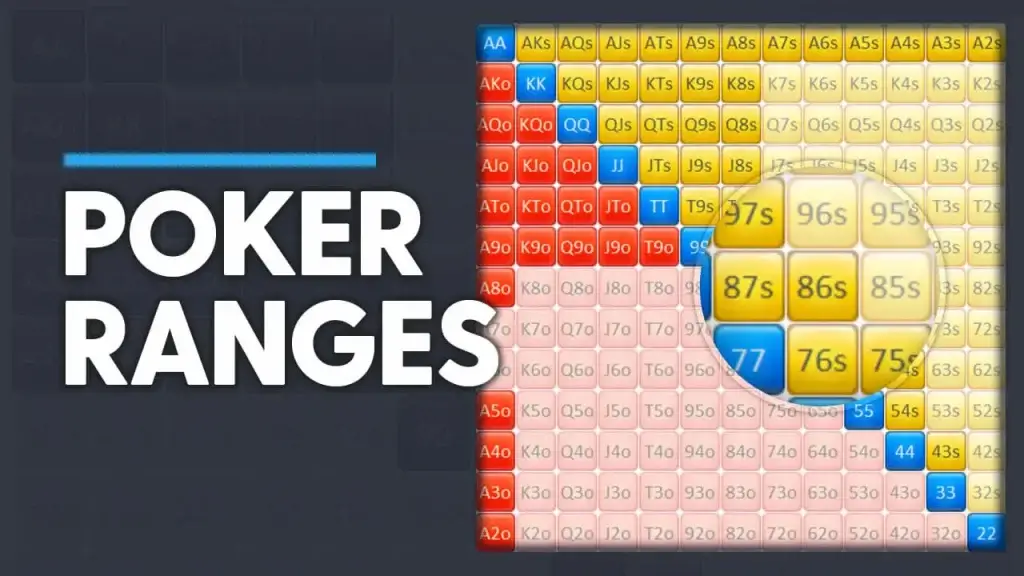
The hand matrix is the standard tool poker players use to visualize poker ranges. It is a 13×13 grid displaying all 169 unique starting hand types.

Pocket pairs run diagonally from AA (top-left) to 22 (bottom-right). Suited hands occupy the upper-right triangle above the diagonal. Offsuit hands occupy the lower-left triangle below it.
When cells are highlighted on this matrix, they define a range visually. A tight cluster in the top-left corner represents a narrow, strong range. A highlighted block covering half the matrix represents a loose, wide range.

How Combos Work
A standard deck has 52 cards. Two-card starting hands produce 1,326 unique combinations. Understanding combo counts is essential for accurate range analysis.
Pocket pairs: 6 combos each. Pocket aces can be dealt as AsAh, AsAd, AsAc, AhAd, AhAc, or AdAc. Six combinations total. The same holds for every pocket pair from AA to 22.
Suited hands: 4 combos each. AKs can only be dealt in four ways: AsKs, AhKh, AdKd, or AcKc. The suit-matching requirement limits combinations to one per suit.
Offsuit hands: 12 combos each. AKo includes all AK combinations where suits do not match. After removing the 4 suited combos, 12 offsuit combos remain.
This math directly impacts range construction. AKo (12 combos) is three times more likely to be dealt than AKs (4 combos). When you estimate poker ranges, count combos, not just hand names. A range of “all pocket pairs” sounds wide but is only 78 combos out of 1,326 total.
Blockers apply combo math to your specific hand. If you hold an Ace, you remove three combos of AA from your opponent’s range (from 6 down to 3). This changes equity calculations significantly. In tight spots, blockers determine whether a call or fold is correct.
| Hand Type | Example | Suited Combos | Offsuit Combos | Total Combos |
|---|---|---|---|---|
| Pocket Pair | AA, KK, 77 | N/A | N/A | 6 |
| Suited Hand | AKs, T9s, 76s | 4 | N/A | 4 |
| Offsuit Hand | AKo, T9o, 76o | N/A | 12 | 12 |
| Any Unpaired Hand | AK (all) | 4 | 12 | 16 |
| All Pocket Pairs (13) | 22 through AA | N/A | N/A | 78 |
| All Starting Hands | Full deck | 312 | 936 | 1,326 |
Combos matter
How to Construct Preflop Poker Ranges by Position
Position determines range width. Earlier position means a tighter range. Later position means a wider range. This is the foundation of preflop poker ranges.
Early Position (UTG, UTG+1)
From UTG, open approximately 12-15% of hands. Your range consists of premium pairs (TT+), strong broadways (AQ+, AK), and select suited hands like AJs and KQs.
You act first on every postflop street, so you need hands that play well from the front. Marginal hands like K9s or 87s are too weak here because positional disadvantage punishes speculative holdings.
Middle Position (MP, LJ, HJ)
From middle position, open approximately 18-22% of hands. Add medium pairs (77-99), suited connectors (87s, 98s, T9s), more suited broadways (KJs, QJs), and suited aces (A5s-A9s).
Fewer players act behind you, reducing the chance of running into a premium hand. These speculative hands become playable.
Late Position (CO, BTN)
The cutoff opens approximately 25-28%. The button opens approximately 40-45%. Late position is where poker profitability concentrates because you act last on every postflop street.
From the button, open wide: all pairs, all suited connectors, all suited aces, most broadways, and suited gappers. The button is the most profitable position in poker. If you open less than 35% from the BTN at 6-max, you are leaving money behind.
Blinds (SB, BB)
From the small blind, a 3-bet or fold strategy is standard. Flat calling is exploitable because you are out of position with one player still behind you.
A typical SB 3-bet range against a button open is 8-12%: premiums like QQ+ and AK, plus bluffs like A5s and K5s.
The big blind defends widest because you already have money invested. Against a button open, defend 35-45% of hands.
This includes suited connectors, low pairs, and hands that would be folds from other positions. You defend wide, but your postflop game is check-call heavy due to positional disadvantage.
| Position | Open-Raise % | Example Hands | Range Description |
|---|---|---|---|
| UTG | 12-15% | TT+, AQo+, AJs+, KQs | Tight premiums only |
| UTG+1 | 14-17% | 99+, AJo+, ATs+, KQs, QJs | Slightly wider |
| MP/LJ | 18-20% | 77+, ATo+, A5s-A9s, KJs+, suited connectors | Adding speculative hands |
| HJ | 20-23% | 66+, A9o+, A4s+, KTs+, QTs+, J9s+ | Wider still |
| CO | 25-28% | 55+, A7o+, A2s+, KTo+, Q9s+, suited gappers | Semi-wide |
| BTN | 40-45% | 22+, A2o+, K5o+, Q8o+, most suited | Very wide |
| SB | 3-bet: 8-12% | QQ+, AK, AQs, bluffs (A5s, K5s) | 3-bet or fold |
| BB defend | 35-45% vs BTN | Wide suited, offsuit connectors, pairs | Widest defend |
How to Read Your Opponent’s Poker Range
Range reading is the process of narrowing your opponent’s possible holdings based on every action they take. Every fold, call, raise, check, and bet eliminates some hands and confirms others.
Preflop Range Reading
An open raise from UTG signals a narrow, strong range (top 12-15%). An open raise from the BTN signals a wide range (top 40-45%).
A 3-bet is polarized: very strong hands (QQ+, AK) plus some bluffs (A5s, suited connectors). A cold call indicates medium-strength hands that play well postflop: suited connectors, medium pairs, suited broadways.
A tight player who raises from EP and then 4-bets a 3-bet? That range is almost certainly AA and KK, sometimes QQ. Remove everything else.
A loose player making the same sequence might include JJ, TT, and AQs. Know your opponent and adjust the range accordingly.
Postflop Range Narrowing
Every street narrows poker ranges further. On the flop, the action reveals how the board texture interacts with the player’s preflop range. A player who raises preflop and c-bets a K-high flop is representing top pair or better, or a strong draw.
Board texture is critical. On A-K-7 rainbow, the preflop raiser’s range dominates: they have more AA, KK, AK, and AQ combos.
On 7-6-5 with two hearts, the caller’s range has more two-pair, straight, and flush draw combos. Range advantage shifts with every board.
A check usually caps a range. If a player checks the flop after raising preflop, they usually do not have the nuts. Large bets on later streets indicate polarized ranges: the nuts or a bluff. Small bets indicate merged ranges with medium-strength hands.
- Start with position: what range does this player open from this seat?
- Apply preflop action: did they call, raise, 3-bet, or 4-bet? Each narrows the range dramatically.
- Read the flop: bets, checks, and raises reveal how the board interacts with their range
- Narrow on the turn: continuing aggression signals strength; checking signals weakness or trapping
- River decisions: river bets are the most polarized. They either have it or they are bluffing.
Range Advantage in Poker Explained
Range advantage occurs when your range as a whole is stronger than your opponent’s on a specific board texture. This concept drives your entire postflop strategy.
Example: you raise from UTG with your top 15% of hands. The BB calls with a wide 40% range. The flop comes A-K-2 rainbow.
Your range contains far more AA, KK, AK, and AQ combos than the BB’s range. You have range advantage. This lets you c-bet profitably even when you completely missed the flop because your opponent expects your range to contain more strong hands.
Now flip the board. Same preflop action, but the flop is 7-6-5 with two hearts. The BB’s wide range now has more two-pair combos (76s, 65s), straight combos (89, 98), and flush draws.
Range advantage shifts to the caller. You should check more often on this board rather than barrel blindly.
The key principle: high, dry boards (A-K-7 rainbow, K-Q-2 rainbow) favor the preflop raiser. Low, connected boards (7-6-5, 8-7-6 two-tone) favor the caller. Recognize which player has range advantage before deciding bet sizing and frequency.
Range advantage drives c-bet frequency, check-raise frequency, and turn/river aggression. Master this concept and your postflop game improves dramatically because you stop guessing and start calculating.
Board texture changes everything
GTO vs Exploitative Poker Ranges
GTO (Game Theory Optimal) ranges come from solvers. They are mathematically balanced: a precise mix of value bets and bluffs at correct frequencies.
Playing pure GTO poker ranges makes you unexploitable. GTO is your baseline when you have no reads on an opponent.
Exploitative ranges deliberately deviate from GTO to punish specific opponent weaknesses. Opponent folds too much to 3-bets? 3-bet wider with more bluffs.
Opponent calls too wide? Tighten your bluff range and widen your value range. Opponent never 3-bets? Open wider from every position since the squeeze threat is gone.
At low stakes ($2NL to $25NL), exploitative play is far more profitable than pure GTO because opponents have massive, predictable leaks.
A player who folds 80% to c-bets does not require a balanced range. They require relentless aggression.
At mid and high stakes ($50NL+), GTO-based play with small exploitative adjustments is standard. Opponents understand ranges and punish large deviations.
The best approach: learn GTO ranges as your foundation, then adjust exploitatively when you identify weaknesses. Use poker calculators to study equity matchups between your range and your opponent’s. Understanding the baseline helps you know exactly how far to deviate.
Common Poker Range Mistakes
Playing the same range from every position is one of the most common leaks. Your UTG range and BTN range should look completely different. If they are identical, you are either too tight on the button or too loose from early position.
Opening too tight from the button costs you money every session. The BTN is your most profitable seat. If you open less than 35% from the button in 6-max, you are leaving significant value behind.
Never 3-betting light makes your range transparent. If your 3-bet range is only QQ+ and AK, opponents fold everything except the nuts. You need bluffs alongside your value hands to remain unpredictable.
Ignoring stack depth is a structural mistake. Short stack ranges (under 30bb) are tighter and more push/fold oriented. Deep stack ranges (150bb+) include more speculative hands that gain value from implied odds. Using the same poker ranges regardless of stack depth is a serious leak.
Not adjusting to table dynamics leaves profit on the table. At aggressive tables with frequent 3-bets, tighten opening ranges. At passive tables where nobody fights back, open wider and value bet thinner.
- Same range every position: adjust for positional strength instead of playing one-size-fits-all
- Too tight on the button: open at least 35% from BTN in 6-max; this is your most profitable seat
- Never 3-betting light: a value-only 3-bet range is transparent and exploitable
- Ignoring stack depth: 20bb and 200bb effective require completely different ranges
- No table adjustments: tighten at aggressive tables, widen at passive tables
Frequently Asked Questions About Poker Ranges
What is a poker range?
A poker range is the complete set of hands a player could hold in a given situation based on their actions and position. Instead of guessing an opponent has a specific hand like AK, you estimate they hold a range such as the top 15% of hands. This allows you to calculate equity, determine optimal bet sizes, and make mathematically sound decisions across every street.
How do I read my opponent's range in poker?
Start with their position. A raise from UTG represents a tight range (12-15%), while a BTN raise represents a wide range (40-45%). Then apply each action as a filter. A 3-bet narrows the range to premiums and bluffs. A flop check-call suggests medium-strength hands and draws. By the river, a well-read opponent’s range is narrow enough to make confident decisions.
What is the 13x13 hand matrix?
The hand matrix is a 13×13 grid that displays all 169 unique starting hand types in poker. Pocket pairs run diagonally from AA to 22. Suited hands sit above the diagonal and offsuit hands below. Players use this matrix to visualize and define poker ranges by highlighting specific cells.
How many combos does each starting hand have?
A pocket pair has 6 combos. A suited hand has 4 combos. An offsuit hand has 12 combos. Any unpaired hand (suited plus offsuit) has 16 combos total. The full deck produces 1,326 unique two-card combinations. Understanding combo counts is essential for accurate range analysis.
What is range advantage in poker?
Range advantage means your overall range is stronger than your opponent’s on a specific board. If you raise from UTG and the flop comes A-K-2, your range has more strong hands (AA, KK, AK, AQ) than a BB caller’s range. This advantage lets you bet profitably even without a strong hand because your opponent expects you to hold better cards.
Should I use GTO or exploitative ranges?
Use GTO ranges as your baseline and deviate exploitatively when you identify specific opponent weaknesses. At low stakes, exploitative play is more profitable because opponents have predictable leaks. At mid and high stakes, GTO-based play with small adjustments is standard. Learn GTO first, then adjust.
What tools can help me study poker ranges?
Flopzilla lets you input ranges and see how they interact with different flop textures. Equilab calculates equity between two or more ranges. GTO solvers like PioSolver and GTO Wizard compute optimal strategies for any situation. PokerTracker and Hold’em Manager track opponent statistics that help estimate ranges in real time.
Conclusion
Thinking in poker ranges is the single most important skill in your poker career. Every decision at the table becomes clearer once you stop guessing about individual hands and start thinking about distributions.
Master the hand matrix and combo math. Build position-based ranges that adjust for your seat. Read opponents by narrowing their holdings with every action. Use range advantage to drive profitable postflop decisions.
Start with GTO ranges as a foundation and adjust exploitatively when you spot weaknesses. Your poker ranges define your strategy. Tighten them, widen them, and balance them with purpose. Every bet you make is a statement about your range. For more poker strategy content, keep building your edge. Use our poker calculators to study range equity and sharpen your decisions.