For 10+ years, our gambling experts have tested poker, casino and sports-betting sites independently. We double-check every bonus, promotion and stat and update pages regularly - see our Editorial Guidelines for the full details.
Transparency Note: If you signup through our links, we may earn a commission at no extra cost to you, which helps us keep our content high-quality and independent. If you like our content, we would be happy if you support our work by using our affiliate links.
Most players lose chips by betting the pot with strong hands and hoping their opponents will call. The best players think differently. An overbet is any bet larger than the current pot. It is one of the most powerful tools in modern poker strategy.
Top grinders use overbets to steal pots with weak hands, extract maximum value from strong ones, and exploit their opponents’ psychology.
This article breaks down the math, frequency, and execution of overbetting on every street. You will learn which board textures reward overbets, how to size bets for maximum expected value (EV), and the optimal times to overbet.
Mastering standard bet sizing and overbets can lead to measurable improvements in your win rate, typically 2 to 4 big blinds per hour in mid-stakes games.
Understanding Overbetting Fundamentals
Profitably overbetting rests on three pillars:
fold equity exploitation
psychological pressure
recognizing range advantage
Master these concepts, and your overbetting decisions will become clearer.
Why Overbets Exploit Overfolds
Poker players in general fold too often to large bets. Studies of mid-stakes players show that, when facing a bet larger than the pot, they fold at rates 3-8% higher than what optimal game theory dictates.
This is your edge. The math behind fold equity is simple: the larger your overbet, the more chips you’ll win when your opponents fold.
Compare the following two scenarios. In the first scenario, you bet one time the size of the pot and get folded to 60% of the time, winning the current pot. Or, you overbet 2.5 times the pot and get folded to 75 percent of the time, winning 2.5 times the pot on those folds.
Your expected value (EV) from fold equity alone often exceeds what you gain from standard sizing. Overbets exploit the cognitive bias that equates bet size with hand strength.
Most recreational players see a big bet and think “this player has the nuts,” so they fold medium-strength hands that would call a pot-sized bet.
The Psychology Behind Overbetting
Overbets trigger three psychological anchors in opponents’ minds. First, they create the perception of strength. For example, a 2x pot bet feels more credible than a pot-sized bet, even if your range is identical.
Second, overbets create decision anxiety. Opponents facing a massive bet will second-guess their hand strength more often. That middle pair they would call with becomes a fold.
Third, they create an aggressive perception. You’re not just betting; you’re applying maximum pressure. Over time, your opponents will begin to fear your large bets and fold more often.
This intimidation factor compounds in tournament play. When stacks are short, an overbet signals an impending shove, prompting most players to avoid conflict.
The best overbettors use this perception strategically to create a table image that makes future overbets even more effective.
Range Advantage vs. Nut Advantage
Overbets work in two distinct scenarios, and understanding the difference determines your frequency. Range advantage means your overall hand distribution is stronger than your opponent’s, even if you do not have the absolute best hand.
You raised from the CO with AQs, the BB called, and the flop is K92r. Your range contains more kings, more aces, and more broadway cards than the BB’s calling range.
A 2x pot overbet here wins the pot immediately 40 to 50% of the time through fold equity alone.
Nut advantage means you hold hands that dominate the board texture and sit near the top of the true range hierarchy. You have AA on an AK2r flop.
You are not just ahead of the BB’s distribution; you are crushing most of their plausible holdings. Range advantage overbets exploit fold equity.
Nut advantage overbets extract maximum value. Both work, but they require different hand selection and frequency calculations.
When and Where Overbetting Works
Not every board, opponent, or stack depth is conducive to overbetting. Profitable overbets require specific conditions. Identify these conditions before sizing up.
Board Textures That Enable Overbets
Dry boards like AK2r, AQ3r, and K96r are overbetting havens. These textures dramatically reduce opponent range connectivity.
When the board has no straights, no flushes, and no paired cards, hand strength becomes highly polarized. Overbets on dry boards generate 45 to 60% fold rates from competent opponents.
Paired boards like AAx, KKx, and QQx reward overbets for different reasons. These textures severely limit opponent holdings.
If you raised preflop and an ace or king hits, your range advantage becomes enormous. The BB rarely has premium pairs because they would have three-bet preflop.
Dry ace-high boards (AK2r, AQ3r, AT6r): Your preflop raising range dominates these textures. Opponents struggle to connect, and fold rates reach 45 to 60%.
Paired boards (AAx, KKx, QQx): Severely limits opponent holdings. If you raised preflop, your range advantage is enormous because they would have three-bet premium pairs.
Static low boards (K42r, Q93r, J72r): Low connectivity means hand strength rarely changes on later streets. Overbets lock in equity advantages early.
Ace-high rainbow boards (AJ4r, AK8r): Preflop aggressors hold more aces and broadway cards. The positional disadvantage for the BB caller becomes severe.
Opponent Profiling: Identifying Overfold Targets
Overbetting is most effective against players with fold rates above 40%. Track VPIP and PFR from your player database.
A player with 28 VPIP and 22 PFR is tight-passive, meaning they fold to aggression more readily. Recreational players typically fold 40 to 60% to overbets on the flop, compared to 25 to 35% for competent regulars. The gap is enormous.
Your overbetting strategy should skew heavily toward exploiting soft fields. When facing multiple strong regulars, overbetting frequency drops significantly because they call too wide and your fold equity evaporates. Review hand histories and track how specific opponents respond to your large bets.
Low SPR Spots and All-In Decisions
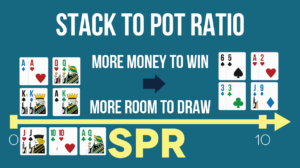
SPR (stack-to-pot ratio) dramatically changes overbetting math. When SPR falls below 3, you enter “commit” territory. An overbet at SPR 2.5 is functionally equivalent to going all-in.
For example, you have AK, the board is Q74r, and SPR is 2.4. An overbet-shove puts your opponent in a position where they can call with any piece of the board plus overcards.
But your EV is still positive if they fold more than 35% of the time and you have 45% equity when called.
Low SPR overbets transition from fold-equity plays to all-in equity plays. Instead of asking “what size generates maximum fold equity,” you ask “am I all-in, and do I have the equity needed to break even.”
This distinction is critical for tournaments where SPR drops throughout the event.
Position Impact on Overbetting
In position, you overbet more frequently because you have information advantage. You see your opponent’s action first, then make decisions with updated tendency data.
An overfold target who checks the flop gives you a green light to overbet. Out of position, overbetting frequency drops 30 to 40% because you are making decisions blind.
BTN vs BB dynamics are asymmetrical. The BTN can profitably overbet with a wider range because the BB plays tighter preflop and has fewer broadway hands in their calling range.
A solid rule: IP overbetting frequency is 20 to 30% higher than OOP frequency in identical spots.
Overbetting by Street: Flop, Turn, River
Each street creates different overbetting dynamics. The flop rewards range-based overbets. The turn rewards information-based overbets. The river rewards nut-advantage overbets.
Flop Overbetting
Flop overbetting works when your range advantage is clearest. You opened CO with AQs, the BB called, and the flop is K92r. Your opening range contains roughly 32 combos that hit this board well.
The BB’s calling range contains 16 combos that connect. You hold a 2:1 range advantage. A 2x pot overbet here generates 50 to 55% fold rates from tight opponents and 35% from competent regulars.
The key is board texture. Flop overbets on connected boards like JT9 or K87ds fail because opponent ranges are too strong and fold rates drop to 25%.
Most flop overbets should size to 2 to 2.5x pot to generate maximum fold equity while leaving room for turn and river adjustments.
Turn Overbetting
Turn overbetting is undervalued because players default to river aggression. The turn is when information advantage peaks. You have seen four community cards and know your equity more precisely.
A brick turn (a card that does not connect to either range) is the prime overbetting spot. You bet 1.5x pot on the flop, your opponent called, and the turn is a 3. Nothing changed.
Your overbetting range is actually stronger because you survived a call. A 2.5x overbet here generates 45 to 50% fold rates.
Threat cards change the dynamic. If the turn is an ace or king when your opponent was the aggressor, this card might help them. Size down to 1.75x pot because your range is less defined in that scenario.
River Overbetting
River overbetting delivers the highest value because you have complete information. All five community cards are visible.
Overbets on the river work when you have nut advantage, meaning you hold hands in the absolute top of your range hierarchy.
You have AA on a board of AK2r7J. Almost everything you could hold is ahead. A 2 to 3x pot overbet generates profit from worse aces, pocket pairs, and value-hand mistakes.
River overbets also work as thin value. You have AQ on an AK282 board. An overbet forces opponents to assume you have AA or KK, and they fold medium-strength hands that would have called a pot-sized bet.
Bluff river overbets are rare because fold equity math is tight. Unless you have specific reads, river bluff overbets underperform.
Multi-Way Pot Adjustments
Three-way and four-way pots change overbetting math dramatically. Fold equity drops linearly with each additional player. In a 3-way pot, you need 20 to 30% higher fold equity to profit from the same overbet size.
Instead of 2.5x pot heads-up, you overbet to 1.75x pot three-way. Multi-way overbets should concentrate on extreme board textures and nut advantage situations.
Most winning players reduce overbet sizing by 30% when a third player enters the pot.
Overbetting Sizing Mathematics
Proper sizing separates profitable overbets from expensive mistakes. The math is learnable and repeatable.
Basic Bet Sizing Formula
A 1.5x pot overbet is the minimum to qualify as an “overbet” and generates 30 to 35% fold rate increases from baseline pot-sized betting.
A 2x pot overbet is the workhorse size, generating 40 to 50% fold rate increases. A 2.5x pot overbet is maximum aggression, generating 50 to 60% fold rate increases but requiring stronger holdings.
The relationship between size and fold equity is non-linear. Doubling your bet does not double your fold rate. Increasing from 1x to 2x pot might increase folds from 55% to 70%, but increasing from 2x to 3x pot might increase folds only from 70% to 78%.
The formula: EV = (Fold Rate x Pot) + (Call Rate x Equity Advantage x Total Pot).
Most overbets fall in the 2 to 2.5x range because this is where fold equity and value extraction optimize.
Extracting Maximum Value with EV Calculations
Concrete example: you have AA on an AK2r flop. Pot is $200. Your opponent’s range: AQ, JJ, TT, some AJ, some air.
Your equity: 85%. A 2x pot bet ($400): fold rate 40%, call rate 60%. EV = 0.40 x 200 + 0.60 x 0.85 x 600 = 80 + 306 = $386. A 2.5x pot bet ($500): fold rate 50%, call rate 50%. EV = 0.50 x 200 + 0.50 x 0.85 x 700 = 100 + 297.5 = $397.50.
The math shows that as sizing increases, EV increases at a decreasing rate. Past a certain point, additional sizing generates diminishing returns.
You want to be in the 2 to 3x range for maximum value. Run this calculation with your actual fold rate and equity estimates for each specific spot.
Balancing Overbets: Frequency and Ratios
Overbetting frequency is where amateurs go wrong. They overbet value hands exclusively and never overbet bluffs, creating an exploitable pattern.
You need balance. The value-to-bluff ratio should be approximately 3:1 in exploitative play. For every three overbet value hands, you overbet one bluff.
Combo counting ensures balance. You have 6 combos of AA, 4 combos of AK, and you should include 3 combos of bluffs like QQ, JJ, or weaker broadway hands.
The ratios compound across streets. Maintaining 3:1 on the flop and 2:1 on the turn produces a properly balanced range by the river.
Pot Odds and Fold Equity Math
When your opponent faces your overbet, their pot odds determine profitability. You overbet 2.5x pot. The total pot is now Pot + 2.5 Pot = 3.5 Pot.
Your opponent needs to call 2.5 Pot to win 3.5 Pot. Their pot odds are approximately 1.4:1. They need 41.7% equity to break even.
If your overbet generates a 50% fold rate against recreational players and your hand holds 60% equity when called, you are profitable.
But if the same overbet generates only 25% fold rate against a competent opponent with 50% equity when called, the play is negative EV.
Larger bets require higher fold rates. You need roughly 40% folds for a 2.5x overbet to break even with 50% equity when called.
Board Type
SPR Range
Recommended Overbet Size
Minimum Fold % Needed
Dry ace-high (AK2r, AQ3r)
4+
2 to 2.5x pot
35-40%
Paired (AAx, KKx)
3-5
1.75 to 2.25x pot
30-38%
Connected wet (JT9, K87ds)
4+
1.5 to 1.75x pot
45-55%
Tournament short stack
1.5-3
2.5 to 3.5x pot (near shove)
25-35%
Low SPR cash game
<2
1.25 to 1.75x pot (shove)
20-30%
Overbetting for Value vs. Bluffs
The distinction between value overbets and bluff overbets drives your entire range construction. Get the ratio wrong, and opponents exploit you in both directions.
Building a Value Range
Your value range on the flop should contain hands with 65%+ equity against opponent likely holdings. On an AK2r flop after a CO open and BB call, your value range includes AA, AK, and occasionally KK.
These hands crush the BB’s range. You do not overbet with JJ or QQ on this texture because those hands have only 50 to 55% equity, and overbet sizing demands better.
Position-specific value ranges matter. You overbet more from the BTN than from the BB because your BTN range is stronger preflop, which naturally builds a stronger postflop value range.
The goal is to value-overbet frequently enough that opponents cannot exploit you by raising, but not so frequently that they call with reckless width.
Bluff Overbets: When and How Often
Bluff overbets work when your hand has equity and fold equity simultaneously. You have 87s on a K85ds flop after a CO open and BB call. You have 8 outs to a straight and multiple overcard outs.
Your equity is 35%. An overbet here works as a bluff with equity backup. Your opponent faces a large bet and folds medium-strength hands. If called, you still win 35% of the time and have turn cards that dramatically improve you.
Bluff frequency depends on your overall overbetting frequency. If you overbet 20% of your combos, one quarter should be bluffs. The best bluff overbets have equity and blocker cards.
A bluff overbet with 34o is awful. A bluff overbet with AQo (blocks strong opponent holdings) or 87s (has strong draw equity) is profitable.
Balancing Your Range
Range balance prevents exploitation. If opponents figure out that you only overbet value, they raise your overbets with marginal hands. If they figure out you overbet bluffs without strong hands, they call wide with air.
Your opponent should be indifferent between calling and folding your overbets. Exploitative adjustments matter: if your opponent folds too much, overbet more hands including weaker value and more bluffs.
If your opponent calls too much, tone down overbetting and rely on smaller sizing. A 3:1 value-to-bluff ratio is a baseline, not a law.
Against aggressive defenders, increase bluff frequency. Against passive folders, increase value frequency.
Hand Examples with Equity Breakdowns
Your Hand
Board
Your Equity
Overbet Size
Fold %
EV Result
AA
AK2r
82%
2x pot
40%
+$386 (strong value)
AK
AQ3r
78%
2x pot
35%
+$375 (strong value)
JJ
J96r
68%
1.75x pot
45%
+$295 (thin value)
AQdd
K85dd
42%
2x pot
50%
+$226 (semi-bluff)
87s
T96r
32%
2x pot
40%
+$195 (bluff with equity)
Nutted hands (AA, KK, sets, strong straights, nut flushes): Always overbet for value when board texture supports it. These hands crush opponent calling ranges and extract maximum chips.
Nut draws with equity backup (OESD+flush draw, combo draws): Semi-bluff overbets with 35%+ equity and fold equity create profitable spots even when called.
Range-advantaged hands (AK on AQ boards, QQ on Q-high boards): Overbet to deny equity realization and force opponents off medium-strength holdings they should defend.
Thin value hands in specific spots (top pair good kicker vs. capped range): When opponent's range is clearly capped through passive action, thin value overbets extract extra chips.
Tournament Overbetting Strategy
Tournament poker demands overbetting adjustments that cash games do not require. Effective stacks shrink constantly, ICM pressure mounts, and all-in equity becomes your primary currency.
Stack Depth and ICM Considerations
Stack depth determines overbetting frequency. At 100BB, you implement overbets cautiously. Your stack absorbs losses across multiple decisions.
At 50BB, overbetting increases slightly as margin for error shrinks. Below 20BB, overbetting becomes all-in territory where push/fold logic dominates.
ICM changes the math entirely. In cash games, you win money directly. In tournaments, you win a payout based on remaining stacks.
A 3x shove that wins a 15BB pot creates a completely different ICM landscape than the same play at 100BB. Factor payout implications into every overbet decision.
Bubble and Endgame Adjustments
The bubble is overbetting paradise. Fold equity skyrockets because players tighten 20 to 30% compared to normal stages. Chip leaders abuse this relentlessly, overbetting with marginal holdings that would lose value in cash games.
A jam with 55 on a K-high board that folds 60% of the time is profitable on the bubble even though it breaks even in isolation.
Short stacks shift to desperation mode. They shove with 15 to 20% of hands. Chip leaders recognize this and widen their calling ranges only when forced.
The endgame becomes high-pressure territory where overbets that seemed risky at 100BB become standard at 4BB.
Push/Fold and the Overbet Shove
All-in is the ultimate overbet. Below 10BB, push/fold becomes your framework. You are not betting anymore; you are committing your remaining stack.
Use tools such as poker calculators like ICMIZER or HoldemResources Calculator to determine shove and call ranges at every stack depth.
BTN vs BB at 8BB? Shove top 45% of hands. UTG at 6BB? Shove top 20%. These are the mathematical equilibrium. Deviating costs chips long-term.
The overbet shove punishes tight defensive ranges. If your opponent calls push/fold correctly, the shove breaks even. If they are tighter by 10%, you gain 2 to 3% equity per spot.
Tournament vs. Cash Game Key Differences
Tournament poker removes table selection. You play the table you are assigned. Stack pressure is constant; in cash games, you rebuy if needed.
In tournaments, every chip matters. Overbetting frequency increases accordingly. By final table stage, players overbet 40% more than their cash game baseline because ICM survival matters more than individual pot size.
Bankroll management is real. A tournament overbet that goes wrong costs your entire entry fee, not a single pot. This makes accurate overbetting even more critical.
Below 20BB, push/fold replaces standard overbetting: All-in is the ultimate overbet. Use push/fold charts from ICMIZER or HoldemResources Calculator to determine shove ranges at every stack depth.
Bubble dynamics increase fold equity by 20 to 30%: Players tighten significantly near pay jumps. Chip leaders should increase overbetting frequency to exploit survival-mode opponents.
ICM changes risk/reward calculations: A 3x shove that wins a 15BB pot creates a different ICM outcome than the same play at 100BB. Factor payout implications into every overbet decision.
Final table overbetting frequency rises 40% above cash game baseline: Stack pressure and elimination risk compound. Players who overbet correctly at final tables accumulate chips faster than tight players.
Live Poker Overbetting
Live poker overbetting works because live players lack solver exposure and fold overly tight. They play on feel, and overbets feel scary.
Recreational players fold 40 to 60% to overbets, while the online solving standard is 35 to 45%. That 5 to 15% gap is your edge.
Exploiting Recreational Overfolds
Low and mid-stakes live games are overbetting goldmines. $1/$2 and $2/$5 regulars have not studied GTO solvers. They fold too much to overbet sizing.
Recreational players correlate large bets with strong holdings in ways that do not translate to online play. The live $2/$5 recreational player assumes you are shoving monster hands.
Exploit this by overbetting marginal value hands that would normally check. The sweet spot is $1/$2 through $5/$10 games where players are competent enough to avoid massive mistakes but have not studied range theory.
Reading Opponents at the Table
Live reads matter. You cannot use database VPIP data, but you can observe in real-time. Does this opponent bet large when strong and check marginal hands?
Does he fold to overbets consistently or occasionally snap-call? Two-orbit observation gives you better information than a 1000-hand sample online.
Watch stack management. Players who protect small stacks tight are fold-heavy. Showdown reads reveal tendencies directly.
When you see opponent showdowns, note bet sizing correlation and adjust your overbetting frequency based on those reads.
Adjusting Against Solid Live Regulars
Solid live regulars call overbets at 30 to 40% frequency correctly. This shrinks your edge significantly.
Restrict your value overbets to nut-advantage holdings: sets, two-pair, strong hands on static boards. Marginal value like bottom pair and backdoor combinations should not be overbetting.
Bluff overbets against solid regulars need careful construction. They call flop raises with 25% of hands and river overbets with 15 to 20%. Frequency matters: overbet three times per hour against recreational players, once per hour against solid regulars.
Common Overbetting Mistakes
Overbetting looks profitable until you lose four stacks in a month. The mistakes are subtle and hide inside seemingly reasonable decisions.
Overbetting the Wrong Board Textures
Wet boards punish overbets. Boards like JT9, KQJ, and 987 give opponents too many ways to improve or already have equity.
Your nut advantage shrinks. Overbetting into a JT9 board works against weak ranges but destroys you against strong ranges because hands that call (flush draws, straight draws, pairs) have 40%+ equity.
Dry boards (AK7r, Q93r, K42r) favor overbets. Wet boards do not. The board itself determines whether overbetting is sound.
Overbluffing Without Range Coverage
Overbets require balance. If you bluff-overbet without sufficient value, opponents exploit you by calling wider. The bluff-to-value ratio matters.
Top solvers maintain 1 bluff per 3 value hands minimum on river overbets. Count your overbets: value overbets, bluff overbets, proportions. If your bluff frequency exceeds 30%, tighten to 20%.
Ignoring Reverse Implied Odds
Overbetting vulnerable hands costs long-term. You hold a strong hand but one that loses to many river cards. Overbet, opponent calls, you are behind on 15 runouts.
This is reverse implied odds. Overbetting is for superior hands, not vulnerable hands. Hands with reverse implied odds should bet normally or check.
Overestimating Opponent Fold Rates
Population stats do not apply to specific players. The average live player folds 50% to overbets. Your specific opponent folds 25%. You copy the stat and lose money.
Multi-way pots destroy overbet fold rates further. With three players, the overbet folds 30% less often. Track your opponents’ individual fold rates and adjust accordingly.
Neglecting Bankroll Variance
Overbetting increases variance by 20 to 30% because pots are larger and swings are wider. Tight bankroll management (20 to 30 buy-in buffer) plus aggressive overbetting equals ruin.
You need 50+ buy-in buffers to weather overbet swings. Bankroll dictates overbet frequency, not ambition.
Overbetting without nut advantage: If you do not hold the strongest hand or near-nut equity, overbetting is speculatively aggressive, not calculated. Stick to nut-equivalent hands.
Overbet frequency exceeds 5% of decisions: If you are overbetting more than once per 20 decisions, you are overbetting weak spots. Solvers maintain 3 to 5%. Above that, opponents exploit you.
Overbetting marginal hands because the pot is large: If the pot size is driving your decision rather than the spot quality, your process is backwards. Overbets exploit ranges, not pot sizes.
No value hand to pair with the bluff: If you cannot name a strong hand you would overbet for value in this exact spot, the bluff overbet is unbalanced and loses money long-term.
Opponent has not shown tight folding tendencies: Overbetting aggressive, loose opponents (call-happy types) loses money. They do not fold enough. Target tight, passive opponents who fold too much.
Tools and Practical Application
Study tools separate winning overbettors from guessers. You need solvers for equilibrium understanding and tracking software for measuring results.
Using GTO Solvers to Study Overbets
PioSOLVER and GTO Wizard show overbetting equilibrium. Load a specific board (BTN open, BB defend, K93r turn, 15BB pot). Run river solutions.
The output tells you which hands to overbet, which to value-bet, which to check. Study BTN vs BB: the most profitable overbet scenario.
Overbets typically comprise 8 to 15% of the river betting range in equilibrium. Spend 30 minutes daily studying one spot. After 100 spots, patterns emerge and you recognize profitable overbet situations at the table without deliberation.
Hand Tracking Software
Hand2Note and PokerTracker 4 let you filter overbet hands (bet sizes above 1.5x pot) and measure win rate. Segment by position, board texture, and opponent type.
BTN overbets versus mid-position overbets. Dry boards versus wet. Against regs versus against fish. The filtering reveals which spots work and which need tightening.
If BTN river overbets run at +15BB/100 but SB overbets run at -5BB/100, you are overbluffing from SB. Tighten that specific spot.
Building Your Personal Overbetting Playbook
Create a document listing: position, board texture, stack depth, opponent type, hand categories, and bet sizing. Add board texture columns: dry, moderate, wet.
Add hand categories: nut value, premium value, marginal value, bluff strong, bluff air. Review the playbook before sessions. Add notes post-session.
Test implementation with two positions first, measure results, then expand once win rate stabilizes. This gradual approach prevents catastrophic adjustments.
Frequently Asked Questions About Overbetting in Poker
What is the difference between an overbet and a normal bet in poker?
A normal bet sizes relative to the pot, typically between 50% and 100% of the current pot. An overbet exceeds 100% of the pot: 1.5x, 2x, 2.5x or larger. Overbets commit more money, change pot odds, and apply different psychological pressure. Normal bets fit standard ranges and maintain balance. Overbets create exploitative gaps by forcing opponents into uncomfortable decisions with medium-strength hands.
When should I overbet instead of making a standard bet?
Overbet when three conditions align: you hold nut advantage (strong hand or strong range), the board texture supports it (dry boards favor overbets, wet boards do not), and your opponent shows tight folding tendencies. In tournaments below 20BB, overbetting becomes your primary structure because stack depth forces push/fold decisions. The best spots are BTN vs BB heads-up on dry board textures.
How do I calculate the correct overbet size?
Start with the EV formula: EV = (Fold Rate x Pot) + (Call Rate x Your Equity x Total Pot After Bet). Most equilibrium overbets size between 1.5x and 2.5x pot. Begin conservative at 1.5x pot. If opponents fold too much, increase to 2x next session. If they call too much, decrease to 1.3x. The proportion controls opponent response, not the absolute dollar amount.
Can I overbet as a bluff, or should overbets only be for value?
Bluff overbets are essential for balance. If you only overbet value hands, opponents exploit you by calling wider. Solvers maintain a minimum 3:1 value-to-bluff ratio for river overbets. Bluff overbets require either true air (very weak hands with 4 to 5 outs) or semi-bluffs (draws with backup equity). Marginal hands with showdown value should not be used as bluff overbets.
Is overbetting more effective in tournaments or cash games?
Tournaments produce better overbetting results. Stack pressure creates tighter defense because players cannot rebuy. ICM awareness makes opponents fold an additional 10 to 15% against overbets compared to cash games. Below 20BB, overbetting is structurally mandatory through push/fold. Cash game overbetting is purely exploitative and optional. Both formats reward overbetting, but tournament dynamics amplify the edge.
What hands should I overbet with on the river?
Value overbets require nut advantage or near-nut strength: sets, two-pair, strong straights, and nut flushes. Marginal value hands (one pair, weak two-pair) should use normal bet sizing. Bluff overbets work with air holdings that bricked their draws (gutshots, wheel draws). Hands with 6+ outs or showdown value should check or bet normally. The best river overbet hands are ultra-polarized: monsters or nothing.
How does my opponent type affect my overbetting strategy?
Recreational opponents fold 45 to 60% to overbets, making marginal value overbets profitable. Solid regulars fold 30 to 40% (near equilibrium), requiring genuine value hands. Tight opponents fold 50 to 70%, rewarding aggressive overbetting with weaker holdings. Loose, aggressive opponents fold only 20 to 35%, making normal betting more profitable than overbetting. Adjust frequency per opponent type in each session.
We use cookies to ensure that we give you the best experience on our website. If you continue to use this site we will assume that you are happy with it.