

MTTs vs Spin & Gos: Which Tournament Format Fits Your Game in 2026?
MTTs (Multi-Table Tournaments) and Spin & Gos are the two most popular tournament formats in online poker, but they reward different player types, demand different bankrolls, and produce very different income patterns.

Picking the wrong format means grinding harder for less money. Picking the right one means your volume, rakeback, and results all push in the same direction. This guide compares the two formats across every factor that affects your bottom line.
If you have not played either format before: an MTT is a tournament where hundreds or thousands of players start at the same time, blinds increase on a schedule, and the last players standing split a prize pool weighted toward the top finishers.
A Spin & Go (also called Spin & Gold on GGPoker, BLAST on 888poker, or Expresso on Winamax) is a 3-player hyper-turbo sit & go with a random prize multiplier, and most games finish in under 7 minutes.
Here is what this guide covers:
- Variance profiles and which type of losing streak fits your personality
- Bankroll requirements and why both formats land on the same guideline for different reasons
- Rakeback earning potential and hourly rate by format
- ICM pressure: when it matters in MTTs and why it barely exists in Spins
- Multi-tabling, session control, lifestyle fit, and a 60-second format picker
For full strategy guides on each format individually, see the dedicated MTT and Spin & Go sections below, which link to the complete walkthroughs.
MTTs vs Spin & Gos at a Glance
This table covers every major difference between the two formats in one screen. If you only have 30 seconds, read this and skip to the decision tree further down.
| Attribute | MTTs | Spin & Gos |
|---|---|---|
| Players per event | Hundreds to thousands | 3 |
| Game length | 4 to 10 hours per event | Under 7 minutes on average |
| Blind structure | Slow (15 to 30 min levels) | Hyper-turbo (2 to 3 min levels) |
| Payout shape | Top-heavy, roughly 10 to 15% of the field cashes | Chip-EV in most games (no payout for 2nd/3rd) |
| ICM (payout pressure) relevance | Central from the bubble onward | Rarely applies (only at high multipliers) |
| Variance class | Very high | Extreme |
| Standard bankroll range | ~150 BIs (standard guideline) | ~150 BIs (standard guideline) |
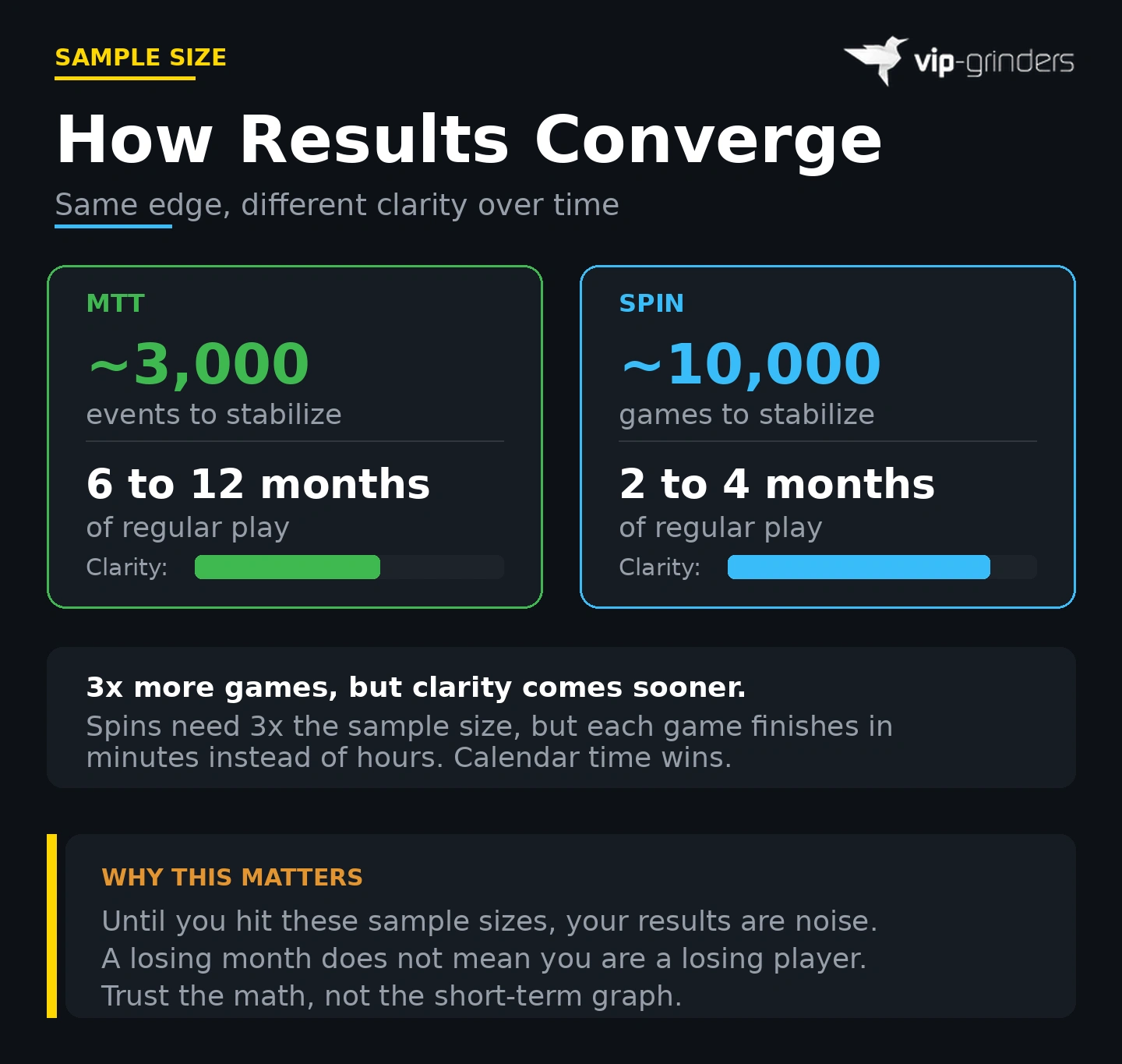
| Sample to stabilize results | Thousands of events | Tens of thousands of games |
| Typical table count | 6 to 12 simultaneous | 4 to 8 simultaneous |
| Session flexibility | Locked in once you run deep | Stop registering any time |
| Rake generated per hour | Lower (fewer games completed per hour) | Higher (more games completed per hour) |
| Best suited for | Deep-stack specialists, big score chasers | Volume grinders, short-session players |
The rest of this guide breaks down each row with the context you need to make a decision. Every section links to the relevant deep-dive guide so you can go as far into the details as you want without this page repeating what already exists elsewhere.
What Is an MTT?
An MTT (Multi-Table Tournament) is a poker tournament where every player pays the same buy-in, receives the same starting stack, and plays until one player holds all the chips. As players are eliminated, tables merge until a single final table remains. The prize pool is split across the top finishers, with the winner typically earning 20 to 25% of the total pool and roughly 10 to 15% of the field receiving any payout at all.
MTTs run on a fixed blind schedule that increases every 15 to 30 minutes depending on the structure. A single event can last anywhere from 4 hours (fast structures, small fields) to 10+ hours (deep stacks, large fields). You cannot leave a tournament early without forfeiting your remaining equity.
For the full strategy breakdown from registration to final table, see the MTT strategy guide.
What Is a Spin & Go?
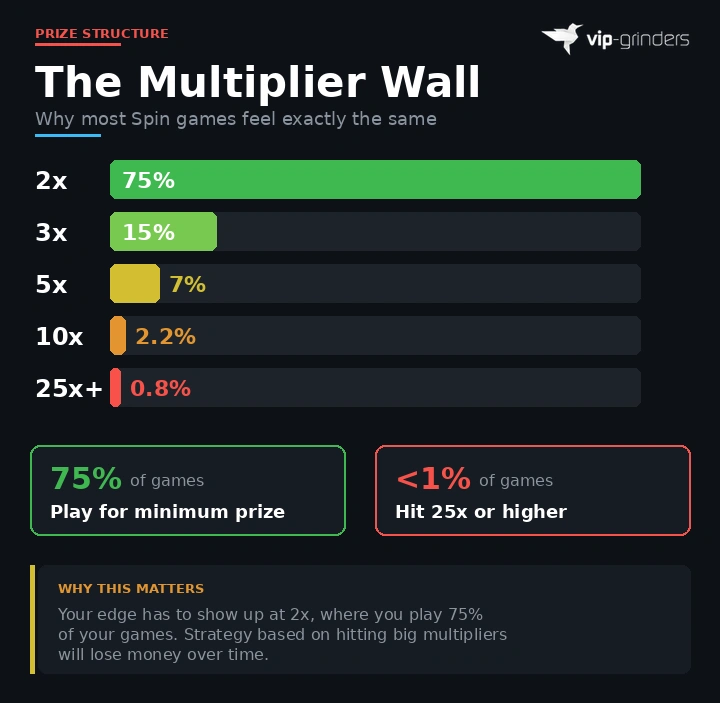
A Spin & Go is a 3-player sit & go with hyper-turbo blinds (levels increase every 2 to 3 minutes) and a random prize multiplier that is revealed before the first hand. The multiplier determines the total prize pool: a $10 Spin with a 2x multiplier plays for $20, while the same $10 Spin with a 100x multiplier plays for $1,000. Most games land on the lowest multiplier (typically 2x), and the entire event finishes in under 7 minutes on average.
Every major poker room offers its own version of this format under a different name: Spin & Gold on GGPoker, BLAST on 888poker, Expresso on Winamax, and Jackpot Poker on Americas Cardroom. PokerStars, which created the original Spin & Go, discontinued its faster Flash variant in 2025 but continues to run the standard format at every buy-in level.
For push/fold charts, multiplier breakdowns, and the full strategy walkthrough, see the Spin & Go strategy guide.
How the Variance Feels Different
Both formats carry high variance, but the way that variance shows up in your day-to-day experience is completely different. Understanding the difference matters because it determines which type of losing streak you will face and whether your personality can handle it.
MTT Variance: The Slow Grind
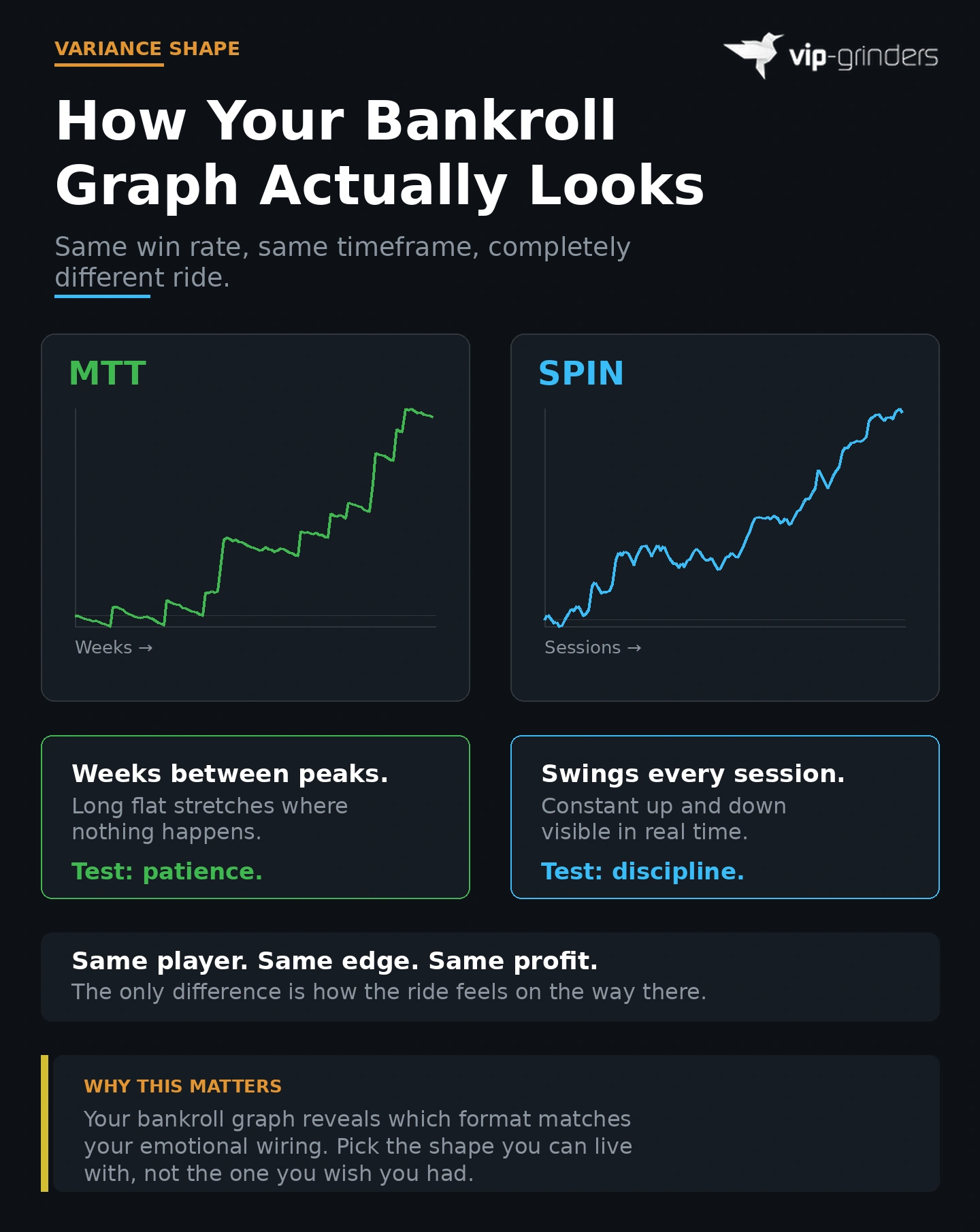
In MTTs, each event takes hours to complete. You might play 15 to 20 tournaments in a week and cash in one or two of them. The losses accumulate quietly across days and weeks of sessions that end with nothing to show for 6 hours of work.
The emotional challenge is patience. You invest full evenings into events and walk away empty-handed most of the time. The wins, when they come, are large enough to erase weeks of losses in a single deep run, but the gap between those runs can stretch longer than most players expect.
MTT pain is slow: weeks of empty sessions between deep runs. Spin pain is fast: rapid losses visible in real time within a single afternoon. The variance is similar in magnitude but opposite in speed.
Spin Variance: The Fast Burn
In Spins, each game finishes in minutes. You can play dozens of games in a single session, and because results arrive so quickly, a bad stretch is visible in real time. You watch your bankroll drop with every completed game, and the speed makes it feel worse than it is.
The emotional challenge is discipline. The temptation to chase losses by registering more games, moving up a buy-in level, or abandoning your strategy is constant because the next game is always just one click away. Spins punish impulsive reactions harder than any other format.
Which Type of Losing Streak Suits You?
- If slow losing stretches over weeks wear you down: Spins give you faster feedback. You play enough games in a single session to see whether today is a winning day or not. The uncertainty resolves quickly.
- If rapid losses in a single session tilt you: MTTs spread the pain across a longer timeframe. You finish a session, sleep on it, and start fresh the next day. The swings are just as large, but they unfold more gradually.
For the full variance math including standard deviation by format, expected downswing depths, and sample size requirements, see the variance guide. You can also model your specific scenario with the MTT variance calculator.
Bankroll: Same Guideline, Different Reasons
One of the most surprising things about these two formats is that they land at roughly the same standard bankroll guideline. Most strategy resources recommend a similar number of buy-ins for both MTTs and Spins. But the reasons behind that number are structurally different, and understanding why matters if you ever need to decide how aggressively to manage your roll.
Why MTT Bankrolls Need to Be Large
MTT bankrolls protect against long dry spells between cashes. In a large-field tournament, the vast majority of players receive nothing. You can play correctly for an entire week and finish every single event with zero return, and the bankroll exists to keep you entering events through those stretches until a deep run resets your graph.
The structural cause is the top-heavy payout distribution. Most of the prize pool is concentrated in the top 3 to 5 finishers, which means your income comes in large, infrequent chunks separated by long periods of net loss. Your bankroll needs to survive those gaps.
Why Spin Bankrolls Need to Be Large
Spin bankrolls protect against rapid-fire losses within sessions. Each game finishes in minutes, and you play dozens per sitting. A losing run unfolds over hours instead of days, and the bankroll exists to absorb those concentrated bursts without forcing you to drop stakes mid-session.
The structural cause is the multiplier lottery combined with hyper-turbo blinds. Your per-game edge is extremely small because most games play at the minimum multiplier and finish before you see more than a dozen or so hands. Variance needs a very large sample to smooth out, and your bankroll has to survive the journey to that sample size.
The Practical Difference
- MTT bankroll stress test: can you handle a full week of sessions that all end at zero? If that scenario would force you to drop stakes or stop playing, your bankroll is too small.
- Spin bankroll stress test: can you handle a single afternoon where you lose 30 to 40 games and your balance drops visibly between every refresh? If that scenario would push you off your strategy, your bankroll is too small.
You can also model your exact bankroll scenario with the bankroll calculator.
Rakeback and Hourly Rate
Your income from poker is not just what you win at the tables. It also includes rakeback: a percentage of the fees you pay to the poker room, returned to you as cash. The more games you complete, the more rake you generate, and the more rakeback you earn.
This is where the two formats produce noticeably different results at the same buy-in level.
Why Spins Generate More Rakeback
An MTT grinder playing $10 buy-in events might finish 2 or 3 tournaments in an evening. A Spin grinder at the same $10 buy-in can complete dozens of games in that same window. The rake paid per individual game is small, but the cumulative total adds up quickly when you multiply it by the number of games per session.
Why This Matters for Your Bottom Line
For players with a strong table edge, rakeback is a nice bonus on top of their winnings. But for players whose edge is thin (which is most grinders at low and mid stakes), the gap in rakeback between formats can be what separates a losing month from a profitable one.
If rakeback is a significant part of your income plan, Spins have a structural advantage. If your income plan relies more on occasional large prize pool scores, MTTs are the format where those scores happen.
- Spins favor rakeback-driven income: high game volume means more rake generated per session, which means more cash returned through your deal. Players with small edges can build their monthly profit primarily from rakeback.
- MTTs favor prize-pool-driven income: fewer games completed per hour means less total rake generated, but a single deep run in a large-field event can produce a payout worth months of Spin rakeback.
For the exact rake-per-hour numbers by format and buy-in level, see how rakeback changes your strategy. For the complete breakdown of how volume, win rate, and deal strength combine into a single hourly number, see the hourly rate guide.
ICM Pressure: Chip-EV vs Graduated Payouts
ICM stands for Independent Chip Model. It is a mathematical model that converts your tournament chip stack into a dollar value based on the payout structure and the remaining players. In simple terms, ICM tells you how much your chips are worth in real money at any point in a tournament, and the two formats handle payouts so differently that ICM barely exists in one of them.
Spins: Pure Chip-EV in Most Games
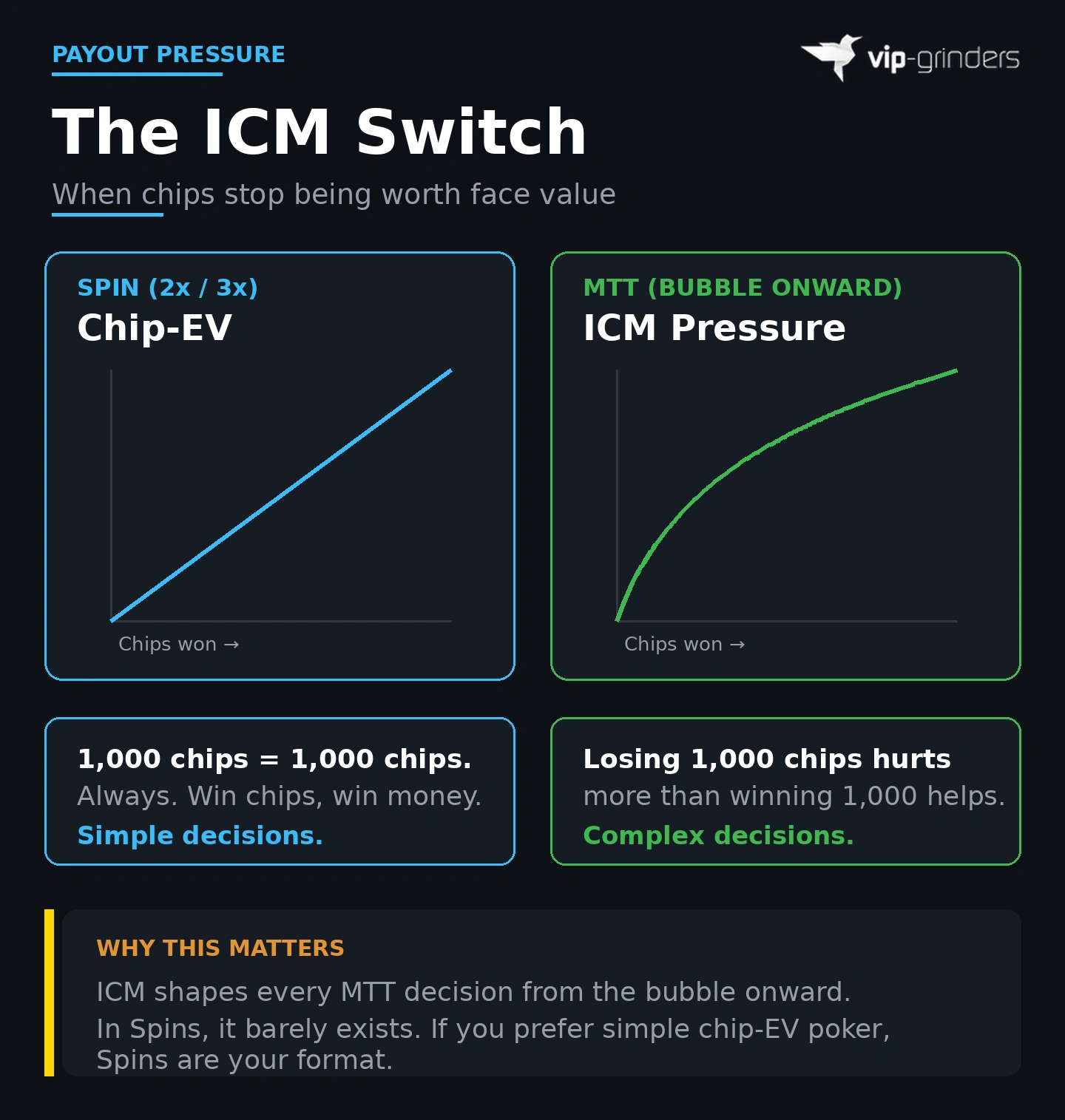
In the vast majority of Spin & Go games, the multiplier lands on 2x or 3x. At those levels, one player wins the entire prize pool and the other two receive nothing. That is a winner-take-all structure with no pay jumps to navigate, no bubble to survive, and no reason to fold a profitable hand just because losing would knock you out.
The only time ICM enters Spin strategy is at high multipliers (typically 10x and above), where all three players receive a payout based on finishing position. Those games are rare. In the vast majority of your Spin volume, you play pure chip-EV poker: accumulate chips, win the game, collect the prize.
MTTs: ICM From the Bubble Onward
In MTTs, the prize pool is split across dozens of finishing positions, and every spot you climb is worth more money. That creates a dynamic where the risk of losing chips is more costly than the reward of gaining the same number of chips. This is ICM pressure, and it starts at the bubble (the point where the next elimination separates players who cash from players who leave with nothing) and intensifies at every pay jump through the final table.
ICM pressure changes which hands you can play and how aggressively you can play them. Shoves that would be clearly profitable in a chip-EV game become risky or even losing plays when a pay jump is at stake. Learning to navigate these situations is one of the most important MTT skills, and it does not exist in most Spin games.
What This Means for Choosing Your Format
- If you prefer straightforward poker: Spins remove ICM from almost every decision. You focus on winning chips and nothing else. The strategy is cleaner and the decision-making is faster.
- If you enjoy strategic depth: MTTs add a layer of decision-making that rewards players who understand when to fold strong hands, when to apply bubble pressure, and when to exploit opponents who play too tight near pay jumps. This is a genuine edge source that does not exist in Spins.
For the full ICM breakdown including risk premiums, bubble factors, and how the math applies across tournament formats, see the ICM guide.
Multi-Tabling and Session Control
This is the section that matters most if your decision comes down to lifestyle. How much time do you have, how flexible does your schedule need to be, and what does a typical session actually look like in each format?
MTT Sessions: Long, Fixed, and Hard to Plan Around
MTT grinders typically run 6 to 12 tables at the same time during a session. Each tournament has a fixed start time, and once you are registered, you are committed. If you run deep in two or three events, your session can stretch past midnight with no option to stop early or forfeit the equity you have built.
This makes MTTs difficult to fit around a job, family commitments, or any schedule that requires you to be done by a specific time. Sunday majors and series events, which offer the largest prize pools, are especially demanding. A deep run in a Sunday Major on PokerStars or GGPoker can last 8 to 12 hours.
The MTT commitment: once you register, you are locked in for the entire run. Plan your sessions around the possibility of going deep, not just the average outcome.
Spin Sessions: Short, Flexible, and Fully Under Your Control
Spin grinders typically run 4 to 8 tables at the same time. Each game finishes in minutes. When you want to stop, you simply stop registering for new games, and your last active table closes within 10 minutes at most.
This means you can fit a meaningful Spin session into a lunch break, a gap between meetings, or a 90-minute window before dinner. You never have to cancel plans because you are “deep in a tournament.” Your session length is always your choice.
The Spin advantage: session control. Stop registering at any time and your last table closes within minutes. No format in poker gives you more scheduling freedom.
Mental Load: Endurance vs Burst Discipline
The two formats tax your concentration in opposite ways.
MTT sessions require sustained focus across hours of play. You start sharp, but after 4 or 5 hours your attention drifts. The players who perform best in MTTs are the ones who can maintain decision quality deep into the night when everyone else is running on autopilot.
Spin sessions require intense focus in short bursts. Each game demands fast, high-pressure decisions (often all-in or fold) with very little time to think. After 30 or 40 games, you start pattern-matching instead of adjusting to each table, and that repetition is where mistakes creep in.
- If you have unpredictable free time: Spins work around any schedule. You play when you can and stop when you need to. No commitment beyond the next 7 minutes.
- If you can block full evenings or weekends: MTTs reward that time investment with access to the largest prize pools and softest fields (Sunday majors, series events, holiday specials).
- If you burn out after long sessions: Spins let you play shorter sessions more frequently instead of one marathon grind. You can spread the same weekly volume across five 90-minute sessions instead of two 6-hour blocks.
For table count optimization and the quality vs quantity trade-off across all formats, see the multi-tabling guide. For session planning, tilt prevention, and maintaining focus during long or intense sessions, see the mental game guide.
Pick Your Format in 60 Seconds
If you have read this far and still are not sure, answer these five questions. Each one points toward the format that fits your situation better. If most of your answers lean the same way, that is your format, and if they split evenly, read the hybrid grinder section below.
- 1How much time per session can you commit? If you have 1 to 2 hours: Spins. If you can block 4+ hours for a single session: MTTs become viable.
- 2Steady cashflow or big single scores? If you want consistent income from volume and rakeback month after month: Spins. If you are willing to accept long dry stretches in exchange for occasional large paydays: MTTs.
- 3Preflop-heavy or deep-stack postflop poker? If you enjoy push/fold decisions and preflop aggression (shoving all-in or folding before the community cards are dealt): Spins. If you prefer playing multiple streets with deep stacks where position and post-flop skill matter most: MTTs.
- 4How do you handle variance emotionally? If rapid losses within a single session push you off your game: MTTs spread the swings across longer timeframes. If slow losing streaks over weeks drain your motivation: Spins give faster feedback loops.
- 5How important is rakeback to your bottom line? If rakeback is a core part of how you plan to be profitable (especially at low and mid stakes where table edges are thin): Spins generate more rake per session. If you rely more on your ROI (Return on Investment: the percentage of your total buy-ins that you earn back as profit) from prize pool finishes: MTTs.
There is no wrong answer. Both formats are profitable for players who study, maintain discipline, and play with a proper bankroll. The question is which format lets your strengths and your schedule generate the most value.
The Hybrid Grinder: Playing Both Formats
You do not have to pick one format and ignore the other. Many winning players combine MTTs and Spins in the same weekly schedule, using each format for what it does best.
A Typical Hybrid Week
The most common approach is to split your schedule by day type.
- Weekday evenings (1 to 2 hours): Spins. Short sessions that fit around work or study. You generate rakeback, maintain volume, and keep your push/fold game sharp without committing to a multi-hour session.
- Weekend sessions (4 to 8 hours): MTTs. This is when Sunday majors, series events, and holiday specials run. Prize pools are at their largest and fields include the most recreational players. The time investment is worth it because the potential payoff is highest here.
This schedule gives you two income streams: steady rakeback from Spin volume during the week, and high-upside prize pool shots on the weekend. Neither format carries the full weight of your results alone.
Why the Skills Transfer
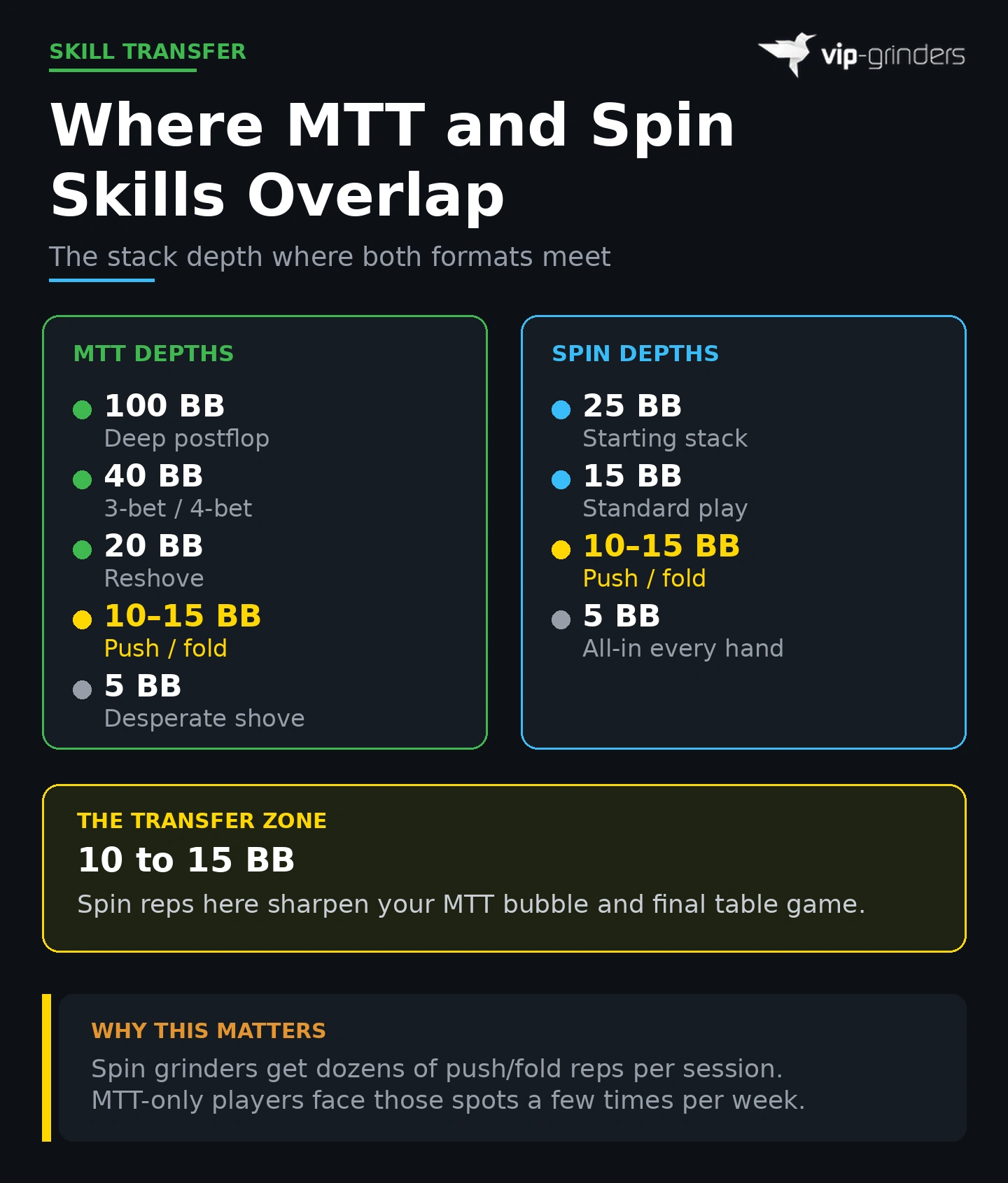
The two formats overlap more than most players expect, especially at short-stack depths. In Spins, you spend most of your time making decisions at 10 to 15 big blinds or less. In MTTs, you face those exact same stack depths at the bubble, the final table, and in late-stage shove-or-fold spots.
A player who grinds Spins during the week arrives at Saturday’s MTT final table with dozens of fresh short-stack reps from the past five days. A player who only plays MTTs might face those situations a few times per week at most. The repetition advantage is real and it compounds over time.
Bankroll Note for Hybrid Players
If you play both formats, size your bankroll for whichever format you play at the higher buy-in. A player who grinds $5 Spins on weekdays and enters $11 MTTs on weekends needs enough for the $11 MTTs, not just enough for the $5 Spins. Your bankroll must support the most expensive format in your rotation at all times.
For the standard SNG format that sits between Spins and MTTs in terms of structure and session length, see the Sit & Go strategy guide.
Best Rooms for MTTs and Spins in 2026
Where you play matters almost as much as what you play. Each poker room has different strengths depending on format, and choosing the right room for your format means better fields, stronger rakeback, and more value from every session.
| Room | Best for | Why |
|---|---|---|
| GGPoker | MTTs + Spins | Largest MTT schedule worldwide, soft Spin & Gold pools, up to 80% rakeback through Fish Buffet |
| ACR Poker | MTTs | Biggest US-facing tournament schedule including the Venom series, consistent overlay opportunities |
| WPT Global | MTTs | Soft recreational fields from casino and sportsbook crossover traffic, strong welcome bonus |
| PokerStars | Spins | Highest Spin volume at every buy-in, widest stake range from $1 to $100+, the original Spin & Go format |
| BCPoker | Spins | Up to 50% rakeback through VIP-Grinders, BC Shield anti-bot protection, fast crypto payouts |
If you plan to grind both formats, GGPoker is the strongest single-room option because it covers both MTTs and Spin & Gold from the same account and bankroll.
For the full list of exclusive sign-up offers with tracked codes across every room, see our rakeback deals page.
Frequently Asked Questions
Is Spin & Go more profitable than MTTs?
Neither format is inherently more profitable. Spins produce steadier income through game volume and rakeback. MTTs produce higher peak earnings from individual deep runs. Your profitability in either format depends on your skill level, the volume you put in, and the strength of your rakeback deal. The full format-by-format income breakdown is in our profitability guide.
Which format has more variance: MTTs or Spin & Gos?
Both carry high variance, but in different shapes. Spin variance hits fast because you complete dozens of games per session and the random multiplier adds an extra layer of unpredictability. MTT variance unfolds slowly because each event takes hours and most of the prize pool goes to the top finishers. Over the same calendar time, Spins tend to produce bigger swings simply because you play far more games. The full math is in our variance guide.
Can a complete beginner start with Spin & Gos?
Yes. Start at the lowest buy-in available ($1 or $2). Spin strategy is heavily based on push/fold decisions (shoving all-in or folding before the flop), which is more straightforward to learn than the deep-stack, multi-street play required in MTTs. That makes Spins a reasonable entry point for new tournament players. The full walkthrough is in the Spin & Go strategy guide.
How many buy-ins do I need for Spins vs MTTs?
Both formats recommend a similar standard bankroll threshold, but for different structural reasons. MTT bankrolls absorb long dry spells between cashes. Spin bankrolls absorb rapid concentrated losses within sessions. The full buy-in tables by stake are in the bankroll management guide.
Which format earns more rakeback?
At equivalent buy-in levels, Spins generate more rake per session because you complete far more games in the same timeframe. More rake generated means more rakeback returned through your deal. The exact gap depends on your room, your table count, and your deal percentage. The full numbers are in our guide on how rakeback changes your strategy.
Can I play both MTTs and Spin & Gos?
Yes. Many grinders play Spins on weekday evenings for volume and rakeback, then switch to MTTs on weekends when the largest prize pools and softest fields are available. The short-stack skills you build in Spins (push/fold at 10 to 15 big blinds) transfer directly to MTT bubble and final table situations.
Are Spin & Gos rigged?
No. The multiplier distribution is predetermined and published by each poker room before you register. Most games land on the lowest multiplier (typically 2x) by design. The format feels volatile because of the random prize pool, but the math behind the distribution is transparent and verifiable on each room’s website.
Which poker rooms are best for Spin & Gos?
PokerStars offers the highest Spin volume and widest buy-in range. GGPoker runs Spin & Gold with soft player pools from casino crossover traffic. BCPoker offers up to 50% rakeback through VIP-Grinders with anti-bot protection via BC Shield. For the full list of rooms with exclusive tracked deals, see our rakeback deals page.