

Double Barreling: When and How to Fire the Second Barrel in 2026
A double barrel is a bet on the turn by the same player who bet the flop, after the opponent called that flop bet. If you have ever fired a continuation bet (c-bet) on the flop, gotten called, and then frozen on the turn with no plan, this guide solves that problem.
At low and mid stakes, most players c-bet around 65 to 70% of flops but only fire the turn about 35 to 40% of the time. That drop from flop to turn is one of the biggest leaks in online poker. This guide gives you a four-category system that tells you which turns to bet, which to check, and how to size each barrel.
It covers the turn decision after a called flop c-bet in single-raised pots (hands where one player raised preflop and one or more players called) only. For the flop c-bet decision and the delayed c-bet (betting the turn after checking the flop), see the continuation betting guide. For bluff strategy across all streets, see the bluffing guide.
Here is what this guide covers:
- Four turn card categories and when to barrel each one
- Sizing tiers matched to each turn type
- Value barrels vs bluff barrels and which hands to use for each
- Five conditions where you should NOT double barrel
- Opponent adjustments for folders, callers, and raisers
The definition table below shows where double barrels fit in the full sequence of postflop bets. The four-category system after it is the core of this guide.
What Is a Double Barrel in Poker
The term comes from the image of firing a second shot: your flop c-bet was the first barrel. When that bet gets called and you bet again on the turn, that is the second barrel. A player who bets all three postflop streets (flop, turn, and river) is firing a triple barrel.
The table below shows where the double barrel fits in the full sequence of postflop bets so you can see how each term relates to the others.
| Term | Street | What Happened Before |
|---|---|---|
| Continuation bet (c-bet) | Flop | You raised preflop and bet the flop |
| Double barrel | Turn | You c-bet the flop, got called, and bet again |
| Delayed c-bet | Turn | You checked the flop, then bet the turn |
| Triple barrel | River | You bet the flop, the turn, and now the river |
The difference between a double barrel and a delayed c-bet matters because your opponent holds a different set of possible hands (called their range) in each spot. When you c-bet the flop and get called, your opponent has already shown some strength by putting chips in. When you check the flop and then lead the turn, their range is wider because they got a free card and had no reason to fold anything.
The Four Turn Card Categories
Not every turn card is the same. Some turns help your range (the collection of hands you could have based on your preflop raise and flop c-bet), and some help the player who called you. The single most important skill in double barreling is recognizing which type of turn you are looking at and adjusting your plan accordingly.
The table below splits every possible turn card into four categories. Each one tells you how often to barrel and what sizing to use as a starting point before you adjust for your specific opponent.
| Turn Category | Who Does It Help? | How Often to Barrel | Typical Sizing | Example |
|---|---|---|---|---|
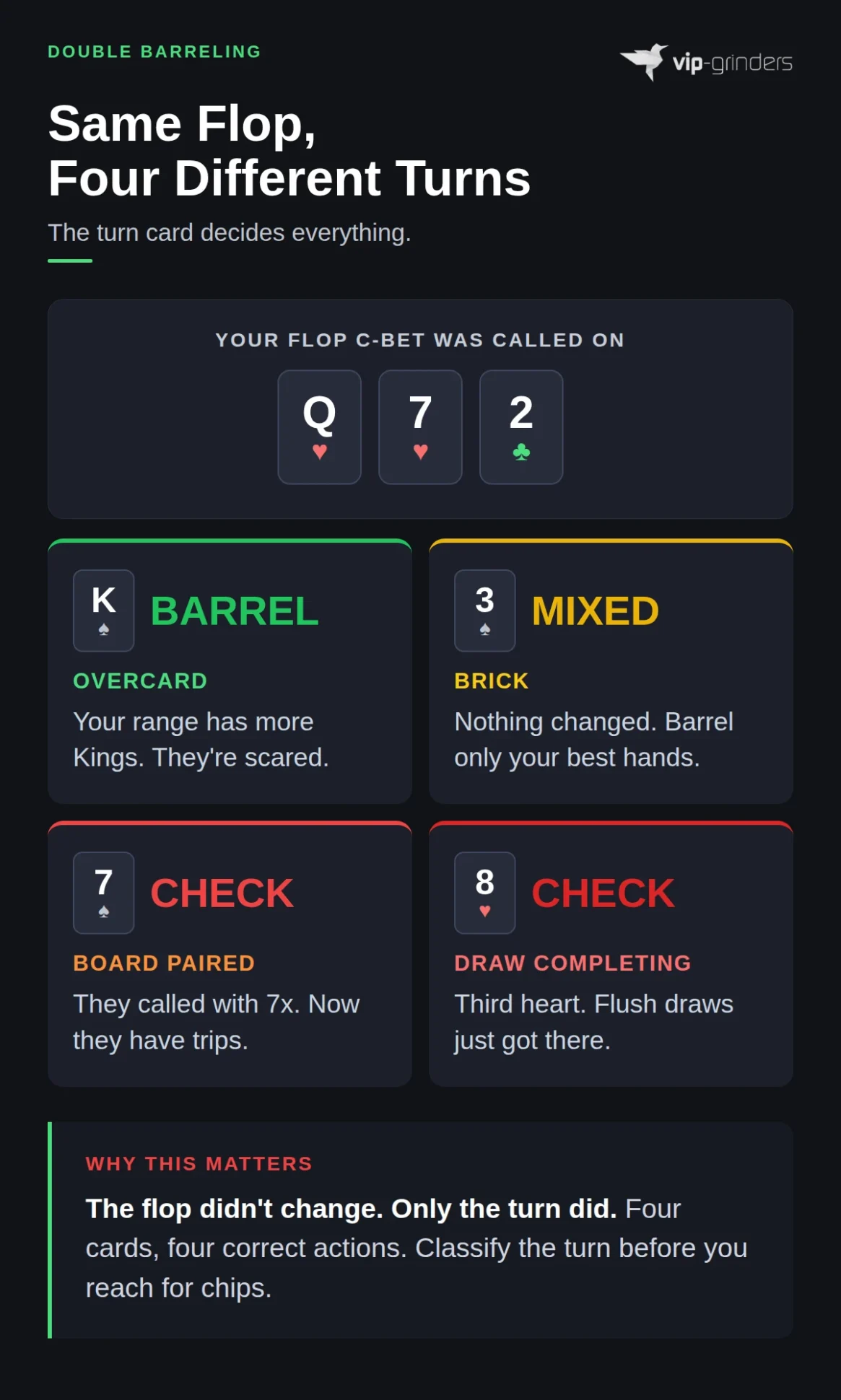
| Overcard / scare card | You (the preflop raiser) | High (60 to 80% of your range) | 65 to 75% pot | Flop: Q 7 2. Turn: K |
| Brick / low blank | Roughly neutral | Mixed (~50% of your range) | 66 to 75% pot | Flop: K 9 5. Turn: 3 |
| Board pairing | Your opponent | Low (check most of your range) | 33 to 50% pot if betting | Flop: K 7 2. Turn: 7 |
| Draw completing | Your opponent | Low (only strong hands and select blockers) | 50% pot or check | Flop: K T 6. Turn: 7 completing a straight |
These are starting points, not rigid rules. Your exact decision will depend on your hand, your opponent, and the specific board. But if you have no other information, this table gives you a baseline that is far better than guessing.
Overcard and Scare Card Turns
An overcard turn is a turn card that is higher than the highest card on the flop. For example, if the flop is Q♦ 7♥ 2♣ and the turn is the K♠, that King is an overcard. A scare card is any turn that looks threatening to the player who called your flop bet, even if it did not literally improve your hand.
These turns favor you (the preflop raiser) because your range naturally contains more big cards than your opponent’s range. You are the one who raised before the flop, so you are more likely to hold hands like A-K, A-Q, K-J, and K-Q. Your opponent called, which means their range is weighted more toward medium pairs, suited connectors (cards close in rank and the same suit, like 7-8 of clubs), and weaker holdings that do not include as many Kings or Aces.
This concept is called range advantage: the idea that certain board cards benefit one player’s entire range of possible hands more than the other’s.
- 1Preflop: You open from the button with A-J offsuit. The big blind calls.
- 2Flop (Q-7-2 rainbow): Three different suits with no obvious flush or straight draws (called a dry board). You c-bet 33% pot, they call.
- 3Turn (K): You now hold a gutshot straight draw (you need a Ten to make a straight) plus an overcard (your Ace). The King is a scare card because your range includes A-K, K-Q, and K-J.
- 4Decision: Bet 65 to 75% pot. This folds out many of their medium pairs and weak Queen-x hands.
Brick Turns (Low Blanks)
A brick is a low card that does not change the board in any meaningful way. If the flop is K♥ 9♠ 5♦ and the turn is the 3♣, that 3 is a brick. It does not complete any draws or add a scare card, so the board looks almost the same as it did on the flop.
Brick turns are the trickiest category because neither player gains a clear advantage. Solver models (computer programs that calculate the mathematically optimal strategy) show a roughly 50/50 split between value bets and bluffs at 75% pot sizing on these turns. That means about half the time you bet, you should have a strong hand, and the other half you should have a bluff with some backup equity.
The key to picking your bluffs on bricks: choose hands that still have a chance to improve if called. Overcards to the board, gutshot straight draws (needing one specific card to complete a straight), and flush draws (needing one more card of the same suit on the river) are better bluff candidates than hands with zero outs.
- 1Preflop: You open from the cutoff with A-10 of hearts. The big blind calls.
- 2Flop (K-9-5 with one heart): You missed the board but have an overcard (your Ace) and a Ten. You c-bet, they call.
- 3Turn (3 of hearts): The turn is a brick for the board, but it gave you a flush draw (two hearts in your hand, two on the board, needing one more on the river) plus an overcard (your Ace).
- 4Decision: Double barrel. This is a strong bluff because you have plenty of ways to improve if called.
Board Pairing Turns
A board pairing turn is when the turn card matches one of the three flop cards. If the flop is K♦ 7♣ 2♠ and the turn is the 7♥, the board has paired. This type of turn generally helps the player who called your flop bet, not you.
The reason is simple: when your opponent called a c-bet on a K-7-2 flop, their range includes hands like 7-8 suited, 6-7 suited, and pocket sevens (a pair of sevens as hole cards). All of those just improved to trips or better. Your range as the preflop raiser is more heavily weighted toward big cards (A-K, K-Q, A-Q) which did not improve at all.
The recommended play on board pairing turns is to check most of your range. Only bet if you hold a very strong hand yourself (trips (three of a kind), a full house, or an overpair (a pocket pair higher than any card on the board) you are confident is ahead) or a very specific bluff that blocks your opponent’s strong hands.
- 1Preflop: You open from the cutoff with A-Q offsuit. The big blind calls.
- 2Flop (K-7-2 rainbow): Dry board, you have two overcards but no pair. You c-bet, they call.
- 3Turn (7): The board pairs. Your A-Q did not improve. Your opponent’s range includes hands like 7-8 suited and pocket sevens (a pair of sevens as hole cards) that just made trips.
- 4Decision: Check. Betting here risks getting called or raised by hands that now have you crushed.
Draw Completing and Low Connector Turns
A draw completing turn is a card that finishes an obvious straight or flush that was possible on the flop. If the flop is J♥ 10♥ 8♦ and the turn is the 9♣, anyone holding a 7 or a Queen now has a straight. If three hearts were already on the flop and the turn brings a fourth heart, anyone with a single heart in their hand now has a flush.
These turns favor the caller because their range typically contains more suited connectors and drawing hands than yours. They were the ones calling your flop bet with those draws. Now those draws just got there.
The adjustment is similar to board pairing turns: check most of your range and only bet with the nuts (the best possible hand) or hands that block the completed draw. A blocker means you hold a card that makes it less likely your opponent has the strong hand. For example, if three hearts are on the board and you hold the Ace of hearts, you block the nut flush (the best possible flush) even though you do not have a flush yourself, which makes your bluff more likely to succeed.
- 1Preflop: You open from the button with A-5 of hearts. The big blind calls.
- 2Flop (K-10-6 with two hearts): You have a flush draw and an overcard. You c-bet, they call.
- 3Turn (7 of spades): This completes a possible straight for anyone holding 8-9. You still have your flush draw (needing one more heart on the river), but the board just got better for your opponent, not for you.
- 4Decision: Check. Your opponent is less likely to fold when a draw just completed in their favor.
How to Size Your Second Barrel
The full math behind bet sizing lives on the bet sizing guide. This section covers only which size matches which turn situation so you can pick the right number without memorizing solver tables.
There are three sizing tiers you need to know for double barrels. Each one sends a different message to your opponent and works best on a specific type of turn.
| Sizing Tier | When to Use It | What It Does |
|---|---|---|
| 50% pot | Brick turns with a merged range (mix of value and medium hands) | Keeps your opponent’s calling range wide so your thin value hands get paid |
| 66 to 75% pot | Overcard and scare card turns with a polarized range (strong hands and bluffs, nothing in between) | Prices out flush draws (~18% equity with one card to come) and forces folds from medium pairs |
| 100%+ pot (overbet) | Turns that shift the nut advantage heavily to you AND your opponent cannot have the best hand | Maximizes pressure when your range is uncapped and your opponent’s range is capped |
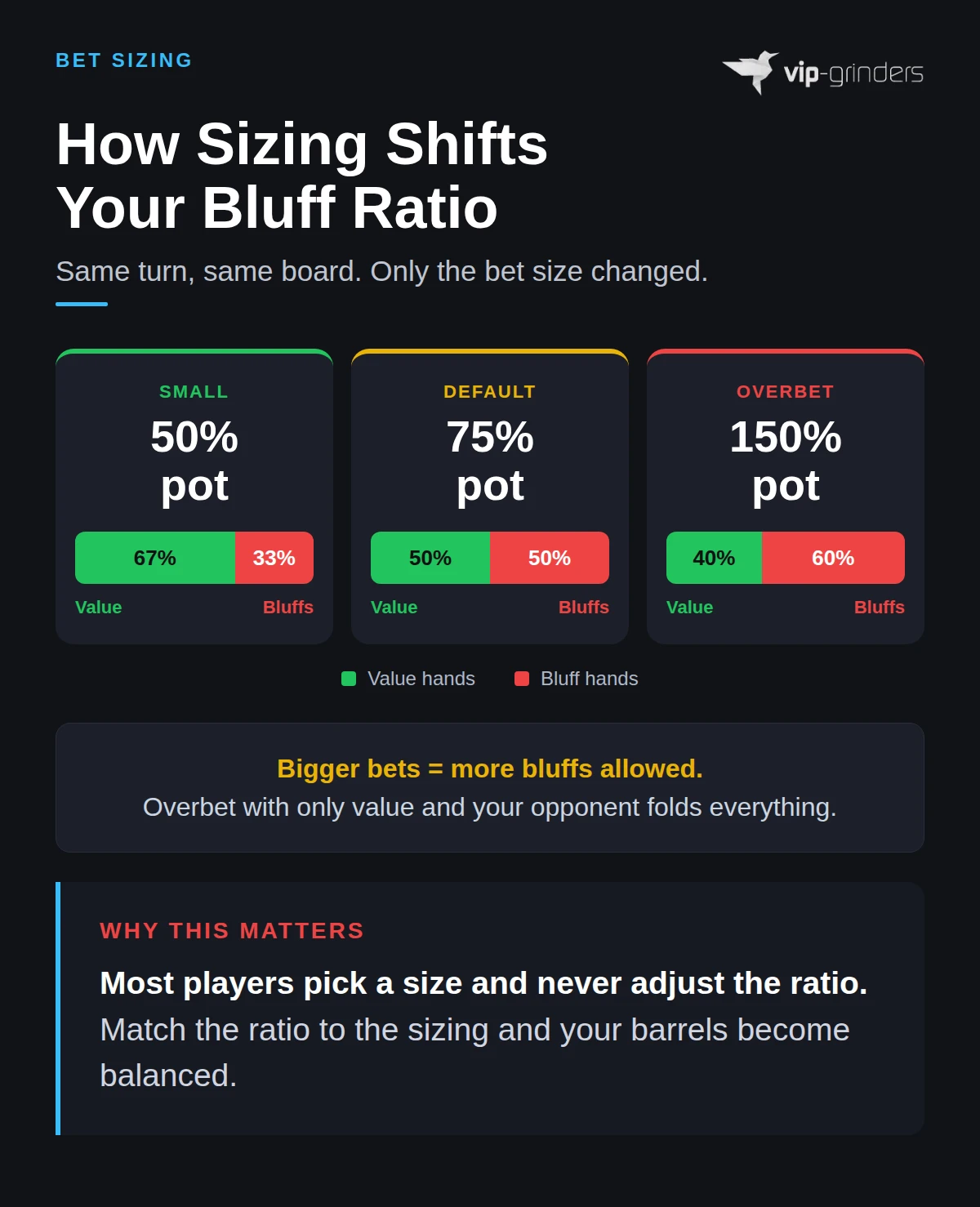
A polarized range means your betting range contains only strong hands and bluffs with nothing in between. A merged range means your betting range includes strong hands, medium hands, and some bluffs all mixed together.
The 66 to 75% pot size works best with polarized ranges because it forces your opponent to either call with a strong hand or fold everything else. The 50% pot size works best with merged ranges because it gives weaker hands a reason to call, which is what you want when you are betting for thin value (a bet with a hand only slightly better than what your opponent is likely to call with).
The default for most double barrels at low and mid stakes is 66 to 75% pot. At that size, a flush draw with roughly 18% equity (9 outs with one card to come) cannot call profitably because they need about 28 to 30% equity to break even. For the math behind that calculation, see the pot odds guide linked in the skill box above.
Overbets (100% pot or larger) are a specialized tool reserved for turns that dramatically shift the nut advantage to you while your opponent’s range is capped (meaning they cannot hold the very best hands). For the three conditions that must be true before you overbet, see the overbetting guide.
Value Double Barrels vs Bluff Double Barrels
Every double barrel is either a value bet or a bluff. Understanding the difference helps you pick the right hands for each role and avoid the common mistake of betting medium hands that are too weak to get called by worse but too strong to want a fold.
When You Barrel for Value
A value double barrel is a turn bet with a hand you believe is ahead of most hands your opponent will call with. The classic example is top pair with a strong kicker (like A-K on a King high board) on a turn that does not change the board much. You want your opponent to call with worse hands like second pair, weak top pair, or draws.
Size value barrels at 50 to 66% pot to keep your opponent’s calling range as wide as possible. If you bet too big, weaker hands fold and you only get action from hands that beat you. For more on extracting value with hands that are only slightly ahead, see the value betting guide.
Value barrels want calls from worse hands. Bluff barrels want folds from better hands. If your hand is too weak to get called by worse but too strong to want a fold, check.
When You Barrel as a Bluff
A bluff double barrel is a turn bet with a hand that cannot win at showdown but has a realistic chance of making your opponent fold. The best bluff candidates are hands with no pair but some backup draws: overcards, gutshots, or flush draws that give you a way to improve on the river if your bluff gets called.
A 2/3 pot bluff on the turn needs your opponent to fold roughly 40% of the time to break even before counting any equity from your outs (cards that can improve your hand on the river). For the math behind that number and how to calculate it for other bet sizes, see the fold equity guide.
One more factor to consider: blockers. If you hold a card that makes it less likely your opponent has a strong hand, your bluff is more profitable. For example, holding the Ace of spades on a board with two spades means your opponent is less likely to have the nut flush draw, which means they are more likely to fold.
When NOT to Double Barrel
Knowing when to fire is only half the equation. Knowing when to stop is what separates disciplined grinders from players who bleed chips by barreling into the wrong situations. If any of the following five conditions are true, checking the turn is almost always the better play.
- 1Your opponent rarely folds to turn bets. Some players call the flop and then call again on the turn with almost anything. Bluffing into these opponents (often called calling stations) is throwing money away. Against them, only barrel for value. For how to identify and adjust to these players, see our guide on how to spot and exploit fish.
- 2The board paired and you do not have trips or better. As covered in the board pairing section above, your opponent’s range improved more than yours. Betting into a paired board without a strong hand is one of the most common and expensive turn mistakes.
- 3Multiple opponents called your flop bet. In multiway pots (three or more players), the chance that someone has a real hand goes up sharply. Your fold equity drops because you need all remaining opponents to fold, not just one.
- 4You hold a medium hand with showdown value. Hands like second pair or a weak top pair can still win at showdown if you check. Betting turns them into a bluff because only better hands will call. Checking keeps the pot small and lets you get to showdown cheaply. This concept is called pot control.
- 5The turn completed an obvious draw and you have no blockers. If a third flush card or a straight completing card hits and you do not hold any cards that block the made hand, your bluff is far less likely to work. Save your chips and check.
Adjusting to Your Opponents
Everything above assumes you have no specific reads on your opponent. Once you do, adjust your barreling frequency based on their tendencies.
- Opponents who fold too much on the turn: barrel wider, especially on scare cards and bricks. Your bluffs do not even need backup draws because these opponents give up before the river.
- Opponents who never fold: stop bluffing on the turn entirely. Only double barrel for value with hands you are confident are ahead. These players will pay you off when you have the goods.
- Opponents who raise the turn aggressively: tighten your barreling range to strong value hands only. Getting check-raised (when your opponent checks, lets you bet, then raises) on the turn is expensive. For the defender’s perspective, see the check-raising guide.
Common Double Barrel Mistakes
Most of the money lost on double barrels comes from the same five errors. If you catch yourself making any of these, you have found an immediate leak to fix.
- Barreling every turn automatically after c-betting the flop. The turn requires a separate decision. Check the turn category table above and ask which type of card landed before you reach for chips.
- Using different sizing for bluffs and value. If you bet small with bluffs and big with value (or the other way around), observant opponents will notice and adjust. Use the same size for both.
- Picking bluffs with zero equity. A hand like 8-6 offsuit on a K-Q-3-J board has no outs, no draws, and no blockers. Choose bluff hands that have at least a gutshot or overcards as backup.
- Firing without a river plan. Every double barrel should come with an answer to one question: if I get called, will I bet the river or give up? If you have no answer, you are guessing, and guessing on the turn is expensive.
- Barreling into multiple opponents. In multiway pots, the chance that someone holds a strong hand goes up sharply. Your fold equity drops because you need every remaining player to fold, not just one.
Double barreling is one piece of a larger postflop puzzle. For a full list of the most expensive leaks across every aspect of the game, ranked by their actual bb/100 cost, see our common mistakes guide.
Frequently Asked Questions
What is a double barrel in poker?
A double barrel is a bet on the turn made by the same player who bet the flop, after their opponent called that flop bet. It is the second consecutive bet in a sequence that started with a continuation bet (c-bet) on the flop.
When should I fire a second barrel?
The best turns to barrel are overcards and scare cards that favor your range, and brick turns where you hold strong value hands or bluffs with backup draws. Check most of the time on board pairing turns and turns that complete obvious straights or flushes.
What is the difference between a c-bet and a double barrel?
A c-bet (continuation bet) is the first bet on the flop by the preflop raiser. A double barrel is the follow-up bet on the turn after that c-bet was called. The c-bet is the first barrel and the turn bet is the second barrel.
Should I double barrel as a bluff?
Yes, but selectively. Choose bluff hands that have overcards, gutshots, or flush draws so you still have a chance to improve if called. At 75% pot, roughly half of your turn bets should be bluffs according to solver models.
What is a triple barrel?
A triple barrel is a bet on all three postflop streets: flop, turn, and river. It is the most aggressive line in poker and typically requires either a very strong hand or a carefully planned bluff with specific blockers that make it unlikely your opponent holds a strong hand.
How big should my double barrel be?
The default is 66 to 75% of the pot for most turn situations. Use 50% pot when betting a merged range for thin value on brick turns. Overbets (100% pot or more) are reserved for turns where the nut advantage shifts heavily in your favor and your opponent cannot have the best hand.