

Pot Control: When to Slow Down with Medium-Strength Hands in 2026
Pot control means checking or betting small with a hand that is good enough to win at showdown (the moment cards are revealed and the best hand takes the pot) but not strong enough to build a big pot. Think top pair with a weak kicker, second pair, or an overpair on a board where stronger hands are possible. The goal is to keep the pot at a size your hand can comfortably handle.

Get this decision wrong in either direction and it costs you money. Check back too often and you miss value from worse hands that would have called. Bet too aggressively with medium holdings and you inflate a pot where the only hands that continue are the ones that beat you.
Here is what this guide covers:
- Three conditions where pot control is the correct play
- Three situations where it costs you money
- Street-by-street adjustments for flop, turn, and river
- Cash game vs tournament differences including ICM pressure
- Five common mistakes that turn pot control into a leak
The section below defines pot control and the two ways to apply it. The three conditions after it tell you when checking back is correct.
What Is Pot Control?
Pot control is the decision to check (pass your turn without betting) or bet small with a hand that has showdown value (a hand likely to win if no more money goes in) but is not strong enough to keep betting for multiple streets. You are not bluffing and you are not value betting. You are keeping the pot small on purpose so your medium-strength hand does not get priced out or crushed by a raise.
The old poker saying sums it up: “big hand, big pot; small hand, small pot.” If you hold the nuts (the best possible hand given the board) or close to it, you want to build the pot as large as possible. If you hold a hand that can win but only against a limited portion of your opponent’s range (the collection of all hands they could have in this spot), you want the opposite.
Two Ways to Pot Control
- Check back in position: when you are last to act (you are in position, or IP) and your opponent checks to you, you choose not to bet. The street ends without more chips going in. This is the cleanest form of pot control because you guarantee a free card.
- Call instead of raise: your opponent bets and your hand is strong enough to continue but not strong enough to raise. Calling keeps the pot smaller than raising would.
Pot control is much easier when you are in position (acting last on each street). When you are out of position (OOP, acting first), checking does not guarantee a free card because your opponent can bet behind you and force a decision. This is why pot controlling from the blinds or from early position is structurally weaker: our position guide covers the full breakdown.
Pot control is strongest when three things align: your hand is way ahead or way behind, the SPR is high, and the board is static. The more of these that are true, the more confident the check-back becomes.
When Pot Control Is the Right Play
Not every medium-strength hand should be checked back. Pot control is correct in specific situations, and understanding those situations is what separates a disciplined check from a scared one. Three conditions make pot control the right play.
1. Your Hand Is “Way Ahead or Way Behind”
This concept has a name in poker theory: way ahead/way behind (sometimes shortened to WA/WB). It describes a spot where your opponent’s range (all the hands they could hold) is split into two groups: hands that are almost drawing dead against you, and hands that crush you. There is very little in between.
When this happens, betting does not accomplish much. The hands that are drawing dead will fold (so you win nothing extra) and the hands that crush you will call or raise (so you lose more). Checking lets the dead hands stay in and possibly bluff the river, or call a small bet later.
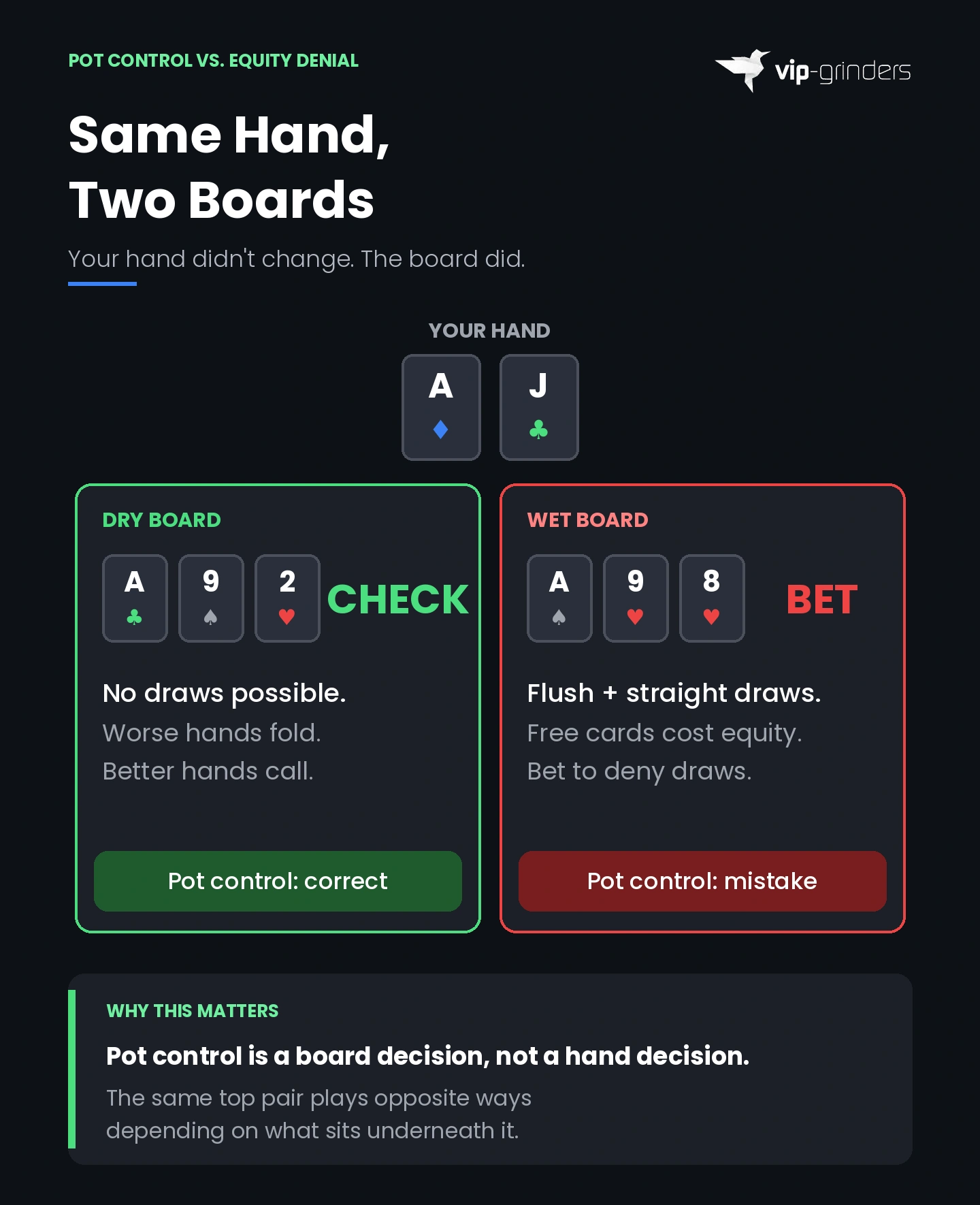
Example: You hold A♥ J♦ on a board of A♣ 9♠ 2♦ with no flush draw. Your opponent (often called villain in poker discussions) either has a better ace like AK or AQ, a set, or a hand with almost no chance of winning like KQ, JT, or a small pocket pair.
Betting folds out everything worse and keeps in everything better. Checking back and calling a river bet (or betting small on the river) extracts more value over time.
- When to apply WA/WB: dry boards (no flush draw, no connected cards) where you hold a strong but not nutted top pair.
- When WA/WB does NOT apply: boards with draws (flush draws, straight draws), because there are hands in the middle that can improve and beat you. On those boards, betting to deny equity is usually better.
2. The Stack-to-Pot Ratio (SPR) Is High
SPR stands for stack-to-pot ratio. It is calculated by dividing your remaining chip stack by the current size of the pot. For example, if the pot is 10bb (bb = big blind, the standard unit for measuring pot and stack sizes) and you have 90bb left, your SPR is 9.
SPR tells you how “deep” you are relative to the pot. The higher the SPR, the more careful you need to be with one-pair hands because the pot can grow far beyond what your hand can profitably handle.
| SPR | What It Means | Default Action with One Pair |
|---|---|---|
| Under 4 | You are nearly committed to the pot | Bet and get the rest in |
| 4 to 8 | The decision zone | Depends on kicker, board, and opponent |
| Above 8 | Pot is small relative to stacks | Pot control: skip a street of betting |
Example: You open to 2.5bb from the cutoff with K♣ 10♦ and the big blind calls. The pot is 5.5bb and you have 97.5bb behind, so SPR is roughly 18.
The flop comes K♠ 8♦ 3♣ and you bet 2bb. Villain calls, making the pot 9.5bb with 95.5bb behind. SPR is now 10.
Your top pair with a ten kicker is a decent hand, but at SPR 10, if you bet the turn and villain raises, you face a decision for a large portion of your stack with a hand that loses to KJ, KQ, AK, and any set. Checking the turn keeps the pot around 9.5bb, a size your hand can handle on the river.
Use our SPR calculator to get exact ratios for your usual stakes and buy-in depth.
The deeper your stack relative to the pot, the more you need pot control. In cash games at 100bb+, that means most sessions. In short-stacked tournament play, SPR rarely climbs high enough to make it a factor.
3. The Board Is Static and Your Hand Has Showdown Value
A static board (also called a “dry” board) is one where very few turn or river cards can change which hand is best. A board like K♦ 7♣ 2♠ is static: no flush draw, no straight draw, and the only cards that could hurt your top pair are the handful that give villain two pair or trips.
On these boards, your medium-strength hand is unlikely to get outdrawn even if you give a free card. Betting for “protection” adds very little because there is almost nothing to protect against. The better play is to check back, keep the pot small, and let villain bluff the next street or call a small bet with a worse hand on the river.
- Static boards favour pot control: examples include K-7-2 rainbow (all different suits, so no flush draw is possible), A-5-3 rainbow, or Q-4-2 with one suit. Few turn cards change anything.
- Dynamic boards do NOT favour pot control: examples include J-T-8 with two hearts, or 9-8-7 with a flush draw. Many turn cards change the best hand. On these boards, betting to deny equity is almost always correct. See our equity denial guide for sizing and strategy on those boards.
When Pot Control Costs You Money
Pot control is not a default play. Checking back every time you feel uncertain is one of the most common leaks at low and mid stakes. The three situations below are where players lose the most money by pot controlling when they should be betting.
1. The Board Is Draw-Heavy
On boards with flush draws, straight draws, or both, checking gives your opponent a free card to complete their draw and beat you. If you hold A♦ 10♣ on a flop of A♠ 9♥ 8♥, your top pair is ahead right now but vulnerable to any heart (completing a flush draw) and any 7, J, or T (completing straight draws).
This is where equity denial takes over. Betting forces drawing hands to either pay a price to continue or fold and give up their equity. Checking lets them see the next card for free, which is exactly what they want.
The key distinction: pot control is for boards where your hand is safe but not strong enough to build a big pot. Equity denial is for boards where your hand is strong enough to bet but vulnerable if you do not.
Pot control and equity denial are not opposites. They are two tools for different board textures. The board tells you which one to reach for.
2. Worse Hands Will Call a Bet
If you can identify specific hands in villain’s range that are worse than yours and would call a bet, you should be betting for value rather than pot controlling. Checking in these spots leaves money on the table.
Example: You hold K♥ Q♦ on a board of K♠ 7♦ 4♣ 2♠ against a loose recreational player. Hands like KJ, KT, K9, QQ, JJ, and TT are all worse than yours and likely to call. Checking the turn “for pot control” means you collect nothing from those hands.
The question to ask is simple: “Will worse hands call if I bet?” If yes, bet for value; if only better hands continue, pot control is correct. For a full breakdown of when and how to size these bets, see our value betting guide.
3. Multi-Way Pots Where Protection Matters
In pots with three or more players, the combined drawing equity of all opponents is much higher than in a heads-up pot (a pot between just two players). Even on a relatively dry board, two or three opponents together hold enough random outs to outdraw you a significant percentage of the time.
Example: You hold J♥ J♣ on a flop of 9♦ 5♠ 3♣ in a three-way pot. Heads-up, this board is static and a check-back could be fine. Three-way, one opponent might hold a gutshot (a straight draw needing one specific card), another might hold two overcards, and together they have enough equity to justify a bet from you to charge them for continuing.
In multi-way pots, lean toward betting your medium-strength hands rather than pot controlling. The more opponents in the hand, the less safe it is to give free cards.
Pot Control Street by Street
Pot control decisions come up on every street, but the turn is where they happen most often. This section walks through the flop, turn, and river so you know what to look for on each one.
Flop: When to Skip the C-Bet
Most players automatically fire a continuation bet (c-bet: a bet made by the preflop raiser on the flop) after raising preflop. In many spots, that is correct. But when you flop a hand with showdown value on a dry board and villain’s range is unlikely to call with worse, checking back is the better play.
Example: You raise preflop with Q♣ J♥ and the big blind calls. The flop comes Q♦ 7♠ 2♣, giving you top pair with a jack kicker on a static board.
A c-bet here folds out most hands that are already losing to you and only gets action from better queens, sets, or the occasional stubborn pocket pair.
Checking back keeps the pot small, lets villain bluff the turn with missed hands, and protects you from a check-raise that would put you in a tough spot. For a deeper look at when to fire and when to check the flop, see our continuation betting guide.
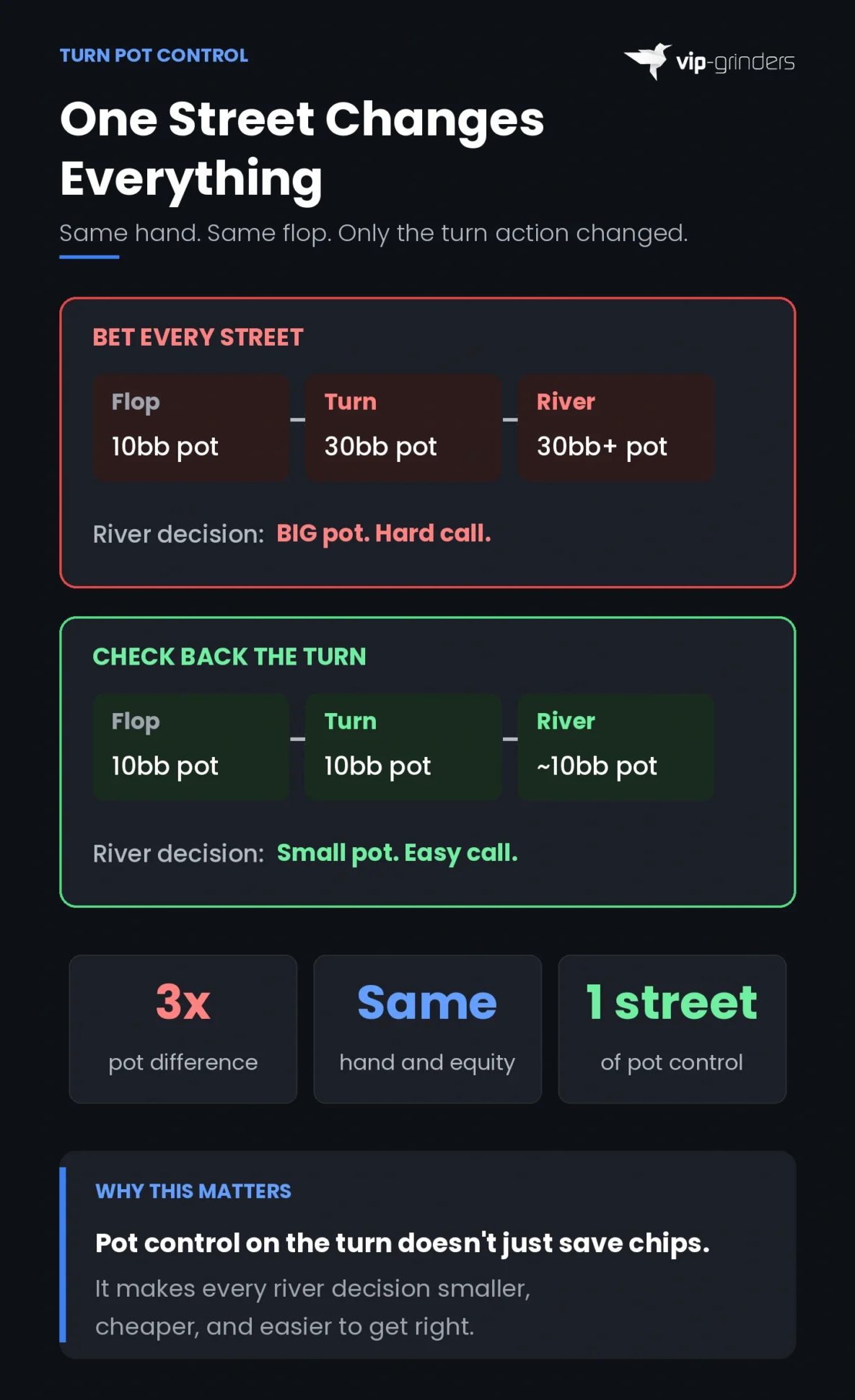
The flop check-back sets up a smaller pot for the rest of the hand. The turn is where that smaller pot starts to pay off.
Turn: The Most Common Pot Control Street
The turn is where pot control happens most frequently. You c-bet the flop, villain called, and now you need to decide whether to bet again. If your hand is medium-strength and the turn card did not improve you, checking is often the highest expected value (EV) play.
Example: You hold A♠ 7♠ on a board of A♥ 5♦ 3♣, c-bet the flop, and villain calls. The turn is J♦.
Your top pair with a seven kicker is still likely ahead, but the jack could have completed villain’s AJ. Betting again risks facing a raise with a hand that cannot comfortably continue.
Checking the turn gives you two advantages. You avoid inflating the pot beyond what your hand can handle, and you give villain a chance to bluff the river with hands that missed. Our double barreling guide covers the opposite decision: when firing the turn IS correct.
River: Thin Bet or Check?
On the river there are no more cards to come, so equity denial is no longer a factor. The pot control decision here is purely about whether betting small for value is more profitable than checking and calling (or checking and folding).
- Bet small for value: if you believe villain will call with at least a few worse hands (weak pairs, busted draws turned into bluff-catchers), a small bet of 25% to 33% of the pot can extract thin value without risking a large raise.
- Check and call: if villain is aggressive and likely to bet when checked to (either as a bluff or with thin value), checking and calling can earn more than betting and getting a fold.
- Check and fold: if the river completed a likely draw and villain bets big, folding a medium-strength hand is often correct. Pot control through the hand does not mean you have to call every river bet.
The river is the street where pot control pays off. If you checked back the turn and kept the pot small, villain’s river bet will be smaller too, making your call cheaper and your decision easier.

Cash Games vs. Tournaments
The format you play changes how often pot control comes up and how valuable it is.
In cash games, stacks are typically deep (100bb or more). That means SPR is high more often, and one-pair hands regularly fall into the pot control zone. If you play 100bb deep at a cash game table, you will use pot control on the turn and river in a large percentage of your sessions.
Cash games reward pot control because stacks stay deep. Tournaments reward aggression because stacks run short.
In tournaments, effective stacks are often shorter (20bb to 40bb), especially in the middle and late stages. Lower stacks mean lower SPR, which means you are committed to the pot more often after a flop c-bet. Pot control with one pair becomes less frequent simply because the math pushes you toward betting and getting it in.
The exception is near the money bubble and at the final table, where ICM (Independent Chip Model: a formula that converts tournament chips into real-money equity) changes the math. Busting out costs more in real-money terms than the chips you would gain by winning, so keeping pots small with medium-strength hands becomes more valuable than it would be in a cash game at the same stack depth. Our tournament strategy guide covers ICM adjustments in detail.
Common Pot Control Mistakes
Most pot control errors come from applying the concept in the wrong situation. These five mistakes are the ones that cost players the most money at low and mid stakes.
- Pot controlling on wet boards. If the board has flush draws or straight draws, checking gives opponents free cards to outdraw you. Bet to deny equity instead.
- Checking against loose players who would call with worse. If villain calls bets with second pair, weak top pair, or any draw, you are leaving value on the table by not betting.
- Always checking the turn with top pair to play it safe. Top pair is not automatically a pot control hand. Evaluate the board texture, your kicker, and villain's likely range before deciding.
- Pot controlling out of position and then folding to a bet. If you check with a hand that has showdown value and then fold when villain bets, you turned a hand that could win into a hand that wins nothing. Either check and call or lead out yourself.
- Treating confusion as pot control. Pot control is a deliberate decision based on hand strength, board texture, and SPR. If you are checking because you are confused, the fix is working on your hand reading and range analysis, not labelling the check as strategy.
Pot control is one of the hardest habits to calibrate because both directions cost you money. For a full list of the most expensive leaks across every aspect of the game, ranked by their actual bb/100 cost, see our common mistakes guide.
Frequently Asked Questions
What does pot control mean in poker?
Pot control means checking or betting small with a medium-strength hand to keep the pot at a size your hand can win at showdown. You are not bluffing and you are not trying to extract maximum value. You are deliberately keeping the pot manageable so a raise or big bet from your opponent does not force you off a hand that is likely ahead.
Should I pot control with top pair?
It depends on three factors: your kicker, the board texture, and the stack-to-pot ratio (SPR). Top pair with a strong kicker (like AK on a K-7-2 board) is usually strong enough to bet for value on multiple streets. Top pair with a weak kicker (like K8 on the same board) is a classic pot control hand because only better hands will continue if you keep betting.
Is pot control the same as playing passive?
No. Passive play is a style where a player checks and calls too often across all hand strengths and all board types. Pot control is a specific, deliberate decision made with a medium-strength hand in situations like high SPR or dry boards, and strong aggressive players use it regularly without being passive.
Does pot control work in tournaments?
Yes, but it comes up less often because tournament stacks are usually shorter, which lowers SPR and commits you to the pot earlier. The exception is near the money bubble and at the final table, where ICM pressure makes chip preservation more valuable than chip accumulation. In those spots, pot controlling with medium-strength hands is often the correct adjustment.
How does SPR affect pot control?
SPR (stack-to-pot ratio) tells you how committed you are to the pot. At low SPR (under 4), your stack is small relative to the pot and you are nearly committed, so betting and getting the rest in is usually correct. At high SPR (above 8), one-pair hands are not strong enough to play for stacks across multiple streets of betting. The higher the SPR, the more often pot control is the correct play with medium-strength hands.
Should I pot control on wet boards?
No. On boards with flush draws, straight draws, or both, checking gives opponents free cards to complete their draws and beat you. Wet boards call for equity denial (betting to charge draws) rather than pot control. Pot control is designed for static boards where very few turn or river cards can change which hand is winning.
When should I bet instead of pot controlling?
Bet instead of pot controlling when the board has draws that need to be charged, when you can identify worse hands in your opponent’s range that would call, or when you are in a multi-way pot where the combined drawing equity of all opponents makes free cards too dangerous. Before checking back, ask three questions: is there a draw on the board, can worse hands call, and am I checking out of fear rather than strategy.