

Overbetting in Poker: When Big Bets Print Money 2026
An overbet is any bet larger than the current pot. It is one of the most misunderstood and underused weapons in No-Limit Hold’em, especially at stakes below NL200 where most players either never overbet or only do it with the nuts.
That second pattern is exactly why learning to overbet properly is so profitable. When your opponents only overbet for value, you can fold every time and lose nothing. When you overbet with a balanced range of strong hands and well-chosen bluffs, they have no idea what to do because they never face it from anyone else.
Here is what this guide covers:
- The three conditions that license an overbet: nut advantage, capped range, and range advantage
- Sizing from 1.25x to 3x pot with bluff-to-value ratios and geometric planning across streets
- Street-by-street overbet spots where solvers bet biggest on the flop, turn, and river
- How to defend against overbets using MDF math, blocker-based calls, and exploitative folds
What Is an Overbet in Poker?
An overbet is any bet that exceeds the current size of the pot. The term applies to any bet above 100% of the pot, regardless of the exact amount. If your all-in happens to be smaller than the pot, that is not an overbet, it is just a shove.
Here is what overbets look like in practice at a $1/$2 cash game:
- Pot is $50, you bet $65: 1.3x pot. Small overbet.
- Pot is $50, you bet $75: 1.5x pot. Standard overbet.
- Pot is $50, you bet $100: 2x pot. Large overbet.
- Pot is $50, you shove $180: 3.6x pot. All-in overbet.
Why Overbets Work in No-Limit Hold’em
The “No-Limit” in No-Limit Hold’em means there is no cap on how much you can bet. This is the structural reason overbets are possible: the rules allow you to wager your entire stack on any street. Everything in this guide applies specifically to NLHE.
In Pot-Limit Omaha, the maximum bet is the size of the pot, which makes true overbets impossible by definition. For PLO strategy, see our Pot-Limit Omaha guide.
The reason overbets are so effective is that they create a math problem most opponents cannot solve in real time. A standard 66% pot bet requires roughly 28% equity to call. A 2x pot overbet pushes that requirement to 40%, which most one-pair hands cannot meet.
The math gap: jumping from 66% pot to 2x pot only adds 12 percentage points to the equity your opponent needs. But that 12-point jump eliminates most one-pair hands from the calling range, which is where all the fold equity comes from.
Most players at low and mid stakes have no practiced response to bets larger than the pot. They default to one of two extremes: folding everything except the nuts, or calling too wide out of frustration. Both patterns are exploitable once you learn when and how to overbet correctly.
Common Overbet Sizes and What They Mean
Not every overbet sends the same message or accomplishes the same goal. Smaller overbets (1.25x to 1.5x pot) put pressure on medium-strength hands while still getting calls from strong holdings. Larger overbets (2x pot and above) polarize your range sharply: you are either extremely strong or bluffing, with very little in between.
| Overbet Size | Equity Opponent Needs to Call | Typical Use |
|---|---|---|
| 1.25x pot | 35.7% | Light pressure on capped ranges, thin value from strong top pairs |
| 1.5x pot | 37.5% | Standard overbet: punishes medium-strength hands, sets up river jams |
| 2x pot | 40.0% | Heavy polarization: nuts or air, forces folds from overpairs and two pair |
| 3x pot (all-in) | 42.9% | Maximum pressure: only the very top of opponent’s range can continue |
These numbers come directly from the pot odds formula. The key takeaway is that even a massive 2x pot overbet only requires your opponent to win 40% of the time to break even on a call. Many players fold far more often than that, which is why overbet bluffs print money against the right opponents.
The Three Conditions That License an Overbet
Not every strong hand deserves an overbet. Overbetting at the wrong time turns a profitable value bet into a wasted opportunity, or worse, an expensive bluff that gets snapped off. Every legitimate overbet spot shares three conditions, and all three must be present at once.
Condition 1: You Have Nut Advantage
Nut advantage means your range contains more of the strongest possible hands on this board than your opponent’s range does. It is not about what you hold specifically. It is about what you could hold given your line so far, compared to what your opponent could hold given theirs.
For a full breakdown of how nut advantage differs from range advantage and how to identify both at the table, see our range advantage and nut advantage guide.
A quick example makes this concrete. You open from UTG and the big blind calls. The flop comes A-K-2 rainbow.
Your UTG opening range contains AA, KK, AK, and AQ. The big blind’s calling range almost never includes AA or KK (they would have 3-bet those preflop) and rarely includes AK. You have a massive nut advantage on this board because you can have the top hands and your opponent cannot.
Condition 2: Your Opponent’s Range Is Capped
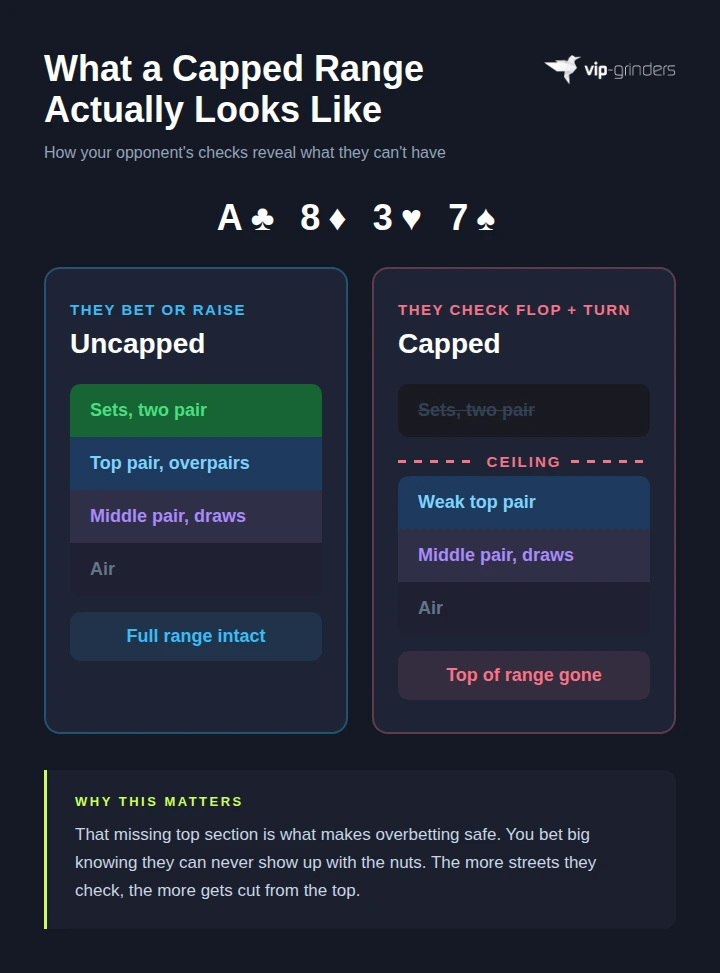
A capped range is one where the strongest hands have been removed by prior actions. When your opponent checks the flop and checks the turn on an A-8-3-7 board, they are telling you they do not have sets, strong two pair, or the nut straight. Those hands would have bet or raised on at least one of those streets.
Once you identify that their range tops out at something like top pair or an overpair, their ability to call a large bet drops sharply. They might comfortably call a 50% pot bet with top pair good kicker, but a 1.5x pot overbet puts them in a spot where calling with one pair feels reckless, and folding feels forced.
Condition 3: You Have Range Advantage on This Board
Range advantage means your overall range has higher average equity than your opponent’s on this specific board texture. This is the broadest of the three conditions. You can have range advantage without nut advantage (your range is stronger on average but lacks the very top hands), and you can have nut advantage without range advantage (you have the nuts but your overall range is weak).
For an overbet to work, you need both. Range advantage gives you the right to bet frequently. Nut advantage gives you the right to bet big.
All Three Together: A Quick Checklist
Before you reach for an overbet sizing, run through these three questions in order:
- 1Do I have nut advantage? Can my range contain the nuts or near-nuts on this board, while my opponent's range mostly cannot?
- 2Is my opponent's range capped? Have their actions (checking, calling small bets, flatting preflop) removed the strongest hands from their range?
- 3Do I have range advantage? Is my overall range stronger than theirs on this board texture?
If the answer is yes to all three, an overbet is on the table. If any answer is no, use a smaller sizing or check. This checklist works on every street: flop, turn, and river.
How to Size an Overbet
Choosing between 1.25x pot and 3x pot is not a feel decision. The size of your overbet determines how often your bluffs need to work, how much value you extract from strong hands, and whether your opponent’s medium-strength holdings can profitably continue. Bigger is not always better.
The sizing decision starts with one question: how polarized is your range in this spot? The more polarized your range (pure nuts or pure air, nothing in between), the larger your overbet should be. The more merged your range (some medium-strength hands mixed in), the smaller your overbet or the more you should consider a standard bet instead.
Bluff Breakeven Frequency by Size
Every bet size has a breakeven point: the percentage of the time your bluff needs to succeed to show a profit. Larger overbets need folds more often, but they also win a bigger pot when they work.
| Overbet Size | You Risk | To Win | Bluff Must Work |
|---|---|---|---|
| 1.25x pot | $62.50 | $50 pot | 55.6% |
| 1.5x pot | $75 | $50 pot | 60.0% |
| 2x pot | $100 | $50 pot | 66.7% |
| 3x pot (all-in) | $150 | $50 pot | 75.0% |
These numbers look demanding, but remember the other side of the equation. At stakes below NL500, most players fold to overbets far more than they should. Population data from solvers suggests that the average fold rate against a 1.5x pot bet on the river is above 65% at low and mid stakes, well above the 60% breakeven threshold.
Geometric Sizing: Planning Your Overbets Across Streets
The most effective overbets are not impulsive. They are the final step in a sizing plan that starts on the flop. Geometric sizing means choosing bet sizes on each street so that a natural all-in lands on the river without awkward leftover chips.
Here is how it works with 100bb effective stacks in a single-raised pot (6bb pot on the flop):
- 1Flop (pot = 6bb): You bet 9bb (1.5x pot). Your opponent calls. Pot grows to 24bb. You have 88bb behind.
- 2Turn (pot = 24bb): You bet 36bb (1.5x pot). Your opponent calls. Pot grows to 96bb. You have 52bb behind.
- 3River (pot = 96bb): You shove 52bb. That is roughly 0.54x pot, a normal value bet that looks nothing like an overbet.
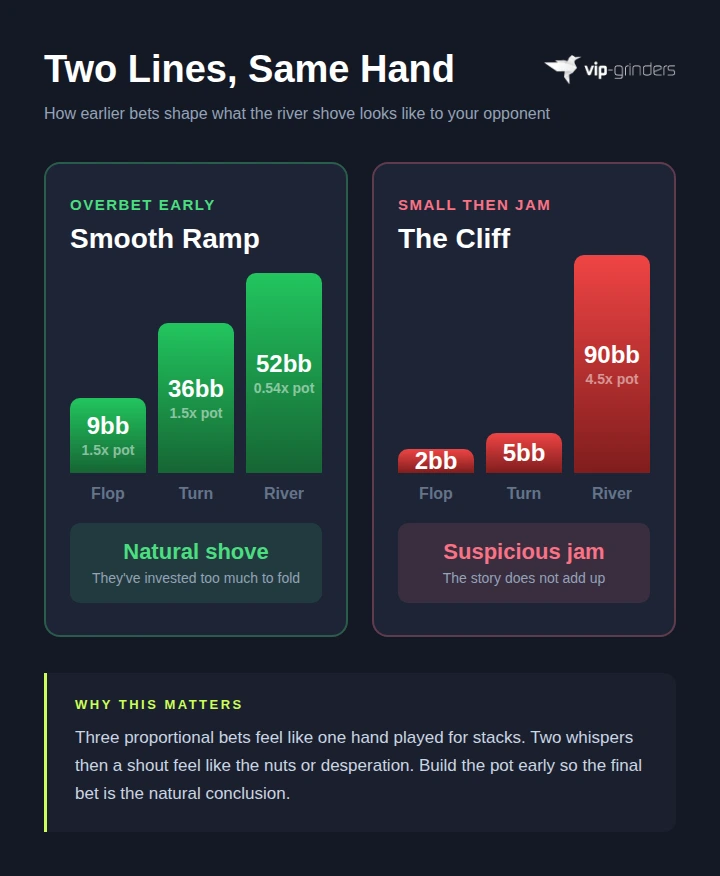
Now compare that to a player who bets 33% pot on the flop and 50% pot on the turn with the same 100bb starting stacks:
- 1Flop (pot = 6bb): You bet 2bb (33% pot). Your opponent calls. Pot grows to 10bb. You have 95bb behind.
- 2Turn (pot = 10bb): You bet 5bb (50% pot). Your opponent calls. Pot grows to 20bb. You have 90bb behind.
- 3River (pot = 20bb): You shove 90bb. That is 4.5x pot, an enormous overbet that only the absolute nuts can call.
The second line looks suspicious because the river shove is wildly disproportionate to the earlier streets. Your opponent knows you barely committed anything on the flop and turn, then suddenly jammed. That screams either the stone-cold nuts or a desperate bluff, and most opponents will simply fold.
The first line builds the pot gradually so the final shove feels like a natural continuation of the action. Your opponent has already invested significant chips on two streets, which makes calling the river psychologically easier for them. This is how you get paid with your value hands and set up credible river overbet bluffs.
When to Use Which Size
A simple rule for choosing your overbet size:
- 1.25x to 1.5x pot: Use when you have nut advantage but your opponent still has some strong hands in their range. This size gets calls from overpairs and top pair while still denying correct odds to draws. The equity denial guide covers when standard sizing fails against combo draws and an overbet becomes necessary.
- 2x pot: Use when your opponent's range is clearly capped at one pair or worse. This size forces folds from hands that would call a smaller bet and maximizes value when you are called by a stubborn top pair.
- 3x pot or all-in: Use when SPR is already low (below 2) and a jam is the natural conclusion of your geometric sizing plan. Also use in spots where your opponent's range is so capped that only a massive bet applies enough pressure.
You can use our SPR calculator to plan your sizing across streets before the hand even begins. Knowing your SPR on the flop tells you exactly how many streets of betting it takes to get all-in, and at what sizes.
Building a Polarized Overbet Range
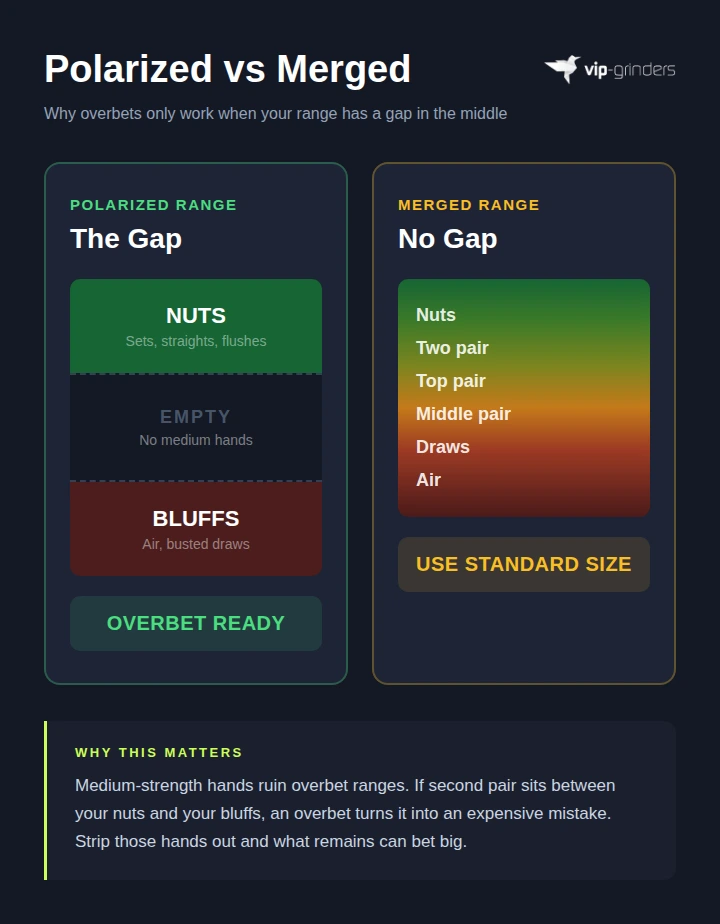
When you overbet, your range should be polarized: it contains the strongest hands (value) and carefully chosen bluffs (air), with nothing in between. Medium-strength hands like second pair or weak top pair do not belong in an overbet range because they lose too much when called and gain too little when they fold out worse.
This is the opposite of a merged (or linear) range, where you bet a wide spectrum of hand strengths at a smaller sizing. Merged ranges work well for 33% to 66% pot bets. Polarized ranges are what make overbets possible.
For a full breakdown of how to construct both types, see our poker ranges guide.
The Bluff-to-Value Ratio
A balanced overbet range contains a specific ratio of bluffs to value hands. The ratio is determined by the pot odds your bet offers your opponent. If your opponent needs 40% equity to call (a 2x pot overbet), you want roughly 40% of your betting range to be bluffs so they break even on a call and cannot exploit you by always calling or always folding.
| Overbet Size | Opponent’s Pot Odds | Optimal Bluff % | In Practice |
|---|---|---|---|
| 1.25x pot | 35.7% | 35.7% | Roughly 1 bluff for every 2 value hands |
| 1.5x pot | 37.5% | 37.5% | Roughly 3 bluffs for every 5 value hands |
| 2x pot | 40.0% | 40.0% | Roughly 2 bluffs for every 3 value hands |
| 3x pot (all-in) | 42.9% | 42.9% | Roughly 3 bluffs for every 4 value hands |
You do not need to count exact combos at the table. The practical takeaway is simple: the larger your overbet, the more bluffs you can include. A 2x pot overbet lets you bluff nearly as often as you value bet, which is why it is such a profitable size when your opponent overfolds.
Which Hands to Overbet for Value
Your value overbets should be hands strong enough to want a call. On most boards, this means:
- Sets and better: Three of a kind, straights, flushes, and full houses are almost always strong enough to overbet for value.
- Strong two pair: Top two pair on a dry board can overbet for value against opponents who will call with top pair.
- Top pair with top kicker (occasionally): Only against calling stations who pay off large bets with second pair or worse. Against competent opponents, top pair is usually too thin to overbet.
The key test: if your opponent calls, are you happy? If the answer is yes most of the time, the hand belongs in your value overbet range. If the answer is “it depends,” the hand is too thin and should bet a smaller size or check.
Which Hands to Use as Overbet Bluffs
Not every weak hand makes a good overbet bluff. The best candidates share specific properties that maximize fold equity and minimize risk. For the broader principles of when and where to bluff, see our bluffing strategy guide.
The ideal overbet bluff has three features:
- 1Zero showdown value. Complete air is better than a weak pair. If your hand has even small showdown value, checking and winning at showdown is often more profitable than turning it into a bluff.
- 2Blocks opponent's calling hands. Holding a card that reduces the number of strong hands your opponent can have makes your bluff more likely to succeed. Example: holding the Ace of spades on a three-spade board blocks the nut flush, making it harder for your opponent to call.
- 3Does not block opponent's folding range. You want your opponent to hold the hands they are most likely to fold. If your bluff hand blocks busted draws or weak pairs that would have folded anyway, you are reducing your own fold equity.
A practical example ties this together. The board is K♠ 9♠ 4♥ 2♦ 7♣ on the river. You hold A♠ 5♠ (a missed flush draw with the nut flush blocker).
This is a strong overbet bluff because you have zero showdown value, you block the nut flush (making it harder for your opponent to have a hand worth calling with), and you do not block weak kings or nines that your opponent is likely to fold.
Overbetting the Flop
Flop overbets are the rarest overbet in solver output, but they are also the most underexplored by human players. Most opponents have never faced a flop overbet in a regular cash game, which means they have no practiced response. That lack of experience is your edge.
Solvers use flop overbets on a narrow set of board textures where one player has an overwhelming nut advantage after the preflop action. The common thread across all of them is a dry, high-card board where the preflop raiser’s range dominates and the caller’s range is almost entirely capped below two pair.
Boards Where Flop Overbets Work
The best flop overbet boards share three features: they are dry (few or no draws), they contain high cards that favour the preflop raiser, and they leave the caller’s range with very few nutted combos.
| Flop Texture | Why It Works | Overbet Candidate? |
|---|---|---|
| A-K-6 rainbow | Raiser has AA, KK, AK. Caller almost never has any of those. | Yes, strong overbet spot |
| K-K-7 rainbow | Raiser can have KK (quads), AK, KQ. Caller rarely has a King. | Yes, strong overbet spot |
| A-A-5 rainbow | Raiser has all pocket Aces combos plus Ax. Caller’s trips are unlikely. | Yes, strong overbet spot |
| Q-7-2 rainbow | Raiser has QQ+, AQ. Caller has some Queens but also many medium pairs. | Moderate, smaller overbet (1.25x) |
| 9-8-7 two-tone | Both ranges connect heavily. Neither player has a clear nut advantage. | No, use standard sizing or check |
The pattern is clear: the higher and drier the board, the more it favours the raiser, and the larger the bet can be. Wet, connected, middling boards distribute equity more evenly between both ranges, which removes the nut advantage overbets require.
What to Overbet on the Flop
On a board like A-K-6 rainbow where you opened from the cutoff and the big blind called, your flop overbet range typically splits into two groups:
- Value: Sets (AA, KK, 66), top two pair (AK), and strong top pair (AQ, AJ) against a range capped at one pair.
- Bluffs: Complete air with blockers to the top of your opponent's range. Hands like QJ offsuit (blocks KQ, KJ) or suited wheel aces like A4 suited (blocks Ax top pair combos) are good candidates.
Hands in the middle of your range (KT, K9, pocket Jacks) should use a smaller bet or check. They are strong enough to want value from worse hands but not strong enough to survive a raise after overbetting.
A Practical Flop Overbet Example
You open to 2.5bb from the cutoff with A♠ A♥. The big blind calls. The flop comes K♦ 7♣ 2♠.
You have the best possible hand on this board. The big blind’s calling range is capped below AA (they would have 3-bet aces preflop) and contains mostly Kx, pocket pairs, and suited connectors that missed. All three overbet conditions are met: nut advantage, capped opponent, range advantage.
You bet 1.5x pot (9bb into a 6bb pot). This sizing pressures all one-pair hands, denies correct odds to any backdoor draws, and starts building a pot that leads to a natural river jam if your opponent calls two streets.
If your opponent folds, you win the pot immediately. If they call, you go to the turn with a large pot, a massive range advantage, and every strong hand still in your range for continued pressure.
A standard 33% pot c-bet would also be profitable here, but it wins a smaller pot when called and gives your opponent better odds to continue with hands that have little equity against you. The overbet extracts more value from Kx and forces folds from hands like pocket Tens that would happily call a small bet. For how standard c-bet sizing works on boards where overbetting is not correct, see our bet sizing guide.
Overbetting the Turn
The turn is where overbets show up most frequently in solver output and where they generate the most profit in practice. The reason is simple: by the turn, your opponent’s range is more defined than on the flop, and the cards that have come (or not come) often cap their range heavily.
Two specific turn scenarios produce the best overbet spots. Both revolve around the same principle: your opponent’s actions have told you they do not have a strong hand, and the turn card did not change that.
Scenario 1: Brick Turns After a Flop Check-Back
You raised preflop, your opponent called, and you checked back the flop. The turn comes a low card that changes nothing. This is one of the most common and most profitable overbet spots in poker.
Why it works: your check on the flop kept your entire range intact. You could still have AA, sets, two pair, or strong draws. Your opponent, meanwhile, checked to you on the flop and saw you check back.
They likely checked again on the turn because nothing changed for them. Their range is now heavily capped at medium pairs, weak top pair, or missed draws.
Here is a concrete example. You open from the button with Q♥ J♥. The big blind calls.
The flop comes A♠ 8♣ 3♦. You check back with a plan to bluff later streets.
The turn comes 2♠. The big blind checks again. Their range is now capped: if they had a strong Ace, they would have led the turn or check-raised the flop to protect against the free card.
You overbet 1.5x pot with your Queen-high, representing the strong Aces and sets that you could easily hold from the button.
Scenario 2: Brick Turns After a Small Flop C-Bet Was Called
You c-bet small on the flop (25% to 33% pot), your opponent called, and the turn is a blank. This is the second classic overbet spot. Your opponent’s flop call with a small bet in front of them usually means a medium-strength hand: top pair weak kicker, second pair, or a draw.
The turn brick confirms that their hand has not improved. You can now overbet the turn to put maximum pressure on those medium-strength holdings. They called a small bet on the flop, and now they face a bet three to four times that size.
Here is how that plays out. You open from the cutoff with K♦ K♠. The big blind calls.
The flop comes 9♥ 6♣ 2♦. You c-bet 2bb into a 6bb pot. The big blind calls.
The turn comes 3♣. The pot is now 10bb. You overbet 15bb (1.5x pot).
Your opponent called a tiny flop bet with a hand like 9♣ 7♣ or 7♦ 7♠. Now they face a much larger bet with a hand that has not improved. Folding becomes their most common response, and when they do call, your Kings are almost always ahead.
Turn Cards That Kill Overbet Spots
Not every turn is an overbet opportunity. Certain cards change the board texture enough to remove one or more of the three conditions.
- Cards that complete obvious draws: A third flush card or a straight-completing card uncaps your opponent's range. They might now have the nuts, which means your nut advantage is gone.
- Cards that pair the board: A paired board introduces full house and trips possibilities for both ranges. Your nut advantage becomes less clear.
- High cards that help the caller's range: If the flop was 9-6-2 and the turn is an Ace, your opponent's Ax hands just improved to top pair. Their range is no longer capped.
The simplest rule: the more the turn card changes nothing, the better your overbet spot. A deuce on a King-high board is the textbook overbet card. An Ace on a Nine-high board is the textbook card to slow down.
Overbetting the River
The river is where overbets generate the most expected value per hand. There are no more cards to come, ranges are at their most defined, and your opponent must make a final decision with no future streets to fall back on. A well-timed river overbet forces the most difficult decision in poker: call off a huge portion of your stack with a bluff-catcher, or fold and surrender everything you have invested.
Why the River Is the Best Street to Overbet
On the flop and turn, your opponent can justify a call by saying “I still have equity if more cards come.” On the river, that escape hatch is gone. Their hand is either good enough to beat your value range or it is not.
This is why overbets on the river are so effective against one-pair hands. A player holding A♦ J♣ on a A♠ 9♥ 4♣ 2♦ 6♠ board knows they have top pair with a decent kicker. Against a standard 66% pot bet, calling feels reasonable.
Against a 2x pot overbet, that same top pair becomes a painful bluff-catcher that needs to be right 40% of the time.
Stack-Getting Math: Planning the River Jam
The most profitable river overbets are not improvised. They are the final step in a geometric sizing plan that started on the flop or turn. The goal is to arrive at the river with a stack-to-pot ratio that makes your all-in feel like a natural continuation of your betting line.
Two quick SPR checkpoints for river overbets:
- SPR below 1 on the river: Your remaining stack is smaller than the pot. Shoving is a natural bet size and does not even qualify as an overbet. This is the ideal outcome of good geometric sizing.
- SPR between 1 and 2 on the river: Your shove is a 1x to 2x pot overbet. This is the sweet spot for polarized river overbets because the size is large enough to pressure bluff-catchers but small enough that strong hands still call.
When SPR is above 2 on the river, a jam becomes a 2x+ pot overbet. These extreme sizes only work when your opponent’s range is very clearly capped and you have maximum nut advantage. Against most opponents at low and mid stakes, an SPR above 2 on the river usually means your earlier street sizing was too small.
A River Overbet Value Example
You open from the cutoff with K♣ K♦. The big blind calls. The board runs out K♥ 9♠ 4♦ 2♣ 7♥.
You c-bet the flop, bet the turn, and now face a river decision with a pot of 80bb and 65bb behind. Your set of Kings is the second-best possible hand on this board (only 99 for a higher set beats you, and the big blind would have 3-bet that preflop).
You shove 65bb into 80bb (roughly 0.8x pot). This is technically not an overbet, but it is the result of good geometric sizing: you built the pot across three streets so that your final bet gets your whole stack in naturally. Your opponent calls with hands like A♥ 9♥ (top pair on the flop, now second pair) or 9♦ 8♦ (pair of nines) because they have invested too much to fold.
A River Overbet Bluff Example
You open from the button with J♥ 10♥. The big blind calls. The board runs out K♠ 8♥ 3♥ 2♦ 6♣.
You c-bet the flop with a flush draw, barrelled the turn as a semi-bluff, and now the river has bricked. The pot is 70bb and you have 55bb behind. Your hand has zero showdown value.
You shove 55bb into 70bb (roughly 0.8x pot). Your bluff needs to work 44% of the time to break even, which is well within range against an opponent whose range is capped at one pair on this board. You are representing the same strong Kings and sets you would shove for value, and your 10h does not block any of the weak Kings or pocket pairs your opponent is likely to fold.
This bluff works because you took the same line (c-bet flop, bet turn, shove river) that you would take with K♦ K♠ or 8♠ 8♣. Your opponent cannot tell the difference, and the pot odds force them to be right too often to call profitably with one pair.
Facing an Overbet: How to Defend
Most overbetting guides only cover how to make overbets. They ignore the other side of the table: what to do when someone overbets into you. This is a gap that costs players money at every stake, because the correct defense is often counterintuitive.
The starting point for defending against overbets is Minimum Defense Frequency (MDF). MDF tells you the minimum percentage of your range you must continue with to prevent your opponent from profiting with any two cards as a bluff. You can calculate MDF for any bet size using our MDF calculator.
MDF Against Common Overbet Sizes
The formula is simple: MDF = pot / (pot + bet). The larger the bet, the less you need to defend.
| Overbet Size | MDF (Minimum % to Defend) | What This Means |
|---|---|---|
| 1.25x pot | 44.4% | Fold slightly more than half your range |
| 1.5x pot | 40.0% | Fold 60% of your range |
| 2x pot | 33.3% | Fold two thirds of your range |
| 3x pot (all-in) | 25.0% | Fold 75% of your range |
These numbers might seem like you should call wide, but notice how quickly MDF drops. Against a 2x pot overbet, you only need to continue with one third of your range. That means folding the majority of your hands is mathematically correct, even against an aggressive opponent.
When to Deviate from MDF
MDF is a baseline for balanced play. In practice, you should deviate based on what you know about your opponent.
- Opponent never bluff-overbets: Fold more than MDF suggests. At stakes below NL200, most recreational players only overbet when they have a very strong hand. Folding top pair to their overbet is not weak, it is correct.
- Opponent overbet-bluffs too often: Call wider than MDF suggests. If you have identified a player who uses large bets as a weapon with weak hands, your bluff-catchers go up in value. One pair becomes a profitable call.
- You have no read: Default to MDF and choose your calls based on blockers. Call with hands that block your opponent's value range and fold hands that block their bluffs.
Blocker-Based Calling Against Overbets
When you face an overbet and your hand is somewhere in the bluff-catcher zone (strong enough to beat bluffs but not strong enough to beat value), blockers determine whether your specific hand should call or fold.
The principle works the same way as blocker-based bluffing, just in reverse:
- Call when you block value: If you hold a card that makes it harder for your opponent to have the nuts, your bluff-catcher goes up in value. Example: holding the Ace of spades on a three-spade board means your opponent cannot have the nut flush.
- Fold when you block bluffs: If you hold cards that make it harder for your opponent to be bluffing, your call becomes worse. Example: holding the missed flush draw cards means your opponent is less likely to have a busted draw as a bluff.
A Practical Example: Should You Call This River Overbet?
You hold A♥ J♦ on a final board of A♣ 9♠ 5♦ 3♥ 7♣. Your opponent overbets 1.5x pot on the river.
You have top pair with a Jack kicker. Is this a call? Run through the checklist:
- 1MDF check: Against a 1.5x pot overbet, you need to defend 40% of your range. Top pair with a Jack kicker is in the top 40% of most ranges on this board.
- 2Blocker check: Your Ace blocks some strong Ax combos (AK, AQ) from your opponent's value range. That is good for your call.
- 3Opponent read: Against a balanced or aggressive opponent, this is a call. Against a passive recreational player who only overbets with two pair or better, this is a fold.
This is the process that separates good defenders from players who either fold too much (letting opponents print money with bluffs) or call too much (paying off every value overbet). MDF gives you the math, blockers give you the hand selection, and opponent reads give you the final adjustment.
Tournament and ICM Overbet Adjustments
Everything covered so far applies primarily to cash games, where chips have a fixed dollar value and every decision is purely about expected value. In tournaments, the value of your chips changes based on your stack size relative to the prize pool. This is called ICM (Independent Chip Model), and it changes how overbets work in two important ways.
Overbet Bluffs Become More Powerful Near the Bubble
Near the money bubble, medium-stacked players face a painful dilemma. Calling an overbet and losing means busting before the payout, while folding only costs them chips they can recover later. This survival pressure makes them fold far more than they should against large bets.
If you have a big stack near the bubble, overbet bluffs become extremely profitable against medium stacks who are trying to ladder into the money. The three overbet conditions still apply, but the capped-range condition is easier to meet because ICM pressure caps your opponent’s willingness to continue, not just their range.
Overbet Value Bets Lose Effectiveness Near the Bubble
The flip side is less obvious. When you overbet for value near the bubble, you are targeting opponents who are already folding most of their range due to ICM pressure. The hands that would call your overbet (top pair, overpairs) are exactly the hands they fold to survive.
This means your value overbets get called less often near the bubble than in a cash game. The correct adjustment is to overbet bluff more and overbet for value less during bubble play. Once the bubble bursts and ICM pressure drops, return to your standard frequencies.
Final Table Pay Jumps
At final tables, every elimination means a pay jump for the surviving players. This creates a second wave of ICM pressure similar to the bubble but with different dynamics.
- Overbet bluffs against medium stacks: Still very effective. Medium stacks at a final table are trying to ladder into the next pay jump and will overfold to large bets from bigger stacks.
- Overbet bluffs against the chip leader: Much less effective. The chip leader faces minimal ICM pressure and can call wider because losing a pot does not threaten their tournament life.
- Overbet value bets when you cover: When you are the big stack and your opponent risks elimination by calling, your value overbets carry extra weight. The threat of busting makes opponents fold hands they would call with in a cash game.
For the full tournament strategy including early, middle, and late stage adjustments, see our MTT strategy guide.
Exploitative Overbet Adjustments by Player Type
Balanced overbetting is the theoretical ideal, but most opponents at low and mid stakes are not balanced themselves. They have patterns you can exploit once you identify them. The three overbet conditions still apply, but your sizing, frequency, and value-to-bluff ratio should shift based on who you are playing against.
Against Calling Stations and Recreational Players
Calling stations call too much by definition. Against them, overbets become a pure value extraction tool.
- Overbet for value wider than normal. Hands like top pair top kicker or strong two pair that would be marginal overbet candidates against a regular become clear overbets against someone who calls with second pair.
- Remove almost all bluffs. There is no point bluffing someone who does not fold. Every overbet bluff against a calling station is money set on fire.
- Use larger sizes. If they are going to call anyway, make them pay the maximum. A 2x pot overbet with the nuts against a station extracts far more than a standard 75% pot bet.
Against Tight and Passive Regulars
Tight players fold too much, especially to bets they rarely face. Overbets are the sizing they see least often, which means their response is almost always to fold anything short of the nuts.
- Overbet bluff more often. Their fold rate against overbets is well above the breakeven threshold. You can print money by overbetting with air in spots where the three conditions are met.
- Reduce value overbets. Tight players fold the hands you want to get called by. A standard 75% pot value bet often extracts more from them than an overbet that scares them off.
- Target river spots. Tight players are most likely to overfold on the river because the decision is final. A turn overbet might get a stubborn call from a tight player who still hopes to improve. A river overbet removes that hope.
Against Aggressive Regulars
Good aggressive players are the hardest opponents to overbet against because they fight back. They raise overbets, they float and attack later streets, and they adjust their frequencies quickly.
- Be selective with both value and bluffs. Only overbet when all three conditions are clearly met. Marginal spots that would work against weaker players will get exploited by good regs.
- Expect raises. Have a plan for what you do when your overbet gets raised. If you cannot answer that question before you bet, use a smaller size.
- Mix your frequencies. If you always overbet in the same spots, a good reg will pick up the pattern within a session. Vary between overbets and standard sizes with the same holdings to stay unpredictable.
Quick Reference: Overbet Strategy by Opponent
| Opponent Type | Overbet for Value? | Overbet as Bluff? | Key Adjustment |
|---|---|---|---|
| Calling station | Yes, wide | Almost never | Max value, zero bluffs |
| Tight/passive regular | Rarely | Yes, frequently | Exploit overfolds, especially on the river |
| Aggressive regular | Selectively | Selectively | Only clear spots, have a plan vs raises |
| Unknown player | Standard (balanced) | Standard (balanced) | Default to theory until you have data |
For broader opponent profiling and game selection advice, see our cash game strategy guide.
Common Overbet Mistakes
Most players who start adding overbets to their game make the same handful of errors. Each one is fixable with awareness, and avoiding them will put you ahead of the majority of opponents who overbet poorly or not at all.
- 1Overbetting without nut advantage. This is the most common and most expensive mistake. If your opponent's range contains as many nutted hands as yours, an overbet just builds a bigger pot for them to win when they have it. Always check the three conditions before reaching for a large sizing.
- 2Overbetting into uncapped ranges. When your opponent has shown strength (raising the flop, betting the turn), their range is not capped. Overbetting into a range that still contains sets, straights, and flushes is asking to get raised or snapped off.
- 3Using the same size for value and bluffs every time. If you always overbet 2x pot with the nuts and always overbet 1.25x pot as a bluff, observant opponents will notice the pattern. Use the same size for both in any given spot.
- 4Overbetting in multi-way pots. With two or more opponents still in the hand, the chance that someone holds a strong hand increases sharply. Overbets work best heads-up where you only need to get through one range.
- 5Ignoring SPR when planning across streets. Betting small on early streets and then jamming a massive overbet on the river looks unnatural and gets fewer calls. Plan your geometric sizing from the flop so the river bet is a natural conclusion.
- 6Never overbetting at all. Many players read about overbets and decide the risk is too high. They cap their own bet sizing at 75% pot on every street, which means they leave value on the table with their strongest hands and never apply maximum pressure with their bluffs.
Mistake number six is worth emphasizing. The goal of this guide is not to turn every bet into an overbet, but to recognize the spots where overbetting is correct and have the tools to execute. Even adding overbets to just two or three spots per session can meaningfully increase your win rate.
Frequently Asked Questions
What is an overbet in poker?
An overbet is any bet that exceeds the current size of the pot. If the pot is $50 and you bet $75, that is a 1.5x pot overbet. The term only applies when the bet is larger than 100% of the pot. A shove that happens to be smaller than the pot is not an overbet, it is just an all-in.
How big should an overbet be?
Common overbet sizes range from 1.25x pot (light pressure) to 2x pot (heavy polarization) to 3x pot or all-in (maximum pressure). The right size depends on how polarized your range is, how capped your opponent’s range is, and your stack-to-pot ratio. Larger overbets require your bluffs to work more often but also extract more value when called.
When should you overbet in poker?
Overbet when three conditions are all met at once: you have nut advantage (your range contains more strong hands than your opponent’s), your opponent’s range is capped (their actions have removed their strongest holdings), and you have range advantage on the current board texture. If any of the three is missing, use a standard bet size or check.
Can you overbet as a bluff?
Yes. Overbet bluffs are a core part of a balanced overbetting strategy. The best overbet bluffs have zero showdown value, block your opponent’s calling hands, and do not block the weak hands they would fold. At low and mid stakes, overbet bluffs are especially profitable because most opponents fold to large bets far more often than they should.
What is a polarized range?
A polarized range contains only the strongest hands (value) and the weakest hands (bluffs), with no medium-strength holdings in between. This is the type of range that supports overbetting. The opposite is a merged or linear range, where you bet a wide spectrum of hand strengths at a smaller sizing.
How do you defend against an overbet?
Start with Minimum Defense Frequency (MDF). Against a 1.5x pot overbet, defend at least 40% of your range. Against a 2x pot overbet, defend at least 33%. Choose your calls based on blockers: call with hands that block your opponent’s value range and fold hands that block their bluffs. Adjust further based on whether your opponent tends to bluff-overbet or only overbets for value.
What is MDF against an overbet?
MDF (Minimum Defense Frequency) is the minimum percentage of your range you must continue with to prevent your opponent from profiting by bluffing with any two cards. The formula is MDF = pot / (pot + bet). Against a 2x pot overbet, MDF is 33%. Against a 3x pot all-in, MDF drops to 25%.
Should you overbet against fish and calling stations?
Overbet for value, yes. Calling stations pay off large bets with weak hands, so your value overbets print money. Remove nearly all bluffs from your overbet range against these players. There is no point risking a large bluff against someone who does not fold.
Do overbets work in tournaments?
Yes, but ICM changes the dynamics. Near the bubble, overbet bluffs become more powerful because medium stacks fold wider to protect their tournament life. Overbet value bets become less effective near the bubble because the hands that would call are exactly the ones opponents fold under ICM pressure. At final tables, target medium stacks with overbet bluffs and avoid overbetting into the chip leader.
What is geometric bet sizing?
Geometric sizing means choosing bet sizes on each street so that your stack naturally reaches all-in on the river without an awkward, disproportionate final bet. For example, betting 1.5x pot on the flop and 1.5x pot on the turn with 100bb stacks leads to a natural half-pot river shove. Betting small on early streets and then jamming the river creates a suspicious 4x+ pot overbet that rarely gets called.
Can you overbet in Pot-Limit Omaha?
No. In Pot-Limit Omaha, the maximum allowed bet is the size of the pot. This structural rule makes true overbets impossible by definition. The overbetting strategies in this guide apply exclusively to No-Limit Hold’em.
When should you NOT overbet?
Do not overbet when your opponent’s range is uncapped (they have shown strength through raises or large bets). Do not overbet in multi-way pots where multiple opponents increase the chance someone holds a strong hand. Do not overbet with medium-strength hands that cannot handle being raised. And do not overbet without a geometric sizing plan, because an isolated large bet after small bets on earlier streets looks unnatural and gets fewer calls.