

Sit and Go Strategy 2026: A Complete Stage by Stage Guide
A Sit and Go is the fastest classroom in poker. One table, fixed buy-in, a top-heavy payout, and a blind structure that forces every tournament decision into 45 to 70 minutes. If you want to learn tournament math without committing six hours to a deep-stack MTT, SNGs are where you do it.

This guide walks through every stage of a 6-max or 9-max single table SNG: early levels, middle stages, the bubble, in the money, and heads-up. It is built for 2026‘s tougher fields and thinner margins, not the boom-era numbers you will still find on most ranking pages.
Here is what this guide covers:
- Stage-by-stage strategy from deep-stacked early levels through middle stage stealing to bubble and heads-up
- ICM-adjusted push/fold charts by position and stack depth for 9-max SNGs
- Bubble and ITM adjustments with stack-based roles and exploitation patterns
- Realistic ROI and bankroll rules by stake and speed format
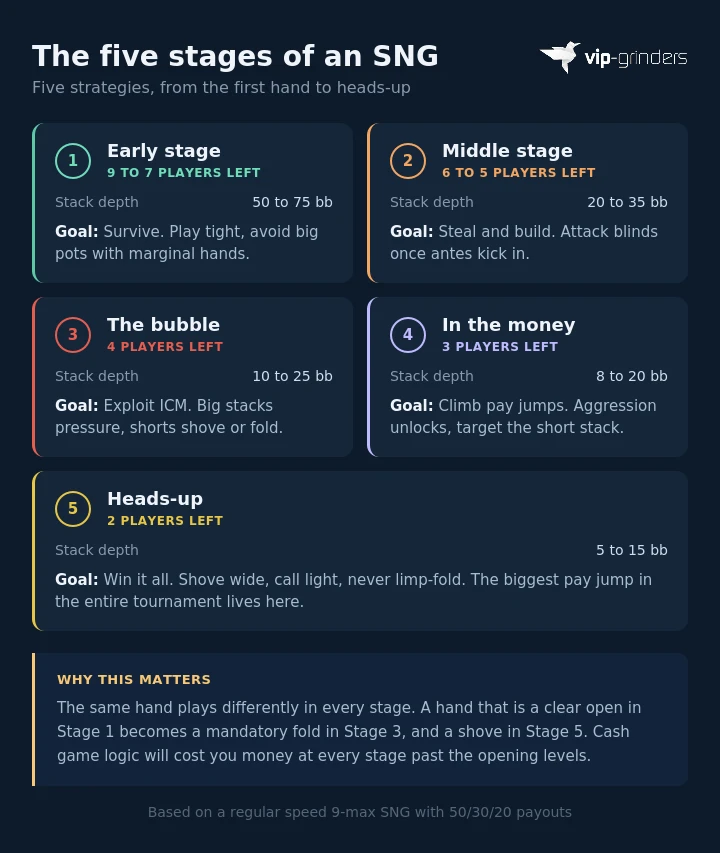
Sit and Go Basics: Formats, Structures and Payouts
A Sit and Go starts as soon as the table fills. There is no scheduled start time, no late registration, and no table balancing. You sit down, the blinds start, and the last player standing (or the top finishers) split the prize pool.
That fixed structure is what makes SNGs so different from multi-table tournaments. In an MTT, fields can run into the thousands and last six or more hours. In a standard SNG, you are playing against 5 or 8 opponents for 45 to 70 minutes, and every decision carries more immediate weight because the payout bubble is never far away.
Table Sizes: 6-Max vs 9-Max
The two most common single table SNG formats are 6-max and 9-max. Each plays differently because the number of opponents changes how fast the blinds eat your stack and how many players need to bust before you reach the money.
- 9-Max: Pays top 3 (typically 50/30/20). Deeper early game, longer bubble phase, more ICM pressure because three pay jumps exist.
- 6-Max: Pays top 2 (typically 65/35). Faster action, shorter bubble, more aggression rewarded because only one pay jump separates second from first.
Both formats use the same fundamental stage-by-stage logic, but the adjustments at the bubble and in the money differ significantly. This guide covers both and flags where the differences matter most.
Speed Formats: Regular, Turbo and Hyper-Turbo
Blind structures in SNGs come in three speeds, and each one compresses or expands your decision-making window differently.
| Speed | Blind Levels | Avg Duration | Starting Stack (typical) | Skill Edge |
|---|---|---|---|---|
| Regular | 10 to 15 min | 45 to 70 min | 1,500 to 3,000 chips | Highest (more postflop play) |
| Turbo | 5 to 6 min | 25 to 35 min | 1,500 chips | Moderate (push/fold starts earlier) |
| Hyper-Turbo | 2 to 3 min | 7 to 15 min | 500 chips | Lowest (almost pure push/fold) |
Regular speed rewards the widest range of poker skills: hand reading, bet sizing, thin value bets. As you move toward turbo and hyper-turbo, postflop play shrinks and the game becomes more about preflop push/fold math. That does not mean turbos are “easier.”
It means the edge comes from different places: range memorization, ICM awareness, and volume instead of postflop creativity.
For beginners, regular speed is the best starting point. For grinders focused on hourly rate, turbos offer a strong balance between edge and volume. Hyper-turbos are for specialists who have internalized push/fold charts and can tolerate extreme variance.
How Payout Structure Shapes Every Decision
The single most important concept in SNG strategy is that chips change value as players bust. A chip you win is worth less than a chip you lose, because each elimination pushes you closer to the money and increases your tournament equity. This is the foundation of ICM, and it separates SNG play from cash games entirely.
Why folding can be worth more than winning: In a 9-max SNG with a 50/30/20 payout, folding a marginal hand on the bubble can be worth more EV than calling and winning. This feels counterintuitive, but ICM math proves it consistently. The deeper you go in this guide, the more this will click.
In a cash game, every chip is worth exactly its face value. In a SNG, the first chip you earn is worth its full share of the prize pool, but by the time you hold 80% of the total chips in play, your stack is not worth 80% of the prize pool. It might only represent 55 to 60% of it.
This shrinking marginal value is why SNG regulars play tighter on the bubble than cash game players would, and why chip leaders can bully shorter stacks with wide shoving ranges.
The payout shape determines how steep this pressure gets. A 50/30/20 structure (9-max) creates three separate pay jumps and makes the bubble brutally tight. A 65/35 structure (6-max) has only one pay jump, so the bubble is less dramatic but the heads-up match carries more value.
SNG Bankroll, ROI, and Variance Reality
SNG win rates are thin. Even strong regulars earn 3% to 8% ROI at low stakes and 2% to 5% at mid stakes. That small per-game edge means bankroll management matters more in SNGs than in almost any other format.
The standard rule is 50 buy-ins for regular speed SNGs. Turbos need 60 to 100, and hyper-turbos need 100 to 300 because the shorter structure amplifies variance. Use the VIP-Grinders Bankroll Calculator to model your own numbers, and our ICM calculator to optimize push/fold decisions at specific payout structures.
Realistic ROI in 2026
Most SNG guides still cite boom-era figures of 15% to 20%. Those numbers are outdated. Modern fields are tougher, rake is higher, and recreational players have shifted toward Spins and MTTs.
| Stake Level | Buy-In Range | Realistic ROI (winning player) |
|---|---|---|
| Micro | $1 to $5 | 5% to 12% |
| Low | $5 to $30 | 3% to 8% |
| Mid | $30 to $100 | 2% to 5% |
| High | $100+ | 1% to 4% |
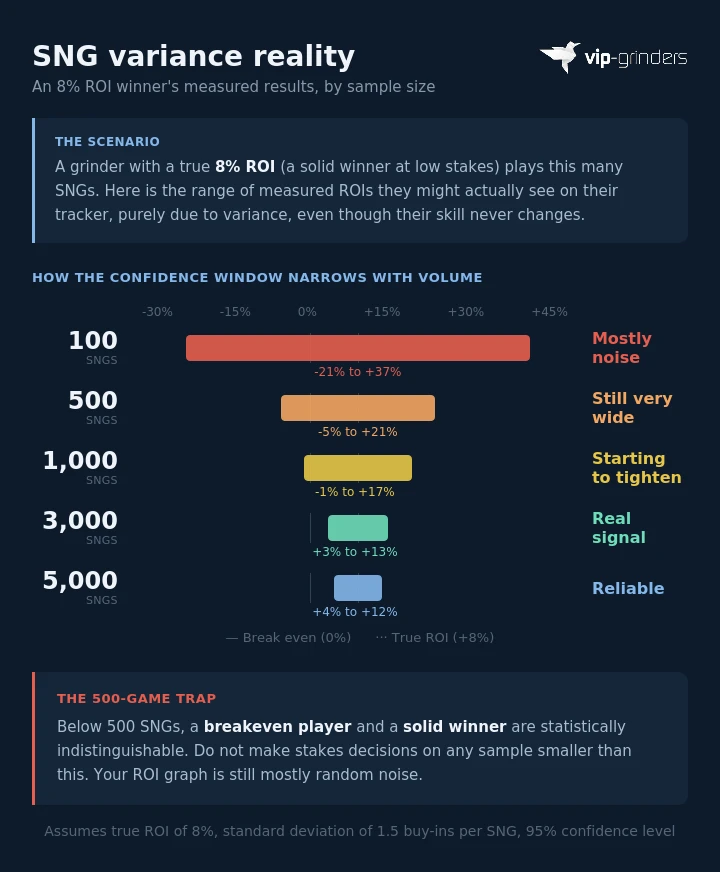
If you are consistently above 0% ROI over 1,000+ games, you are beating the field. You need at least 3,000 games before your measured ROI becomes statistically reliable, and below that sample downswings of 15 to 30 buy-ins are normal. Run your own projections through the VIP-Grinders Variance Simulator, and see our variance guide for the full math on standard deviation and sample size.
Early Stage Strategy: Deep Stacks, Tight Ranges
The early stage of a SNG covers the first few blind levels, when stacks are deepest relative to the blinds. In a typical 9-max with 1,500 starting chips and blinds at 10/20, you are sitting on 75 big blinds. That sounds comfortable, but it disappears faster than you think.
The most common mistake at this stage is playing it like a cash game. Deep stacks tempt players into seeing too many flops, chasing draws, and building big pots with marginal holdings. In a SNG, the chips you lose in level one are gone forever, and replacing them gets harder as blinds climb and opponents tighten up.
What to Play and What to Fold
Your early stage opening range should be noticeably tighter than a full ring cash game range, especially from early and middle positions. The reason is simple: there is almost no reward for building big pots at 10/20 blinds, but the cost of losing one is enormous relative to your tournament life.
- Open from early position (UTG to UTG+2 in 9-max): premium pairs (TT+), AK, AQs. That is roughly 5% of hands. Fold everything else.
- Open from middle position (MP to HJ): add suited broadways (KQs, KJs, QJs), medium pairs (77 to 99), and AJo. Roughly 10% of hands.
- Open from cutoff and button: widen to suited connectors (87s+), suited aces (A2s to A9s), and any pair. Roughly 18% to 25% depending on table dynamics.
- From the blinds: defend selectively. Call or 3-bet with hands that play well postflop (suited connectors, strong broadways), but do not call wide just because you already have money in.
These ranges are starting points for regular speed 9-max. In 6-max, shift everything roughly one position wider because you are closer to the button more often. In turbos, tighten slightly from the blinds because the cost of defending marginal hands is higher when blinds escalate quickly.
Bet Sizing at Early Levels
Keep your preflop raises consistent: 2.5x to 3x the big blind from all positions. Do not min-raise, because it gives the blinds too good a price to call. Do not oversize to 4x or 5x, because it bloats the pot with a stack you cannot afford to lose.
Postflop, standard sizing applies. Bet 50% to 66% of the pot on most flops for value and protection. Save larger bets for when you have a strong hand and expect a call, not for bluffing opponents off marginal holdings at a stage where the pot is not worth the risk.
The Trap to Avoid: “I Have Position, So I Should Play More Hands”
Position is valuable in every poker format, but in early SNG levels it does not justify widening your range as much as it would in a cash game. The reason is stack preservation. Winning a 40-chip pot at 10/20 blinds barely moves your stack, but losing a 600-chip pot puts you at 60% of your starting stack with no way to rebuy.
The players who consistently reach the middle stages with above-average stacks are not the ones who play the most hands early. They are the ones who avoid unnecessary confrontations, let weaker players knock each other out, and enter pots with strong hands in good positions.
In 9-max you can comfortably fold 85% of your hands for the first 15 minutes and still be in good shape. In 6-max, blinds come around faster and you need to open roughly one position wider to avoid bleeding chips, so folding more than 70% to 75% will leave you short before the bubble.
Middle Stage: Stealing Blinds and Rebuilding
The middle stage begins when stacks drop to 20 to 35 big blinds and antes kick in. This is the transition zone where the game shifts from postflop poker to preflop aggression. If you played the early stage correctly you should be near the average stack, and if you are short this is where you need to rebuild before the bubble arrives.
The defining feature of the middle stage is dead money. Once antes are in play, every pot contains chips worth fighting for before anyone looks at their cards. A player who folds through the middle stage is actively losing chips every orbit, and by the time the bubble hits, they will be too short to exert any pressure.
When to Start Stealing
The switch from tight early play to aggressive middle play does not happen at a specific blind level. It happens when three conditions align.
- Antes are live: the pot is already worth 1.5x to 2x the big blind before action begins. Stealing becomes profitable even with a wide range.
- Stacks are 20 to 35 BB: at this depth, a standard open-raise of 2.2x to 2.5x commits a meaningful percentage of your stack, which means opponents need a real hand to defend.
- Tight players are in the blinds: identify who is folding too much and target them from late position. A player who only defends the big blind with top 15% hands is giving up profit every orbit.
You do not need a strong hand to steal. From the cutoff or button with 25 BB, raising to 2.2x with any suited broadway, any pair, any suited ace, or any suited connector is profitable if the players behind you fold more than 60% of the time. At low and micro stakes, most players fold far more than that.
Open-Raise Sizing in the Middle Stage
As stacks get shallower, reduce your open-raise sizing. The goal is to risk the minimum amount necessary to take down the blinds and antes without a fight.
| Stack Depth | Recommended Open Size | Why |
|---|---|---|
| 30 to 40 BB | 2.5x BB | Standard sizing, enough fold equity, leaves room to fold to a 3-bet |
| 20 to 30 BB | 2x to 2.2x BB | Smaller risk, same fold equity against tight opponents |
| 15 to 20 BB | 2x BB or all-in | Below 20 BB, a standard raise commits too much of your stack to fold postflop |
The key principle: once your stack drops below 20 BB, any raise you make should be one you are willing to commit with. If you raise to 2.2x with 18 BB and face a 3-bet shove, you are getting a price that forces you to call with almost anything you opened. If you are not comfortable doing that, shove or fold instead of raising.
Rebuilding a Short Stack
If you reach the middle stage with 12 to 18 BB, you are in rebuild mode. Your primary tool is the open-shove from late position. At 15 BB, shoving from the button or cutoff puts maximum pressure on the blinds because they risk their tournament if they call and lose.
- At 15 BB: shove any pair, any ace, any suited king, and most suited connectors from the cutoff or button if folded to you.
- At 12 BB: expand your shoving range to include any two broadway cards and most suited hands from late position. Waiting for a premium at this depth is a losing strategy because blinds and antes will grind you below 10 BB within two orbits.
- At 10 BB or below: you are in pure push/fold territory. The next section on push and fold charts covers exact ranges for these stack depths.
The worst thing you can do with a short stack in the middle stage is limp or min-raise. Both give your opponents a cheap price to see a flop, and you lose the one advantage a short stack still has: fold equity. Use that pressure while your stack is big enough to scare opponents, and if it is so small that nobody folds, wait for a hand in the top 30% and shove.
Middle Stage Mistakes That Cost You EV
Most SNG regulars lose the bulk of their expected value in the middle stage, not through individual bad beats, but through patterns.
- Blinding down to 10 BB without attempting a steal: every orbit you fold through costs you 1.5 to 2 BB in blinds and antes. Three passive orbits at 20 BB leaves you at 14 BB with far less fold equity.
- Stealing from the wrong positions: opening wide from UTG with 25 BB is a leak. You still have 5 to 8 players behind you, and the risk of running into a real hand is high. Save wide opens for HJ, CO, and BTN.
- Flat-calling raises with a medium stack: at 22 BB, calling a 2.5x open and then folding the flop costs you 11% of your stack for nothing. Either 3-bet shove or fold. The in-between play is the leak.
If you find yourself reaching the bubble with less than 10 BB more often than not, the middle stage is almost certainly where the problem lives. Review your steal frequency from late position and your open sizing relative to your stack. Those two adjustments alone can shift your average bubble stack by 3 to 5 BB, which translates directly into more final table appearances and higher ROI.
Bubble Strategy and ICM Pressure
The bubble is the most profitable stage of a SNG for players who understand the math, and the most expensive for those who do not. In a 9-max SNG the bubble starts when 4 players remain and 3 get paid, while in a 6-max it starts at 3 players with 2 getting paid. Every decision at this point is magnified because a single mistake can cost more tournament equity than all of your early stage play combined.
The reason is ICM. Finishing 4th in a 9-max SNG pays exactly the same as finishing 9th (zero), but finishing 3rd pays 20% of the prize pool. That jump from nothing to something makes every chip you risk on the bubble worth more than its face value.
How ICM Changes Your Decisions
In a cash game, calling an all-in with 55% equity is always profitable. On the SNG bubble, the same call can be a clear fold because ICM assigns a dollar value to your stack based on all remaining stacks and the payout structure, not just the pot you are contesting. A coinflip call on the bubble where you risk $12 in tournament equity to gain $5 is a terrible trade, even when you win more often than you lose.
This is why tight play on the bubble is not cowardice: it is math. For the full model with worked examples and stack-by-stack equity calculations, see our dedicated ICM in Poker guide.
Stack-Based Bubble Roles
Your bubble strategy depends almost entirely on your stack relative to the other players. The same hand can be a shove, a fold, or a call depending on where you sit in the chip counts.
- Chip leader (35%+ of chips in play): you are the aggressor. Shove wide against medium stacks who cannot afford to call, because they risk bubbling if they lose. Your target is not the short stack (who will call light because they are desperate) but the medium stacks caught between survival and aggression.
- Medium stack (20% to 30% of chips): the hardest spot on the bubble. You have enough to survive but too much to gamble. Tighten your calling range significantly and only get involved with strong hands unless you are the one putting pressure on a shorter stack.
- Short stack (under 15% of chips): you are running out of time. Shove any reasonable hand before blinds eat your fold equity completely. Waiting for a premium at 5 BB on the bubble is a mistake because even if you double up, you are still short. Shove early while your stack still makes opponents think twice.
For a broader look at bubble play across MTTs and other formats, see our full poker bubble strategy guide.
Exploiting Bubble Tightness
At low and micro stakes, most opponents play the bubble too tight. They understand that “you should be tight on the bubble” but apply it uniformly regardless of their stack. This creates opportunities.
- As chip leader: if the three remaining opponents are folding to your raises, shove any two cards from the button. A player who folds 80% of the time is giving you 1.5 to 2 BB in dead money per shove.
- As medium stack: if the chip leader is shoving every hand, do not try to make a stand with K7 offsuit. Wait for a top 15% hand and let them pay you off. Punish their aggression when you have real equity, not to prove a point.
If you play both formats, note that 6-max bubbles are flatter because only one pay jump exists (0 to 35%). Expand your calling range by roughly 5% to 10% compared to 9-max, because the ICM penalty for busting is smaller relative to the upside of accumulating chips for heads-up.
Push/Fold Charts and Short Stack Play
Below 15 BB, standard poker disappears. You either shove all-in or fold, because any other play (min-raising, limping, calling) costs you fold equity and commits chips without maximum pressure. The charts below show which hands to shove from each position when folded to you in a 9-max SNG, based on ICM-adjusted Nash equilibrium ranges.
These are ICM-adjusted ranges, not chip-EV. They account for payout structure, which means they are tighter than what you would see in a cash game shove chart.
Open-Shove Ranges by Stack Depth (9-Max, Pre-Bubble)
The table below shows the approximate percentage of hands you should shove from each position when folded to you, assuming a 9-max SNG with 50/30/20 payouts and equal starting stacks.
| Stack | UTG to MP | HJ | CO | BTN | SB |
|---|---|---|---|---|---|
| 15 BB | ~5% | ~9% | ~18% | ~35% | ~45% |
| 10 BB | ~8% | ~15% | ~30% | ~55% | ~65% |
| 7 BB | ~14% | ~25% | ~40% | ~65% | ~80% |
| 5 BB | ~25% | ~35% | ~50% | ~80% | ~90% |
To translate those percentages into specific hands: 5% means premium pairs and AK only, 15% adds medium pairs, suited broadways, and strong aces, and 35% includes any pair, any ace, suited kings, and suited connectors. Above 50%, you are shoving most hands with any face card or suited holding.
These ranges widen as your stack shrinks because the cost of folding one more orbit becomes a larger percentage of your chips. At 5 BB in the small blind, passing up a hand like J6 offsuit costs you roughly 30% of your stack in the next two orbits. Shoving is almost always better than waiting.
How the Bubble Changes These Ranges
The chart above assumes pre-bubble play where ICM pressure is moderate. On the bubble, ranges shift dramatically based on your role.
- Chip leader: your shoving ranges WIDEN on the bubble compared to pre-bubble, because medium stacks are forced to fold even more. You can shove close to any two cards from the button against tight medium stacks.
- Medium stack: your shoving ranges TIGHTEN significantly. At 10 BB on the bubble as the second-largest stack, you might fold hands like A9o from the cutoff that would be clear shoves pre-bubble.
- Short stack: your ranges stay roughly similar or slightly widen, because you have no equity to protect. You need to double up or you are out regardless.
Calling a Shove: Tighter Than You Think
Knowing when to call someone else’s all-in is just as important as knowing when to shove. Calling ranges are always tighter than shoving ranges because when you call, you give up fold equity and guarantee a showdown.
A practical baseline for calling an open-shove in a 9-max SNG.
| Your Stack | Shover’s Stack | Call with (approx.) |
|---|---|---|
| 15 BB | 10 BB (covers you) | 77+, ATs+, AJo+, KQs |
| 12 BB | 8 BB | 55+, A9s+, ATo+, KQs |
| 10 BB | 10 BB | 66+, ATs+, AJo+, KQs |
| On the bubble | Any | Tighten all of the above by 5% to 15% depending on stack dynamics |
On the bubble, calling ranges should be the tightest of any stage. If two other players have similar stacks and one has already shoved, the correct play is often to fold hands as strong as AQo because the risk of busting outweighs the value of winning.
Chip-EV vs ICM: Why Your Chart Source Matters
Not all push/fold charts are equal. The two most common types are chip-EV (which ignores payout structure) and ICM-adjusted (which factors in pay jumps and stack distributions).
- SnapShove: uses chip-EV by default. Solid baseline for cash games and early tournament stages, but overestimates shoving ranges on the SNG bubble because it does not account for the penalty of busting near the money.
- HoldemResources Calculator (HRC): the industry standard for SNG ICM analysis. Input exact stack sizes, payout structures, and positions to get ICM-adjusted shove, call, and reshove ranges.
- ICMIZER 3: the co-leader for SNG study. Same ICM capabilities as HRC plus a built-in training mode that drills push/fold scenarios by tournament type.
For deeper study, use HRC or ICMIZER 3 to run your own stack distributions and payout structures. Both are covered in our poker tools guide. SnapShove is a useful mobile supplement for drilling chip-EV baselines, but always cross-check SNG bubble spots with an ICM tool.
In the Money: Heads Up and Final Stages
Once the bubble bursts, the game changes again. ICM pressure drops sharply because everyone is already guaranteed money, whether it is three players splitting 50/30/20 in a 9-max or two players at 65/35 in a 6-max. The question shifts from “how do I survive?” to “how do I maximize my finish?”
This is where many SNG regulars leave money on the table. They played tight through the bubble, locked in a cash, and then either coast passively into 3rd or gamble recklessly trying to win. The correct approach is controlled aggression with an understanding of how pay jumps affect your risk tolerance.
Three-Handed Play (9-Max)
With three players left and payouts of 50/30/20, the next pay jump (from 3rd to 2nd) is worth 10% of the prize pool. The final jump (from 2nd to 1st) is worth 20%. That means the difference between 2nd and 1st is twice as valuable as the difference between 3rd and 2nd.
- Short stack (3rd in chips): you are guaranteed 20% but need to double up to compete for 1st. Push wider than the bubble because the penalty for busting is smaller (you already have money locked in). Target the medium stack if the chip leader is folding too much.
- Medium stack: you can now play more aggressively than on the bubble. The survival pressure is off, and every chip you accumulate pushes you toward the 50% first-place payout. Look for spots to attack the short stack and build a heads-up lead.
- Chip leader: stay aggressive but pick your spots. You are the favorite to win, so avoid unnecessary coinflips against the medium stack. Apply pressure on the short stack and let the pay jump math work for you.
Three-handed play in a 9-max SNG typically lasts only a few hands because stacks are shallow and blinds are high by this stage. Most pots are shove-or-fold. If stacks are deep enough for postflop play, focus on position and avoid bloating pots out of position with medium-strength hands.
Heads-Up Play
The heads-up match is where the biggest pay jump lives: 20% of the total prize pool in a 9-max (2nd to 1st) and 30% in a 6-max. This is the single largest chunk of EV in the entire tournament, and the player who adjusts fastest usually takes it.
By the time you reach heads-up, stacks are almost always shallow: typically 8 to 15 BB each. At this depth, the game is pure push/fold for most hands. Open-raising to 2x and folding to a shove wastes chips you cannot afford to lose.
| Your Stack (BB) | SB/BTN Strategy | BB Strategy |
|---|---|---|
| 12 to 15 BB | Open-shove ~60% to 70% of hands, or raise to 2x with top 30% and shove the rest | Call shoves with top 35% to 40%, 3-bet shove over raises with ~25% |
| 8 to 12 BB | Open-shove ~70% to 80% of hands | Call shoves with top 40% to 50% |
| 5 to 8 BB | Open-shove ~85%+ of hands | Call shoves with top 50% to 60% |
These ranges are wider than anything you played during the SNG, and that is correct. Heads-up with both players already in the money, chip-EV and ICM-adjusted ranges converge. Folding too much gives your opponent free chips every hand.
Exploitative Heads-Up Adjustments
At low and micro stakes, most opponents play heads-up too passively. They wait for strong hands, fold too often from the small blind, and call too tight from the big blind. If your opponent is folding more than 50% of hands to your shoves, you are printing money by shoving close to any two cards.
The reverse also applies. If your opponent is shoving every hand into you, tighten your calling range to the top 40% and let them run into your stronger hands. Do not try to outbluff someone who never folds.
The single biggest heads-up leak in low-stakes SNGs is limp-folding from the small blind. Over 15 to 20 hands at 8 BB effective, those free half big blinds add up to 5 to 10% of your stack donated for nothing. Either shove or fold.
The Rakeback Factor
With SNG ROI margins as thin as 2% to 5%, rakeback can represent a significant share of your total earnings. A player breaking even on the tables who receives 20% rakeback is a winning player once rake return is factored in. For a full breakdown of how your deal should influence stakes, volume, and room selection, see our rakeback and strategy guide.
Other SNG Formats
The strategy above covers standard single table SNGs. Three other sub-formats play differently enough to mention: Knockout (KO) SNGs add a bounty component that widens calling ranges, Double or Nothing (DoN) SNGs reward pure survival since all finishers split equally, and Multi-Table SNGs (18 to 180 players) blend SNG fundamentals with MTT final table concepts. Each deserves its own guide.
Jackpot-style 3-max SNGs are a different format entirely and are covered in our dedicated Spin & Go guide. If you are choosing between formats, our MTTs vs Spin & Gos comparison covers the full decision.
Frequently Asked Questions
How many buy-ins do I need for SNGs?
For regular speed SNGs, 50 buy-ins is the most widely recommended bankroll. Turbo SNGs need around 60 to 100 buy-ins, and hyper-turbos require 100 to 300 buy-ins depending on your risk tolerance. These numbers are higher than cash game bankroll requirements because SNG variance is driven by the tournament format, not just hand-to-hand swings.
What is a good ROI for SNGs?
At micro stakes ($1 to $5 buy-ins), a winning player can expect 5% to 12% ROI. At low stakes ($5 to $30), 3% to 8% is realistic. At mid stakes and above, 2% to 5% is strong. Any ROI consistently above 0% over 1,000+ games means you are beating the field. The boom-era figures of 15% to 20% are no longer realistic at most stake levels.
How does ICM affect SNG strategy?
ICM (Independent Chip Model) calculates the real dollar value of your chip stack based on all remaining stacks and the payout structure. In SNGs, this means a chip you win is worth less than a chip you lose, especially near the bubble. ICM makes correct plays on the bubble look counterintuitive: you will often fold hands that would be profitable calls in a cash game because the risk of busting outweighs the reward of winning.
Should I play tight or aggressive in a SNG?
Both, at different stages. Play tight in the early levels when blinds are small and there is little to gain from big pots. Shift to aggressive stealing in the middle stage when antes create dead money worth fighting for. On the bubble, your aggression depends on your stack: chip leaders shove wide, medium stacks tighten up, and short stacks push before their fold equity disappears. Heads-up is the most aggressive phase of the entire tournament.
What is the best SNG speed for beginners?
Regular speed. Blind levels of 10 to 15 minutes give you time to make postflop decisions, read opponents, and learn stage transitions without being forced into pure push/fold within the first few minutes. Once you are comfortable with SNG fundamentals, turbos offer a good balance of skill edge and volume. Hyper-turbos are for specialists only.
How many SNGs do I need to play before I know my true ROI?
At least 1,000 for a rough directional read, and ideally 3,000 or more for a reliable assessment. At 500 games, your ROI measurement has roughly plus or minus 5% uncertainty. Variance in SNGs is high enough that a breakeven player can appear to be a 10% winner (or a 10% loser) over short samples. Use our Variance Simulator (linked in the bankroll section above) to model your own confidence intervals.
Is it better to play SNGs or MTTs?
It depends on what you value. SNGs offer shorter sessions (under an hour), faster feedback loops, more predictable scheduling, and strong hourly rates at low and mid stakes. MTTs offer much larger prize pools and higher peak payouts but require longer time commitments, more patience, and significantly larger bankrolls to handle the variance. Many grinders play both and adjust based on their schedule.
Can I use HUDs at SNG tables?
It depends on the poker site. Some rooms like PokerStars and GGPoker restrict or ban third-party HUDs entirely. Others like Americas Cardroom still allow them. Check your room’s terms of service before using any tracking overlay. Even on sites that ban HUDs, you can still use tracking software like PokerTracker or Hold’em Manager to review hands after your session, which is where most of the study value comes from anyway.