

If you’ve played online poker for any amount of time, you know how much the rake — the commission sites take from each pot or tournament entry — eats away at your edge. Rakeback is the most powerful tool an online poker player can use to reclaim part of that cost.
Over time, a solid rakeback deal can convert a break-even or marginally winning player into a consistently profitable one.
At VIP‑Grinders, we’ve tracked hundreds of real accounts over years — and we’ve repeatedly seen rakeback do more than just cushion downswings. It smooths out variance, speeds up stake climbs, and turns tables against the house’s unseen rake tax.
In this guide, we break down: what rakeback is, how it works, what forms it comes in, how to use it strategically — and which top poker rooms offer the most transparent, valuable deals.

What is Rakeback?
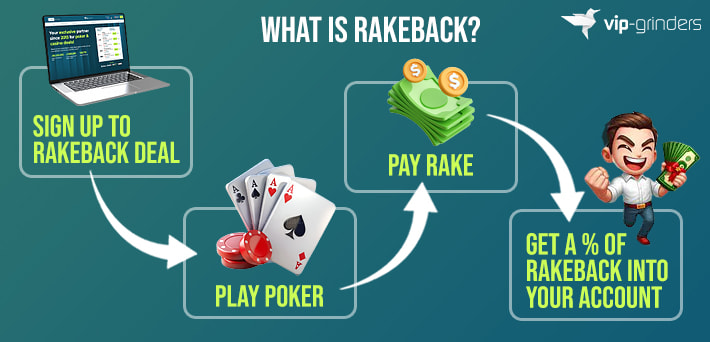
Rakeback is a portion of the rake you paid to a poker site, returned to you. That’s what rakeback is in a nutshell.
Every time you play a cash‑game hand or enter a tournament, the poker site extracts rake (or fees as with tournaments and SnG’s). Rakeback gives you part of that back — often as cash, credits, tokens, or loyalty points.
Depending on the site, you might get a percentage of the rake you generated (e.g. 30%), or you may enter a loyalty program where you earn points per hand, then redeem them for cash or perks. You can also use our dedicated rakeback calculator to find the best deals.
Weighted Contributed Rake
Common rakeback percentages range from 20% to 40%6. Some examples include:
- 1Understand the core concept of GTO and why it provides an unexploitable baseline strategy.
- 2Learn to balance your ranges and bluff frequencies to avoid predictability.
- 3Apply exploitative adjustments by reading opponents’ tendencies and adapting your strategy to maximize value.
What is a Rake Cap?
This only happens if the pot has exceeded a certain size. If not, you won’t be charged. No rake is taken if there is no flop. There is also a cap, which is set by the online poker room or casino.
How Rakeback is Calculated (and what to watch out for)
Contributed Rake vs Dealt Rake vs Points-based
Contributed rake: You get a rebate based on how much rake you personally contributed across all pots. Good for cash‑game regulars who see lots of action. For example, if a player contributes $100 to a pot with $5 rake, and the site offers 30%, they would get ~ $1.50 back.
Dealt rake: You earn rakeback per hand dealt — whether you contributed to the pot or folded.
Points / loyalty‑based rakeback: Some sites assign “points per rake dollar or hand dealt,” which can then be redeemed for cash, tickets or tokens. The net rebate depends heavily on conversion rates, tiers or additional multipliers.
Rakeback example calculation
- 1You play 10,000 hands in a month
- 2Average rake per hand: $1
- 3Total rake paid: $10,000
- 4Rakeback rate: 30%
- 5Your rakeback: $10,000 * 30% = $3,000
⚠️ Always check how the room calculates rakeback! Many deals that look generous actually require high volume or favourable conditions before they pay out.
Types of Rakeback Deals: Expert Overview
Rakeback is a critical component of long-term online poker profitability. Different formats offer varying trade-offs between simplicity, upside potential, and stability. Understanding these can help you optimize your returns based on your volume and play style.
Flat-rate Rakeback
- A fixed percentage of the rake you pay is returned to you.
- Simple and predictable, ideal for players favoring stability.
- Limited upside for high-volume grinders seeking more aggressive rewards.
Tiered VIP/Loyalty Programs
- Rewards scale with your rake volume or hands played.
- Higher tiers unlock better rebates and value-added bonuses such as tournament entries.
- Suited for players who can consistently generate large volume.
Promotional and Time-Limited Boosts
- Temporary increases in rakeback, such as a 50% boost for the first week.
- Great for capitalizing on short-term opportunities but require active participation.
- Can add meaningful value if timed right but are not sustainable long-term.
Affiliate Deals — Preferred for Serious Grinders
- Affiliates like VIP-Grinders receive commissions based on your rake and share part back as rakeback plus exclusive bonuses.
- Often offer better effective rakeback rates than direct site offers, including special perks and personalized support.
- Flexible and lucrative for grinders aiming to maximize every dollar of rake.
- Combining consistent rakeback with timely bonuses provides superior long-term value.
Points-to-Cash / Reward Conversion
- Earn points per hand or rake, convertible to cash, tickets, or bonuses.
- Offers versatility but can lack transparency and sometimes provide less direct value than cash rakeback.
- Often preferred by recreational players who enjoy flexibility over raw rebate percentage.
My Verdict: For grinders focused on maximizing ROI, affiliate-sponsored rakeback deals deliver the best mix of stable and boosted returns, layered with valuable extras that can significantly increase your net profit. Align your choice with your volume, style, and strategic goals for optimal results.
How Rakeback Influences Your ROI and Bankroll
A stable 25–35% rakeback deal can add roughly 0.8–1.2 BB/100 to your net win rate — enough to turn a break‑even player into a modest winner.
For grinders doing 5,000–15,000 hands/month, that’s a real bonus of hundreds or even thousands per month.
When it comes to thinking about rakeback vs skill, it is important to think of rakeback as an essential variance buffer. Rakeback raises your bottom line, giving you more breathing room to focus on sound play, study, and growth.
Rakeback Deals from Major Poker Sites
Major poker sites provide you with highly appealing deals, which we will explain to you.
| Poker Site | Percentage | Terms |
|---|---|---|
| CoinPoker | 33% | Flat rate, requires CHP balance, paid weekly |
| WPT Global | 20% – 40% | Based on table stakes, paid weekly |
| GGPoker | 20% – 60% | Fish Buffet system |
| Americas Cardroom | 27% flat or Elite Benefits | Choice between flat rate or loyalty program |
How to Use Rakeback Strategically (Not Just Passively)
- 1Don’t chase rakeback at any cost: Getting sucked into 20–40 tables just to chase a higher rakeback tier rarely works out. It usually destroys your win rate long before rakeback covers the losses. Only increase volume when you're confident in your win rate per table.
- 2Match games to rakeback structure: Sites like WPT Global pay better on “table‑starter” games — meaning early seat in empty tables. If you’re a night‑owl or multi‑tabler, choose rooms with flat-rate or loyalty-based rakeback instead.
- 3Track rake & payout history meticulously: Keep spreadsheet logs or hand‑history imports. Know exactly how much rake you generate vs how much rebate you receive. If numbers consistently diverge — ask support, change deals, or leave.
- 4Treat rakeback as part of your long‑term bankroll plan: Don’t “spend” rakeback immediately. Use it to absorb downturns, invest in study, or fund bankroll moves. The value of rakeback shows over months, not individual sessions.
Poker Rakeback Offers vs Bonuses: Why both still Matter
Rakeback is a recurring, performance-based cashback. Of course, for regular players this is great as it directly impacts winrate. A poker room’s deposit or reload bonuses are a one-time or periodic boost. In comparison to rakeback, the bonuses only offer a short-term boost, but are important for building a starting bankroll.
To get the best of both worlds, combine both when possible. Prioritise rakeback for stability. Bonuses are a bonus; rakeback is reliable returns.
Our Tip: poker sites usually run lots of promotions. We are constantly checking new offers for you and recommend making use of our exclusive poker bonus codes to claim the juiciest bonuses.
3 Common Rakeback Myths (Debunked)
- 30% is a competitive rakeback offer (maybe in 2012, not in 2025)
- High-volume players may receive 50% or even more
- Some sites offer tiered percentages, increasing with player activity
Rakeback Case Studies: Comparing Rakeback Benefits
CoinPoker Rakeback Case Study
Rake—the fee charged by the poker room for hosting the game—is the single biggest drain on a player’s long-term profitability. For a recreational player, it can determine whether they stay in the game; for a professional grinder, it can be the difference between a good income and a miserable one.
This analysis examines the impact of a 33% rakeback deal on two distinct player profiles at CoinPoker, focusing on their total fees paid (rake + tournament fees) and the value of their weekly rebate.
CoinPoker Rake Structure
| Format | Fee/Rake Percentage | Rakeback Percentage | Effective Fee/Rake |
|---|---|---|---|
| Cash Games (Rake) | 5% (with caps) | 33% | $5% times (1 – 0.33) = **3.35%**$ |
| Tournaments (Fee) | 8% (built into buy-in) | 33% | $8% times (1 – 0.33) = **5.36%**$ |
Find out more about CoinPoker in our in-depth VIP-Grinders CoinPoker review.
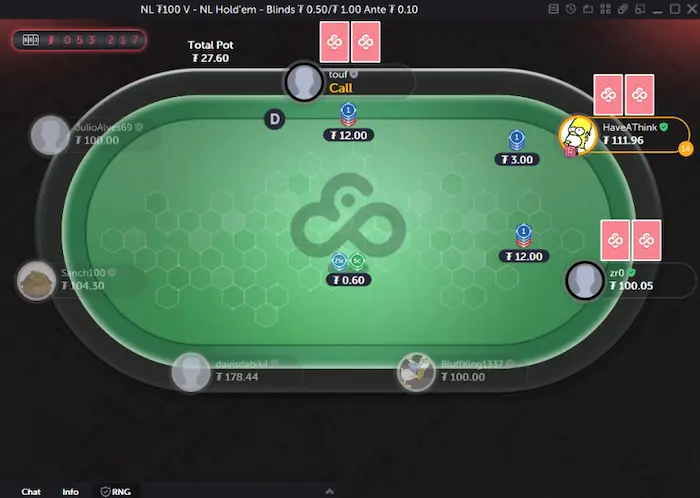
Rakeback for a Recreational Player at CoinPoker
Rakeback acts as a safety net, helping to smooth out downswings and prolonging their bankroll’s lifespan. For a recreational player, this extra failsafe can keep a bankroll sustained for significantly longer and prevent them from going broke.
| Detail | Assumption |
|---|---|
| Playtime | 6.25 hours per week (2.5 days × 2.5 hours/session) |
| Cash Games | 70% of playtime, playing at the $0.05/$0.10 NLH Stake. |
| Tournaments | 30% of playtime, playing an average $10 Buy-in ($1 Fee). |
Below you can get a snapshot of what an average recreational poker player might pay in weekly rakeback, and what they’d earn back with the CoinPoker rakeback offer.
| Category | Weekly Rake/Fees Paid | 33% Weekly Rakeback Earned |
|---|---|---|
| Cash Games | $28.13 | $9.28 |
| Tournaments | $3.75 | $1.24 |
| Total | $31.88 | $10.52 |
The Grinder and Rakeback Expectations at CoinPoker
This player treats poker as a profession, relying on high volume and rakeback to achieve a sustainable hourly rate. For a grinder, rakeback is a predictable revenue stream that helps stabilize their income.
| Detail | Assumption |
|---|---|
| Playtime | 27.5 hours per week (5 days × 5.5 hours/session) |
| Cash Games | 90% of playtime, playing at the $0.25/$0.50 NLH Stake. |
| Tournaments | 10% of playtime, playing an average $30 Buy-in ($2.40 Fee). |
Demonstrated in the table below, the grinder earns $291.04 per week, totaling over $15,000 per year. For a professional, this is a major portion of their annual income.
| Category | Weekly Rake/Fees Paid | 33% Weekly Rakeback Earned |
|---|---|---|
| Cash Games | $868.73 | $286.68 |
| Tournaments | $13.20 | $4.36 |
| Total | $881.93 | $291.04 |
Bankroll Health Benefits of 33% Rakeback
The table below summarizes how the 33% rakeback benefit translates into tangible value for both player types, demonstrating its critical role in bankroll health.
| Metric | Recreational Player | Grinder |
|---|---|---|
| Total Weekly Rake/Fees Paid (Gross) | $31.88 | $881.93 |
| Weekly Rakeback Earned (33%) | $10.52 | $291.04 |
| Net Weekly Cost of Rake/Fees | $21.36 | $590.89 |
| Annual Rakeback Benefit | $547 | $15,134 |
WPT Global: A Rakeback Analysis with Tiered Rewards
WPT Global’s rakeback system is designed to incentivize starting new cash games and rewards high-stakes players with a superior return.1 This creates a powerful differentiator compared to the flat rakeback model.
Get more details about WPT in our WPT Global review.
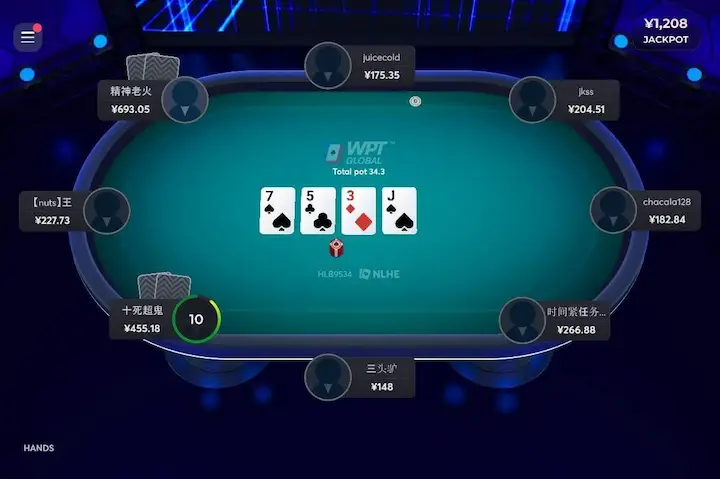
WPT Global Rakeback for a Recreational Player
The recreational player falls into the 20% cash game rakeback tier. This structure is less beneficial than flat-rate systems, as it offers no rakeback on tournament fees, resulting in significantly lower total weekly earnings.
| Metric | Cash Games (20% Rakeback) | Tournaments (0% Rakeback) | Total |
|---|---|---|---|
| Weekly Playtime | 4.38 hours | 1.87 hours | |
| Gross Fees Paid | $28.13 | $3.75 | $31.88 |
| Weekly Rakeback Earned | $5.63 | $0.00 | $5.63 |
| Annual Benefit | $293 | $293 |
The High Stakes Grinder (WPT Global High Stakes)
The high-volume, high-stakes grinder strategically reaches the maximum 40% cash game rakeback tier. Due to immense rake volume at high stakes, this system turns rakeback into a healthy income stream, demonstrating WPT Global’s push to attract elite players.
| Metric | Cash Games (40% Rakeback) | Tournaments (0% Rakeback) | Total |
|---|---|---|---|
| Weekly Playtime | 24.75 hours | 2.75 hours | 27.5 hours |
| Gross Fees Paid | $5,346.00 | $55.00 | $5,401.00 |
| Weekly Rakeback Earned | $2,138.40 | $0.00 | $2,138.40 |
| Annual Benefit | $293 | $111,200 |
Americas Cardroom (ACR): Flat 27% Rakeback
ACR’s 5% rake structure, combined with the Weighted Contributed distribution, is a standard, competitive model. The 27% rakeback provides a strong, consistent return across all formats.
The site provides a 100% bonus up to $2,000 for new players. Find out more about Americas Cardroom in our ACR review.

The Recreational ACR Player (27% Flat Rakeback)
The recreational player benefits from the 27% Flat Rakeback deal, which is applied consistently to both cash game rake and tournament fees. This is a solid, straightforward return that offers better value than the WPT Global base rate for multi-game players.
| Metric | Cash Games (27% RB) | Tournaments (27% RB) | Total |
|---|---|---|---|
| Weekly Playtime | 4.38 hours | 1.87 hour | 6.25 hours |
| Gross Fees Paid | $28.13 | $3.75 | $31.88 |
| Weekly Rakeback Earned | $7.59 | $1.01 | $8.60 |
| Annual Benefit | $293 | $447 |
The ACR Grinder (Elite Benefits Program)
The high-volume grinder maximizes their earnings by opting for the Elite Benefits VIP program over the 27% flat rate, reaching an estimated General Status (37%-46% effective rakeback). This tier provides the highest return, transforming the rakeback into a substantial, stable income source.
| Metric | Basis of Calculation | Value |
|---|---|---|
| Weekly Playtime | (90% Cash, 10% MTT) | 27.5 hours |
| Annual Rake/Fees Paid (Gross) | $28.13 | $45,860 |
| Weekly Rakeback Earned | ($895.13 Gross) | $358.05 |
| Annual Benefit | $18,618 |
GGPoker
GGPoker’s Fish Buffet rewards program offers tiered rakeback. The rakeback system at GG Poker is not as straightforward as at WPT Global or CoinPoker, and much of the rake contribution goes towards rewards, rather than direct rakeback. Get all the details in our GGPoker review.
The Recreational GG Poker Player
The recreational player benefits from the GGPoker Fish Buffet system with a high PVI (closer to 1.0), meaning most of their paid rake counts toward rewards. They can expect an estimated average cashback of 20% to 28%, applied to both Cash Games and Tournaments.
| Metric | Cash Games (27% Effective) | Tournaments (27% Effective) | Total |
|---|---|---|---|
| Weekly Playtime | 4.38 hours | 1.87 hours | 6.25 hours |
| Gross Fees Paid | $28.13 | $3.75 | $31.88 |
| Weekly Rakeback Earned (Est.) | $7.59 | $1.01 | $8.60 |
| Annual Benefit (Est.) | $447 |
The Grinder (GGPoker – Low PVI / Platinum Status)
The winning grinder is heavily penalized by the PVI (estimated at $sim 0.35$ for winners), which drastically reduces the effective rakeback, even when achieving a high fixed rate like Platinum Whale. The PVI is applied before the fixed rate, resulting in one of the lowest annual rakeback figures for a professional.
| Metric | Basis of Calculation | Value | |
|---|---|---|---|
| Weekly Playtime | (90% Cash, 10% MTT) | 27.5 hours | |
| Weekly Rake/Fees Paid (Gross) | $895.13 | ||
| Effective Rakeback Rate (PVI Adjusted) | ($50%$ Fixed Rate $times$ $0.35$ PVI) | 17.5% | |
| Weekly Rakeback Earned (Est.) | ($895.13 Gross $times$ 17.5%) | $156.65 | |
| Annual Benefit (Est.) | $8,146 |
AI Summary TL;DR: What is Poker Rakeback and How Does It Work?
The Debate: Is Rakeback Good for Poker?
Let’s break down the arguments for and against rakeback and see how it fits into the bigger picture of online poker.
- Fair Policies: Sites should offer transparent and fair terms that reward genuine play without encouraging irresponsible behavior. Clear rules help maintain trust and integrity.
- Cap Percentages: Limiting it to 30-40% prevents sites from offering excessively high rates that could undermine their profitability and sustainability.
- Offer Cashback to All Players: Providing cashback to all players, not just high-volume grinders, promotes fairness and inclusivity. This approach ensures that both casual players and grinders benefit.
- Mix it with Other Rewards: Combining cashback with other rewards like bonuses, loyalty points, and tournament entries caters to different player preferences and prevents over-reliance on any single incentive.
- Encourage Skill Development: Sites should promote skill development alongside cashback programs. Players should focus on improving their poker skills to ensure long-term success and maintain game integrity.
- Time-Based Cashback: Implementing time-based rewards playing activity, not just raking, can encourage consistent and responsible play.
- Regular Reviews and Adjustments: Poker sites should regularly review and adjust their systems based on player feedback and industry trends to ensure they remain fair and effective.
What is Rakeback in Poker: Conclusion
Rakeback is not a mere perk. Rakeback in gambling is the single most powerful tool an online poker player can use to turn a marginally winning or break-even session into a consistently profitable long-term career. Combined with solid poker strategy rakeback acts as an essential variance buffer.
The analysis of CoinPoker, WPT Global, ACR, and GGPoker reveals that there is no single “best” rakeback deal; the optimal choice is entirely dependent on the player’s volume, stakes, and game preference (Cash vs. MTT).
Top 7 Rakeback Takeaways
- 1Rakeback Converts Break-Even Players into Winners: A stable rakeback deal adds value to a player's net win rate, providing the crucial cushion needed for long-term profitability.
- 2Strategy Depends on Player Type (Flat vs. Tiered): Recreational Players benefit most from flat-rate rakeback. High-Volume Grinders must pursue tiered VIP programs to maximize their annual income.
- 3The PVI System Severely Penalizes Winners: GGPoker's Player Value Index (PVI) system heavily biases rewards towards losing/recreational players.
- 4WPT Global Offers the Highest Earning PotentialThe WPT Global tiered system, rewarding table-starters and high stakes, creates the highest potential rakeback ceiling. It is, however, the least beneficial for casual MTT players.
- 5Rakeback Type Dictates Game Choice: Players should match their game volume and format to the site's structure. For instance, ACR and CoinPoker are better for multi-table tournament (MTT) volume due to applying rakeback to fees, while WPT Global is strictly better for cash game volume.
- 6Affiliate Deals Are Key for Serious Grinders: Affiliate-sponsored deals often provide a superior effective rakeback rate compared to direct site offers by combining the standard rebate with exclusive bonuses, promotions, and personalized support, maximizing overall Return on Investment (ROI).
- 7Rakeback is a Bankroll Tool, Not a Strategy: The strategic use of rakeback means treating the earnings as a separate investment: use it to absorb downswings, study, or fund bankroll movement, rather than spending it immediately.
FAQ
What is Rakeback in Gambling?
In poker, rakeback is a rebate of the rake paid by players. For example, with a 27% rakeback deal, if you pay $1,000 in rake over a month, you get $270 back.
What is the Difference Between Rake and Rakeback?
Rake is the fee taken by the poker room from each pot. Rakeback is a percentage of that rake returned to the player.
Why Did Molly Have to Take a Rake?
In “Molly’s Game,” Molly started taking a rake to cover potential losses from players unable to pay their debts. She initially took 2% uncapped from each pot.
Do Casinos Make Money off Poker?
Yes, casinos profit from poker through rake. They typically take a small percentage (less than 10%) from each pot up to a certain limit.
What is the Percentage of Rakeback?
Rakeback percentages vary, but typically range from 10% to 60%. Some deals offer around 27%, while others can go up to 40% or more.
What is a Poker Ante?
An ante is a forced bet that all players must place before cards are dealt. It ensures there’s always a minimum amount in the pot and encourages action.
Does PokerStars have rakeback?
Yes, PokerStars offers rakeback through its PokerStars Rewards program. You earn 100 Reward Points for every $1 in rake or tournament fees paid and rakeback is paid in cash through Chests, which you unlock by accumulating Reward Points.