


Fast-Fold Poker Strategy: How to Beat Zoom, Rush & Cash & Snap in 2026
Fast-fold poker deals 200 to 300 hands per hour at a single table. The moment you fold, you are dealt into a new hand against new opponents at a new seat, with zero waiting. That one change rewrites nearly every standard cash game decision you make.
The pool you face in Zoom, Rush & Cash, Snap, and other fast-fold variants is reg-heavy, anonymous, and fold-happy. You will not build history on opponents because you will not see them again for hours. Your edge has to come from format reads, not player reads.
This guide covers the format-level adjustments that apply to fast-fold cash games in 2026, from NL10 to NL200. It assumes you already understand core NLHE cash game strategy and know how to build and read poker ranges. If those fundamentals are not yet locked in, start there first.
What Is Fast-Fold Poker?
Fast-fold poker is a cash game format where folding your hand instantly moves you to a new table with new opponents. Instead of waiting for the current hand to finish, you are dealt back in immediately at a different seat, in a different lineup, with a fresh hand. There is no waiting period and no penalty for folding marginal spots.
The format runs on a shared pool model. Every player at a given stake sits in one large pool rather than at a fixed table. When you fold, the software pulls you out of your current hand and places you at the next available seat in that pool.
You never see the same lineup twice in a session. The player to your left on this hand will almost certainly not be the player to your left on the next one. Every adjustment in the rest of this guide flows from this single fact.
The Major Fast-Fold Variants
Every major poker room runs its own branded version of fast-fold. The mechanics are nearly identical across rooms. The names differ because the format is trademarked separately at each operator.
| Poker Room | Variant Name | Format Note |
|---|---|---|
| PokerStars | Zoom | The largest fast-fold pool in online poker |
| GGPoker | Rush & Cash | Includes random Cash Drop bonuses in pots |
| 888poker | Snap | Smaller pools, peak traffic in European evenings |
| partypoker | fastforward | Available across NLHE and PLO |
| WPN / ACR Poker | Blitz | US-facing, HUD-friendly environment |
| WPT Global | Flash | Asian-heavy traffic, soft player pool |
| KKPoker | Flash | Mobile-first room with club-style lobbies |
| Ignition / Bovada | Zone | Anonymous tables, US and Canada focus |
The strategic advice in this guide applies to all of them. When the article references “Zoom” or “Rush & Cash” later, the points are interchangeable unless explicitly noted otherwise. The room you choose changes your rake, your rakeback, and your traffic windows, but the in-hand strategy is the same format-wide.
Why Fast-Fold Exists in the First Place
Fast-fold was designed to solve one specific problem: the dead time between hands at regular tables. A standard 6-max cash game deals 75 to 100 hands per hour, which means most of your time at the table is spent watching other players act in pots you have already folded out of.
Recreational players find that pace boring, and bored recreational players leave. Fast-fold turns the fold action itself into the engine of the format: every fold moves you to a new hand, so the action never stops. Full Tilt launched the original version (Rush Poker) in 2010, PokerStars followed with Zoom in 2012, and within two years every major room had its own variant.
For grinders, the appeal is raw volume. For recreational players, the appeal is constant action with no waiting. Both player types share the same pool, and that mix is exactly what creates the fast-fold dynamic the rest of this guide is built around.
How Fast-Fold Pools Differ from Regular Tables
Standard cash game strategy is built on one assumption: you face the same opponents repeatedly. You build reads, develop dynamics, exploit specific tendencies, and adjust as players adjust to you. None of that applies in fast-fold.
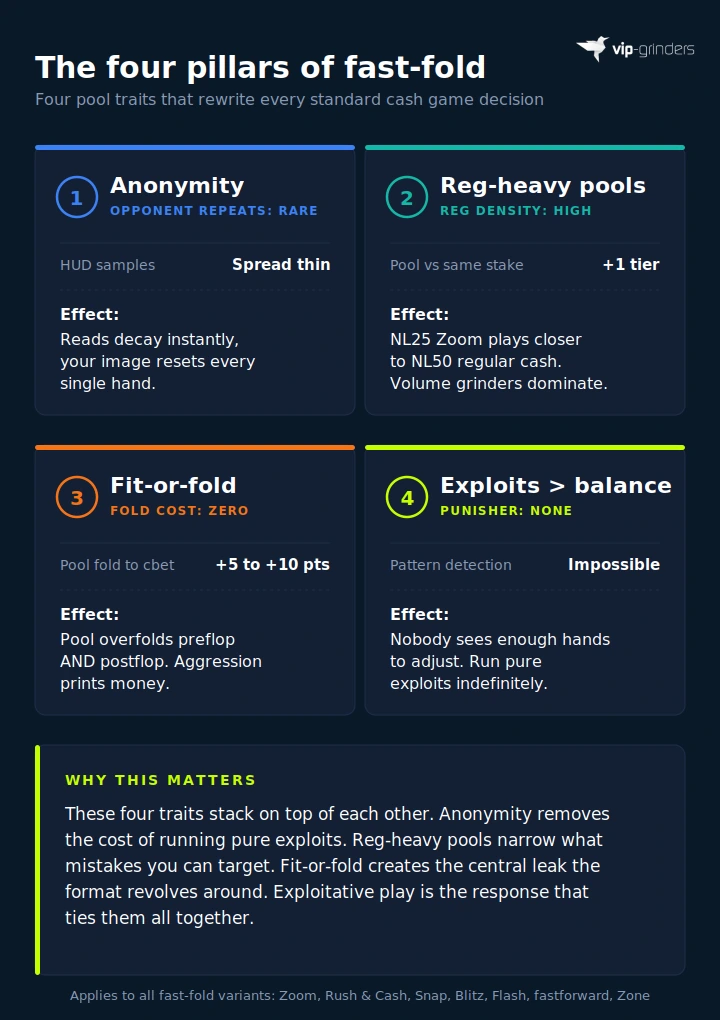
Four pool traits separate fast-fold from standard cash. Each one shows up later as a specific preflop or postflop adjustment.
The Anonymity Effect
You will not see the same opponent twice in a typical fast-fold session. By the time a player ends up at your table again, dozens of hands have passed and any read you had on them is stale. Every hand is effectively heads-up against a stranger.
This breaks the read-building cycle that drives regular cash games. HUD samples never accumulate on individual players because they are spread across the entire pool. Your notes stay mostly empty because there is no point tagging an opponent you will not see again all session.
Your own image also resets every hand. The 3-bet you made two hands ago is invisible to the new opponent on your left, so you can take the same exploitative line repeatedly without any individual player seeing the pattern.
Why Fast-Fold Pools Skew Reg-Heavy
Fast-fold attracts volume players first. Playing 3 to 4 times more hands per hour is irresistible to grinders who want more rakeback for the same number of hours at the desk. Most of the players you face in any fast-fold pool below NL100 are regulars running ABC strategies on multiple tables.
Recreational players are present, but in smaller proportions than at standard tables. The format is overwhelming for casual players who want to chat, watch the action, or take their time. Many recreational players try fast-fold once and leave, which keeps the reg-to-fish ratio stubbornly tilted toward regs.
The practical consequence is that a fast-fold table at a given stake plays tighter and more solid than a regular table at the same stake. NL25 Zoom feels closer to NL50 regular cash in terms of population skill, and the gap widens at higher stakes.
| Population Trait | Standard Cash Tables | Fast-Fold Pools |
|---|---|---|
| Reg density | Mixed, varies by table | Heavily skewed toward regs |
| VPIP (typical low stakes) | 22% to 28% | 18% to 22% |
| Fold to cbet (flop) | 50% to 55% | 58% to 65% |
| Average hands per orbit you face same opponent | 20 to 50 | 1 to 2 |
| Player image effect | Builds over the session | Resets every hand |
| Recreational player density | Higher at peak hours | Lower at all hours |
The Fit-or-Fold Mentality
Folding in regular cash costs you time. You sit out a few hands, watch the table, and wait for the next playable spot. In fast-fold, folding costs you nothing: the instant you click fold, you are dealt a new hand at a new seat with no penalty for waiting.
Fast-fold regulars know this and act accordingly. They fold more often, fold faster, and fold to smaller bet sizes than the same player would at a regular table. Average fold-to-cbet rates across the pool run 5 to 10 points higher in fast-fold than in equivalent stakes regular cash.
This is the single most exploitable trait of the format. A pool that overfolds rewards aggression, smaller sizings, and high-frequency stab bets. The preflop and postflop sections that follow are built around this one population leak.
Why Exploitative Beats Balanced in Fast-Fold
GTO strategy is designed to be unexploitable against opponents who study your patterns and adjust. Playing balanced only matters when someone is watching closely enough to punish you for being unbalanced. In fast-fold, nobody is watching closely because nobody sees enough of your hands to spot a pattern.
You can run pure exploitative lines indefinitely. If the pool overfolds to flop cbets, you can cbet 80% of your range forever and no individual opponent will ever build a sample large enough to start calling you down. Your exploit will not get punished because the punisher does not exist.
This does not mean GTO study is useless for fast-fold players. Solver work builds the foundation that lets you recognize population leaks and adjust off them. But the actual in-game strategy should lean hard into exploits, because the format permanently rewards them.
How Your Preflop Game Must Change in Fast-Fold
Standard cash game preflop ranges were built for tables where you have history with opponents, where 3-bet wars escalate over multiple orbits, and where implied odds compound across sessions. None of that survives in fast-fold. Your preflop strategy has to bend around three pool realities: anonymity removes implied odds, fit-or-fold rewards aggression, and reg-heavy pools punish loose calls.
This section covers the five preflop adjustments that matter most. They apply at every stake from NL10 to NL200 because they are format deltas, not stake-specific tweaks.
Tighter Early Position Ranges
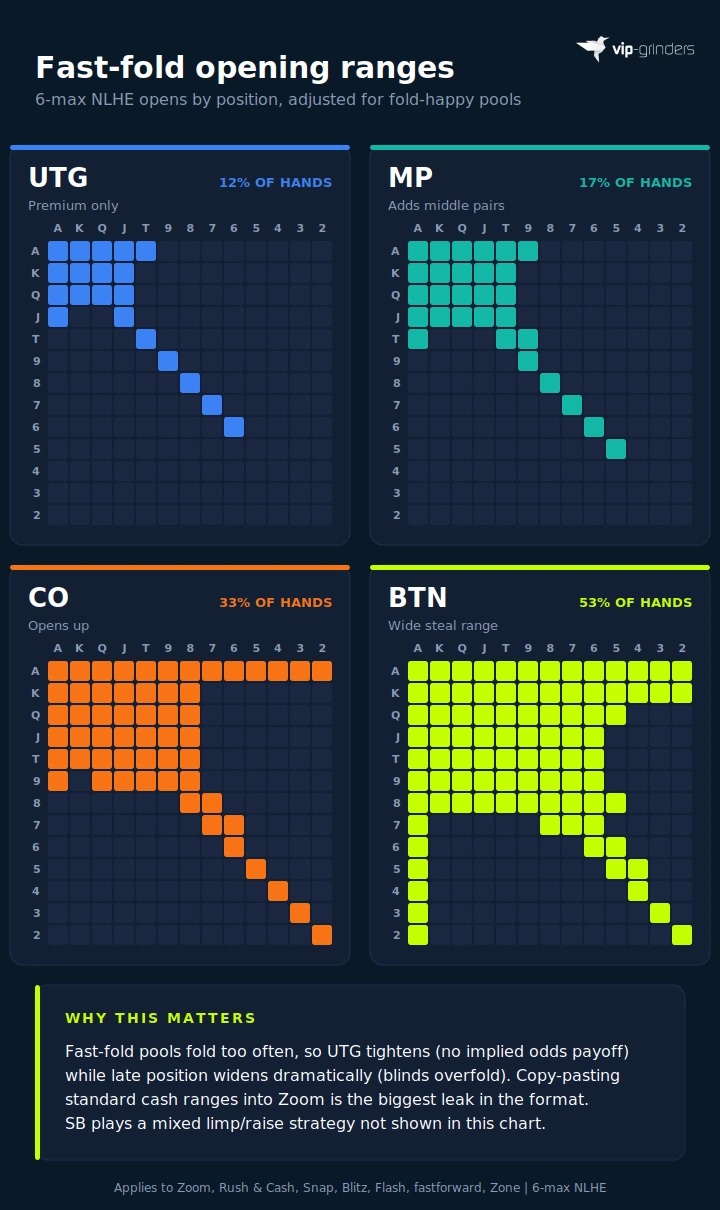
Standard cash games reward marginal early position opens because you can extract big pots from recreational players who pay you off across multiple streets. In fast-fold, those implied odds disappear. The recreational player who would pay you off at a regular table is more likely to be a reg multi-tabling four screens, and they will not stack off light against your UTG open.
Suited connectors and small pocket pairs lose value first. At regular tables, hands like 76s and 33 print money against opponents who chase draws and call down with second pair. In fast-fold, the same hands face tighter ranges, less postflop action, and no implied odds payoff when you flop a set or straight against a nit who folds top pair to your river bet.
The fix is to drop the bottom 10% to 15% of your standard early position opening range. Cut the speculative hands that need implied odds to break even. Keep the broadway hands, the bigger pairs, and the suited aces that retain equity even against tight calling ranges.
Specifically, cut these hands from your UTG and MP opens in 6-max fast-fold:
- Small suited connectors: 76s and below
- Suited gappers: 86s, 97s, T8s, J9s
- Smallest pocket pairs: 22 to 44 from UTG at 6-max
- Weak offsuit aces: A9o and below
Wider Late Position Steals
The cutoff, button, and small blind are the most profitable seats in any cash format, and fast-fold amplifies the edge. Pool-wide blind defense rates run lower in fast-fold than at regular tables because the same fit-or-fold mentality that overfolds postflop also overfolds preflop. The math on stealing improves, and stealing is already profitable.
You can open wider than standard 6-max ranges from the cutoff and button. Add the suited gappers, the offsuit aces, and the offsuit broadways that are marginal at regular tables. They become profitable opens in fast-fold because the blinds fold too often to make defending correct.
The small blind plays differently. With only the big blind left to act, you face a single defender who is usually a multi-tabling reg defending a tight, GTO-informed range. The right approach is to mix limps and small raises from the SB rather than folding most hands, leaning toward raises against tight defenders and limps against unknown opponents.
- Cutoff and Button: add suited connectors down to 65s, suited gappers, and small suited kings (K6s to K9s) to your opening range
- Button only: add offsuit aces (A2o to A8o) and offsuit broadways (KTo, QTo, JTo) when the blinds fold over 70% of the time
- Small Blind: mix limps and small raises against unknown defenders, leaning toward raises versus tight regulars and limps versus unknowns
Smaller Open Sizing: Why 2x to 2.5x Beats 3x
Standard cash game opens sit at 2.5x to 3x, with some players going as high as 4x at micro stakes against passive pools. Fast-fold flips that math. Because the pool overfolds preflop, smaller opens win the blinds at nearly the same rate as larger ones, while costing you less when you do get called or 3-bet.
A 2x or 2.25x open from late position picks up the blinds against a fast-fold pool roughly 60% to 65% of the time, depending on stake. A 3x open from the same position picks them up maybe 65% to 68%. The difference in fold equity is small, but the difference in cost compounds: a 2x that gets 3-bet costs 2bb, while a 3x that gets 3-bet costs 3bb across thousands of hands.
| Position | Standard Cash Open Size | Fast-Fold Open Size |
|---|---|---|
| UTG / MP | 2.5x to 3x | 2.25x to 2.5x |
| CO / BTN | 2.5x to 3x | 2x to 2.25x |
| SB | 3x to 3.5x | 2.5x to 3x |
The smaller sizing has a secondary benefit: it makes your overall preflop investment lighter, which protects your win rate when variance hits. At 200 to 300 hands per hour, every bb saved on routine opens compounds quickly across a session.
3-Betting Without a History
Standard cash 3-betting strategy is heavily polarized at higher stakes. You 3-bet your value hands and your bluff combos, balanced so that observant opponents cannot exploit your range. That balance is unnecessary in fast-fold because nobody is observing.
You can run a more linear 3-betting range from every position against unknown opponents. 3-bet your value hands and the strongest hands just below value (KQs, AJo, 99 to JJ) without worrying about polar bluffs. The pool will not adjust to your linear range because no individual opponent sees enough of it to identify a pattern.
3-bet sizing should also shrink. A standard 3-bet at regular tables is 9bb to 11bb in position and 11bb to 13bb out of position, and in fast-fold you can drop both ranges by 1bb. Smaller 3-bets fold out the same hands while costing less when called.
Big Blind Defense in Fast-Fold
The big blind is the worst seat in poker at any format, and fast-fold makes it slightly worse. Your defending range needs to tighten compared to standard cash because two factors stack against you: the late position openers in fast-fold are tighter than at regular tables, and your postflop edge against a multi-tabling reg out of position is smaller than at standard tables.
Drop the bottom 10% of your standard BB defending range against opens from the cutoff and button. The hands that lose first are the suited gappers, the small offsuit aces, and the weakest suited kings (K6s to K9s). They were marginal defends at regular tables and they are losing defends in fast-fold.
Against small blind opens, defend wider than you would at a regular table. SB ranges in fast-fold tend to be wider and less polarized, which means you face more weak hands and have a clearer postflop edge in heads-up pots. Defend any reasonable holding and prioritize 3-betting your strongest combos.
The five preflop adjustments above all serve one goal: take less risk on marginal holdings and apply more pressure on profitable spots. Tighten where the format punishes you (early position, big blind defense) and widen where it rewards you (late position steals, smaller opens). Every change is a delta from your standard cash game, not a replacement for it.
Postflop Adjustments for Fit-or-Fold Pools
The same overfolding tendency that shapes fast-fold preflop play becomes even more exploitable postflop. Pool-wide fold-to-cbet rates run 5 to 10 points higher than at regular tables, second barrels get respected more often, and rivers see fewer hero calls than in any other cash format. Your postflop strategy needs to print money on aggression and stay disciplined when the pool fights back.
Five postflop adjustments matter most. They build on the same exploitative-first principle from the preflop section: bet small when the pool overfolds, restrain yourself when they call.
Smaller, More Frequent Continuation Bets
The fold-to-cbet rate in fast-fold pools sits between 58% and 65%, compared to 50% to 55% at standard cash games. That gap is the largest single edge available in the format. A half-pot cbet needs only 33% folds to break even as a pure bluff, and you are collecting 60% folds across the entire pool.
You should cbet at high frequency on most flops, especially in heads-up pots. Range bets work in fast-fold because no opponent ever sees enough of your hands to identify the pattern. The pool just folds, and you collect.
Sizing should shrink alongside your preflop opens. A 25% to 40% pot cbet folds out the same range as a 50% to 66% pot cbet against fit-or-fold players who are looking for any reason to muck. The smaller sizing keeps the pot manageable when you do get called by a real hand.
| Postflop Tendency | Standard Cash | Fast-Fold Pools |
|---|---|---|
| Pool fold to flop cbet | 50% to 55% | 58% to 65% |
| Recommended cbet size | 50% to 66% pot | 25% to 40% pot |
| Cbet frequency in HU pots | 60% to 70% | 75% to 85% |
| Pool river bluff frequency | Moderate | Low |
| Thin value betting | Profitable at most stakes | Loses money against the pool |
The Second Barrel: When to Fire and When to Shut Down
The pool that overfolds the flop calls turns and rivers more selectively. When a fast-fold reg calls your cbet, they usually have something they intend to play with. Pure bluff barrels into a flop caller lose money against most fast-fold populations because the calling range is already filtered for real hands.
Fire your second barrel when you have equity to fall back on (draws, overcards, blockers) or when the turn card improves your perceived range more than theirs. Skip the second barrel when the turn changes nothing and your hand has no equity. Give up cleanly and reload your aggression for the next favorable spot.
A fast-fold reg who calls your flop and turn will not fold to a third barrel without a strong reason. River bluffs against unknown fast-fold opponents are rarely profitable. Save the bluffs for the flop and turn, and let your value hands carry rivers.
Tighter Call-Down Ranges Against Pool Aggression
Fast-fold pools bluff less than regular cash pools. The same fit-or-fold mentality that overfolds also under-bluffs, because most of the regs in the pool are running ABC strategies that prioritize value over deception. When an unknown fast-fold opponent fires multiple barrels for big sizings, the line is value far more often than at regular tables.
Tighten your call-downs accordingly. Hands that you would hero call with at NL50 regular cash become folds in NL50 Zoom against the same line. Save your bluff catches for spots where the bet sizing or line makes no sense as value.
The exception is small probe bets on rivers. Fast-fold pools occasionally fire small blocker-sized rivers with bluff catchers of their own, and those are easy spots to call lighter than usual. Read the sizing first, then decide.
Polarized Value Betting
Thin value bets are a staple of regular cash game strategy. They work because recreational players call too wide with marginal hands. Fast-fold pools do not call those bets at the same rate, so the thin value spots that print money in your standard NL50 game lose money in NL50 Zoom.
The fix is to polarize your value sizing. Bet bigger with your strong hands and check back the marginal ones that beat villain’s calling range but lose to their value range. The pool will pay off your nuts because regs hate folding strong showdown value, but they will not look up your top pair weak kicker for two streets.
- Bet for full value with: top pair good kicker or better in heads-up pots, overpairs on dry boards, sets, two pair, straights, and flushes
- Bet bigger on action boards: when you have a nutted hand on a wet board, use 75% pot or overbet sizings because the pool will not fold strong showdown value
- Check back instead with: top pair weak kicker, second pair on action-heavy boards, and marginal overpairs against multiway action
- Skip thin value bets: the pool folds marginal hands that would call at regular tables, which turns your thin value bets into unintentional bluffs
Why Fancy Plays Die in Fast-Fold
Slow-plays, multi-street float lines, and elaborate check-raise traps all rely on the same thing: the opponent paying close enough attention to misread your line. In fast-fold, no opponent is paying that kind of attention. Your check-raise looks identical to every other check-raise the multi-tabling reg has faced today, and they treat it the same way.
Stick to straightforward, exploitative lines. Bet when you should bet, check when you should check, and let the pool’s overfolds and under-bluffs do the work. The boring strategy is the winning strategy in fast-fold because the format does not reward creativity, it rewards repetition of the right basic decisions across thousands of hands.
Postflop in fast-fold comes down to a single discipline loop: print money with small, frequent cbets where the pool overfolds, restrain aggression when the pool calls, tighten your call-downs against pool sizing, and skip the fancy plays that need an audience to pay off. Every adjustment in this section flows from the same exploitative-first principle that drove the preflop section.
Why Volume Reshapes Your Strategic Equation
The 200 to 300 hands per hour figure is not just a marketing line. It changes how you think about every part of your game outside the actual hand-by-hand decisions. Volume compresses time, compounds variance, and amplifies decision fatigue, and each one of those forces shifts your strategic priorities away from creative play and toward repeatable execution.
This section covers the four ways high volume rewires the format. None of them are about specific hands. They are about how the rest of your poker setup has to bend around the volume reality.
More Decisions per Hour, Less Time per Decision
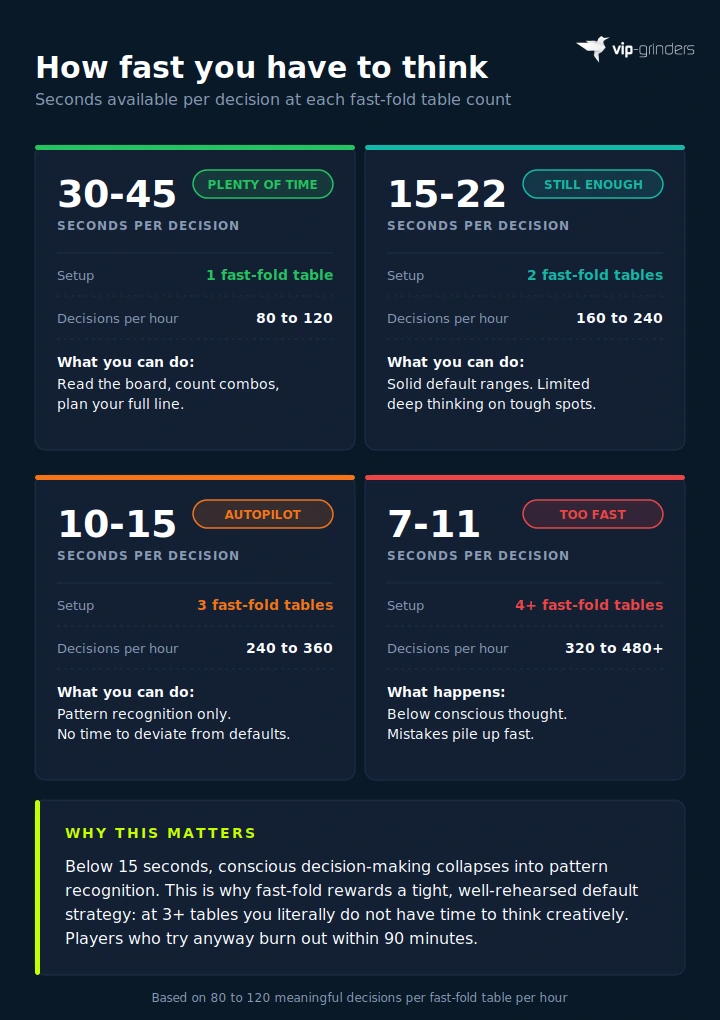
A standard 6-max cash table presents you with roughly 30 to 40 meaningful decisions per hour. A fast-fold table presents you with 80 to 120. You face 3 times the decisions in the same hour, and each one gets a fraction of the thinking time you would spend at a regular table.
The format does not reward deep, creative thought on individual hands. It rewards fast, accurate, repeatable decisions executed thousands of times per session. This is why fast-fold strategy leans so hard on simple frameworks (range bet small, fold to multi-street aggression, 3-bet linear) instead of nuanced situational thinking.
Your goal at the table should be to make 95% of your decisions on autopilot using a tight, well-rehearsed default strategy, and reserve your active thinking for the 5% of spots that genuinely deviate from the script. Players who try to think hard about every decision burn out within 90 minutes and start leaking money in the second half of every session.
Multi-Tabling Fast-Fold: Less Is More
Volume grinders moving from regular cash to fast-fold often try to keep their old table count. If you played 6 regular tables before, you try to play 6 fast-fold tables now, but that math does not work. One fast-fold table generates hands at the rate of 3 regular tables, so 6 fast-fold tables is the cognitive equivalent of running 18 regular tables simultaneously.
The sweet spot for most fast-fold players is 2 to 3 tables. At 3 tables you are already processing 600 to 900 hands per hour, which puts you near the upper limit of what a focused human can handle without quality erosion. Beyond 3 tables, your win rate per table drops faster than your total hands gained, and your total hourly profit goes down even though you are playing more hands.
| Setup | Hands per Hour | Cognitive Load (vs 1 regular table) |
|---|---|---|
| 1 regular table | 75 to 100 | 1x baseline |
| 4 regular tables | 300 to 400 | 4x |
| 1 fast-fold table | 200 to 300 | 3x |
| 2 fast-fold tables | 400 to 600 | 6x |
| 3 fast-fold tables | 600 to 900 | 9x |
| 4 fast-fold tables | 800 to 1,200 | 12x (most players leak here) |
The right number depends on your skill level, your screen setup, and your room’s software latency. Test by adding one table at a time over 5,000-hand samples and tracking your total win rate. Stop adding tables the moment your bb/100 drops by more than your hands gained.
Faster Variance Realization
Fast-fold variance is not larger than regular cash variance: the standard deviation per 100 hands is roughly the same. What changes is how fast you experience the swings. A 20-buy-in downswing that takes a regular grinder 4 to 6 weeks to play through arrives in 10 to 14 days at the same table count in fast-fold.
Your bankroll requirements do not change, so use the same buy-in counts you would use for standard cash. What does change is the mental impact: compressed downswings hit harder because you have less recovery time between losing sessions. For the standard rules and tables by format, see the bankroll management guide.
The practical implication is session structure. Plan shorter, more focused sessions in fast-fold than you would in regular cash, and build in mandatory breaks. Two 90-minute fast-fold sessions with a 20-minute break in between will produce a higher win rate than one 3-hour marathon, because the compressed variance and faster decision pace burn through your mental reserves faster than regular cash.
The Volume vs Win Rate Trade-Off
Volume only matters if your win rate survives the volume. A 3 bb/100 winner playing 800 hands per hour earns more per hour than a 6 bb/100 winner playing 200 hands per hour, but only if the 800-hands player can actually maintain that 3 bb/100 across the full session. Most players cannot.
The trap is assuming linear scaling. Players add fast-fold tables expecting their hourly rate to scale with hands played, but their per-table win rate collapses faster than their volume rises, leaving them with more rake paid, more stress, and the same or lower total hourly than they earned at fewer tables. For the full $/hour math and the formulas to calculate your own break-even table count, see the hourly rate framework.
The honest version of the volume question is: what is the maximum number of fast-fold tables you can play while maintaining at least 80% of your single-table win rate? Find that number through testing, not assumption. Then play exactly that many tables and resist the urge to add more.
HUDs and Notes in Fast-Fold (The Sample Size Problem)
HUDs and tracking software were designed for an environment where you face the same opponents repeatedly. At a standard 6-max table, you might face the same player 50 to 100 times across a session, which is enough sample for VPIP, PFR, fold-to-cbet, and 3-bet stats to become reliable individual reads. Fast-fold breaks this model entirely.
This section covers what changes when you cannot build samples on individuals, how to use HUDs differently, and which rooms even allow them.
The Sample Size Problem
In a fast-fold pool, the players you face on this hand are almost never the same players you faced on the previous hand. Across an hour of play at 250 hands per hour, you will encounter roughly 1,500 unique opponents in a typical pool. Your HUD’s sample is spread across all of them rather than concentrating on the 5 opponents at your table.
The math is brutal: at a regular table, after 200 hands you have 200 hands on each of 5 opponents. At a fast-fold table after the same 200 hands, you have a few hands each on 100+ different opponents, and most of them you will not see again before the session ends.
This means traditional HUD usage breaks down. Individual VPIP and PFR readings on most opponents are statistically meaningless because the sample is too small. The reg you are 3-betting on the button might show 24/19 over 8 hands, which is essentially noise.
| Metric | Regular 6-Max Cash | Fast-Fold Pools |
|---|---|---|
| Hands per opponent in 1-hour session | 50 to 100 | 1 to 5 |
| Time to build 50-hand sample on a single villain | 30 to 45 minutes | Practically impossible |
| Useful HUD reads per session | 5 to 10 individuals | 0 to 2 individuals |
| Pool-wide population stats | Less critical | The primary read source |
Population Reads Replace Player Reads
The shift you have to make is from reading individuals to reading the pool. Instead of tracking what player A does with top pair, you track what the entire NL25 Zoom pool does with top pair on average. Your HUD becomes a population analytics tool rather than an individual exploit tool.
Pool-wide reads are built differently. You accumulate them over thousands of hands and tens of thousands of pool encounters, then apply them as default assumptions for every unknown opponent you face. Once you know that the NL25 Zoom pool folds to flop cbets 62% of the time on average, you treat every unknown opponent as a 62% folder until proven otherwise.
This is why fast-fold strategy is built around population leaks and exploitative defaults rather than situational reads. The default exists because you do not have time to read the individual.
Note-Taking When You Cannot Build History
Standard note-taking advice (color-tag fish, write specific player tendencies, build history over multiple sessions) loses most of its value in fast-fold. By the time you have built a meaningful note on an individual opponent, the session is over and they are gone from your immediate pool.
The notes that survive the format are short, instantly actionable tags that tell you something binary about a player you might run into again. Skip the long descriptive notes and use a simple tagging system that lets you process information in under 2 seconds when an opponent shows up again.
- Tag fish immediately: any opponent who shows obviously bad play (limp-calling, open-limping, calling 3-bets with weak hands) gets a color tag you can spot instantly on future encounters
- Skip notes on unknown regs: do not waste time writing long notes on unknown regulars you will see once more before the session ends
- Track line tells, not player histories: note unusual sizings or lines (donk bets, overbet rivers, small probe bets) that a specific player uses, since those stick across encounters
- Color code by type, not by individual: red for fish, yellow for unknown, green for tight regs. Process the color without opening the note
The goal of fast-fold note-taking is not to build a database. It is to flag the small number of players who will repeatedly affect your decisions and ignore everyone else.
Room HUD Policies and Why They Matter More in Fast-Fold
HUD policies vary widely across rooms. PokerStars allows basic HUDs with restrictions on real-time data sharing, while 888poker and WPN/ACR Poker allow full third-party HUDs. GGPoker, partypoker, WPT Global, and KKPoker ban third-party HUDs entirely, providing only their own built-in stat tools that show session-only data.
In regular cash, HUD bans are inconvenient but workable. You build reads through observation and notes over a long session at the same table. In fast-fold, the no-HUD environment compounds the sample size problem because you cannot fall back on observation when you are barely seeing the same opponent twice.
| Room | Third-Party HUDs | Built-In Stat Tool |
|---|---|---|
| PokerStars Zoom | Allowed with restrictions | None |
| GGPoker Rush & Cash | Banned | Smart HUD (session-only) |
| 888poker Snap | Allowed | HUDdy (session-only) |
| partypoker fastforward | Banned | None |
| WPN / ACR Blitz | Allowed (full) | None |
| WPT Global Flash | Banned | None |
| Ignition / Bovada Zone | Allowed but anonymous tables limit usefulness | None |
The format-level lesson is that HUD policy matters more in fast-fold than at any other format. If you rely heavily on HUD-driven decisions, choose a room that allows them. If you play mostly on no-HUD rooms, lean harder on the population-read approach in this guide.
Standard table selection (picking which table to sit at based on lobby stats) does not apply in fast-fold because you get auto-seated into the pool. For the regular-tables version of game selection and lobby scanning, see the table selection guide.
Common Fast-Fold Mistakes
The leaks that hurt fast-fold players are not the same leaks that hurt regular cash players. Fast-fold has its own catalog of mistakes driven by the volume, the anonymity, and the temptation to apply standard cash habits to a format that punishes them. The six mistakes below cost more bb/100 than any technical postflop error, and every one of them is fixable inside a single session once you spot it.
The list is ordered by impact. Fix the top leaks first.
- Playing the same ranges as regular tables: the single biggest leak in fast-fold. Players who copy-paste their NL50 regular cash opening ranges into NL50 Zoom get punished on the speculative hands that need implied odds to break even. Tighten EP, widen LP, and shrink your open sizes as covered in the preflop section.
- Over-bluffing rivers in a fold-happy pool: fast-fold pools under-bluff rivers, which means when a fast-fold opponent fires three barrels they usually have it. Players who transfer their regular-cash bluff frequencies to fast-fold bleed chips into value ranges that never fold.
- Adding too many tables: more tables feels like more volume, but past 3 fast-fold tables your per-table win rate collapses faster than your hands gained. Most players earn more total hourly at 2 to 3 fast-fold tables than at 4 to 6.
- Autopilot and decision fatigue: at 800 to 1,200 decisions per hour, mental energy depletes fast. The last 30 minutes of a long fast-fold session are statistically the worst for most players, because by that point every decision is being made on fumes. Stop when focus drops, not when the clock says you should.
- Ignoring rakeback when comparing rooms: fast-fold generates 3 to 4 times more rake per hour than regular cash at the same stake, which means rakeback has 3 to 4 times the impact on your bottom line. Choosing a room without factoring rakeback is the most expensive mistake a volume grinder can make. See the rakeback strategy guide for how your deal should shape your format and room choices.
- Treating micro stakes as practice money: the fast pace of fast-fold at NL2 or NL5 can make each individual pot feel unimportant, which leads players to call down wider, bluff more often, and splash chips they would never splash at regular tables. Every bb still counts, especially at the rake-heavy micro stakes where the difference between a winner and a loser is 2 to 3 bb/100.
Fix your biggest leak first. If you are not sure which one costs you the most, review your last 10,000 hands of fast-fold play and filter for losing spots by position and bet sizing. The pattern usually reveals itself within 30 minutes of database review, and the fix is almost always one of the six items above.
Frequently Asked Questions
What is fast-fold poker?
Fast-fold poker is a cash game format where folding your hand instantly moves you to a new table with new opponents. Instead of waiting for the current hand to end, you are dealt back in immediately at a different seat in a fresh lineup. The format runs on a shared player pool, and the most popular variants are Zoom (PokerStars), Rush & Cash (GGPoker), and Snap (888poker).
Is fast-fold poker profitable?
Yes, but the math is different from regular cash. Fast-fold pools are tighter and more reg-heavy than standard tables, so per-hand win rates run lower (typically 2 to 4 bb/100 for solid winners versus 4 to 6 bb/100 at regular tables). The format makes up for the lower win rate with 3 to 4 times the volume per hour, which means a lower bb/100 winner can still earn more per hour in fast-fold than at regular cash, provided their win rate survives the pace.
How many hands per hour can you play in fast-fold?
A single fast-fold table deals 200 to 300 hands per hour, compared to 75 to 100 at a regular 6-max table. Two fast-fold tables push you to 400 to 600 hands per hour, and three tables can hit 600 to 900. Most players cannot maintain quality decisions beyond 3 fast-fold tables simultaneously.
What's the difference between Zoom, Rush & Cash, and Snap?
The mechanics are nearly identical across all three. Zoom is PokerStars’ version and has the largest player pool. Rush & Cash is GGPoker’s version and includes random Cash Drop bonuses in pots, plus a no-HUD environment. Snap is 888poker’s version, with smaller pools and full HUD support. The in-hand strategy in this guide applies to all three.
Can you use a HUD in fast-fold poker?
It depends on the room. PokerStars allows basic HUDs with restrictions, 888poker and WPN/ACR allow full third-party HUDs, while GGPoker, partypoker, WPT Global, and KKPoker ban third-party HUDs entirely. Even on rooms that allow HUDs, individual player samples build up much slower in fast-fold because you face new opponents on nearly every hand, so HUDs work better as population analytics tools than as individual exploit tools in this format.
How many tables should I play in fast-fold?
Most players maximize their hourly rate at 2 to 3 fast-fold tables. One fast-fold table generates hands at the rate of 3 regular tables, so 3 fast-fold tables already match the cognitive load of 9 regular tables. Beyond 3 tables, your per-table win rate drops faster than your hands gained, and your total hourly profit usually declines even though you are playing more hands.
Is fast-fold poker harder than regular cash games?
At the same nominal stake, yes. A fast-fold pool at NL25 plays closer to a regular NL50 cash table in terms of population skill, because the format attracts volume-focused regulars and filters out casual players. The format is also harder mentally because of the higher decision rate and faster variance realization. Most players should expect to drop down one stake tier when transitioning from regular cash to fast-fold.
How much bankroll do I need for fast-fold poker?
Use the same buy-in counts you would use for regular cash games (typically 30 buy-ins for the stake you are playing). Fast-fold variance is the same size as regular cash variance per 100 hands, but it arrives faster: a 20 buy-in downswing that takes 4 to 6 weeks at regular tables can hit in 10 to 14 days at the same table count in fast-fold. Plan shorter sessions to manage the compressed mental impact.
Why are fast-fold pools so tight?
Fast-fold attracts volume-focused grinders first because the 3 to 4 times hands-per-hour multiplier maximizes rake generation and rakeback. Recreational players find the pace overwhelming and tend to leave after a few sessions. The result is a player pool dominated by regulars running tight ABC strategies, with fold-to-cbet rates that run 5 to 10 percentage points higher than at equivalent regular cash tables.
Does rakeback matter more in fast-fold?
Yes. Fast-fold generates 3 to 4 times more rake per hour than regular cash at the same stake, which means rakeback has 3 to 4 times the impact on your bottom line. A grinder with a 30% rakeback deal in fast-fold earns the rakeback equivalent of a 90% to 120% deal at the same stake in regular cash. Choosing a fast-fold room without factoring in rakeback is the most expensive mistake a volume grinder can make.