


How to Play Texas Holdem for Beginners
Texas Hold’em is the world’s most popular form of poker, and for good reason. The rules are simple to learn, but the strategy takes a lifetime to master.
If you’re a beginner, your goal isn’t to outplay the pros on day one — it’s to build a strong foundation that will let you grow into a solid, confident player.
In this guide, I’ll share the essential strategies you need to get started, along with a few lessons I learned the hard way when I started playing poker more than 20 years ago.
Texas Holdem for Beginners: 3 Basics of Winning
The simplest way to think about poker strategy as a beginner is this:
- Play fewer hands than you think you should.
- Play those hands aggressively.
- Use position to your advantage.
That’s the tight-aggressive (TAG) style. It’s not flashy, but it’s the most reliable way to learn and win as a new player. It is easy getting wrapped up advanced concepts and overthink hands, but sticking to this simple formula is the first step to success in poker.

Texas Holdem for Beginners: Preflop Fundamentals
Starting Hand Selection
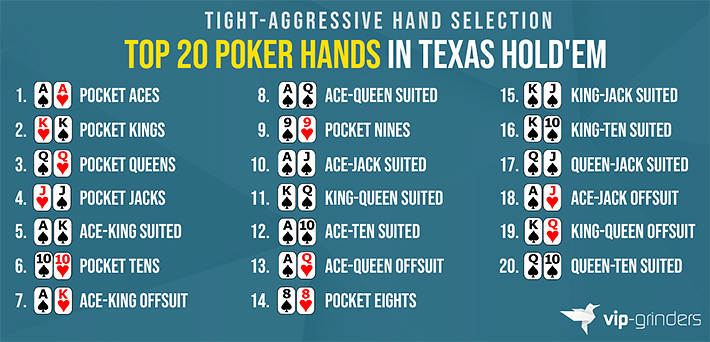
Not all poker hands are created equal. Pocket aces (AA) are a monster; seven-two offsuit is trash. As a beginner, stick to the strongest 15–20% of hands (as detailed in the hand chart below).
- Premium hands (AA, KK, QQ, AK): Raise or re-raise from any position.
- Strong hands (JJ, TT, AQ, AJ, KQ): Play these, but more carefully in early position.
- Suited connectors (98s, T9s): Play sometimes from late position when the price is right.
- Weak hands: Fold and wait for better spots.
When I first started, I used to call with hands like K-9 suited just because it had a picture card and was suited (i.e it looked pretty.) I can’t tell you how many chips I lost that way. Once I disciplined myself to fold those hands, my results improved immediately.

Position is Power in Holdem Poker
Position is not simply where you sit relative to the dealer button. Acting later in the betting round gives you more information and lets you control the pot.
- 1Early position (first to act): Play only premium hands.
- 2Middle position: Add some strong but non-premium hands.
- 3Late position (button, cutoff): You can widen your range — even steal blinds with raises.
Preflop Betting
When you decide to play a hand, raise. Don’t just call. A standard open raise is about 2–3x the big blind. This builds the pot and makes opponents with weaker hands pay to see the flop.
Postflop Fundamentals
Flop Play
- Top pair or better: Bet to protect your hand.
- Strong draws (flush and/or open-ended straight): Consider betting or raising (semi-bluffing).
- Weak pairs or backdoor draws: Usually fold.
One of the first times I was aware of making a big mistake, was when in a 50/1 cash games, I checked my set of eights on a dry flop, trying to “trap.” My opponent checked back, then caught a straight on the turn and stacked me. Lesson: bet your strong hands — don’t get too fancy as a beginner.
Turn and River Play
On later streets, bet strongly when you’re ahead and fold when you’re behind. Don’t call just because “you’ve already put chips in.” Beginners often lose the most money by chasing on the turn and river.
Texas Holdem for Beginners 101: Bankroll Management
If there was one piece of poker advice I wish someone had told me in the beginning, it would have been about bankroll management. You could be a supernaturally good poker player (Stuey Unger, for example), but without a fundamental bankroll management plan, it is certain you will go broke.
Here are some basics to keep you in the game:
- Play premium hands aggressively — raise and re-raise, don’t limp. Avoid calling too often with marginal hands.
- Focus on extracting value post-flop.
Cash Games vs. Tournaments vs. Sit & Gos
When starting to play a combination of cash games and tournaments, you will have to adjust your game. Here are some things to keep in mind for adapting to both formats.
Cash Games
Cash games are the most stable format because the blinds never change and you can rebuy at any time. They reward patience and consistency, making them perfect for practicing solid fundamentals.
The goal is to play strong hands for maximum value and avoid tricky situations with weak holdings.
Top Tips for Cash Games:
- Play tight in the early levels and avoid unnecessary risks.
- Apply pressure near the bubble when others tighten up.
- Shift gears in the later stages — steal blinds and attack short stacks.
Texas Holdem for Beginners Tournaments (MTTs)
Tournaments start everyone with the same chips, but the blinds increase over time, forcing players to adapt. Early on, survival matters most, but as stacks shrink, aggression becomes essential to keep up. They’re exciting but high variance, since only a fraction of players make the money.
Top Tips for Tournaments:
- 1Understand the core concept of GTO and why it provides an unexploitable baseline strategy.
- 2Learn to balance your ranges and bluff frequencies to avoid predictability.
- 3Apply exploitative adjustments by reading opponents’ tendencies and adapting your strategy to maximize value.
Sit & Gos (SNGs)
Sit & Gos are small tournaments that begin as soon as all seats are filled, usually with 6–10 players. They teach survival, short-stack play, and payout awareness in a compact format.
Because only the top spots are paid, strategy changes dramatically between the early game and the money stages.
My Final Thoughts on Texas Holdem for Beginners:
No Limit Texas Hold’em is ironically one of the most tricky forms of poker, but it is the variant most players start off playing.
I was lucky to have began by playing Limit cash games online, which helped give me an understanding on hand range and board textures, without the risk of going broke on every hand.
Fewer online poker sites offer Limit Hold’em games as an option now, but I recommend starting with Limit, or Baby Stakes NL games. It is also worth learning by playing small stake SnG tournaments.
Protect your bankroll, stay patient, and remember that poker is a game of long-term decisions. If you make consistently good choices, the results will come with time.
Most importantly: enjoy the game. Every hand, win or lose, is a chance to learn and grow as a player. Nos w, when you’ve mastered these fundamentals, read our Advanced Texas Hold’em strategy guide.
My 6 Texas Holdem for Beginners Takeaways
- 1Play tight-aggressive (TAG): fewer hands, played strongly.
- 2Respect position: the later you act, the more hands you can profitably play.
- 3Raise, don’t limp: give yourself a chance to win pots outright and build pressure.
- 4Value bet strong hands: don’t get fancy — make opponents pay to draw.
- 5Discipline: fold weak hands and don’t chase losses.
- 6Formats differ: cash, tournaments, and Sit & Gos all require strategic adjustments.


The Most Expensive Mistakes in Poker

What Is the Mental Game of Poker?

What is Rakeback in Gambling?

Understanding Variance in Poker
Beginner's Texas Hold'em FAQs
How do I know which hands to play as a beginner?
Stick to the top 15–20% of starting hands (AA–TT, AK, AQ, AJ, KQ, and suited connectors like 98s in late position). If in doubt, fold — especially in early position.
Why is position so important in poker?
The later you act, the more information you have about what your opponents did. This lets you make better decisions, control pot size, and bluff more effectively.
Should I ever limp (just call the big blind) preflop?
As a beginner, no. Limping puts you at a disadvantage because you give opponents cheap flops. Raising is almost always the better play.
What’s the biggest mistake beginners make?
Playing too many hands and calling too often with weak ones. Discipline and patience separate winning players from losing ones.
How much should I raise preflop?
A standard open raise is 2–3 times the big blind. This amount pressures weaker hands without risking too many chips.
How do I avoid going broke quickly?
Bankroll management is key. For cash games, keep at least 30–50 buy-ins. For tournaments, 100 buy-ins. Never play with money you can’t afford to lose.
Should I bluff as a beginner?
Bluffing is part of poker, but beginners often overdo it. Focus on betting when you have strong hands first — you’ll naturally spot better bluffing opportunities as your game develops.
What’s better for beginners — cash games or tournaments?
Cash games are generally better for learning fundamentals since blinds don’t increase and you can rebuy. Tournaments are fun but more volatile.
How do I know when to stop playing?
Set a time limit or stop-loss before you sit down. If you’re tired, tilted, or chasing losses, take a break. Good poker comes from clear decisions, not emotions.