

Poker Etiquette: The Unwritten Rules Every Player Must Know in 2026
Poker has two sets of rules. The first set is printed in every rulebook: hand rankings, betting order, how the winner is decided. The second set is not written down anywhere, but break these and you will hear about it from every player at the table.
This guide covers both: the violations that carry real penalties and the unwritten rules that determine whether the table wants you back. Here is what it includes:
- Which violations carry penalties from dealers and floor staff
- Angle shooting and slowrolling: gray area moves that destroy your reputation
- Social norms that keep you welcome at the table
- Format-specific etiquette for live, online, tournament, and home games
- When to call the clock and when to let it go
If you need a refresher on how a hand plays out, our Texas Hold’em rules guide walks through the full game from blinds to showdown. The Do/Don’t table below gives you the quick version of everything in this guide.
The Short Version: Do vs Don’t
The sections below explain every rule in detail. If you just want a quick list to check before your first session, here it is.
| Do | Don’t |
|---|---|
| Wait for your turn before acting | Fold, bet, or raise before the action reaches you |
| Say “raise” out loud before moving chips | Push chips forward in multiple silent motions (string bet) |
| Place bets in a neat stack in front of you | Toss chips into the middle of the pot (splashing) |
| Keep large chips visible at the front of your stack | Hide big chips behind small ones |
| Show your winning hand promptly at showdown | Deliberately delay revealing the winner (slowrolling) |
| Lose gracefully and move on | Berate opponents or dealers after a bad beat |
| Fold obvious trash hands quickly | Stall for 30 seconds on every routine decision |
| Protect your cards with a chip or card guard | Leave cards hanging off the edge where the dealer can accidentally discard them |
| Tip $1 to $2 per won pot in live US games | Play an entire session without tipping once |
| Keep strategy talk out of active hands | Comment on a hand in progress or coach a friend mid-hand |
Every point in this table is explained in detail below, starting with the violations that carry actual penalties.
Rules That Will Get You Penalized
These are not suggestions. Break any of the rules below and a dealer or floor manager can issue a verbal warning, force you to sit out a hand, or remove you from the table entirely. The Tournament Directors Association (TDA) lists most of these in their official rulebook, and virtually every major poker room and online platform enforces them.
Acting Out of Turn
Acting out of turn means folding, betting, calling, or raising before it is your turn to act. This is the most common penalty-level mistake new players make, and it happens because they are not paying attention to who the action is on.
The problem is not just procedural. When you act early, you give free information to every player who was supposed to act before you. If you fold out of turn, the remaining players now know there is one fewer opponent to worry about, which changes their decisions and damages the fairness of the hand.
Under TDA Rule 38, an out-of-turn action may be ruled binding if the action has not changed by the time it reaches you. If you announce “raise” before your turn and nobody else does anything different, the floor can hold you to that raise.
The fix is simple: watch the dealer’s hand or the action indicator on screen. Wait until the player to your right finishes before you touch your cards or chips. For a deeper look at why acting order matters strategically, see our guide to positional play.
String Bets
A string bet is a bet or raise made in multiple motions without a verbal announcement first. The classic version: a player silently pushes out chips to call, pauses, watches their opponent’s reaction, then pushes out more chips to “raise.” Only the first motion counts, and the rest is void.
The rule exists to prevent players from reading reactions mid-bet. If you want to raise, say “raise” before your chips move. Once you have announced verbally, you can take as long as you need to count out the amount, and that declaration is what protects you.
Two rules cover most penalties in this section: announce your action out loud before moving chips, and wait for your turn before touching anything.
Splashing the Pot
Splashing the pot means throwing your chips directly into the pile of chips in the center rather than placing them in a neat stack in front of you. When chips are tossed into the pot, the dealer cannot verify whether the correct amount was bet. The hand stops, someone has to count the pot, and the entire table waits.
Place your chips in a clear stack between you and the pot. The dealer will pull them in once the action is confirmed.
Hiding Your Chips
Every player at the table has the right to know how many chips you have. Hiding large denomination chips behind smaller stacks, or keeping chips in your pocket (“going south”), is a rule violation at every regulated poker room.
The standard practice is to keep your largest chips at the front of your stack where they are visible to everyone. If an opponent asks how much you are playing, you (or the dealer) must give an accurate count. Online software handles this automatically by displaying stack sizes next to every player’s seat.
Exposing Cards During a Hand
Showing your hole cards (your two face-down cards) to another player while a hand is still active violates the one-player-to-a-hand rule (TDA Rule 67). Even showing a single card to your neighbor can result in your hand being declared dead, because it gives that player information nobody else has.
There is one exception: some rooms allow you to show your cards after folding, but only face-up so the entire table can see them equally. Even where this is permitted, doing it when three or more players are still in the hand is poor form because it reveals information that can affect the remaining players’ decisions.
Soft Play, Chip Dumping, and Collusion
These are the most serious violations in poker and they carry the harshest penalties.
- Soft play: deliberately going easy on a friend or partner at the table. Refusing to bet a strong hand because you know the other player personally is soft play.
- Chip dumping: intentionally losing chips to a specific player. This is a form of cheating used to transfer funds between accounts or to give a partner a stack advantage in a tournament.
- Collusion: two or more players sharing information about their hands or coordinating their actions to gain an unfair advantage over the rest of the table.
Online rooms enforce these aggressively. GGPoker’s House Rules outline a four-step enforcement chain for chip dumping: warning, suspension, permanent ban, and full confiscation of funds.
At the 2025 World Series of Poker, the WSOP withheld the bracelet from the Millionaire Maker after an investigation into alleged chip dumping during heads-up play between Jesse Yaginuma and James Carroll. No winner was recognized, the first and second place prize money was split evenly between both players, and no bracelet was awarded.
These rules apply at every level of poker, from home games to the World Series. Acting out of turn and string bets are the two violations from this section that also show up as common strategic mistakes because they cost you money even when no penalty is issued.
Everything above is black and white: break those rules and a dealer steps in. Everything below is gray: technically legal, but the table will remember.
Moves That Cross the Line (Angle Shooting)
The rules in the previous section are black and white. Break them and a dealer or floor manager steps in. The behaviors below sit in a different category: they are not against any written rule, but every serious player at the table will notice.
In poker, these are called “angle shoots”: moves that technically stay within the rules but trick opponents through manipulation rather than skill. You will not get thrown out for doing them. But you will get a reputation that follows you for years.
Why These Moves Are Different from Bluffing
An angle shoot is any action that exploits a technicality or ambiguity in the rules to gain an unfair advantage without technically breaking them. It is not cheating in the legal sense and not against any written rule in most rooms. But it is intentionally deceptive in a way that goes beyond normal poker strategy.
The difference between an angle shoot and a well-timed bluff is intent. A bluff says “I might have a strong hand.” An angle shoot says “I am going to manipulate the rules or my physical actions to trick you into making a mistake you would not have made otherwise.”
Angle shooters are remembered. Dealers, regulars, and floor staff all treat them differently from that point forward. The short-term gain from a single angle is never worth the long-term cost to your reputation and your ability to find good games.
Slowrolling: Why It Is the Worst Thing You Can Do at a Table
A slowroll happens when a player holds the winning hand (or a near-certain winner) at showdown and deliberately delays revealing it. The opponent is left believing they won the pot for several seconds before discovering they lost. There is no strategic benefit: it exists purely to humiliate the other player.
Slowrolling is not against any formal rule in most poker rooms. TDA Rule 70 allows floors to penalize “persistent delay of the game” and “abusive conduct,” which some tournament directors interpret to include repeated slowrolling. But in practice, the punishment is social: the entire table turns against you.
There is an important distinction between a slowroll and what players call “Hollywooding.”
| Slowroll | Hollywooding |
|---|---|
| Happens at showdown, after all betting is complete | Happens during the betting rounds, while action is still live |
| You already know you have the winner | You are acting weak to induce a bet or call from your opponent |
| Zero strategic purpose, purely disrespectful | Standard deception and part of normal poker strategy |
| Universally condemned | Universally accepted |
Hollywooding is acting; slowrolling is cruelty. One is part of the game, and the other has no place in it. VIP-Grinders covered one of the most infamous examples in poker history in our editorial on the slowroll of the century.
The Most Common Moves That Cross the Line
These gray area moves come in many forms, but the same handful show up at tables over and over. Knowing what they look like protects you from falling for them and ensures you never accidentally do one yourself.
- The fake fold: moving your cards toward the muck (the discard pile) to see if an opponent reacts, then pulling them back and staying in the hand.
- Ambiguous chip motions: moving chips toward the pot as if betting, then claiming you were just organizing your stack.
- Hiding big chips: placing large denomination chips behind small ones so opponents underestimate your stack before committing chips.
- Going south: secretly removing chips from the table and pocketing them to reduce your visible stack. Also called ratholing.
- Misleading verbal statements: saying something like "I have nothing" while holding the nuts (the best possible hand), hoping the opponent interprets it as a truthful admission and calls.
- Pump-fake bets: reaching for chips aggressively when it is not your turn to act, hoping to influence the player currently deciding.
- "I didn't look at my cards": claiming you have not seen your hole cards to appear reckless and induce a call, when you actually looked and hold a strong hand.
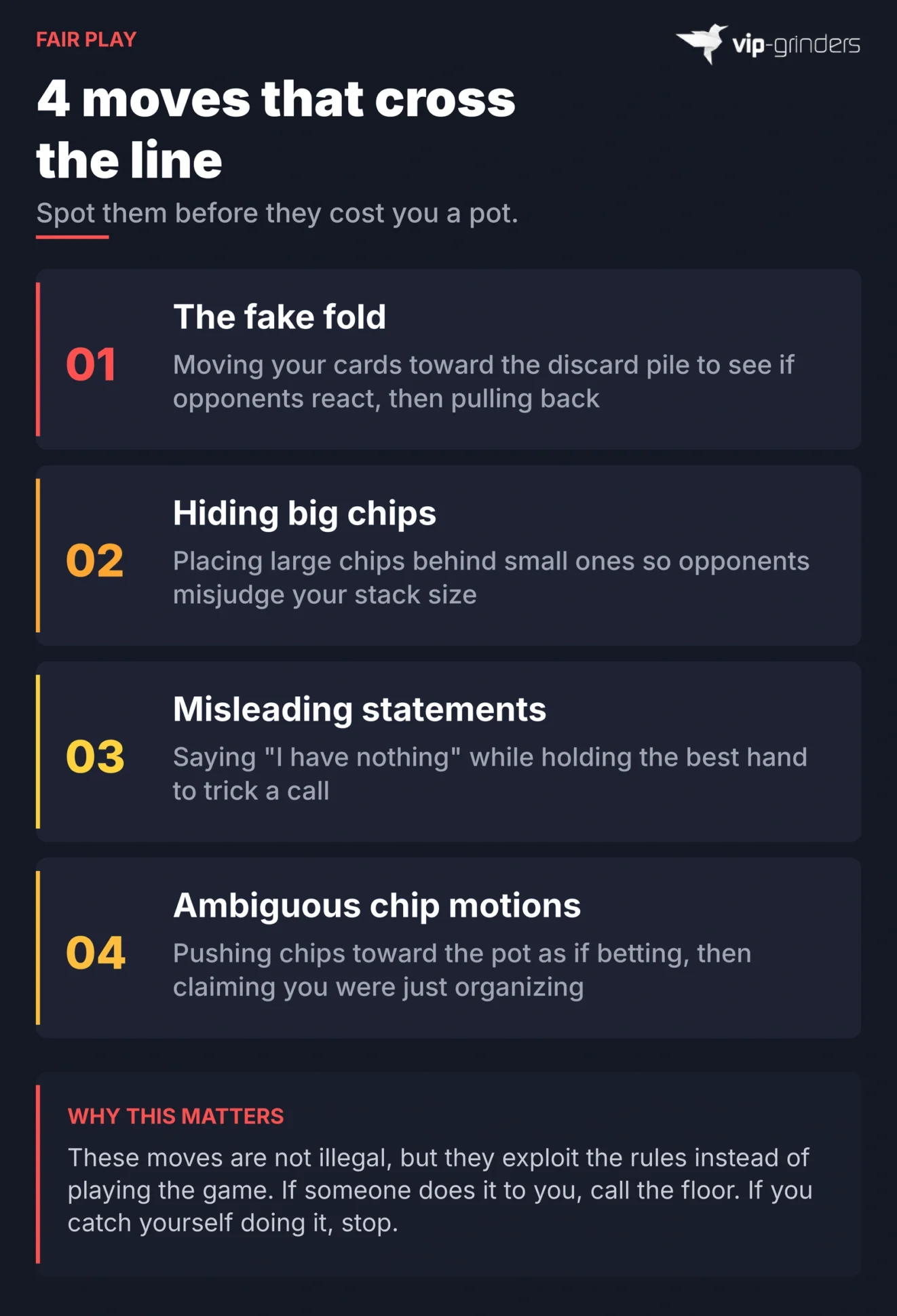
Some of these are also formal rule violations depending on the room. Hiding big chips, for example, crosses from gray area into penalty territory at most regulated card rooms. When in doubt, ask yourself: “Am I trying to win through better poker, or through tricking someone into a procedural mistake?” and if the answer is the second, do not do it.
Social Norms That Keep You Welcome at the Table
Nothing in this section will get you penalized by a dealer or banned from a room. But ignore these norms consistently and you will notice something: the good games dry up, regulars avoid your table, and recreational players stop coming back. Poker is a social game, and the players who understand that tend to find softer, more profitable tables.
Don’t Berate Opponents or Dealers
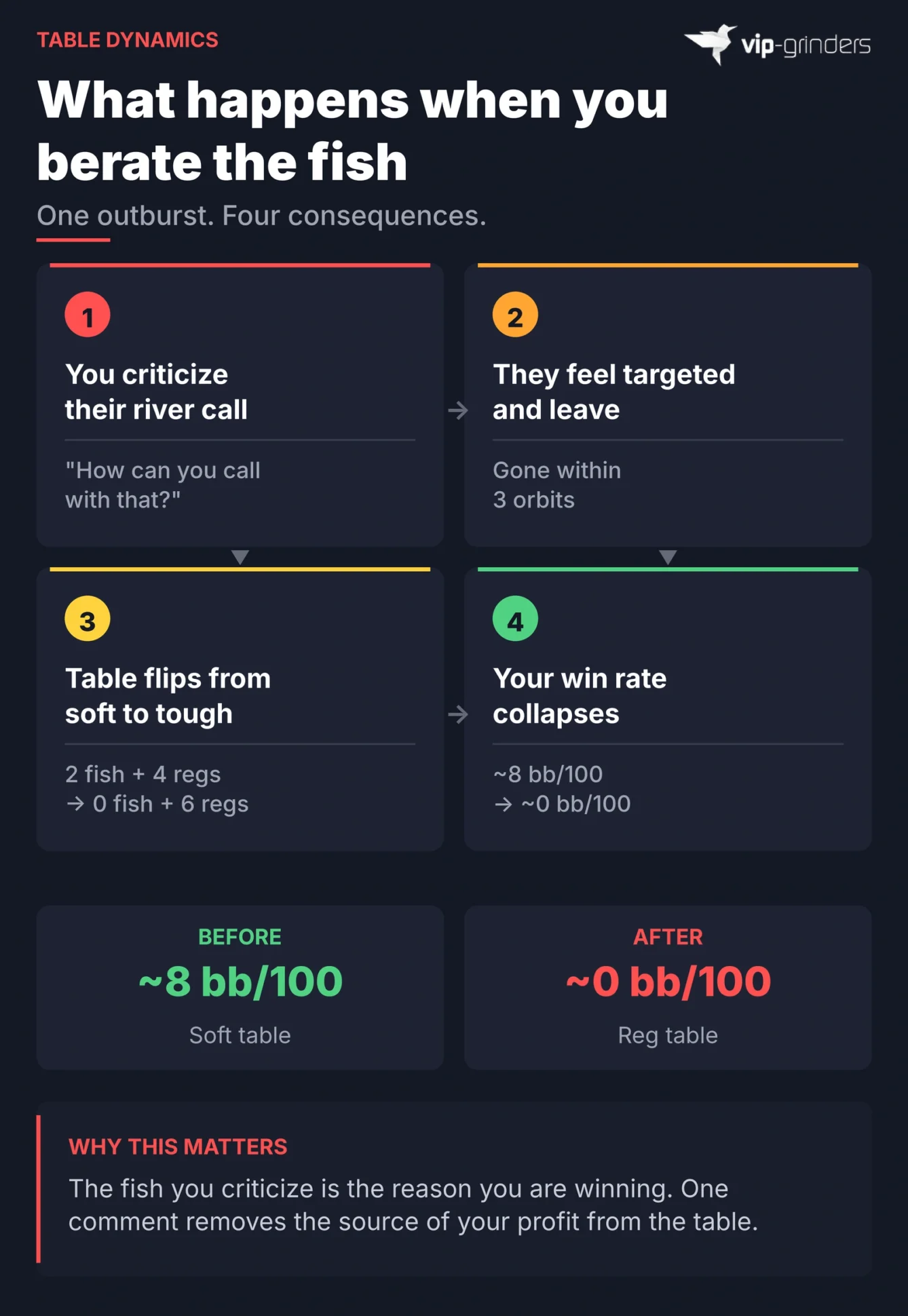
A recreational player calls your all-in with bottom pair, catches a lucky card on the river, and scoops a massive pot. Your instinct is to tell them how bad the call was. Do not do it.
Criticizing a weaker player’s decisions is the single fastest way to kill a profitable game. That player was putting money in with the worst hand, which is exactly what you want them to do.
If you berate them for it, they either tighten up, leave the table, or stop playing poker entirely. All three outcomes cost you money.
The same applies to dealers. They do not control the cards. Blaming the dealer for a bad beat is like blaming the weather forecast for rain.
Our mental game guide covers how to keep your composure after losses. Our guide on spotting and playing against fish explains why keeping recreational players comfortable is one of the most profitable things you can do at a table.
Don’t Tank Trivial Decisions
Taking 60 seconds to decide whether to fold the worst hand in poker is not thoughtful poker. It is wasting everyone’s time. Save your longer decisions for spots that actually require thought: tough calls on the final card, big raise decisions, or tournament spots where real money is on the line.
A good rule of thumb for live games: if you know you are folding, fold within 5 seconds. If you are genuinely unsure, take your time. The table can tell the difference.
Don’t Hit and Run
A hit and run means winning a large pot and immediately leaving the table. There is no rule against it, and you are free to leave any cash game at any time. But doing it repeatedly, especially right after doubling up, is considered poor form because it denies the table a fair chance to win those chips back.
If you need to leave, playing a couple more orbits (full rotations of the dealer button around the table) after a big win is enough to avoid the label. For the strategic side of when to end a session, our session management guide covers stop-loss rules and weekly scheduling.
Tipping the Dealer
Tipping is expected in US card rooms and appreciated in many international venues. Dealers earn a significant portion of their income from tips, and a player who never tips across an entire session will be noticed.
| Format | Standard Tip |
|---|---|
| Cash game (per won pot) | $1 to $2 |
| Tournament (when cashing) | 1% to 3% of net payout, if not already deducted |
| Bad beat or jackpot payout | Discretionary, typically $5 to $20 |
Tipping conventions vary by region. In most European, Asian, and Latin American card rooms, tipping is lighter or not expected at all. If you are unsure about a specific venue, ask a regular or the floor staff.
Phones, Headphones, Food, and Hygiene
Keep your phone face down during hands. Headphones are fine at most rooms, but respond when the dealer or another player speaks to you. Eat between hands, not while cards are being dealt: these are small courtesies that keep the game moving.
On hygiene: TDA Rule 70 specifically lists “offensive hygiene” as an enforceable etiquette violation. Floors can and do ask players to leave the table for this reason. If you are playing a long session, take care of the basics before you sit down.
Etiquette by Format: Live, Online, Tournament, and Home Games
The core principles from the previous sections apply everywhere. But some rules shift depending on whether you are sitting in a casino, clicking buttons on your laptop, or playing at a friend’s kitchen table. This section covers the differences worth knowing.
Live vs Online: What Changes
Online poker software eliminates most of the physical violations covered earlier. You cannot string bet, splash the pot, act out of turn, or hide your chips because the software does not allow it. What remains is behavioral: how fast you act, how you use the chat box, and how you handle timebanks.
| Etiquette Point | Live | Online |
|---|---|---|
| Acting pace | Fold trash quickly, take time only on real decisions | Same principle: do not burn the full timebank every hand |
| Tipping | $1 to $2 per won pot (US convention) | Not applicable |
| Table talk | No strategy discussion during active hands | No abusive chat; most rooms mute or ban for violations |
| Showing cards | Optional after folding (room-dependent) | Some rooms allow it, some disable it entirely |
| Leaving the table | Hit-and-run etiquette applies | Less stigma online, but sitting out repeatedly is frowned upon |
| Collusion enforcement | Floor staff and manual observation | Automated behavioral analysis and account flagging |
Online Specific Etiquette
Three behaviors come up constantly in online games that have no live equivalent.
- Timebank abuse: every online room gives you a timebank (a reserve of extra seconds for tough decisions). Burning the entire timebank on routine folds and standard preflop calls slows the game for everyone. If your timebank is firing every hand, you are playing too many tables.
- Sit-out stalling: in heads-up (one-on-one) games or Spin & Gos, some players sit out repeatedly to frustrate their opponent or stall the blind structure. Rooms like GGPoker and PokerStars now auto-fold and eventually remove players who sit out too long. Our Spin & Go strategy guide covers how to handle stallers without tilting.
- Chat box abuse: profanity, insults, and berating opponents through the chat will get you muted or banned at every regulated room. Most rooms also require English-only chat at international tables.
Auto-posting blinds is a small courtesy that keeps cash games moving. When you disable auto-post, every orbit pauses briefly while the software waits for you to manually post your blind. It adds up across a full session.
Tournament Specific Etiquette
Most live etiquette rules apply identically in tournament poker, with one addition: stalling. Deliberately playing slowly near the money bubble (the point where one more elimination puts everyone into the paid positions) or at a final table to let other short stacks bust is a gray area.
Some players consider it a legitimate strategy, especially in satellites (qualifier tournaments where you win a seat into a bigger event instead of cash). Most tournament directors tolerate mild stalling but will intervene if it becomes excessive, and many high-stakes events now use 30-second shot clocks to prevent it entirely.
Crypto and Anonymous Table Etiquette
Anonymous tables (where players appear as seat numbers instead of usernames) and no-KYC crypto rooms (sites that do not require identity verification to play) create a feeling of invisibility. Some players treat that as permission to behave however they want. It is not.
Chip dumping, collusion, and abusive chat are enforced on anonymous and crypto platforms the same way they are everywhere else. GGPoker, ACR, CoinPoker, and Stake all use behavioral analysis tools that flag suspicious patterns regardless of whether your real name is attached to the account. Getting caught results in the same enforcement chain: warnings, suspensions, bans, and fund confiscation.
If you play on crypto or anonymous platforms, our crypto poker guide covers the rooms with the strongest security and player protection.
Home Game Etiquette
Home games run on a simpler principle: the host sets the rules. Buy-in amounts, blind structures, re-buy policies, and even which hands are played are all up to whoever is running the game. Formal TDA rules do not apply unless the host specifically adopts them.
The core etiquette still holds: act in turn, do not slowroll, do not berate players, and respect the pace. Beyond that, follow whatever the host asks. If you are new to a home game, watch one orbit before jumping into action and ask if there are any house rules you should know about.
A full guide to setting up and running your own poker home game is coming soon to the strategy hub.
The same core etiquette applies in every format: act in turn, respect the pace, do not exploit technicalities, and keep the game one that people want to come back to.
Calling the Clock: When It Is OK and When It Is Not
Calling the clock means asking the floor staff to impose a time limit (usually 60 seconds) on a player who is taking too long to act. Once the clock is called, the player must make a decision before the countdown expires or their hand is automatically folded.
In live cash games, there is no formal rule about how long you can take. But when a player repeatedly tanks (thinks for an extended time) on routine decisions, anyone at the table can ask the dealer to call the floor for a clock.
A reasonable rule of thumb: if someone has been sitting motionless for over two minutes on a standard decision, calling the clock is fair. If it is the first long tank of the session, let it go.
In live tournaments, the rules are more structured. Many high-stakes events now use 30-second shot clocks with a limited number of timebank extensions per level.
At the 2025 WSOP, high-roller events such as the $250,000 Super High Roller used 30-second shot clocks. For lower buy-in tournaments without shot clocks, the floor decides when a player requests a clock.
Online poker handles this automatically. Every room has a built-in action timer and a timebank reserve, and if you run out of time, the software folds your hand. No one needs to call anything.
Frequently Asked Questions
What is poker etiquette?
Poker etiquette is the set of written and unwritten behavioral rules that keep the game fair, fast, and respectful. It covers how you bet, how you treat opponents and dealers, how quickly you act, and what you can and cannot do with your cards and chips. Some violations carry penalties from dealers or floor staff. Others are social norms that protect the quality of the game for everyone at the table.
Is slow rolling against the rules?
Slowrolling is not technically against the rules at most poker rooms. There is no specific TDA rule that bans it. However, TDA Rule 70 allows tournament directors to penalize “persistent delay of the game” and “abusive conduct,” which some floors interpret to include repeated slowrolling. In practice, the real punishment is social: the entire table will turn against you, and your reputation will suffer long after the hand is over.
What is angle shooting in poker?
Angle shooting is the poker term for exploiting a technicality or ambiguity in the rules to gain an unfair advantage without technically breaking them. Common examples include fake folds, ambiguous chip motions, hiding large chips, and misleading verbal statements. It is not cheating in the legal sense, but it is universally condemned by serious players and will damage your reputation at any table.
Is it bad etiquette to leave after winning a big pot?
Leaving immediately after winning a big pot is called a “hit and run.” It is not against any rule, and you can leave a cash game at any time. But doing it repeatedly is considered poor form because it denies the rest of the table a fair chance to win those chips back. Playing a few more orbits after a big win is enough to avoid the label.
How much should I tip the poker dealer?
In US card rooms, the standard tip is $1 to $2 per won pot in cash games. For tournaments, tipping 1% to 3% of your net payout is common where tips are not already deducted from the prize pool. Tipping conventions vary by region. In most European, Asian, and Latin American poker rooms, tipping is lighter or not expected at all. When in doubt, ask a regular or the floor staff.
Can I talk during a poker hand?
You can talk at the table, but there are limits. During an active hand, you must not discuss strategy, comment on the board, or give advice to any player involved. This is called the one-player-to-a-hand rule. If you are not in the hand, stay quiet about anything that could influence the action. General conversation unrelated to the current hand is fine at most tables.
What is a string bet?
A string bet is a bet or raise made in multiple physical motions without a verbal announcement. For example, pushing chips forward to call, pausing, and then pushing more chips to raise. Only the first motion counts. The rest is void. To avoid string bets, always say “raise” (or “call” or “bet”) out loud before moving any chips.
Does poker etiquette apply online?
Yes. Online software prevents physical violations like string bets and splashing the pot, but behavioral etiquette still applies. Do not abuse the chat box, do not burn your entire timebank on routine decisions, do not sit out repeatedly to stall in heads-up or Spin and Go games, and do not engage in chip dumping or collusion. Most rooms actively enforce these rules and will mute, suspend, or ban players who violate them.