

Poker Final Table Strategy: How to Close Out Tournament Wins in 2026
The final table is where most of your poker tournament profit is made or lost. A single pay jump at the last nine players can be worth more than several earlier cashes combined, yet most MTT (multi-table tournament) grinders spend almost zero time studying final table play. They study preflop ranges and bubble math, then improvise when the biggest money is on the line.
Final table poker is not the same game you played to get there. Chip stacks are shallower, every elimination triggers a pay jump, and ICM (the Independent Chip Model) distorts the value of every decision. A call that is profitable at 50 players left can be a clear fold at 9 players left, even with the same cards and the same pot odds.
Here is what this guide covers:
- What changes at the final table: pay jumps, ICM pressure, and why 9-handed is the tightest phase
- How to play each stack size from chip leader through short stack
- Stage-by-stage adjustments from 9-handed through heads-up
- Final table deal making: ICM chop vs chip chop and when to accept or decline
- The 7 most expensive final table mistakes and how to fix them
For the full tournament arc from registration through the bubble, see our MTT strategy guide. For the math behind ICM and how it converts chips into dollar equity, see our ICM guide.
Why the Final Table Changes Everything
The Pay Jump Curve
In the middle stages of a tournament, finishing 85th instead of 90th barely changes your payout. At the final table, every single elimination moves everyone up a pay tier. The dollar difference between adjacent finishes grows exponentially as the field shrinks.
Here is what a typical payout curve looks like for a $100 buy-in MTT with 1,000 entries and a $90,000 prize pool (after rake):
| Finish | Payout | Jump from Previous |
|---|---|---|
| 9th | $1,080 | $270 (from 10th) |
| 8th | $1,440 | $360 |
| 7th | $1,980 | $540 |
| 6th | $2,700 | $720 |
| 5th | $3,780 | $1,080 |
| 4th | $5,400 | $1,620 |
| 3rd | $7,920 | $2,520 |
| 2nd | $12,600 | $4,680 |
| 1st | $19,800 | $7,200 |
The jump from 9th to 8th is $360. The jump from 2nd to 1st is $7,200, a 20x difference. This curve is why final table decisions carry so much more weight per hand than anything you faced earlier in the tournament.
Why ICM Pressure Peaks at Nine Handed
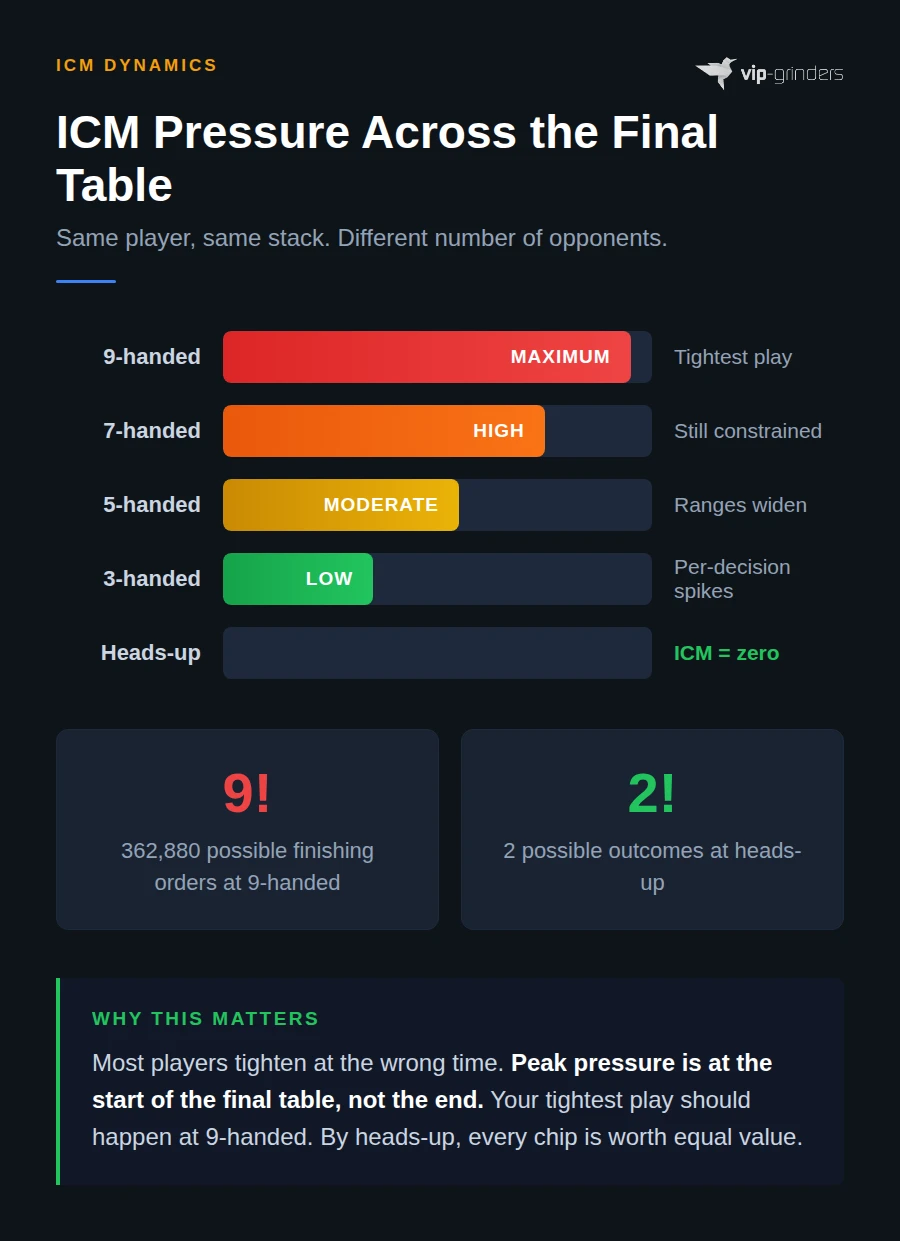
Most players assume ICM pressure builds steadily as the field gets smaller and peaks at heads-up. The opposite is true. ICM pressure is highest at the start of the final table, when all nine players are seated.
The reason is mathematical: with nine players and nine distinct payout slots, the number of possible finishing orders is enormous. Every chip you risk affects your probability of finishing in all nine positions simultaneously. That complexity creates the widest gap between what a chip is worth if you win it versus what it costs you if you lose it.
As players bust out and the field shrinks to six, then three, then two, the number of possible outcomes drops and ICM pressure eases. At heads-up, ICM disappears entirely because only two payouts remain and the only question is how the gap between 1st and 2nd gets divided.
For the full breakdown of how ICM converts chip stacks into dollar equity, including bubble factor calculations and worked examples, see our bubble strategy guide.
Stack Archetypes at the Final Table
Your stack size relative to everyone else at the table determines your entire final table strategy. The same hand in the same position can be a shove, a fold, or a min-raise depending on whether you cover the table or the table covers you. Four archetypes define final table poker, and every player fits into one of them at any given moment.
Chip Leader: How to Use Coverage
As the chip leader, you are the least constrained player at the final table. You can lose an all-in against a short stack, drop 25% of your chips, and still have a playable stack. That safety net lets you open wider, 3-bet more often, and apply constant pressure on the players who cannot afford to fight back.
Your primary targets are mid-stacks, not short stacks. Mid-stacks have the most unrealized equity to protect: one lost pot drops them into short-stack territory and costs them multiple pay jumps worth of value. They know this, and they fold far more than their cards justify.
- Open wider from late position: your button and cutoff opening ranges should expand because the blinds fold at a higher rate than normal. Every uncontested steal adds real-dollar equity to your stack.
- Avoid chip-leader-vs-chip-leader wars: if another player also covers most of the table, they can call you down without ICM risk. These pots offer no ICM edge and carry the risk of losing your lead. Attack the players who are scared, not the one who is not.
- Use min-raises for value, shoves for polarization: at 15 to 35 big blinds (bb) effective, modern solver outputs show that chip leaders should min-raise with strong hands (to build pots and keep opponents in) and shove with polarized ranges (strong hands and bluffs) to maximize fold equity.
Second Largest Stack: The Worst Seat at the Table
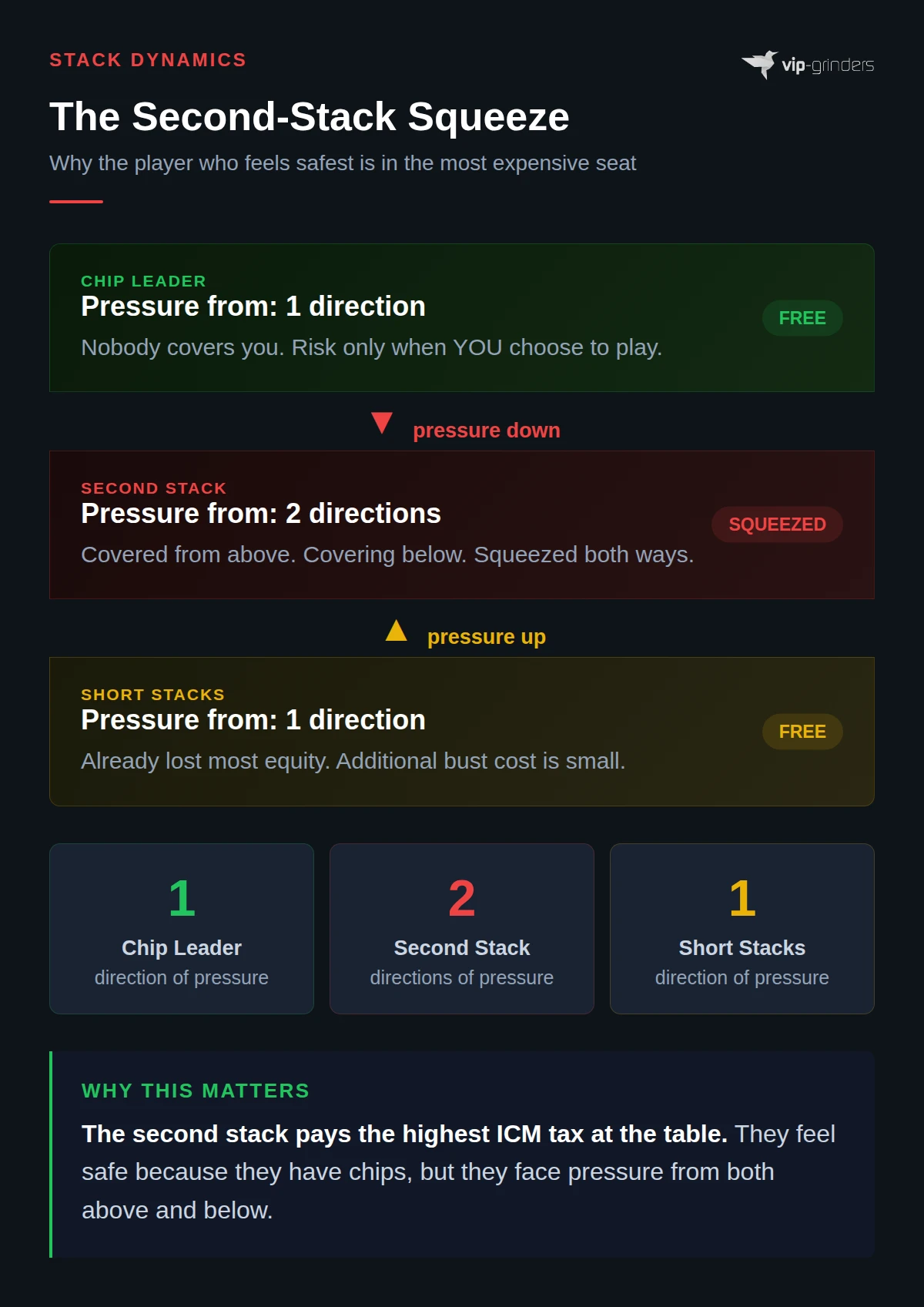
This is the most misunderstood position at the final table. Players who hold the second biggest stack often feel comfortable because they have plenty of chips. In reality, they are in the most expensive seat.
The problem is asymmetry. You cover most opponents, so you face ICM pressure when tangling with them, but the chip leader covers you, so you also face ICM pressure from above. You are squeezed from both directions while the chip leader and the short stacks are squeezed from only one.
- Tighten up against the chip leader: avoid marginal confrontations with the one player who can bust you. Folding a hand you would normally play costs you a few blinds. Losing an all-in to the chip leader costs you several pay jumps.
- Attack shorter stacks selectively: you can pressure players you cover, but only when the chip leader is not in the hand. If the chip leader is in the blinds behind you, a wide open from the cutoff risks a 3-bet that puts your entire tournament on the line.
Mid Stack: The Laddering Position
With a mid-stack at the final table, your goal is survival into the next pay jump. You have enough chips to stay alive through several blind orbits but not enough to absorb a lost all-in and remain competitive.
This is where discipline pays the most. Every hand you fold in a marginal spot is a hand where someone else might bust, moving you up one payout tier without risking a single chip. The math favors patience here because the pay jumps you gain from laddering are worth more than the small pots you might win by opening marginal hands.
- Cut marginal opens from early and middle position: hands like K-9 offsuit or Q-J offsuit that you would open in a normal spot become folds when a big stack is in the blinds.
- Call all-ins only with a significant equity edge: a call that needs 50% equity in chip-EV terms (the math if chips were worth equal value, like in a cash game) might need 65% or more under ICM at the final table. Premium pairs and A-K qualify. A-J offsuit usually does not.
- Look for resteal windows: if the chip leader is opening too wide from late position, a well-timed all-in re-raise (reshove) with 15bb to 20bb can exploit their weak range. They opened light, and they often fold because calling and losing costs them their coverage advantage.
Short Stack: Paradoxically Free
Below 10 big blinds at the final table, you are in push-or-fold territory. There is no room for min-raises, no room for postflop play, and no room for limping. You either shove all-in or you fold.
The counter-intuitive truth about being short at the final table is that you face less ICM pressure than the mid-stacks. You have already “paid” most of the elimination cost by being short. Your unrealized equity is small, which means the additional cost of busting is relatively low compared to a mid-stack who still has several pay jumps to protect.
This does not mean you should shove recklessly. It means your shoving ranges should be wider than instinct suggests, especially from late position where fewer players can wake up with a calling hand. Sitting and waiting for a premium usually means the blinds eat your stack and you bust anyway, just slowly.
- Stack distribution matters: holding 10bb when the other stacks are 10, 30, 40, and 65 big blinds is very different from holding 10bb when they are 10, 11, 15, and 50. In the second scenario, two other players are also close to busting, so folding has real laddering value. In the first, you are the only short stack and waiting gains you nothing.
- Shove wider from the button and small blind: at 8bb on the button, any pair, any Ace, most Kings, and suited broadways are profitable shoves because fold equity does most of the work.
- Tighten from early position: shoving K-8 offsuit under the gun with 6 players still to act gives you almost no fold equity. Stick to pairs, strong Aces, and suited broadways from early seats.
The table below summarizes targeting rules and strategic priorities for each archetype.
| Archetype | Primary Target | Avoid | Core Adjustment |
|---|---|---|---|
| Chip leader | Mid-stacks | Other big stacks | Open wider, pressure relentlessly |
| Second largest | Short stacks (when leader is out) | Chip leader | Tighten against the leader, pick spots below |
| Mid stack | Nobody (ladder into pay jumps) | Big stacks, marginal spots | Fold more, resteal selectively |
| Short stack | Blind steals from late position | Shoving into multiple callers | Shove wider than instinct says |
For a deeper look at how to construct and adjust preflop ranges by position and stack depth, see our dedicated guide.
Stage by Stage Final Table Poker Strategy
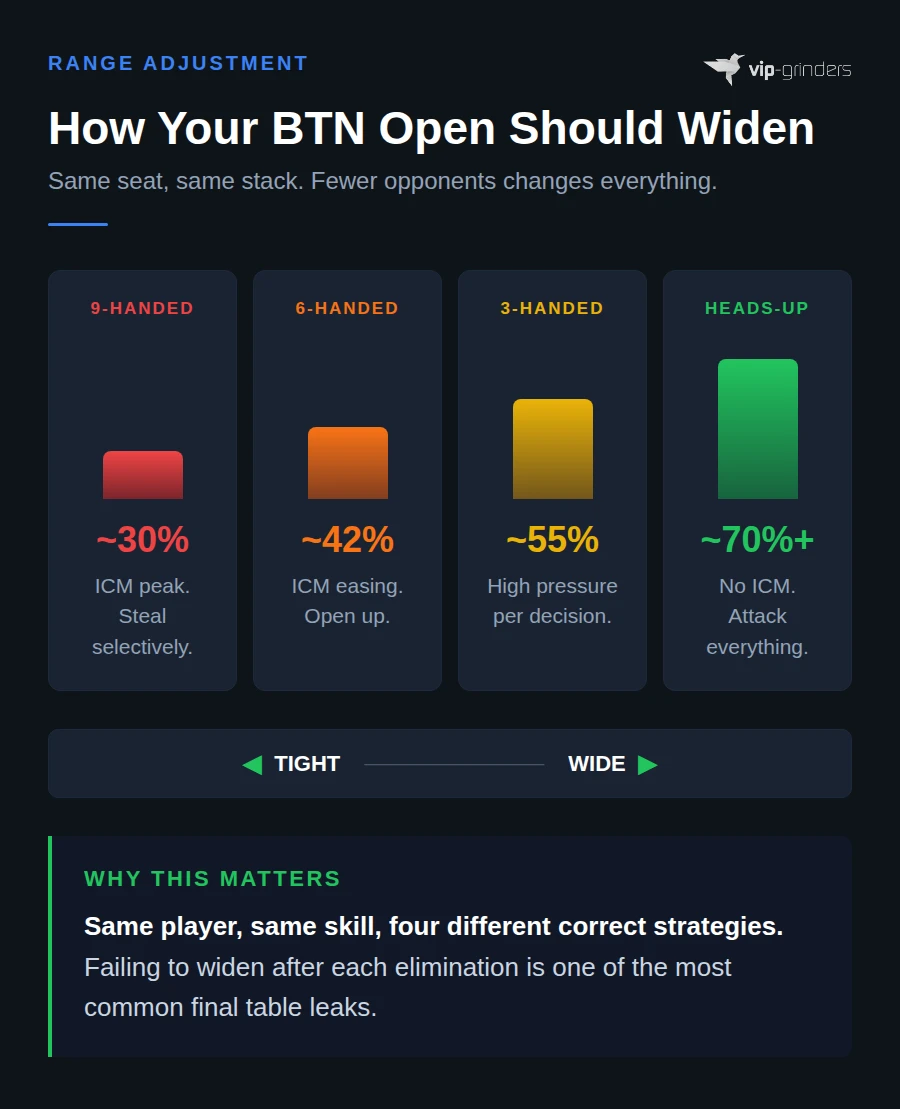
The stack archetypes above tell you what to do based on your chip count. This section tells you what changes as players get eliminated and the table gets shorter. Strategy at a 9-handed final table is fundamentally different from strategy at 5-handed, 3-handed, or heads-up, and failing to adjust after each elimination is one of the most common leaks at the final table.
9 Handed and 8 Handed: Maximum ICM, Minimum Risk
This is the tightest phase of the final table. With 9 distinct payout slots still in play, the number of possible finishing orders is at its peak and so is ICM pressure. Every confrontation carries the highest risk premium (the extra equity cost the payout structure charges you for playing a pot) of the entire tournament.
What this looks like in practice: ranges tighten across the board. The chip leader can still open wide from late position, but even they should avoid large pots against other big stacks. Everyone else should be playing noticeably tighter than they were 20 minutes ago when 15 players remained.
- Bluffing frequency drops for everyone except the chip leader: mid-stacks and short stacks cannot afford to get caught bluffing at this stage. The cost of being wrong is measured in pay jumps, not just chips. For more on when bluffing spots and frequencies are actually profitable, see our dedicated guide.
- Calling ranges shrink dramatically: a hand like A-J offsuit that you would call an all-in with at 30 players left becomes a fold at 9-handed if you are a mid-stack facing a big stack shove. The pot odds look the same but the ICM cost of busting is far higher.
- Postflop sizing compresses: continuation bets trend smaller (25% to 33% of the pot instead of 50% to 75%) because players want to keep pots small and controllable. Overbets nearly disappear from mid-stack and short-stack play.
7 Handed Through 5 Handed: The Transition
As eliminations thin the field, two things happen simultaneously. First, ICM pressure eases slightly because fewer payout slots remain. Second, the blinds and antes become a larger percentage of the average stack, which forces more action.
This is the phase where the final table shifts from a survival contest to a chip-accumulation race. Players who sat tight at 9-handed need to start opening up or the blinds will grind them down. Pay jumps are still significant (the table above shows that moving from 7th to 6th is worth $720 in our example), but the cost of blinding out now rivals the cost of a bad call.
- Deal conversations often start at 5 handed: once everyone has locked up a meaningful cash, players begin thinking about reducing variance. If a deal is going to happen, this is typically when it gets proposed.
- Ranges widen for the chip leader: with fewer players to act behind, the chip leader can now open even wider from every position. A cutoff open at 9-handed faces 4 potential callers. A cutoff open at 5-handed faces only 2.
- Bet sizing starts to shift: as stacks get shallower relative to the blinds, min-raising preflop becomes more common than 2.5x or 3x opens. Postflop, smaller bets continue to dominate because effective stacks are often 20bb to 30bb at this stage.
4 Handed and 3 Handed: Highest Pressure Per Decision
At 4-handed and especially 3-handed, every remaining pay jump represents a large percentage of the total prize pool. The jump from 4th to 3rd in our example is $2,520, and the jump from 3rd to 2nd is $4,680. Each elimination is now worth thousands of dollars.
The second-largest-stack trap is most acute at 3-handed. With only three players left, the second stack is squeezed between the chip leader above and the short stack below. The chip leader can attack freely, the short stack can shove freely, and the second stack is the only player who faces full ICM pressure on every decision.
- The chip leader gains maximum leverage: at 3-handed, the chip leader should be opening the majority of hands from every position. Both opponents face severe ICM consequences for calling incorrectly, so even weak opens generate profitable steals.
- Mid-stack discipline is everything: if you are the second stack at 3-handed, your best outcome is often letting the short stack bust so you lock up the 2nd-place money before heads-up begins. Avoid marginal confrontations with the chip leader unless you have a genuine premium.
- Short stack urgency increases: at 3-handed, the blinds come around faster (every 3 hands instead of every 9). If you are short, you need to find a spot to shove within the next few orbits or the blinds will cripple you.
Heads-Up: ICM Disappears
When two players remain, the final table transforms completely. ICM no longer applies because only two payouts exist (1st place and 2nd place), and the only dollar value in play is the gap between those two numbers. Every chip is now worth the same amount, exactly like a cash game.
This means the extreme tightening that defined 9-handed through 3-handed play is no longer correct. Heads-up poker rewards aggression, wide ranges, and relentless pressure. High-stakes heads-up data shows that strong players open 70% or more of hands from the small blind (which acts first preflop in heads-up) and contest nearly every pot.
- Ranges run extremely wide: any Ace, any pair, any King, most Queens, suited connectors, and even many offsuit broadways are standard opens from the small blind. If you are only opening 30% of hands heads-up, you are folding away your equity.
- Calling down with marginal hands is correct: when your opponent opens 70% of hands, their average hand is weak. Middle pair or even Ace-high is often good enough to call a river bet because their range contains so many missed draws and weak holdings.
- Prepare for heads-up before you reach it: most MTT grinders play thousands of hands at 6-max and 9-max but almost none heads-up. Playing a few dozen heads-up SNGs or cash sessions before your next deep run gives you a huge edge over opponents who are improvising. Our SNG strategy guide covers heads-up SNG dynamics that directly translate to MTT final table heads-up.
Final Table Deal Making
At most final tables with significant prize money on the line, someone will eventually suggest a deal. Knowing how deals work, which type benefits you, and when to accept or decline is a skill that directly affects your annual tournament income. A bad deal at a $500 buy-in final table can cost you more than an entire month of mid-stakes grinding.
ICM Chop: The Modern Default
An ICM chop uses the Independent Chip Model to assign each remaining player a dollar share of the prize pool based on their current chip stack and the payout structure. It is the fairest method available because it accounts for the fact that doubling your chips does not double your equity (the same asymmetry that drives all ICM decisions).
In most modern tournaments, both online and live, ICM chop is the standard. Online rooms like GGPoker, PokerStars, partypoker, and WPT Global have built-in deal calculators that default to ICM. In live events, the floor staff will often run an ICM calculation on request.
Players typically agree to leave 10% to 20% of the remaining prize pool for the eventual winner on top of their ICM share. This “play it out” portion keeps a meaningful incentive to compete for first place rather than coasting after the deal is made.
Chip Chop and Equal Split
Two older deal types still come up, especially in live games and smaller tournaments.
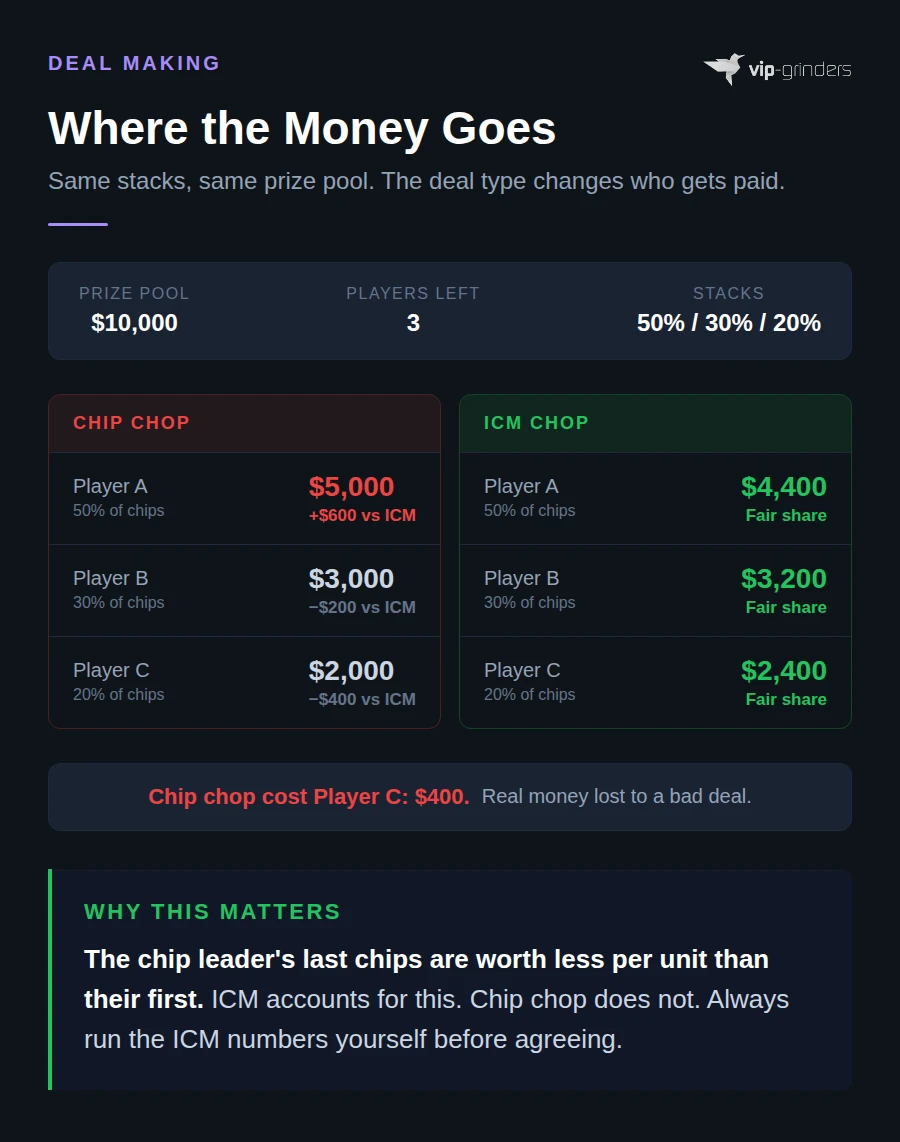
A chip chop divides the remaining prize pool in direct proportion to each player’s chip count. If you hold 40% of the chips in play, you get 40% of the money. This sounds fair but it systematically overpays the chip leader relative to ICM, because ICM recognizes that the chip leader’s last chips are worth less per unit than their first chips.
An equal split divides the money evenly regardless of chip counts. This overpays short stacks and underpays big stacks. It is almost never used in serious play unless all remaining stacks are very close in size.
Online vs Live Deals
Online deals are straightforward. The poker room’s software calculates each player’s ICM equity, displays the proposed amounts, and every player clicks accept or decline. The process takes under a minute.
Live deals require more caution: there is no software running the numbers for you by default, and the player who speaks first often sets the frame for the negotiation. Bring your phone to the final table with ICMIZER or a similar app ready, and when a deal is proposed, enter the current stack sizes and payout structure yourself before responding.
- PKO (Progressive Knockout) tournaments: in PKO events, bounties are typically not included in the chop. Each player keeps the bounties they have already collected, and only the standard (non-bounty) portion of the prize pool gets divided. Make sure you know which portion is being chopped before you agree.
- When to accept a deal: deals are most valuable when you are a mid-stack or short stack and the ICM chop locks in more money than you expect to win by playing it out. They are least valuable when you are the chip leader with a significant skill edge over the remaining field.
- When to decline: if you are the chip leader and believe you have a meaningful skill advantage, playing it out often has higher expected value than any deal. The ICM chop gives you a fair share based on stacks, but it does not account for skill differences.
The 7 Most Expensive Final Table Mistakes
Most poker final table bustouts are not bad luck. They are the same handful of errors repeated across thousands of tournaments by players who never review their final table play. Each mistake below feels justified in the moment and costs real equity over time.
- Playing too tight as chip leader. Chip leaders who tighten up because they are "already going to cash" give away hundreds of dollars in uncontested steals per final table. Every hand you fold from the button or cutoff as the biggest stack is a steal you handed to someone else for free. Your chip lead exists to generate pressure, and the final table is where that pressure converts directly into free equity.
- Calling all-ins with cash game math. A hand that needs 45% equity in a cash game might need 60% or more at a 9-handed final table under ICM. The pot odds look identical on the surface, but the payout structure adds a hidden tax to every call. If you are not adjusting your calling thresholds for ICM, you are calling too wide at every final table.
- Ignoring the second largest stack trap. Players with the second biggest stack feel safe because they have plenty of chips, but they are squeezed from both directions: ICM pressure from above (the chip leader covers them) and below (they cover everyone else). Treating the second stack like a chip leader is one of the most expensive positions to misplay.
- Accepting a chip chop without running the numbers. A chip chop divides money proportionally by chip count, which overpays the chip leader relative to their actual ICM equity. If the biggest stack proposes a chip chop, they are asking for more than their fair share. Always counter with an ICM chop and run the calculation yourself before agreeing.
- Running 9-handed ranges at 5-handed. Every elimination should trigger a range adjustment. ICM pressure eases as players bust, the blinds come around faster, and fewer players act behind you. A player who keeps the same tight ranges from 9-handed will blind down at 5-handed because the cost of folding catches up to the cost of playing.
- Treating heads-up like 3-handed. When two players remain, ICM disappears and every chip is worth equal value. The tight calling ranges that were correct at 3-handed become massive leaks at heads-up. Players who continue folding 70% of hands are donating equity with every fold.
- Not preparing for heads-up in advance. Most MTT grinders play thousands of hands at 6-max and 9-max but almost zero hands heads-up. Even 20 to 30 heads-up SNG sessions before your next deep run will give you a meaningful edge over opponents who are improvising. The time investment is small and the payoff is large.
For managing the emotional side of final table pressure, including tilt after tough beats and pay jump anxiety, see our tilt and emotional control guide.
Final table performance is one of the biggest drivers of your overall tournament ROI. Players who convert final tables into top-3 finishes consistently earn more per year than players who bust 7th or 8th at the same rate. For how your rakeback deal reshapes your overall return, and how to calculate your hourly rate by format, see our dedicated guides.
Frequently Asked Questions
What is a final table in poker?
The poker final table is the last table in a multi-table tournament (MTT), typically the last 9 players in a standard format or the last 6 in some online events. Every remaining player is guaranteed a payout, and each elimination moves everyone up one pay tier. The final table is where the largest pay jumps occur and where most of a tournament player’s long-term profit is made or lost.
When does ICM matter most at the final table?
ICM pressure is highest at the start of the final table when all 9 players are seated. With 9 distinct payout slots, the number of possible finishing orders is enormous, which creates the widest gap between what a chip is worth if you win it versus what it costs if you lose it. As players get eliminated and fewer outcomes remain, ICM pressure gradually eases. At heads-up it disappears entirely.
What is the worst stack size to have at a final table?
The second largest stack is the most expensive position. You cover most opponents (creating ICM pressure when you play pots against them) but the chip leader covers you (creating ICM pressure from above). You are squeezed from both directions, while the chip leader and the short stacks each face pressure from only one side.
Should I accept a deal at the final table?
It depends on your stack size and skill edge. Deals are most valuable when you are a mid-stack or short stack and the ICM chop locks in more money than you expect to earn by playing it out. They are least valuable when you are the chip leader with a meaningful skill advantage over the remaining opponents. Always run your own ICM calculation before agreeing, and insist on an ICM chop rather than a chip chop, which overpays the biggest stack.
What is the difference between ICM chop and chip chop?
An ICM chop assigns each player a dollar share based on the Independent Chip Model, which accounts for the fact that each additional chip is worth slightly less than the previous one. A chip chop divides the money in direct proportion to chip counts, which ignores that diminishing value and systematically overpays the chip leader. ICM chop is the fairer method and the modern standard at most tournaments.
How do I prepare for heads-up at the final table?
Play heads-up SNGs or heads-up cash game sessions before your next deep tournament run. Most MTT grinders have almost no heads-up experience, so even 20 to 30 dedicated sessions will put you ahead of most opponents. Focus on opening extremely wide from the small blind, calling down lighter with marginal hands, and understanding that ICM no longer applies when only two players remain.
Does final table strategy differ in PKO tournaments?
Yes. In Progressive Knockout (PKO) tournaments, the bounty on each player’s head adds direct cash value to every elimination. This partially offsets ICM pressure and keeps calling ranges wider than in standard MTTs. When deals are made at PKO final tables, bounties are typically not included in the chop. Each player keeps their collected bounties, and only the standard prize pool portion gets divided.
Should I ever fold pocket Aces at a final table?
In a standard MTT final table, almost never. Pocket Aces are too strong to fold in any realistic scenario where you are playing for pay jumps. The one exception is satellite tournaments with flat payouts, where folding Aces can be correct if you have a comfortable stack and two shorter players are already all-in against each other. Letting them eliminate each other wins you the seat without risk. For standard MTT final tables, always play your Aces.