

Poker Bubble Strategy: How to Exploit the Money Bubble 2026
The bubble is the point in a poker tournament where one more elimination separates everyone from the money. It is the single highest-pressure moment in any MTT (multi-table tournament), and the players who understand it gain a massive edge over those who don’t.

Here is what changes on the bubble: every chip you lose is worth more than every chip you win. That one sentence is the entire foundation of bubble strategy, and it comes from a model called ICM (the Independent Chip Model) that converts your chip stack into real-dollar equity. Because of ICM, the “correct” play on the bubble is often radically different from the correct play five minutes earlier.
Here is what this guide covers:
- How to play each stack size on the bubble: big stack, mid-stack, and short stack
- Bubble factor and risk premium math with a worked example
- Approximate push/fold ranges by position at four stack depths
- The 5 costliest bubble mistakes and how to fix them
- How bubble strategy changes in satellites and PKO tournaments
What Is the Bubble in a Poker Tournament?
Every poker tournament has a payout structure that pays a fixed number of finishers. In a 1,000-player MTT that pays the top 150, player number 151 is “on the bubble.” That player finishes with nothing, while player 150 walks away with the minimum cash (min-cash).
The bubble is not a single hand. It is a phase that builds pressure gradually as the field approaches the payout threshold. Two terms describe how that pressure escalates:
- Soft bubble: the period when remaining players reach roughly 110% to 115% of paid spots. In a 150-paid tournament, this starts around 165 to 170 players left. Ranges begin tightening, but the pressure is mild.
- Stone bubble: the final few eliminations before the money. At 152 or 151 players left in a 150-paid field, ICM pressure is at its peak. This is where the biggest strategic shifts happen.
The player who finishes in the last unpaid spot is called the bubble boy (or bubble girl). It is considered one of the worst outcomes in tournament poker: you survived long enough to nearly cash, played for hours, and left with zero.
Hand-for-Hand Play
When the field is one or two bustouts from the money, the tournament switches to hand-for-hand mode. Every table must finish its current hand before any table is allowed to deal the next one. This eliminates stalling as a strategy, because the slowest table sets the pace for everyone.
In online poker, hand-for-hand is automatic. In live tournaments, the floor announces it and dealers wait for a signal before each new deal. Once the bubble bursts (enough players bust to reach the payout threshold), normal play resumes immediately.
Why the Bubble Matters More Than Any Other Phase
The bubble is where the gap between correct play and default play is widest. Most recreational players either freeze up and fold too much, or ignore the pressure entirely and play the same ranges they used 50 hands ago. Both approaches cost real money.
Players who understand bubble dynamics can exploit both types: pressuring the folders with wider opens from late position, and trapping the loose players by tightening calling ranges when covered. The rest of this guide shows exactly how, starting with the math that drives every bubble decision.
For the full tournament arc from early levels through the final table, see our MTT strategy guide.
Why the Bubble Changes Everything
In a poker cash game, every chip is worth the same. Win 1,000 chips, gain $10. Lose 1,000 chips, lose $10.
The math is symmetrical. On the tournament bubble, that symmetry breaks completely.
The reason is ICM (the Independent Chip Model), the math that converts your chip stack into a real-dollar value based on the payout structure and the stacks around you. ICM says that doubling your chip stack does not double your tournament equity, but losing your entire stack always costs you 100% of your equity. That gap is the core of every bubble decision.
A simple example makes this concrete. Ten players remain in a $100 buy-in tournament with a $1,000 prize pool, nine get paid, and you have an above-average stack:
- Your current equity: roughly $180 in tournament value (based on your stack size relative to the field).
- If you double up: your equity rises to maybe $280. You gained $100.
- If you bust: your equity drops to $0. You lost $180.
You risked $180 to gain $100. That is a bad deal even if you are a 55% favorite in the hand, because the same all-in that would be clearly profitable in a cash game becomes a losing play on the bubble.
The cost of elimination outweighs the benefit of doubling up. This asymmetry is what makes the bubble unique.
It does not exist in cash games, and it barely exists in the early levels of a tournament when everyone is far from the payouts. It only kicks in when real money is on the line, and it peaks at the exact moment the bubble is about to burst.
For a full breakdown of how ICM converts chip stacks into dollar equity across different payout structures, see our ICM strategy guide.
The 3 Stack Archetypes on the Bubble
Your stack size relative to the rest of the field determines your entire bubble strategy. The same hand in the same position can be a shove, a fold, or a raise depending on whether you cover the table or the table covers you.
Three archetypes define bubble play. Every player at the table fits into one of them at any given moment.
Big Stack: You Cover Most of the Table
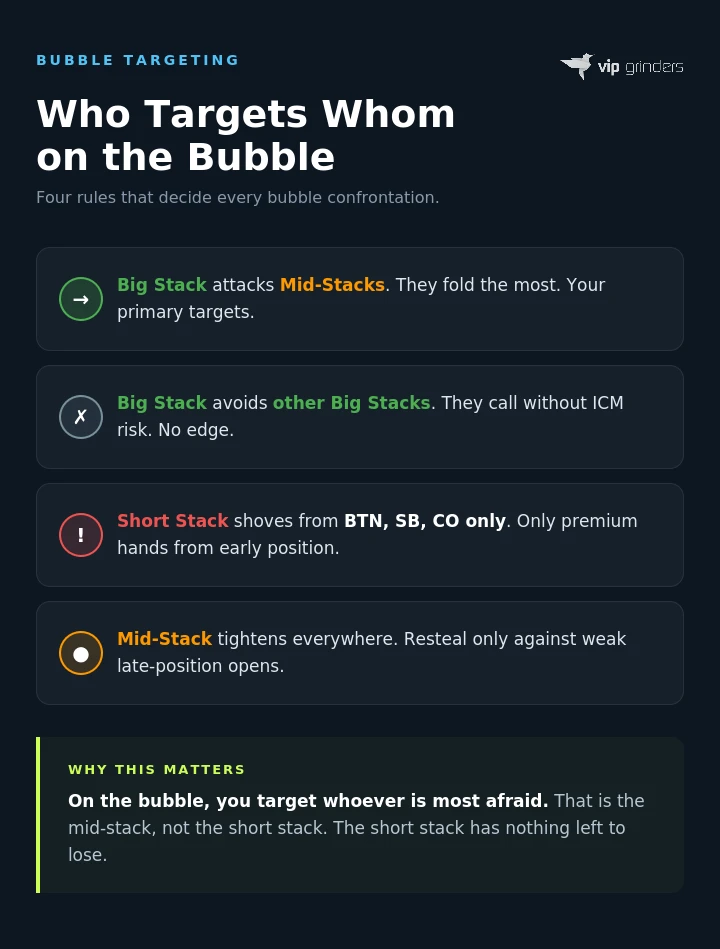
As the big stack on the poker bubble, you are the least affected by ICM pressure. You can lose an all-in against a short stack, drop 30% of your chips, and still be alive with a healthy stack. That freedom lets you open wider, steal more blinds, and put constant pressure on the players who cannot afford to call.
Your primary targets are mid-stacks, not short stacks. Mid-stacks have the most to lose from tangling with you because a lost pot drops them into short-stack territory right before the money. They know this, so they fold far more than their cards justify.
- Open wider from late position: button and cutoff opens should expand because the blinds are folding at a higher rate than normal. Solver data shows button opens stay around 45% to 47% on the bubble with equal stacks, but against covered mid-stacks the effective fold equity is much higher.
- Avoid big-stack-vs-big-stack wars: another player who also covers the table can call you down without ICM risk. These pots offer no ICM edge and carry the risk of losing your chip lead.
- Pressure the blinds relentlessly: every uncontested steal on the bubble is worth more in real-dollar equity than the same steal five levels earlier, because the blinds and antes are larger and opponents fold more often.
Mid Stack: The Most Dangerous Seat
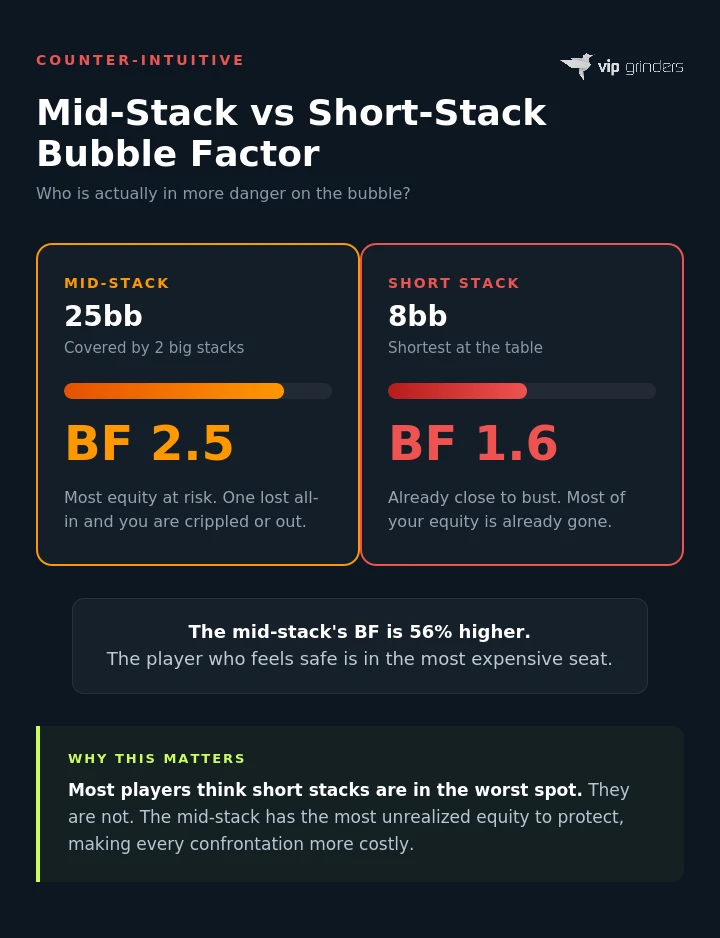
This is the most ICM-constrained position at the table. You have enough chips to make the money comfortably if you avoid disaster, but one lost all-in drops you to a short stack or eliminates you entirely.
Here is the counter-intuitive truth that most players miss: mid-stacks face higher bubble factors than short stacks. A short stack has already “paid” most of the elimination cost by being short. A mid-stack still has significant unrealized equity to protect, which means every confrontation risks more dollar value.
- Tighten your opens: cut marginal hands from early and middle position. Hands like K-9 offsuit or Q-J offsuit that you would open in a normal spot become folds when a big stack is in the blinds.
- Avoid calling all-ins from big stacks: the math requires you to have far more equity than in a cash game. A call that needs 50% equity in chip-EV terms (the math if chips were worth equal value, like in a cash game) might need 65% or more under ICM.
- Look for resteal windows: if a big stack is opening too wide from late position, a well-timed shove from the blinds with 15 to 20 big blinds can exploit their weak range. They opened light, and they often fold because calling and losing costs them their chip lead.
The mid-stack trap is real: you feel safe because you are not the shortest stack, but your dollar risk per confrontation is actually the highest at the table. Discipline here is what separates players who cash from players who bubble.
Short Stack: 10 Big Blinds or Less
Below 10 big blinds (10bb), you are in push-or-fold mode. There is no room for min-raises, no room for postflop play, and no room for open-limping. You either shove all-in or you fold, because every other action bleeds chips you cannot afford to lose.
The biggest mistake short stacks make on the bubble is folding into the blinds hoping someone else busts first. This is only correct when there are micro-stacks (players with 2bb or less) at other tables who are almost certain to bust before you. If no one is shorter than you, sitting and waiting means the blinds eat your stack and you bust anyway, just slowly.
Understanding positional advantage is critical here. A hand that is a clear shove on the button can be a clear fold under the gun at the same stack depth. Position determines how many players can call behind you, which directly controls your fold equity.
Bubble Factor and Risk Premium: The Math That Matters
The stack archetypes tell you what to do on the bubble. Bubble factor tells you why, with exact numbers. If you want to understand why a 55% favorite call can be a losing play, this is the math behind it.
What Is Bubble Factor?
Bubble factor (BF) is a single number that measures how much more it costs you to lose an all-in than it benefits you to win one. It is defined as:
Bubble Factor = Dollar equity you lose if you bust ÷ Dollar equity you gain if you double up
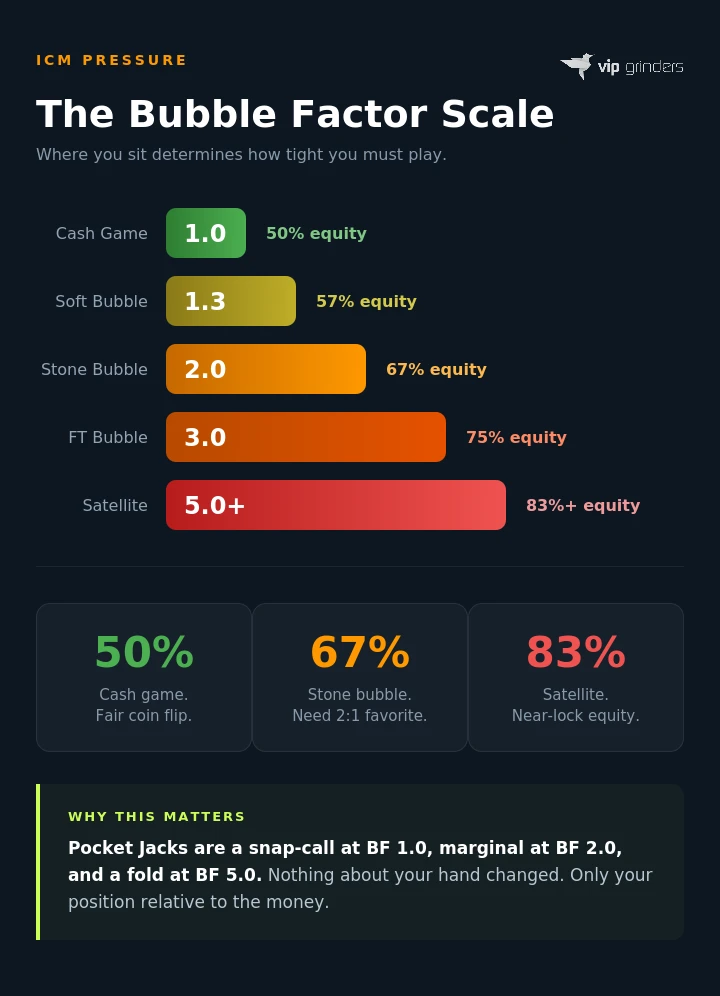
In a cash game, bubble factor is always 1.0: you lose $100, you gain $100, perfectly symmetrical. On the tournament bubble, bubble factor climbs above 1.0. The higher it goes, the tighter your calling range must be.
A bubble factor of 2.0 means you stand to lose twice as much equity as you gain. A factor of 3.0 means three times as much. At extreme spots (satellite bubbles, very flat payout structures), bubble factor can exceed 5.0.
Worked Example: The Full Calculation
Blinds are 150/300 with no ante and you are in the big blind with 2,000 chips. The button (a big stack) shoves all-in and everyone else folds. You need to call 1,700 more into a pot of 2,450 (the small blind’s 150, your posted 300, and the button’s shove).
In a cash game, you would need roughly 40% equity to call profitably based on pot odds alone. But this is the bubble, and your bubble factor against this opponent is 2.3.
The adjusted formula for required equity under ICM is:
Required Equity = (BF × Call Amount) ÷ (Pot You Win + BF × Call Amount)
Plugging in the numbers:
- 1BF × Call Amount: 2.3 × 1,700 = 3,910
- 2Pot You Win + BF × Call Amount: 2,450 + 3,910 = 6,360
- 3Required Equity: 3,910 ÷ 6,360 = 61.5%
You need 61.5% equity to call, not the 40% that pot odds alone would suggest. That 21.5 percentage point gap is what bubble pressure looks like in real numbers. Hands like A-J offsuit or pocket sevens, which would be easy calls in a cash game, become clear folds on the bubble in this spot.
What Is Risk Premium?
Risk premium is the gap between the equity you need under ICM and the equity you would need in a pure chip-value calculation. It is the “extra cost” the bubble charges you for every confrontation.
Risk Premium = ICM Equity Needed − Chip-EV Equity Needed
In the example above, risk premium is 61.5% − 40% = 21.5%. That means the bubble added 21.5 percentage points of extra equity requirement on top of what the pot odds demanded.
Risk premium is not constant. It changes with every variable at the table:
- Higher risk premium: stone bubble, mid-stack vs big stack, flat payout structures (satellites), large min-cash relative to buy-in.
- Lower risk premium: soft bubble (far from the money), short stack vs big stack, top-heavy payout structures, small min-cash relative to buy-in.
- Zero risk premium: cash games and the very early levels of a tournament when payouts are not yet a factor.
Approximate Push/Fold Ranges on the Bubble
Below 15 big blinds, most bubble decisions simplify to push-or-fold. The ranges below are based on published solver outputs from tournament ICM models. They are guidelines, not exact cutoffs: adjust based on your specific bubble factor and the players behind you.
At 8bb effective:
- Button: any pair, any Ace, K-2s+, K-7o+, Q-8s+, Q-To+, J-9s+, suited connectors 5-4s+.
- Cutoff: any pair, A-2s+, A-7o+, K-9s+, K-Jo+, Q-Ts+.
- Small Blind: any pair, any Ace, K-5s+, K-9o+, Q-9s+, Q-Jo+.
- Early Position: pairs 55+, A-9s+, A-Jo+, K-Qs.
At 12bb effective:
- Button: any pair, A-2s+, A-5o+, K-9s+, K-Jo+, Q-Ts+, J-Ts.
- Cutoff: pairs 33+, A-2s+, A-8o+, K-Ts+, K-Qo, Q-Js+.
- Small Blind: any pair, A-2s+, A-7o+, K-Ts+, K-Jo+, Q-Js+.
- Early Position: pairs 66+, A-Ts+, A-Jo+, K-Qs.
At 15bb effective:
- Button: pairs 22+, A-2s+, A-8o+, K-Ts+, K-Jo+, Q-Js+, J-Ts.
- Cutoff: pairs 44+, A-5s+, A-9o+, K-Js+, Q-Js+.
- Small Blind: pairs 22+, A-2s+, A-9o+, K-Ts+, K-Qo, Q-Js+.
- Early Position: pairs 77+, A-Js+, A-Qo+, K-Qs.
At 20bb effective:
- Button: pairs 22+, A-7s+, A-To+, K-Js+, K-Qo, Q-Js+.
- Cutoff: pairs 55+, A-9s+, A-Jo+, K-Qs+.
- Small Blind: pairs 33+, A-5s+, A-To+, K-Js+, K-Qo.
- Early Position: pairs 88+, A-Qs+, A-Ko.
These ranges assume you are the shorter stack at the table and opponents are folding at typical ICM-adjusted rates. Against a very tight table, widen slightly. Against players who call too often, tighten by removing the weakest hands in each cell.
For a deeper look at how to construct and adjust preflop ranges, see our dedicated guide.
5 Costly Poker Bubble Mistakes
Most bubble bustouts are not bad luck. They are the same handful of errors repeated across thousands of tournaments by players who never audit their bubble play. Each mistake below feels justified in the moment and costs real equity over time.
1. Calling All-Ins with Cash Game Math
The most expensive bubble leak is calling an all-in because you have “the right pot odds.” Pot odds alone do not account for the ICM tax on your call. A hand that needs 40% equity in chip-EV terms might need 60% or more under bubble pressure.
Before calling any all-in on the bubble, ask: what is my bubble factor in this spot? If you are a mid-stack covered by the shover, the answer is almost always “high enough to fold everything except premiums.”
2. Folding Into the Blinds as a Short Stack
Short stacks who fold every hand hoping to “ladder” into the money usually blind out and bust anyway. The blinds and antes do not wait for you, and every orbit you sit through without shoving costs you chips you cannot replace.
The only time pure survival folding is correct is when micro-stacks (2bb or less) at other tables are almost certain to bust before your next blind. If no one is shorter than you, pick a spot and shove. A well-timed 8bb shove from the button with K-T suited is far more profitable than blinding down to 4bb where even a double-up leaves you crippled.
3. Ignoring Stack Distribution at Other Tables
Your bubble strategy depends on the entire field, not just your table. If three players across the room have 2bb or less, everyone else’s bubble factor drops because those micro-stacks are likely to bust first. You can afford to play slightly looser.
If every remaining player has 15bb or more, nobody is close to busting and bubble pressure stays high across the board. Online tournaments show stack distributions in the lobby. Check them before making close decisions.
4. Attacking Other Big Stacks Instead of Mid-Stacks
Big stacks gain their bubble edge from pressuring players who cannot fight back. Another big stack can fight back, because they face almost no ICM penalty for calling you down.
A big-stack-vs-big-stack all-in pot on the bubble has no ICM edge for the aggressor. You are risking your chip lead for a coin flip against the one player at the table who is not scared. Target the mid-stacks who fold 70% of their range, not the other big stack who calls with 40%.
5. Playing “Survival Mode” as the Chip Leader
Some big stacks tighten up on the bubble because they are “already going to cash.” This is the most expensive passive leak in tournament poker. Every hand you fold from the button or cutoff as chip leader is a steal you gave away to someone else.
The bubble is the one phase where your chip lead translates directly into free money through unopposed steals. Tightening up as chip leader is leaving that money on the table. Open aggressively, target the mid-stacks, and use your stack as the weapon it is.
Satellites, PKOs, and the Final-Table Bubble
The money bubble in a standard MTT is the most common bubble scenario, but it is not the only one. Three other formats create their own bubble dynamics, and each one changes the math in ways that catch players off guard.
Satellite Tournaments
In a satellite, every remaining player wins the same prize: a seat to a bigger tournament. There are no pay jumps, no first-place bonus, and no incentive to accumulate chips beyond what you need to survive. The payout structure is completely flat.
This makes satellite bubbles the most extreme ICM environment in poker. Bubble factors routinely exceed 5.0, and the correct strategy is far more conservative than in any cash-MTT bubble.
- Survival is everything: once you have enough chips to comfortably outlast the remaining eliminations, stop risking them. There is zero reward for finishing with the biggest stack.
- Folding strong hands is correct: in a satellite bubble with 5 seats awarded and 6 players left, folding pocket Kings preflop can be the right play if two shorter stacks are all-in at another table. Letting them eliminate each other wins you the seat without risking a single chip.
- Chip accumulation has no value: doubling up from 40bb to 80bb gains you nothing in a satellite. You already had enough to win the seat. The only thing the extra chips do is create risk where none was needed.
PKO and Bounty Tournaments
Progressive Knockout (PKO) tournaments add a bounty on every player’s head. When you eliminate someone, you win their bounty in cash. This changes bubble math because bounties partially offset ICM pressure.
In a standard MTT, calling an all-in on the bubble is punished by ICM. In a PKO, the bounty you collect for eliminating your opponent adds direct cash value to the call, which means your effective pot odds improve.
- Ranges stay wider: the bounty reward means you can call all-ins on the bubble with weaker hands than in a standard MTT. The bigger the bounty relative to the buy-in, the more this effect matters.
- Covering opponents is extra valuable: in a PKO, you only win the full bounty if you are the one who eliminates the player. Having a bigger stack than your opponent gives you the chance to collect, which adds a layer of aggression incentive that does not exist in standard MTTs.
- ICM still applies: bounties do not eliminate ICM pressure entirely. The remaining prize pool (the non-bounty portion) still creates pay jumps and bubble factors. Think of PKO bubble math as standard ICM with a discount, not as cash game math.
The Final-Table Bubble
The money bubble is not the only ICM bubble in a tournament. The final-table bubble (typically 10th or 11th place, just short of the final 9) creates its own pressure spike, and in many payout structures the pay jump from 10th to 9th is larger in percentage terms than the min-cash itself.
The same principles apply: mid-stacks tighten, big stacks pressure, short stacks shove or fold. The difference is that at the final-table bubble, every remaining player is already in the money, so the “survival instinct” is replaced by a pay-jump instinct. Players are no longer afraid of going home empty; they are afraid of missing the next significant payout tier.
Additional pay-jump bubbles appear throughout the final table: the jump from 4th to 3rd, or from 2nd to 1st, can be worth more than several earlier pay levels combined. Recognizing these mini-bubbles and adjusting your ranges accordingly is what separates final-table grinders from players who just “play their cards.” For the complete stage-by-stage breakdown, see our final table strategy guide.
For SNG bubble adjustments, which behave differently because of smaller fields and steeper payout structures, see our dedicated guide.
How to Study Poker Bubble Spots
Reading about bubble strategy is the first step. Studying your own bubble decisions is what makes it stick. Three tools let you replay bubble spots with real ICM math, and none of them require a subscription to get started.
- ICMIZER: the most popular dedicated ICM calculator. Paste in stack sizes, payout structure, and the action, and it returns the exact bubble factor, risk premium, and optimal shoving/calling range for every position. Free trial available.
- Holdem Resources Calculator (HRC): similar to ICMIZER but with a different interface. Particularly strong for SNG and Spin push/fold analysis. One-time purchase, no subscription.
- GTO Wizard: a browser-based solver that includes precomputed ICM solutions for common tournament spots. The bubble section lets you compare chip-EV vs ICM ranges side by side. Subscription model with a limited free tier.
You do not need all three. Pick one, and use it to review your most recent bubble decisions. For a broader look at how to integrate solvers into your study routine, see our dedicated guide.
For quick equity checks during your review, our free poker calculators can help with the baseline math before you run the full ICM solve.
Frequently Asked Questions
What is the bubble in a poker tournament?
The bubble is the phase of a tournament where one more elimination separates the remaining players from the money. In a 1,000-player MTT that pays 150 spots, player 151 is “on the bubble.” The player who finishes in the last unpaid position is called the bubble boy (or bubble girl).
What does bubble boy mean in poker?
Bubble boy is the player who finishes in the last unpaid spot in a tournament. They survived long enough to nearly cash but left with nothing. It is widely considered one of the worst outcomes in tournament poker because of how close the player came to earning a payout.
When does the bubble start in a tournament?
The bubble builds gradually. The soft bubble begins when remaining players reach roughly 110% to 115% of paid spots. ICM pressure increases from there and peaks at the stone bubble, which is the final one or two eliminations before the money. Bubble strategy should start adjusting as soon as the soft bubble begins.
What is bubble factor and how do I calculate it?
Bubble factor is the ratio of dollar equity you lose if you bust divided by dollar equity you gain if you double up. In a cash game, bubble factor is always 1.0. On the tournament bubble it climbs above 1.0, often reaching 2.0 to 3.0 in standard MTTs and exceeding 5.0 in satellites. The higher your bubble factor, the more equity you need to justify calling an all-in.
Should I tighten up on the bubble to make the money?
It depends on your stack size. Mid-stacks should tighten significantly because they have the most unrealized equity to protect. Short stacks below 10bb should actually look for spots to shove, because folding into the blinds usually costs more than a well-timed push. Big stacks should do the opposite of tightening: open wider and pressure the mid-stacks who cannot afford to call.
Is it ever correct to fold pocket Aces on the bubble?
In standard MTTs, almost never. In satellites with flat payouts, yes. If you have a comfortable stack and two shorter players are already all-in against each other, letting them eliminate each other wins you the seat without risk. Folding Aces in this specific satellite scenario can be the highest-EV play available.
What is hand-for-hand play?
Hand-for-hand is a tournament procedure that starts when the field is one or two bustouts from the money. Every table must complete its current hand before any table deals the next one. This prevents stalling, because the slowest table sets the pace for everyone. In online poker, hand-for-hand is handled automatically by the software.
How is the bubble different in satellites vs regular MTTs?
Satellite bubbles are far more extreme because every remaining seat wins the same flat prize. There are no pay jumps and no incentive to accumulate chips. Bubble factors in satellites routinely exceed 5.0, making the correct strategy dramatically more conservative than in a standard MTT where the prize pool is top-heavy.
How does bubble strategy change in PKO tournaments?
In PKO (Progressive Knockout) tournaments, bounties partially offset ICM pressure. The cash value of eliminating an opponent improves your effective pot odds on every call, which means calling ranges stay wider on the bubble than in standard MTTs. ICM still applies to the non-bounty portion of the prize pool, so PKO bubble math is standard ICM with a discount, not cash game math.
What is the difference between the money bubble and the final-table bubble?
The money bubble separates paid from unpaid finishers. The final-table bubble separates players who make the final table from those who fall just short. Both create ICM pressure spikes, but the final-table bubble is driven by pay-jump size rather than the fear of going home empty. In many payout structures, the jump from 10th to 9th place is larger in percentage terms than the min-cash itself.