

Check-Raise in Poker: When to Raise, How Big & Which Hands 2026
You are in the big blind on a wet flop with bottom two pair, and the preflop raiser fires a 33% pot c-bet. Calling keeps the pot small and lets every draw see a cheap turn. Check-raising triples the pot, forces draws to pay full price, and puts the aggressor on defense for the rest of the hand.
A check-raise is the act of checking to your opponent, waiting for them to bet, and then raising that bet in the same round of action. It is the single most powerful weapon available to the out-of-position player, and it is the reason a skilled big blind defender can be profitable in a spot that is structurally disadvantaged.
Here is what this guide covers:
- Three conditions that make a check-raise correct and when to use each one
- Sizing rules from 2.5x to 3.5x the c-bet, mapped to board texture in a quick reference table
- Value vs bluff hand selection and the 2:1 bluff-to-value ratio that solvers recommend
- Street-by-street application plus tournament, ICM, and short-stack adjustments
- Five check-raise mistakes that cost low and mid-stakes grinders the most bb/100
What a Check-Raise Is and Why It Exists
Most players learn the check-raise as a “tricky play.” That framing undersells it. The check-raise is a structural necessity for any player who acts first on a betting round, because without it, the out-of-position player has no way to build a large pot or punish loose c-bets.
The sequence is simple: you check, your opponent bets, and you raise in the same round of action. The minimum raise size in most formats is 2x the bet, and there is no maximum in No-Limit Hold’em.
Two problems create the need for check-raises. The first is pot building from out of position. Checking and then raising lets you trap the aggressor’s c-bet into a bigger pot while disguising your hand, rather than donk-betting and announcing your strength immediately.
The second is range protection. If you only ever check-call or check-fold from the big blind, the preflop raiser can c-bet any two cards profitably because your check never threatens them. Adding check-raises to your range forces the c-bettor to narrow their betting frequency, which benefits every hand in your checking range.
A well-constructed check-raising range makes your check-calls stronger too. The c-bettor has to worry about running into a raise, which makes them check back more often with marginal hands. That gives you free cards and cheaper showdowns with your medium-strength holdings.
When to Check-Raise: The Three Conditions
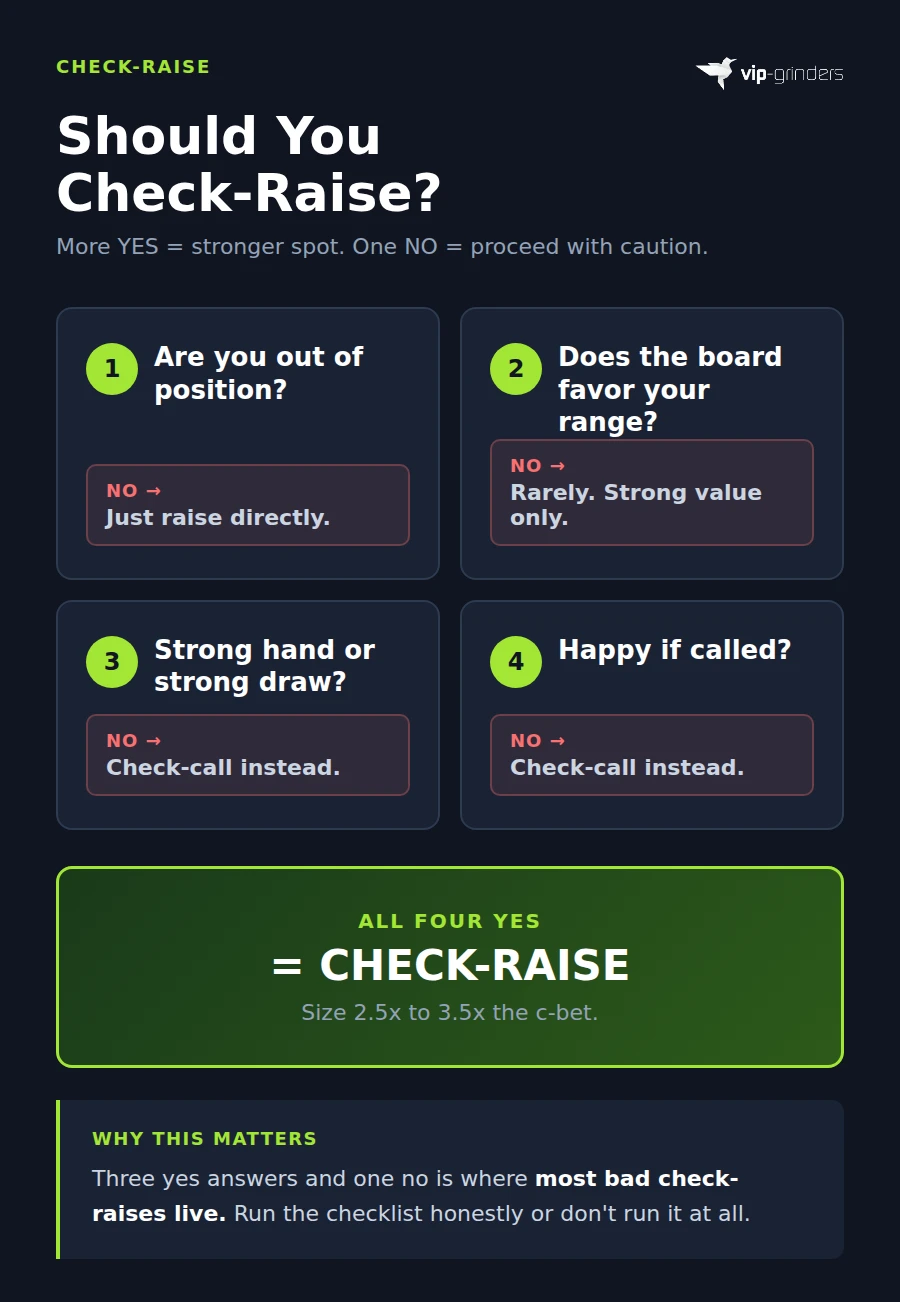
Not every check is a check-raise opportunity. Raising without the right conditions turns a profitable check-call into an expensive mistake. Three conditions drive every correct check-raise, and at least two must be present before you pull the trigger.
Condition 1: You Are Out of Position
Check-raising is almost exclusively an OOP play. In position, you can simply raise a bet directly. The check-raise exists because acting first is a disadvantage, and the raise compensates by turning that disadvantage into a trap.
The most common check-raise spot in poker is the big blind vs a preflop raiser’s c-bet. This spot comes up in roughly 15% to 25% of all hands you play from the big blind, depending on how often the raiser c-bets.
Condition 2: The Board Texture Supports It
Some boards favor the caller’s range enough to check-raise frequently. Others give the preflop raiser such a large range advantage that check-raising becomes a losing play at almost any frequency.
| Board Type | Example | Check-Raise Friendly? | Why |
|---|---|---|---|
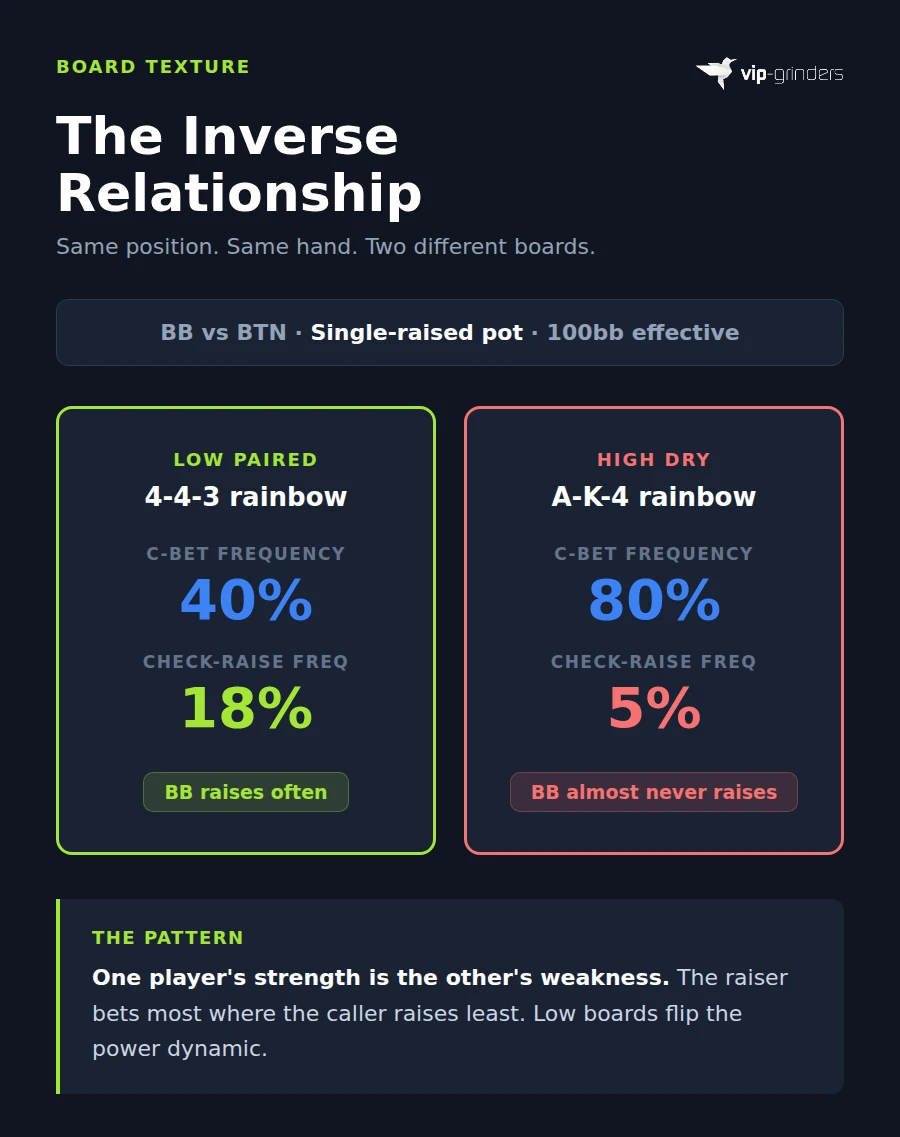
| Low connected | 8-5-2 rainbow | Yes (12% to 15%) | BB connects with two pair, sets, and straight draws the raiser misses. |
| Low paired | 4-4-3 rainbow | Yes (15% to 20%) | BB has trips more often. Raiser has overcards that fold. |
| Medium two-tone | J-T-6 two hearts | Moderate (10% to 12%) | Draws support semi-bluff check-raises. Both ranges connect. |
| High dry rainbow | A-K-4 rainbow | Rarely (4% to 6%) | Raiser has massive range advantage. Most BB hands fold or call. |
| Monotone | 9-6-3 all spades | Selective (8% to 10%) | Only raise with the flush or a strong draw to it. |
Condition 3: Your Hand Benefits from Building the Pot Now
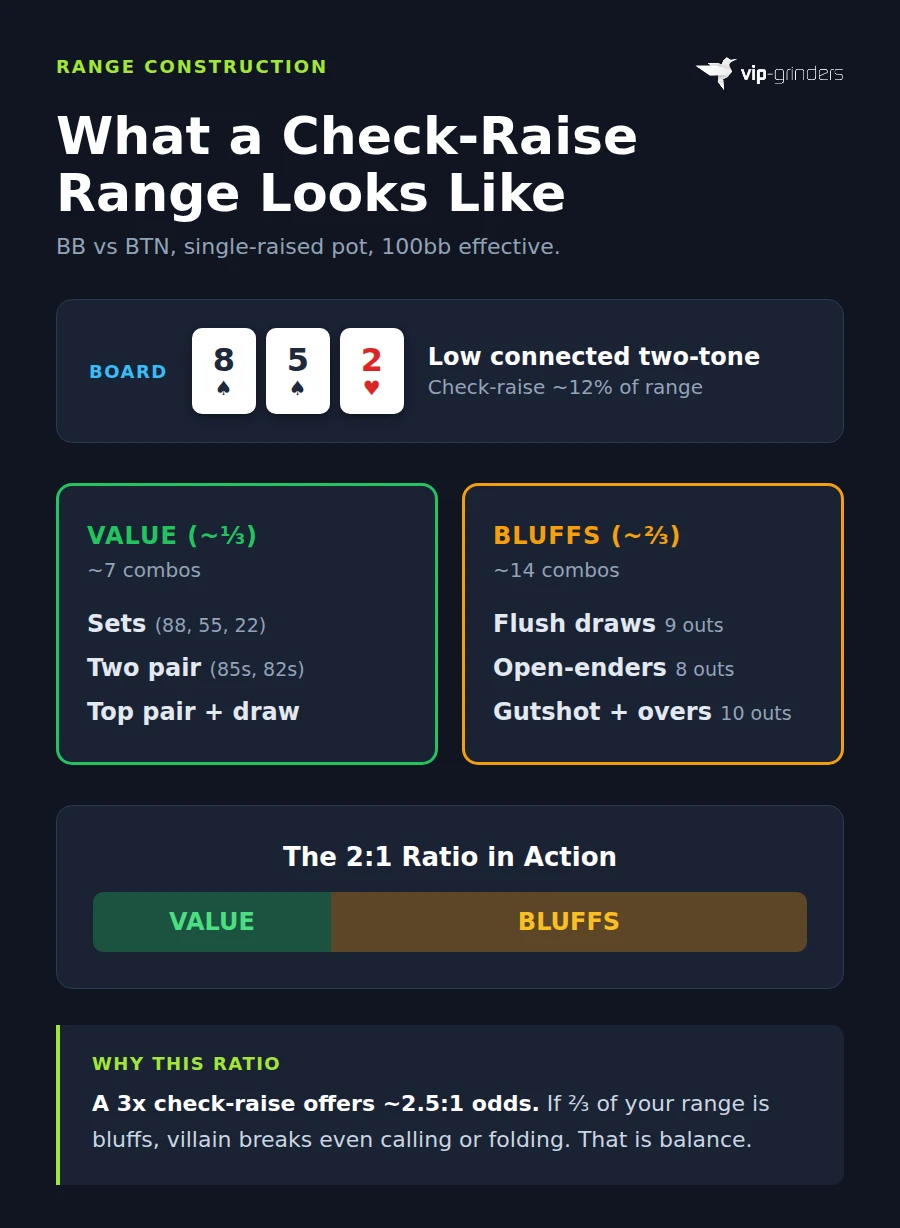
Two hand categories benefit from a check-raise. The first is strong made hands that want a bigger pot: sets, two pair, and strong top pair on boards with draws that threaten you. These hands want to build the pot before a scare card kills your action.
The second is draws with enough equity to semi-bluff: flush draws, open-ended straight draws, and combo draws. These hands have 30% to 50% equity when called, which means the check-raise profits from fold equity now AND from hitting on later streets when called.
Hands in between are usually better as check-calls. Weak top pair, second pair with no draw, and ace-high hands do not want to inflate the pot against the top of the c-bettor’s range. Check-calling for pot control keeps the pot small and lets them realize their equity cheaply.
Check-Raise Sizing by Board Texture
The size of your check-raise determines how much equity you deny to draws and whether your bluffs need to work often enough to be profitable. The bet sizing guide covers the full street-by-street system. This section covers the specific math for check-raises.
The 2.5x to 3.5x Rule
The standard check-raise size is 2.5x to 3.5x the c-bet. On dry boards, size smaller. On wet boards where you need to charge draws, size larger.
| Board Texture | C-Bet Size | Check-Raise Size | Multiplier | Why |
|---|---|---|---|---|
| Dry (K-7-2 rainbow) | 2bb into 7bb | 5bb to 6bb | 2.5x to 3x | Few draws to charge. Smaller size keeps bluffs cheap. |
| Semi-wet (Q-9-4 two-tone) | 3bb into 7bb | 9bb to 10bb | 3x to 3.3x | One major draw. Price it out without overcommitting. |
| Wet (J-T-8 two-tone) | 3bb into 7bb | 10bb to 11bb | 3.3x to 3.5x | Multiple draws. Maximize denial. Only raise strong hands and strong draws. |
A minimum check-raise on a wet board offers roughly 5:1 odds, which makes flush draws and open-enders easy calls. Sizing up to 3x or 3.5x pushes the required equity above 28%, which folds out most single draws.
Too large overcommits your stack with bluffs and risks building a pot you cannot control. The 2.5x to 3.5x range balances these forces across most board types and stack depths.
When to Jam Instead of Raise
Below 35bb effective, a standard check-raise commits too much of your stack to fold on a later street. If your raise would put more than 30% of your remaining stack into the pot, jamming is almost always better.
| Effective Stack | Check-Raise Action | Why |
|---|---|---|
| 60bb+ | Standard size (2.5x to 3.5x) | Full postflop play. Turn and river decisions remain meaningful. |
| 35bb to 60bb | Size to set up a turn jam | Your check-raise + a turn shove gets stacks in over two streets. |
| Below 35bb | Check-raise all-in or check-call | A standard raise commits too much to fold. Jam or do not raise. |
Which Hands to Check-Raise: Value vs Bluffs
A balanced check-raise range contains two groups: hands strong enough to build a pot for value and hands weak enough to bluff with but carrying enough equity to survive if called.
Value Check-Raise Hands
Your value check-raises should be hands you are happy to get called with. If villain calls and you wish you had just check-called instead, the hand does not belong in your value range.
- Sets: the cleanest value check-raise. Disguised hand that crushes top pair and overpairs. Build the pot while you are ahead of almost everything that continues.
- Two pair on wet boards: bottom two or top and bottom pair when flush or straight draws are present. Strong now but vulnerable to free cards, so the raise charges draws and denies equity. The equity denial guide covers the math behind protecting vulnerable made hands.
- Strong top pair with a draw: top pair plus a flush draw, or top pair top kicker on a board you need to protect. Current strength plus backup equity if the runout goes badly.
Top pair without a draw or without top kicker is usually a check-call, not a check-raise. It is strong enough to continue but not strong enough to want a big pot against the range that calls a raise.
Bluff Check-Raise Hands
The best check-raise bluffs have two features: equity if called and blockers to villain’s continuing range. Hands with both survive the spots where your bluff fails and succeed more often in the spots where it works.
- Flush draws: nine outs give you roughly 35% equity on the flop. If villain folds, you win the pot now. If villain calls, you hit the flush by the river one in three times.
- Open-ended straight draws: eight outs and roughly 32% equity. Slightly weaker than flush draws because straights are harder for opponents to pay off, but still strong enough to semi-bluff on most textures.
- Gutshot plus overcards: a hand like A-J on a T-8-3 board has roughly 10 outs combined (four to the straight, six to top pair). That is enough equity to check-raise as a semi-bluff.
- Combo draws: flush draw plus straight draw. 45% to 55% equity when called makes you a slight favorite against most one-pair hands. The strongest bluff check-raise candidate.
Hands with zero equity and zero blockers make poor check-raise bluffs. If you hold 7-2 offsuit on an A-K-4 board, you have no draw, no pair, and no cards that reduce villain’s strong holdings. For the broader principles of when blockers matter, see the bluffing guide.
The 2:1 Bluff-to-Value Ratio
Solver output consistently shows a baseline of roughly 2 bluffs for every 1 value hand when check-raising the flop. A 3x check-raise offers the c-bettor about 2.5:1 odds, meaning they need roughly 28% equity to call.
| Check-Raise Size | Odds Offered to C-Bettor | Bluff-to-Value Ratio |
|---|---|---|
| 2.5x the c-bet | ~3:1 | ~1.5 bluffs per value hand |
| 3x the c-bet | ~2.5:1 | ~2 bluffs per value hand |
| 3.5x the c-bet | ~2.2:1 | ~2.5 bluffs per value hand |
You do not need to count exact combos at the table. For every set or two pair you check-raise, include roughly two flush draws or straight draws as bluffs. That gets you close to the solver ratio across most textures.
Check-Raising on the Flop, Turn and River
Check-raises happen on all three postflop streets, but their frequency, purpose, and hand selection change dramatically from flop to river.
Flop Check-Raises
The flop is where 80%+ of all check-raises occur. Draws hold their highest equity here (flush draws at 35%, open-enders at 32%) and a check-raise forces them to pay the most to continue. Many opponents also c-bet 50% to 70% of their range on the flop, which means a large portion is weak and folds to a raise.
The continuation betting guide covers what c-bet ranges look like by board texture. The short version: the wider your opponent c-bets, the more profitable your check-raises become.
Match your flop check-raise range to the board texture frequencies from the conditions table. On low connected boards (8-5-2 type), check-raise 12% to 15% of your range with a 2:1 bluff-to-value ratio. On high dry boards (A-K-4 type), drop to 4% to 6% and weight heavily toward value.
Turn and River Check-Raises
Turn check-raises are far less common and should be heavily polarized: the nuts or near-nuts for value, and strong semi-bluffs with 10+ outs. Two specific spots produce most turn check-raise opportunities.
- Turn after you check-called the flop: you called the flop c-bet with a draw or a slow-played strong hand. The turn completes your draw or bricks and you go for maximum value. Size to 2.5x to 3x the turn bet.
- Turn after the flop checked through: both players checked the flop. Villain bets the turn as a delayed c-bet. Their range is capped because they skipped a street where they would have bet strong hands. A check-raise here targets that capped range and often wins the pot immediately.
After a turn check-raise, the plan is simple: if called, jam the river. There is rarely enough stack left for a third street of non-all-in betting at 100bb stacks.
River check-raises are the rarest and most exploitative line in poker. You need the nuts or very close to it for value, because villain is calling your raise with only the strongest part of their range. River check-raise bluffs require villain to bet thinly with a hand they cannot fold, while you hold blockers to the nut hands.
Check-Raises in Tournaments and Short Stacks
Everything above applies to cash games at 100bb stacks. In tournaments, two forces change the check-raise math: shrinking stacks simplify the decision to jam or check-call, and ICM pressure changes how often your bluffs succeed.
At short stacks (15bb to 35bb), the check-raise collapses into a binary decision: check-raise all-in or check-call. Standard sizing does not exist because any non-all-in raise commits too much of your stack to fold on the turn. The hands that jam are tighter: top pair top kicker or better for value, and flush draws or combo draws for bluffs.
Near the money bubble, check-raise bluffs become more powerful. Medium stacks fold wider than pot odds suggest because busting before the payout costs more in prize equity than the chips at risk.
| Tournament Stage | Check-Raise Adjustment | Why |
|---|---|---|
| Early and middle stages | Same as cash games | ICM pressure is minimal. Chip EV equals prize EV. |
| Approaching the bubble | More bluff check-raises, smaller sizing | Medium stacks overfold to protect their position. |
| On the bubble | Maximum bluff check-raise frequency | ICM makes calling a tournament life decision for medium stacks. |
| Final table pay jumps | Target medium stacks, avoid the chip leader | Medium stacks ladder. Chip leader faces minimal ICM pressure. |
The biggest tournament check-raise mistake is never bluff check-raising on the bubble. This is the single most profitable spot for check-raise bluffs in all of poker. Players who only check-raise for value near the bubble leave the largest edge on the table.
How to Defend When You Face a Check-Raise
You will face check-raises far more often than you execute them, because every time you c-bet into a player acting before you, they have the option to raise.
| Your Hand | Response | Why |
|---|---|---|
| Air (no pair, no draw) | Fold | You have nothing. The check-raise priced you out. |
| Weak draw (gutshot, backdoor) | Fold (usually) | Not enough equity to call a raised pot. |
| Strong draw (flush draw, open-ender) | Call | You have 30%+ equity. See the turn and re-evaluate. |
| Top pair good kicker | Call | Strong enough to continue but not to escalate. |
| Overpair | Call (sometimes re-raise) | Re-raise on dry boards. Call on wet boards. |
| Two pair or better | Call or re-raise | Call to trap on dry boards. Re-raise on wet boards to deny draws. |
The most common mistake when facing a check-raise is folding too often with one-pair hands. At low and mid stakes, most opponents check-raise with a 2:1 bluff-to-value ratio, which means two thirds of their check-raises are bluffs. Folding top pair every time gives them a free license to print money.
Against aggressive regs who check-raise 15%+ of their range, call wider because their range includes many bluffs. Against passive recreationals who check-raise below 5%, fold everything except the top of your range because they almost always have two pair or better.
The 5 Most Expensive Check-Raise Mistakes
Most check-raise leaks are frequency errors, not hand selection errors. These five mistakes show up more than any others in hand history reviews at low and mid stakes.
- 1Never check-raising from the big blind. If your flop check-raise frequency is below 5% across all board textures, the c-bettor can bet any two cards profitably because your check never threatens them. Fix: start on low connected boards (8-5-2 type) where your range connects best. Add two bluffs for every value hand.
- 2Check-raising only for value. If you only check-raise with sets and two pair, your range is face-up strong. Villain folds every time except when they hold a monster, and you never get paid. Fix: add flush draws and straight draws as bluffs at a 2:1 ratio.
- 3Undersizing the check-raise on wet boards. A minimum raise (2x the c-bet) on J-T-8 two-tone offers roughly 5:1 odds. Every draw in the deck calls profitably. Fix: size to 3x or 3.5x the c-bet to push required equity above 28%.
- 4Check-raise bluffing with hands that have showdown value. Second pair on a dry board wins at showdown often enough to be a profitable check-call. Turning it into a bluff risks a hand already making money. Fix: bluff with hands that have equity but no showdown value (flush draws, open-enders, gutshot plus overcards).
- 5Using the same frequency on every board. Check-raising 12% on A-K-4 rainbow (where the raiser dominates) is burning money. Check-raising 4% on 8-5-2 rainbow (where the BB connects) is leaving money behind. Fix: low boards = raise more, high boards = raise less.
At stakes below NL200, the average flop check-raise frequency from the big blind is 6% to 8% while solvers recommend 10% to 15%. That gap is pure money left on the table. The fix: identify the three to four board categories where your frequency should be highest (low paired, low connected, medium two-tone) and look for check-raise spots every time those boards appear.
Frequently Asked Questions
What is a check-raise in poker?
A check-raise is the act of checking to your opponent, waiting for them to bet, and then raising that bet in the same round of action. It is primarily used by the out-of-position player (usually the big blind) to build pots with strong hands, deny equity to draws, and balance the checking range so opponents cannot c-bet freely.
Is check-raising legal in poker?
Yes. Check-raising is legal in every major poker format, at every online poker room, and in virtually every live cardroom worldwide. Some older home games restricted it under “no sandbagging” rules, but those restrictions have disappeared from all standard play.
How big should a check-raise be?
The standard check-raise size is 2.5x to 3.5x the c-bet. On dry boards with few draws, 2.5x to 3x is enough. On wet boards with multiple draws, 3x to 3.5x denies correct odds. Below 35bb effective, the check-raise simplifies to all-in or check-call because standard sizing commits too much of your stack to fold on later streets.
When should I check-raise vs check-call?
Check-raise with hands that want a bigger pot: sets, two pair, strong top pair on wet boards, flush draws, and combo draws. Check-call with hands that are strong enough to continue but do not want to inflate the pot: weak top pair, second pair, gutshots without extra equity. The two-question test from this guide gives you the decision rule for every spot.
What is the best hand to check-raise with?
Sets are the cleanest value check-raise because they crush everything that calls. For bluffs, flush draws are the strongest candidates because they have 35% equity when called and win the pot immediately when villain folds. The ideal check-raise range combines both at a ratio of roughly 1 value hand to 2 bluffs.
How often should I check-raise from the big blind?
Solvers recommend 10% to 15% of your flop range across all board textures combined. This breaks down by board type: 15% to 20% on low paired boards, 12% to 15% on low connected boards, 10% to 12% on medium two-tone boards, 4% to 6% on high dry boards, and 8% to 10% on monotone boards. Most low-stakes players check-raise only 6% to 8%, which is too infrequent.
How do I defend against a check-raise?
Against a balanced opponent, fold air and weak draws, call with strong draws and top pair, and re-raise with two pair or better. Against aggressive opponents who check-raise 15%+ of their range, call wider. Against passive opponents who check-raise below 5%, fold everything except the top of your range because they almost always have a strong hand.
Does check-raising work in tournaments?
Yes, and it becomes even more powerful near the money bubble. ICM pressure makes medium stacks fold wider to check-raises because busting before the payout costs more in prize equity than the chips they risk by calling. At short stacks (below 35bb), the check-raise simplifies to all-in or check-call because standard sizing commits too much of your stack.
Should I check-raise in multiway pots?
Rarely with bluffs. In a three-way pot, your check-raise needs two opponents to fold for a bluff to succeed. If each folds 60% individually, both fold together only 36% of the time. Check-raise multiway almost exclusively with strong value (two pair or better) and combo draws with 12+ outs. Single draws become check-calls because fold equity drops too far.
What is the check-raise bluff-to-value ratio?
Solvers recommend roughly 2 bluffs for every 1 value hand when check-raising the flop. This ratio comes from the pot odds the raise offers your opponent. At 3x the c-bet, the c-bettor gets about 2.5:1 odds and needs 28% equity to call. Two bluffs per value hand keeps them from auto-folding or auto-calling profitably.