

Value Betting & Thin Value: How to Extract Maximum 2026
A value bet is a bet you make because you expect to be called by a worse hand more often than by a better hand. If your hand beats more than half of the hands your opponent will continue with, betting is more profitable than checking. That single test drives every value betting decision in poker.

Most players lose far more money from missed value bets than from bad bluffs. Checking back the river with the winning hand, undersizing against opponents who would have called more, or refusing to bet thin when the math supports it: these leaks quietly drain win rates month after month. Fixing them is the fastest way to move from breakeven to profitable.
Here is what this guide covers:
- The 50% equity rule that separates a value bet from a bad bet and how sizing changes by opponent type
- The three thin value checks that tell you when a marginal river bet is correct
- Tournament and live adjustments where ICM and player tendencies change the math
- The five most expensive value betting mistakes and how to fix each one
What Makes a Bet a Value Bet
The test is simple: if your hand beats more than 50% of the hands your opponent will call with, betting for value is profitable. If it beats less than 50%, your bet is either a bluff or a mistake. Everything in this guide builds on that single threshold.
Notice the key phrase: “hands your opponent will call with.” You are not measuring your equity against their entire range but against the narrower slice that continues after your bet. The only question is whether you are ahead of what stays in the pot.
The Value Spectrum: Fat, Thin, and Merged
Not all value bets carry the same margin. Some are easy decisions you would never check, while others sit right on the edge where one wrong read turns a profitable bet into a loss. The table below maps the three types you will encounter.
| Type | Your Edge Over the Calling Range | Example | Risk Level |
|---|---|---|---|
| Fat value | You beat 70% or more of calls | Top set on a dry board | Low. Bet every time. |
| Thin value | You beat 50% to 60% of calls | Second pair on a static river | Medium. Requires a read. |
| Merged | You beat some calls, lose to others, but the bet is still +EV | Top pair weak kicker on a wet board | High. Sizing matters most. |
Fat value is automatic: you have a strong hand, your opponent has worse hands that will pay you off, and there is no reason to check. Thin value is where most of the money lives, because it requires you to estimate your opponent’s calling range accurately and choose a size that keeps worse hands in the pot. Merged value is the hardest category: your hand is good enough to bet but not good enough to withstand a raise, so your sizing and read have to be precise.
The skill gap between breakeven and winning players almost always sits in the thin value zone. A player who bets fat value and checks everything else is leaving money on the table every session.
Value Bet vs Bluff vs Protection Bet
Three bet types exist, and confusing them costs chips. Each one wants a different response from your opponent.
- Value bet: you want a call. You are ahead of the hands that continue and your profit comes from worse hands paying you off.
- Bluff: you want a fold. You are behind and your profit comes from better hands giving up. For the full math on when bluffing is profitable, see our dedicated guide.
- Protection bet: you want to deny equity. You may or may not be ahead right now, but giving a free card lets draws catch up. The bet profits by preventing your opponent from realizing their equity for free.
The Math Behind Every Value Bet
Value betting is not a feel play. Every value bet has a specific number attached: your equity against the hands that call. If that number is above 50% the bet makes money, and if it is below 50% you are paying your opponent to show you a better hand.
Equity Against the Calling Range
Your equity in a value betting spot is not measured against your opponent’s full range. It is measured against the narrower set of hands they will actually continue with after your bet. That distinction changes the math on almost every river decision.
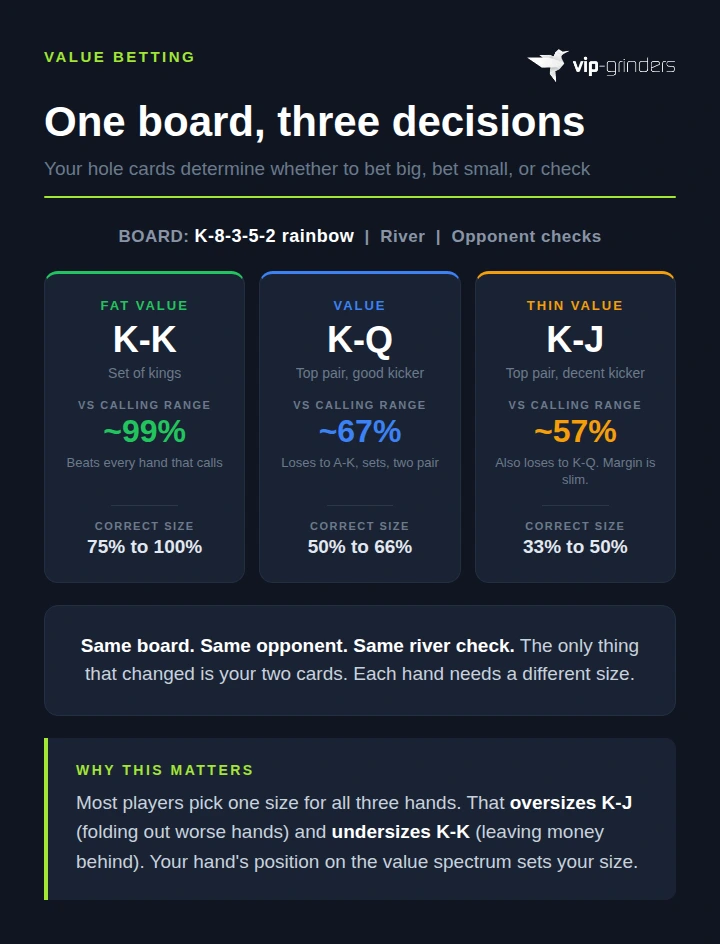
You hold K-Q on a final board of K-8-3-5-2 rainbow. Your opponent’s full range after calling the flop and turn might include any king, any eight, pocket pairs from 99 to QQ, and some missed straight draws. When you bet the river the missed draws fold, leaving a calling range of mostly kings, pocket pairs, and the occasional slow-played set.
Against that calling range, K-Q beats every Kx worse than K-Q (K-J, K-T, K-9 and below), every pocket pair, and every eight. It loses to K-A, sets, and two pair. Run the numbers and K-Q is ahead of roughly 65% to 70% of calls, which is a clear value bet.
| Hand Category in Calling Range | How K-Q Performs |
|---|---|
| Worse kings (K-J, K-T, K-9 and below) | Ahead |
| Pocket pairs (99 to QQ) | Ahead |
| Eights that call (A-8, 8-7) | Ahead |
| Better kings (A-K) | Behind |
| Sets and two pair | Behind |
How Sizing Changes the Calling Range
The size of your bet directly changes which hands your opponent continues with. A small bet keeps a wider calling range in the pot, which includes more weak hands you beat. A large bet narrows the calling range to stronger hands, which shifts the equity balance against you.
This is the core tension in value bet sizing: a bigger bet wins more per call, but it gets called by fewer worse hands.
| Your Bet Size | Typical Calling Range | Your Equity vs Callers | EV Per Bet |
|---|---|---|---|
| 33% pot | Wide: any pair, weak top pair, stubborn draws | Higher (you beat more of what calls) | Smaller pot, but called more often |
| 66% pot | Medium: top pair decent kicker, overpairs | Moderate | Balanced: good size, reasonable call rate |
| 100% pot | Narrow: strong top pair, two pair, sets | Lower (you lose to more of what calls) | Big pot, but called only by hands that beat you more often |
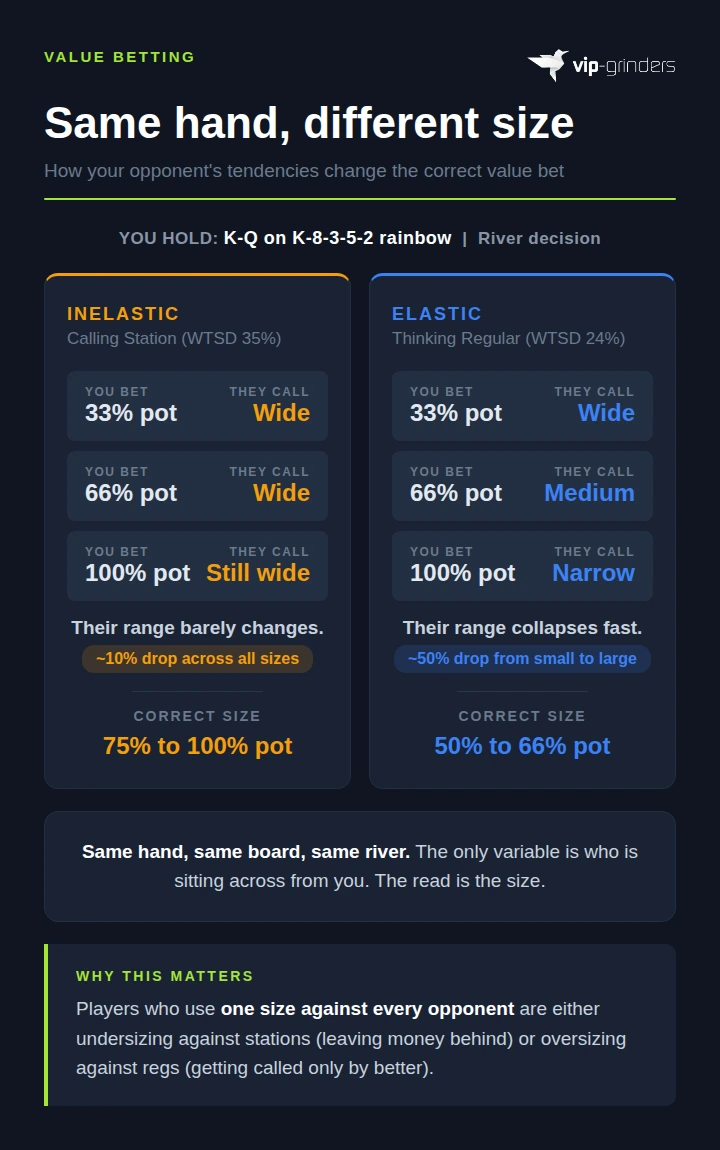
Some opponents barely adjust their calling range based on bet size: a calling station who calls 33% pot with middle pair will also call 75% pot with middle pair, so sizing up extracts more money. Other opponents tighten significantly as the bet grows, and against them smaller bets keep worse hands in the pot and produce higher total EV. Identifying which type you face is the single most important read for value bet sizing.
The poker term for this is elasticity. An elastic opponent adjusts their calling range sharply by size: bet small and they call wide, bet big and they fold most hands. An inelastic opponent calls roughly the same range no matter what you bet.
Four Factors That Control Every Value Bet Decision
The 50% rule tells you whether a value bet is profitable. These four factors tell you whether the spot in front of you passes that test. Check them in order before every value bet, especially on the turn and river where the decision matters most.
1. Opponent’s Tendencies
The single biggest factor. A calling station makes thin value bets profitable that would be check-behinds against a tight player. The table below maps the key stats to your adjustment.
| Opponent Stat | Threshold | What It Means for Value Betting |
|---|---|---|
| WTSD (Went to Showdown) | Above 30% | Calls too much. Go thinner with value bets. Size up. |
| WTSD | Below 22% | Folds too much postflop. Only bet fat value. Bluff more instead. |
| Fold to River Bet | Above 55% | Overfolds rivers. Thin value is risky (only strong hands call). |
| Fold to River Bet | Below 40% | Underfolds rivers. Bet thinner and larger. They pay off. |
Without a HUD, use table behavior as a proxy: a player who has called three streets in two of the last five hands is almost certainly a high-WTSD opponent, while a player who has folded to every river bet is almost certainly low-WTSD. Adjust accordingly even without exact numbers. For a full breakdown of the six recreational player types and the specific adjustments for each, see our guide to identifying and exploiting fish.
2. Board Texture
Static boards hold your hand’s value across streets. Dynamic boards shift it every card.
On a static board like K-8-3-7-2 rainbow, your top pair stayed top pair from flop to river. Nothing changed. Value betting is straightforward because the hands your opponent calls with on the flop are still the same relative strength on the river.
On a dynamic board like J-T-8-Q with a flush completing on the river, your overpair may have gone from the best hand to a bluff-catcher in one card. Value betting on dynamic boards requires tighter hand selection and more attention to which draws completed. For how board texture interacts with range and nut advantage, see the range advantage guide.
3. Your Hand’s Vulnerability
A vulnerable hand can be outdrawn on the next street. A non-vulnerable hand cannot. This distinction tells you when to bet now versus when you can afford to check and let your opponent catch up.
- High vulnerability: top pair on a wet board with flush and straight draws available. Bet now. Every free card risks losing your edge.
- Low vulnerability: a set on a dry rainbow board. You can check one street to let your opponent catch a pair or pick up a draw they will pay you off with. Slow-playing is an option here because almost nothing outdraws you.
- Medium vulnerability: overpair on a board with one draw. Bet for value now, but choose a size that keeps worse pairs calling while charging the draw.
The common mistake is treating vulnerability and value as the same thing. A hand can be valuable (ahead of most calls) but not vulnerable (nothing realistic outdraws it). In that case, checking to induce a bet or let your opponent improve is often higher EV than betting immediately.
4. Stack Depth and SPR
The stack-to-pot ratio (SPR) on the flop shapes how aggressively you can value bet across multiple streets. In a 3-bet pot with an SPR of 4 to 7, your value bets commit a large percentage of the remaining stack, which simplifies decisions: bet, get called, and often play for stacks by the river.
In a single-raised pot with an SPR of 10 to 15, three streets of value betting requires planning. Each bet needs to be sized so the total action across all streets makes sense relative to the remaining stacks. Betting too large on the flop can bloat the pot beyond what your hand justifies by the river.
Low SPR spots favor wider value betting because the commitment math is simpler. High SPR spots favor selective value betting because the risk of playing a large pot with a marginal hand increases. For how SPR interacts with continuation betting decisions on the flop, see our dedicated guide.
Value Bet Sizing
The elasticity read from the last section tells you whether to go big or small. This section turns that read into specific numbers by opponent type and shows you how to plan sizing across multiple streets when you expect to bet for value on the flop, turn, and river.
Size by Opponent Type
The right value bet size depends more on who you are betting against than on what you hold. The table below gives default sizing ranges for four common profiles.
| Opponent Type | Value Bet Size | Why This Size Works |
|---|---|---|
| Calling station (WTSD above 30%) | 75% to 100% pot | Calls the same range regardless of size. Bigger bet extracts more per call. |
| Thinking regular (WTSD 24% to 28%) | 50% to 66% pot | Adjusts calling range by size. Mid-range keeps worse hands calling. |
| Tight nit (WTSD below 22%) | 33% to 50% pot | Only calls with strong hands. Small bet gets paid by the narrow range that continues. |
| Unknown | 66% pot | The default that loses the least against any type. Adjust after 50+ hands of data. |
These are river defaults. On earlier streets, your sizing also needs to account for future bets, which is where geometric sizing comes in.
Geometric Sizing: Planning Three Streets of Value
When you flop a strong hand and plan to bet for value on all three streets, each bet should build the pot so that your river bet puts your opponent near a commitment decision. Betting too large on the flop means the pot is already bloated by the river. Betting too small means you miss value across the hand.
The principle is simple: divide the total money you want to get in across three bets that grow proportionally with the pot. Here is what that looks like at 100bb starting stacks in a single-raised pot.
- Flop (pot 7bb): bet 33% pot (~2.3bb). Pot grows to ~11.6bb.
- Turn (pot ~11.6bb): bet 50% pot (~5.8bb). Pot grows to ~23.2bb.
- River (pot ~23.2bb): bet 75% pot (~17.4bb). You have invested ~25.5bb across three streets, and the final pot is ~58bb.
The sizing escalates naturally: small on the flop, medium on the turn, larger on the river. Each bet is a reasonable percentage of the current pot, but the total builds a pot size that extracts close to a full buy-in from opponents who call all three streets. The key is planning backward from the river amount you want, not forward from the flop.
In 3-bet pots where the SPR starts lower, the same principle applies but the number of streets shrinks. A flop bet of 33% pot followed by a turn shove is often the correct geometric plan because there is not enough money behind for three comfortable bets.
When to Overbet for Value
Overbetting (betting more than the pot) is correct in one specific situation: you have nut advantage and your opponent’s range is capped at one pair or worse. The overbet exploits the gap between the strongest hand you can have and the strongest hand they can have.
This is an advanced tool that belongs in a small number of spots. The overbetting guide covers when large sizings print money and when they backfire. For now, the rule is: if your opponent cannot have two pair or better and you can, an overbet extracts more than a standard sizing.
Thin Value: The Skill That Separates Winners
Fat value bets are easy. You have a strong hand, your opponent has weaker hands that call, and the decision is automatic. Thin value is where the real money lives, because most players check these spots out of fear and leave profit on the table hand after hand.
A thin value bet is a bet where your hand beats only a slim majority of your opponent’s calling range. You are ahead of roughly 50% to 60% of the hands that continue. The margin is small, which means the decision depends entirely on your read and the spot.
Three Checks Before Betting Thin
Run these in order before every thin value bet. If all three pass, bet. If two or more fail, check.
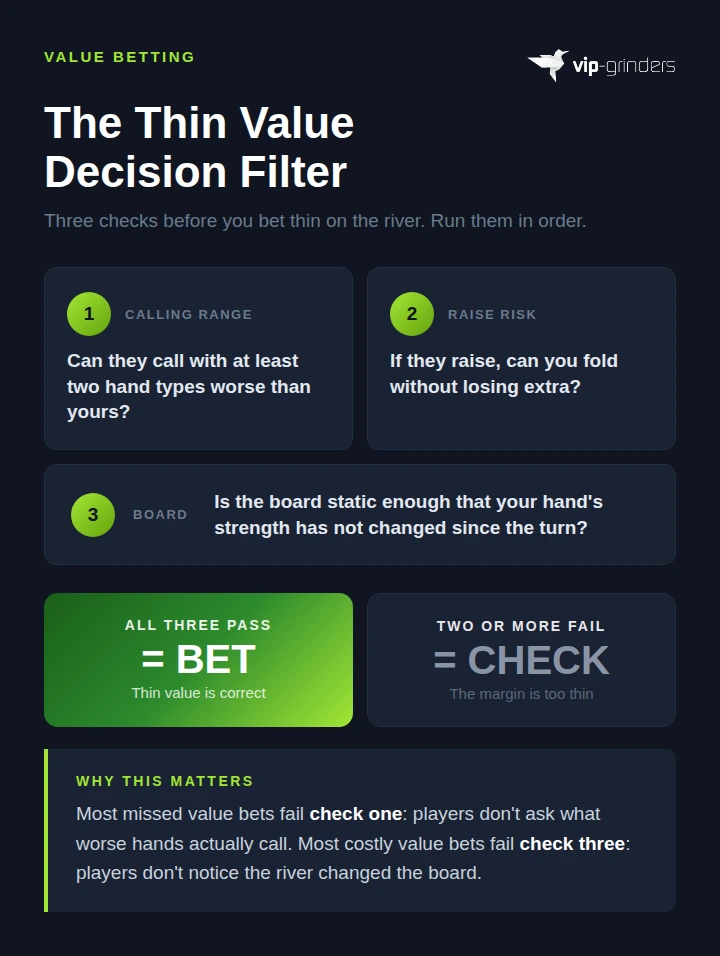
- 1Can your opponent call with at least two hand types worse than yours? For a thin value bet to work, you need multiple worse hands in the calling range. If only one hand type is worse and everything else beats you, the bet is too thin.
- 2If your opponent raises, can you fold without losing extra? At low and mid stakes, river raises are almost always value. If your opponent’s raise frequency is below 10% (which covers most players at NL50 and below), you can bet thin and fold to a raise without the raise risk canceling your profit.
- 3Is the board static enough that your hand’s relative strength has not changed since the turn? If the river completed a flush or straight draw, hands that were behind you on the turn now beat you. Your thin value bet gets called primarily by the hands that improved, which flips the equity against you.
The third check is where most players go wrong. They bet the river for thin value without noticing the board changed on the last card. A hand that was a clear value bet on the turn can become a check-behind on the river if the wrong card falls.
Worked Example: A-T on K-T-5-3-7 Rainbow
You hold A-T in position on a final board of K-T-5-3-7, all rainbow. Your opponent check-called the flop and turn, then checks the river. Should you bet?
Run the three checks.
- 1Two worse hand types that call? Yes. Worse tens (Q-T, J-T, T-9) and pocket pairs like 88 or 99 that called two streets and will look you up on the river. Two categories of worse hands that call. Check one passes.
- 2Can you fold to a raise? Yes. At low stakes, a river check-raise here is almost always two pair or better. You fold A-T comfortably. Check two passes.
- 3Is the board static? Yes. K-T-5-3-7 rainbow has no flush completed and no obvious straight completed. Your second pair with the ace kicker is the same relative strength it was on the turn. Check three passes.
All three checks pass: bet 50% pot. Your opponent calls with J-T and you take down the pot. That extra half-pot bet is money most players leave on the table by checking behind out of fear.
When Checking Is Better Than Thin Value
Thin value is not always correct. When your hand has showdown value but does not pass the 50% test, pot control is the better approach. Three spots where checking the river wins more than betting.
- Your opponent raises rivers often (above 12%): the raise risk eats the thin profit from getting called by worse. Against aggressive river players, check and call instead of betting and facing a raise.
- The river completed a draw: a third flush card or a four-straight board means some hands that were behind you just got there. Your thin value bet now gets called disproportionately by the hands that beat you.
- You block the hands you want your opponent to call with: if you hold T-9 on a ten-high board, you block many of the worse tens that would pay you off. Fewer worse calling combos means thinner margin, which pushes the math below 50%.
The decision is always the same three checks: if they pass, bet, and if they fail, check. Over thousands of hands, this filter catches the river bets that cost chips and clears the river bets that print them.
Value Betting in Tournaments and Live Poker
Everything so far applies to online cash games where every chip is worth the same amount. Tournaments and live poker both change the value betting math in ways that most strategy content ignores entirely.
Tournament Thin Value and ICM
In cash games, winning 10bb and losing 10bb have equal impact on your bankroll, but in tournaments they do not. Near the money bubble and at final tables, losing chips costs more in prize equity than winning the same number of chips gains. This is the core of ICM (Independent Chip Model), and it directly affects how thin you should value bet.
The adjustment is straightforward: in the early and middle stages of a tournament where stacks are deep and ICM pressure is low, value bet at the same width as a cash game. Near pay jumps, tighten your value range because the downside of getting raised or called by better outweighs the upside of extracting thin value.
| Tournament Stage | Value Betting Adjustment | Why |
|---|---|---|
| Early and middle stages | Bet as wide as cash games. Go thin freely. | ICM pressure is minimal. Chip EV equals prize EV. |
| Approaching the bubble | Tighten to fat value only against medium stacks. | Medium stacks are tight because busting before the money costs them the most. |
| On the bubble | Widen value against short stacks. Tighten against big stacks. | Short stacks are desperate. Big stacks can bust you. |
| Final table pay jumps | Tighten thin value. Avoid marginal spots. | Each pay jump adds real dollars. A thin value bet gone wrong costs more in equity than it gains. |
The biggest tournament mistake is value betting as wide on the bubble as you would in level three. The math is different because the chips are worth different amounts at different stages.
Live Poker Adjustments
Live low-stakes cash games ($1/$2 and $2/$5) have two features that change value betting compared to online play.
- Opponents call rivers far more often: live recreational players treat river calls as a cost of entertainment. Hands that would be check-behinds online become clear value bets live because the calling range is so much wider. Go thinner than you would online.
- River raises are almost always the nuts: live players at low stakes almost never bluff-raise rivers. This means thin value bets are safer live than online because the raise risk from the second thin value check is near zero. When they do raise, fold without hesitation.
The combination of wider calling and almost no bluff-raising makes live low-stakes poker the best environment for thin value betting. If you are used to checking back marginal hands online, force yourself to bet them live. The math supports it almost every time.
The 5 Most Expensive Value Betting Mistakes
Most players study bluffing leaks and preflop errors but never audit their value betting. The five mistakes below show up in hand history databases more than any other value betting errors, and each one has a specific fix you can apply in your next session.
- 1Checking back the river with the best hand: the most common and most expensive leak. Players check because they fear a raise, but at low and mid stakes river raises happen less than 10% of the time. Fix: if you would call a bet in this spot, you should almost always be betting yourself.
- 2Using one size for every opponent: betting 66% pot against a calling station and 66% pot against a nit leaves money on the table in both directions. Fix: use the opponent sizing table from this guide. Size up against inelastic callers, size down against elastic folders.
- 3Betting thin against players who raise rivers frequently: thin value becomes a losing play when your opponent check-raises at above 12%. The raise risk wipes out the small profit from getting called by worse. Fix: run the three thin value checks before firing. If check two fails, check behind.
- 4Value betting without a multi-street plan: betting the flop for value and then checking the turn and river gives your opponent a free showdown with hands that would have called two more streets. Fix: before you bet the flop, decide how many streets you plan to bet and use geometric sizing to build the pot. The bet sizing guide covers the full street-by-street sizing plan.
- 5Confusing value with protection: betting top pair on a wet board to protect against draws is valid, but the sizing should target the hands you want to call, not the hands you want to fold. Fix: before choosing your size, ask what worse hands call. If the answer is none, your bet is protection, not value, and the sizing math changes.
Every mistake on this list costs fractions of a big blind per hand, and over thousands of hands a month those fractions compound into the difference between a breakeven grinder and a profitable one. If you are unsure which leak costs you the most, filter your hand history database for river decisions where you checked back and won at showdown. The total pot size across those hands is roughly how much thin value you left on the table.
Frequently Asked Questions
What is a value bet in poker?
A value bet is a bet made when your hand beats more than 50% of the hands your opponent will call with. The profit comes from worse hands paying you off, not from folds. If your hand is behind more often than it is ahead when called, the bet is a bluff, not a value bet.
What is thin value?
Thin value is a bet where your hand beats only a slim majority (roughly 50% to 60%) of your opponent’s calling range. The margin is small, which means the decision depends on your read of the opponent, the board texture, and whether your opponent is likely to raise. Run the three checks from this guide before every thin value bet.
How do you size a value bet?
Size depends on your opponent’s elasticity. Against calling stations who call the same range regardless of size, bet 75% to 100% pot to extract maximum value. Against thinking regulars who tighten their calling range as the bet grows, bet 50% to 66% pot to keep worse hands in. Against tight players, 33% to 50% pot gets paid by the narrow range that continues. When unsure, 66% pot is the default.
Should you value bet on the river?
Yes, whenever the three thin value checks pass. Most players check back the river with the winning hand far too often. At low and mid stakes, river raises happen less than 10% of the time, which means the fear of getting raised is costing you more than the raises themselves. If you would call a bet in this spot, you should usually be betting.
How do you adjust value betting against calling stations?
Size up and go thinner. Calling stations have a high WTSD (above 30%), which means they call with worse hands more often than the average opponent. Bet 75% to 100% pot with your value range because they pay off at the same rate regardless of size. Cut your bluffs against them entirely and focus on extracting maximum value from every made hand.
Does value betting change in tournaments?
Yes. In the early and middle stages, value bet at the same width as cash games because ICM pressure is minimal. Near the money bubble and at final table pay jumps, tighten your value range because losing chips costs more in prize equity than winning the same number of chips gains. The biggest tournament mistake is value betting the same width on the bubble as you would in level three.