

Continuation Betting: When to C-Bet, When to Check 2026
A continuation bet (c-bet) is a bet made on the flop by the player who was the last preflop aggressor. You raised before the flop, someone called, the flop came down, and you bet again. That second bet is the c-bet, regardless of whether you hit the board or missed completely.
The reason c-betting matters is that it is the single most frequent postflop decision in online poker. Getting this decision wrong by even 10% costs you more over a month than most preflop mistakes combined.
Here is what this guide covers:
- The five factors that control every c-bet decision including board texture, position, and range advantage
- Solver-era sizing defaults for dry, semi-wet, and wet boards
- How c-betting changes in 3-bet pots, multiway spots, and out of position
- The five most expensive c-bet mistakes and how to fix each one
Why Continuation Bets Work
The math behind c-betting is simple: your opponent misses the flop roughly two-thirds of the time. When you raised preflop and they called with a weaker range, most flops leave them with nothing worth continuing. A bet of any size forces them to make a decision with air, and most players fold.
That alone makes c-betting profitable in many spots even when you hold nothing yourself. But a c-bet is not always a bluff. You fire continuation bets with three types of hands, and knowing which category you fall into on each board is what separates a profitable c-bettor from someone burning chips.
- Value hands: you hit the flop and want to build the pot. Top pair with a good kicker, overpairs, sets. You bet because worse hands will call.
- Draws and semi-bluffs: you have equity to improve (flush draws, open-enders, backdoor combos) and want to either win the pot now or set up a profitable turn and river.
- Pure bluffs: you missed entirely but the board favors your range. You bet because your opponent folds often enough to make the bet profitable on its own.
The Five Factors That Control Every C-Bet Decision
Every profitable c-bet checks at least three of these five factors. Before you put chips in the middle on any flop, run through this list.
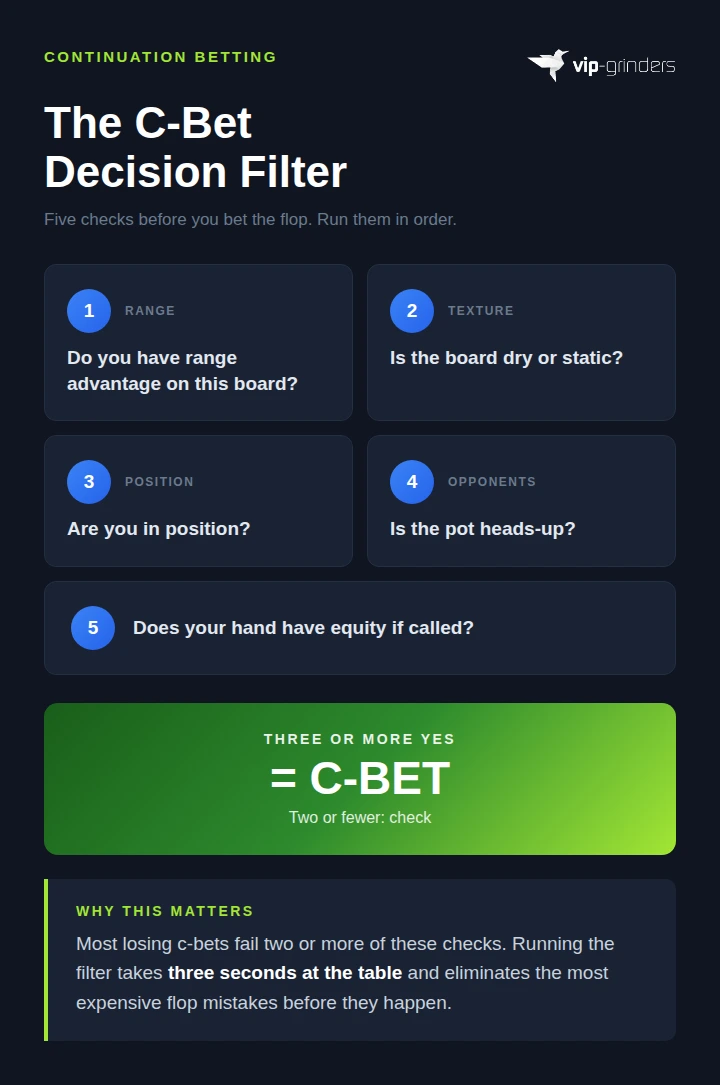
1. Board Texture
Board texture is the single biggest factor in your c-bet decision. A dry, static board like K-7-2 rainbow barely connects with your opponent’s calling range, so a small bet folds out most of their hands. A wet, connected board like J-T-8 with two hearts gives your opponent straight draws, flush draws, and pair-plus-draw combos that will not fold.
The table below shows how texture changes your approach on three common flop types.
| Flop Example | Texture | C-Bet Approach | Why |
|---|---|---|---|
| K-7-2 rainbow | Dry, static | Bet small (25% to 33% pot), high frequency | Opponent rarely connects. Small bet folds out most hands. |
| J-T-6 two-tone | Semi-wet | Bet medium (50% to 66% pot), selective | Draws exist. Need to charge for equity and protect your hand. |
| 8-7-6 monotone | Wet, dynamic | Check more often, bet large when you do | Opponent connects often. Bluffing is expensive and gets called. |
A useful shortcut: the wetter the board, the less often you should c-bet, and the larger your sizing should be when you do.
2. Position
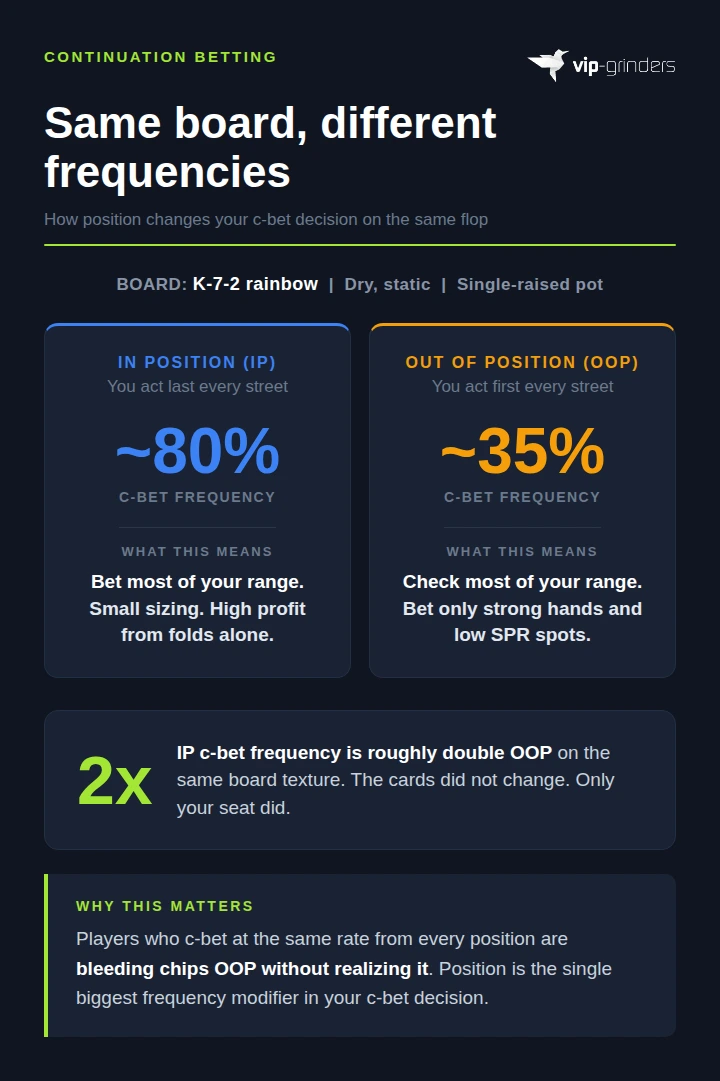
C-betting in position (IP), meaning you act after your opponent on every street, is significantly more profitable than c-betting out of position (OOP), where you act first. IP lets you see your opponent’s response before committing to a turn plan. OOP forces you to bet blind into their range and gives them the option to raise, call, or float with position for the rest of the hand.
Solvers reflect this clearly: a typical IP c-bet frequency on a dry board runs 50% to 85%, while the same player OOP on the same board drops to 30% to 35%. If you are unsure whether to bet, position is the tiebreaker. For a full breakdown of why seat matters more than cards, see the position guide.
3. Number of Opponents
Every additional player in the pot makes your c-bet less effective. Heads-up, you only need one opponent to fold. In a three-way pot, you need two opponents to fold, and the chance that at least one of them connected rises sharply.
As a rule of thumb, c-bet frequency drops by roughly 11% for each extra caller. In multiway pots, default to checking anything that is not a strong value hand or a draw with high equity. Save your bluff c-bets for heads-up situations where fold equity is highest.
4. Range Advantage
Range advantage means your overall range connects with the flop better than your opponent’s range. When you open from the cutoff and the big blind calls, a flop like A-K-4 rainbow heavily favors you because your range contains far more aces, kings, and big card combos than theirs.
On boards where you have range advantage, you can c-bet frequently with small sizes because your opponent is forced to fold a large portion of their range. On boards where ranges are closer (like 8-7-5 two-tone against a big blind caller), you lose that leverage and need to be more selective. For the full concept, including nut advantage and how it differs from range advantage, see the range advantage guide.
5. Stack Depth and SPR
The stack-to-pot ratio (SPR) on the flop shapes how your c-bet fits into a multi-street plan. In a single-raised pot with 100bb stacks, the SPR is typically around 10 to 15, which means there is enough money behind for three streets of betting. You need to plan your c-bet as the first step of a flop, turn, and river sequence.
In a 3-bet pot, the SPR drops to around 4 to 7, depending on the 3-bet sizing. The pot is already large relative to the remaining stacks, which means your c-bet commits a bigger percentage of your stack and simplifies later decisions. This is why c-bet frequencies in 3-bet pots are higher than in single-raised pots: the math favors betting more often when the SPR is low.
C-Bet Sizing: Three Sizes for Three Board Types
Most poker content still recommends c-betting half pot to three-quarters pot on every flop. That advice is outdated. Modern solvers have shown that the optimal c-bet size depends almost entirely on board texture and how polarized your betting range is.
The table below covers 95% of the flops you will face. Three default sizes, three board types.
| Board Type | C-Bet Size | When to Use | Example Flop |
|---|---|---|---|
| Dry, static | 25% to 33% pot | You c-bet wide with your whole range. Opponent folds often to any size, so a small bet risks less. | A-5-3 rainbow, Q-7-2 rainbow |
| Semi-wet, medium texture | 50% to 66% pot | Draws exist but the board is not fully connected. You need to charge draws while still getting calls from worse made hands. | J-T-4 two-tone, Q-9-6 one suit |
| Wet, highly connected | 75% to 100%+ pot | Your range is polarized (strong hands and bluffs, nothing in between). Bet large to deny equity and build a pot for your value hands. | 8-7-6 monotone, T-9-8 two-tone |
The logic behind small sizing on dry boards is counterintuitive at first. If your opponent folds K-7-2 rainbow to a 25% pot bet at roughly the same rate as a 66% pot bet, the smaller bet achieves the same result while risking less with your bluffs and losing less when called by better.
On wet boards, the dynamic flips. A small bet gives your opponent a cheap price to chase their draws, and they have enough equity to call correctly. A larger bet forces them to pay more than their draw is worth, which is how you profit from their continuing mistakes: the equity denial guide covers the full EV math behind protection bets.
C-Betting in Position
Playing IP as the preflop raiser is the most common c-bet scenario in online poker, and it is also the most profitable. You raised, one player called, and now you act last on every street. That positional advantage means you can c-bet wider, adjust your turn plan based on your opponent’s flop action, and give up cheaply when the board shifts against you.
On dry boards where you hold range advantage, solvers default to betting your entire range at 25% to 33% pot. The bet is so small that even your weakest hands profit from the folds they generate. On wetter textures, your frequency drops and your sizing goes up, but you are still betting more often IP than you would in the same spot OOP.
- You open A-Q offsuit from the cutoff. The big blind calls. Pot is 6.5bb.
- Flop: K-8-3 rainbow. Dry board, one overcard in your hand, two backdoor straight draws. You have clear range advantage (your cutoff range holds far more kings than a big blind calling range).
- Decision: c-bet 33% pot (~2bb). Your opponent folds most of their range to this size. If called, you still have six outs to top pair and backdoor equity. If raised, you fold cheaply because you only risked 2bb.
The key IP advantage is that checking back is also a strong play. When you hold a medium-strength hand like second pair or ace-high with no draw, checking keeps the pot small and lets you reach showdown without inflating the pot against hands that beat you: this is pot control. Good IP c-bettors do not bet every flop.
When to Check Back Instead of C-Betting IP
Checking back IP is not giving up. It is a deliberate play that protects your checking range and avoids building a pot you cannot win.
- You hold a medium-strength showdown hand: second pair, third pair, or ace-high on a board where better hands will not fold and worse hands will not call.
- The board connects heavily with your opponent’s range: flops like 9-8-7 two-tone when you opened from early position. Your range has fewer straights and two-pair combos than the big blind’s calling range.
- You have no backdoor equity: hands with zero chance of improving on the turn make poor c-bet bluffs because you have nothing to fall back on if called.
C-Betting Out of Position
C-betting OOP is where most players lose money without realizing it. The temptation is to bet every flop because you were the preflop aggressor, but acting first on every street means your opponent always gets the last word. They can call with position, float (call and see the next street without a strong hand), and raise when the board shifts in their favor.
Solvers confirm what experienced grinders already know: OOP c-bet frequencies are roughly half of IP frequencies on most board textures. On a dry K-7-2 rainbow where you would bet 80% of your range IP, the correct OOP frequency drops to around 35% to 40%. On wet boards, OOP c-betting drops even further, sometimes below 25%.
The boards where OOP c-betting IS correct share two features: you have a clear range advantage, and the SPR is low enough that your c-bet sets up a simple turn decision.
- You 3-bet A-K suited from the small blind. The button calls. Pot is 13.5bb, stacks are 87bb. SPR is around 6.4.
- Flop: K-8-2 rainbow. You flopped top pair with the best kicker on a dry board. Your range advantage is massive (your 3-betting range contains far more kings and overpairs than the button’s calling range).
- Decision: c-bet 25% pot (~3.4bb). Low SPR means this small bet still sets up a pot-sized turn shove if needed. The dry texture means your opponent folds most of their range to any size.
Notice the contrast with the IP example. The hand is stronger (top pair, top kicker vs overcards), the SPR is lower (3-bet pot), and the board is even drier. OOP c-betting requires more boxes checked than IP c-betting to be correct.
The Default OOP Strategy: Check to the Aggressor
When you are OOP in a single-raised pot at 100bb, checking should be your default on most flop textures. This does three things for you.
- 1Protects your checking range: if you only check when you are weak, your opponent can bet any two cards and print money. Checking strong hands sometimes keeps your range balanced.
- 2Avoids bloating the pot without position: a pot you build OOP is a pot your opponent controls. Keeping it small lets you reach showdown with medium-strength hands.
- 3Induces mistakes: many opponents overbet or bluff too aggressively when checked to. A check from OOP with a strong hand lets them hang themselves.
The exception is when you hold the bluffing conditions that make a lead bet (donk bet) profitable: a board that shifted heavily in your favor on the turn after a flop check, or a specific read that your opponent will check back a wide range. Outside of those narrow spots, checking OOP in single-raised pots is the higher-EV default.
C-Betting in Multiway Pots
Everything that makes c-betting profitable heads-up gets weaker with every additional player in the pot. Heads-up, you need one opponent to fold. Three-way, you need two opponents to fold, and the probability that at least one of them connected with the board roughly doubles.
The adjustment is straightforward: tighten your c-bet range and drop most of your bluffs. The table below shows how frequency shifts as players are added.
| Pot Type | Typical C-Bet Frequency | What to Bet |
|---|---|---|
| Heads-up (IP, dry board) | 60% to 85% | Wide: value, draws, and bluffs |
| 3-way | 35% to 50% | Strong value and high-equity draws only |
| 4+ players | Below 25% | Near-nut hands and monster draws only |
The most expensive multiway mistake is c-betting a mediocre hand into two opponents on a coordinated board. With two players behind you, at least one of them is likely holding a piece of the flop, a draw, or both. Your bet folds out the hands you were already beating and gets called or raised by the hands you lose to.
When you do c-bet multiway, size up. A 25% pot bet that works heads-up gives multiple opponents a cheap price to continue. In three-way pots on semi-wet boards, 55% to 70% pot is a better default because it charges each opponent individually for their equity share.
C-Betting in 3-Bet Pots
3-bet pots play differently from single-raised pots for one reason: the SPR is much lower. A typical 100bb single-raised pot starts with an SPR of 10 to 15, while a 3-bet pot starts with an SPR of 4 to 7 because the pot is already large relative to the remaining stacks.
That lower SPR changes c-betting in three ways.
- 1Frequency goes up: on dry boards, the 3-bettor’s range advantage is even larger than in single-raised pots. Solvers often c-bet 80% to 100% of their range on high-card dry flops like A-7-2 or K-5-3 rainbow.
- 2Sizing goes down: because the pot is already large, a bet of 25% to 33% pot puts significant pressure on your opponent’s stack. You do not need to bet big to build a pot that is already built.
- 3Turn decisions simplify: with a low SPR, a flop c-bet followed by a turn bet often commits you to the pot. Plan your c-bet with the assumption that you are playing for stacks by the river if called.
Those three shifts show up clearly in a typical 3-bet pot hand.
- You 3-bet Q-Q from the button. The cutoff calls. Pot is 13.5bb, stacks are 87bb. SPR is around 6.4.
- Flop: J-6-2 rainbow. Overpair on a dry board. You have range advantage (your 3-bet range contains every overpair and most broadways; their calling range is capped, meaning they would have 4-bet aces and kings so those hands are not in their range).
- Decision: c-bet 25% pot (~3.4bb). This small sizing works because the SPR means even a quarter-pot bet sets up a clean turn shove. Your opponent folds hands like A-T, K-T, small suited connectors, and you get value from their jacks and pocket pairs that call.
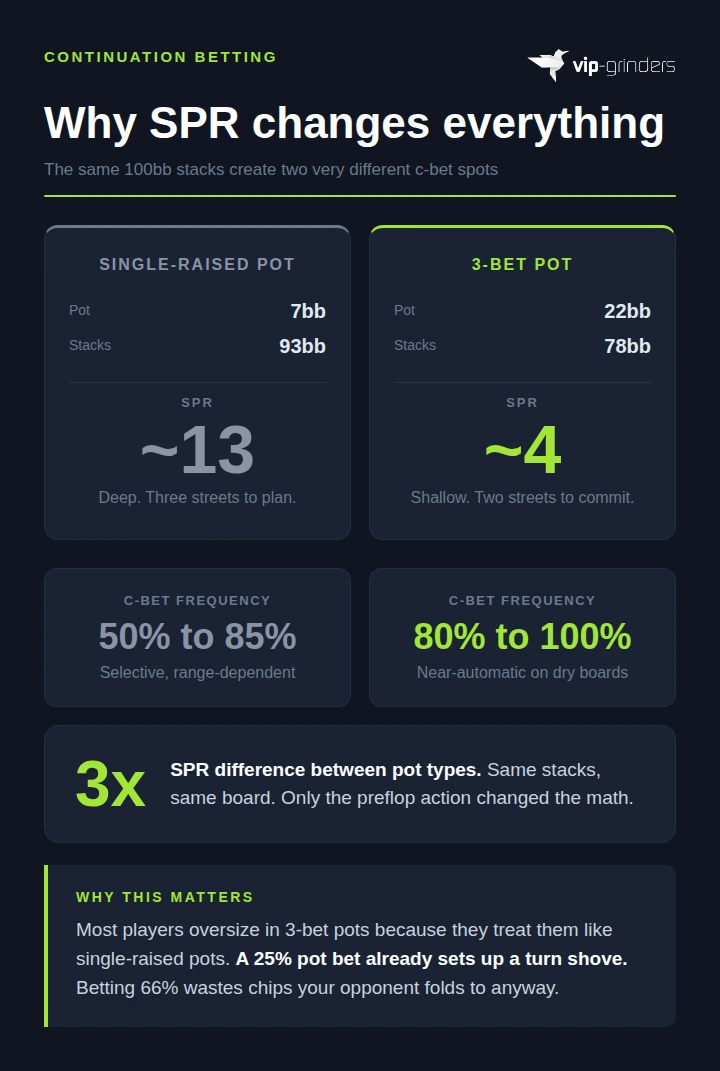
The biggest leak in 3-bet pots is sizing too large on dry boards. Players who fire 66% pot into A-7-2 in a 3-bet pot are risking more than they need to because their opponent folds the same hands to 25% pot and calls the same hands to 66% pot. The larger bet only costs more when they are behind.
Defending Against C-Bets
Knowing how to c-bet is only half the equation. You will face c-bets far more often than you fire them, because every time you call a preflop raise and check the flop, the preflop aggressor has the opportunity to bet into you. Your response to that bet determines whether you bleed chips slowly or exploit opponents who c-bet too often.
Three responses exist, and each one fits a specific hand category.
- Call: the default with medium-strength hands and draws that have enough equity to continue. Pairs, gutshots with overcards, flush draws. Calling keeps the pot small and lets you reevaluate on the turn.
- Raise: reserved for strong value hands (two pair or better) and semi-bluffs with high equity (combo draws, flush draw plus pair). Raising a c-bet builds the pot when you are ahead and puts maximum pressure on the bettor’s weak range. For the full mechanics of when and how to raise after a bet, see the check-raising guide.
- Fold: correct when you have no equity, no draw, and no reason to believe you can win the pot on a later street. Against a small c-bet (25% to 33% pot), you need very little equity to call, so folding should happen less often than most players think.
Adjusting to C-Bet Size
The size of the c-bet you face should directly change how wide you defend. This is where pot odds become practical.
| C-Bet Size | Pot Odds You Get | Minimum Equity to Call | Defend Width |
|---|---|---|---|
| 25% pot | 5 to 1 | ~17% | Very wide. Fold only total air. |
| 33% pot | 4 to 1 | ~20% | Wide. Most pairs and draws continue. |
| 50% pot | 3 to 1 | ~25% | Moderate. Drop weak backdoor hands. |
| 66% pot | 2.5 to 1 | ~29% | Tighter. Need a real hand or a real draw. |
| 75% to 100% pot | 2.3 to 1 or less | ~30% to 33% | Tight. Only strong made hands and high-equity draws. |
This is why the solver-era trend toward small c-bets is a double-edged sword. When your opponent bets 25% pot, they risk very little, but they also give you a price that is too good to fold most of your range. The correct counter to frequent small c-bets is to call wider and fold less, not to over-fold because “they must have something.”
The 5 Most Expensive C-Bet Mistakes
Most players lose more money from repeated c-bet errors than from any other postflop leak. Each mistake below includes the fix so you can correct it in your next session.
- 1C-betting 100% of flops: the most common mistake at every stake. Betting every flop makes your checking range transparently weak and lets observant opponents attack it. Fix: check 40% to 50% of your range OOP and 20% to 40% IP, depending on texture.
- 2Using one size for every board: firing half pot on K-7-2 rainbow and half pot on 8-7-6 monotone wastes chips on dry boards and undercharges on wet ones. Fix: use the three-size structure from this guide. For a deeper look at how sizing extends across all streets and bet types, see the bet sizing guide.
- 3Giving up every time you get called: players who c-bet the flop and then check-fold every turn are lighting money on fire. Your opponent learns to call the flop with anything because they know you will shut down. Fix: before you bet the flop, identify which turn cards you will continue on. The double barreling guide covers the full turn decision tree.
- 4C-betting into multiple opponents like it’s heads-up: the math changes drastically with each additional player. Fix: drop your bluffs in multiway pots and only bet strong value and high-equity draws.
- 5Ignoring opponent type: c-betting at the same frequency against a player who folds 70% to c-bets and a player who folds 30% is leaving money on the table. Fix: against players who rarely fold, cut your bluff c-bets and increase your value bet sizing. Against players who overfold, c-bet more often with smaller sizes.
Every mistake on this list costs fractions of a big blind per hand, and over thousands of hands a month those fractions compound into the difference between a breakeven grinder and a profitable one. If you are unsure which leak costs you the most, review your last 10,000 hands filtered by flop c-bet spots.
Frequently Asked Questions
What percentage of the time should I c-bet?
There is no single correct frequency because it depends on position, board texture, and number of opponents. As a rough baseline, solvers c-bet 50% to 85% of their range IP on dry boards and 30% to 40% OOP. On wet boards and in multiway pots, those numbers drop significantly. The five-factor checklist in this guide is a more reliable tool than any fixed percentage.
Should I c-bet with nothing on a dry board?
Often, yes. On dry boards like A-5-3 rainbow where you raised preflop and have range advantage, a small c-bet (25% to 33% pot) folds out most of your opponent’s range regardless of what you hold. The key is that your bluff c-bets should have at least some backdoor equity so you have options if called.
What is the best c-bet size?
It depends on board texture. On dry, static boards, 25% to 33% pot is the solver-era default because your opponent folds at roughly the same rate as they would to a larger bet. On semi-wet boards, 50% to 66% pot charges draws correctly. On wet, highly connected boards, 75% pot or more is needed to deny equity. Using one size for every board is one of the most common and expensive c-bet mistakes.
Should I c-bet more in position or out of position?
In position. IP c-bet frequencies run roughly double OOP frequencies on most board textures because you have the advantage of acting last on every street. OOP, your default in single-raised pots should be to check most flops and reserve c-bets for boards where you have a clear range advantage and a low SPR.
How do I adjust my c-bet against calling stations?
Cut your bluff c-bets and increase your value bet sizing. Against opponents who fold 30% or less to c-bets, bluffing is a losing play because they call too often. Focus on betting your strong hands for larger amounts (66% to 100% pot) since they will pay you off with weaker holdings. Save your checking range for medium-strength hands that cannot handle a raise.
Is c-betting still profitable?
Yes, but the approach has changed. In earlier eras of online poker, c-betting 80% to 100% of flops with a half-pot sizing was standard and profitable. Modern opponents defend better, so profitable c-betting now requires texture-based sizing, position awareness, and selective frequency. Players who adapt to solver-era sizing and frequency still extract significant value from continuation bets at every stake.