

Crypto Casino Market Report August 2026: Deposits, Whales and Reserves Tracked Onchain
This report tracks $47.6 billion in onchain deposit volume across 41 crypto casinos, 16 cryptocurrencies and 10 blockchain networks over the trailing 12 months. It is the most detailed set of crypto gambling statistics available from any public source. The data comes from Tanzanite.xyz, an analytics platform that monitors verifiable blockchain transactions flowing into known casino wallet clusters.

Every Tanzanite figure in this report can be checked onchain. In August, the 41 tracked operators took $4.23 billion across 7.68 million deposits.
The 41 operators tracked here are the largest centralized crypto casinos by deposit volume, including Stake, Roobet, Rainbet, Duel, Shuffle, Gamdom, 1WIN, StakeUS, Sportsbet.io, Cloudbet and 31 others. They do not represent the entire crypto gambling market. Fiat-first online casinos that also accept crypto are excluded, as are smaller crypto-native casinos outside Tanzanite’s coverage.
Third party estimates of the total crypto casino market range from $250 million to $81.4 billion, depending on whether the source measures gross gaming revenue, total wager volume, B2B software spend or broader blockchain gaming. We reference those estimates for context throughout the report, labelled with their source and what each one actually measures. Our own analysis is built entirely on the Tanzanite dataset.
The sections below cover operator rankings and month on month movers, average deposit sizes and how deposit value is distributed, how few wallets actually drive the market, which currencies and blockchains players use, what casinos hold in their hot wallets, and the regulatory shifts reshaping the market. One finding frames the rest of the page: just 4,063 wallets, 0.26% of the 1.55 million that deposited, controlled 64.7% of all tracked volume in August.
Key Findings
All figures below come from Tanzanite.xyz onchain deposit tracking across 41 centralized crypto casinos unless otherwise noted. August 2026 data.
- $47.6B tracked, $4.23B in August: Deposit volume across the 41 tracked casinos reached $47.6 billion over the trailing 12 months. August brought in $4.23 billion across 7.68 million deposits, down 2.5% by value and up 4.7% by count. The average deposit fell from $591 to $550.
- Roobet rebounded 23%, Rollbit collapsed 74%: Roobet grew to $453M while its deposit count fell 1.6%, so the high value depositors returned. Rollbit fell to $13.1M on volume down 73.5% and count down 77.6%. BC Game dropped 55.7%.
- 4,063 wallets control 64.7% of the market: Wallets above $100,000 are 0.26% of the 1.55 million that deposited in August, yet hold 64.7% of all tracked volume. Only 404 sit above $1M. Concentration is falling, with the same measure reading 76.7% across the trailing year.
- Stablecoins are 75.5% of deposits but 55.1% of reserves: Tether, USDC and Dai make up 75.5% of August deposit volume and just 55.1% of what casinos hold in their hot wallets. Ethereum is held at 1.78 times its deposit weight and Solana at 1.37 times.
- Ethereum leads by value, BSC by transaction count: Ethereum settled $1.51B against Tron's $1.22B and has led for two months running. BSC overtook Solana by count for the first time, 2.65 million deposits against 1.95 million.
- Reserves reached $395M, up 24% in a year: The monthly timeseries puts the 41 operators at $395 million at the end of August, up from $320 million in October. The live snapshot used in the operator table reads $483 million. Stake ended August at its highest level in the series, Rollbit at its lowest.
- Onchain casinos remain a rounding error: Solpump and Solpot took $14.6 million in bets during August and kept $590,000 in revenue, which is 0.34% of centralized deposit volume. Luck.io shut down in April 2026.
These are the headline numbers. The sections below break down the data behind each one: which operators are growing and which are losing share, how deposit value concentrates at the top of the curve, what currencies and blockchains players actually use, and what hot wallet balances reveal about operator liquidity.
Crypto Casino Operator Rankings by Deposit Volume
The rankings below are based entirely on onchain deposit volume tracked by Tanzanite.xyz. Deposit volume measures the total value of cryptocurrency transferred into each casino’s known wallet clusters. It is not gross gaming revenue or wager handle, both of which are multiples of deposits because players wager the same funds repeatedly.
Deposit Volume by Casino: Month on Month Movers
The table shows the top 15 operators by August deposit volume, the change against July, and a three month rolling average. The rolling column matters more than the monthly one at this scale, because a single month at the tail of the market is often noise rather than direction.
| # | Casino | August Volume | Change vs July | 3 Month Average |
|---|---|---|---|---|
| 1 | Stake | $2.12B | Down 2.3% | $2.07B |
| 2 | Roobet | $453.0M | Up 23.1% | $416.3M |
| 3 | Rainbet | $294.0M | Down 16.2% | $317.3M |
| 4 | Duel | $251.0M | Up 9.1% | $216.3M |
| 5 | Shuffle | $201.0M | Down 1.5% | $199.0M |
| 6 | Gamdom | $185.0M | Up 5.7% | $171.0M |
| 7 | 1WIN | $114.0M | Up 12.9% | $112.3M |
| 8 | StakeUS | $107.0M | Up 21.7% | $101.3M |
| 9 | Sportsbet.io | $67.3M | Down 0.1% | $68.2M |
| 10 | Thrill | $49.1M | Down 11.4% | $69.2M |
| 11 | BC Game | $46.1M | Down 55.7% | $93.0M |
| 12 | Winna | $37.3M | Down 3.1% | $45.1M |
| 13 | Cloudbet | $32.7M | Down 41.0% | $41.9M |
| 14 | Casinobet | $29.1M | Down 13.6% | $27.8M |
| 15 | Duelbits | $25.6M | Up 32.6% | $19.6M |
Stake remains the largest crypto casino by onchain deposit volume at $2.12 billion, half of everything tracked. Its volume was flat month on month, but its deposit count rose 15.2% to 3.41 million. The average Stake deposit fell from $733 to $622, which is the clearest single illustration of the pattern running through the whole market this month.
That pattern is more deposits, smaller ones, less total value. Across all 41 operators, transaction count rose 4.7% while volume fell 2.5% and the average deposit dropped from $591 to $550.
Roobet is the month’s biggest reversal. Volume grew 23.1% to $453 million while its deposit count fell 1.6%, so the growth came entirely from larger deposits rather than more players. The published Q2 edition of this report described a whale exodus at Roobet. Those depositors have returned.
Volume tells you how much moved. Deposit count tells you how many people moved it. When one rises and the other falls, the casino has not changed size, it has changed customer.
Three operators contracted sharply enough to need explaining. Rollbit fell 73.5% to $13.1 million with its deposit count down 77.6%, so it lost players faster than it lost volume. BC Game dropped 55.7% to $46.1 million on a count down only 8.8%, the opposite signature: players retained, large depositors gone. Cloudbet fell 41.0% to $32.7 million.
At the other end, Duelbits grew 32.6%, StakeUS 21.7% and 1WIN 12.9%. All three did it on falling deposit counts, meaning larger deposits rather than more of them. Duel is the only operator above $10 million where volume and transaction count both rose.
All 41 tracked operators recorded deposits in both months, so the all-operator total and the constant-panel total are the same figure this month at $4.23 billion. We publish both every month because Tanzanite’s coverage has expanded before, and when it does the two will diverge.
Other Tracked Operators (Ranks 16 to 41)
The remaining 26 operators processed $214 million between them in August, which is 5.1% of all tracked volume. The three month rolling column is the one to read here, because monthly swings at this scale are frequently noise.
| # | Casino | August Volume | Change vs July | 3 Month Average |
|---|---|---|---|---|
| 16 | Razed | $23.2M | Down 16.5% | $26.4M |
| 17 | 500 Casino | $23.1M | Up 9.5% | $22.6M |
| 18 | MetaWin | $23.1M | Down 17.2% | $23.4M |
| 19 | Yeet | $21.6M | Down 32.1% | $30.3M |
| 20 | Dicey | $19.3M | Up 14.9% | $17.9M |
| 21 | BetFury | $15.5M | Down 10.4% | $18.6M |
| 22 | Solcasino | $14.1M | Down 13.5% | $15.8M |
| 23 | Rollbit | $13.1M | Down 73.5% | $39.2M |
| 24 | ShuffleUS | $8.4M | Up 3.8% | $8.6M |
| 25 | Gamba | $8.3M | Down 12.5% | $7.7M |
| 26 | CoinCasino | $6.8M | Down 0.9% | $7.4M |
| 27 | ToshiBet | $5.8M | Down 14.3% | $6.1M |
| 28 | Acebet | $5.3M | Down 18.7% | $5.7M |
| 29 | Whale.io | $5.0M | Up 12.7% | $4.7M |
| 30 | Housebets | $4.7M | Up 17.4% | $3.6M |
| 31 | Qzino | $3.5M | Down 2.3% | $4.3M |
| 32 | Goated | $2.8M | Down 2.4% | $2.8M |
| 33 | Spartans | $2.7M | Down 39.6% | $5.8M |
| 34 | Degen City | $2.7M | Down 4.6% | $2.6M |
| 35 | Wager | $1.6M | Up 368.3% | $736K |
| 36 | Chips | $1.5M | Up 8.0% | $1.5M |
| 37 | Shock | $1.4M | Down 27.1% | $2.4M |
| 38 | Cybet | $544K | Down 16.7% | $547K |
| 39 | Jackpotbet | $288K | Down 11.9% | $542K |
| 40 | Bluff | $87K | Down 85.7% | $486K |
| 41 | Flush | $76K | Down 57.9% | $141K |
Two movements in this tier are real rather than statistical. Dicey grew 14.9% to $19.3 million and has risen in eight of the eleven months since it started recording deposits. Spartans fell 39.6% to $2.7 million, completing a full round trip after peaking at $45.1 million in May.
Wager’s 368.3% rise to $1.55 million is the clearest example of why the rolling column exists. That entire increase is a single deposit of roughly $1.15 million, which is 74% of everything the site took all month.
Average Deposit Size: Whales vs Mass Market
Deposit volume alone does not reveal what kind of player a casino attracts. A $250 million month could come from 250 players depositing $1 million each or from a million players depositing $250. Dividing volume by deposit count separates the two.
The table covers the 23 operators above $10 million in August volume. Below that threshold, deposit counts are small enough that a handful of transactions distorts the average.
| # | Casino | August Volume | Deposits | Avg Deposit |
|---|---|---|---|---|
| 1 | Casinobet | $29.1M | 2.1K | $14,126 |
| 2 | Sportsbet.io | $67.3M | 17.3K | $3,890 |
| 3 | Cloudbet | $32.7M | 9.6K | $3,420 |
| 4 | Dicey | $19.3M | 11.3K | $1,708 |
| 5 | Duel | $251.0M | 240.0K | $1,046 |
| 6 | Gamdom | $185.0M | 230.0K | $804 |
| 7 | Roobet | $453.0M | 682.0K | $664 |
| 8 | Winna | $37.3M | 58.2K | $641 |
| 9 | Stake | $2.12B | 3.41M | $622 |
| 10 | Yeet | $21.6M | 34.9K | $619 |
| 11 | BC Game | $46.1M | 78.7K | $586 |
| 12 | Duelbits | $25.6M | 43.9K | $583 |
| 13 | StakeUS | $107.0M | 215.0K | $498 |
| 14 | Rollbit | $13.1M | 28.7K | $456 |
| 15 | Razed | $23.2M | 53.4K | $434 |
| 16 | MetaWin | $23.1M | 58.3K | $396 |
| 17 | BetFury | $15.5M | 39.7K | $390 |
| 18 | 500 Casino | $23.1M | 59.4K | $389 |
| 19 | Shuffle | $201.0M | 549.0K | $366 |
| 20 | Thrill | $49.1M | 139.0K | $353 |
| 21 | Rainbet | $294.0M | 1.03M | $285 |
| 22 | 1WIN | $114.0M | 434.0K | $263 |
| 23 | Solcasino | $14.1M | 58.8K | $240 |
The spread runs from $240 at Solcasino to $14,126 at Casinobet, a factor of 59 between two businesses described by the same two words.
Casinobet took $29.1 million across 2,060 deposits. Cloudbet averaged $3,420 and Sportsbet.io $3,890. All three are established sportsbook-led brands where a small number of accounts move very large sums.
Three averages moved sharply against July. BC Game fell 51% from $1,205 to $586, Cloudbet fell 38% from $5,485 to $3,420, and Stake fell 15% from $733 to $622. In each case the deposit count held far better than the volume, which means these casinos kept their players and lost their largest depositors.
Roobet went the other way, rising 25% from $531 to $664. Sportsbet.io rose 15%. Averages also rose at StakeUS, 1WIN and Duelbits, where volume grew while deposit counts fell.
The average deposit is the fastest way to see a whale leave. Volume falls, count holds, and the average collapses within a single month. It moved by more than 15% at fifteen of the 23 largest operators in August, in both directions.
Rainbet remains the mass market anchor at $285 across 1.03 million deposits, second only to Stake by transaction count. Our US Gambling Survey 2026 gives some sense of who those depositors are: 9% of Americans have used cryptocurrency to fund gambling, rising to 16.1% among 25 to 34 year olds.
Deposit Distribution: Where the Money Actually Sits
The average deposit is useful but it hides the extremes. Tanzanite splits every deposit into six size buckets, which shows how much of a casino’s volume arrives in small transactions and how much arrives in very large ones.
The table below covers the 23 operators above $10 million in August volume, sorted by the share of volume arriving in deposits over $100,000. Each row sums to 100% of that casino’s deposit volume.
| Casino | <$100 | $100 to $1K | $1K to $10K | $10K to $100K | $100K to $1M | $1M+ |
|---|---|---|---|---|---|---|
| Casinobet | 0.1% | 0.4% | 0.4% | 13.8% | 82.0% | 3.4% |
| Cloudbet | 0.2% | 2.4% | 7.9% | 17.4% | 62.9% | 9.2% |
| Sportsbet.io | 0.4% | 2.7% | 7.0% | 19.9% | 50.3% | 19.8% |
| Roobet | 3.3% | 12.1% | 13.7% | 15.9% | 41.5% | 13.5% |
| StakeUS | 3.4% | 22.8% | 23.5% | 4.9% | 3.3% | 42.2% |
| Winna | 2.6% | 12.4% | 23.1% | 17.0% | 37.5% | 7.4% |
| BetFury | 4.0% | 13.9% | 18.0% | 22.7% | 20.8% | 20.5% |
| Stake | 3.0% | 13.8% | 22.4% | 20.8% | 23.0% | 17.0% |
| Dicey | 1.0% | 4.4% | 14.7% | 40.4% | 39.5% | 0.0% |
| Gamdom | 2.1% | 16.0% | 21.3% | 25.1% | 25.7% | 9.8% |
| Razed | 2.9% | 18.0% | 22.9% | 20.9% | 35.3% | 0.0% |
| Duel | 2.5% | 11.9% | 21.0% | 31.5% | 28.8% | 4.2% |
| 1WIN | 4.8% | 15.8% | 24.2% | 22.2% | 24.0% | 9.0% |
| Yeet | 2.6% | 12.7% | 29.8% | 29.1% | 25.8% | 0.0% |
| Rollbit | 4.6% | 21.5% | 30.3% | 18.1% | 25.5% | 0.0% |
| Thrill | 5.4% | 20.1% | 27.5% | 25.6% | 21.4% | 0.0% |
| Shuffle | 5.9% | 20.1% | 25.5% | 27.1% | 21.3% | 0.0% |
| Rainbet | 8.4% | 22.7% | 24.6% | 23.6% | 17.1% | 3.5% |
| BC Game | 2.2% | 23.2% | 27.6% | 28.2% | 18.9% | 0.0% |
| Duelbits | 3.4% | 16.7% | 24.9% | 37.5% | 17.4% | 0.0% |
| 500 Casino | 4.6% | 23.8% | 30.6% | 28.4% | 12.6% | 0.0% |
| Solcasino | 9.6% | 35.7% | 32.7% | 14.6% | 7.5% | 0.0% |
| MetaWin | 5.6% | 27.3% | 27.3% | 33.1% | 6.6% | 0.0% |
Casinobet, Cloudbet and Sportsbet.io are the most top-heavy operators in the dataset. At Casinobet, 85.4% of volume arrives in deposits above $100,000 while deposits under $100 account for one tenth of one percent. Cloudbet reads 72.1% and Sportsbet.io 70.1%.
StakeUS has the strangest profile. Its $1M+ bucket alone is 42.2% of volume, the highest single-bucket concentration at the top tier of any tracked casino, yet 49.7% of its volume still arrives below $10,000. Almost nothing sits in between, with the two middle buckets holding just 8.2% between them.
At the other end, MetaWin takes just 6.6% of its volume above $100,000 and Solcasino 7.5%. Rainbet remains the most evenly spread of the major operators, with 8.4% arriving under $100 and only 3.5% above $1 million.
What the same data looks like by transaction count
Volume share and transaction share describe completely different things, and the gap between them is the whole point of this section.
- Under $100: 65.6% of all deposits, carrying 3.5% of all volume. Roughly 4.8 million transactions in August.
- $100 to $1,000: 29.2% of deposits, 14.9% of volume. Together with the bucket above it, this is where almost every transaction happens.
- $100,000 and above: 0.06% of deposits, 38.2% of volume. 4,356 transactions out of 7.3 million, or one in every 1,680.
- $1 million and above: 240 transactions across the entire month, carrying 12.8% of all tracked deposit volume.
Two hundred and forty individual deposits moved $540 million into crypto casinos in August. That is one eighth of the entire market, arriving in a number of transactions you could list on a single page.
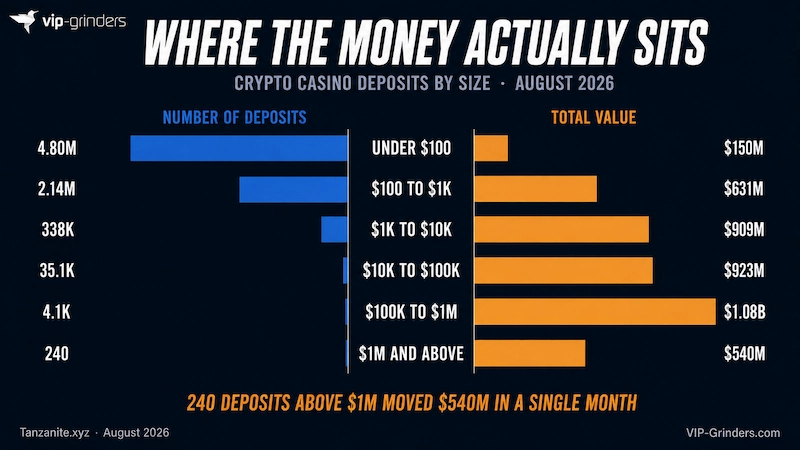
Two thirds of crypto casino deposits are under $100. Those deposits carry 3.5% of the money. The industry describes itself as a mass market consumer business, and by transaction count that is true. By revenue it is something else entirely.
This is deposit-level concentration, measured one transaction at a time. It understates the real picture, because a wallet that deposits $50,000 twenty times does not appear in the $1M+ bucket at all. The next section measures the same market by wallet instead, and the answer is roughly three times more concentrated.
Wallet Concentration: How Few Wallets Drive Crypto Casino Volume
Every figure so far has measured individual deposits. This section measures wallets, meaning the total each depositing address sent to a casino across the whole month.
The distinction matters more than it sounds. A wallet that deposits $50,000 twenty times never appears in the $1 million bucket at deposit level, but at wallet level it is a million dollar depositor. Measuring one transaction at a time understates how concentrated this market actually is.
Across the 41 tracked casinos in August, 1.55 million wallets made 7.3 million deposits, an average of 4.7 deposits per wallet. Tanzanite’s wallet panel counts slightly fewer deposits than its headline figure of 7.68 million, a difference we explain in the methodology.
- 4,063 wallets held more than $100,000: That is 0.26% of every wallet that deposited, and they account for $2.74 billion, or 64.7% of all tracked volume.
- 404 wallets held more than $1 million: One wallet in every 3,825. They hold $1.78 billion between them, 42.1% of the market, averaging $4.41 million each.
- The other 99.74% of wallets share a third of the money: Roughly 1.54 million wallets deposited under $100,000 each, and together they account for 35.3% of volume.
- Concentration is falling: Across the trailing 12 months, wallets above $100,000 held 76.7% of volume. In August they held 64.7%, twelve points lower.
The Crypto Casino Whale Index
The Whale Index ranks each casino by the share of its deposit volume that comes from wallets holding more than $100,000. It is a VIP-Grinders derived metric, calculated from Tanzanite wallet distribution data, and we publish it monthly.
The table covers the 23 operators above $10 million in August volume. Below that threshold a single wallet can swing the result, so those casinos are excluded rather than ranked misleadingly.
| # | Casino | Whale Index | Deposit Level | vs 12 Month |
|---|---|---|---|---|
| 1 | Casinobet | 99.6% | 85.4% | +0.0 |
| 2 | Sportsbet.io | 89.0% | 70.1% | -0.6 |
| 3 | Dicey | 81.4% | 39.5% | -0.2 |
| 4 | Cloudbet | 80.0% | 72.1% | -9.2 |
| 5 | Roobet | 76.2% | 55.0% | -7.3 |
| 6 | Duel | 68.5% | 33.0% | -8.9 |
| 7 | Stake | 65.7% | 40.0% | -12.6 |
| 8 | Winna | 65.6% | 44.9% | -15.1 |
| 9 | 1WIN | 62.3% | 33.0% | -2.6 |
| 10 | Gamdom | 61.6% | 35.5% | -12.3 |
| 11 | StakeUS | 61.0% | 45.5% | -11.6 |
| 12 | BetFury | 60.1% | 41.3% | -22.1 |
| 13 | Yeet | 59.2% | 25.8% | -26.5 |
| 14 | Thrill | 54.6% | 21.4% | -24.9 |
| 15 | Shuffle | 54.0% | 21.3% | -17.6 |
| 16 | Razed | 53.9% | 35.3% | -17.3 |
| 17 | Rainbet | 50.8% | 20.7% | -13.5 |
| 18 | Duelbits | 50.8% | 17.4% | -7.3 |
| 19 | MetaWin | 49.0% | 6.6% | -14.5 |
| 20 | BC Game | 46.0% | 18.9% | -28.0 |
| 21 | Rollbit | 44.7% | 25.5% | -26.4 |
| 22 | 500 Casino | 41.9% | 12.6% | -17.9 |
| 23 | Solcasino | 29.2% | 7.5% | -15.1 |
The Whale Index column measures wallets. The deposit level column measures individual transactions, and it is there to show the gap.
Every casino is more concentrated at wallet level than at deposit level. The gap averages 26 points and runs from 7.9 at Cloudbet to 42.4 at MetaWin. MetaWin looks like a mass market platform on transactions at 6.6%, and is half whale money once you total each wallet.
That gap is the reason deposit-level concentration figures published elsewhere understate this market. Whales do not send single seven-figure transfers. They accumulate seven-figure positions out of five-figure deposits.
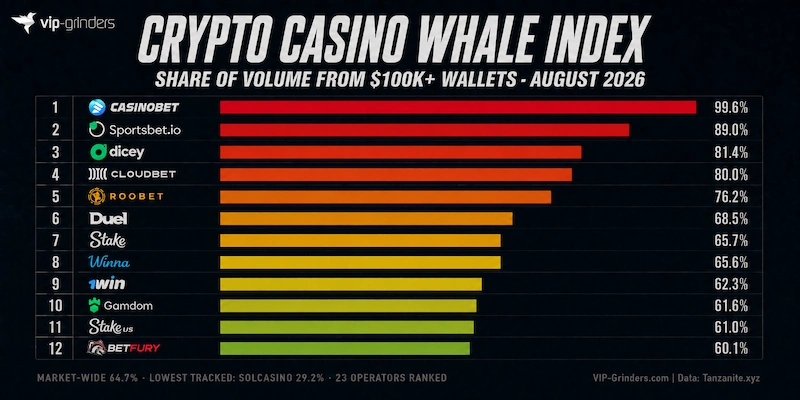
When 4,063 wallets out of 1.55 million control two thirds of the money, this is not a mass consumer market with a whale segment. It is a VIP business with a mass market front end. That has consequences for regulation, for marketing spend, and for how honest the industry is about who actually generates the revenue.
Concentration fell at 22 of the 23 ranked operators against their trailing 12 month figures. BC Game dropped 28.0 points, Yeet 26.5, Rollbit 26.4 and Thrill 24.9. Casinobet is the only one that did not fall, and at 99.6% it has nowhere to go.
The mass market end did not move at all. Deposits under $100 were 65.5% of transactions across the trailing year and 65.6% in August. Everything happening in this market is happening at the top of the curve.
For players at the other end of that curve, our guide to high roller crypto casinos covers which operators actually cater to large deposits and what limits they run.
Which Cryptocurrencies Players Use
Tanzanite tracks 16 cryptocurrencies across all 41 casinos, measuring both deposit volume and deposit count. A currency can dominate by value while ranking far lower by transaction count, and that gap is the clearest signal of who uses it and why.
Stablecoins Control the Majority of Deposit Volume
Tether and USDC together accounted for 75.3% of all deposit volume in August. Adding Dai takes the stablecoin share to 75.5%. That figure has climbed slowly across the year, from 73.8% in October, rather than jumping.
| Token | August Volume | Change vs July | Deposits | Avg Deposit |
|---|---|---|---|---|
| Tether | $2.34B | Down 1.3% | 2.33M | $1,004 |
| USD Coin | $844.0M | Down 5.5% | 672K | $1,256 |
| Solana | $489.0M | Up 5.8% | 1.59M | $308 |
| Ethereum | $394.0M | Down 0.5% | 940K | $419 |
| XRP | $74.5M | Down 9.7% | 600K | $124 |
| Tron | $39.1M | Down 19.0% | 269K | $145 |
| BNB | $22.1M | Down 18.5% | 1.03M | $21 |
| Dai | $7.1M | Up 291.2% | 804 | $8,806 |
| Arbitrum | $6.5M | Up 415.7% | 4K | $1,548 |
| TON | $3.6M | Down 2.2% | 109K | $33 |
| Chainlink | $1.9M | Up 242.2% | 975 | $1,969 |
| MATIC | $1.7M | Up 0.6% | 120K | $14 |
| Shiba Inu | $1.2M | Down 21.3% | 6K | $198 |
| Avalanche | $699K | Down 12.0% | 6K | $110 |
| TRUMP | $545K | Up 34.2% | 1K | $389 |
| Pepe | $7K | Down 63.7% | 49 | $147 |
USDC has been the year’s strongest performer, growing from $535 million in October to $844 million in August, a rise of 58%. It has ranked above Ethereum in ten of the last twelve months and has held second place without interruption since March. Ethereum went the other way, from $450 million to $394 million.
Solana grew 5.8% in August to $489 million, the only major token to gain ground. Tron fell 19.0% and its deposit count fell 36.3%, the sharpest contraction of any tracked currency.
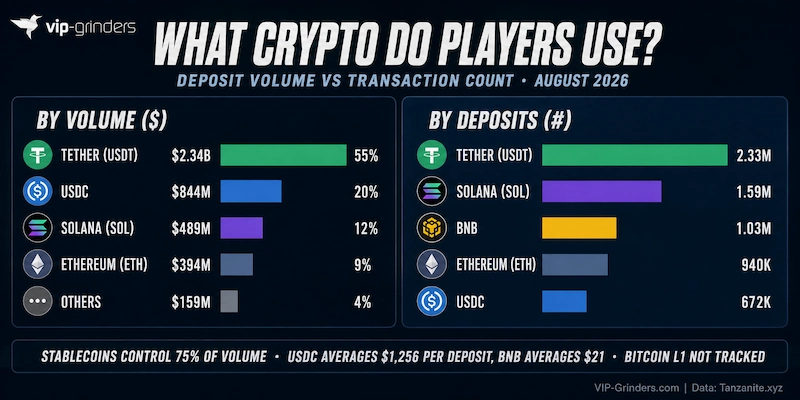
XRP is down 60% from its January peak of $188 million to $74.5 million, with no recovery at any point in between.
Bitcoin’s native blockchain is not tracked by Tanzanite, which covers 10 chains but not Bitcoin L1. BTC deposits sent on Bitcoin L1 are excluded from this dataset entirely. Wrapped BTC on Ethereum is included but is a small fraction, which means every stablecoin share figure on this page is overstated to an unknown degree.
This aligns with broader industry data. SOFTSWISS, which aggregates over 700 partner brands, reported Bitcoin’s share of crypto gambling bets falling roughly 17 percentage points in a single year, with stablecoins the primary beneficiary. The same dataset shows that 35% of crypto casino players are women, a higher share than any other online casino format.
Deposit Count by Currency: Which Crypto Has the Most Transactions
Tether leads by transaction count as well as by value. Over the trailing 12 months it processed 21.3 million deposits against Solana’s 17.6 million, a gap of 21%.
August broke that pattern in an unusual way. BNB recorded 1.03 million deposits, up 68.3% in a month, while its deposit volume fell 18.5%. The average BNB deposit collapsed to $21.
- Tether: 2.33 million deposits in August at an average of $1,004. High value players moving significant funds in stablecoin form.
- Solana: 1.59 million deposits at an average of $308. Mass market players depositing often on a chain with sub-cent fees.
- USDC: 672,000 deposits at $1,256, the highest average of any major token. USDC depositors now move more per transaction than Tether depositors.
- BNB: 1.03 million deposits at an average of $21, the lowest of any tracked currency by a wide margin.
The USDC figure inverts something we published previously. Tether’s average deposit used to sit above USDC’s. Tether’s transaction count grew 58% across the year while its average fell, and USDC now leads on value per deposit at $1,256 against $1,004.
Deposit Size by Currency: Which Tokens Whales Use
Applying the same wallet analysis to currencies rather than casinos answers a question the volume table cannot. Stablecoins dominate this market, but that is a result rather than an explanation. The distribution data shows why.
The table covers the seven tokens above $10 million in August volume, ranked by the share of volume held in wallets above $100,000.
| Token | Wallet Level | Deposit Level | $1M+ Wallets |
|---|---|---|---|
| USD Coin | 71.2% | 49.0% | 108 |
| Tether | 69.1% | 41.6% | 231 |
| XRP | 60.9% | 6.9% | 7 |
| Ethereum | 52.8% | 33.1% | 36 |
| Solana | 39.3% | 16.3% | 28 |
| BNB | 37.6% | 17.8% | 3 |
| Tron | 10.7% | 3.0% | 0 |
Stablecoins are the whale rails. USDC holds 71.2% of its volume in wallets above $100,000 and Tether 69.1%. Solana sits at 39.3% and Tron at 10.7%.
The concentration is extreme at the very top. 231 Tether wallets hold $1.07 billion and 108 USDC wallets hold $405 million. Between them, 339 wallets account for a third of everything deposited across the tracked market in August.
That reframes the stablecoin story. The usual explanation is that players prefer a dollar peg because it removes price volatility, which is true and also incomplete. Stablecoins are 75% of deposit volume largely because whales use them, and whales are two thirds of the market.
When transaction counts mislead
BNB recorded 999,000 deposits under $100 in August, carrying $2.07 million between them. That is an average of $2.07 per deposit, and they came from 678,000 separate wallets.
That works out at 1.5 deposits per wallet. For comparison, sub-$100 depositors average 2.7 deposits per wallet on Tether, 4.7 on Ethereum and 9.7 on Solana.
Strip that single event out and the August market processed 6.33 million deposits rather than 7.32 million. Every volume figure on this page is unaffected.
Transaction counts are the easiest number in this industry to inflate and the hardest to interpret. One million deposits averaging two dollars is not a million players. This is why we publish volume, count and wallet data side by side rather than picking whichever tells the better story.
Blockchain Networks Powering Crypto Gambling
Tanzanite tracks deposits across 10 blockchain networks. The distinction between a token and a chain matters throughout this section. Tether is a token that runs on several chains, so a player can deposit USDT via Ethereum, Tron, Solana or BSC, and the chain figures count the network carrying the transaction rather than the asset being sent.
Chain totals are therefore always larger than the token of the same name. Ethereum the chain settled $1.51 billion in August. Ethereum the token accounted for $394 million of it.
| Chain | August Volume | Change vs July | Deposits | Avg Deposit |
|---|---|---|---|---|
| Ethereum | $1.51B | Down 7.4% | 1.35M | $1,119 |
| Tron | $1.22B | Down 1.6% | 542K | $2,251 |
| Solana | $762.0M | Down 2.8% | 1.95M | $391 |
| BSC | $502.0M | Up 19.0% | 2.65M | $189 |
| Polygon | $110.0M | Up 21.7% | 294K | $374 |
| XRP | $74.5M | Down 9.7% | 600K | $124 |
| Base | $35.2M | Up 8.0% | 136K | $259 |
| Arbitrum | $10.8M | Up 88.2% | 9K | $1,149 |
| TON | $6.2M | Up 5.0% | 137K | $46 |
| Avalanche | $1.2M | Down 6.1% | 8K | $153 |
Ethereum and Tron: The Two Largest Settlement Chains
Ethereum settled $1.51 billion in August against Tron’s $1.22 billion. Ethereum has led for two consecutive months, though the gap narrowed in August from roughly $390 million to $290 million as Ethereum fell 7.4% against Tron’s 1.6%.
The lead has changed hands four times across the last 12 months. Tron was ahead in January and February, and again in May and June. Ethereum has held it since July.
Tron peaked at $1.70 billion in January and is down 28% since. Its deposit count fell 27.7% in August alone, to 542,000, while its volume barely moved.
That leaves Tron with the highest average deposit of any chain at $2,251, double Ethereum’s $1,119. Only 1,750 Tron deposits exceeded $100,000 in August, and they carried 49.4% of everything the chain settled.
Tron is not losing players so much as it never had many. It is where large stablecoin transfers settle, because fees are low and confirmation is fast, and the wallet data supports that reading: 128 wallets hold 56.7% of all Tron volume.
Between them the two chains carry 65% of the market, down from 72% in October as Solana, BSC and Polygon absorbed share.
Which Blockchain Processes the Most Casino Deposits
Volume and transaction count give completely different answers. BSC processed 2.65 million deposits in August, more than any other chain, ahead of Solana at 1.95 million and Ethereum at 1.35 million.
That is a change. Solana led on transaction count in nine of the last twelve months. BSC took the lead in early August and extended it, growing 29.9% in a month and 102% across the year.
Part of that is genuine. Part of it is the BNB dust event described in the currency section above, which accounts for 999,000 of BSC’s deposits at an average of $2.07 each.
BSC carries 42.9% of every sub-$100 deposit in the entire tracked market. At $189 average it remains the low-value rail regardless of the dust.
Solana is the mass market chain by any honest reading. It settled $762 million across 1.95 million deposits at a $391 average, with 18.8% of its volume arriving above $100,000, the second lowest of any major chain.
Smaller Networks: Base, Polygon, Arbitrum and TON
Base grew 274% across the year, from $9.4 million in October to $35.2 million in August, the fastest growth of any tracked chain by a wide margin.
The shape matters more than the rate. Almost all of that growth happened in a single month, when Base jumped from $13.6 million in February to $65 million in March. It has fallen or held flat every month since and now sits 46% below that peak.
Polygon grew 86% across the year to $110 million and is 21% off its own July peak. TON rose 70% to $6.25 million and reached its high point in August, the only smaller network currently at its peak.
Arbitrum went the other way, down 48% across the year despite an 88.2% jump in August, and sits 62% below its December high.
Deposit Size by Chain: Settlement Rails and Retail Rails
Applying the wallet analysis to chains splits the ten networks into two clear groups.
- Settlement rails: Tron holds 56.7% of its volume in wallets above $1 million, Ethereum 47.4%. Between them 303 wallets account for more than half of what the two largest chains carry.
- Retail rails: Solana holds 23.6% in $1M+ wallets and BSC carries 42.9% of every sub-$100 deposit in the market. These are the chains where ordinary players actually transact.
- Reserves follow a different logic: Tron carries 28.8% of deposit volume but holds only 11.1% of casino reserves. Money arrives on Tron and leaves almost immediately.
Casino Financial Health: Hot Wallet Balances
Tanzanite tracks the value of cryptocurrency held in each casino’s known hot wallet addresses across all ten chains. Hot wallet balances are not total company reserves. They are the funds an operator keeps immediately available for player withdrawals and day to day liquidity.
A casino with high deposit volume and low visible reserves may simply be sweeping funds to cold storage quickly. Neither pattern is inherently good or bad. What the data shows clearly is the direction each operator is moving.
Hot Wallet Balances by Casino
The 41 tracked operators hold $483 million in visible hot wallet balances on Tanzanite’s live snapshot, which is the source for every figure in this table. The monthly timeseries used in the trend section below reads $395 million at the end of August, and operator balances differ between the two. The top five account for $350 million of the snapshot total, and the bottom 20 hold $12.3 million between them.
| # | Casino | Balance | August Deposits | Balance as % of Deposits | Chains |
|---|---|---|---|---|---|
| 1 | Stake | $155.0M | $2.12B | 7.3% | 6 |
| 2 | Rainbet | $93.4M | $294.0M | 31.8% | 8 |
| 3 | StakeUS | $42.1M | $107.0M | 39.3% | 6 |
| 4 | Roobet | $37.0M | $453.0M | 8.2% | 7 |
| 5 | BC Game | $22.9M | $46.1M | 49.7% | 10 |
| 6 | Shuffle | $20.6M | $201.0M | 10.2% | 8 |
| 7 | 1WIN | $16.8M | $114.0M | 14.7% | 7 |
| 8 | Duel | $16.2M | $251.0M | 6.5% | 8 |
| 9 | Cloudbet | $11.4M | $32.7M | 34.9% | 10 |
| 10 | Solcasino | $6.9M | $14.1M | 48.7% | 10 |
| 11 | Dicey | $6.7M | $19.3M | 34.6% | 2 |
| 12 | Duelbits | $6.4M | $25.6M | 24.9% | 5 |
The percentage column is a liquidity ratio, not a solvency measure. It shows how much sits in trackable wallets against how much flowed through that casino during the month.
Stake holds the largest balance at $155 million, spread across six chains, but that is only 7.3% of its monthly deposit flow. Rainbet holds $93.4 million at a 31.8% ratio, the highest of the three largest operators by some distance.
The ratio rises sharply further down the table. BC Game holds 49.7% of a month’s deposits, Solcasino 48.7% and StakeUS 39.3%. Smaller operators keep proportionally more of their flow visible onchain, which is what you would expect from businesses without established cold storage operations.
BC Game, Cloudbet and Solcasino hold reserves across all ten tracked chains. Dicey holds across two.
Reserve Trend: How Casino Balances Have Moved
Every figure in this section comes from the monthly timeseries rather than the live snapshot used in the table above, so operator balances here will not match it.
Across the 41 operators, visible reserves have risen 24% over the last 12 months, from $319.6 million in October to $395.0 million at the end of August. The low point was November at $251.8 million and the peak was $400.4 million in early July.
Measured against deposit flow, the picture is steadier. Reserves have run between 6.25% and 9.98% of monthly deposit volume across the year, sitting at 9.35% now on the timeseries basis. The same ratio on the snapshot reads 11.4%. That ratio is the cleanest single indicator of market-wide liquidity and we will track it every month.
Stake ended August at $173 million, its highest reading in the entire series, having climbed from $121 million in October. 1WIN grew from $759,000 to $15.9 million, the largest proportional build of any tracked operator.
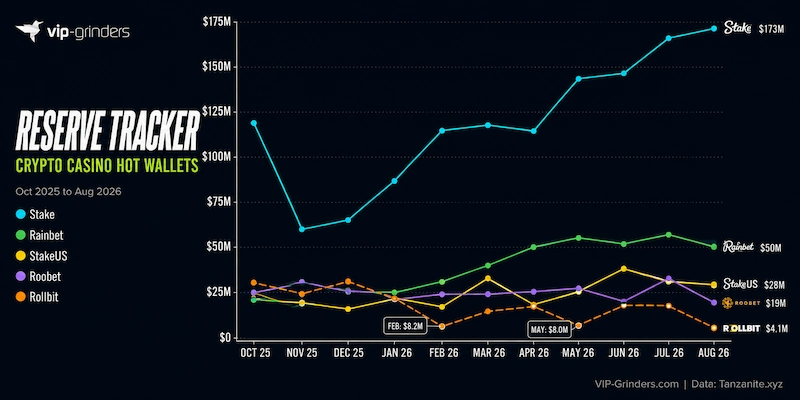
Rainbet more than doubled across the year to $49.6 million but peaked at $56.7 million in July. Roobet is down 22% across the year despite its August deposit rebound.
Rollbit: how a reserve drawdown looks onchain
Rollbit held $28.9 million in October and $4.09 million at the end of August, a fall of 86%. The path there matters more than the endpoint.
Its balance dropped below $10 million in three separate windows. Twice it recovered fully, from $8.24 million in February back to $21.0 million by April, and from $8.04 million in May back to $17.3 million by July.
The third drawdown has not recovered. Rollbit fell to $6.11 million in early August and $4.09 million by month end, while its deposit volume fell 73.5% and its deposit count 77.6% over the same period.
Reserve Composition: What Casinos Actually Hold
Knowing how much a casino holds is one question. What it holds is a different one, and the answer is not what the deposit data would lead you to expect.
Players deposit stablecoins. Casinos do not hold them in the same proportion. Tether, USDC and Dai account for 75.5% of August deposit volume and 55.1% of hot wallet reserves, a gap of more than 20 points.
| Token | Share of Reserves | Share of Deposits | Ratio |
|---|---|---|---|
| Tether | 29.8% | 55.4% | 0.54x |
| USD Coin | 22.7% | 20.0% | 1.14x |
| Ethereum | 16.5% | 9.3% | 1.78x |
| Solana | 15.8% | 11.6% | 1.37x |
| XRP | 4.3% | 1.8% | 2.46x |
| BNB | 3.6% | 0.5% | 6.88x |
| Dai | 2.6% | 0.2% | 15.66x |
| Tron | 1.8% | 0.9% | 1.96x |
Tether is 55.4% of what arrives and 29.8% of what is held. Ethereum and Solana run the other way, held at 1.78 and 1.37 times their deposit weight.
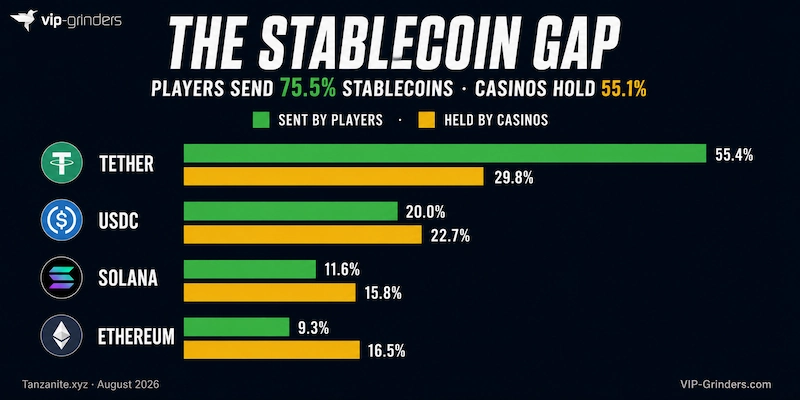
A player who deposits USDT is owed dollars. If an operator converts that into ETH or SOL and the market falls 20%, the liability does not move and the asset covering it does. That is an unhedged position on money the casino does not own.
This is not evidence of wrongdoing and it may well be deliberate treasury policy. It is a risk that has never been measurable before, and it now is.
The spread across operators is wide. BC Game holds 21.9% of its balance in stablecoins, the lowest of any major operator, with $7.7 million sitting in SOL and $4.7 million in BNB. StakeUS reads 35.6% and Stake 51.5%. At the other end, Razed holds 85.2%, 1WIN 83.4% and Roobet 75.0%.
Three quarters of the money arriving at crypto casinos is dollar-pegged. Barely half of what they hold against it is. Nobody in this industry publishes that comparison, and it is the single most useful thing onchain data can tell you about operator risk.
Chain Diversification: Where Reserves Actually Sit
Reserves concentrate differently from deposits. Ethereum holds 31.7% of all tracked balances, Solana 23.5%, BSC 15.5% and Tron 11.1%.
Tron is the outlier and it confirms what the deposit data showed. It carries 28.8% of deposit volume and holds 11.1% of reserves, equal to just 4.4% of a single month’s flow on that chain. Money arrives on Tron and leaves almost immediately.
Ethereum holds 10.1% of its monthly flow, Solana and BSC around 14.9% each. Polygon holds 33.6% and XRP 28.1%, both far above their deposit weight, which is what a chain used for storage rather than settlement looks like.
Two individual positions stand out. BC Game holds $3.0 million on Arbitrum, 42% of every Arbitrum reserve in the tracked market. 1WIN holds $2.37 million on TON, 60% of the market total, consistent with a Telegram-facing operation.
Centralized vs Fully Onchain Casinos
Tanzanite tracks three fully decentralized onchain casinos alongside the 41 centralized operators. These run entirely on Solana smart contracts, so players interact with the protocol directly rather than depositing into a company wallet, and game outcomes, payouts and house revenue are all verifiable onchain in real time.
Two of the three are still operating. Luck.io shut down in April 2026.
Onchain Casino Performance: Bet Volume, GGR and Players
| Casino | August Bet Volume | Change vs July | August GGR | Implied House Edge | Active Players |
|---|---|---|---|---|---|
| Solpump | $13.3M | Up 22% | $528K | 3.97% | 9.4K |
| Solpot | $1.2M | Down 30% | $62K | 4.98% | 15.1K |
The sector is smaller than a rounding error. Combined August bet volume across both surviving platforms was $14.6 million against $4.23 billion in centralized deposits, and bet volume is handle rather than deposits, so the real gap is wider still. Stake alone processed 146 times the sector’s entire monthly wagering.
What happened here is not that decentralized gambling failed everywhere at once. One platform was the sector, and it stopped.
Luck.io accounted for 77% of trailing-year bet volume and 63% of gross gaming revenue before it shut down. Strip it out and the two survivors did $234 million across the year, an average of $19.5 million a month.
The two remaining platforms are moving in opposite directions. Solpump grew 22% in August with GGR up 35%, sitting at 84% of its twelve month average. Solpot fell 30% across bet volume, wagers and revenue at once.
Solpot has an odd signature worth noting. Its active player count rose 20% while volume fell 30%, at an average bet of $4.30 across 19 bets per player. Solpump runs the opposite profile: fewer users, $19.97 average bet, 71 bets each.
The house edge data supports one clear conclusion. Across the trailing year, Luck.io ran an implied edge of 2.74% against Solpump’s 5.29% and Solpot’s 5.00%.
The platform that charged players the least is the one that no longer exists. That is not proof of causation, but a protocol taking roughly half what its competitors take, with no marketing arm and no balance sheet behind it, has very little room when volume falls.
A sector that loses three quarters of itself when one smart contract stops is not a market. It is a proof of concept with a single point of failure, and that is the more interesting finding than any growth rate.
How Big Is the Crypto Casino Market?
There is no audited figure for the size of the crypto gambling market, and the published estimates disagree by a factor of eight. That gap is not a rounding error. It is the result of different sources measuring different things and the results being repeated under the same label.
Why Published Market Sizes Range from $250M to $81B
The most widely cited number is $81.4 billion in gross gaming revenue for 2024, produced by Yield Sec and reported by the Financial Times in April 2025. It has since been repeated by Cointelegraph, Forbes, SiGMA World and dozens of others, almost always described as crypto casino revenue.
It does not measure crypto casinos. In July 2026, Gambling Insider put the figure to Yield Sec founder Ismail Vali, who confirmed it bundles crypto sports betting, crypto prediction markets and financial products alongside casino. The casino-only component is roughly $48 billion.
The prediction market component is substantial and growing. Our monthly Prediction Markets Report tracked $35.07 billion in event contract trading volume in August 2026 across 11 platforms, though notional trading volume and gross gaming revenue are not comparable measures.
The full workings have never been published, so there is no model to inspect and no wallet set to reproduce. Yield Sec stands by the number.
| What Is Being Measured | Source | Figure | Basis |
|---|---|---|---|
| All crypto gambling GGR, all verticals | Yield Sec / Financial Times | $81.4B (2024) | Estimated, methodology unpublished |
| Crypto casino GGR only | Yield Sec, via Gambling Insider | ~$48B (2024) | Casino component of the above |
| Crypto casino GGR | Tanzanite.xyz | $10B to $11B (2024) | Onchain, 20 casinos, 90+ wallets |
| Crypto casino deposits | Gambling Insider | $22.7B (2025) | Onchain, 12 casinos, 29 wallets |
| Crypto casino deposits | This report | $47.6B (trailing 12 months) | Onchain, 41 casinos |
| Crypto share of operator bet volume | SOFTSWISS, 700+ brands | 20% to 30% | Observed at partner operators |
| Crypto casino B2B software market | Business Research Insights | ~$13B | Vendor revenue, not player facing |
| DeFi-native gambling dApps only | Blockonomi / WifiTalents | $250M (2024) | Single-chain dApps, excludes all major operators |
The $250 million figure at the bottom of that table and the $81.4 billion at the top are both real numbers. They are 326 times apart because one counts DeFi smart contracts on a single chain and the other counts every form of crypto wagering worldwide. Neither describes what most people mean by the crypto casino market.
What our own data implies
The industry convention for converting deposits into revenue is the ratio published by Tanzanite, derived from Stake’s publicly observable figures: roughly 37 cents of gross gaming revenue per dollar deposited.
Applied to the $47.6 billion this report tracks across 41 operators, that implies $17.6 billion in trailing 12 month gross gaming revenue, an average of $1.47 billion a month.
That sits between Tanzanite’s $10 to $11 billion for 2024 across 20 casinos and Yield Sec’s $48 billion casino-only component. Our operator coverage is 3.4 times Gambling Insider’s and our deposit total is 2.1 times theirs, which is what you would expect from tracking 41 casinos rather than 12.
The $81.4 billion figure has been repeated for eighteen months as crypto casino revenue. It was never that. Every number in this report can be checked against a public blockchain, which is the only real answer to a market where the headline figure came from a model nobody has seen.
The Broader Online Gambling Context
Global online gambling gross gaming revenue across every vertical and every currency runs at roughly $103 billion. If crypto gambling alone were $81.4 billion, crypto would account for around 79% of all online gambling worldwide, which nobody in the industry believes.
Our implied figure of $17.6 billion would put crypto casinos at roughly 17% of the global online gambling market. That is close to the 20% to 30% range SOFTSWISS observes directly across its 700 partner brands, and close to the 17% Surgence Labs estimates independently.
| Metric | Estimate | Forecast | Source |
|---|---|---|---|
| Total online gambling | $87.69B (2025) | $153.57B by 2030 | Grand View Research |
| Total online gambling | $91.63B (2025) | $168.71B by 2031 | Mordor Intelligence |
| Total gambling, online and offline | $456.71B (2025) | $633.99B by 2030 | Mordor Intelligence |
For a full breakdown of how crypto fits within the wider casino sector, see our Casino Statistics 2026 overview.
One further check on the size of the long tail. Gambling Insider examined five smaller crypto casinos and found they took $151 million combined across 2025, less than one percent of Stake alone. The case for the largest estimates rests on tens of thousands of small operators making up the difference. If a typical tail casino handles tens of millions a year rather than billions, that arithmetic does not work.
Regulation Reshaping the Crypto Casino Market
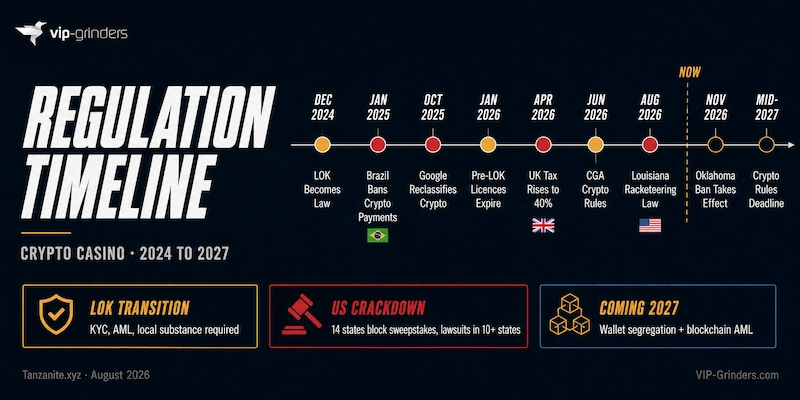
Six regulatory developments are changing how crypto casinos operate, where they can advertise and which players they can serve. The pace picked up sharply through 2026, with Curaçao completing its licensing overhaul, the number of US states banning sweepstakes casinos rising to fourteen, and the UK nearly doubling its tax on online casino revenue.
Almost none of it is visible in the deposit data yet. Where it is, we say so.
Curaçao’s LOK Transition: New Licensing Standards
Most of the casinos tracked in this report operate under Curaçao jurisdiction. For decades that meant four private master licence holders issuing sub-licences with minimal oversight, and an operator could go live for little more than a registration fee.
That system no longer exists. The National Ordinance on Games of Chance, known as the LOK, came into force on 24 December 2024. Master licences were abolished a week later and the Curaçao Gaming Authority now issues every licence directly as an independent public body.
- KYC and AML are mandatory: Operators must run identity verification, transaction monitoring and chain analysis tools for blockchain payments. Anonymous crypto platforms are rejected outright.
- Local substance required: A resident managing director, a local office and an AML officer are all mandatory. Physical presence became compulsory on 1 January 2026 and the local staffing deadline runs to 1 April 2027.
- The old seals are gone: Master licences were abolished on 1 January 2025 and the legacy orange seals expired permanently in October 2025. Every operator now holds a direct CGA licence recorded in a public register.
- Territory restrictions are the operator's problem: The framework restricts service to a defined country list, and enforcement sits with each licensee rather than a master holder. Affiliates without geo-targeting built into their tracking are exposed alongside the operator.
- October 2026 terms deadline: New transparency rules require terms and conditions to be readable, reachable within one click on every platform, and consistent with actual business practice.
The transition is largely complete. Stake, Cloudbet and BC Game all hold direct CGA licences. Yolo Group, parent of Sportsbet.io, moved its operations to Estonian licensing instead, one of the first established operators to choose a European regime over Curaçao’s reformed one.
In June 2026 the CGA published crypto-specific rules covering wallet segregation, transaction monitoring and blockchain-based AML, with a mid-2027 implementation deadline. It also published a formal enforcement policy setting out how sanctions, fines and revocations will work.
On 3 July 2026 the regulator issued a cease and desist warning to operators using foreign licences issued through Curaçao-registered entities, closing a workaround where companies incorporated locally to imply CGA oversight they did not have.
For players, a Curaçao licence now carries considerably more weight than it did two years ago. For operators, the cost of holding one has risen enough that several rejected applicants moved to Anjouan, a jurisdiction with far less regulatory infrastructure behind it.
US Sweepstakes Casino Crackdown Escalates
Sweepstakes casinos use dual-currency models to sit between social gaming and real money gambling. States have spent 2025 and 2026 closing that gap, and the count has moved well past where it stood at the start of the year.
- Eleven states have passed explicit statutory bans: California, Connecticut, Indiana, Louisiana, Maine, Montana, Nevada, New Jersey, New York, Oklahoma and Tennessee. Idaho, Michigan and Washington block operators under existing gambling law.
- Louisiana went furthest: From 1 August 2026, dual-currency sweepstakes are treated as gambling by computer and added to the definition of racketeering. Maximum fines rose from $20,000 to $100,000 with up to five years in prison.
- Liability now extends past the operator: The Louisiana statutes name platform providers, suppliers, geolocation providers, promoters and media affiliates. Anyone knowingly helping run the games is in scope.
- Enforcement powers are being handed to regulators: Iowa gave its Racing and Gaming Commission cease and desist and injunctive powers from 1 July 2026. Oklahoma's ban takes effect 1 November 2026 after a veto override.
The Louisiana provision naming media affiliates is the one worth watching. Most sweepstakes legislation targets operators and payment processors. Extending liability to anyone knowingly promoting the games changes the risk calculation for publishers, affiliates and advertising networks in a way the earlier state bans did not.
Enforcement has also moved up the supply chain. A Los Angeles lawsuit named game suppliers Evolution, Pragmatic Play and Hacksaw Gaming as co-defendants alongside operators. A New York case named Coinbase as a payment facilitator. All 50 state attorneys general have asked the Department of Justice to prioritise enforcement against offshore gambling, sweepstakes included.
The deposit data shows no impact yet. StakeUS took $107 million in August, up 21.7% on July, while facing class actions in at least ten states. Its reserves stand at $42.1 million, the third largest of any tracked operator.
UK Remote Gaming Duty Rose to 40%
The UK’s Remote Gaming Duty rose from 21% to 40% of gross gaming yield on 1 April 2026, close to a doubling and the largest change to British gambling taxation in years. A further remote betting duty of 25% follows in April 2027.
The detail that matters for crypto casinos is that the duty follows the customer rather than the licence. Where an operator is incorporated makes no difference: if the player usually lives in the UK, the duty applies.
That cuts both ways. It removes the offshore arbitrage that a crypto-native operator might otherwise exploit, and it squeezes margins hard enough at licensed operators that some UK players have started looking at platforms outside the licensing system entirely.
Brazil Banned Crypto Payments for Gambling
Brazil’s regulated online betting market launched on 1 January 2025 under Normative Ordinance No. 615/2024, which explicitly prohibits cryptocurrency as a payment method. All deposits and withdrawals must move through institutions authorised by the Central Bank of Brazil.
The direct volume impact was small. H2 Gambling Capital estimated crypto accounted for only 0.7% of Brazilian gambling transactions before the ban.
The signal matters more than the number. Brazil chose to exclude crypto entirely rather than regulate it alongside fiat, in one of the largest gambling populations in the world.
Google Reclassified Crypto Wagering as Real Money Gambling
In October 2025 Google updated its Gambling and Games advertising policy, reclassifying sweepstakes casinos as real money gambling and extending the definition to games using virtual currencies with real world value.
That brought crypto casino advertising under the same rules as traditional online casinos. Operators must hold valid licences in the markets they target, and ads are blocked where online gambling is prohibited.
The effect was to push acquisition spend toward channels Google does not control: influencer partnerships, Telegram, X and affiliate networks. Operators with their own distribution absorbed it more easily, which is part of why Stake’s ownership of Kick matters commercially.
Offshore Crypto Casinos Face US Legal Action
Beyond the sweepstakes bans, multiple states have filed or are preparing action against offshore crypto casinos serving US residents without local licences. The legal theory is straightforward: accepting deposits from a state where unlicensed online gambling is illegal breaks that state’s law regardless of where the company sits.
Multi-state class actions against Stake.us are active in at least ten states, alleging the sweepstakes model constitutes illegal gambling and that players can recover losses. A judgment or settlement in any one of them would apply to every similar platform.
Geo-blocking is a weaker defence than it was, because the actions increasingly target payment processors and game suppliers rather than only the platform.
FAQs
What is the biggest crypto casino?
Based on onchain deposit data tracked by Tanzanite.xyz, Stake is the largest crypto casino by a wide margin. It took $2.12 billion in deposits during August 2026, roughly half of all tracked volume across 41 operators. Over the trailing 12 months Stake processed $23.4 billion across 30.6 million deposits. Roobet ranks second at $453 million in August, ahead of Rainbet at $294 million and Duel at $251 million. Stake also holds the largest visible hot wallet balance at $155 million across six chains.
Is crypto gambling legal?
It depends entirely on jurisdiction. Curaçao, which licenses most of the operators tracked in this report, completed its LOK transition in January 2025 and introduced crypto-specific compliance rules in June 2026 covering wallet segregation, transaction monitoring and blockchain-based AML. Brazil banned crypto payments for gambling from 1 January 2025. The UK applies a 40% Remote Gaming Duty as of April 2026, and that duty follows the player rather than the licence. In the United States, eleven states have passed explicit statutory bans on sweepstakes casinos and three more block them under existing law, with Louisiana treating dual-currency sweepstakes as racketeering from August 2026. Most crypto casinos operate under offshore licences and accept players from jurisdictions where their legal status is ambiguous. Players are responsible for understanding the law where they live.
Which cryptocurrency is most used for gambling?
Tether dominates on both measures. It accounted for $2.34 billion of August deposit volume and 2.33 million individual deposits, and over the trailing 12 months it processed 21.3 million deposits against Solana’s 17.6 million. USD Coin ranks second by volume at $844 million and has grown 58% across the year. Solana leads among non-stablecoins at $489 million. Combined, Tether and USDC represent 75.3% of all tracked deposit volume. Bitcoin’s native blockchain is not tracked by Tanzanite, so BTC deposits sent on Bitcoin L1 are excluded entirely, which means the stablecoin share is overstated by an unknown amount.
How big is the crypto casino market?
Published estimates disagree by a factor of eight. The most cited figure is $81.4 billion in gross gaming revenue from Yield Sec, reported by the Financial Times in 2025, but that number covers crypto sports betting, prediction markets and financial products alongside casino. Yield Sec confirmed to Gambling Insider in July 2026 that the casino-only component is roughly $48 billion. Tanzanite’s own onchain analysis put 2024 crypto casino revenue at $10 to $11 billion. This report tracks $47.6 billion in verifiable deposits across 41 operators over the trailing 12 months. Applying the industry convention of 37 cents of revenue per dollar deposited implies roughly $17.6 billion in trailing gross gaming revenue, which sits between the two competing estimates.
Are crypto casinos safe?
Safety varies considerably between operators, and onchain data gives one measurable signal: hot wallet reserves. The 41 tracked casinos hold $483 million in visible balances, with Stake at $155 million, Rainbet at $93.4 million and StakeUS at $42.1 million. The bottom 20 hold $12.3 million between them. Rollbit is the clearest warning in the current data, falling 86% across the year to $4.09 million after three separate drawdowns below $10 million, with deposit volume down 73.5% in August. Reserve levels do not prove solvency, since casinos also hold cold storage and fiat reserves that are not visible onchain. Beyond reserves, choosing operators with valid licences under the Curaçao LOK framework provides the strongest layer of player protection.
What is the average deposit at a crypto casino?
The market-wide average was $550 in August 2026, down from $591 in July. Across the 23 operators above $10 million in monthly volume, averages range from $240 at Solcasino to $14,126 at Casinobet, a spread of 59 times between businesses described by the same two words. Stake sits at $622 across 3.41 million deposits and Rainbet at $285 across 1.03 million. Two thirds of all individual deposits are under $100, but those deposits carry only 3.5% of the money. Deposits above $100,000 are 0.06% of transactions and carry 38.2% of volume.
Do crypto casinos require KYC?
Under the Curaçao LOK framework, all licensed operators must implement KYC and AML procedures, and the CGA rejects applications from anonymous crypto platforms outright. In June 2026 the regulator added crypto-specific rules requiring wallet segregation, transaction monitoring and blockchain-based AML, with implementation due by mid-2027. Enforcement is still catching up in practice. Some operators allow deposits before verification is complete, and platforms licensed outside Curaçao under jurisdictions such as Anjouan operate to different requirements. Brazil’s framework mandates biometric KYC for all licensed operators.
What are the most popular crypto casino games?
SOFTSWISS data from over 500 partner brands shows slots remain dominant, generating more than 80% of online casino gross gaming revenue globally. Live dealer games and crash titles such as Spribe’s Aviator follow. Crash games are particularly popular at crypto-native casinos, where operators run provably fair originals including Crash, Plinko, Dice, Mines and Limbo, some with house edges as low as 1%. Among the fully onchain casinos tracked here, Solpump and Solpot run provably fair mechanics on Solana with implied house edges of 5.29% and 5.00% respectively across the trailing year.
How many crypto casinos are there?
Tanzanite.xyz tracks 41 centralized crypto casinos and three fully onchain casinos, two of which are still operating. Those 41 are the largest by deposit volume but are not an exhaustive count. Hundreds of smaller crypto-native casinos exist outside this coverage, though a Gambling Insider investigation found five typical tail operators took just $151 million combined across 2025, less than one percent of Stake alone. Fiat-first online casinos that also accept crypto are excluded entirely. No single source documents the total number of crypto casinos operating worldwide.
Is the crypto casino market growing?
Trailing 12 month deposit volume across the 41 tracked casinos reached $47.6 billion. August brought in $4.23 billion, down 2.5% on July by value but up 4.7% by transaction count, with the average deposit falling from $591 to $550. The pattern across the market is more deposits at smaller sizes. Growth is uneven at operator level: Roobet rose 23.1% and Duelbits 32.6%, while Rollbit fell 73.5% and BC Game 55.7%. Whale concentration is falling, with wallets above $100,000 holding 64.7% of volume in August against 76.7% across the trailing year.
Methodology & Data Sources
This report combines primary onchain data from Tanzanite.xyz with secondary market estimates from industry analysts, research firms and regulators. Each section below states what a source measures, how we use it, and where it can be checked.
Primary Data: Tanzanite.xyz
Every operator ranking, deposit volume, deposit count, average deposit, distribution table, wallet figure, hot wallet balance and onchain casino metric in this report comes from Tanzanite.xyz. Tanzanite monitors cryptocurrency moving into and out of known wallet clusters belonging to 41 centralized crypto casinos and three fully decentralized ones.
- What it measures: Deposit volume, deposit count, wallet-level distribution, hot wallet balances by chain and by token, and for onchain casinos, bet volume, gross gaming revenue and active players.
- What it does not measure: Wager handle, gross gaming revenue at centralized casinos, player counts, withdrawals, cold storage reserves or any fiat transaction.
- Measurement window: Tanzanite's data points sit 30 days apart rather than aligning to calendar month ends. Each monthly figure covers the 30 days ending on the date shown, and we label it by the month it mostly falls in.
- Chains tracked: Ethereum, Tron, Solana, BSC, Polygon, XRP, Arbitrum, Base, Avalanche and TON.
- Tokens tracked: Tether, USD Coin, Ethereum, Solana, XRP, Tron, BNB, Dai, Arbitrum, TON, MATIC, Shiba Inu, Avalanche, Chainlink, TRUMP and Pepe.
- Bitcoin limitation: Bitcoin's native blockchain is not tracked. BTC sent on Bitcoin L1 is excluded from this dataset entirely. Wrapped BTC on Ethereum is included but is a small fraction, so every stablecoin share figure here is overstated by an unknown amount.
- Verifiability: All Tanzanite data derives from onchain transactions and can be checked independently against public block explorers.
- Transparency note: Tanzanite.xyz is supported by Stake.com. We disclose the relationship and note that it does not affect whether the onchain data itself can be verified.
Derived Metrics
Several figures here are calculated by VIP-Grinders from Tanzanite’s raw data rather than reported by the platform.
- Average deposit size: Total deposit volume divided by total deposit count for each casino, token or chain.
- Month on month change: The most recent 30 day window against the one before it. The three month rolling column is the mean of the last three windows.
- The Crypto Casino Whale Index: The share of a casino's deposit volume held in wallets above $100,000. Published for operators above $10 million in monthly volume, because below that a single wallet distorts the result.
- Reserve coverage ratio: Total visible hot wallet balances divided by that month's deposit volume. A liquidity indicator, not a solvency measure.
- Reserve composition gap: The share of deposit volume arriving in stablecoins minus the share of hot wallet reserves held in stablecoins.
- Implied gross gaming revenue: Deposit volume multiplied by 0.37, the ratio published by Tanzanite from Stake's observable figures. We did not calculate that ratio and treat the result as an order of magnitude.
- Implied house edge: Gross gaming revenue divided by bet volume, possible only for the fully onchain casinos where both are visible.
Editorial Independence
VIP-Grinders operates affiliate relationships with some of the operators listed in this report, disclosed on their individual review pages. No operator pays for inclusion in this dataset, for its position in any ranking, or for how it is described. Rankings are determined solely by onchain deposit volume as tracked by Tanzanite.xyz.
We have no commercial relationship with Tanzanite.xyz. Tanzanite is supported by Stake.com, which is the largest operator in this dataset, and we state that wherever their data carries an argument rather than just a number.
Where our findings contradict something we previously published, we say so in the text rather than quietly restating. This edition corrects two claims from the previous version of this report, each one named where it appears.
Secondary Sources
Market sizing, industry context and regulatory information come from the sources below. These are not our data. We cite them with their source and flag where methodologies differ.
| Source | What It Measures | How We Use It |
|---|---|---|
| Yield Sec / Financial Times | All crypto gambling GGR across every vertical | Upper bound, with the casino-only component separated out |
| Gambling Insider | Onchain deposits across 12 casinos, and the Yield Sec interview | Independent onchain comparison and source of the vertical breakdown |
| SOFTSWISS | Crypto share of bet volume across 700+ partner brands | Operator-level adoption rates and currency mix |
| Grand View Research | Total online gambling market size | Denominator for crypto’s share of online gambling |
| Mordor Intelligence | Total online and offline gambling market size | Alternative denominator for cross-referencing |
| Surgence Labs | Crypto share of global iGaming bets | Independent check on our implied revenue figure |
| Business Research Insights | Crypto casino B2B software market | Flagged as vendor revenue, not player facing |
| Blockonomi / WifiTalents | DeFi-native gambling dApps on a single chain | Flagged as measuring a different segment entirely |
| Curaçao Gaming Authority | LOK licensing framework and enforcement actions | Regulatory context for operator licensing |
Limitations
Known limitations readers should weigh when interpreting anything on this page.
- Coverage is not exhaustive: Tanzanite tracks 41 centralized crypto casinos and three onchain casinos. Hundreds of smaller crypto casinos sit outside this dataset, and fiat-first casinos that accept crypto are excluded entirely.
- Deposit volume is not revenue: This report measures crypto flowing into casino wallets. It does not measure what casinos keep, what players lose, or total wager handle.
- Bitcoin L1 is not tracked: A known gap that affects every currency share calculation on this page.
- Hot wallet balances are partial: Only addresses Tanzanite has identified. Cold storage, custodial accounts and fiat reserves are invisible. A low balance does not indicate insolvency.
- Two balance sources exist: A live snapshot and a monthly timeseries. They do not always agree, so we use the snapshot for current balances and the timeseries for trend, and never mix a figure from one with a figure from the other.
- The distribution panel counts fewer deposits: Bucket-level deposit counts total 7.32 million for August against 7.68 million in the headline count. Volume reconciles almost exactly, so the difference appears to be near-zero-value transactions. We have asked Tanzanite to confirm and report count-level bucket figures on the panel's own denominator.
- Wallets are not players: One person can control several wallets, and custodial arrangements can pool many. Wallet counts are the closest verifiable proxy for depositor numbers, not a headcount.
- Tooltip rounding: Some figures are read from dashboard displays that show rounded values. Exact figures may differ slightly from a raw data export.
- Coverage changes retroactively: The dashboard renders the current operator roster across the whole period. If Tanzanite adds operators, historical totals rise, including months already published. Trailing figures should be read as current-panel figures.
Update Schedule
This report is part of the VIP-Grinders research programme and is updated monthly. Each edition refreshes every Tanzanite dataset, recalculates the derived metrics, and notes any change in secondary estimates or regulation.
Section headings on this page are fixed and will not change between editions, so any link to a specific section will keep working. Figures, findings and commentary change every month.
For how crypto poker fits into the wider online poker landscape, see our Online Poker Traffic Report, which ranks 36 networks by cash game players and tournament entries every month.
If you are a journalist, researcher or analyst using data from this report, contact João Mourato at VIP-Grinders for verification, additional context or access to the underlying tables.