


How to Make $1,000/Month Grinding Online Poker 2026
Making $1,000 a month from online poker is not a fantasy, but it is not automatic either. The number requires a specific combination of stake, volume, table count, and rakeback. Get all four right and $1,000/month becomes a repeatable outcome, not a lucky streak.
The mistake most players make is thinking they need to move up to NL50 or NL100 before this target is realistic. A disciplined grinder at NL25 on 4 to 6 tables with a solid rakeback deal can hit $1,000/month playing 150 hours. A high-volume player at 10NL (NL10) with a strong deal can get there too, though it takes more tables and more hours.
This guide lays out multiple paths to $1,000/month with exact math for each one. Pick the path that matches your current stake, bankroll, and available hours, then use the tables below to see exactly what you need to adjust. For the underlying $/hour framework that powers these calculations, see the hourly rate guide.
The $1,000/Month Math
There is no single way to earn $1,000/month from poker. The table below shows six different paths, each using a different combination of stake, table count, win rate, and rakeback deal. Every path assumes 100 hours of play per month.
| Path | Stake | Tables | Win Rate | Deal | Table Profit | Rakeback | Total/mo |
|---|---|---|---|---|---|---|---|
| A | NL10 | 10 | 3 bb/100 | 25% | $225 | $188 | $413 |
| B | NL10 | 10 | 3 bb/100 | 40% | $225 | $300 | $525 |
| C | NL25 | 6 | 3 bb/100 | 25% | $338 | $225 | $563 |
| D | NL25 | 6 | 4 bb/100 | 25% | $450 | $225 | $675 |
| E | NL50 | 4 | 3 bb/100 | 25% | $450 | $300 | $750 |
| F | NL50 | 6 | 3 bb/100 | 25% | $675 | $450 | $1,125 |
None of these paths hit $1,000 at NL10 on 100 hours alone. Path B with a 40% deal still only reaches $525. To hit $1,000 at NL10 you need either 200+ hours per month or a win rate well above 3bb/100.
At NL25, the math starts working. Path D (4bb/100, 6 tables, 25% rakeback) produces $675/month at 100 hours, and bumping that to 150 hours clears $1,000.
At NL50, Path F hits $1,125 at just 100 hours on 6 tables.
The key takeaway from this table: your fastest path to $1,000/month is almost always moving up one stake rather than adding more hours at a lower stake. The sections below break down each realistic path in detail so you can identify which one fits your current situation.
- All numbers assume 75 hands/hour per table: standard for 6-max. Zoom and Spin paths are covered separately below.
- Rakeback varies by deal and room: Paths A through F show 25% and 40% deals, both available through tracked affiliates depending on the room.
- 100 hours/month: roughly 25 hours per week or 3.5 hours per day. Sustainable for serious part-time grinders. Players willing to put in 150 hours can reach $1,000 at lower stakes.
You can plug your own stake, table count, and deal percentage into our rakeback calculator to see exactly where you land against the $1,000 target.
Path 1: NL25 Cash (The Most Realistic Route)
For most grinders, NL25 is where $1,000/month first becomes achievable without heroic volume. The games are still soft at most rooms, the bankroll requirement is manageable, and the combination of table profit plus rakeback produces real income at a sustainable pace.
Here is the full breakdown for a NL25 6-max player with a 4bb/100 win rate, 6 tables, and a 25% rakeback deal playing 150 hours per month.
| Variable | Value |
|---|---|
| Win rate | 4 bb/100 |
| Big blind value | $0.25 |
| Hands per hour (per table) | 75 |
| Tables | 6 |
| Hours per month | 150 |
| Total hands per month | 67,500 |
| Table profit per month | $675 |
| Rake generated per month | $1,350 |
| Rakeback at 25% | $338 |
| Total monthly income | $1,013 |
That is $1,013/month with a moderate win rate and a standard affiliate deal. With a 35% deal, the same grind produces $1,148. The margin above $1,000 is comfortable enough to absorb a bad week without missing the target.
Why NL25 Is the Sweet Spot
- Game quality: NL25 still has a high percentage of recreational players at most rooms. The jump in difficulty from NL10 to NL25 is smaller than from NL25 to NL50, which means your win rate is more likely to hold.
- Bankroll requirement: 30 buy-ins for NL25 is $750. Most grinders who have beaten NL10 for 50,000+ hands will have built this naturally.
- Rake generation: at 6 tables, you generate roughly $9/hour in rake. That is enough for rakeback to meaningfully contribute to your monthly income, unlike NL5 or NL10 where the absolute amounts are small.
- Volume is sustainable: 150 hours per month is roughly 5 hours per day, 6 days per week. Demanding but realistic for a dedicated part-time grinder or someone treating poker as a serious side income.
For a deeper look at how player pools change at each stake and the adjustments that matter most, see the cash games strategy guide.
What If Your Win Rate Is Lower?
A 3bb/100 winner on the same setup (6 tables, 150 hours, 25% rakeback) earns $844/month. That falls short of $1,000, but there are two ways to close the gap: increase to 8 tables (which adds volume and rakeback even accounting for some win rate decay) or upgrade to a 40% deal (adds roughly $200/month in extra rakeback). Either adjustment pushes you past the target.
A 2bb/100 winner needs both: more tables and a stronger deal. At 8 tables with a 35% deal and 150 hours, a 2bb/100 NL25 player earns approximately $980/month. That is tight but achievable, and it assumes a conservative win rate that many regular grinders exceed.
Path 2: 10NL (NL10) at High Volume + Rakeback
Not everyone is ready for NL25. If you are still building your bankroll or your sample size at NL25 is too small to confirm an edge, 10NL is a viable path to $1,000/month. It requires more hours, more tables, and a stronger rakeback deal, but the games are softer and the right 10NL poker strategy combined with volume can still produce real income.
The math at NL10 is demanding. A 3bb/100 winner on 10 tables with a 40% deal earns $525/month at 100 hours. To reach $1,000, you need roughly 190 hours per month at that rate, or you need a significantly higher win rate.
The Volume Path at NL10
| Win Rate | Tables | Deal | Hours Needed for $1,000 | Hands/Month |
|---|---|---|---|---|
| 3 bb/100 | 10 | 25% | 242 | 181,500 |
| 3 bb/100 | 10 | 40% | 190 | 142,500 |
| 5 bb/100 | 8 | 25% | 222 | 133,000 |
| 5 bb/100 | 10 | 40% | 148 | 111,000 |
| 8 bb/100 | 8 | 25% | 159 | 95,000 |
At 3bb/100, even with the best available deal, you need 190 hours to hit the target. That is roughly 6.5 hours per day, every day, which is possible for a full-time grinder but not realistic as a side income.
At 5bb/100 with a 40% deal and 10 tables, the requirement drops to 148 hours, which is closer to 5 hours per day.
The takeaway is clear: $1,000/month at NL10 is only realistic if you have an above-average win rate (5bb/100+) and a strong rakeback deal (30%+). Without both, the volume needed is unsustainable for most players.
Real-World Proof: MeTaJIJIucT at NL10
MeTaJIJIucT is one of the most consistent 10NL grinders tracked on PokerStars. Over 339,000 hands at NL10 in 2024, they maintained an 18.9bb/100 win rate and earned $6,700 in table profit alone.
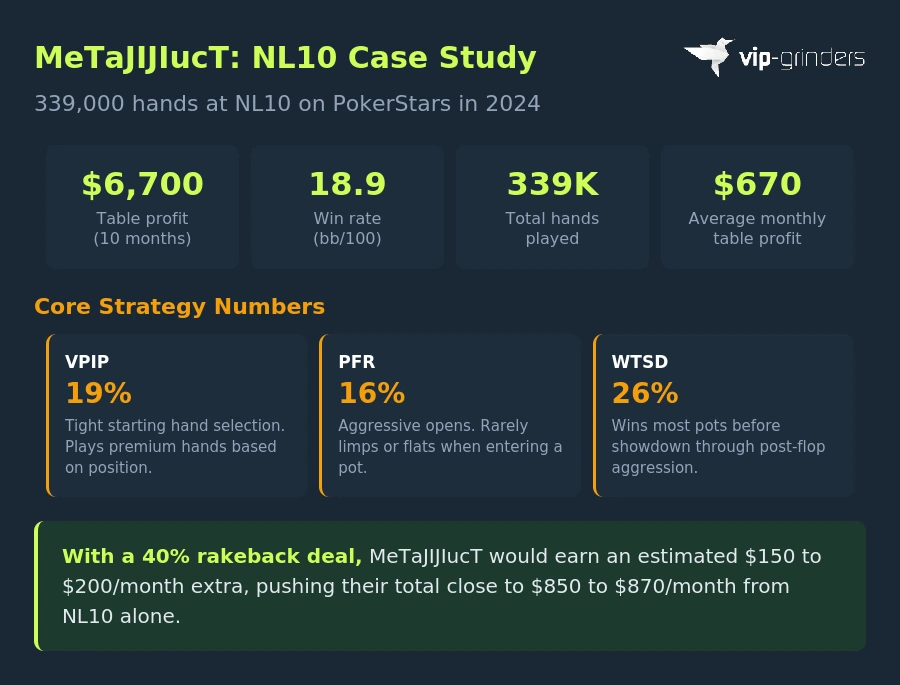
Their monthly results from 2024 show the consistency behind those numbers.
| Month | Hands | Table Profit | Win Rate (bb/100) |
|---|---|---|---|
| January 2024 | 33,000 | $508 | 7.5 |
| February 2024 | 30,000 | $790 | 26.6 |
| March 2024 | 41,000 | $898 | 21.9 |
| April 2024 | 27,000 | $801 | 29.5 |
| May 2024 | 38,000 | $927 | 24.5 |
| June 2024 | 48,000 | $879 | 18.8 |
Those are table profits only, without any rakeback included. A win rate of 18.9bb/100 is elite and not something most players should expect. But the monthly results show what is possible when a disciplined grinder combines a tight-aggressive strategy with consistent volume at soft stakes.
The key numbers behind MeTaJIJIucT’s approach: a 19 VPIP (tight starting hand selection), 16 PFR (aggressive opens), and a 26% WTSD (wins most pots before showdown). They play premium hands, bet aggressively in position, and avoid marginal spots. At NL10, this straightforward approach is enough to print money against the recreational-heavy player pool.
Path 3: NL50 (Fewer Hours, Higher Edge Required)
NL50 is the first stake where $1,000/month is comfortably achievable on a part-time schedule. The math works at 100 hours per month on 6 tables, and even 4-table players can reach the target with a moderate win rate and a solid deal.
The trade-off is clear: you need fewer hours but a bigger bankroll and a proven edge against tougher opponents.
| Setup | Win Rate | Tables | Deal | Hours/mo | Total/mo |
|---|---|---|---|---|---|
| Conservative | 3 bb/100 | 4 | 25% | 100 | $750 |
| Standard | 3 bb/100 | 6 | 25% | 100 | $1,125 |
| With strong deal | 3 bb/100 | 4 | 40% | 100 | $930 |
| Part-time | 3 bb/100 | 6 | 25% | 80 | $900 |
| Part-time + deal | 3 bb/100 | 6 | 40% | 80 | $1,116 |
The “Standard” setup clears $1,000 with room to spare. Even the part-time option (80 hours, 6 tables) falls just short at 25% but crosses $1,000 with a 40% deal. For players with the bankroll and the skill, NL50 is the most time-efficient path to the target.
What You Need Before Playing NL50
NL50 is where the $1,000/month target transitions from a grind to a realistic side income. The hours are manageable, the math is generous, and the monthly buffer above the target protects you from variance eating into your earnings.
Format Alternatives: Spins and Zoom
Regular 6-max cash is not the only way to reach $1,000/month. Zoom and Spins generate more hands per hour, which means more rake, more rakeback, and in some cases a faster path to the target. The trade-off is different skill requirements and higher variance.
| Format | Stake/Buy-in | Tables | Edge | Deal | Hours for $1,000 |
|---|---|---|---|---|---|
| Zoom NL50 | $0.25/$0.50 | 2 | 2 bb/100 | 25% | 125 |
| Zoom NL50 | $0.25/$0.50 | 3 | 2 bb/100 | 25% | 83 |
| Spins $5 | $5 | 6 | 2% ROI | 40% | 107 |
| Spins $10 | $10 | 4 | 2% ROI | 25% | 103 |
Zoom at NL50 on 3 tables reaches $1,000 in just 83 hours per month. That is 20 hours per week, making it one of the most time-efficient paths available. The catch is that Zoom win rates are typically 1 to 2bb/100 lower than regular tables because the player pool rotates constantly and table selection is not possible.
Spins require a strong rakeback deal to make the math work at $5 buy-ins. At $10 Spins with a 25% deal, the hours are comparable to NL25 cash but the variance is significantly higher. Players who choose the Spin path need a larger bankroll (150+ buy-ins) and a higher tolerance for losing stretches.
The Bankroll You Need for Each Path
Every path to $1,000/month requires a different starting bankroll. The table below maps each route to the minimum bankroll needed using standard guidelines.
| Path | Stake/Format | Standard Bankroll (30 buy-ins) | Conservative (50 buy-ins) | Hours/mo Needed |
|---|---|---|---|---|
| NL10 high volume | Cash 6-max | $300 | $500 | 150 to 190 |
| NL25 balanced | Cash 6-max | $750 | $1,250 | 150 |
| NL50 efficient | Cash 6-max | $1,500 | $2,500 | 80 to 100 |
| Zoom NL50 | Fast-fold | $1,500 | $2,500 | 83 to 125 |
| $5 Spins | Jackpot SNG | $750 (150 buy-ins) | $1,000 (200 buy-ins) | 107 |
| $10 Spins | Jackpot SNG | $1,500 (150 buy-ins) | $2,000 (200 buy-ins) | 103 |
The NL10 path needs the smallest bankroll ($300) but the most hours (150 to 190). The NL50 and Zoom paths need the largest bankroll ($1,500+) but the fewest hours (80 to 125). Your choice depends on which resource you have more of: time or capital.
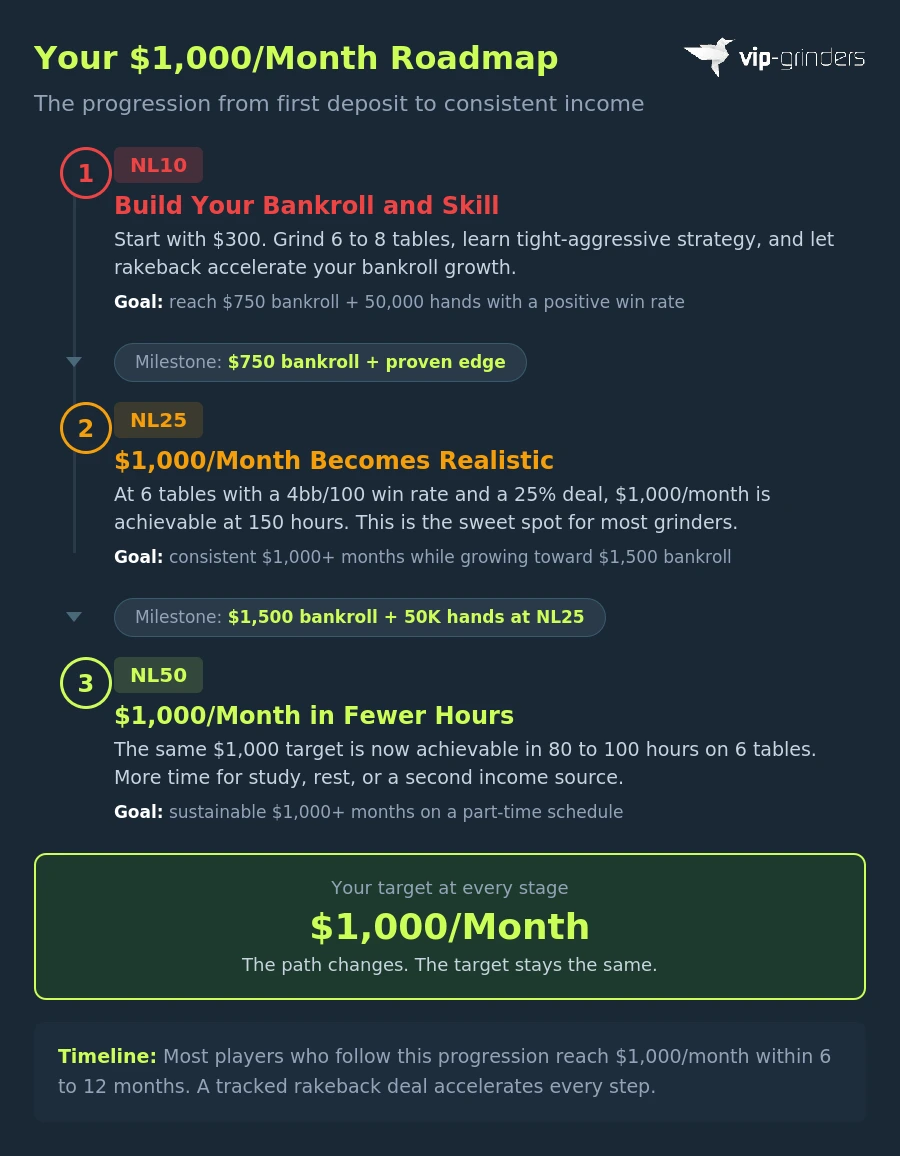
For players starting with a small bankroll, the realistic progression is: build at NL10, move to NL25 once you have $750 and a proven win rate, then target $1,000/month at NL25 while continuing to grow toward NL50. Signing up through VIP-Grinders rakeback deals accelerates every step of this progression because the rakeback income compounds into your bankroll from day one.
Common Mistakes That Keep You Under $1,000
The math in this guide is straightforward. The execution is where most players fall short.
- Playing too many stakes: splitting sessions between NL10 and NL25 makes it harder to track your win rate at either level and dilutes your hourly. Pick one primary stake and commit.
- Ignoring rakeback: every path in this guide includes rakeback as a core income component. A player with no deal needs roughly 30% to 50% more hours to hit the same target.
- Not tracking hours and results: if you do not know your win rate, hours played, and rake generated, you cannot identify which variable is holding you back. Log every session.
- Underestimating the volume at micro stakes: $1,000/month at NL10 requires 150 to 190 hours. Many players assume they can do it on 100 hours and end up frustrated when the numbers fall short.
- Moving up too early: jumping from NL10 to NL50 because the hourly rate looks better on paper is the fastest way to lose your bankroll. Move up one stake at a time with 50,000+ hands confirming your edge at each level.
The players who consistently hit $1,000/month are not the ones with the highest win rates. They are the ones who pick a stake, lock in a deal, put in the hours, and track everything. The math does the rest.
Frequently Asked Questions
Can you really make $1,000 a month playing online poker?
Yes, but it requires the right combination of stake, volume, and rakeback. At NL25 with a 4bb/100 win rate, 6 tables, and a 25% deal, you need roughly 150 hours per month to clear $1,000. At NL50, the same target is achievable in 80 to 100 hours. It is not passive income, but it is a realistic side income for disciplined grinders.
What is the best stake to make $1,000 a month?
NL25 is the most realistic starting point for most players. The games are still soft, the bankroll requirement is manageable ($750), and the combination of table profit plus rakeback produces meaningful income at 150 hours per month. NL50 is more time-efficient but requires a bigger bankroll and a proven edge against tougher opponents.
Can I make $1,000 a month at NL10?
It is possible but demanding. A 3bb/100 winner at NL10 with a 40% rakeback deal needs roughly 190 hours per month to hit $1,000. That is over 6 hours per day, every day. A higher win rate (5bb/100+) reduces the requirement to around 148 hours. For most players, moving up to NL25 is a more sustainable path to the same target.
How important is rakeback for making $1,000 a month?
Rakeback is critical at every stake below NL100. At NL25 with 6 tables and 150 hours, rakeback contributes $338 to $540 per month depending on your deal. That is 25% to 50% of your total income. Without a deal, you need a significantly higher win rate or more hours to reach the same target.
How many hours per week do I need to play?
It depends on your stake. At NL50 with 6 tables and a 25% deal, roughly 25 hours per week is enough. At NL25, plan for 35 to 38 hours per week. At NL10, you need 45+ hours per week, which is essentially a full-time job. The higher your stake and your deal, the fewer hours you need.
What bankroll do I need to start?
For the NL10 path, $300 (30 buy-ins). For NL25, $750. For NL50, $1,500. These are standard guidelines. Players who depend on poker income should add a buffer and target 50 buy-ins. If you are starting from scratch, begin at NL10, build your roll through play and rakeback, and move up when both your bankroll and sample size support it.
Is $1,000 a month from poker enough to live on?
It depends entirely on where you live and your expenses. In many countries in Southeast Asia or Latin America, $1,000/month covers a comfortable lifestyle. In major Western cities, it is a strong side income but unlikely to replace a full-time salary. Most players at this income level treat poker as a supplement rather than their sole income source.
What is the fastest way to go from $0 to $1,000 a month?
Start at the lowest stake your deposit allows, focus on learning a tight-aggressive strategy, and sign up through a tracked affiliate for the best available rakeback deal. Build your bankroll at NL5 or NL10, track every session, and move up to NL25 once you have $750 and a proven win rate over 50,000+ hands. Most players who follow this progression reach $1,000/month within 6 to 12 months.