

3-Bet Strategy 2026: Ranges, Sizing & Bluff Math for 6-Max
A 3-bet is the third raise in a betting round, and it is the single preflop move that separates winning players from breakeven ones. When someone opens the pot and you raise again, you isolate them, take the initiative, and force them to play a bigger pot than they wanted. Done correctly, 3-betting wins more money than any other preflop action in online poker.
Most players either 3-bet too tight (only QQ+ and AK) or too wide (every suited Ace they see). Both leak money. The correct approach is a structured range of value hands and bluffs, sized differently in position vs out of position, with hand selection driven by blockers and pot odds.
Here is what this guide covers:
- How to build a 3-bet range with linear, polarized, and merged construction
- Position-by-position charts for the four core 6-max matchups at 100bb
- Bluff hand selection by blocker value and equity, plus the breakeven fold math
- The squeeze play that quietly prints the most money of any 3-bet variant
What a 3-Bet Is and Why It Prints Money
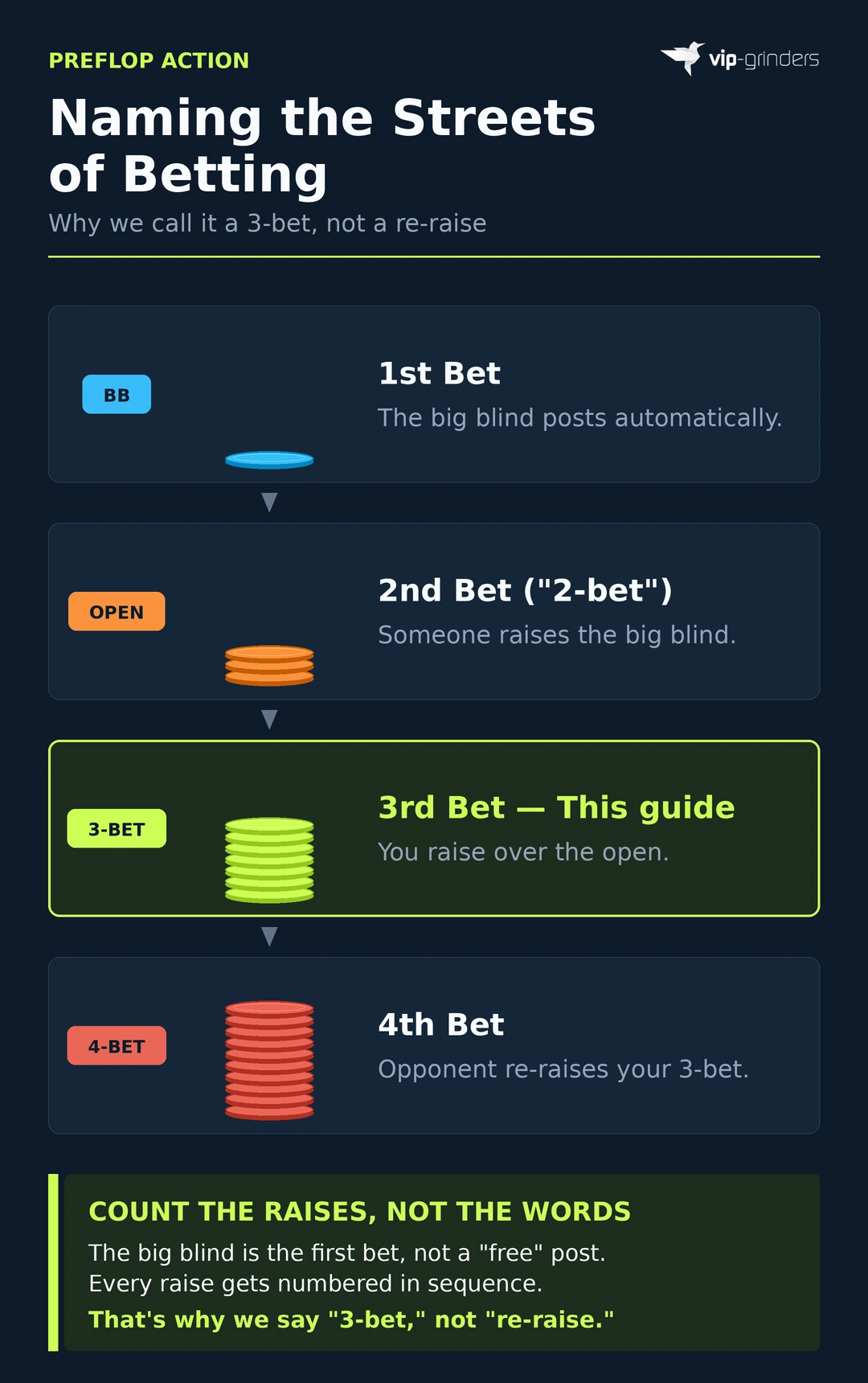
The naming is simple once you count correctly. The big blind is the first bet. An open-raise is the second bet (a “2-bet”).
When you raise again over that open, you have made the third bet, which is where the term 3-bet comes from. A 4-bet is the next raise after your 3-bet, a 5-bet is the one after that, and so on.
Why a 3-Bet Wins More Than a Flat Call
Calling an open is passive: you let the raiser take control of the pot and keep their full range intact. 3-betting is active: you shrink their range on the spot, build a pot where you have initiative, and win uncontested a high percentage of the time.
Three effects combine to make this profitable:
- Isolation: you fold out every other player behind the opener and get heads-up against a capped range. Multi-way pots are harder to win; heads-up pots are where your edge lives.
- Initiative: you become the last aggressor preflop, which lets you c-bet the flop with range advantage on the boards that favor a 3-bettor.
- Equity denial: many of the speculative hands that would have flopped well against a flat call (small suited connectors, low pairs, suited gappers) fold to a 3-bet, so you deny them the chance to realize their equity.
Why “Only 3-Bet Premiums” Leaves Money on the Table
The most common beginner approach is to 3-bet only with QQ+ and AK. This works against opponents who have never seen a poker forum, but against any half-observant regular it becomes transparent fast. Once the table knows your 3-bet range is four hands, they fold everything except hands that beat you, and your “value 3-bet” never gets paid off.
A profitable 3-bet range mixes value hands (QQ+, AK, sometimes JJ and AQs depending on the spot) with bluff hands (suited Aces, suited connectors, suited Kings) in roughly a 2:1 value-to-bluff ratio at 100bb. The value hands get called and paid off because the bluffs exist.
The bluffs win the pot outright often enough to cover their cost. Together they make 3-betting the highest-EV preflop weapon in the game.
How to Build a 3-Bet Range
A 3-bet range is built from two groups of hands: value hands that want to get called, and bluffs that want to fold out better. The trick is not which hands to pick, but how to combine them so your opponents cannot exploit you.
There are three ways to combine value and bluffs into a single range: linear, polarized, and merged. Each one wins in a different spot.
Linear Ranges: Top-Down Strength
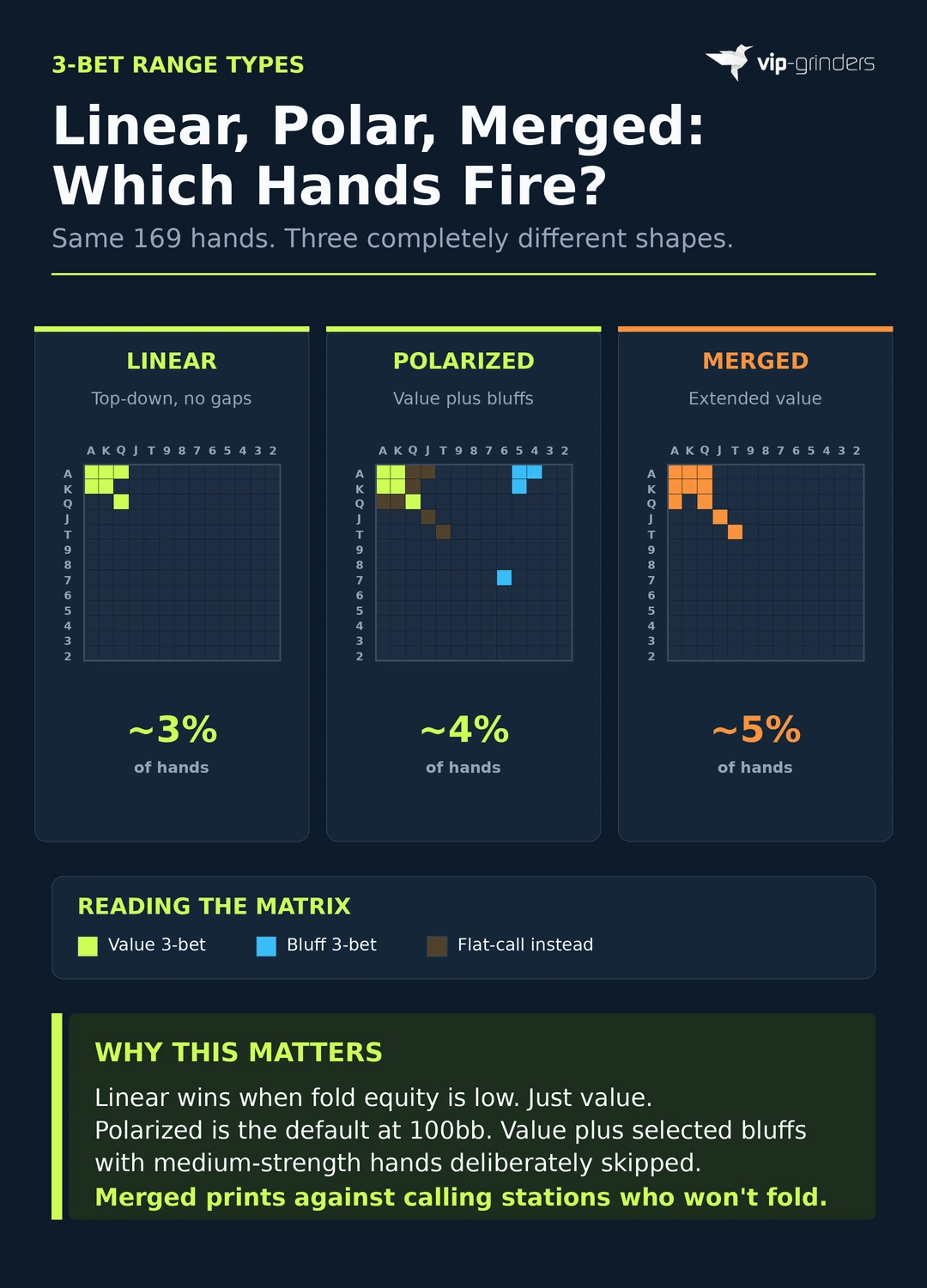
A linear range is the top X% of hands with no gaps: QQ+, AK, AQs, or JJ+, AQ+, KQs. No suited connectors mixed in and no bluff hands added below the value tier. You pick a cutoff and 3-bet everything above it.
Linear ranges win when fold equity is low. If your opponent calls 3-bets wide or has a wide opening range with lots of trash at the bottom, you do not need bluffs in your range. You 3-bet hands that are already ahead of their calling range and collect value when called.
The clearest spot for a linear 3-bet is the early stages of an MTT against a passive table, or against recreational players at low-stakes cash who call 3-bets with K9o and 66.
Polarized Ranges: Value Plus Bluffs
A polarized range combines strong value hands with selected bluff hands, skipping the medium-strength hands in between. Value: QQ+ and AK, bluffs: A5s, A4s, K5s, 76s. No JJ, no AQ, no TT as a 3-bet (those hands flat-call instead).
Polarized construction is the default at 100bb in 6-max cash against observant regulars. The math works because the bluffs win the pot when the opponent folds, and the value hands get paid off because the bluffs force opponents to defend wider.
The standard ratio is roughly 2:1 value-to-bluff at 100bb as a mid-position baseline. With 6 combos each of QQ, KK, AA plus 16 combos of AK (34 value combos total), you pair them with around 16 bluff combos: four suited Ace types like A5s, A4s, A3s, A2s. The button runs heavier on bluffs because of positional leverage, while UTG 3-bets skip bluffs entirely in favor of pure value.
Merged Ranges: Against Calling Stations
A merged range is a value-heavy range that also includes the medium-strength hands polarized construction would skip. JJ, TT, AQ, KQs all get 3-bet for value instead of flat-called.
Merged construction wins against opponents who call 3-bets too wide and play passively postflop. These players pay off your AQ on an A-high board because they cannot fold A8.
They pay off your JJ on a Jack-high board because they cannot fold middle pair. The hands that would be medium-strength against a tight caller become value hands against a station.
For the theory behind how ranges interact postflop (range advantage, board texture, equity shifts), see our GTO and solvers guide. The short version: solvers build polarized ranges as the default because they assume opponents defend correctly. Against opponents who defend incorrectly, merged ranges print.
Ranges by Position: The 6-Max Charts
The position you 3-bet from and the position you 3-bet against both matter more than the hand you hold. The button 3-betting the cutoff is a different animal from the big blind 3-betting the button, even with the same two cards. This section gives you the four core 6-max 100bb matchups.
The table below summarizes total 3-bet frequency by position pair. Specific hand ranges follow in each matchup below.
| Your Position | Opener’s Position | 3-Bet % | Range Type |
|---|---|---|---|
| Button | Cutoff / Hijack | ~12% | Polarized |
| Cutoff | UTG | ~6% | Linear |
| Small Blind | Button | ~10-12% | Polar (3-bet-or-fold) |
| Big Blind | Button | ~8-10% | Polarized |
Button vs Cutoff Open: The Widest 3-Bet Spot
When the cutoff opens and you sit on the button, you have the most profitable 3-bet spot in all of 6-max poker. The cutoff opens wide (around 25% of hands), you close the preflop action heads-up in position, and the blinds almost always fold. Your 3-bet percentage should land around 12% total: roughly 5% value, 7% bluffs.
Value hands: QQ+, AK, AQs, sometimes JJ.
Bluff hands: A5s-A2s (suited wheel Aces as blockers), K9s-K5s, 98s, 87s, 76s, 65s.
The reason this spot prints money is positional leverage. When the cutoff calls your 3-bet you play the flop in position against a capped range, when they fold you pick up the pot plus the dead blinds, and when they 4-bet your suited wheel Ace bluffs fold cheaply.
Cutoff vs UTG Open: Tight and Linear
When UTG opens and you are in the cutoff, the math flips. UTG opens a narrow range (around 12%), heavily weighted toward premiums, which means your fold equity is low and your equity when called is poor. This is a linear 3-bet spot: value hands only, no bluffs.
Target around 6% total, all value.
Value hands: JJ+, AK, AQs. Sometimes TT and AKo depending on the opener.
Do not 3-bet suited connectors, suited Aces, or anything below TT in this spot. UTG’s range is tight enough that your bluff combos fold out hands you already beat (like A7o) and get called by hands that dominate you (like AJ+). Flat-call your good-but-not-great hands (99, AQo, KQs) instead.
Small Blind vs Button Open: 3-Bet or Fold
When the button opens and you are in the small blind, your default strategy is 3-bet-or-fold. Flat calling is a leak because you play every postflop street out of position against a button that has range advantage, and the big blind still has position on you. The math on flatting from the SB does not work at standard rake structures.
Target around 10-12% total: roughly 5% value, 5-7% bluffs.
Value hands: QQ+, AK, AQs, JJ, TT.
Bluff hands: A5s-A2s, K9s-K5s, Q9s, 87s, 76s.
The button opens wide (40%+), so your polar 3-bet collects a high percentage of folds, and the suited bluffs have decent postflop playability when called. Fold everything else: no limping, no flatting, no compromise ranges.
Big Blind vs Button Open: Defend Wide, 3-Bet Polar
The big blind is different from every other 3-bet spot because you already have 1bb invested. That changes the math on flatting: you get a better price to call, so your overall defense range is much wider than any other seat. Your 3-bet range, however, stays polar and disciplined.
Target around 8-10% as 3-bets, with another 25-35% of hands flat-calling.
Value hands: QQ+, AK, AQs, JJ.
Bluff hands: A5s-A4s, K5s-K2s, 87s, 76s (mixed with flats).
The flat-call range is wider here than anywhere else: suited connectors down to 54s, suited Kings K9s-KTs, all pocket pairs 22-TT, and Broadways like KQo and QJs. For the full flat-call-vs-3-bet split from the big blind, see our position guide. The 3-bet range specifically stays tighter and more polar because you play the entire hand out of position.
Sizing: How Much to Raise and Why
3-bet sizing depends on two things: whether you are in position or out of position, and how deep the stacks are. Get these two inputs right and your sizing will be correct in 95% of spots without thinking. Get them wrong and you leak money on every 3-bet, whether you win the pot or not.
The table below covers the full sizing structure.
| Stack Depth | IP Sizing | OOP Sizing | Multiway Add-on |
|---|---|---|---|
| 100bb (cash default) | 3x the open | 3.5x to 4x the open | +1x per extra caller |
| 75bb | 2.8x the open | 3.5x the open | +1x per extra caller |
| 50bb | 2.5x the open | 3x the open | +0.5x per extra caller |
| 30bb and below | All-in only | All-in only | All-in only |
In Position: 3x the Open
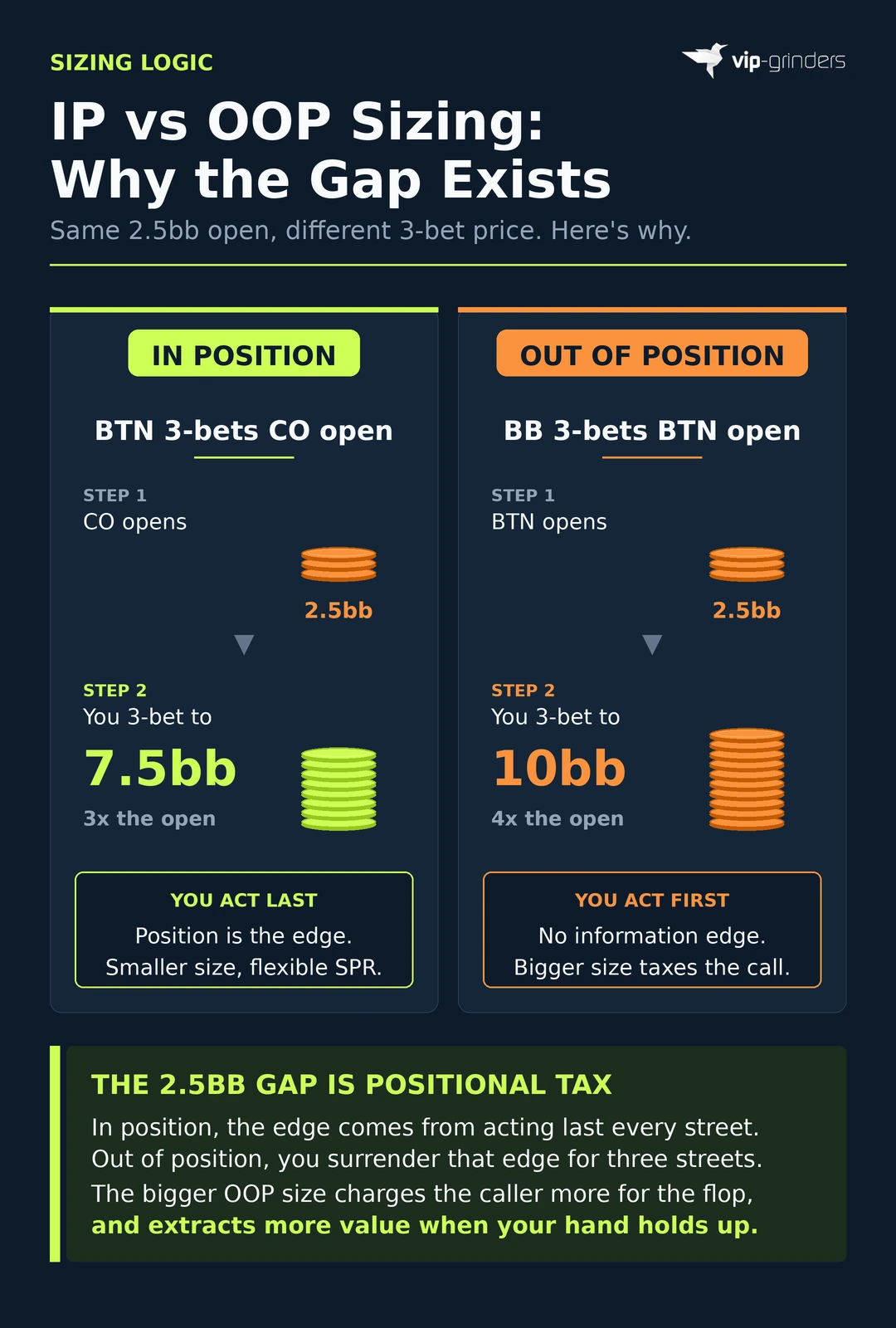
When you are in position, your sizing can stay smaller because position itself gives you postflop edge. A 3x the open 3-bet at 100bb is the standard: against a 2.5bb open, you raise to 7.5bb. Against a 3bb open, you raise to 9bb.
Smaller IP sizing accomplishes two things. It risks fewer chips when your bluffs fail, and it keeps the stack-to-pot ratio manageable when your value hands get called. A 3x size means you can still bet three streets postflop without committing your entire stack, which keeps the value hands flexible and the bluffs cheap.
Do not deviate from 3x IP unless you have a specific read. A larger size folds out the bluff catchers you want called by your value hands, and a smaller size gives opponents good odds to flat too wide.
Out of Position: 3.5x to 4x the Open
When you are out of position, your sizing must be bigger to compensate for the positional disadvantage. Standard is 3.5x to 4x the open at 100bb. Against a 2.5bb open, that means raising to 9bb or 10bb.
The reason is simple: when you 3-bet out of position and get called, you play three postflop streets without the information advantage that comes from acting last. A bigger preflop size extracts more value when your hand holds up, and charges the caller more when they want to see a flop. Both effects push your EV up.
The deeper you go, the more OOP sizing matters. At 150bb+ cash, some OOP 3-bets go to 4.5x or 5x because the stacks behind the 3-bet reward bigger pots with value hands.
Multiway: Add 1x Per Caller
When there is an open plus at least one caller before the action reaches you, your 3-bet is a squeeze and the sizing changes. The rule: add 1x the open for every additional caller on top of your standard IP or OOP size.
So if the cutoff opens 2.5bb and the button flats, and you 3-bet from the big blind, your standard OOP size of 4x the open (10bb) goes up to 5x (12.5bb). If two players called before you, it would go up to 6x (15bb). This sizing rule adjusts for the dead money in the pot and keeps your fold equity intact against the additional callers.
The full squeeze breakdown (ranges, hand selection, breakeven math) comes later in the squeeze play section. For now, the sizing rule and stack-depth adjustments are identical to non-squeeze 3-bets.
The Bluff Math That Makes 3-Bets +EV
A 3-bet bluff is profitable when your opponent folds often enough to cover the bb you risk. That fold rate has an exact number, and most players never calculate it. Once you know the breakeven, you know whether your bluff works before you click the button.
The Formula: Risk Divided by Risk Plus Reward
The required fold frequency formula is the same across all of poker:
Breakeven Fold % = Risk / (Risk + Reward)
For a 3-bet, the inputs are:
- Risk: the amount of your 3-bet raise (the chips you lose if you get called and fold later, simplified to the initial bet for preflop bluff math).
- Reward: the dead money in the pot that you win when everyone folds (the open, the blinds, and any antes).
For a standard 9bb 3-bet over a 2.5bb open with blinds of 0.5bb and 1bb, the math is 9 / (9 + 2.5 + 0.5 + 1) = 9 / 13 = ~69%. If your opponent folds more than 69% of the time, any two cards are a profitable bluff before considering the equity you have when called.
The Dead-Blind Adjustment Most Players Miss
The 69% breakeven is a clean number, but it ignores something real. When you 3-bet from the big blind, the 1bb you already posted is not “risk” anymore. That money is dead.
Most players include the full 9bb raise as risk, which overstates the breakeven. Your actual incremental risk from the BB is only 8bb (9bb raise minus the 1bb already posted). The correct math is 8 / (8 + 2.5 + 0.5 + 1) = 8 / 12 = ~67%.
Two percentage points lower than the naive calculation. That gap widens at bigger 3-bet sizes and when antes are in play, which is the difference between a marginal bluff and a clearly profitable one across thousands of hands.
What This Means at the Table
Pool fold-to-3-bet rates vary by stake and format, but the numbers below are reliable enough to make real-time decisions from.
- Low-stakes cash (NL10-NL50): pool folds 55-65% on average. Bluffing is profitable with good combos (suited Aces, suited connectors) but marginal with pure trash.
- Mid-stakes cash (NL100-NL200): pool folds 60-70%. Any-two bluffs start to break even from late position, and good combos print.
- Fast-fold pools: pool folds 65-75%. Linear 3-bets become the default because any-two works and balanced bluffs are wasted.
- MTTs at 100bb: pool folds 55-65% in early levels, tightening as stacks shrink and ICM kicks in.
The bluff math explains why 3-betting any-two from the button against a tight reg prints money, and why bluffing QQ+ only against a loose station is a guaranteed leak. The formula never changes. Only the inputs do.
Picking Bluff Hands: Blockers and Equity
A good 3-bet bluff does two jobs: it blocks the hands your opponent calls with, and it has enough equity to win the pot when called. Most players pick bluff hands by feel, which is how you end up 3-bet bluffing Q9o and folding A5s. Reverse that order and your bluffs will print money instead of burning it.
The table below shows equity for the four main bluff classes against a standard calling range of JJ-TT, AQ, KQs.
| Bluff Class | Example Hands | Equity vs Calling Range | Blocker Quality |
|---|---|---|---|
| Suited wheel Aces | A5s, A4s, A3s, A2s | ~27-30% | Excellent (blocks AA, AK, AQ) |
| Suited connectors | T9s, 98s, 87s, 76s, 65s | ~32-35% | Poor (no high-card blockers) |
| Suited Kings | K5s, K6s, K7s, K8s, K9s | ~28-33% | Good (blocks KK, AK, KQ) |
| Offsuit Broadways | KQo, KJo, QJo | ~35-38% | Mediocre (dominated when called) |
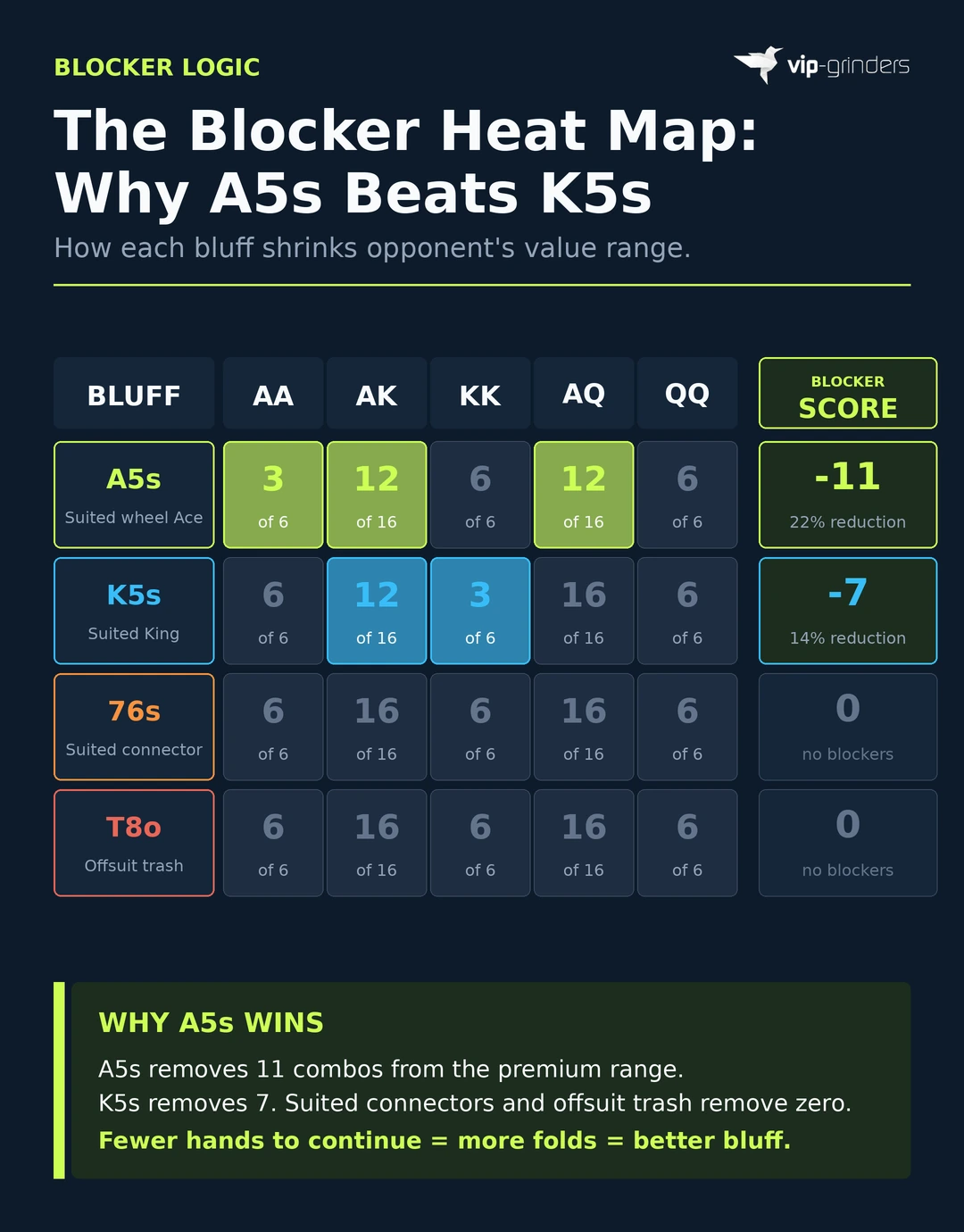
Note: The equity numbers above show raw equity when called. Suited wheel Aces look weakest on raw equity because they get dominated by AQ in the calling range. Their value as the best bluff class comes from blocker-driven fold equity, not postflop equity when called.
Suited Wheel Aces: The Best Bluff Class
A5s through A2s are the best 3-bet bluff combos in poker. The Ace blocks the strongest part of your opponent’s value range (AA, AKs, AKo, AQs, AQo), which means they have fewer combos to continue with. When they do call or 4-bet, you hold the nut-flush blocker, which lets you barrel rivers or call down wider.
Use all four suited wheel Aces (A5s, A4s, A3s, A2s) as standard bluffs from every late position. That’s 16 combos of pure blocker bluffs.
A5s and A4s are slightly better than A3s and A2s because of straight potential (A-2-3-4-5 wheel), but the difference is small. Mix them in equally and focus on blocker value over raw equity.
Suited Connectors: Playability Over Blockers
T9s, 98s, 87s, 76s, and 65s do not block much, but they flop more equity than any other bluff class when called. Open-ended straight draws, flush draws, pair-plus-draws on every middling board. When your 3-bet bluff gets called and you hit a 9-high flop with 98s, you have a hand that can bet three streets and get paid off.
Use suited connectors as bluffs primarily from the button and from the big blind, where postflop playability matters most. Avoid them from the small blind, where you play out of position and cannot realize equity cleanly.
In position, two or three suited connector combos per 3-bet spot is plenty. Any more and you over-bluff; any fewer and you under-use a strong class.
Suited Kings: The Middle Class
K5s through K9s sit between wheel Aces and suited connectors. The King blocks KK, AK, and KQ. The hand has decent postflop playability (top-pair potential, flush draws, some straight potential).
These are workhorse bluffs when you need to round out your range without over-using suited Aces. K7s and K6s in particular are underrated because they block KK and AK without being the “obvious” A5s bluff your opponent might expect.
Use suited Kings when you’re building a polar range with enough bluff combos to stay balanced but have already used your suited wheel Aces.
Hands to Never 3-Bet Bluff
Three types of hands are negative-EV 3-bet bluffs in almost every spot:
- Offsuit trash: J9o, T8o, Q7o. No blocker value, no equity when called, no postflop playability. Fold pre.
- Medium pocket pairs: TT, 99, 88. These hands lose too much set-mining value when you 3-bet and get called or 4-bet. Flat-call instead to keep the set-mining odds intact.
- Too-strong-for-bluff: JJ, AQo. These hands are ahead of most calling ranges and should be value-3-bet in a linear spot or flat-called in a polar spot. Treating them as bluffs miscategorizes their EV.
The rule is simple: if a hand has no blocker, no equity, and no playability, it does not belong in your 3-bet bluff range.
When You Get 3-Bet: Call, 4-Bet, or Fold
Most players defend against 3-bets on autopilot, calling too wide with weak hands and 4-betting only premiums. That default leaks money in both directions. The correct approach is a three-way split (call, 4-bet, fold) with explicit thresholds for each group.
The table below summarizes your defense strategy when you open the cutoff and face a 3-bet from the button or blinds.
| Action | Hand Strength | Example Hands | % of Opening Range |
|---|---|---|---|
| 4-bet for value | Premium value | KK+, AKs | ~3-4% |
| 4-bet as bluff | Blocker bluffs | A5s, A4s | ~2-3% |
| Flat call | Medium strength IP | QQ, JJ, TT, AQs, KQs, 99-66 | ~15-20% |
| Fold | Everything else | Suited gappers, offsuit Broadways | ~50-60% |
When to Flat Call: In Position with Medium Strength
Flat-calling a 3-bet works best when you are in position with a hand that plays well postflop but is not strong enough to 4-bet for value. Pocket pairs 66-QQ set-mine profitably at 100bb when you can see a flop cheaply. Suited Broadways like KQs and AQs hit top pairs and flush draws that win significant pots when you hit.
Flatting is weakest out of position. When you open from UTG and the button 3-bets, most of your medium-strength hands (99, AJs, KQs) should be folded rather than flatted, because you play three postflop streets without position.
The exception is deep stacks (150bb+) where implied odds on sets and premium draws justify a wider flatting range even OOP. At 100bb and below, default to tight.
When to 4-Bet for Value
4-betting for value is correct only with hands that are ahead of your opponent’s 5-bet-shove range. At 100bb, that means KK+ and AKs as standard value 4-bets. AKo is a mix between 4-bet and call depending on the opponent’s 3-bet frequency.
Sizing: 4-bet to 2.2x to 2.5x the 3-bet. Against a 9bb 3-bet, that means 4-betting to 20-23bb. Smaller sizes give opponents good odds to call and see a flop; larger sizes commit too much of your stack with no additional fold equity.
Do not 4-bet JJ or QQ for pure value at 100bb. These hands do better flat-calling in position against most 3-bettors, because a 4-bet folds out worse hands and keeps in hands that dominate you.
When to 4-Bet as a Bluff
The best 4-bet bluffs are hands with an Ace that can be folded to a 5-bet shove. A5s and A4s are the standard blocker 4-bet bluffs at 100bb because the Ace blocks AA, AK, and AQ in your opponent’s 5-bet range. When they do shove, you fold cheaply.
Do not bluff 4-bet without an Ace blocker. Hands like 87s and K9s have no blocker value and do not fold cleanly when your opponent shoves. The entire point of a 4-bet bluff is blocker-driven fold equity, and non-Ace hands do not deliver that.
Frequency: roughly 1 bluff 4-bet for every 1.5 to 2 value 4-bets. With KK+ and AKs as value (around 7 combos), add 4 combos of A5s or A4s as bluffs. That keeps you balanced against observant opponents.
When to Fold
Against a 3-bet, the correct fold frequency for a solid opening range is ~55-60%. Solver ranges fold this much by default, even though it feels too tight.
The hands to fold are straightforward: suited gappers (J9s, T8s, 97s), offsuit Broadways that dominate nothing (KJo, QJo, JTo), and small suited Aces when you are out of position. If a hand has no equity when called and no blocker value, fold and move to the next hand.
Over-folding is not a leak at this stage. Under-folding against a balanced 3-bettor is a much bigger leak, because every marginal flat-call is a losing play when the bluff-to-value ratio is tight.
Squeeze Play: The Most Profitable 3-Bet
A squeeze is a 3-bet made after an open and at least one cold-call. It is the single most profitable 3-bet variant because the dead money in the pot pushes your breakeven fold frequency far below a standard 3-bet. Most grinders under-squeeze, which is why the spot prints money for anyone who gets it right.
The reason squeezes work is simple: every caller adds dead money to the pot without adding equity to the opener. You collect that dead money when everyone folds, which happens more often than you think.
The Dead-Money Math
A standard 9bb 3-bet over a 2.5bb open needs 69% folds to break even. When the button cold-calls the cutoff’s 2.5bb open and you squeeze to 12bb from the big blind, the math flips hard. Your risk stays similar, but the pot already has 6.5bb of dead money (open 2.5 + caller 2.5 + SB 0.5 + BB 1) instead of 4bb.
The breakeven calculation is 12 / (12 + 2.5 + 2.5 + 0.5 + 1) = 12 / 18.5 = ~65%. You need less fold equity than a heads-up 3-bet despite risking more chips. Factor in the BB dead-blind adjustment (your actual risk is 11bb) and the breakeven drops to around 11 / 17.5 = ~63%.
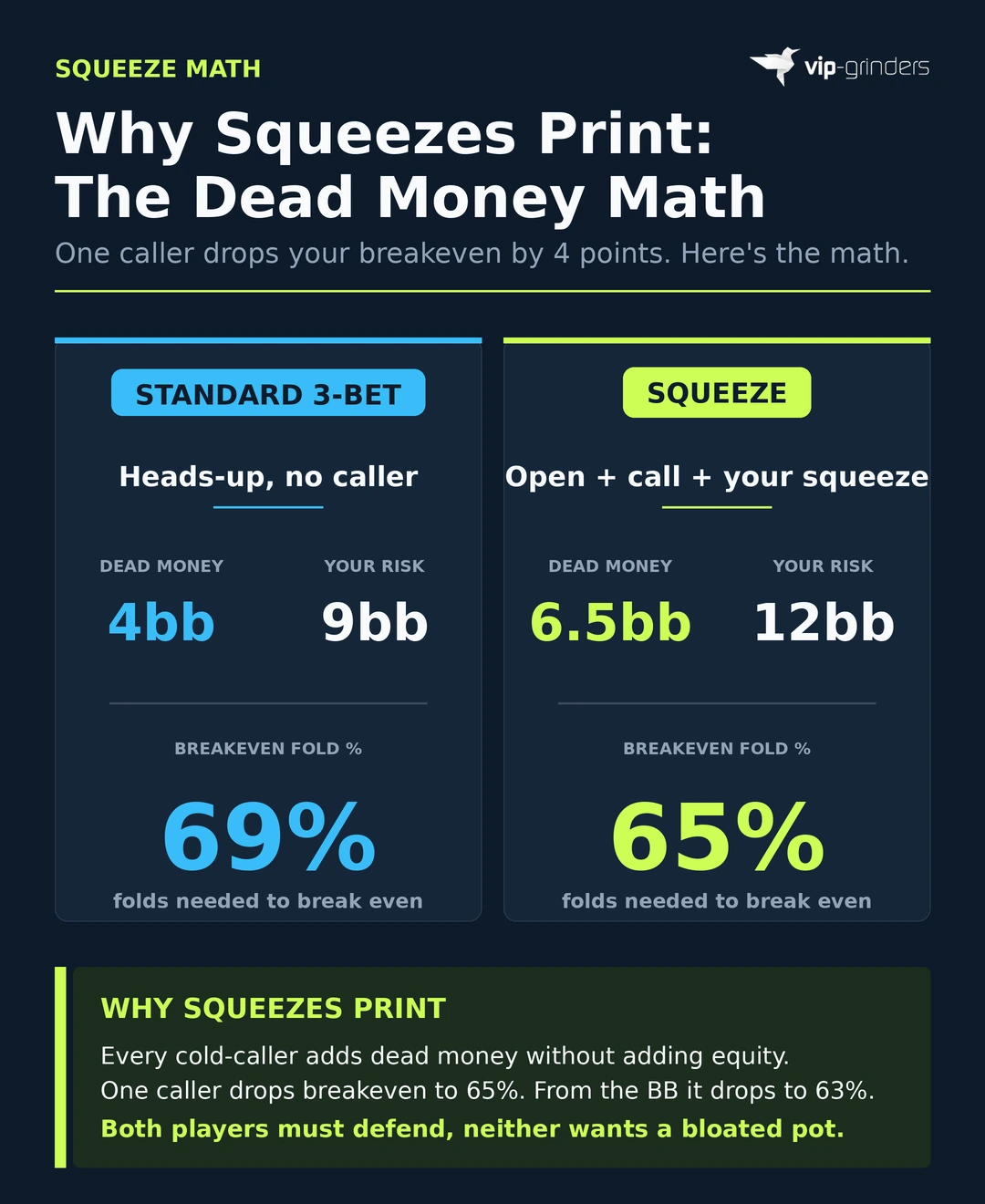
That 6-point gap between a standard 3-bet breakeven and a squeeze breakeven is where the money lives. Most opponents fold to squeezes even more often than they fold to regular 3-bets because both players have to defend, and neither wants to play a bloated pot out of position against the other.
Squeeze Sizing: Bigger Than a Standard 3-Bet
Squeeze sizing follows the sizing rule from earlier (add 1x the open per additional caller) but deserves its own table because the math is so different from a heads-up 3-bet. Against a 2.5bb open with one cold-caller:
| Your Position | Squeeze Sizing | Multiplier |
|---|---|---|
| Button (IP) | 10-11bb | ~4x the open |
| Small Blind (OOP) | 12-13bb | ~5x the open |
| Big Blind (OOP) | 12-14bb | ~5x the open |
| Add per extra caller | +3bb | +1x the open |
The bigger size punishes loose callers and discourages the opener from flatting your squeeze with hands they would have continued against a heads-up 3-bet. Smaller sizes leak EV because both players see a flop wider, which is exactly what you do not want.
Hand Selection: Blockers Matter More Than Equity
Squeeze bluffs should be blocker-heavy. When two players have shown interest in a pot, their combined calling range is wider than a single heads-up caller, so blocker value matters more than raw equity.
Standard squeeze bluff class: A5s, A4s, A3s, A2s. The Ace blocks the value 4-bet range of both players (AA, AKs, AQs) and gives you a playable hand if called. Add one or two suited connectors (76s, 65s) for playability when the opener is tight and the cold-caller is a recreational player.
Value squeeze range stays tight: QQ+, AK, sometimes AQs from late position. Do not squeeze JJ or TT for pure value. Those hands do better flat-calling or folding, because a squeeze gets called by hands that dominate them (AQ, AK, KK+) and folds out the hands that do not.
Best Spots to Squeeze
The most profitable squeeze spots in 6-max poker share three features: wide opener, loose cold-caller, and your range advantage from the blinds. The best of these spots is big blind vs cutoff open plus button flat. The cutoff opens wide (25%+), the button flats with hands they would 3-bet against a tight opener, and you close the action with a polar range that punishes both.
Small blind squeezes against a late-position open plus a button flat work the same way, with the added benefit of removing the big blind from the pot entirely.
Avoid squeezing when the opener is UTG and the cold-caller is another reg. That combination screams strength, and your fold equity collapses. Flat-call your premiums and fold everything else in those spots.
Exploits by Opponent Type
The balanced 3-bet ranges in this guide are your default against unknown opponents. The moment you have reads, you throw balance out the window. Every dollar of EV in poker comes from exploiting predictable tendencies, and opponents with extreme stats are the easiest to exploit.
The table below gives you the three most common archetypes with HUD stat thresholds and the specific adjustment that prints money against each.
| Archetype | Fold to 3-Bet % | Adjustment | Key Tell |
|---|---|---|---|
| Nit | 75%+ | Bluff any-two IP | VPIP under 18, PFR under 14 |
| TAG reg | 55-65% | Balanced polar, add A5s 4-bet bluffs | VPIP 20-24, PFR 18-22 |
| Station / maniac | under 50% | Drop bluffs, widen value | VPIP 30+, passive postflop |
The Nit: 3-Bet Any Two in Position
Nits fold to 3-bets at 75% or higher. That number is well above the breakeven we calculated earlier, which means any two cards are a profitable 3-bet bluff in position against this player type. Your equity when called does not matter because you barely ever get called.
Against nits, expand your 3-bet bluff range from the standard suited Aces and suited connectors to include offsuit Broadways, small suited Aces you would normally fold (A9s-A6s), and suited one-gappers (97s, 86s). The point is not to have balanced bluffs. The point is to print fold equity.
When the nit does call or 4-bet, believe them. Their calling range is JJ+/AK and their 4-bet range is QQ+/AK. Fold your bluffs cleanly and move to the next hand.
The TAG Reg: Balanced Play with Blocker 4-Bet Bluffs
TAGs fold to 3-bets at 55-65%. Their fold rate sits near the breakeven, which means pure any-two bluffs are marginal against them. You win EV against TAGs through precise construction, not volume.
Against a TAG, run the standard polar 3-bet range from the position charts without widening. Their opening range is tight, their 4-bet range is balanced, and they defend correctly enough that over-bluffing punishes you. Where you gain edge is in 4-betting them: add A5s and A4s as blocker 4-bet bluffs after they 3-bet you, because TAGs fold to 4-bets at ~60% on average.
The trap to avoid: do not try to exploit TAGs by getting tricky. They punish imbalance. Your EV against them comes from positional leverage and blocker-driven 4-bet bluffs, not from wild 3-bet frequencies.
The Station / Maniac: Value-Heavy, Bluffs to Zero
Stations fold to 3-bets under 50%. Maniacs 3-bet you back at absurd frequencies. Both player types break the math that makes polar 3-betting profitable, and both require collapsing your bluff count to zero.
Against stations, drop all bluffs and widen your value range. A merged construction (JJ, TT, AQ, KQs all 3-bet for value) works because the station calls with dominated hands and pays off on every street. Run the equity calculator to see how JJ plays against a loose calling range (~65% equity vs a typical station’s 3-bet-call range).
Against maniacs, flip the script: wait for value hands and let them bluff into you. Your 3-bet range collapses to QQ+/AK for value, while everything else either flat-calls (trapping the maniac into c-betting) or folds. Bluffing a maniac is the biggest leak possible because they will 4-bet you with air and force you to fold equity back to them.
Aggressive 3-betting builds variance faster than any other preflop adjustment. A deeper bankroll buffer matters more when your 3-bet frequency climbs, because swings compound with every marginal spot.
Adjusting for Cash, MTT, and Fast-Fold
The ranges and sizing in this guide assume 6-max cash at 100bb effective. Every other format is a variation, not a different game. Get the cash baseline right and the adjustments for MTTs and fast-fold are small deltas you can apply on the fly.
The table below covers the three-way format comparison.
| Format | Typical Sizing | Range Type | Key Adjustment |
|---|---|---|---|
| 6-max Cash (100bb) | 3x IP, 4x OOP | Polarized | Baseline |
| MTT (40-100bb) | Shrinks with stack | Polar to linear as stacks shrink | ICM tightens ranges at bubbles |
| Fast-Fold Pools | Often 1bb smaller | Linear | Wider folds, drop bluffs |
MTT: Ranges Shrink as Stacks Shrink
MTT 3-bet strategy changes across three stages: early levels (80-100bb), mid-stages (40-80bb), and late stages (under 40bb). Early levels play like cash, so the ranges in this guide apply directly. Mid-stages tighten significantly because stacks no longer support speculative bluff 3-bets, and ICM pressure near money bubbles further compresses calling ranges.
Late stages (under 30bb) collapse to all-in or fold, which is a different math problem entirely. For the full stage-by-stage breakdown including ICM-adjusted ranges, see our MTT stage-by-stage sizing adjustments.
The key MTT adjustment: squeeze frequency increases sharply on money bubbles because short stacks fold wide to preserve tournament life. Use that window aggressively.
Fast-Fold Pools: Linear Replaces Polar
Fast-fold pools (Zoom, Rush & Cash, Snap) change the math on 3-betting because the anonymous pool plays tighter to 3-bets than seated cash regs. Fold-to-3-bet rates run 65-75%, well above the 69% breakeven, which means any-two bluffs print.
The correct adjustment: drop bluff hands like suited connectors that rely on postflop playability. Replace them with a wider linear value range (AJs, KQs, 99-JJ added to the 3-bet range). You never play a long hand against the same opponent, so range balance matters less than immediate fold equity.
Sizing drops by about 1bb across the board because fields fold enough that smaller sizes still collect the dead money. For the full pool-type breakdown including stake-tier fold rates, see our fast-fold preflop adjustments for anonymous pools.
3-Bet FAQs
What is a 3-bet in poker?
A 3-bet is the third raise in a betting round preflop. The big blind counts as the first bet, an open-raise counts as the second bet (a “2-bet”), and when you raise over that open, you have made the third bet. 3-bets isolate the original raiser, build the pot in position, and deny equity to speculative hands that would have flopped well against a flat call.
What is a good 3-bet percentage at 6-max?
A balanced 6-max 3-bet frequency sits between 8% and 12% of total hands dealt, depending on your position and opponent profile. From the button against a cutoff open, 12% is standard. From the cutoff against UTG, 6% is correct. If your HUD shows your overall 3-bet stat below 6% or above 14%, you are likely leaking EV in one direction.
How much should I 3-bet in position vs out of position?
In position, 3-bet to 3x the open at 100bb. Against a 2.5bb open, that means raising to 7.5bb. Out of position, 3-bet to 3.5x-4x the open, which is 9-10bb against a 2.5bb open. OOP sizing is bigger to compensate for the positional disadvantage you face on every postflop street.
What hands should I 3-bet bluff with?
The best 3-bet bluff hands share two features: blocker value and playability. Suited wheel Aces (A5s, A4s, A3s, A2s) are the top class because they block AA, AK, and AQ. Suited connectors (T9s, 98s, 87s, 76s, 65s) flop the most equity when called. Suited Kings (K5s-K9s) round out balanced bluff ranges. Avoid offsuit trash, medium pocket pairs, and hands like JJ that are too strong to bluff.
When should I squeeze versus flat-call?
Squeeze when someone opens and at least one player cold-calls before the action reaches you. The dead money in the pot drops your breakeven fold frequency to around 65%, well below a standard 3-bet breakeven of 69%. Flat-call only when you have a medium-strength hand in position that plays well postflop (pocket pairs for set-mining, suited Broadways for top-pair equity). From the blinds, default to squeeze-or-fold: flatting out of position in a multiway pot is almost always a leak.
How do I respond when I get 4-bet?
Your 5-bet range against a standard 4-bet is KK+ and AKs. Everything else folds. If you 4-bet bluffed with A5s or A4s and got 5-bet shoved on, fold cleanly. The entire point of the A5s blocker bluff is that it folds cheaply to a shove. Do not 5-bet bluff at 100bb without a specific read, because the risk-reward math does not justify it.
Should I 3-bet bluff at low stakes?
Yes, but selectively. At NL10-NL50, pool fold-to-3-bet rates run 55-65%, which is near the breakeven. Bluffing with strong combos (suited Aces, suited connectors) is profitable. Bluffing with pure trash is marginal. At stakes where opponents call 3-bets with K9o and 66, shift to a linear or merged 3-bet range that punishes their mistake with value instead of trying to fold out hands that never fold.
Do 3-bet ranges change between cash and tournaments?
Yes. Cash game ranges at 100bb match the charts in this guide. MTT ranges tighten as stacks shrink: mid-stages (40-80bb) drop speculative bluff 3-bets, and late stages (under 40bb) collapse to all-in or fold. ICM pressure near money bubbles tightens calling ranges further, which is why squeeze opportunities increase. Fast-fold pools go linear (value-heavy, fewer bluffs) because anonymous opponents fold more to 3-bets than seated regs.