

Position in Poker: The 6-Max and 9-Max Seat Map Guide 2026
Position is the seat you occupy relative to the dealer Button, and it decides when you act on every street. It’s the single biggest factor in poker that has nothing to do with your cards.

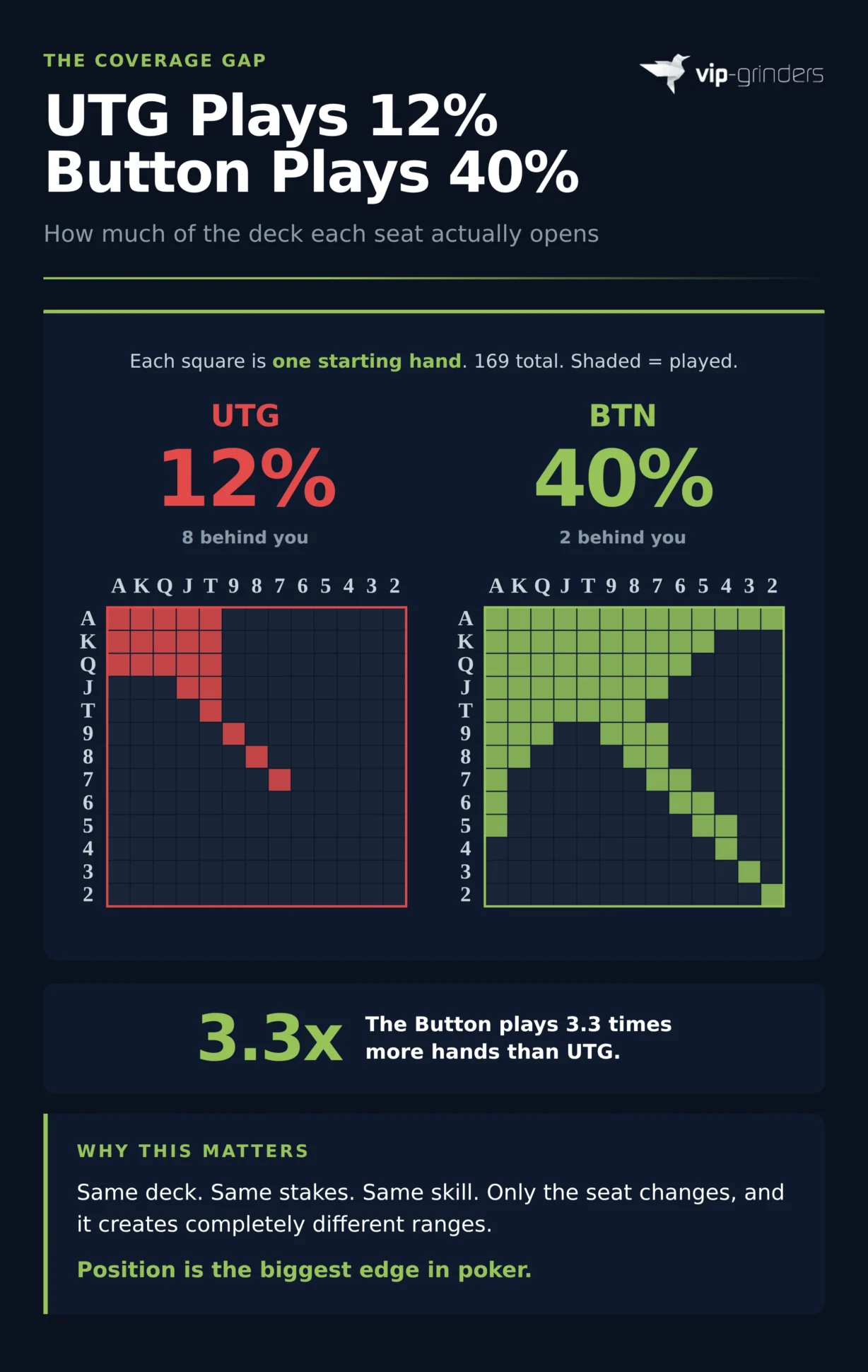
The Button opens roughly 40% of hands while Under the Gun opens closer to 12%. Same skill level, same game, same stakes. The gap is entirely positional.
Here is what this guide covers:
- The full seat map for both 6-max and 9-max tables with opening range percentages by seat
- Why acting last wins more money than any other edge in poker
- In position vs out of position and the relative position trap most guides skip
- Seven positional leaks that cost beginners 3 to 8 bb/100
Why Your Seat at the Table Decides How Much Money You Make
Position in poker means one thing: when you act compared to everyone else in the hand. The player who acts last has more information than anyone who acted before them, on every street, from preflop through the river.
That extra information is worth real money. Acting last means you’ve watched every other player check, bet, raise, or fold before you have to decide anything. You’re making decisions with data while they made theirs with a guess.
Consider the same hand played from two different seats:
- From Under the Gun: you open-raise with A-Q suited. Eight players act after you. Any of them could have a bigger hand. You don't know.
- From the Button: same A-Q suited, but six players have already folded. Only the two blinds are left. Your hand is now a clear favorite against their random ranges.
Identical cards, identical pot, two completely different decisions because of where you’re sitting. The Button version is a routine open that prints money, while the UTG version is a close call that often loses against tougher tables.
| Seat | Typical Win Rate (bb/100) |
|---|---|
| Button | +20 to +30 |
| Cutoff | +5 to +15 |
| Hijack | 0 to +5 |
| UTG / EP | -5 to +2 |
| Big Blind | -15 to -25 |
| Small Blind | -25 to -40 |
These numbers vary by stakes, player pool, and sample size, but the pattern is universal. Late position prints money while early position and the blinds cost it.
The 9-Max Seat Map: Every Position Named
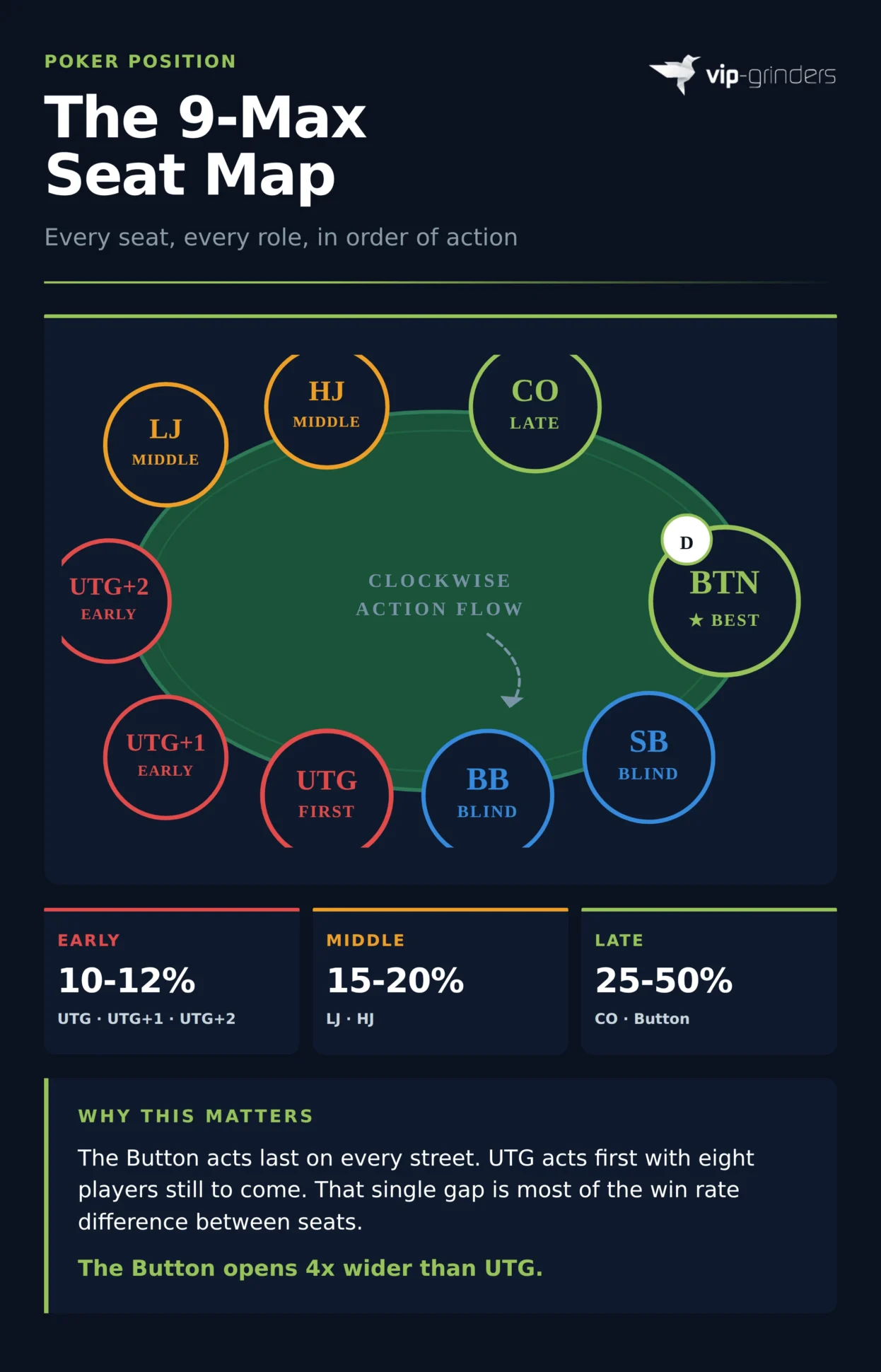
A 9-max table has nine seats, each with its own name, role, and strategic implications. Live poker rooms and some online tournaments still run 9-max by default, so even if you mostly play 6-max online, you’ll hit these positions eventually.
Before the diagrams, here’s the jargon you’ll see across every poker guide, forum post, and training video:
| Abbreviation | Full Name | What It Means |
|---|---|---|
| UTG | Under the Gun | First to act preflop, immediately left of the big blind |
| UTG+1 | Under the Gun plus 1 | Second to act preflop |
| UTG+2 | Under the Gun plus 2 | Third to act preflop |
| LJ | Lojack | Two seats right of the Button |
| HJ | Hijack | One seat right of the Cutoff |
| CO | Cutoff | Directly right of the Button |
| BTN | Button | The dealer position, acts last on every postflop street |
| SB | Small Blind | Posts half a big blind, acts first on every postflop street |
| BB | Big Blind | Posts one full big blind, acts last preflop, second on postflop |
The nine seats break into three zones: early position (UTG, UTG+1, UTG+2), middle position (LJ, HJ), and late position (CO, BTN, plus the blinds as a separate category).
Early Position: UTG, UTG+1, UTG+2
Early position is the hardest part of the table. Six to eight players still have to act after you, meaning any hand you play will likely face resistance from a stronger range. You open the tightest here, usually somewhere around 10-12% of hands.
The common mistake is treating UTG like any other seat. Players open suited connectors, small pairs, and weak suited Aces from UTG because the hand “looks good,” then get 3-bet by tighter ranges behind them and play a second-best hand out of position.
Middle Position: Lojack and Hijack
Middle position opens up. Fewer players are left to act, so you can profitably add more hands to your opening range. Suited connectors, broadway hands, and medium pairs all become playable here that weren’t in early position.
Lojack sits two seats to the right of the Button. Hijack sits one seat to the right of the Cutoff. In 9-max they’re distinct seats, but in 6-max the Lojack effectively disappears, which is why different guides disagree on naming.
Late Position: Cutoff and Button
The Cutoff and Button are where money gets made. By the time action reaches these seats, most of the table has folded and the remaining opponents are the blinds, who will play the rest of the hand out of position against you.
The Button is the single best seat in poker. You act last on every postflop street, which means you always have maximum information before committing chips. Button open ranges run around 40-50% of hands, four times wider than UTG, for exactly this reason.
The Cutoff is the second-best seat and plays similarly to the Button with a slight tightening. Cutoff opens typically sit around 25-30% of hands.
The Blinds: Small Blind and Big Blind
The blinds are a structural disadvantage. You’ve already put money in before seeing your cards, and you’ll act first on every postflop street for the rest of the hand. Both seats lose money long-term in most winning players’ databases.
The Small Blind is the worst seat at the table. The goal in the SB isn’t to win money from it, it’s to lose less than everyone else does. Our small blind strategy guide covers the preflop defaults and postflop adjustments for this seat.
The Big Blind is slightly better because you’ve already posted a full big blind, so you’re getting a discounted price to see the flop against most opens. You defend wider here than any other seat, often 40%+ against late-position raisers. Our big blind defense guide covers exact frequencies by opener position and sizing.
Here’s the full 9-max seat map at a glance:
| Seat | Zone | Opens Roughly | One-Line Role |
|---|---|---|---|
| UTG, UTG+1, UTG+2 | Early | 10-12% | Tightest ranges, strong hands only |
| LJ, HJ | Middle | 15-20% | Add suited connectors and broadways |
| CO | Late | 25-30% | Steal when folded around |
| BTN | Late | 40-50% | The money seat, act last postflop |
| SB | Blind | Situational | Structural loss, minimize damage |
| BB | Blind | Defensive | Get discounted flops, defend wide |
This page covers the seat map. The next sections cover why position changes which hands you should play.
The 6-Max Seat Map: The Online Cash Default
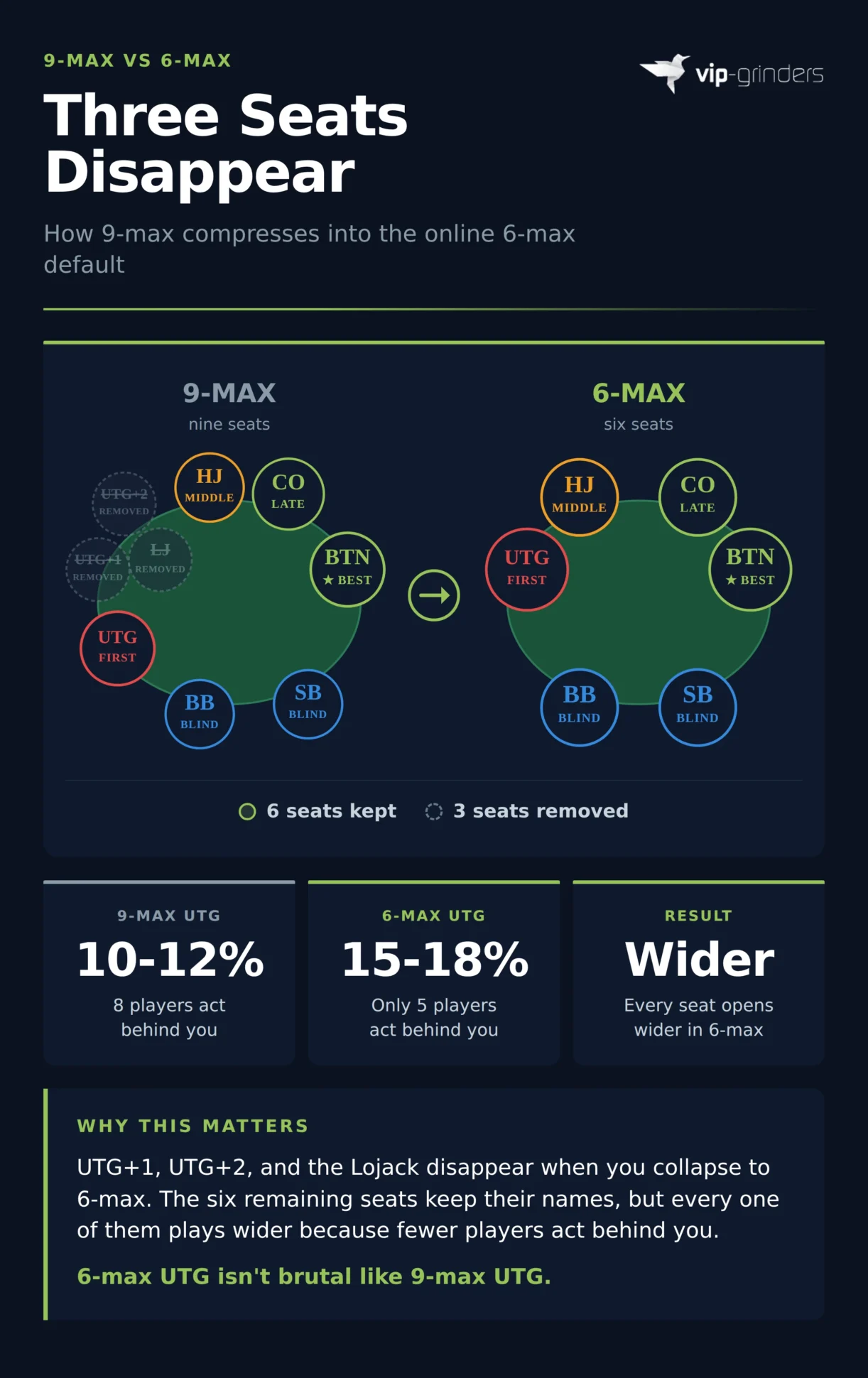
Most online cash games run 6-max, not 9-max. If you’re learning poker in 2026, odds are the first table you sit at will be 6-handed. The seat names stay the same, but three of the nine seats disappear and the strategic weight of every remaining seat shifts.
6-max has six positions: UTG, Hijack, Cutoff, Button, Small Blind, and Big Blind. UTG+1, UTG+2, and Lojack don’t exist in 6-max because there aren’t enough seats to fit them between the blinds and the Button.
How Seats Shift from 9-Max to 6-Max
When you collapse a 9-max table down to 6-max, the seat roles compress. What used to be middle position becomes early position, and what used to be late position becomes middle. The Button and blinds stay the same, but everything else shifts one slot earlier in strategic weight.
Here’s how the mapping works:
| 6-Max Seat | Plays Like Which 9-Max Seat | What Changes |
|---|---|---|
| UTG (6-max) | Lojack (9-max) | Opens wider than 9-max UTG because only 5 players act after |
| Hijack | Hijack (9-max) | Role stays roughly the same |
| Cutoff | Cutoff (9-max) | Role stays roughly the same |
| Button | Button (9-max) | Identical, still the best seat |
| Small Blind | Small Blind (9-max) | Identical, still the worst seat |
| Big Blind | Big Blind (9-max) | Identical, defends slightly wider vs tighter fields |
Why the 6-Max UTG Is Different
The most important shift is the UTG seat. In 9-max UTG is brutal with eight players behind you, but in 6-max only five players can act after you. Opening ranges run closer to 15-18% of hands in 6-max UTG, compared to 10-12% in 9-max UTG.
Some training sites and solvers label the 6-max UTG as “Lojack” because strategically that’s what it plays like, while others keep the UTG label. Both are technically correct. If you see solver charts with an “LJ” label for 6-max, that’s the first seat after the blinds, not a fourth middle-position seat that doesn’t exist.
Why 6-Max Rewards Aggression
Fewer players means fewer opponents with strong hands in any given pot. The mathematical result is that every seat opens wider than its 9-max equivalent, and post-flop play gets more aggressive because bluff frequencies go up when your opponent’s range is capped.
6-max is also where most online rakeback grinding happens. Cash tables run 24 hours a day on every major network, and the format is what fast-fold variants like Zoom and Rush & Cash are built on top of.
In Position vs Out of Position: The One Rule That Matters Most
You’ll hear two terms used constantly in poker strategy: in position (IP) and out of position (OOP). These are the two states every player is in on every postflop street, and they decide who controls the hand.
In position means you act last on every street after the flop, while out of position means you act first. On the Button you’re always in position, and in the blinds you’re almost always out of position. Everywhere else, it depends on who else is in the hand.
Why In Position Beats Out of Position on Every Street
The IP player has one structural advantage: they see what the OOP player does before making any decision. On the flop, turn, and river, the OOP player has to act blind, betting or checking without knowing how their opponent will respond.
That information gap compounds across streets. By the river, the IP player has watched three rounds of OOP decisions and can price their final bet or call with near-perfect information. The OOP player is still guessing on the last decision of the hand.
Win rates reflect this: across major online tracker databases, the Button is the most profitable seat by a wide margin, followed by the Cutoff. Every other seat shows negative win rates for most players outside elite regulars. Position isn’t one of many edges in poker: it’s the edge the rest of your game either amplifies or wastes.
Relative Position: The Sandwich Trap
There’s a nuance most beginner guides skip: relative position. Your absolute seat at the table is fixed, but your position relative to the player who has initiative in the hand is what actually determines how you should play each street.
If the Hijack raises preflop and the Cutoff calls, the player on the Button is now sandwiched between two active players. Even though the Button is technically the best seat, they’re calling a raise knowing another player still has to act behind them on every street. That’s relative position working against them.
The same logic flips in the blinds. If the Button raises and the Small Blind calls, the Big Blind has the Button closing the action behind them on every street, but the Small Blind is sandwiched in the middle. In pots like this, the Small Blind plays like the worst seat at the table even though the Big Blind technically acts first.
What IP and OOP Actually Feel Like
The difference between playing IP and OOP shows up in the decisions you’re forced to make. IP, you can check behind with a marginal hand to get a free card, bet for value when the action checks to you, and control the pot size on the river. All three moves rely on acting last.
OOP, those options collapse. You can’t check behind because you act first, and you can’t control pot size because your opponent always has the last word on sizing. Your only real weapons are check-raising and donk-betting, both of which give away information about your hand the moment you use them.
This is why pot odds calculations are easier in position. You already know the bet you’re facing when it’s your turn. Out of position, you’re estimating what your opponent will bet before they’ve even decided, which means every pot odds decision has an extra layer of uncertainty baked in.
How Position Changes the Hands You Should Play
Position doesn’t just change when you act. It changes which hands are worth playing in the first place. The same two cards can be a clear raise from one seat and a clear fold from another.
The principle is simple: the more players left to act after you, the more likely one of them has a stronger hand. That means you need stronger starting cards to profitably enter the pot. As position improves and fewer players remain behind, weaker hands become profitable because the odds of running into a monster drop sharply.
The Tighter-Early, Wider-Late Principle
Every winning poker strategy follows the same shape: tight ranges from early seats, wider ranges from late seats. A hand like K-J offsuit is a clear fold from UTG in most games, a close call from the Hijack, and a comfortable open from the Button.
This isn’t a style preference, it’s math. From UTG at a 9-max table eight players can still wake up with a bigger hand, while from the Button only two can and they’ll play their blinds tighter than any other seat. The same K-J faces completely different expected opponents depending on where you’re sitting.
Why You Can’t Just Memorize One Range
A common beginner mistake is learning a single “good starting hands” list and using it from every seat. It feels efficient. It’s also the fastest way to lose money.
Playing a UTG-tight range from the Button wastes dozens of profitable steal opportunities per session. Playing a Button-wide range from UTG walks you into traps that cost your entire stack. The only way to play position-aware poker is to use different ranges from different seats, calibrated to how many opponents still have to act.
For the actual hand-by-hand breakdown, including opening charts, 3-bet ranges, and defense frequencies by seat, see our full poker ranges guide. This page covers why ranges change by position. The ranges guide covers what those ranges actually look like.
The Seven Positional Leaks That Cost Beginners the Most
Most losing players at low stakes aren’t losing because of card luck or bad bluffs. They’re losing because they ignore position on specific, repeatable spots that cost 3 to 8 bb/100, making it one of the most expensive mistakes in poker. Fix these seven leaks and a break-even game turns profitable without changing anything else.
1. Opening the Same Range from Every Seat
The single biggest leak in beginner poker is using one “starting hands” list from every position. Playing K-10 offsuit profitably on the Button doesn’t mean it’s profitable from UTG. The math flips the moment you change seats.
The fix: build distinct opening ranges for early, middle, and late position. If you can only memorize one number, remember that UTG opens should be roughly one-third as wide as Button opens.
2. Folding the Button Too Tight
The opposite mistake. Players who’ve been burned by loose play overcorrect and play the Button like it’s UTG. They fold hands like 8-7 suited, A-4 offsuit, and K-9 offsuit when the action folds to them, missing easy steals.
Default instead: when the action folds to you on the Button, your default should be to raise. You’re against two players who’ll play the rest of the hand out of position. Fold only the weakest trash.
3. Cold-Calling from the Small Blind
The SB is the worst seat at the table. Flat-calling a raise from the SB puts you in a three-way pot (or more) out of position against every other player for the rest of the hand. You compound the worst seat with the worst preflop line.
Better line: from the SB facing a raise, your options should be 3-bet or fold. Cold-calling should almost never be in your range, especially in cash games where stacks are deep enough to punish OOP mistakes.
4. Playing Suited Connectors from UTG
Suited connectors look fun. They connect well with flops and make big hands occasionally. But from UTG in a 9-max game, eight players can still wake up with a bigger hand, and suited connectors play terribly against 3-bets.
Solution: save 7-6 suited, 8-7 suited, and 9-8 suited for middle and late position. From UTG, stick to premium pairs, broadway hands, and the strongest suited Aces.
5. Ignoring the Straddle
When someone posts a straddle (usually 2x the big blind), the action shifts: UTG becomes UTG+1 and the straddler acts last preflop instead of the Big Blind. Every position is essentially one seat earlier than it was before the straddle. Most players don’t adjust their ranges at all, which turns a positional edge into a positional leak.
Adjustment: treat straddled hands as if you’re one seat earlier. Tighten your UTG range when there’s a straddle behind you, because the straddler acts last preflop and you’re now opening into an extra active, position-aware opponent.
6. Playing Live Like Online Without Tightening OOP
Live poker runs at 30 hands per hour while online runs at 75+. Most online strategy assumes fast decisions, thin value bets, and frequent positional steals. Live players who copy online ranges without adjusting for the slower pace and looser fields leak money from out of position.
What to do instead: live, widen your late-position opens to exploit looser fields, but tighten your OOP calling ranges. Live opponents are less likely to fold to postflop aggression, which punishes thin OOP defends.
7. Defending the Big Blind with Offsuit Junk
Seeing cheap flops feels good. But defending Q-4 offsuit against an UTG raise because “I’m getting 3-to-1” ignores that you’ll play the rest of the hand out of position with a dominated hand.
The fix: your BB defending range should be built around hands that flop well, not hands that are cheap to see a flop with. Suited connectors, suited gappers, small pairs, and broadway hands outperform offsuit junk by a huge margin, even at the same pot odds.
Frequently Asked Questions
What is the best position in poker?
The Button is the best position in poker. You act last on every street after the flop, which means you always have maximum information before committing chips. Across major online tracker databases, the Button is the most profitable seat by a wide margin, followed by the Cutoff.
What does UTG mean in poker?
UTG stands for “Under the Gun.” It’s the seat immediately to the left of the Big Blind and acts first preflop. The name comes from the pressure of being first to act without any information about what other players intend to do. UTG is the tightest opening seat at the table in both 9-max and 6-max games.
What's the difference between Lojack and Hijack?
Lojack sits two seats to the right of the Button. Hijack sits one seat to the right of the Cutoff. In 9-max games they’re distinct middle-position seats. In 6-max, the Lojack effectively disappears because there aren’t enough seats between the blinds and the Button, which is why some guides use “UTG” and others use “Lojack” for the same 6-max seat.
How many positions are there in 6-max vs 9-max?
A 9-max table has nine positions: UTG, UTG+1, UTG+2, Lojack, Hijack, Cutoff, Button, Small Blind, and Big Blind. A 6-max table has six positions: UTG, Hijack, Cutoff, Button, Small Blind, and Big Blind. UTG+1, UTG+2, and Lojack don’t exist in 6-max because the structure removes the middle seats between the blinds and the late positions.
Why is the Small Blind the worst seat?
The Small Blind combines two disadvantages. You’ve already put money in the pot before seeing your cards, and you act first on every postflop street for the rest of the hand. That combination means you’re investing chips with no information while your opponents get to act with more information than you for the entire hand. Most winning players’ databases show the SB as the biggest losing seat at the table.
Is position more important in cash games or tournaments?
Position matters more in cash games because stacks stay deep throughout the session. At 100bb+ effective stacks, your positional edge compounds across the flop, turn, and river. In tournaments, stacks shrink as blinds increase, and once you’re below 20bb effective you’re mostly in push-or-fold territory where position matters far less. Early tournament stages with deep stacks play closer to cash games.
Does position matter in Pot-Limit Omaha?
Yes, and it matters more in PLO than in Hold’em. PLO equities run much closer together than Hold’em equities, which means the information advantage of acting last matters on every street. Deep-stacked PLO is one of the highest-value positional environments in poker. Any serious PLO strategy guide treats position as the single most important preflop and postflop factor.
How do I improve my positional play?
Start by using different opening ranges from different seats. The single biggest upgrade most beginners make is switching from a one-size-fits-all starting hand chart to position-specific ranges. Pair that with the seven leaks covered in this guide and you’ll immediately reduce the most expensive positional mistakes.