

Pot Odds in Poker: How to Calculate & Use Them 2026
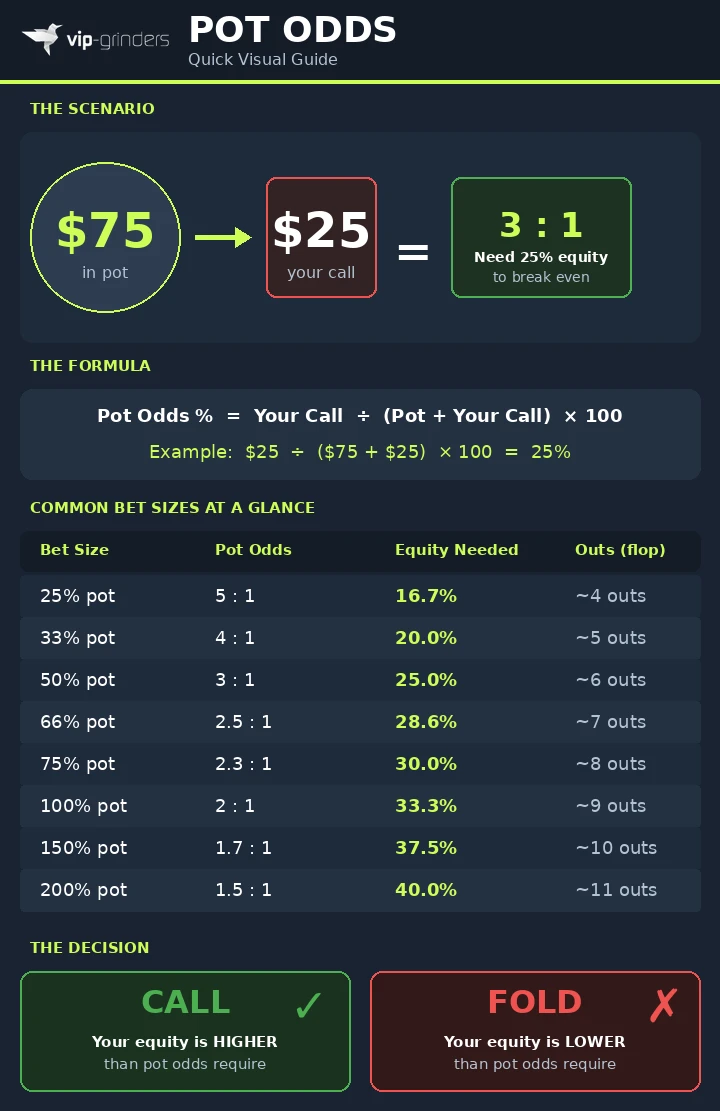
Pot odds tell you whether a call is profitable. They compare the price you pay (the bet you must call) to the size of the pot you can win. If your equity is higher than what the pot charges you, calling makes money over time. If it is lower, you fold.
Calling without pot odds costs 2 to 5 bb/100 and ranks as one of the most expensive mistakes in poker. This guide gives you the full calculation, a bookmark-ready reference table, and real hand examples so you can apply the math at the table.
Here is what this guide covers:
- Step-by-step calculation with the ratio and percentage methods
- Quick reference table covering every common bet size from 25% pot to 2x overbets
- Rule of 4 and 2 for counting outs and estimating equity in seconds
- Three real hand examples showing flush draws, river bluff catches, and preflop all-ins
What Are Pot Odds?
Pot odds are the ratio between the size of the pot and the cost of your call. They answer one question: “How much am I risking compared to how much I can win?” If the potential reward is large enough relative to the price, calling is profitable in the long run, even if you lose the individual hand.
You can express pot odds two ways: as a ratio (like 3:1) or as a percentage (like 25%). A ratio of 3:1 means the pot is offering you three dollars for every one dollar you invest. A percentage of 25% means you need to win the hand at least 25% of the time to break even.
The core decision every time you face a bet comes down to one comparison:
- Your equity (chance of winning) is higher than the pot odds require: calling makes money over time.
- Your equity is lower than the pot odds require: folding is correct.
Pot odds apply any time you face a bet or raise: preflop (should you call a 3-bet?), on the flop (is chasing a flush draw profitable?), and on the river (is this bluff-catch worth it?). The math does not change between formats. A 3:1 ratio means the same thing at a $0.05/$0.10 micro-stakes table as it does in a $10,000 tournament.
How to Calculate Pot Odds (Step by Step)
The calculation takes three steps. Once you do it a few times, it becomes automatic.
Step 1: Count the Total Pot
Add up everything in the pot including your opponent’s bet. This is the mistake most players make: they forget the bet is already part of the pot before they act.
If the pot was $50 before the flop and your opponent bets $25, the total pot is now $75.
Step 2: Divide Your Call by the Total Pot After Calling
Take the amount you need to call and divide it by the total pot size after your call goes in. This gives you the percentage of the pot you are investing.
Using the same example: you must call $25 into a pot that will be $100 after you call ($75 + your $25). That gives you $25 / $100 = 0.25, or 25%.
Step 3: Compare to Your Equity
If your hand has more than 25% equity against your opponent’s likely range, calling is profitable. If it has less, fold.
You can also use our pot odds calculator to run these numbers instantly during hand reviews. The real skill is learning to do it at the table in a few seconds, which the next two sections will help you master.
Pot Odds Quick Reference Table
Memorizing the exact formula is useful for study, but at the table you need to make decisions in seconds. This table covers every common bet size you will face, from small probes to large overbets, with the pot odds ratio and the minimum equity your hand needs to justify a call.
| Opponent’s Bet (% of Pot) | Pot Odds Ratio | Equity Needed to Call |
|---|---|---|
| 25% | 5 : 1 | 16.7% |
| 33% | 4 : 1 | 20.0% |
| 50% | 3 : 1 | 25.0% |
| 66% | 2.5 : 1 | 28.6% |
| 75% | 2.3 : 1 | 30.0% |
| 100% (pot-size bet) | 2 : 1 | 33.3% |
| 150% | 1.7 : 1 | 37.5% |
| 200% (2x pot overbet) | 1.5 : 1 | 40.0% |
The three rows you will use most often are 33%, 50%, and 75%. These are the most common bet sizes at low and mid stakes online. If you memorize just those three equity thresholds (20%, 25%, and 30%), you can make correct calling decisions in the majority of spots without doing any math at the table.
Notice how even a 200% pot overbet only requires 40% equity to call. Many players overfold against large bets because the size feels intimidating. The math often supports calling more than your instincts suggest.
For the full defense framework including MDF and blocker-based calls, see our overbetting guide.
Counting Outs and the Rule of 4 and 2
Pot odds tell you the price. To use them, you also need to know your equity: how likely your hand is to improve and win. The fastest way to estimate equity at the table is to count your outs (cards left in the deck that complete your draw) and apply a simple multiplier.
Common Draws and Their Outs
| Draw Type | Example | Outs |
|---|---|---|
| Flush draw | A♥ 9♥ on K♥ 6♥ 2♦ | 9 |
| Open-ended straight draw (OESD) | 8♠ 7♠ on 9♦ 6♣ 2♥ | 8 |
| Gutshot straight draw | J♣ 10♣ on 8♦ 5♠ 2♥ | 4 |
| Two overcards | A♠ K♦ on 7♥ 5♣ 3♠ | 6 |
| Flush draw + gutshot | J♥ 10♥ on 9♥ 3♥ 7♦ | 12 |
| Flush draw + open-ender | 8♥ 7♥ on 9♥ 6♥ 2♦ | 15 |
| Set to full house/quads | 9♠ 9♦ on 9♣ K♥ 5♦ | 7 |
The Rule of 4 and 2
Once you know your outs, multiply them by 4 on the flop (two cards to come) or by 2 on the turn (one card to come). The result is your approximate equity percentage.
- Flop with a flush draw (9 outs): 9 × 4 = 36% equity. Actual: 35.0%.
- Turn with a flush draw (9 outs): 9 × 2 = 18% equity. Actual: 19.6%.
- Flop with a gutshot (4 outs): 4 × 4 = 16% equity. Actual: 16.5%.
- Flop with flush draw + OESD (15 outs): 15 × 4 = 60% equity. Actual: 54.1%.
When the Shortcut Loses Accuracy
The Rule of 4 works well up to about 10 outs. Above that, the shortcut overestimates your equity: with 15 outs it tells you 60%, but the real number is closer to 54%.
For high-out combo draws, multiply by 3.5 instead of 4 for a safer estimate. You can also use our equity calculator during post-session review to train your intuition.
The Rule of 4 also assumes you will see both remaining cards for free. If your opponent can bet again on the turn, you may not get to see the river without paying another price. In those spots, using the Rule of 2 (multiply outs by 2) on each street individually gives a more realistic picture of your actual equity per decision point.
Pot Odds in Action: Real Hand Examples
Theory makes sense on paper. These three examples show how pot odds work in real spots you will face at the table, from a standard flush draw decision to a river bluff catch.
Example 1: Calling a Flush Draw on the Flop
You hold A♥ 10♥ in the cutoff. The flop comes K♥ 7♥ 3♦. Your opponent bets $30 into a $60 pot.
- Pot after bet: $60 + $30 = $90
- Your call: $30
- Pot after calling: $90 + $30 = $120
- Pot odds: $30 / $120 = 25%
- Your outs: 9 hearts remaining = flush draw
- Your equity (Rule of 4): 9 × 4 = 36%
Your equity (36%) is well above the 25% threshold. This is a clear call. You could even consider raising as a semi-bluff, since you have the nut flush draw with the A♥.
Example 2: Facing an Overbet on the River
You hold Q♠ Q♥ on a final board of J♦ 8♣ 4♠ 2♥ 5♦. Your opponent shoves $150 into a $100 pot.
- Pot after bet: $100 + $150 = $250
- Your call: $150
- Pot after calling: $250 + $150 = $400
- Pot odds: $150 / $400 = 37.5%
You need to win 37.5% of the time to break even. On this dry board, your Queens are an overpair that beats every bluff and most value hands except sets, straights, or two pair. The question becomes: does your opponent bluff or bet worse hands here at least 37.5% of the time?
Against aggressive players who overbet rivers with missed draws and thin value, calling is often correct. Against tight opponents who only overbet with the nuts, folding saves you $150. This is where pot odds meet opponent ranges and range advantage on polarized rivers.
Example 3: Preflop All-In Decision
You hold A♠ J♥ in the big blind. A short-stacked opponent with $15 behind shoves all-in from the button and the small blind folds. The pot contains $15 (the shove) plus $1.50 (your big blind at $1) plus $0.50 (the small blind).
- Pot after shove: $15 + $1.50 + $0.50 = $17
- Your call: $14 (you already have $1 in as the big blind)
- Pot after calling: $17 + $14 = $31
- Pot odds: $14 / $31 = 45.2%
You need 45.2% equity to call. Against a typical button shoving range of around 40% of hands, A♠ J♥ has roughly 52% equity. The call is profitable.
If the same player shoved from under the gun with a much tighter range (say top 12% of hands), your equity with AJ offsuit drops to around 38%. That is below the 45.2% threshold, so the call loses money.
Same hand, same pot odds, different answer. This is why combining pot odds with range estimation matters.
Pot Odds vs Implied Odds
Pot odds measure what the pot offers you right now. Implied odds add the extra money you expect to win on future streets when you complete your draw. The two work together: when raw pot odds say fold, implied odds can sometimes turn that fold into a profitable call, especially with deep stacks and concealed draws.
For the full math, when reverse implied odds force a fold, the 20x rule for set mining, and worked examples across cash and tournaments, see our complete implied odds strategy guide.
How to Use Pot Odds to Size Your Bets
Most players think about pot odds from the caller’s side: “Am I getting the right price?” But the concept works in reverse too. When you are the one betting, you control what pot odds your opponent receives, letting you deny profitable calls from draws while still getting paid by worse made hands.
| Your Bet Size | Odds You Give Opponent | Equity Opponent Needs | What This Targets |
|---|---|---|---|
| 33% pot | 4 : 1 | 20.0% | Thin value vs weak pairs, cheap bluffs |
| 50% pot | 3 : 1 | 25.0% | Standard value bet, prices out gutshots |
| 66% pot | 2.5 : 1 | 28.6% | Charges flush draws, punishes loose calls |
| 75% pot | 2.3 : 1 | 30.0% | Prices out most single draw hands |
| 100% pot | 2 : 1 | 33.3% | Forces fold from all naked draws except combo draws |
A player on a flush draw with 9 outs has roughly 36% equity on the flop using the Rule of 4. If you bet 50% pot, you give them 3:1 (25% needed), and their call is correct because 36% beats 25%.
If you bet 100% pot, they need 33.3%, and their call is still slightly profitable. Only an overbet above 120% of the pot pushes the equity requirement past 36% and makes their flush draw call a losing play.
Understanding what equity your bet denies is the starting point for choosing a size. When you bet for value, you want calls from hands with less equity than the pot odds require. When you bluff, you need folds from hands with enough equity to call. Same math, opposite goal.
For more on the betting side, see our guides on value betting and fold equity.
Frequently Asked Questions
What are pot odds in poker?
Pot odds are the ratio between the size of the pot and the amount you need to call. They tell you what percentage of the time you need to win the hand for a call to be profitable. For example, if the pot is $75 and you must call $25, your pot odds are 3:1, meaning you need at least 25% equity to break even.
How do you calculate pot odds quickly?
The fastest method is to divide your call by the total pot after calling. If you face a $50 bet into a $100 pot, the total pot after your call is $200. Divide $50 by $200 to get 25%. At the table, you can also memorize the three most common spots: a 33% pot bet needs 20% equity, a 50% pot bet needs 25%, and a 75% pot bet needs 30%.
What is the Rule of 4 and 2 in poker?
The Rule of 4 and 2 is a shortcut for estimating your equity from your number of outs. On the flop (two cards to come), multiply your outs by 4. On the turn (one card to come), multiply by 2. For example, a flush draw has 9 outs: 9 × 4 = 36% on the flop, or 9 × 2 = 18% on the turn. The shortcut loses accuracy above 10 outs, where multiplying by 3.5 gives a better estimate.
Do pot odds work in tournaments?
Yes. The pot odds formula works identically in cash games, MTTs, Sit and Gos, and Spin and Gos. However, in tournaments you should also consider ICM (Independent Chip Model), which means the value of your chips changes based on your stack size relative to the prize pool. Near the bubble or at a final table, ICM can make a fold correct even when pot odds alone support a call.
What is the difference between pot odds and implied odds?
Pot odds measure what the pot offers you right now based on the current bet. Implied odds add the extra money you expect to win on future streets when you complete your draw. Implied odds matter most with deep stacks, concealed draws, and opponents who pay off big hands.
How do pot odds affect bet sizing?
When you bet, you control what pot odds your opponent receives. A larger bet forces your opponent to have more equity to call, which prices out more draws. A smaller bet gives better odds, which invites calls from weaker hands. Choosing the right size depends on whether you want calls (value betting) or folds (bluffing).
Can I use a calculator for pot odds?
During live play and most online sessions, you need to do the math in your head or memorize common spots from the reference table. However, during post-session hand review, using a pot odds calculator or equity calculator helps you verify your decisions and build intuition over time. VIP-Grinders offers a free pot odds calculator you can use for study.
How many outs do I need to call a half pot bet?
A half pot bet gives you 3:1 odds, which means you need 25% equity. Using the Rule of 4 on the flop, you need roughly 6 or more outs (6 × 4 = 24%, close enough). Using the Rule of 2 on the turn, you need about 13 outs (13 × 2 = 26%), which is a combo draw. This is why flush draws (9 outs = 36%) are easy calls against half pot bets, while gutshots (4 outs = 16%) are not.