

Omaha Hi-Lo Strategy: How to Scoop Pots Consistently 2026
Omaha Hi-Lo (also called Omaha 8-or-Better or O8) splits every pot between the best high hand and the best qualifying low hand. That single rule changes everything about how you pick starting hands, size your bets, and decide whether a pot is worth entering. If you only win half the pot, you barely cover rake, but if you win both halves, that is called scooping, and scooping is where all the profit lives.
Most players approach Hi-Lo like regular Pot-Limit Omaha and lose money because split pots drain their win rate one chopped hand at a time. The strategy in this guide is built around one principle: play hands that can win both sides of the pot, and fold everything else.
Here is what this guide covers:
- Qualifying low rules and how to read low hands at a glance
- Top 15 starting hands ranked by scoop potential
- The exact math behind quartering and counterfeiting
- How position changes in multi-way Hi-Lo pots
- Key differences between Limit O8, PLO8, and NL08
The rules section below covers everything you need in 90 seconds. If you already understand split pots, skip ahead to the starting hands.
Omaha Hi-Lo Rules in 90 Seconds
Omaha Hi-Lo plays like standard Omaha with one twist: at showdown, the pot is split between the best high hand and the best qualifying low hand. If nobody has a qualifying low, the best high hand scoops the entire pot.
Three rules control every decision in this game:
- 1Exactly two hole cards, exactly three board cards. You receive four hole cards but must use precisely two from your hand and three from the board to build each five-card hand. You can use different combinations for high and low.
- 2The low must qualify. A qualifying low is five unpaired cards all eight or lower (this is why the game is called ‘8-or-Better’). Straights and flushes do not count against the low. The best possible low is 5-4-3-2-A, called the ‘wheel’, which also makes a straight for the high.
- 3No qualifying low = high scoops. The board needs at least three cards ranked eight or lower for any low to be possible. If the board shows only two low cards or fewer, no one can qualify and the high hand wins everything.
Worked Example: A Split Pot
The board shows 2♣ 4♥ 7♠ K♦ J♣ (three low cards on board, so a low is possible).
| Player | Hole Cards | Best High | Best Low |
|---|---|---|---|
| Player A | A♠ 3♠ K♠ Q♥ | Pair of Kings (using K, Q from hand) | 7-4-3-2-A (using A, 3 from hand) |
| Player B | K♥ J♥ 10♠ 9♦ | Two pair, Kings and Jacks (using K, J from hand) | Cannot qualify (10 and 9 are too high) |
Player B wins the high half with two pair, Player A wins the low half with 7-4-3-2-A, and the pot is split 50/50. Notice Player A used different cards for each half: K and Q for high, A and 3 for low. That flexibility is legal and happens constantly in Hi-Lo.
Now imagine the board was K♦ J♣ 9♠ Q♠ 10♦ instead. No card is eight or lower, so no low qualifies and Player B scoops the entire pot. This happens roughly 40% of all hands, which is why holding strong high cards alongside your low draws matters so much.
How to Read the Low Hand
Reading lows confuses beginners because the logic is backwards from everything else in poker. The lowest hand wins, and you compare from the highest card down. The same A-to-5 ranking is used in Razz, which awards the entire pot to the lowest hand with no 8-or-better qualifier.
Take two low hands: 7-5-4-3-A and 8-4-3-2-A. Start with the highest card in each: the first hand’s top card is 7, the second hand’s top card is 8. Since 7 is lower than 8, the first hand wins and you never even look at the other four cards.
If the top card ties, move to the second highest card. Then the third, and so on until you find a difference.
Low Hand Rankings: Quick Reference
| Rank | Low Hand | Name | Notes |
|---|---|---|---|
| 1 (best) | 5-4-3-2-A | The Wheel | Also a straight for the high half |
| 2 | 6-4-3-2-A | Six-four low | Second best possible low |
| 3 | 6-5-3-2-A | Six-five low | Loses to any six-four |
| 4 | 6-5-4-3-2 | Six-five low (no ace) | Also a straight for the high half |
| 5 | 7-4-3-2-A | Seven-four low | Any six-low beats any seven-low |
| Worst qualifying | 8-7-6-5-4 | Eight-seven low | Barely qualifies. Loses to every other low. |
Common Misreads That Cost Money
- Counting pairs as low: a low hand must have five unpaired cards. If the board shows 2-4-4-7-K, the duplicate four means you only have three unique low cards on the board (2, 4, 7). You still need two low cards from your hand to qualify.
- Forgetting the two-card rule: if the board shows A-2-3-8-K, you might think you have a low. But you must contribute exactly two cards from your hand. Holding Q-J-10-9 means you have no qualifying low despite the board having four low cards.
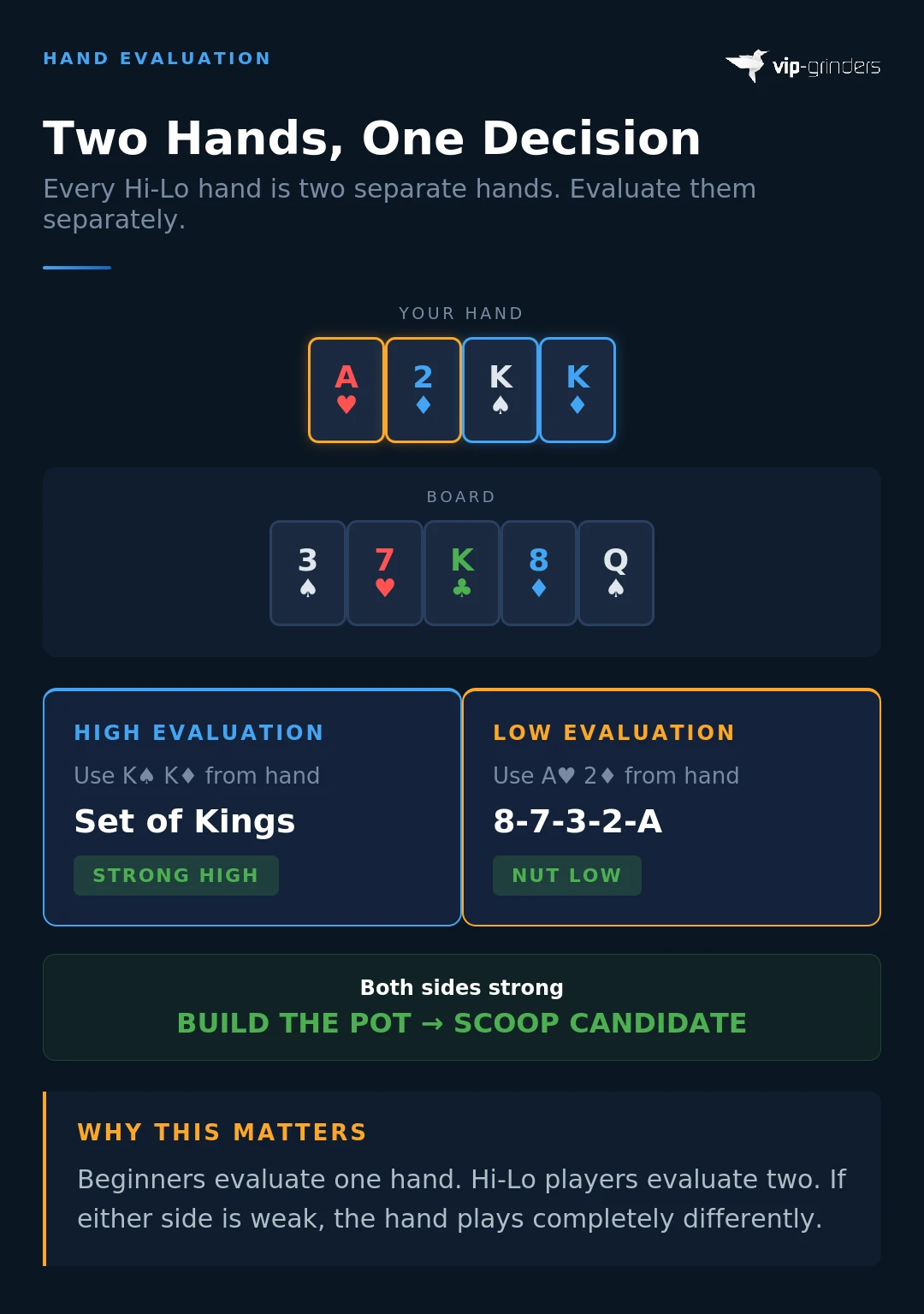
- Assuming A-2 always wins: A-2 gives you the nut low draw (the best possible low draw), but the final low depends on which three board cards complete it. On a board of 3-7-8-K-Q, your A-2 makes 8-7-3-2-A. Another player holding A-4 makes 8-7-4-3-A, which is worse. Your A-2 wins here, but not because A-2 automatically beats everything.
Top 15 Starting Hands and What Makes a Hand Two-Way
A two-way hand is any four-card combination that can compete for both the high and the low half of the pot. These are the only hands worth playing in Omaha Hi-Lo because they give you a realistic chance to scoop. One-way hands (strong high only or low only) win half at best and get quartered at worst.
The hands below are ranked by scoop potential. “DS” means double suited (two cards of one suit, two of another), “SS” means single suited, and “R” means rainbow (no two cards share a suit).
Premium (Raise or Re-raise From Any Position)
| Hand | Scoop Path |
|---|---|
| A-A-2-3 DS | Nut low draw + nut flush draws + pocket aces for high |
| A-A-2-4 DS | Same structure, slightly less low connectivity |
| A-A-2-3 SS | One flush draw instead of two, still top tier |
| A-A-2-5 DS | Wheel potential with aces and two flush draws |
| A-A-2-4 SS | Strong low backup with one flush draw |
Strong (Raise From Late Position, Call From Early)
| Hand | Scoop Path |
|---|---|
| A-A-3-4 DS | Aces plus backup low cards if the 2 is on the board |
| A-A-2-3 R | Still premium cards, but no flush potential reduces scoop paths |
| A-A-2-2 DS | Two flush draws, but the duplicate 2 reduces low outs |
| A-A-3-5 DS | Wheel draw + aces, weaker without the 2 |
| A-2-3-4 DS | Best non-aces hand. Four wheel cards + two flush draws. |
Playable (Call in Position, Fold From Early)
| Hand | Scoop Path |
|---|---|
| A-2-K-K DS | Nut low draw paired with a strong high hand |
| A-2-Q-Q DS | Same idea, slightly weaker high |
| A-3-4-5 DS | Four low cards with straight and flush potential |
| A-2-3-K DS | Three wheel cards plus Broadway high backup |
| 2-3-4-5 DS | Pure low hand with straight potential, but no ace is a real weakness |
The Patterns Behind Good Hi-Lo Hands
Three things separate winning starting hands from losing ones:
- An ace with a deuce: A-2 is the foundation of almost every premium Hi-Lo hand. It makes the nut low on the most boards and finishes as the best low roughly 18% of the time at showdown. Without A-2, you are drawing to second-best lows far too often.
- Double suited: two flush draws instead of one roughly doubles your chance of making a flush for the high half. In a game where you need to win both sides, every extra scoop path matters.
- Low card connectivity: hands like A-2-3-4 give you backup low cards if the board counterfeits one of your primary low cards. A hand like A-2-J-10 has no backup: if an ace or deuce hits the board, your low draw is often dead.
Hands to Avoid
High-only hands like K-Q-J-9, J-10-9-8, and Q-J-10-7 look playable if you come from PLO, but they are long-term losers in Hi-Lo. They can never win the low half, which means they can never scoop unless no low qualifies. Since a low is possible roughly 60% of the time, these hands are competing for half the pot in most deals.
Low-only hands without an ace (like 3-4-6-7 or 4-5-7-8) are equally dangerous. They make second or third-best lows that get quartered in multi-way pots, and they have almost no path to winning the high.
Scoop, Split, and Quarter: The Three Outcomes That Define Your Win Rate
Every Hi-Lo hand ends in one of three ways for you, and the difference between them is enormous. Understanding this math is the reason experienced players fold so many hands that look playable on the surface.
| Outcome | What Happens | Your Share ($100 pot) | Your Profit (3-way, $33 invested) |
|---|---|---|---|
| Scoop | You win both halves | $100 | +$67 |
| Split | You win one half, opponent wins the other | $50 | +$17 |
| Quarter | You tie for one half, opponent wins the other | $25 | -$8 |
Look at the profit column. Scooping earns you four times more than splitting, and getting quartered actually loses money even when you “win” your half of the pot.
Now add 5% rake on top and a split in a heads-up pot becomes a net loss: you put in $50 to build a $100 pot, rake takes $5, and you get back $47.50. You paid to chop.
This is why the entire strategy of Hi-Lo revolves around scooping. Splitting is treading water. Quartering is drowning.
When Quartering Happens
Quartering (receiving only 25% of the pot) occurs when you tie with another player for the same half. The most common scenario:
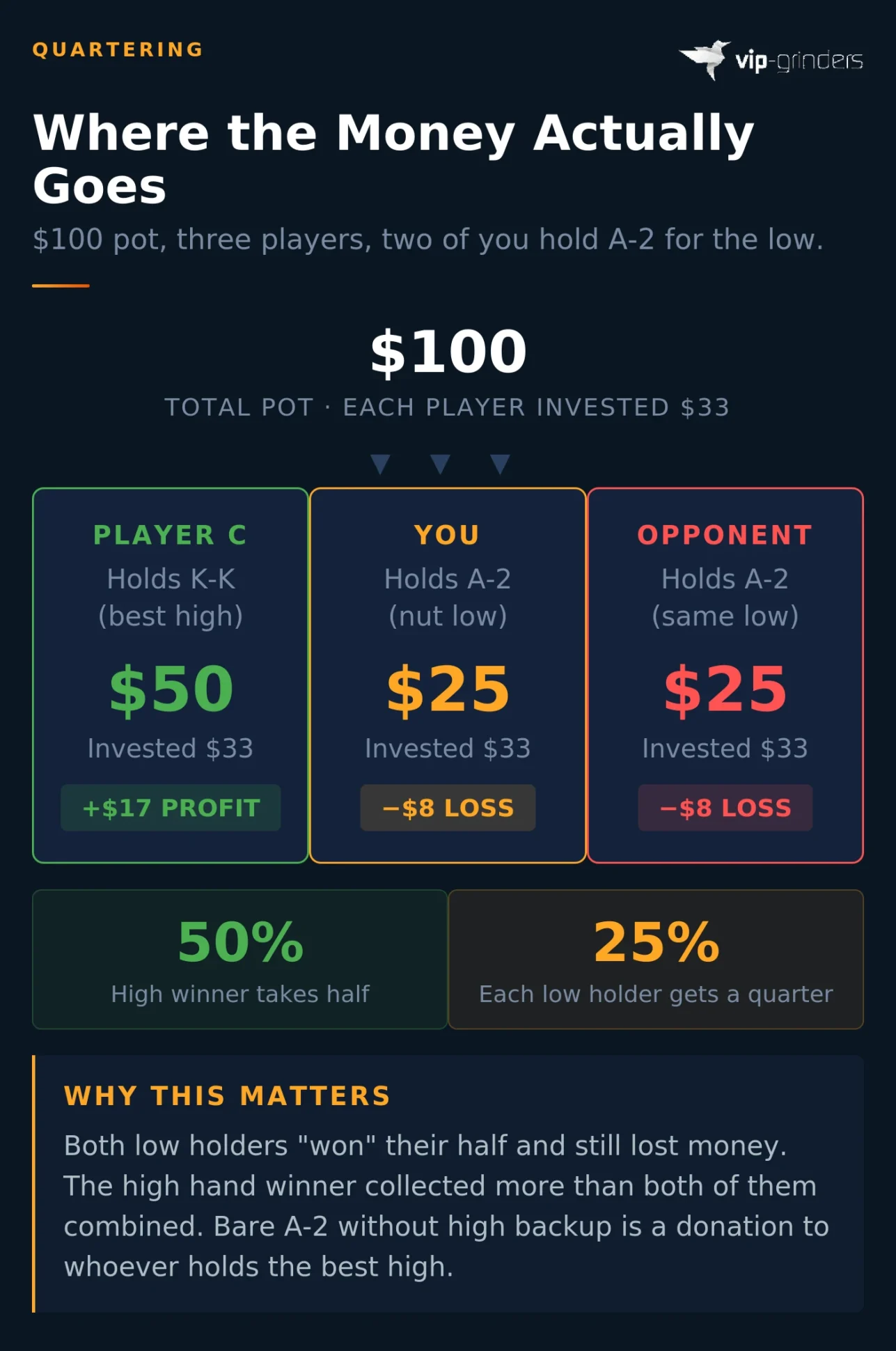
- Two players hold A-2 for the nut low: a third player wins the high half and takes $50. You and your opponent split the low half and each receive $25. If you each put in $33, you both lost $8.
- Why it happens so often: A-2 is the most desirable low holding in Hi-Lo. In a full ring game with six to nine players, the chance that two or more players hold A-2 in the same hand is higher than most beginners expect.
- How to avoid it: hold A-2 with a strong high backup (like A-A-2-3 or A-2-K-K) so that even if you split the low, you have a shot at winning the high half too. Bare A-2 with no high value is a quartering trap.
Counterfeiting: The Hidden Killer in Hi-Lo
Counterfeiting happens when the board duplicates one of your low hole cards. Your low hand stays the same, but the new board card opens up better lows for your opponents. You go from holding the nut low to losing it without your hand changing at all.
How It Works
You hold A♥ 2♦ J♣ Q♠ (bare A-2 with no low backup).
The board on the turn is 4♥ 6♣ 8♠ K♦. Three low cards are out, and your low is A-2 from hand + 4-6-8 from board = 8-6-4-2-A. That is the nut low: nobody can beat you for the low half.
The river is 2♣, making the board 2♣ 4♥ 6♣ 8♠ K♦. You still use A-2 from your hand + 4-6-8 from the board = 8-6-4-2-A. Your hand has not changed.
Watch the board, not your hand. When a card you already hold appears on the board, your low has not improved, but your opponents’ lows may have. That is counterfeiting in action.
But your opponent holds A♣ 3♠ J♥ 10♦. They use A-3 from hand + 2-4-6 from board = 6-4-3-2-A, a six-low that crushes your eight-low. You went from nut low to second-best without doing anything wrong.
Why A-2-3 Protects You
Now replay the same hand, but you hold A♥ 2♦ 3♣ K♠ instead.
The same 2♣ hits the river. This time you switch combinations: you use A-3 from your hand + 2-4-6 from the board = 6-4-3-2-A. The backup three let you include the board’s deuce in your low, matching or beating the same opponent who just destroyed bare A-2.
This is exactly why the starting hands section ranked A-2-3-4 DS as the best non-aces hand in the game, and why hands like A-2-J-10 with no low connectivity belong in the “avoid” category.
Position and Multi-Way Pot Dynamics
Position matters more in Omaha Hi-Lo than in almost any other poker format. Most Hi-Lo pots go to the flop with three to five players, and every decision requires evaluating two separate hands (your high and your low). Acting last gives you critical information before you commit chips.
- You see how many players are in the pot: more players means higher quartering risk and more opponents likely holding A-2. In position, you can fold marginal low draws cheaply when three players are already betting and raising.
- You control pot size: in a split-pot game, building a big pot only makes sense when you can scoop. Acting last lets you keep the pot small with one-way hands and build it with two-way monsters.
- You get better pot odds on draws: when two opponents bet and call before you, the pot is already inflated. Your call costs the same but your potential return is larger.
The practical takeaway for hand selection: premium two-way hands (A-A-2-3, A-A-2-4) play from any seat. Speculative playable hands (A-2-Q-Q, A-3-4-5, 2-3-4-5) should only enter pots from late position where you have information and pot control. From early position with a marginal hand, folding is almost always correct in Hi-Lo because multi-way action behind you is the norm, not the exception.
Street-by-Street Play: Preflop Through River
Each street in Hi-Lo requires you to evaluate both halves of the pot separately. Here is what to focus on at each stage.
Preflop
Tight hand selection is the single biggest edge in Hi-Lo. Most of your profit comes from entering pots with hands that have realistic scoop potential and folding everything else. If you are not sure whether a hand qualifies, review the starting hands section above.
Raise or re-raise with premium two-way hands from any position. With strong and playable hands, call in position and fold from early seats. In multi-way pots, resist the urge to “see a cheap flop” with one-way hands because those flops cost more than they look when you are drawing to half the pot at best.
Flop
On the flop, ask two questions: can I win the high, and can I win the low? If the answer to both is yes or at least “probably,” continue. If you can only win one side, proceed with caution in multi-way pots.
The best flops for your hand give you the nut low draw plus a strong high draw or made hand. For example, holding A-2-K-K on a flop of 3♠ 7♥ K♦ gives you top set for high and the nut low draw. That is a scoop candidate worth building the pot with.
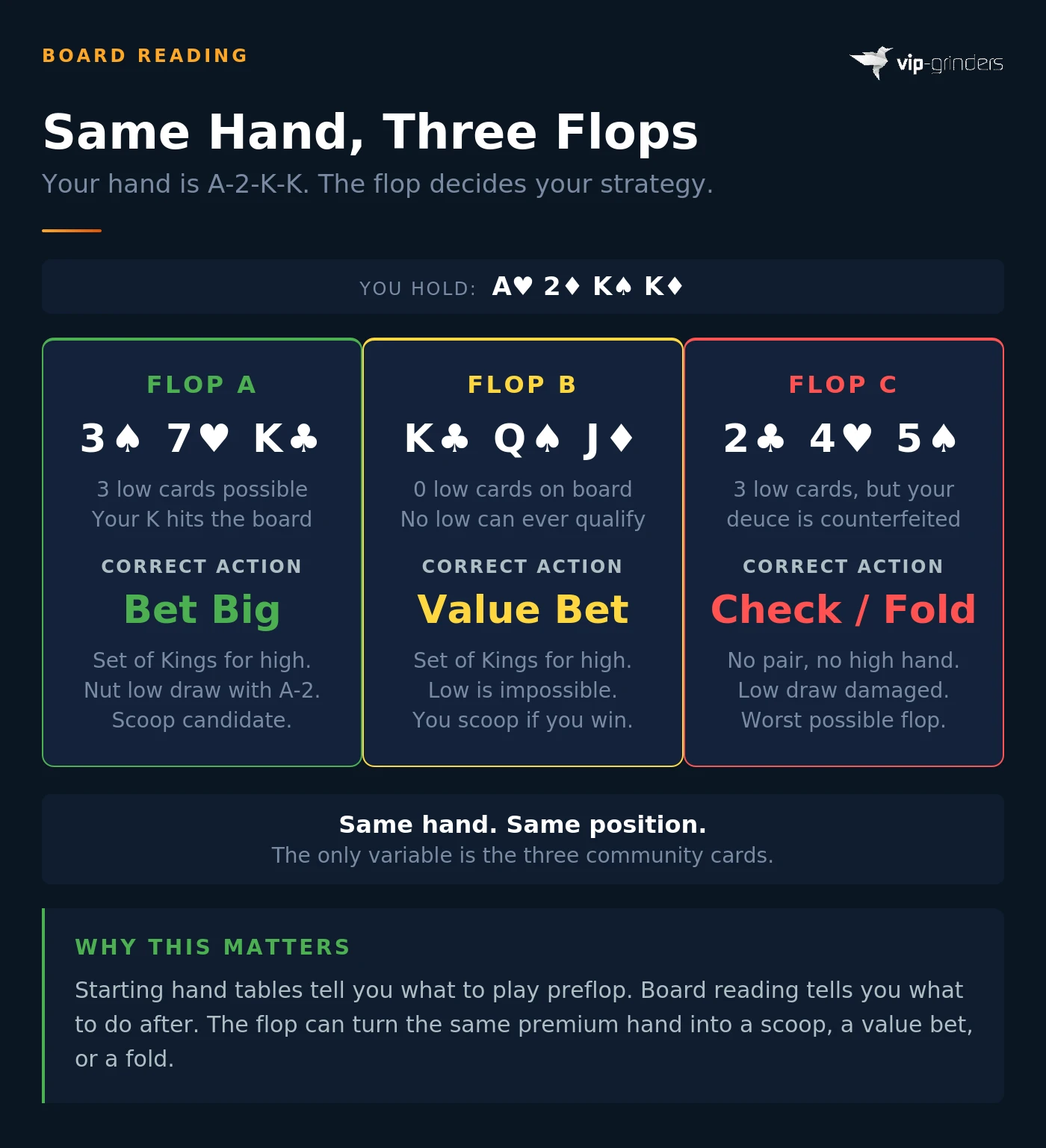
The worst flops are the ones where you have a marginal low and no high. Fold early and save chips for better spots.
Turn
The turn is where counterfeiting risk peaks. If you held the nut low on the flop, check whether the turn card duplicated one of your low hole cards. If it did and you have no backup (bare A-2), your low is now vulnerable and the river could kill it entirely.
With the nut low still intact and a strong high, the turn is the street to build the pot. In Limit O8, this means betting and raising. In PLO8, size your bets to charge one-way draws.
The turn decision: if your nut low survived and your high is strong, build the pot. If your low was counterfeited and you have no backup, save your chips for a better spot.
River
On the river, the pot is either going to be scooped or split. Your goal is simple: bet when you can scoop, check when you can only split, and fold when you are getting quartered.
If you have the nut low and a weak high, check and call rather than betting. Betting only invites raises from players who hold the high and potentially the same low. If you have both the nut high and nut low, value bet for the maximum because you are freerolling against the entire table.
Limit O8 vs PLO8 vs NL08: Three Formats, Three Strategies
Omaha Hi-Lo is played in three betting structures, and each one changes the strategy in meaningful ways. Limit O8 (fixed bet sizes) is the format used at the WSOP and in mixed games like HORSE and 8-Game, while PLO8 (pot-limit betting) is the most common format online. NL08 (no-limit betting) is less widespread but available on several major sites and growing in tournament schedules.
| Factor | Limit O8 | PLO8 | NL08 |
|---|---|---|---|
| Betting cap | Fixed sizes, max 4 raises per street | Pot-sized maximum | No limit |
| Bluffing | Rarely profitable (bets are too small relative to the pot) | Selective, usually for the high half | Highly effective with deep stacks |
| Quartering damage | Painful but survivable | Can cost a full buy-in | Can cost your entire stack |
| Low draw value | High (cheap to chase) | Medium (pot-sized bets price out weak draws) | Low (big bets make half-pot draws unprofitable) |
| Best starting hands | Any A-2 with backup plays well | Need A-2 with strong high backup | Premium two-way hands only |
| Where it is played | WSOP, HORSE, 8-Game, live cardrooms | Most online poker sites | PokerStars, select tournaments |
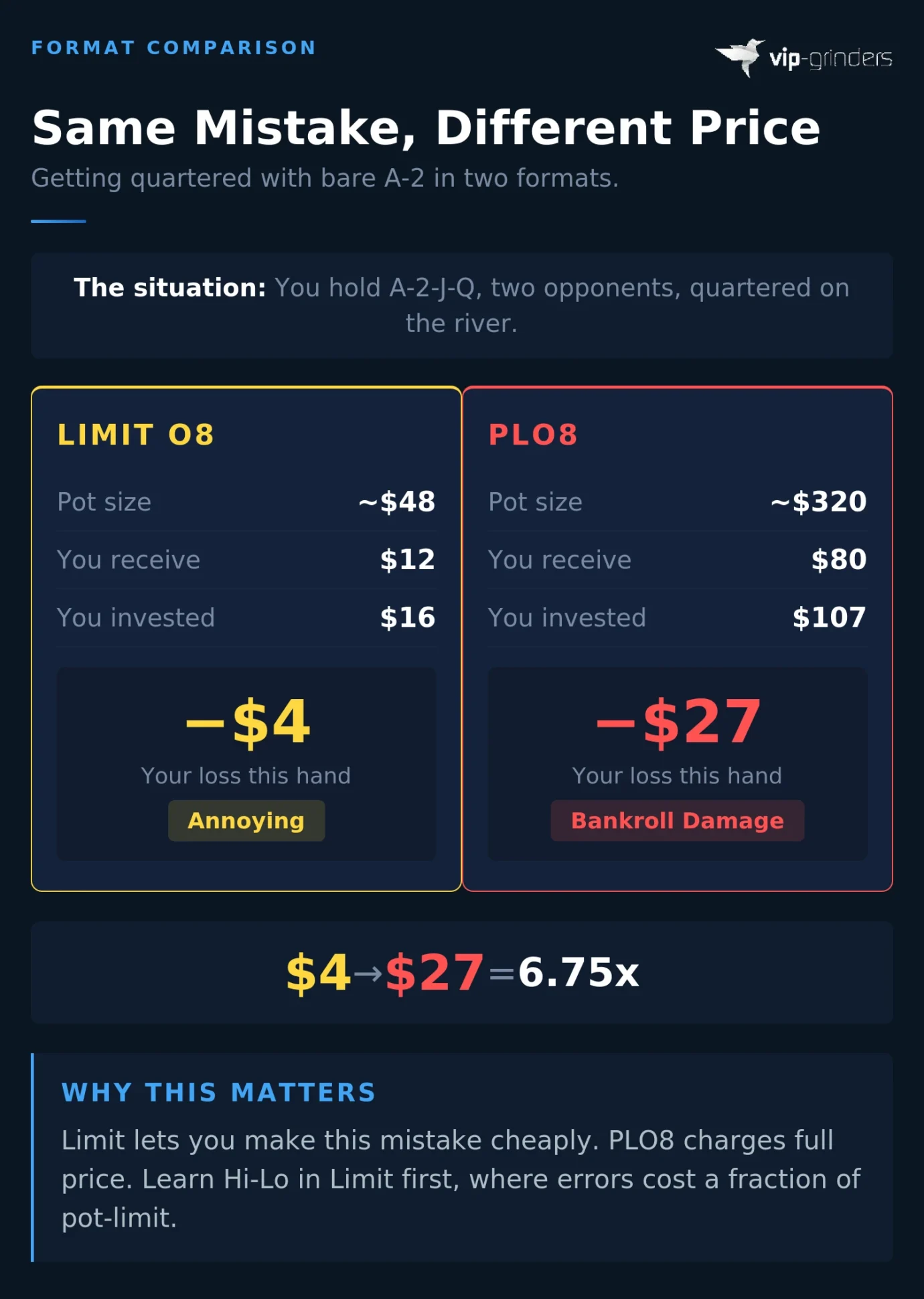
The key difference is how much each bet costs relative to the pot. In Limit, calling with a one-way low draw is cheap enough to be profitable, but in PLO8, pot-sized bets make the same call borderline. In NL08, a large bet can price out every draw that is only competing for half the pot.
If you are new to Hi-Lo, start with Limit O8. The fixed bet sizes let you see more flops, make more mistakes cheaply, and learn the split-pot dynamics before moving to pot-limit where the cost of those mistakes multiplies.
The Most Expensive Mistakes in Omaha Hi-Lo
Every mistake below is specific to Hi-Lo. General poker leaks (playing too loose, ignoring position, poor sizing) apply here too, but these five errors are the ones that cost Hi-Lo players the most money because they stem from misunderstanding the split-pot structure.
- Calling with the nut low and no high in multi-way pots: holding the nut low feels strong, but if three opponents are betting and raising, at least one of them likely shares your low. You are calling to win 25% of the pot while someone else takes 50%.
- Bluffing into three or more opponents: in Hold’em, a well-timed bluff can take down a multi-way pot. In Hi-Lo, someone almost always has at least one half of the pot locked up. Bluffing into a player who knows they are getting half regardless is burning money.
- Building big pots with one-way hands: pocket aces with no low cards (like A-A-K-Q rainbow) tempt players into raising wars preflop. When a low qualifies, you can only win half the pot you just inflated. Keep the pot small with high-only hands unless the board blocks all lows.
- Chasing a low draw when the board only has two low cards: with only two low cards on the flop, you need the turn or river to deliver a third before any low qualifies. You are chasing a draw to win half the pot at best, which makes the effective pot odds roughly twice as bad as they appear.
- Tilting after getting quartered: quartering is not bad luck. It is a structural feature of every Hi-Lo game. If you play the format regularly, you will get quartered hundreds of times. The players who treat it as routine rather than a personal insult are the ones who stay profitable.
Mistake number five is worth expanding on. Quartered pots create a specific kind of frustration that regular poker does not: you made the right hand, you won your half, and you still lost money. Over time that frustration compounds into tilt patterns that leak chips across entire sessions, and our mental game guide covers how to recognize and manage tilt before it damages your results.
Bankroll, Variance, and the Split-Pot Rake Trap
Split-pot games are harder on your bankroll than regular poker for two reasons. First, you win the full pot less often because scoops are rarer than outright wins in Hold’em or PLO. Second, the effective rake you pay is higher when you split, because the house takes its percentage from the full pot before dividing it.
This rake drag is why bankroll management needs to be tighter for Hi-Lo than for regular Omaha or Hold’em. Published simulations for mid-stakes PLO8 recommend 150 buy-ins for professional play, compared to roughly 50 to 100 buy-ins for NLHE cash games at the same stakes.
The variance profile in Hi-Lo is also unusual. Your standard deviation per 100 hands is similar to PLO, but your win rate is structurally lower because you are splitting so many pots. That combination means longer downswings and slower bankroll recovery, which makes both your bankroll size and your rakeback deal more important than in any other format.
Ready to put this into practice? Our best Omaha poker sites page lists the rooms with the most active Hi-Lo tables, and every deal includes tracked rakeback through VIP-Grinders so you recover value from day one. You can also test hand matchups before sitting down using the equity calculator.
Omaha Hi-Lo Strategy FAQ
What is the best starting hand in Omaha Hi-Lo?
A-A-2-3 double suited is the strongest starting hand in Omaha Hi-Lo. It combines pocket aces for the high half, the nut low draw (A-2) for the low half, a backup low card (3) for counterfeit protection, and two flush draws for additional scoop paths.
What is the best possible low hand?
The best low is 5-4-3-2-A, called the “wheel.” It is also a five-high straight, which means it competes for both the low and the high half of the pot at the same time. Making a wheel is one of the most common ways to scoop in Hi-Lo.
How often does a low qualify in Omaha Hi-Lo?
A qualifying low is possible roughly 60% of the time. The board needs at least three cards ranked eight or lower for any low to exist. The other 40% of the time, no low qualifies and the best high hand scoops the entire pot.
What does getting quartered mean?
Getting quartered means you tie with another player for one half of the pot while a third player wins the other half outright. You receive only 25% of the total pot. In a three-way pot where you invested a third of the money, getting quartered means you lose money even though you “won” your half.
What is counterfeiting in Omaha Hi-Lo?
Counterfeiting happens when the board duplicates one of your low hole cards, enabling opponents to build better lows using that board card. For example, if you hold A-2 and a deuce hits the river, opponents with A-3 can now use the board’s deuce to make a stronger low than yours. Holding A-2-3 instead of bare A-2 protects against this.
Is Omaha Hi-Lo easier than PLO?
No. Hi-Lo adds a second equity calculation to every decision because you must evaluate both your high and your low on every street. The split-pot structure also creates unique traps like quartering and higher effective rake that do not exist in standard PLO. Most players find Hi-Lo strategically more complex than PLO high-only.
Should I start with Limit or Pot-Limit Omaha Hi-Lo?
Start with Limit O8. Fixed bet sizes let you see more flops, make cheaper mistakes, and learn the split-pot dynamics before moving to PLO8 where pot-sized bets punish errors much harder. Limit O8 is also the format used in WSOP events and mixed games like HORSE and 8-Game.
How many buy-ins do I need for Omaha Hi-Lo?
For professional PLO8 cash games, published simulations recommend around 150 buy-ins. This is significantly more than the 50 to 100 buy-ins typically recommended for NLHE cash games. The higher requirement reflects the lower win rate caused by frequent pot splits and the structurally higher effective rake in split-pot formats.