


Beginner’s Pot-Limit Omaha Strategy 2026
What Makes PLO Different from No-Limit Hold’em
PLO isn’t a simple variation of Hold’em. The extra cards and pot-limit betting create a completely different strategic environment. Preflop edges are smaller, and postflop precision matters far more.
In Texas Hold’em, a player can often rely on top pair or overpairs. In Omaha, that same hand is rarely enough to win. The value of position, coordinated holdings, and nut potential increases dramatically. While come of the basic principles will be covered in our Hold’em Beginner’s Guide, Omaha required a completely different mindset overall.
Key differences:
- Four hole cards, must use two: Each hand has far more combinations and interaction with the board.
- Equity edges are narrower: Even premium hands like AAxx rarely exceed 65% equity preflop.
- Strong second-best hands lose more often: The “cooler” factor is real — discipline is essential.
- Position is critical: Acting last gives you information and control over pot size.
- Pot-limit structure: Bet sizing discipline replaces the freedom of no-limit shoves.
- Variance is higher: Downswings are part of the game; proper bankroll management is non-negotiable.
Omaha Hand Starting Hand Selection
Solid preflop fundamentals are the foundation of every winning Omaha player. Because equities run closer together, you can’t rely on raw hand strength — you need hands that play well across many board textures.
A good PLO hand works together. Each card should contribute to straights, flushes, or strong redraws. Single-purpose hands (like bare Aces) lose value when you miss the flop.
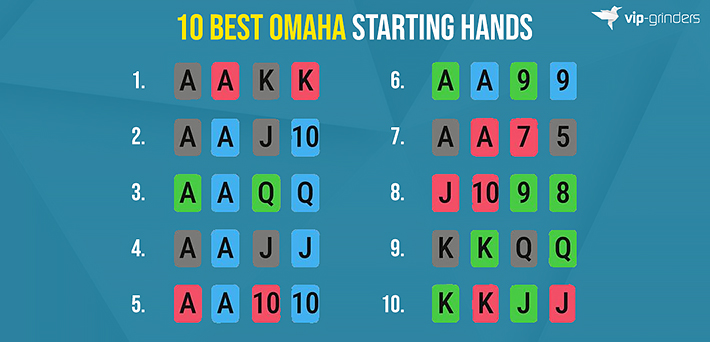

4 Qualities of strong starting hands:
- Double-suited: Two suits create more nut flush opportunities.
- Connected: Cards that form straight possibilities (JT98, T987, etc.).
- High cards: Improve top-end equity and block opponents’ strongest hands.
- Few “danglers”: Avoid cards that don’t connect with the rest of your hand.
Position and Range Discipline
Start tighter than you think. Position play is as important in Omaha as in Hold’em. Omaha punishes speculative preflop mistakes far more than Hold’em does.
| Position | Strong Hands | Marginal | Fold |
|---|---|---|---|
| UTG | AAxx (ds), strong rundowns | AA + KQJds | Bare Aces, low disconnected hands |
| MP | Add suited rundowns, high connected | 6789ds, KQJTds | Unsuited, ragged |
| CO / BTN | Wider: suited rundowns, double pairs | One-gap ds hands | Low disconnected |
| Blinds | Tight: premium ds only | Defend with playable equity | Trash hands |
Omaha Preflop Principles
Your aim before the flop is to enter the pot with hands that can continue profitably on a wide variety of boards. That means raising for value and control, not just to build pots.
Core Beginner’s Omaha concepts:
- Raise, don’t limp: Taking initiative gives you fold equity and defines ranges.
- 3-bet for nut potential: AAxx (ds), AKJTds, or strong rundowns perform well.
- Defend carefully: In the blinds, play hands that can flop nutted draws.
- Use position: The later you act, the wider your profitable range becomes.
Postflop Omaha Fundamentals
PLO is won and lost after the flop. Strong postflop play comes from understanding board texture, relative hand strength, and when to control the pot.
Omaha Flop Play
The first question to ask is: Who has the nut advantage on this board? Continue aggressively with nut draws, top sets, and strong wraps. Slow down with medium-strength hands that are vulnerable to redraws. Avoid large bluffs — value-driven aggression is more reliable at lower stakes.
Omaha Turn and River Play
Re-evaluate when new draws or pairs appear; they change everything. Protect your stack when holding second-best hands. Fold when the story and math align against you — even if your hand looks strong.
Bet Sizing and Pot Control
Because Omaha uses a pot-limit structure, bet sizing has to be intentional. You can’t overbet freely; each bet must fit a clear purpose.
Basic formula:
- Pot raise = current pot + (2 × call amount)
Guidelines:
- Full-pot bets: Use for value or semi-bluffs with strong equity.
- Half-pot: Balanced option for range coverage.
- Small bets: Control pot size or induce lighter calls.
- Check: With medium-strength hands on dynamic boards.
Good Omaha players treat pot size as a resource — build it when ahead, manage it when uncertain.
Comparing PLO and NLHE Equity Dynamics
One of the biggest adjustments for Hold’em players moving to PLO is learning how often equities run close together. In Hold’em, big draws often hold clear percentage advantages; in Omaha, that gap narrows.
| Draw Type | NLHE Typical Equity | PLO Typical Equity | Observation |
|---|---|---|---|
| Nut flush draw | 35–40% | 20–25% | More competing draws and blockers |
| Open-ended straight | 30–35% | 20–25% | Equity spread reduced |
| Combo wrap + flush | — | 40–55% | Enormous multiway equity potential |
| Top pair + draw | 45–55% | 30–35% | Rarely a value hand in PLO |
In short: there are fewer “safe” hands in Omaha. You win by playing for the nuts, not by relying on equity margins.
Worked Omaha Beginner’s Hand Examples
Hand 1 – Nut Flush vs Full House Danger
- Hero: A♦ K♦ J♠ T♠
- Board: 9♦ 5♦ 2♣ 7♦ 7♣
Hero flops and turns the nut flush, but the river pairs the board. Against aggression, folding here is correct. The paired river gives many full house combinations that beat you.
- Lesson: Always re-evaluate hand strength when the board pairs.
Hand 2 – Monster Combo Draw
- Hero: 9♠ T♠ J♥ Q♥
- Flop: 8♠ 7♠ 2♦
Hero holds both a wrap straight draw and a nut flush draw. This is one of the strongest possible flops in PLO. Betting pot maximizes fold equity and value when called.
- Lesson: Combo draws are your best semi-bluffing hands in Omaha.
Hand 3 – Second-Nut Trap
- Hero: J♦ Q♦ J♠ T♠
- Board: A♦ 9♦ 4♣ 8♣ 2♥
Hero flops a king-high flush, but any K♦x♦ beats it. In multiway pots, this should often be played as a check-call or even a disciplined fold.
- Lesson: In Omaha, strong but non-nut hands lose more money than weak ones you fold preflop.
6 Common Beginner’s Omaha Mistakes
- Overplaying second-best hands.
- Calling down with dominated draws.
- Overvaluing bare Aces.
- Letting pots grow with medium-strength hands.
- Ignoring board changes that destroy your equity.
- Playing too many disconnected holdings.
Bankroll, Variance, and Mental Game in Omaha
Omaha variance is part of the format, and in many ways it the increased variance has a lot to do with its popularity. Even perfect play can lead to heavy short-term losses. On the flipside, winnings are often bigger and come quicker.
Maintain at least 50–100 buy-ins for your stake. Focus on decision quality, not short-term results. Reviewing difficult hands is more valuable than replaying bad beats.
Top Pot-Limit Omaha Poker Online sites for Beginners (2025):
To play PL Omaha poker online for real money, here we list the highest value rakeback deals to maximize your profits here:
Omaha Beginner’s Strategy Final Thoughts
Pot-Limit Omaha rewards players who think beyond surface strength. By focusing on structure, position, and nut potential, you’ll avoid the traps that cause most beginners to lose. Learn to control the pot, respect variance, and make disciplined folds. The fundamentals in this guide will carry you from the smallest online stakes to meaningful long-term profit. Once you have mastered these concepts, dive into our Advanced Pot-Limit Omaha strategies.
Beginner’s Pot-Limit Omaha Strategy FAQs
What is a “wrap” in PLO?
It’s a straight draw where many internal cards can complete it — e.g. with J-T-9-8 on flop 7-6 you have many outs.
Can you use only one hole card in Omaha?
No — the rules require exactly two hole cards + three community cards.
How many buy-ins should I have for PLO?
A conservative guideline is 50–100+ full buy-ins depending on stake & edge.
Why fold a flush?
Because in PLO flushes can be lower than the nut flush, and board pairs / better flushes / full houses can kill you.
What is “nut advantage”?
The likelihood your hand (or draw) can become the absolute nuts; hands with nut advantage dominate many spots.
Is PLO more for aggressive players?
Yes, but aggression must be structured and based on ranges, not random bluffs.
How do I count outs?
More complex than Hold’em: count combinations, subtract blockers, account for non-nut draws.
Can beginners bluff in PLO?
Very cautiously. Bluffs must be backed by range equity and blockers; rarely bluff from early positions.