


According to simulation data from Primedope, a winning NL Hold’em player’s biggest annual downswing averages 29 buy-ins. At the 90th percentile, however, that number jumps to 45 buy-ins.
In a truly cursed year (the 1-in-100 scenario), your bankroll could plummet by 65 buy-ins.
These aren’t just opinions. They’re the direct output of Monte Carlo simulations run across millions of hands at standard win rates and deviations.
If you’re surprised by these numbers, it means you probably underestimate how brutal variance in poker can be, even when you’re playing well.
This guide breaks down the math behind poker variance using real numbers, including standard deviations by format, downswing probabilities, and bankroll thresholds that can withstand the swings. It also provides practical tools to distinguish “running bad” from “playing bad.”
What Variance in Poker Actually Means (And What It Doesn’t)
Variance is not bad luck. Rather, it is the mathematically inevitable difference between your expected and actual results over a given sample of hands.
Your win rate indicates what you should earn per 100 hands in the long term. Your standard deviation (SD) shows how much your actual results will fluctuate around that number in the short term.
A typical NL Hold’em 6-max player has an SD between 75 and 120 bb/100. That means even with a solid 5 bb/100 win rate, your session-to-session results will scatter across a massive range.
Here’s the formula that matters: your 95% confidence interval equals your win rate plus or minus (2 x SD / square root of hands played x 100).
For a 5 bb/100 winner with 90 bb/100 SD after 10,000 hands, that interval is roughly +5 bb/100 plus or minus 1.8 bb/100.
Sounds tight, right? Now run the same calculation after just 1,000 hands, and the interval explodes to plus or minus 5.7 bb/100, meaning you could easily show a loss despite playing winning poker.
The takeaway is simple. Short-term results tell you almost nothing about your true skill level. Variance dominates until you have accumulated enough data for the math to stabilize.
Standard Deviation by Format: Where Your Swings Come From
Not all poker formats are created equal. The format you choose directly determines how much variance you’ll experience, and the differences are significant.
| Format | Typical SD (bb/100) | Variance Level |
|---|---|---|
| NL Hold’em 6-max | 75-120 | Medium-High |
| NL Hold’em 9-max (Full Ring) | 60-80 | Medium |
| PLO 6-max | 140-160 | Very High |
| PLO 9-max | 100-140 | High |
| MTTs | N/A (measured by ROI variance) | Extreme |
| Spin & Gos | N/A (measured by ROI variance) | Extreme |
Cash Games vs. Tournaments
Cash game variance is lower for three reasons: hands are independent (no elimination pressure), stacks are typically deeper (more room for skill expression), and you can quit any time a session feels off.
Tournament poker is a different animal entirely. Top-heavy payout structures mean you’ll finish out of the money roughly 80-85% of the time, even as a strong player.
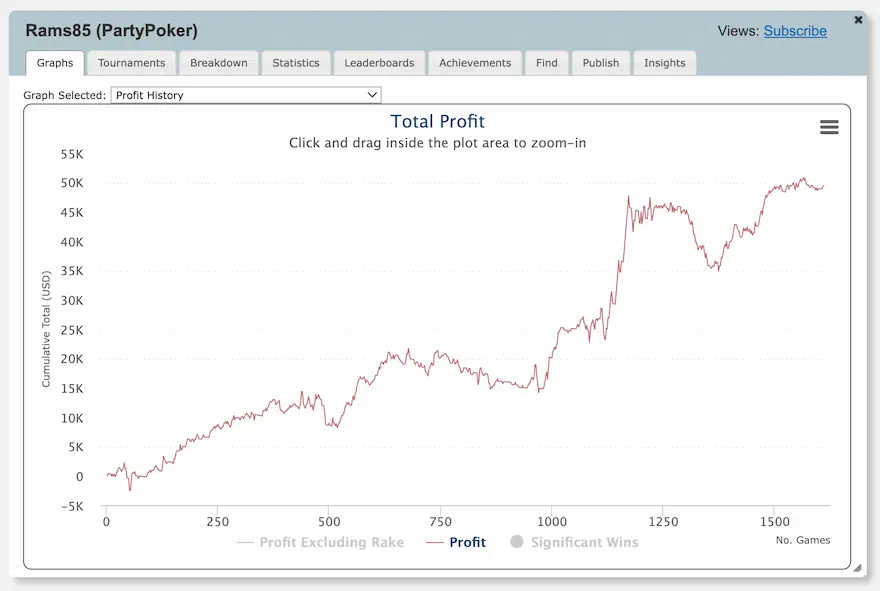
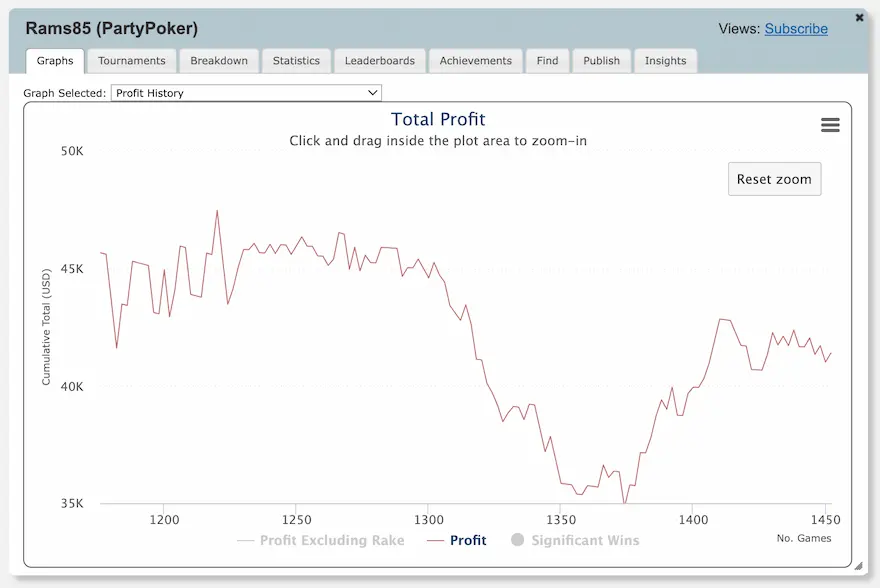
A world-class tournament grinder featured in VIP-Grinders’ analysis endured a $10,000 downswing across 330 games before finishing the year $50,000 in profit.
That kind of swing is standard in MTTs; it’s not exceptional.
Spin & Gos push variance even further because random multipliers add an extra layer of randomness to the already volatile, short-stacked, hyper-turbo format.
You need to play thousands of games before the ROI data becomes meaningful.
No-Limit Hold’em vs. Pot-Limit Omaha
PLO generates roughly 40-60% higher standard deviation than NLH at equivalent table sizes, according to data from PloGenius.
An aggressive Pot-Limit Omaha (PLO) 6-max player can expect to see SD values around 200 big blinds (bb)/100, compared to 100-110 bb/100 for a similarly aggressive No-Limit Hold’em (NLH) player.
This is due to the structure of the game: four hole cards create more equity-close situations, bigger pots build faster, and the mandatory aggression leads to more frequent high-SPR confrontations.
If you play PLO, you need to plan for deeper swings and a larger bankroll. Period.
How Bad Can Downswings Actually Get? The Simulation Data
Most players underestimate how deep and how long their downswings can run. Simulation data paints a far harsher picture than gut feeling.
| Scenario | Downswing Depth | Probability |
|---|---|---|
| Average biggest annual downswing | 29 buy-ins | Expected (median) |
| Bad year (90th percentile) | 45 buy-ins | 1 in 10 years |
| Nightmare year (99th percentile) | 65 buy-ins | 1 in 100 years |
| Biggest downswing exceeds 25 BI | 25+ buy-ins | 75% of players |
These numbers apply to winning players with positive expected value. If you’re a marginal winner with a low win rate, the math becomes more complicated.
A player winning at just 1 bb/100 with an SD of 70 bb/100 will have a losing month 32.5% of the time. That’s roughly one losing month out of every three.
Even a solid 5 bb/100 winner should expect to lose money approximately every sixth month. A winning player has a 1-in-7 chance of showing a net loss after 100,000 hands.
Not 1,000. Not 10,000. One hundred thousand hands, and you still might be underwater.
Breakeven streaks of 30,000 hands are considered normal. Stretches of 100,000 hands occur for players with real edges.
A player will be in the middle of a 1,000+ big blind downswing roughly one-third of the time.
The old recommendation of having a bankroll of 20–30 buy-ins? It’s dangerously insufficient. Simulations show a 75% probability that your biggest downswing will exceed 25 buy-ins.
Bankroll Management Rules That Survive Variance
Your bankroll exists for one reason: to absorb the mathematically inevitable downswings without forcing you to drop stakes or go broke.
The numbers below are built from simulation data, not conservative guesswork.
| Format | Win Rate | SD (bb/100) | Recommended Bankroll | Risk of Ruin (<5%) |
|---|---|---|---|---|
| NLH 6-max | 3 bb/100 | 90 | 67 buy-ins ($6,700 at NL100) | Below 5% |
| NLH 6-max | 5 bb/100 | 90 | 40 buy-ins ($4,000 at NL100) | Below 5% |
| PLO 6-max | 3 bb/100 | 150 | 100-120 buy-ins | Below 5% |
| MTTs | 15% ROI | N/A | 100-200 buy-ins | Below 5% |
| Spin & Gos | 3-5% ROI | N/A | 150-200 buy-ins | Below 5% |
A 3 bb/100 NLH 6-max grinder needs roughly 67 buy-ins to keep risk of ruin below 5%. At $1/$2, that’s approximately $13,400.
If you’ve been playing NL100 with a $3,000 bankroll, you’ve been gambling with your poker career.
The dynamic approach works best: move up when you hit 40-50 buy-ins for the next stake, and move down immediately when you drop to 30 buy-ins at your current level. Don’t wait. The math doesn’t care about your ego.
For PLO players, the numbers are steeper. We recommend 100 buy-ins per limit as a conservative starting point, noting that roughly one-third of 5 bb/100 PLO winners will experience downswings at least 100,000 hands long and 50 buy-ins deep.
How to Use a Poker Variance Calculator
A poker variance calculator turns abstract math into personalized projections. Enter your win rate, standard deviation, and hand volume. Then, it will run Monte Carlo simulations to show you the realistic range of outcomes you should expect.
Here’s how to use it effectively: Enter your win rate. Use a conservative estimate, not your best guess. Most players overestimate their true win rate by 20-50%.
Set your standard deviation (SD) to the default for your format. For NLH 6-max, 90 bb/100 is a solid starting point. Choose your sample size. Then, run the simulation.
The output shows the best-case, worst-case, and median bankroll trajectories for the specified number of hands. Pay attention to the bottom 5% line. That’s the worst-case scenario your bankroll needs to survive.
- Primedope Variance Calculator: The gold standard for cash game variance simulations. Inputs for win rate, SD, and number of hands. Also offers a separate tournament variance calculator.
- VIP-Grinders Variance Simulator: Runs thousands of Monte Carlo simulations based on your real stats. Shows heater and downswing projections across any sample size.
- GTO Wizard Bankroll Tool: Combines variance analysis with risk-of-ruin calculations. Useful for setting bankroll thresholds at any stake.
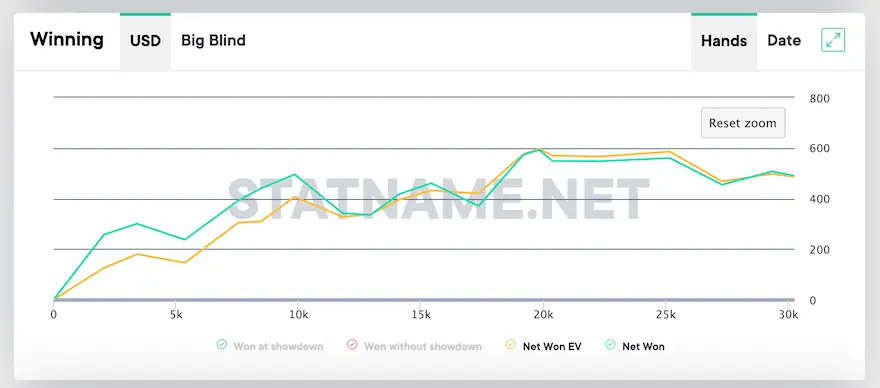
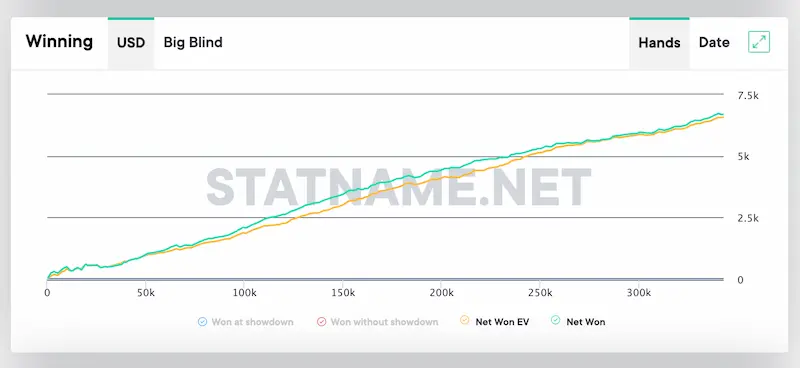
- PokerTracker 4 / Hand2Note: Track your actual EV-adjusted win rate over time. Comparing your green line (actual results) against your yellow line (EV line) reveals exactly how much variance is affecting your results.
Variance Reduction: What You Can Actually Control
Variance is an inherent part of poker. However, you can reduce it. Here are the levers that can actually make a difference.
Your win rate is the most powerful way to reduce variance. A higher win rate shortens downswings, reduces their depth, and narrows your confidence intervals.
A player with a 10 bb/100 win rate cannot lose after 500,000 hands. In contrast, a 1 BB/100 winner will spend about one-third of their playing life in a significant downswing.
Improving your edge by even 1-2 bb/100 through better poker strategy has a larger impact on variance survival than any bankroll trick.
Game selection matters almost as much. Softer tables increase your win rate and reduce the frequency of high-variance confrontations against skilled opponents.
For example, if you’re grinding NL50 on a tough site with an average VPIP of 22%, switching to a softer platform with an average VPIP of around 31% will boost your profits. It also evens out your results.
Rakeback provides a guaranteed income floor that cushions variance. A strong rakeback deal can add 2-4% to your effective ROI, regardless of how the cards fall.
At the micro and low stakes levels, elite grinders can earn $300-$400 per month from rakeback alone, transforming potential losing months into breakeven or marginally profitable ones.
- Increase your win rate: Study, review hands, and plug leaks. Every bb/100 you gain directly reduces your expected downswing depth and duration.
- Choose softer games: Table-select ruthlessly. Soft fields mean higher win rates and fewer close-EV spots that generate variance.
- Play a lower-variance format: NLH full ring has roughly 40% less SD than 6-max. If bankroll pressure is real, format choice is a legitimate tool.
- Maximize rakeback: A strong rakeback deal through VIP-Grinders adds guaranteed value every month, regardless of short-term results.
- Control table count: Playing fewer tables during downswings lets you make better decisions, which protects your win rate when you can least afford to lose it.
The Mental Game: Surviving Variance Between the Ears
Knowing the math is only half the battle. You also need to be able to handle variance psychologically, which is where most grinders actually fail.
Track your EV line, not just your results. Poker tracking software like PokerTracker 4 and Hand2Note shows your EV-adjusted win rate alongside your actual results.
When your green line (actual winnings) dips below your yellow line (expected value), you know that variance, not your play, is responsible.
This distinction is critical during downswings because it prevents you from changing your strategy unnecessarily based on results rather than the quality of your decisions.
Set stop-loss rules before you sit down. Decide in advance how many buy-ins you’re willing to lose in a session. Three to five buy-ins is a reasonable threshold for most players.
Stop when you hit it. No exceptions. Extending sessions during a downswing almost always results in worse play, larger losses, and a longer recovery period.
The counterintuitive upside of variance is that it’s the reason poker remains profitable. Variance allows recreational players to experience winning sessions despite making -EV decisions.
Without those occasional wins, recreational players would stop depositing, games would dry up, and your edge would disappear.
Every brutal bad beat you endure is, in a sense, the cost of doing business in a game that only exists because weaker players occasionally win.
Frequently Asked Questions About Variance in Poker
What is variance in poker?
Variance in poker is the statistical measure of how much your actual results deviate from your expected win rate over a given sample of hands. A high standard deviation (like 150 bb/100 in PLO) means wider swings, while a lower SD (like 70 bb/100 in NLH full ring) produces smoother results. It’s not luck. It’s math.
How many hands do I need to reach the long run in poker?
There’s no magic number, but most variance experts agree you need at least 100,000 hands of cash games or 3,000+ tournament entries before your results become statistically meaningful. Even after 100,000 hands, a winning player has roughly a 1-in-7 chance of showing a net loss due to variance in poker.
How long do poker downswings last?
Breakeven stretches of 30,000 hands are considered normal for winning cash game players. In extreme cases, downswings can extend to 100,000+ hands. For tournament players, losing streaks of 100-300 events are common. The length depends heavily on your win rate: higher win rates produce shorter, shallower downswings.
Is a 30 buy-in bankroll enough for poker?
No. Simulation data shows that 75% of winning players will experience a downswing exceeding 25 buy-ins. A 3 bb/100 NLH 6-max player needs approximately 67 buy-ins to keep risk of ruin below 5%. For PLO, you need 100+ buy-ins. The old 20-30 buy-in guideline is outdated and dangerous for serious grinders.
Does PLO have more variance than Hold'em?
Yes, significantly. PLO 6-max produces a standard deviation of 140-160 bb/100, compared to 75-120 bb/100 for NLH 6-max. The four-card starting hand structure creates more equity-close situations and bigger pots, which amplifies swings. PLO bankrolls should be 50-100% larger than equivalent NLH bankrolls.
How do I know if I'm on a downswing or just playing badly?
Use a poker variance calculator and your tracking software. Compare your actual results (green line) against your EV-adjusted results (yellow line) in PokerTracker or Hand2Note. If your EV line is trending positively while your actual results lag behind, variance is the culprit. If both lines are dropping, you have a strategy leak to fix.
Can rakeback help reduce variance in poker?
Rakeback doesn’t reduce mathematical variance, but it provides a guaranteed income floor that cushions the impact of downswings. A solid rakeback deal adds 2-4% effective ROI to your results. At low stakes, this can mean $300-400 per month in guaranteed value through VIP-Grinders deals, turning potential losing months into breakeven ones.
What is the best poker variance calculator?
Primedope’s Poker Variance Calculator is widely regarded as the best free tool. It uses Monte Carlo simulations to project realistic outcomes based on your win rate, standard deviation, and sample size. The VIP-Grinders Variance Simulator offers similar functionality with a focus on visual downswing projections. Both are free to use.