

Spin & Go Strategy: How to Beat Jackpot SNGs 2026
Your edge in Spin & Gos lives in preflop push/fold accuracy. Three players, 25bb starting stacks, blinds that double every three minutes, and most games over in under seven minutes. There is almost no postflop poker.
The format attracts heavy casino crossover traffic, which means player pools at low and mid buy-ins are noticeably softer than in standard SNGs or MTTs. That soft field is where your ROI comes from, but the hyper-turbo structure makes variance brutal.
Here is what this guide covers:
- Format breakdown with multiplier distribution and how Spins compare to other formats
- Stage-by-stage strategy from 25bb early levels through sub-10bb push/fold
- Push/fold charts for Button shoves and BB calls at 15bb, 10bb, 7bb, and 5bb
- Exploitative adjustments against limpers, nits, and maniacs
What Are Spin & Go Tournaments?
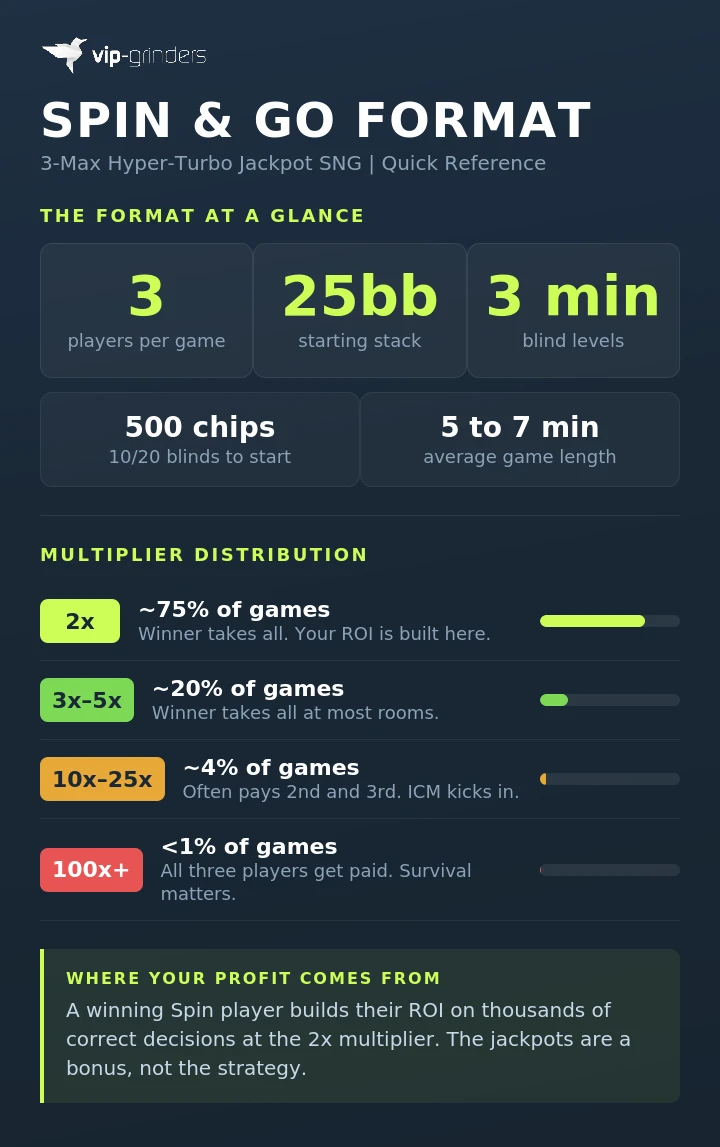
A Spin & Go is a 3-player hyper-turbo sit & go where a random multiplier sets the prize pool before the first hand. You pay a fixed buy-in, and the total pot can range from 2x up to 10,000x or more depending on the room. Starting stacks are 500 chips (25bb), blinds increase every 3 minutes, and most games end in under 7 minutes.
Multiplier Distribution
| Multiplier | Approximate Frequency | Prize Pool ($10 buy-in) | Payout Structure |
|---|---|---|---|
| 2x | ~75% | $20 | Winner takes all |
| 3x to 5x | ~20% | $30 to $50 | Winner takes all (most rooms) |
| 10x to 25x | ~4% | $100 to $250 | Often pays 2nd and 3rd a small share |
| 100x+ | <1% | $1,000+ | All three players typically receive a payout |
The 2x multiplier hits three out of every four games. That is where your long-term profit comes from. A winning Spin player builds their ROI on thousands of correct decisions at the low multipliers, not on hitting a 1,000x once.
At 10x and above, all three players typically receive a payout. That introduces ICM pressure: survival has direct cash value, which tightens your shoving and calling ranges. The GTO adjustments section below covers exactly how much.
How Spins Compare to Other Formats
| Feature | Spin & Go | Standard SNG (9-max) | MTT |
|---|---|---|---|
| Players | 3 | 6 to 9 | 100+ |
| Starting stacks | 25bb | 50 to 100bb | 100 to 200bb |
| Average game length | 5 to 7 min | 30 to 45 min | 3 to 8 hours |
| Primary skill | Push/fold, ICM | Bubble play, push/fold | Full postflop, stack management |
| Variance | Very high | High | High (smoothed by field size) |
| Games per hour | 8 to 12 per table | 1 to 2 | Less than 1 |
The combination of short game length and high volume is what makes Spins unique. You can fire 50 to 100 games in a two-hour session. For a full side-by-side breakdown across variance, bankroll, rakeback, and lifestyle fit, see our MTTs vs Spin & Gos comparison.
Core Spin & Go Strategy by Stage
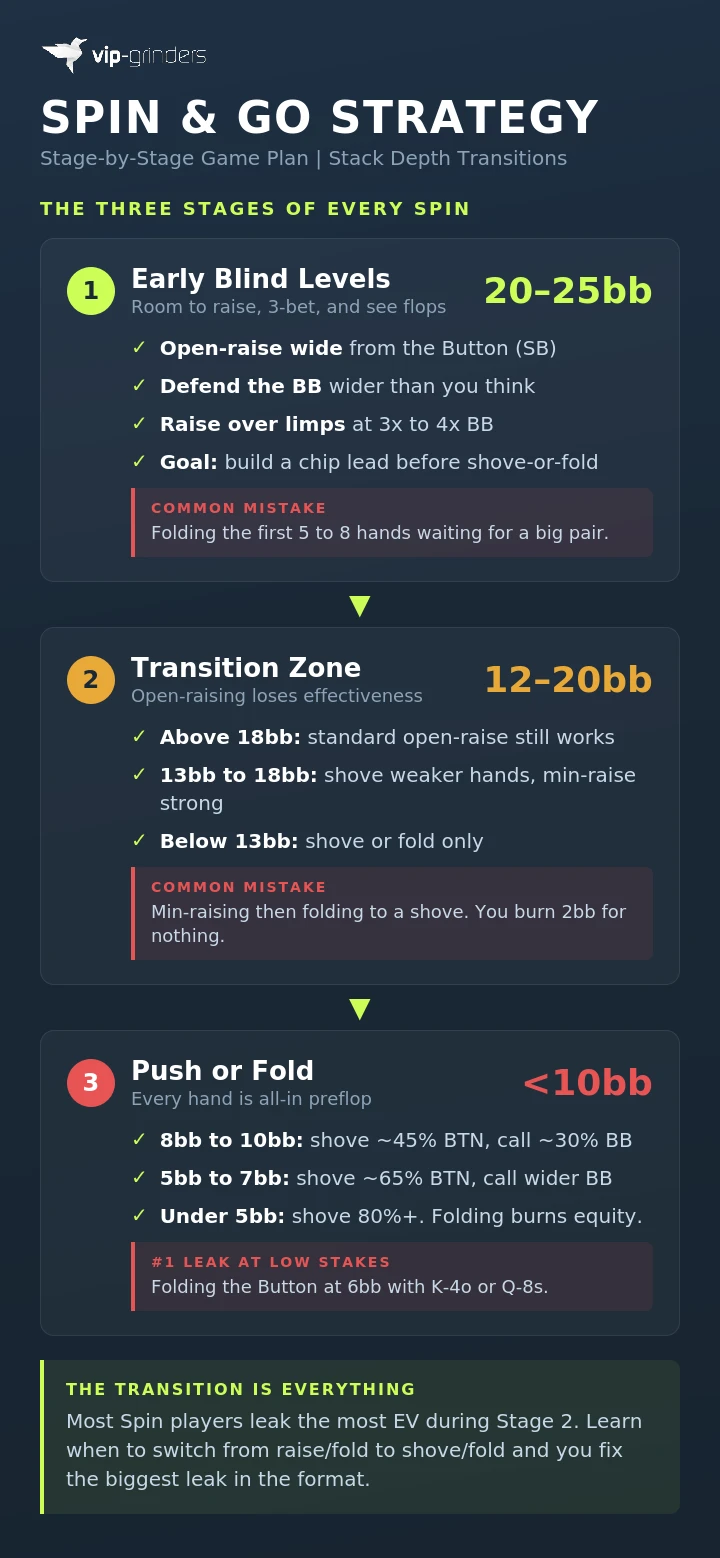
A Spin & Go moves through three distinct phases based on effective stack depth. Each demands a different approach, and the transitions happen fast.
Early Blind Levels (20bb to 25bb)
The first few hands are the only time you have enough chips for open-raises, 3-bets, and occasional postflop play.
| Position | Recommended Action at 25bb | Sizing |
|---|---|---|
| Button (SB) | Open-raise a wide range. You act last postflop and put pressure on the BB. | 2x to 2.5x BB |
| Big Blind vs. raise | Defend wider than you think. You are getting a good price and closing the action. | Call or 3-bet shove depending on hand strength |
| Big Blind vs. limp | Raise to punish limps. Most recreational players limp too much from the SB. | 3x to 4x BB |
Your goal is to build a chip lead before the blinds force shove-or-fold decisions. A player who accumulates 35bb to 40bb heading into the mid-blind levels has a massive structural advantage.
Common mistake: folding the first 5 to 8 hands waiting for a big pair. By the time you find one, blinds have already eaten 20% of your stack. Controlled aggression from hand one puts you in a position to dictate the game.
Mid Blinds (12bb to 20bb)
This is the transition zone where open-raising starts to lose effectiveness. At 15bb, a standard 2.5x open commits over 15% of your stack preflop. If you get 3-bet shoved on, you are often priced in with a mediocre hand.
- Above 18bb: you can still open-raise from the Button and fold to a 3-bet shove with the bottom of your range.
- 13bb to 18bb: replace open-raises with open-shoves for weaker holdings. Keep a min-raise range with your strongest hands to induce action.
- 12bb to 13bb: almost every hand should be a shove or a fold. The raise-fold line is too expensive.
The biggest mistake at this stage is min-raising and then folding to a shove. You invest 2bb, get jammed on, and surrender chips you could have kept by either shoving or folding preflop.
Short Stack Play (Under 10bb)
Below 10 big blinds, every hand is shove or fold. The only question is which hands are profitable shoves from each position at your exact stack depth.
| Stack Depth | Button (SB) Strategy | Big Blind Strategy |
|---|---|---|
| 8bb to 10bb | Shove roughly top 40% to 50% of hands. Any Ace, any pair, suited connectors down to 54s, most Kings. | Call with roughly top 25% to 35% depending on opponent’s shove frequency. |
| 5bb to 7bb | Shove roughly 60% to 70%. Almost any two cards with a face card or suited connector. | Call wider. The pot odds are too good to fold most playable hands. |
| Under 5bb | Shove almost any two cards (80%+). Folding is burning equity. | Call extremely wide. You are usually getting 2:1 or better. |
These percentages are approximations. The exact ranges depend on opponent tendencies and multiplier. The push/fold charts in the next section give you precise ranges by position and stack depth.
The #1 leak at low stakes Spins: folding the Button at 6bb with hands like K-4 offsuit or Q-8 suited. At this depth, pot odds make shoving these hands clearly profitable. Every fold at 5bb or less costs you EV that compounds across thousands of games.
Push/Fold Charts for Spin & Gos
Push/fold charts are the single most valuable study tool for Spin players. They tell you exactly which hands to shove and which hands to fold from each position at every stack depth, removing guesswork from the decisions you face most often.
The charts below are baselines for winner-takes-all play, which covers roughly 95% of all Spins (2x through 5x multipliers). At higher multipliers where ICM applies, ranges tighten (covered in the next section). Use these as your default and adjust from there.
Button (SB) Shove Ranges
| Stack | Shove % (approx.) | Hands Included |
|---|---|---|
| 15bb | ~30% | All pairs, A2s+, A7o+, K9s+, KTo+, Q9s+, QJo, J9s+, T9s, 98s, 87s, 76s |
| 10bb | ~48% | All pairs, A2s+, A2o+, K2s+, K7o+, Q5s+, Q9o+, J7s+, J9o+, T7s+, T9o, 97s+, 86s+, 76s, 65s, 54s |
| 7bb | ~65% | All pairs, all Aces, all Kings, Q2s+, Q5o+, J4s+, J8o+, T5s+, T8o+, 95s+, 85s+, 75s+, 64s+, 54s, 53s |
| 5bb | ~80% | Nearly everything. Fold only the very worst offsuit hands like 72o, 83o, 92o, 42o. |
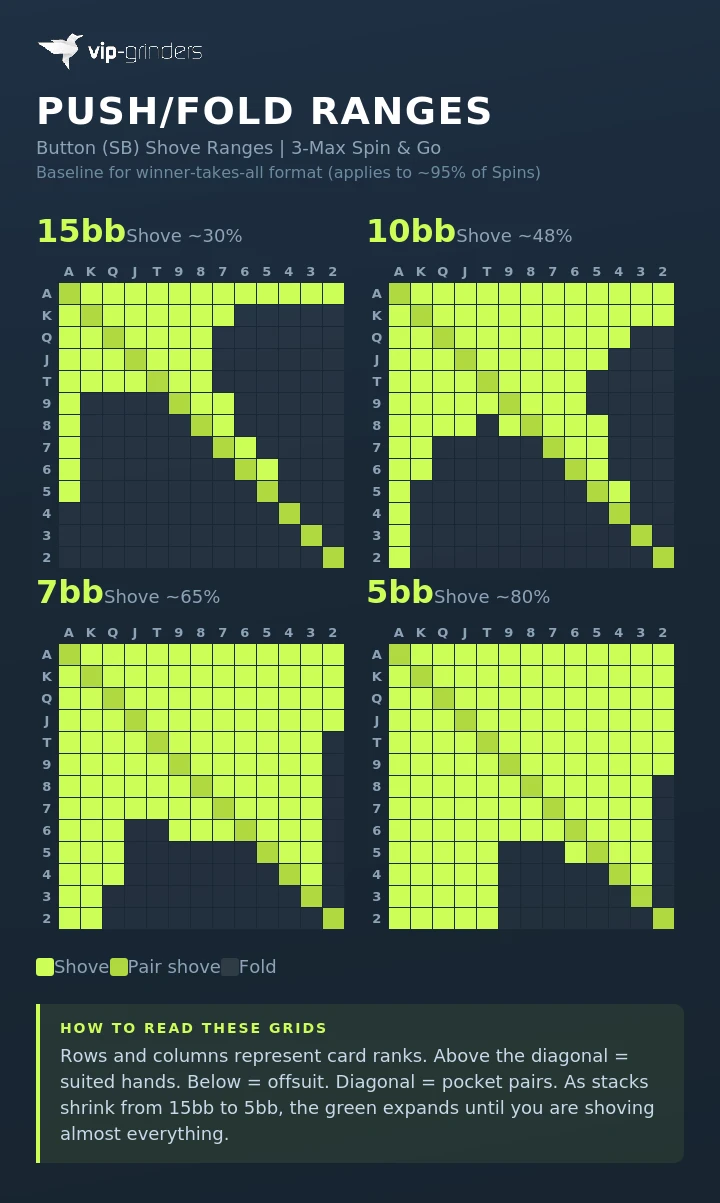
At 10bb on the Button, you shove roughly half of all hands. If this feels too wide, run the numbers in an equity calculator: the dead money in the blinds makes shoving these hands clearly +EV.
Big Blind Call Ranges
Your calling range depends on your pot odds and how wide your opponent is shoving. Against the baseline Button shove ranges above:
| Stack | Call % (approx.) | Hands Included |
|---|---|---|
| 15bb | ~18% | 77+, A9s+, ATo+, KTs+, KQo, QJs |
| 10bb | ~30% | 22+, A2s+, A7o+, K9s+, KTo+, QTs+, QJo, JTs |
| 7bb | ~42% | 22+, A2s+, A2o+, K5s+, K9o+, Q8s+, QTo+, J8s+, JTo, T8s+, 98s |
| 5bb | ~55% | 22+, all Aces, K2s+, K5o+, Q5s+, Q8o+, J7s+, J9o+, T7s+, T9o, 97s+, 87s, 76s |
Notice how much wider the calling range gets as stacks shrink. At 5bb, the BB is putting in 1bb to win 6bb (the opponent’s 5bb shove plus the 1bb already posted). That is roughly 5:1 pot odds, which means you only need about 17% equity to break even. Most hands clear that threshold against a wide shoving range.
Using These Charts in Practice
Memorizing every hand in every row is not realistic during a session. Instead, focus on the boundary hands: the weakest hands in each range. Those are the spots where most of your EV edge comes from.
- At 10bb on the Button: the boundary is around K7o, Q9o, J9o, T9o, 54s. If you are folding these, you are leaving money on the table.
- At 10bb in the BB: the boundary is around A7o, KTo, QJo, JTs. Calling with these is correct against a standard shoving range, even though they feel marginal.
- At 5bb anywhere: stop thinking about hand quality. The pot odds are so good that folding most hands is a mistake. Shove or call unless your hand is truly garbage.
These charts assume your opponent plays reasonably. Against a player who folds 80% of hands in the BB, your Button shove range should be even wider. Against a player who calls every shove, tighten up and let them pay you off with worse hands.
GTO Adjustments and Exploitative Play
The push/fold charts above give you the mathematically correct baseline. But Spins are not played against solvers. They are played against real opponents who make predictable mistakes, and the multiplier changes the incentive structure from game to game. Knowing when and how to deviate from the baseline is where your edge grows.
Adjusting to Multiplier Size
At 2x through 5x (winner takes all), the charts apply directly. There is no ICM. First place gets everything, so chip EV equals prize EV. Play to accumulate chips as aggressively as possible.
At 10x and above, the payout structure changes. All three players typically receive something, which means survival has direct cash value. This shifts your strategy in two ways.
| Multiplier | Payout Impact | Strategy Adjustment |
|---|---|---|
| 2x to 5x (WTA) | Winner gets everything. No ICM. | Play the baseline charts. Maximize chip accumulation. |
| 10x to 25x | 2nd and 3rd place get a small payout. | Tighten shove ranges by ~5% to 10%. Avoid marginal spots early. Let opponents bust each other. |
| 100x+ | All three places pay significant prizes. 3rd place alone can be worth 10x+ your buy-in. | Tighten significantly in early levels. Only shove premium hands when all three players are still in. Open up once heads-up. |
The key principle is simple: the more valuable finishing 2nd or 3rd becomes relative to the buy-in, the more you should avoid coin-flip situations early. At a 2x multiplier, calling a marginal all-in costs you one buy-in if you lose. At a 100x multiplier, that same call risks a guaranteed payout worth dozens of buy-ins.
Exploiting Common Opponent Types
Most Spin players at low and mid stakes fall into three categories. Recognizing them quickly and adjusting your ranges is more profitable than memorizing GTO charts perfectly.
| Opponent Type | How to Spot Them | How to Adjust |
|---|---|---|
| The Limper (casino crossover) | Limps the SB frequently. Calls too wide preflop. Rarely shoves without a strong hand. | Raise their limps to 3x to 4x every time. When they shove, fold everything but premiums. They are telling you they have it. |
| The Nit | Folds the SB at 8bb+. Only shoves with top 15% to 20% of hands. Folds the BB to shoves at a high rate. | Shove the Button relentlessly. Your baseline range can expand to 60%+ at 10bb because they are not calling. When they do shove, fold your marginal hands. |
| The Maniac | Shoves 70%+ at any stack depth. Min-raises and then calls 3-bet shoves with weak hands. | Tighten your shoving range and widen your calling range. Let them shove into you with garbage. Hands like A8o and KTo become strong calls at 10bb against this player. |
At low stakes, the Limper is the most common opponent. Casino players who discover Spins often play them like slot machines: they limp, call too much, and only raise with very strong hands. Against this profile, raising every limp and folding to their aggression is one of the highest EV adjustments you can make.
Speed matters: you have 3 to 5 hands to identify your opponent’s type before stacks reach shove-or-fold territory. A single SB limp or an early fold at 20bb tells you more about their strategy than any HUD stat would.
When GTO Beats Exploitative (and Vice Versa)
Against unknown opponents in the first few hands, play the baseline charts. You do not have enough information to exploit, and the GTO approach protects you from being exploited yourself.
Once you spot a pattern (and in 3-max with fast blinds, patterns emerge quickly), shift toward exploitative play. The adjustment does not need to be dramatic.
- Against a nit: shove 5% to 10% wider than baseline from the Button. That alone adds meaningful EV over hundreds of games.
- Against a maniac: call shoves with 5% to 10% wider than baseline from the BB. Hands like KTo and A5o become clear calls.
- Against a limper: raise 100% of limps in the BB. They fold often enough to make this profitable with any two cards.
The best Spin players start at the baseline, read the table within two orbits, and make small adjustments that compound across thousands of games.
Reading Opponents Without a HUD
Most rooms now block HUDs in Spin lobbies. In a 10 to 20 hand game, you only need to answer three questions:
- Do they limp the SB? If yes, recreational player. Raise every limp, respect their shoves.
- Do they fold the BB to shoves? Two folds in the first orbits = expand your Button shove range.
- How wide do they shove? Shoving at 20bb or three hands in a row = maniac. Tighten shoves, widen calls.
Three data points, observable within the first orbit. Use your client’s colour-tag feature to mark opponents across sessions.
Spin & Go Flash Variant
Spin & Go Flash uses 2-minute blind levels instead of 3, cutting the average game to 3 to 5 minutes. The push/fold charts above still apply. What changes is how fast you reach shove-or-fold territory.
| Feature | Standard Spin & Go | Spin & Go Flash |
|---|---|---|
| Blind level duration | 3 minutes | 2 minutes |
| Average game length | 5 to 7 minutes | 3 to 5 minutes |
| Hands before shove-or-fold | 8 to 12 | 5 to 8 |
| Games per hour (single table) | 8 to 12 | 12 to 18 |
| Variance | Very high | Even higher |
Should You Play Flash or Standard?
| Priority | Best Format | Why |
|---|---|---|
| Maximum games per hour | Flash | 40% to 50% more games per session. More rake generated, faster VIP progress. |
| Higher table ROI | Standard | Extra early-game hands let you exploit recreational players before pure shove/fold. |
| Rakeback optimization | Flash | Higher volume means more rake per hour and more cashback. |
| Lower variance | Standard | More decisions per game means skill shows up over fewer games. |
For most grinders, the practical answer is to play both. Fire Standard when tables are soft. Add Flash when you want volume or when the regular lobby is thin.
Bankroll Management for Spin & Gos
Spins are the highest variance format in online poker. The standard rule is 100 to 200 buy-ins for your current stake. Our bankroll management guide covers the full system across all formats. The Spin-specific numbers:
| Buy-in | Conservative (200 BIs) | Standard (150 BIs) | Aggressive (100 BIs) |
|---|---|---|---|
| $1 | $200 | $150 | $100 |
| $3 | $600 | $450 | $300 |
| $5 | $1,000 | $750 | $500 |
| $10 | $2,000 | $1,500 | $1,000 |
| $25 | $5,000 | $3,750 | $2,500 |
| $50 | $10,000 | $7,500 | $5,000 |
| $100 | $20,000 | $15,000 | $10,000 |
Move up when you have 150+ buy-ins for the next stake and a positive ROI over at least 3,000 games. Move down if your roll drops below 100 BIs.
A player with a 3% ROI across 10,000 Spins can still experience 150-BI downswings over shorter stretches. You can model this using our variance simulator.
Are Spin & Gos Profitable?
Yes, but only if you account for all three components: table ROI, rake, and rakeback.
Realistic ROI Ranges
| Player Level | Typical ROI (before rakeback) | What This Means at $10 Buy-ins |
|---|---|---|
| Losing recreational | Negative 5% to negative 15% | Losing $0.50 to $1.50 per game on average |
| Break-even regular | Negative 2% to 0% | Roughly flat before rakeback. Profitable after. |
| Solid grinder | 1% to 3% | Earning $0.10 to $0.30 per game before rakeback |
| Strong winner | 3% to 5% | Earning $0.30 to $0.50 per game before rakeback |
| Elite (top 5%) | 5%+ | Rare at higher stakes. More common at micros where fields are weakest. |
A 2% to 3% ROI is a realistic target at low and mid stakes. At 4 tables and 10 games per hour per table, that is 40 games per hour. At $5 buy-ins with 2% ROI, that is $4/hour in table profit before rakeback.
How Rakeback Changes the Math
Spin buy-ins include 6% to 8% rake depending on room and stake. Rakeback returns a percentage of that, which is significant for break-even or marginally winning players.
| Scenario ($10 buy-in, 7% rake, 1,000 games) | Table Profit | Rake Paid | Rakeback (25%) | Total Profit |
|---|---|---|---|---|
| Break-even player (0% ROI) | $0 | $700 | $175 | $175 |
| Small winner (2% ROI) | $200 | $700 | $175 | $375 |
| Solid grinder (3% ROI) | $300 | $700 | $175 | $475 |
For the full breakdown of how your deal should influence your format mix and table count, see the rakeback and strategy guide. The hourly rate guide covers the complete breakdown across all formats.
Where to Play Spin & Gos
The push/fold charts, multiplier adjustments, and opponent profiling in this guide apply to every room that runs 3-max Spins with 25bb starting stacks. What changes between rooms is field softness, rake, and rakeback.
Rooms with casino crossover traffic (GGPoker, BCPoker, WPT Global) tend to have softer pools at low stakes. PokerStars has the largest player pool and widest buy-in range. Always compare effective rake (rake minus rakeback) rather than headline numbers.
How to Study and Improve at Spins
Volume alone does not make you better. The players who climb stakes study between sessions and bring one specific fix to the next day’s grind.
- Step 1: Review folds at 8bb or less. Filter your hand history for spots where you folded the Button short-stacked. Check each fold against the push/fold charts. This is where most low-stakes leaks hide.
- Step 2: Drill mistakes in an ICM trainer. ICMizer and HRC let you set up exact stack depths and quiz you until the correct action is automatic. Start with 10bb spots.
- Step 3: Pick one fix for your next session. If you are folding K7o at 10bb on the Button, your only goal for the next 500 games is to shove it every time. One fix per cycle.
We have also created a free ICM calculator for final table and Spin scenarios. For a comparison of tracking software in hyper-turbo formats, see our Holdem Manager 3 review.
You need at least 5,000 games to identify major leaks and 10,000+ games before your ROI becomes statistically reliable. Focus on decision quality, not your results graph.
Frequently Asked Questions
What is the best strategy for Spin & Go tournaments?
The core strategy is push/fold accuracy. Around 75% of Spins are 2x multiplier (winner takes all), so your edge comes from thousands of correct shove and call decisions at short stack depths. Learn the baseline push/fold charts for 15bb, 10bb, 7bb, and 5bb, then adjust based on opponent tendencies and multiplier size.
How many buy-ins do I need for Spin & Gos?
The standard guideline is 100 to 200 buy-ins for your current stake. Spins have higher variance than any other poker format because of the 3-max structure, hyper-turbo blinds, and random multiplier. A winning player can experience 100+ BI downswings over short stretches. Conservative players should target 200 BIs, while experienced grinders with outside income can operate at 100 BIs.
What is the difference between Spin & Go and Spin & Go Flash?
Spin & Go Flash uses 2-minute blind levels instead of 3 minutes, cutting the average game to roughly 3 to 5 minutes. This means less early-game poker and faster transitions into push/fold territory. Flash generates 40% to 50% more games per hour but carries higher variance. The push/fold charts are identical for both formats.
What ROI can I expect playing Spins?
A solid grinder at low to mid stakes can realistically achieve 1% to 3% ROI before rakeback. Break-even players can still be profitable after factoring in rakeback. Elite players at micro stakes may see 5%+, but this drops as you move to higher buy-ins where the fields are tougher. Rakeback typically adds 1% to 3% effective ROI on top of your table results.
Can I use a HUD in Spin & Gos?
Most rooms now block third-party HUDs in Spin lobbies. PokerStars, GGPoker, WPT Global, and BCPoker all restrict real-time tracking software. The games are too short for HUD stats to be meaningful anyway. Focus on manual reads: does your opponent limp the SB, fold the BB to shoves, or shove too wide? Those three data points replace most of what a HUD would tell you.
How wide should I shove from the Button at 10bb?
At 10bb in a winner-takes-all Spin (2x to 5x multiplier), the GTO baseline is roughly 48% of hands from the Button. That includes all pairs, all Aces (suited and offsuit), all suited Kings, K6o+, Q4s+, Q8o+, J5s+, J8o+, T6s+, T9o, suited connectors down to 54s, and most suited one-gappers. If this feels too wide, run the numbers in an equity calculator. The dead money in the blinds makes these shoves clearly profitable.
How do I adjust strategy for high multipliers (10x+)?
At 10x and above, all three players typically receive a payout. This introduces ICM pressure, meaning survival has direct cash value. Tighten your shove ranges by 5% to 10% compared to the winner-takes-all baseline. At 100x+, tighten significantly in early levels and avoid coin-flip situations while all three players are alive. Open up again once you are heads-up.
How many Spin & Gos do I need to play before I know if I'm winning?
At minimum 5,000 games to identify major leaks, and 10,000+ games before your ROI becomes statistically reliable. A 1,000-game sample means almost nothing in Spins due to the multiplier variance. During smaller samples, focus on reviewing decision quality (are you shoving and calling correctly?) rather than your results graph.