


Poker Ranges Explained: How to Build, Read & Attack Ranges 2026
Most players at the lower stakes try to put their opponent on a specific hand. “He probably has Ace-King.” That thinking fails because you are making one guess and basing every decision on whether that guess is right.
A range is the full set of hands someone could reasonably hold in a given spot. When a tight player raises from under the gun, they could have AA, KK, QQ, JJ, AKs, AQs, or any number of strong hands. The question is not “what does he have?” but “what could he have, and how does my hand perform against that entire set?”
Once this clicks, your decisions get sharper on every street. You stop guessing and start calculating.
This guide covers the 13×13 hand matrix, combo math, position-based opening ranges for 6-max NLHE, how to narrow your opponent’s range street by street, and how to exploit the gaps you find. If hand rankings and pot odds are not second nature yet, work through those guides first.
What Is a Poker Range?
A poker range is every hand a player could hold given the actions they have taken so far. Not one hand. Not your best guess. The full set.
Say you are playing 6-max and the player in the cutoff opens to 2.5bb. You do not know their exact two cards, but you know that a reasonable cutoff opening range is roughly 25% of hands: pocket pairs down to around 55, suited broadways, suited connectors, ATo+, KJo+, and a few more. That entire group is their range.
Your job is to figure out how your hand performs against that group, not against any single holding inside it.
What This Looks Like at the Table
| Spot | Guessing Approach | Range Approach |
|---|---|---|
| UTG raises in 6-max | “He has Ace-King” | “Top ~12% of hands: big pairs, AK, AQ, some suited broadways” |
| Button opens, BB calls | “Probably a small pair” | “Wide defending range: suited connectors, suited Aces, broadways, pairs, some offsuit connectors” |
| Villain c-bets flop, checks turn | “He gave up” | “The turn check removes most overpairs and strong top pair. What is left is draws, weak pairs, and some slow plays.” |
The guessing approach works when you happen to be right. The range approach works consistently because you are playing against the full picture, not a single snapshot.
Why This Matters for Your Win Rate
- Equity becomes measurable: you can calculate your equity against a range. You cannot calculate equity against a guess.
- Your bluffs get better: when you can see that your opponent’s range is capped (the strong hands are gone), you know a bet will work often enough to show a profit.
- Bet sizing makes sense: a big bet against a wide range folds out too much. A small bet against a narrow range leaves money behind. The right size depends on what your opponent can hold.
- You find spots other players miss: range analysis reveals profitable calls, raises, and bluffs that are invisible when you are guessing.
Everything in this guide builds on that idea. Once it clicks, the rest follows naturally.
The 13×13 Hand Matrix
Every poker player who studies ranges uses the same tool: a 13×13 grid that maps all 169 unique starting hand types in Hold’em. If you have ever seen a coloured chart showing which hands to open from each position, it was built on this grid.
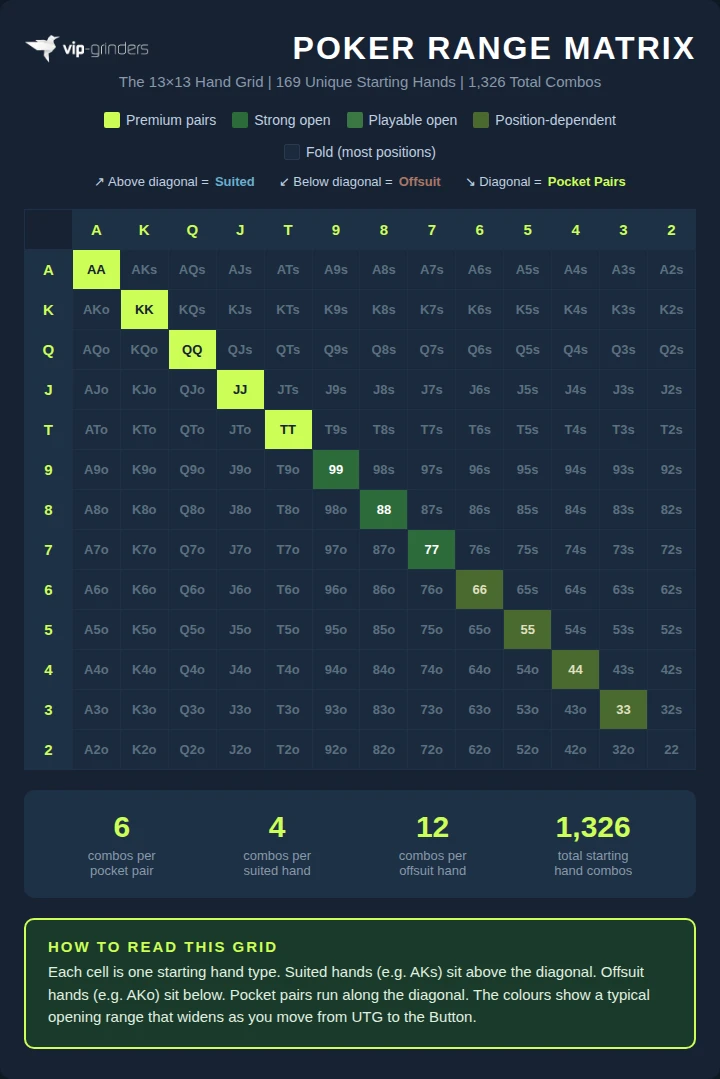
The grid has 13 rows and 13 columns, one for each card rank from Ace down to Deuce. Three zones divide the grid.
- The diagonal (top-left to bottom-right): pocket pairs. AA sits in the top-left corner, 22 in the bottom-right. There are 13 pocket pairs in total.
- Above the diagonal: suited hands. AKs, AQs, T9s, 76s and so on. These share the same suit (e.g. both hearts).
- Below the diagonal: offsuit hands. AKo, KJo, T8o and so on. The two cards are different suits.
That gives you 13 pairs + 78 suited hands + 78 offsuit hands = 169 hand types. But not every hand type has the same number of actual card combinations, and this is where most beginners get confused.
Combo Math: Why It Matters
A “hand type” on the grid is not the same as a “combo.” AKs is one cell, but there are four actual ways to be dealt Ace-King suited (one for each suit). AKo is also one cell, but there are twelve ways to be dealt Ace-King offsuit.
That difference changes everything when you estimate how likely someone is to hold a specific hand.
| Hand Type | Combos | Why | Example |
|---|---|---|---|
| Pocket pair (e.g. JJ) | 6 | Choose 2 suits from 4: 4×3÷2 = 6 | J♠ J♥, J♠ J♦, J♠ J♣, J♥ J♦, J♥ J♣, J♦ J♣ |
| Suited (e.g. AKs) | 4 | One combo per suit | A♠ K♠, A♥ K♥, A♦ K♦, A♣ K♣ |
| Offsuit (e.g. AKo) | 12 | 4 suits for card A × 3 remaining suits for card B | A♠ K♥, A♠ K♦, A♠ K♣, A♥ K♠, … (12 total) |
Add them up: (13 × 6) + (78 × 4) + (78 × 12) = 78 + 312 + 936 = 1,326 total starting hand combos.
There are 16 combos of AK (4 suited + 12 offsuit) but only 6 combos of QQ. If you ignore combo math, you overweight pairs and underweight broadways in your opponent’s range.
What “Opening 15% of Hands” Actually Means
When a player opens 15% of hands, they are playing roughly 199 combos out of 1,326 (0.15 × 1,326). On the grid, that covers about 25 to 30 of the 169 hand types, depending on which ones are included.
The key insight is that not all cells carry equal weight.
- Adding one offsuit hand to a range adds 12 combos.
- Adding one suited hand adds only 4 combos.
- Adding one pocket pair adds 6 combos.
A range heavy on offsuit broadways is much wider in real combos than it looks on the grid.
This is why range percentages and the grid do not tell the full story on their own. You need both: the grid to visualise which hand types are included, and the combo count to understand how often each one actually shows up.
How to Build a Preflop Range by Position
The single biggest factor in deciding which hands to open preflop is where you are sitting. A hand that is a clear open from the Button is often a fold from under the gun. The reason is simple: the earlier you act, the more players are left behind you who could wake up with a strong hand.
In 6-max NLHE, ranges widen dramatically as you move from UTG to the Button. Here is what a typical opening range looks like at each seat.
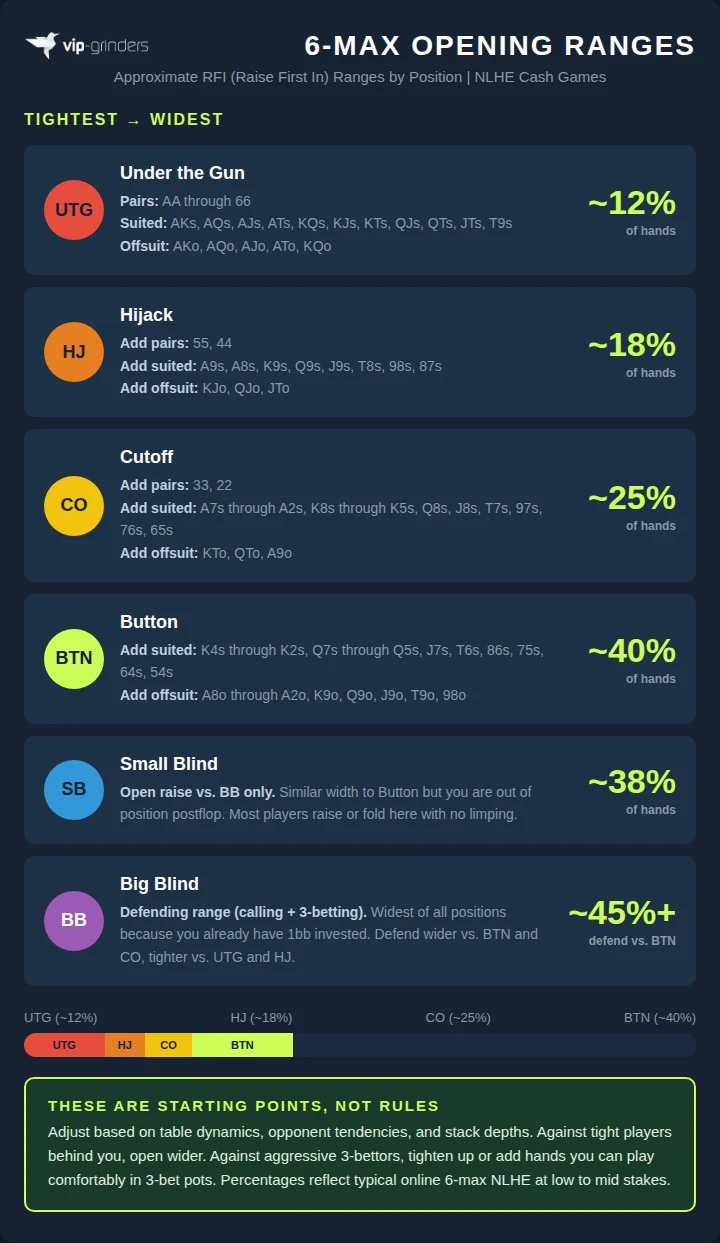
Why Ranges Widen by Position
From UTG you have five players left to act. The chance that at least one of them holds a premium hand is high, so you stick to a tight range of roughly 12% (about 152 combos).
By the time action reaches the Button, only the two blinds remain. They are out of position for the rest of the hand, which makes their life harder even when they call. That lets you open around 40% of hands (about 536 combos) profitably.
- UTG (~12%): mostly big pairs, strong broadways, and suited connectors down to T9s. You need hands that play well in raised pots against tight calling and 3-betting ranges.
- HJ and CO (~18% to ~25%): add more suited connectors, lower pairs, and suited Aces. Fewer players behind you means less risk of running into a premium hand.
- Button (~40%): the widest opening range. You act last on every postflop street, which gives you a structural edge even with marginal hands.
- SB (~38%): wide but not as wide as the Button because you are out of position against the BB for the entire hand. Most winning players use a raise-or-fold strategy here with no limping.
- BB (~45%+ defending vs. BTN): you already have 1bb invested, so you are getting a better price on calls. Defend wider against late-position opens, tighter against early-position raises. The math behind defending connects directly to pot odds and implied odds.
Common Mistakes With Positional Ranges
| Mistake | What Happens | The Fix |
|---|---|---|
| Opening the same range from every seat | You play too many weak hands from early position and bleed chips to 3-bets | Tighten UTG and HJ, widen CO and BTN |
| Never adjusting to table conditions | Charts say open, but the player behind you 3-bets 15% of the time | Cut the bottom of your range against aggressive players behind you |
| Overfolding the BB | You fold hands that have enough equity to call given the price | Calculate your pot odds. Against a 2.5bb open, you need roughly 28% equity to call |
How to Read Your Opponent’s Range
Building your own range is the first step. Reading your opponent’s range is where the money is. Every action they take (raise, call, bet, check, fold) removes some hands and keeps others, narrowing the set you are playing against.
The process works the same way every hand. Start with their preflop range based on position, then update it on every street based on what they do.
Street by Street Range Narrowing
The image below walks through a full hand showing how a villain’s range shrinks from preflop to river. Pay attention to what gets removed at each step and why.
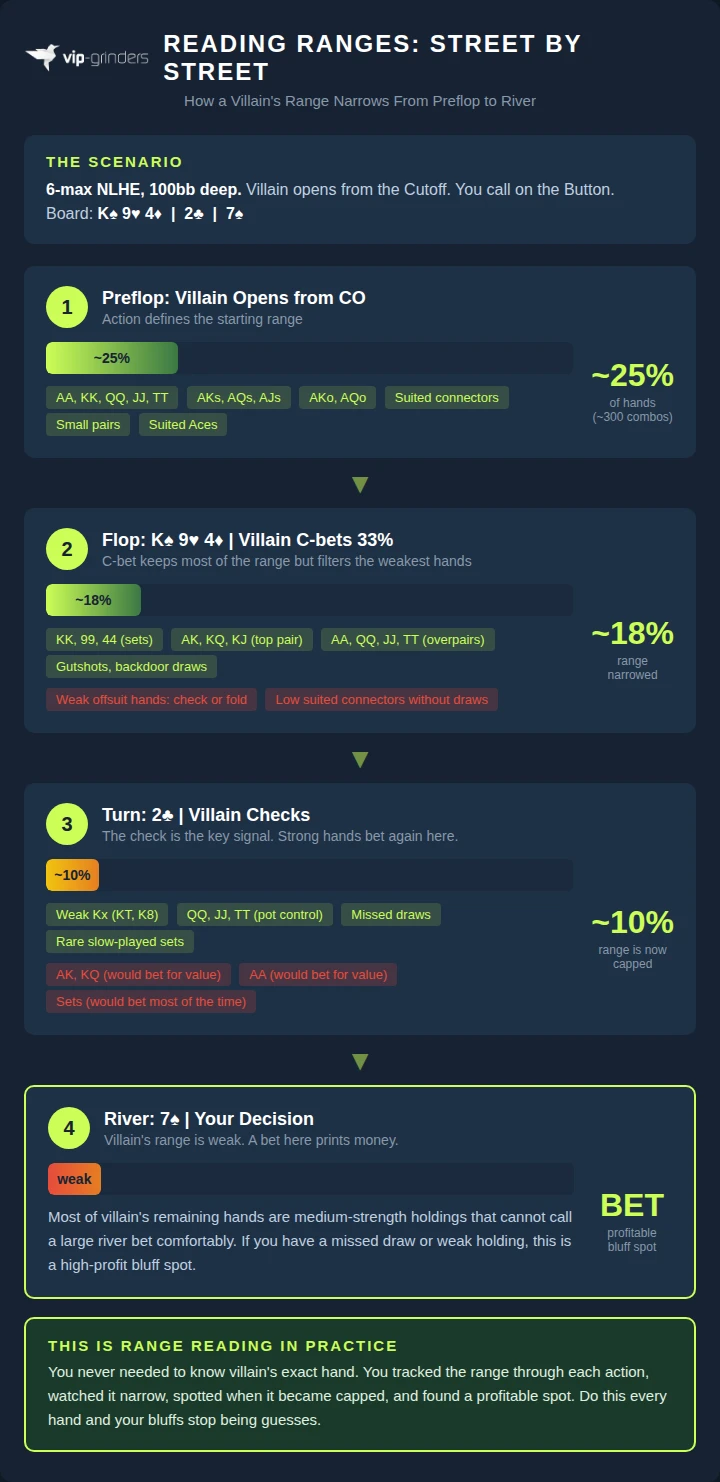
Here is the logic at each decision point.
- Preflop (CO opens, ~25%): the villain’s position sets the starting range. From the cutoff, that is roughly 300 combos including pairs, suited broadways, suited connectors, and offsuit broadways.
- Flop c-bet on K♠ 9♥ 4♦ (~18%): a small c-bet keeps most of the range but filters out the weakest offsuit hands and low suited connectors that missed completely. Top pair, overpairs, sets, and gutshots all stay.
- Turn check on 2♣ (~10%, capped): this is the key street. Strong hands like AK, KQ, AA, and sets almost always bet again for value. The check removes them, leaving weak Kx, medium pairs like QQ or JJ, and missed draws.
- River 7♠ (profitable bluff): the remaining range is mostly medium-strength hands that cannot call a large bet. If you hold a missed draw or weak hand, a bet here shows a profit.
The point is not to memorise this example. It is to internalise the process: position defines the range, actions narrow it, and the narrower it gets, the more precisely you can exploit it.
Three Signals That Narrow a Range Fast
Some actions tell you more than others. These three are the most reliable at low and mid stakes.
| Signal | What It Usually Means | What Gets Removed |
|---|---|---|
| Bet, bet, check | Villain had a continuation betting plan but gave up. Range is now capped. | Strong top pair, overpairs, sets (they would keep betting) |
| Check-raise on the flop | Polarised: either very strong or a semi-bluff draw | Medium-strength hands like second pair or weak top pair (they just call) |
| Small bet on the river | Usually thin value, rarely a bluff at lower stakes | Air and strong hands (air gives up, strong hands bet bigger) |
A check narrows a range more than a bet. Betting is consistent with both strong and weak hands. Checking almost always removes the strongest part of a player’s range, which is why turn and river checks are the best spots to find profitable bluffs.
Blockers: How Your Own Cards Affect Their Range
Your hole cards remove combos from your opponent’s range. This concept is called a blocker.
If you hold A♠ K♦, there are only 9 remaining combos of AK in the deck instead of 16, and only 3 combos of AA instead of 6.
Blockers matter most in two spots.
- Bluffing: holding an Ace when you bluff on an Ace-high board means your opponent is less likely to have top pair. Your bluff works more often.
- Calling: if you hold a card that blocks your opponent’s value hands (e.g. you hold the A♠ on a three-spade board), their range contains fewer flushes and more bluffs. That makes calling more profitable.
You do not need to count exact combos during a hand. Just ask yourself: “Do my cards make it harder for my opponent to have the hands I am worried about?” If yes, lean toward action. If no, lean toward caution.
Range Advantage and Board Texture
Not every board is equal for every player. Some flops hit the preflop raiser’s range hard and barely touch the caller’s. Others do the opposite.
Knowing who has the range advantage on a given board tells you who should be betting and who should be checking.
What Range Advantage Means
Range advantage means one player’s overall range connects better with the board than the other’s. It does not mean they always have the best hand. It means that across all the hands they could hold, they have more strong combos on this specific texture.
| Board | Who Has Range Advantage | Why |
|---|---|---|
| A♠ K♦ 7♥ | Preflop raiser | AK, AQ, KK, AA are all in the raiser’s range. The caller rarely has these hands (they would have 3-bet most of them). |
| 7♥ 6♦ 5♠ | Preflop caller | Suited connectors like 76s, 65s, 87s, 54s, and small pairs that make sets are more common in the caller’s range. The raiser has overcards but few made hands. |
| Q♥ J♦ 3♣ | Roughly even | Both players have broadways that connect. The raiser has QQ, JJ, AQ, AJ. The caller has QJs, JTs, QTs, and pairs. |
What Nut Advantage Means
Nut advantage is a narrower concept. It asks: which player can have the very best hands on this board? A player can have range advantage without nut advantage, and that changes how they should bet.
- On 8♥ 9♥ 10♦, the preflop raiser has range advantage (more overpairs) but the caller has nut advantage (more straights and two-pair combos like 89s, T9s, J7s).
- On A♠ K♦ 7♥, the raiser has both range advantage and nut advantage. They are the only player who can have AK, AA, and KK.
- When you have both, you can bet frequently with a wide range. When you have range advantage but not nut advantage, bet smaller and more selectively.
How This Affects Your Betting Strategy
| You Have | Betting Approach | Example Board |
|---|---|---|
| Range + nut advantage | Bet frequently, use a mix of sizes. You can pressure with a wide range because your opponent cannot fight back easily. | A♠ K♦ 7♥ as the preflop raiser |
| Range advantage, no nut advantage | Bet smaller and more selectively. Your opponent has the nuts sometimes, so large bets risk running into the top of their range. | 8♥ 9♥ 10♦ as the preflop raiser |
| No range advantage | Check more often. Let your opponent bet into you and look for spots to check-raise or call down with the right hands. | 7♥ 6♦ 5♠ as the preflop raiser |
This is where GTO and solvers become useful. Solver outputs are built entirely on range advantage calculations, and understanding the concept behind them makes every study session more productive.
For a deeper look at how ranges interact with board textures across different spots, see our range advantage and nut advantage guide.
Attacking Ranges: Exploitative Adjustments
Knowing your opponent’s range is only half the job. The other half is adjusting your strategy to exploit the gaps in it: bluff more against players who fold too much, value bet wider against players who call too much.
This section turns range reading into profit.
Three Common Player Types and How to Attack Them
Every regular below NL200 will recognise these profiles. The key is matching the right adjustment to the right opponent.
| Player Type | What Their Range Looks Like | How to Exploit It |
|---|---|---|
| The Nit (folds too much) | Very tight preflop range (8% to 10%). Rarely calls without a strong hand postflop. Folds to 3-bets at 70%+. | Steal their blinds constantly. 3-bet them light because they fold most of their opening range. Give up when they fight back. |
| The Station (calls too much) | Wide preflop range. Calls c-bets and turn bets with any pair, any draw, and sometimes Ace-high. Almost never folds to one bet. | Stop bluffing them. Value bet wider and thinner than normal. They pay you off with second pair and worse, so extract maximum value with hands you would normally check. |
| The LAG (raises too much) | Wide and aggressive. Opens 30%+ from most positions, 3-bets liberally, and fires multiple barrels with air. | Tighten your opening range slightly but widen your calling and 4-betting range. Let them bluff into you. Trap with strong hands instead of raising early. |
Exploitative play means deliberately unbalancing your own range to target a specific weakness. This works well below the high-stakes level where opponents repeat the same patterns. At higher stakes where players adjust back, GTO and solvers provide the baseline you deviate from.
Adjusting Your 3-Bet Range
The 3-bet is one of the most effective tools for attacking ranges preflop. How you construct your 3-bet range depends entirely on who you are targeting.
- Vs. players who fold to 3-bets >65%: 3-bet wider with hands like A5s, A4s, K9s, and suited connectors. You profit from the fold alone.
- Vs. players who call 3-bets but play passively postflop: 3-bet for value with a wider range (AJo+, KQo, TT+). They call with weaker hands and let you control the pot.
- Vs. aggressive 4-bettors: tighten your 3-bet range to hands that play well against a 4-bet (QQ+, AKs). You avoid getting squeezed out with marginal holdings.
Adjusting Your Postflop Bluffing Range
Against opponents who fold too often postflop, you can expand your bluffing range on specific board textures.
- High-card boards (A-K-x, K-Q-x): if you were the preflop raiser, your range advantage is large. Most opponents fold anything that did not connect. C-bet frequently with a small sizing.
- Paired boards (e.g. 9-9-3): very few hands connect with a paired board. A c-bet here works at a high frequency because your opponent missed most of the time.
- Turn and river after a check: as covered in the range reading section, a check caps your opponent’s range. This is the best spot to attack with a delayed bluff, especially if you have fold equity and blockers to strong hands.
Adjusting Your Value Range
Against stations, the adjustment is the opposite: stop bluffing and bet thinner for value.
At most low-stakes tables, players call too often rather than fold too often. That means value betting wider is the single highest EV adjustment you can make.
If your opponent calls a river bet with third pair, you should be betting second pair for value against them. Most players skip this because it “feels wrong,” but the math is clear.
Ranges give you the map. Exploitative adjustments give you the route. Identify what your opponent does too much or too little, then shift your own range to punish it.
Common Range Mistakes That Cost You Money
Most players learn about ranges and then make the same five errors for months before fixing them. Each one leaks EV in a specific, measurable way.
- Putting opponents on one hand: you make binary decisions instead of playing against a set of holdings. Fix: force yourself to name at least five hands your opponent could have before acting.
- Not updating ranges postflop: you assign a preflop range and then ignore every action after it. Fix: after every bet or check, ask what hands just left the range and what stayed.
- Ignoring position when assigning ranges: a UTG raiser and a Button raiser do not have the same range. The UTG range is 3x tighter. Fix: always start with the seat.
- Playing your own range face up: if you always c-bet strong and check weak, observant opponents will exploit you. Fix: mix in checks with strong hands and bets with weak ones.
- Confusing hand rankings with hand strength: Two Pair is a strong ranking, but on a four-to-a-flush board it can be worthless. Fix: evaluate every hand relative to the board and your opponent’s range.
That last mistake is one of the most common leaks at the beginner level. Our hand rankings guide explains the difference between what a hand ranks as and what it is actually worth in context.
Tools for Studying Ranges
Range thinking improves fastest when you study away from the table. These are the tools that serious grinders use to build range intuition.
Our poker equity calculator is free and built for exactly this: plug in your hand, assign a range to your opponent, and see your exact equity. Use it after every session to check whether your toughest decisions were +EV. The tools below cover everything else you need for range study.
| Tool | What It Does | Best For |
|---|---|---|
| Equilab (free, desktop) | Equity calculator with a built-in range editor. Visualise ranges on the 13×13 grid. | Building and visualising preflop ranges. |
| Flopzilla (paid, free trial) | Shows how a range connects with any flop. Breaks it into top pair, overpairs, draws, air. | Understanding range vs. board texture. |
| GTO Wizard (paid) | Browser-based solver with precomputed solutions and a trainer that quizzes you on correct plays. | Learning how solvers construct ranges. |
| PioSolver / GTO+ (paid) | Full solvers for any custom spot you define. | Advanced study once you are comfortable with the concepts in this guide. |
| Hand2Note / PokerTracker 4 (paid) | HUD and database. Track VPIP, PFR, fold to 3-bet, c-bet frequency, and more. | Assigning ranges based on real opponent data. |
Spend 15 minutes after each session plugging your toughest hands into the equity calculator. Assign a realistic range to your opponent and check whether your decision was +EV. This single habit builds range intuition faster than any course or video.
Frequently Asked Questions
What is a poker range?
A poker range is the full set of hands a player could hold based on their position, actions, and tendencies. Instead of guessing one specific hand, winning players assign a range and calculate their equity against the entire set. This approach produces consistent, math-based decisions.
What is a 13x13 hand matrix?
The 13×13 matrix is a grid showing all 169 unique starting hand types in Hold’em. Pocket pairs run along the diagonal, suited hands sit above it, and offsuit hands sit below. Players and software tools use this grid to visualise and define ranges.
How many combos are in a poker range?
There are 1,326 total starting hand combos in Hold’em. Each pocket pair has 6 combos, each suited hand has 4, and each offsuit hand has 12. When someone opens “15% of hands,” that means roughly 199 of the 1,326 possible combos.
How do you assign a range to an opponent?
Start with their position. A UTG open in 6-max represents roughly the top 12% of hands, while a Button open can be 40% or wider. Then narrow the range on each street based on their actions: bets keep strong hands and some bluffs, checks remove most strong hands.
What is the difference between a linear and polarised range?
A linear (or merged) range includes hands in order of strength from top down, with no gaps. A polarised range contains strong value hands and bluffs, but skips the medium-strength hands in between. Polarised ranges are typically used for large bets, while linear ranges suit smaller sizings.
How do ranges change postflop?
Every action narrows the range. A flop c-bet removes the weakest hands that would check-fold. A turn check removes most strong hands that would bet for value. By the river, a player’s range is often a fraction of where it started preflop.
Should beginners learn GTO ranges?
Beginners should focus on understanding what a range is, learning position-based opening ranges, and practising range narrowing before studying GTO. Solver outputs are more useful once you can assign ranges instinctively. For most players below NL50, exploitative adjustments produce more profit than memorising solver-generated frequencies.
What tools help you study ranges?
Free options include the VIP-Grinders Equity Calculator and Equilab. For deeper study, Flopzilla shows how ranges connect with specific boards, and GTO Wizard offers a trainer that quizzes you on correct plays. HUD software like Hand2Note tracks real opponent data so you can assign ranges based on actual statistics.
How does position affect your range?
Position is the primary factor in range construction. In 6-max NLHE, UTG opens roughly 12% of hands while the Button opens around 40%. The later your position, the wider you can play because fewer opponents remain to act behind you and you gain the advantage of acting last postflop.
Do ranges work differently in PLO or Short Deck?
The concept of range thinking applies to every poker variant. The specific ranges change because hand equities shift. In Pot-Limit Omaha, ranges are much wider preflop because four hole cards create more playable combinations. In Short Deck, the 36-card deck changes hand frequencies and adjusts which hands are strong enough to include in your range.