


Range Advantage and Nut Advantage in Poker 2026: Board Texture, Frequencies and Sizing
Most players look at the flop and ask “did my hand hit?” Winning players ask a different question: “whose range did this board hit harder, mine or my opponent’s?” That single shift is what separates guessing from knowing on every postflop decision.
Range advantage and nut advantage are the two concepts that answer it. Range advantage measures whose range has more equity across the whole board. Nut advantage measures who can have the strongest specific hands within that range.
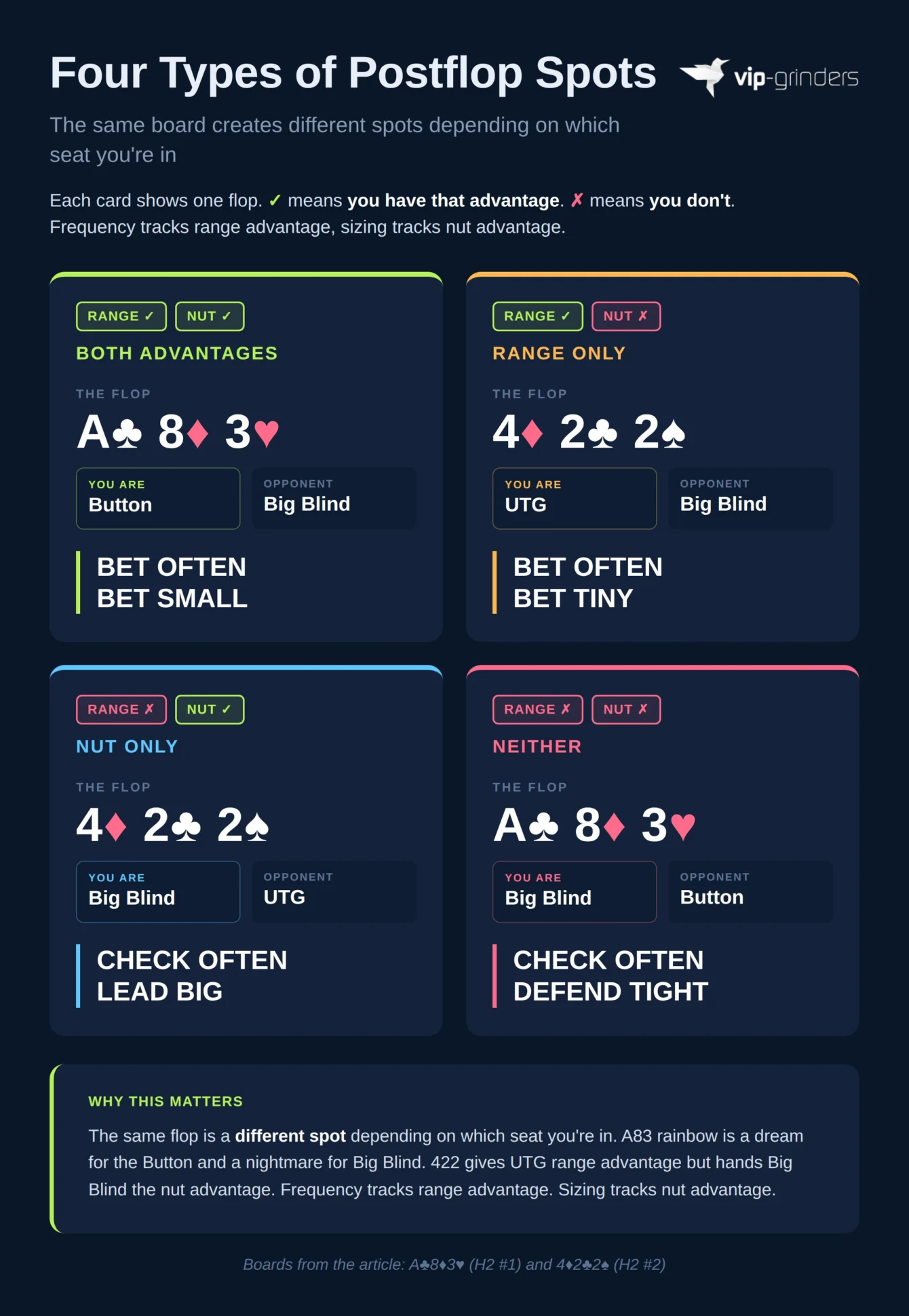
One rule ties them together: range advantage drives how often you bet, nut advantage drives how big, and position multiplies both. Master those three levers and you stop memorizing solver charts and start reading boards.
This guide covers how to spot each advantage on any flop, the solver-backed c-bet frequencies that actually win at low and mid stakes, how advantages shift from flop to river, what changes in 3-bet pots and multiway pots, and when to deviate from GTO against recreational pools. If preflop range construction is still fuzzy, start with our guide on how to build and read poker ranges first. Everything that follows assumes you can visualize what hands each player can hold after a given preflop action.
What Range Advantage and Nut Advantage Really Mean
The fastest way to understand both concepts is to look at one flop and walk through the thinking. Once you see the logic on a simple board, the rest of this guide just applies the same question to harder spots.
Start with One Simple Board
You open the Button for 2.5bb and the Big Blind calls. The flop comes A♣ 8♦ 3♥, a dry ace-high rainbow with no draws. Before you even look at your own cards, ask one question: whose range has more strong combos on this board?
Your Button opening range contains every Ace you play: AA, AK, AQ, AJ, AT, A9s and lower. It also contains 88 and 33 for sets, and A8s or A3s for two pair combos. The Big Blind’s calling range contains almost none of these, because most strong Aces would have 3-bet preflop and weak Aces would have folded.
That imbalance is range advantage. Your range has meaningfully more equity than your opponent’s on this specific flop, because the board connects with the hands you chose to open and misses the hands your opponent chose to defend with.
Now ask a narrower question: on this board, who can have the very best hands? The nuts here are sets (AA, 88, 33) and top two pair (A8, A3). You can have all of those combos.
Your opponent can have almost none of them. That is nut advantage. It is a related but separate concept, and a player can have one without the other.
The One Rule: Frequency, Sizing, Position
Once you can spot both advantages on a board, the strategic response follows a rule that holds across every texture, every stake, and every format:
- Range advantage drives frequency: the bigger your range advantage, the more often you c-bet. With a clear edge, you can bet your entire range for a small size.
- Nut advantage drives sizing: the more nutted combos you have that your opponent cannot, the larger your bets get. Nut advantage is what licenses overbets and polarized lines.
- Position multiplies both: being in position lets you realize more of your equity on every street, which amplifies the value of any advantage you already have.
On A83 rainbow as the Button, you have range advantage, nut advantage, and position. The solver response is to bet very often, with a small sizing, using your whole range. Every lever points the same direction.
The Hidden Third Factor: Vulnerability
There is one more concept most articles skip. A range can be strong but not need to bet, because nothing can realistically outdraw it.
Vulnerability measures how much equity your range loses from giving a free card. A range full of sets on a dry rainbow board is not vulnerable, because there are no draws to protect against. A range full of top pairs on a wet two-tone board is very vulnerable, because flush and straight draws can crush it on the turn.
This matters because vulnerability is the reason two boards with similar range advantage call for completely different betting strategies. We will come back to it in every worked example.
How to Use the Rest of This Guide
The next section breaks down five board textures that cover every common postflop spot. After that, you get the sizing framework, the multi-street progression, 3-bet and multiway adjustments, and the exploit deviations that turn theory into profit at low and mid stakes.
If you remember nothing else, remember the rule: frequency, sizing, position. Everything that follows is how to apply it.
Five Board Textures That Change Everything
The rule from the last section sounds simple on paper. The hard part is seeing which levers apply on a board you have never thought about before. These five textures cover the full range of postflop situations you will face, from the easiest range-bet spot to the hardest mixed-strategy problem.
Work through each one and you will have a template for almost any flop that comes up at the tables.
High-Card Dry: K♣7♦2♠
You open the Button 2.5bb and the Big Blind calls. The flop comes K♣ 7♦ 2♠, rainbow and high card with no draws. This is the best possible texture for the preflop raiser, and the solver response is close to trivial once you see why.
Your range is packed with combos that connect: AK, KQ, KJ, KT, KQs through K9s, plus every overpair and the 77/22 sets. Big Blind cannot have most of those hands because AK and KK would usually 3-bet preflop, and Big Blind’s defending range tops out at weaker kings that lose badly to yours. The result is range advantage and nut advantage on every front.
Solver data from GTO Wizard on dry K-high rainbow boards: c-bet frequency lands between 76% and 91% depending on the exact kickers, with the vast majority of bets sized at 33% pot. You do not need to split your range into big bets and checks. You bet small with almost your whole range and let the Big Blind pay you off with weak defends.
This is the purest example of the frequency, sizing, position rule. Every lever points the same direction, so the strategy is aggressive in frequency but restrained in size.
Paired: K♥4♥4♦
Paired boards look similar to high-card dry flops at first glance, but the math flips in one direction. On K♥ 4♥ 4♦, your Button range still has overpairs, AK, and strong top pair hands containing a King. But your opponent has something you do not: a full helping of hands that contain a four.
Big Blind’s defending range includes hands the Button never opens preflop: 54o, 74s, 84s, 94s, T4s, and plenty of offsuit low connectors. The Button’s opening range is much tighter on these hands. That means Big Blind is actually more likely to hold trips here than you are, which flips nut advantage to the caller even though overall range advantage still favors you.
The solver response is high frequency, very small size. You c-bet often because your range is stronger overall, but you keep sizing tiny because any large bet walks into trips. Small bets fold out the Big Blind’s air without giving them a reason to check-raise.
K44 and K72 look like the same spot at a glance, but the paired low card quietly flips nut advantage. Paired boards with a low pair deserve extra respect, not a bigger bet.
Monotone: K♥9♥5♥
Monotone flops break the rules most players have learned. On K♥ 9♥ 5♥, the Button still has a slight range advantage on paper. The reality at the table is much worse than it looks.
Big Blind defends a lot of suited hearts that block the Button’s best holdings. Hands like :th: 8♥, Q♥ J♥, and 7♥ 6♥ all see the flop, and many of them make flushes. Worse, when the Button does hold the ace of hearts for the nut flush draw, that card removes some of the flush combos from Big Blind’s range, which means the hands you wanted to bet into are less likely to be there.
Solver data shows c-bet frequency on monotone flops drops dramatically, often to around 30% compared to 90% on the rainbow equivalent. You are not range-betting here. You are picking specific hands (made flushes, high hearts with equity, and the occasional bluff that removes a flush combo from Big Blind’s range) and checking the rest.
Your overpairs and top pair are highly vulnerable to any turn heart or straight card, which pushes toward protection. But nut advantage has collapsed, so large protection bets lose value against the flushes Big Blind actually has. For more on how this interacts with draw-heavy textures, see our guide to equity denial on wet textures.
The common leak here is auto c-betting 33% pot because “Button always bets king-high.” The solver checks most of the range, and when it does bet, it sizes down further because Big Blind is defending tight and only the calls that pay off on safe turns are worth chasing.
Range Advantage Without Nut Advantage: 4♦2♣2♠
This is the clearest example of the two concepts splitting apart. UTG opens and the Big Blind calls on a flop of 4♦ 2♣ 2♠. UTG’s range is full of overpairs (AA down to 77), AK, and strong broadways, which gives UTG a large range advantage measured by total equity.
But Big Blind has something UTG cannot: the overwhelming majority of trip-2 combos. 32s, 42s, and 52s are in Big Blind’s defending range, along with some A2o combos. UTG’s tight opening range almost never includes these hands, leaving Big Blind with the clear nut advantage on this texture.
The result is a board where UTG can bet often but cannot bet big. Any large bet walks into trips or a full house. The solver c-bets frequently but almost exclusively at 25% to 33% pot, never polarized, never overbet.
This is the entire lesson of the article in one board: range advantage tells UTG to keep betting, but nut advantage sitting with Big Blind caps how large those bets can be. Two different levers, two different jobs.
Middling Dynamic: J♥T♦6♣
The first four boards had clear answers. J♥ :td: 6♣ has none. Both ranges interact with this flop heavily, and neither has a clean edge.
Button’s range contains JT, J9s, T9s, QJ, KJ, AJ, and plenty of overpairs. Big Blind’s range contains many of the same hands, plus a wider tail of connected holdings like 65s and 54s that Button folds preflop. The equity distribution is close to even, and nut advantage is genuinely contested.
The solver response is a mixed strategy. Some hands bet for value, some hands bet as bluffs with equity, and most of the middle of the range checks. C-bet frequency lands around 45% to 55%, with sizing spread across 33% and 66% depending on the specific hand.
This is where players who memorize range-bet heuristics get punished. There is no small-bet-everything answer on JT6. If your default is “Button bets 33% on every flop,” this is where that habit leaks EV, and checking your medium strength hands is often better than betting them.
The Wetness Parabola: Why Sizing Follows a Curve
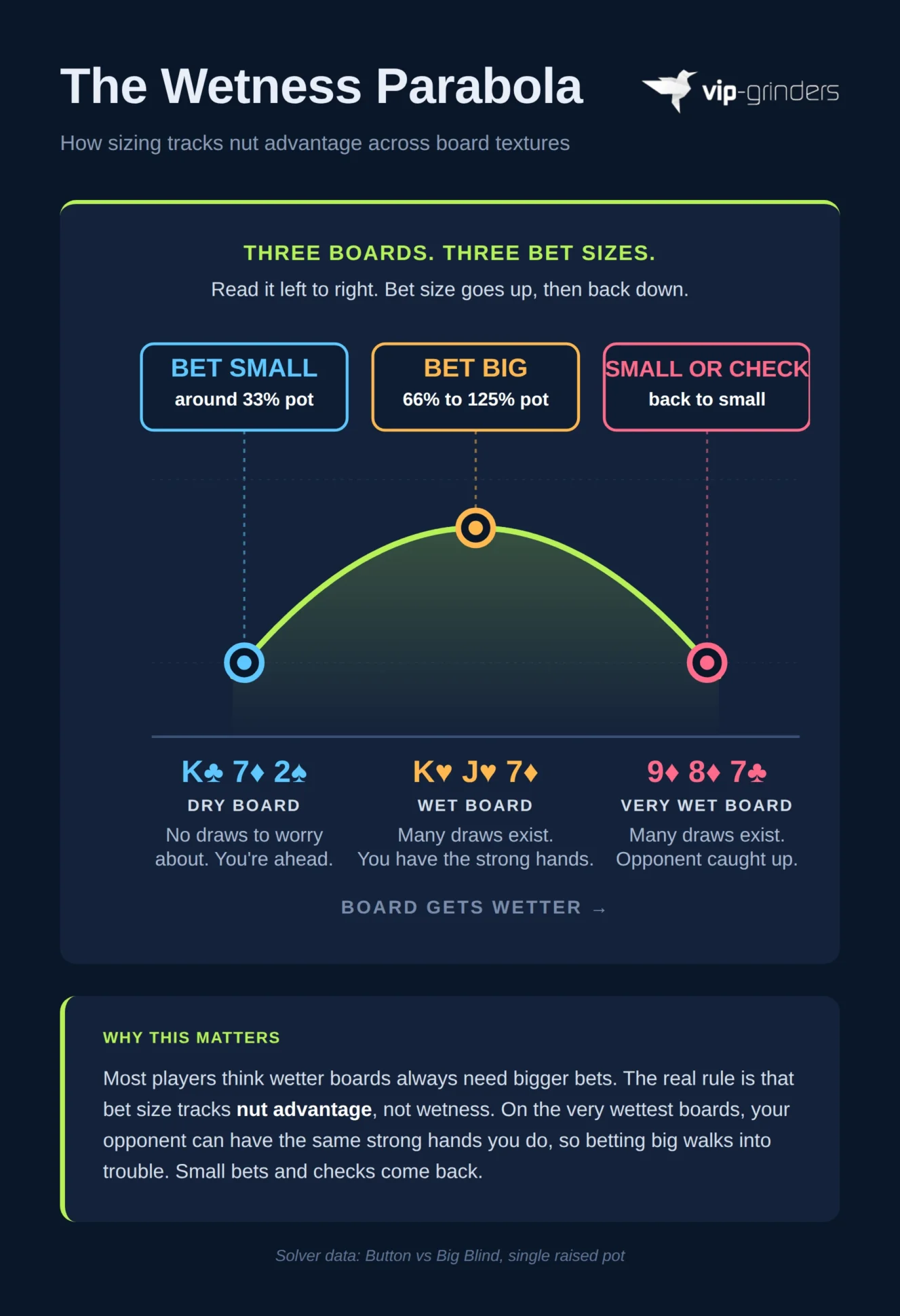
Most players learn a simple rule about bet sizing: the wetter the board, the bigger you bet. That rule is half right. Sizing does go up as boards get wetter, but only to a point, and on the wettest textures of all it comes back down.
The reason is nut advantage. Sizing scales with how many more nutted combos you have than your opponent, and that relationship is not linear.
Dry Boards: Small Bets
On a dry high-card rainbow like K72r, you have range advantage and nut advantage, but your opponent has almost no draws to protect against. Your overpairs do not need to fold out equity that does not exist.
The solver response is a small bet with a wide range. 33% pot is enough to get called by weak defends and enough to fold out air. Anything bigger just charges yourself for no return.
Wet Boards: Large Bets
On a wet two-tone broadway board like K♥ J♥ 7♦, your Button range still has all the overpairs, sets, and strong top pairs. Big Blind has draws but almost none of the nutted holdings, since KK, JJ, 77, and most KJ combos never make it to the flop.
Nut advantage is massive and now there are draws to deny. Solver c-bet sizing jumps to 66% or even 125% pot for specific hands. This is called a polarized strategy: you bet big with your strongest hands and your weakest bluffs together, and you check everything in the middle.
Polarized sizing like this comes directly from solver output. For how to study these spots yourself, see our solver study workflow.
Very Wet Boards: Small Bets Again
Here is the counterintuitive part. Take 9♦ 8♦ 7♣. Button has overpairs and some top pairs, but Big Blind has T9s, 98s, 87s, 76s, 65s, 54s, and every straight and flush draw in between.
Both players have nutted hands on this board. Nut advantage has evaporated because Big Blind can match or beat your strongest combos. Large bets walk into check-raises from made straights and combo draws.
The solver response drops back to small sizes or pure checks. There is no nut advantage to leverage, so there is no reason to polarize, and your overpairs are too vulnerable to bet big without protection.
How to Use This at the Table
Before you choose a bet size on any flop, ask two questions in order. First, do I have nut advantage on this board? Second, how vulnerable is my range to a free card?
If the answer to both is yes, size up. If the answer to the first is no, size down or check, even when the board looks wet. The parabola is just the visual shape of those two questions working together across every texture.
How Advantages Shift From Flop to River
Range advantage is not locked in after the flop. Every turn and river card rewrites the math, sometimes in your favor and sometimes against you. The player who tracks those shifts hand by hand makes money from opponents who are still betting based on what the flop looked like.
Three types of turn cards cover almost every situation. Learn to recognize which one you are facing and you will know whether to keep barreling, slow down, or give up.
Blank Turns: Your Advantage Grows
A blank is a low card that changes nothing about who can have what. On K72r, a turn like the 3♣ is a blank. It does not complete any draws, it does not put a new overcard on the board, and it does not give Big Blind any combo they did not already have.
When the flop favors you and the turn is a blank, your advantage grows. Big Blind’s range is now narrower because they called the flop with weaker holdings, and those holdings are still weaker. You can keep betting because the flop call already capped their range, which means the strongest possible hands are no longer in their range.
This is where second barrels print money. A 33% pot c-bet on the flop followed by a 66% pot bet on a blank turn applies maximum pressure to a capped range with minimum risk.
Connecting Turns: Nut Advantage Can Flip
A connecting turn brings a card that interacts with the flop in a way one player can use and the other cannot. On K72r, the 5♦ is a mild connector because it gives Big Blind some straight draws with 43 and 64 that they may have defended preflop.
More dangerous is a turn like 8♠ on 765 two-tone, where the card completes straights for hands the caller has and the raiser does not. A single card turns your overpairs from clear value into bluff catchers.
When nut advantage flips on the turn, you have to slow down with hands that were strong on the flop. Checking back top pair is often correct. Betting into a range that now has you crushed is the fastest way to lose a stack.
Completing Turns: The Equity Reversal
A completing turn finishes a draw that was on the flop. A third heart on a two-tone flop, a fourth card to a straight, or a paired board card all change the ranges dramatically.
The player who held the draw now has the made hand. The player with the previously-best made hand now has a bluff catcher at best. If Big Blind called a flop c-bet on K♥ J♥ 7♦ and the turn brings the 2♥, every suited heart in their defending range just made a flush.
Your overpairs and top pair need to check at high frequency. Leading into the player who just completed the most likely draw is a clear mistake. Let them bet and use the information to decide whether you can call.
Rivers Always Polarize
By the river, every range is more polarized than it was on earlier streets. Medium hands have been bet or checked and called down into thinner ranges, leaving mostly very strong hands and very weak hands in the betting range.
This is why large river bets are either the nuts or a bluff. When you face a river overbet, you are facing polarization, not a mix of value and medium hands. Your job is to decide whether your hand can beat enough bluffs to call, which comes back to basic pot odds math.
When you are the one betting, rivers are where nut advantage matters most. If your range still has the best possible hands and your opponent’s does not, you can overbet for value with your strong hands and bluffs with your weakest hands together. Medium hands check.
Worked Example: K♣7♦2♠ Flop, Three Different Turns
Start with the same flop: K♣ 7♦ 2♠. You c-bet 33% pot with your Button range and Big Blind calls. Now three different turns show what changes.
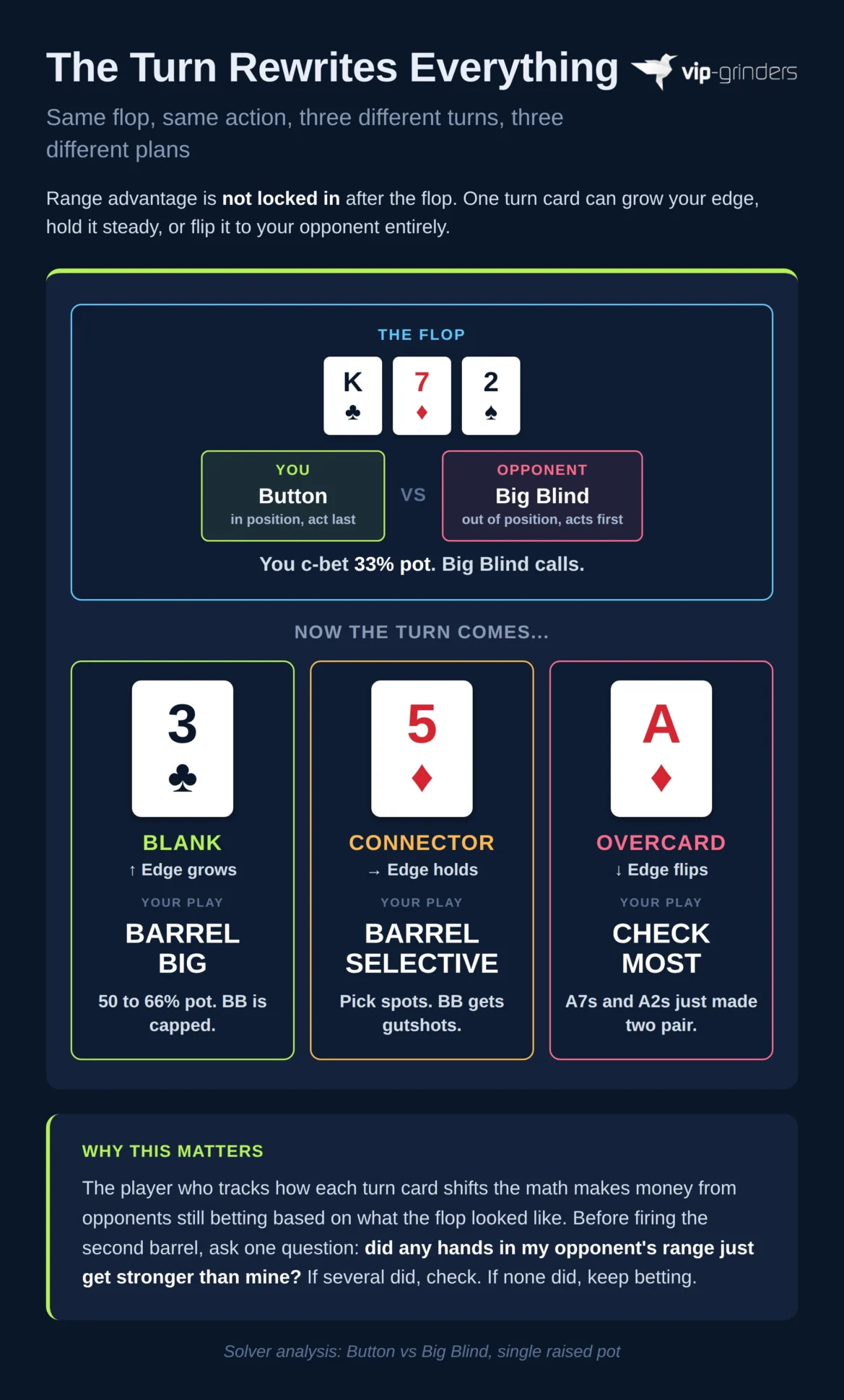
- Turn comes 3♣ (blank): your range advantage grows. Big Blind is capped at weaker Kings and middle pairs. Fire a second barrel at 50% to 66% pot with value and strong bluffs.
- Turn comes 5♦ (mild connector): Big Blind picks up some straight draws with 64 and 43. Range advantage still favors you, but pick specific hands to barrel rather than betting everything.
- Turn comes A♦ (overcard): an Ace hits Big Blind's range harder than yours on this flop. Their A7s and A2s just made two pair, while your KK dropped from the best hand to the second best. Check most of your range and let them tell you what they have.
Same flop, same action, three completely different turn strategies. That is how much range advantage can move between streets.
Three-Bet Pots Flip the Script
A 3-bet pot is any postflop pot where one player raised, another player 3-bet (re-raised), and the first player called. Both ranges are narrower than in a single raised pot, which changes how range advantage plays out on every flop.
The short version: range advantage becomes even more extreme, c-bet frequencies jump, and sizing gets smaller. Here is why.
Narrower Ranges Amplify Range Advantage
When a player 3-bets, they are telling the table they have a specific kind of hand: big pairs, strong broadways, and a few well-chosen bluffs. When the opener calls, they are filtering down to hands strong enough to play out of position against that range.
Both sides now hold narrower, higher quality ranges than in a single raised pot. On any dry high card flop, the 3-bettor’s range connects extremely hard because that range was built on big pairs and broadway hands that crush weaker holdings.
The result is a range advantage that dwarfs what you see in single raised pots. On a flop like A♣ K♦ 4♥, the 3-bettor has a huge equity edge because AA, KK, AK, and AQ are all in their range at high frequency, while the caller is mostly stuck with medium pairs and a few suited broadways.
Frequency Jumps, Sizing Drops
Solver data shows the practical effect clearly on a dry K-high rainbow flop.
| Pot Type | C-bet Frequency | Typical Sizing |
|---|---|---|
| Single raised pot | 76% to 91% | 33% pot |
| 3-bet pot | Close to 100% | 25% pot |
Two things drive the smaller size. First, the pot is already larger relative to the remaining stacks, so a 25% bet in a 3-bet pot applies the same real pressure as a 33% bet in a single raised pot. Second, both ranges are narrow enough that you do not need to split into big bets and checks, you just need to keep the pressure on.
This is the frequency and sizing rule in its clearest form. Range advantage pushes frequency toward 100%, and the lack of nut advantage (since both players have narrow, top-heavy ranges) keeps sizing small.
The Out-of-Position Check-Down
One 3-bet pot spot breaks the pattern entirely. When the 3-bettor is out of position and the flop does not connect with their high-card heavy range, the solver checks at very high frequency, sometimes the entire range.
Take a flop like 8♦ 7♣ 5♥ in a 3-bet pot where the 3-bettor is out of position. The 3-bettor’s range is full of overpairs, AK, and broadway hands that mostly miss this flop. The caller’s range contains more of the suited connectors and small pairs that actually connect with a low mid board.
In this spot, the out-of-position 3-bettor checks most or all of their range. Range advantage has flipped to the caller, and firing any bet into a stronger range is burning money. This is the clearest case where being the preflop aggressor does not mean you should be the postflop aggressor.
Multiway Pots and Why Range Betting Dies
Everything so far has assumed heads-up postflop play: one bettor, one caller. Add a second caller and the math breaks. Range betting, the small-bet-everything approach that works so well on dry boards heads-up, becomes a losing strategy in multiway pots.
The reason is simple and underappreciated by most players.
The Collective Defense Problem
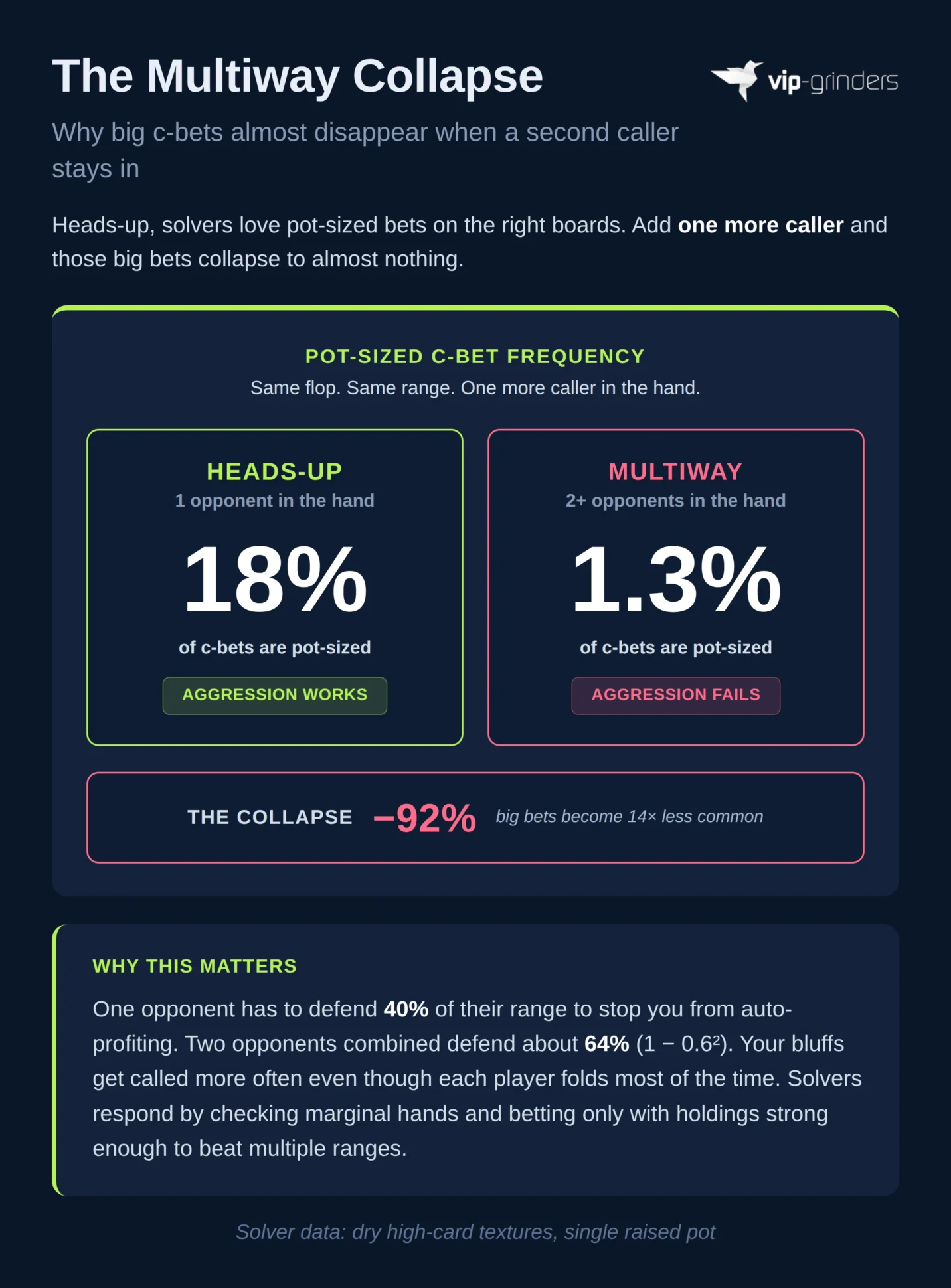
In a heads-up pot, your opponent has to defend a certain percentage of their range against your bet to stop you from auto-profiting with any two cards. In a multiway pot, that defensive burden is spread across multiple players.
If two opponents each defend 40% of their range, you face a combined defense of about 64% (one minus 0.6 squared). Your bluffs get called more often even though each individual opponent is folding most of the time. The mathematical incentive to bet disappears.
Solver data confirms the shift. Average c-bet frequency drops by roughly 11% when you add a second caller, and pot sized bets (which make up around 18% of heads-up c-bets on certain textures) collapse to about 1.3% in multiway pots. The solver is telling you to check, not bet.
What to Do Instead
Multiway pots reward two strategies and punish everything else:
- Check your marginal hands: let someone else commit chips on their own judgment. Hands that would range-bet heads-up belong in the check pile multiway.
- Bet only with nut-level strength: top pair good kicker or better on dry boards, and even tighter on wet textures. You need a hand that beats the calling range of multiple opponents.
That usually means nut advantage, not range advantage. On a dry high-card flop where you would range bet heads-up, you now bet only with top pair good kicker or better. Your bluffs go into the check pile because you cannot fold out enough equity across two opponents to make them profitable.
The frequency and sizing rule still applies, but the thresholds shift. Range advantage alone is no longer enough to justify betting, because the collective defense of multiple opponents eats the thin edge that range betting relied on. Only nut advantage gives you a reason to put chips in.
The One Exception: Effective Nuts
When you flop a hand that beats almost everything both opponents can have, the math flips back in your favor. A set on a dry board, top set on a wet board, or the nut flush in a monotone pot all justify aggressive betting even against two callers.
The reason is that multiway pots are also bigger. When your hand is a clear favorite against two ranges instead of one, you have double the value to extract. Size up and bet for protection, because the pot is worth more than the risk of running into an even stronger hand.
Position Amplifies Range Advantage
Position is not just a convenience, it is a structural multiplier on every advantage you already have. Understanding why it matters that much comes down to one concept most players have never had explained in plain language: equity realization.
Why Position Works: Equity Realization
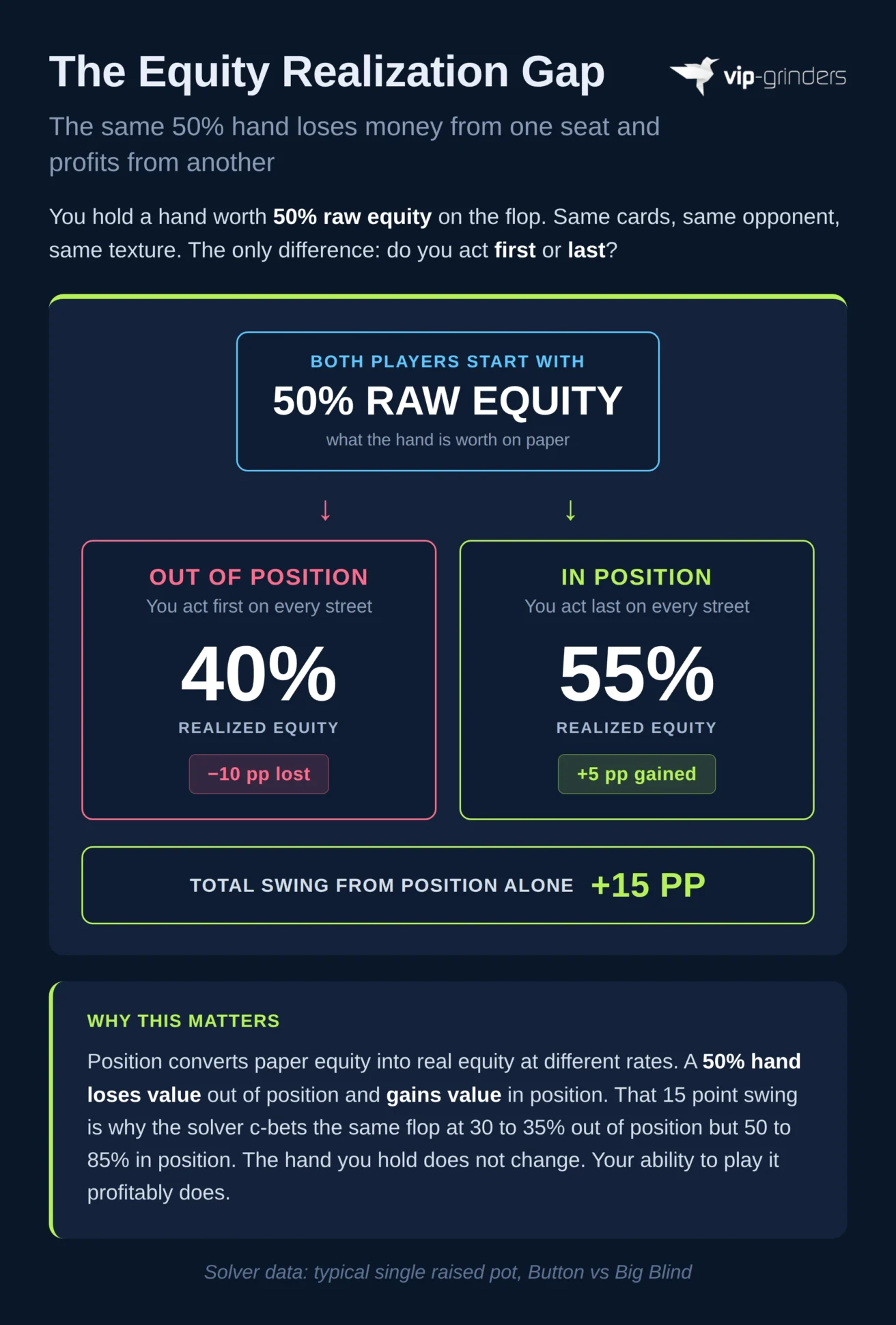
Equity realization is the gap between the equity your hand has on paper and the equity you actually cash in by the end of the hand. A hand with 50% raw equity that only realizes 40% loses money against a hand that plays the same equity up to 55%.
Position is the single biggest lever on equity realization. Acting last on every postflop street lets you see what your opponent does before committing chips, which means you fold more of your weak hands profitably and extract more value with your strong ones. Research on solver outputs puts the effect at roughly 5 to 8% of equity across a typical hand.
That multiplier sits on top of whatever range advantage you already have. If you have a 55-45 range advantage on a flop and you are in position, your effective edge is closer to 60-40 because you realize more of your equity than your opponent does.
The In-Position vs Out-of-Position Frequency Gap
Solver data shows the effect clearly in c-bet frequencies. On a typical single raised pot flop, the in-position player c-bets between 50 and 85% of their range depending on texture. The out-of-position player on the exact same flops c-bets only 30 to 35%.
The gap is not because out-of-position players have worse ranges. It is because they cannot realize as much equity on later streets, so they have to check more and give up the initiative on hands that an in-position player would bet.
This is why the three lever rule has position as the multiplier. Range advantage and nut advantage tell you what to do. Position decides how much of that plan you can actually execute.
When Range Advantage Is Not Enough
The practical takeaway is that range advantage alone does not always justify betting out of position. On boards where your range advantage is small and the texture is dynamic, checking is often correct even when you are technically ahead on equity.
In position on the same board, you can bet with a wide range because you will see the turn card before committing more chips. Out of position, you bet and then face difficult decisions on every later street without the information edge. The solver responds by checking more from out of position, not because it lacks confidence in the range advantage, but because the advantage cannot be fully cashed in without position.
Exploit Deviations for Low and Mid Stakes
Everything so far has been about solver-correct play. Against solvers, those frequencies are optimal. Against the real humans you face at low and mid stakes, they are a starting point, not a finish line.
The biggest wins come from recognizing common player types within the first few hands and adjusting your range advantage strategy to exploit them. Here are the four profiles that cover 90% of the pool.
Against Passive Opponents Who Rarely Check-Raise
The solver assumes your opponent will fight back with check-raises at equilibrium frequency. Most low stakes players do not. When your opponent check-calls too much and check-raises too little, the threat that keeps your c-bet frequency from going higher has disappeared.
The adjustment is simple: c-bet more often with smaller sizes on every board where you already have range advantage. Where the solver says 70% c-bet, you bet 85 to 90%. Where it says 33% pot, you still bet 33% pot but with a wider range of hands, including the marginal ones you would normally check.
Against Fit-or-Fold Populations
Some players fold any flop they miss and continue only when they connect. These opponents are the easiest to exploit because range advantage turns into near-guaranteed fold equity on every board that does not pair them.
Range bet 25% to 33% on every high card and dry board, even the ones where the solver prescribes checking. Your opponent does not need to see a solver output to tell you they are folding, they will tell you themselves in the first two hands. When they do call, slow down immediately and give them credit.
Against Calling Stations
Calling stations break range advantage strategy entirely. They do not fold top pair or second pair, they do not respect big bets, and they do not believe in bluffs. Against them, the frequency-sizing rule inverts.
- Eliminate bluffs almost entirely: bluffs do not work against players who refuse to fold. Value bet relentlessly and accept you will not steal pots.
- Size up for value: use 75% pot and overbets with strong hands because they will still get called by worse. The ceiling on value is much higher than the solver suggests.
- Overfold to aggression: when a station suddenly raises, they have it. Fold hands that GTO would call with, because their raising range is almost entirely value.
Triple Barrel Spots
One specific stat profile opens the door to barreling every bluff on every street. When an opponent shows Fold to Flop C-Bet above 55% and Fold to Turn C-Bet above 55%, they are telling you they do not want to play postflop unless they have it.
Against this profile, you fire three streets with every bluff combo, not just the good ones. The frequency-sizing rule still holds, but the rule shifts: range advantage alone justifies the first barrel, the second barrel, and often the third. For help picking which specific hands make the best triple-barrel candidates, see our guide on picking bluff candidates and running triple barrels.
The Warning Most Exploit Guides Miss
The biggest mistake grinders make when deviating from GTO is over-bluffing later streets against recreational players. Exploit wins happen on the flop where you bet wide and small. The turn and river are where recreational players call down with the hands they already committed to.
When a recreational player calls your flop bet and your turn bet, they are not in the same mental state as a solver. They are in “I already put chips in, I am seeing this through” mode. Slow down, take the pot at showdown, and do not light money on fire trying to push them off a pair.
Seven Mistakes That Cost Chips
The exploit section gave you ways to win more. This section helps you stop losing by flagging the leaks that cost the most EV in typical low and mid stakes play. Each one maps to a concept from earlier in the guide, and each fix is something you can apply on your very next hand.
- 1Range betting on wet connected boards: The small-bet-everything approach works on K72r because there are no draws to protect against. On 987 two-tone, the same strategy walks into check-raises from made hands and combo draws.
- 2Conflating range advantage with nut advantage: Having the stronger overall range does not mean you can bet big. Sizing scales with nut advantage, not range advantage, and large bets on boards where you lack nut advantage walk into trips or better.
- 3Auto c-betting out of position without either advantage: Being the preflop aggressor does not give you a right to bet every flop. The solver c-bets out of position around 30 to 35% of the time, roughly half the in-position rate. Check more often when you are out of position and the board does not favor you.
- 4Treating monotone flops like rainbow flops: Range advantage collapses when three cards of one suit appear. C-bet frequency drops to around 30% and sizing shrinks further. Defaulting to 33% pot on king-high boards bleeds EV until you recognize the texture.
- 5Ignoring how turn cards shift nut advantage: A blank turn grows your edge, a connecting turn flips it, and a completing turn ends it. Barreling the same way on every turn card treats the flop as if it were the whole hand, which is where most mid stakes leaks live.
- 6Applying heads-up frequencies to multiway pots: Range advantage concepts break down when a second caller joins. C-bet frequency drops by roughly 11% and pot-sized bets nearly disappear. Check marginal hands multiway and bet only with nut-level strength.
- 7Copying solver frequencies against recreational pools: The solver assumes balanced opponents who check-raise at equilibrium. Most low stakes players do not. Against fit-or-fold populations you bet more than the solver says, and against calling stations you stop bluffing entirely.
Every one of these comes from mixing up what you have (range advantage) with what you can do with it (sizing and position). Keep the three lever rule in front of you and most of them become impossible to make.
FAQs
What is the difference between range advantage and nut advantage?
Range advantage measures whose range has more total equity across the whole board, which tells you how often to bet. Nut advantage measures who can have the strongest specific hands on that board, which tells you how big to bet. A player can have one without the other, and the most common postflop mistake is treating them as the same concept.
Can you have nut advantage without range advantage?
Yes, and it happens more often than most players realize. The clearest example is a paired low board like 422 against an early position raiser. The raiser has a stronger overall range thanks to overpairs and big broadways, but the Big Blind holds almost all of the trip-2 combos because UTG rarely opens hands like 32s or 42s. Big Blind has nut advantage, the raiser has range advantage, and that mismatch caps how big the raiser can bet.
How does range advantage change on the turn and river?
Every turn and river card rewrites the math. Blank turns grow your advantage because your opponent’s range is now capped by the flop call. Connecting turns can flip nut advantage when a card completes straights or sets that the caller has and the raiser does not. Completing turns end your advantage entirely when a draw gets there. By the river, every range is more polarized, which is why large river bets are almost always either the nuts or a bluff.
How does range advantage differ in 3-bet pots?
Range advantage becomes more extreme in 3-bet pots because both ranges are narrower and more top-heavy. On dry high-card flops, the 3-bettor c-bets close to 100% of their range for around 25% pot, compared to 76 to 91% for 33% pot in single raised pots. The exception is when the 3-bettor is out of position on a low connected flop, where range advantage can flip to the caller and the solver checks the entire range.
When does range advantage matter less?
Range advantage matters less in three specific spots. Multiway pots, where the collective defense of multiple opponents eats the thin edge that small bets rely on. Out-of-position spots where you cannot realize your equity even when you are technically ahead. And against calling stations, where opponents refuse to fold often enough for any frequency-based strategy to work. In all three, you stop range betting and switch to nut-advantage-only betting.