


Pot-Limit Omaha Strategy: From Beginner to Advanced PLO Guide 2026
Pot-Limit Omaha is the second most popular poker variant in the world, and it punishes Texas Hold’em instincts harder than any other format. Four hole cards instead of two means 270,725 possible starting hand combinations against Hold’em’s 1,326, equity that runs much closer preflop, and pots that grow faster because of the pot-limit betting cap. A hand that crushes in NLHE is often dead money in PLO, and a hand that looks weak can be a 60% favorite in the right spot.
The skill ceiling is higher and the variance is brutal, but the player pools are softer than NLHE at almost every stake. That combination is why winning grinders treat PLO as one of the best EV opportunities in modern online poker, especially in low and mid stakes where casino crossover traffic floods the lobbies.
This guide covers everything from the four traits that make a PLO hand playable, to the top 30 starting hands ranked in order, to advanced concepts like Nut Blocking Frequency and Reverse Nut Implied Odds that almost no free resource explains. If you are coming from Hold’em, expect your instincts to fight you for the first few thousand hands. The math is different, the nuts matter more, and bare overpairs do not win pots the way they used to.
What Makes PLO a Different Game
Pot-Limit Omaha looks like Texas Hold’em with two extra cards. It is not. The four-card structure changes equity, pot geometry, and the relative value of every hand category in ways that break NLHE intuition almost completely. You can be a winning Hold’em player and still lose money at PLO for thousands of hands until your instincts catch up to the new math.
The good news is that the rules are simple. The strategic implications take longer to internalize, but the underlying mechanics can be learned in five minutes.
Four Cards, One Rule: Exactly Two From Your Hand
In PLO, every player is dealt four hole cards instead of two. At showdown, you must use exactly two of your four hole cards plus exactly three of the five community cards to make your final five-card hand. Not one, not three, not four. Exactly two.
This rule trips up almost every NLHE player in their first session. If the board comes four to a flush in hearts and you hold the ace of hearts in your hand, you do not have the nut flush unless you also hold a second heart. One heart in your hand plus four on the board does not work. You need two hearts in your hand plus three on the board.
The same applies to straights. If the board comes 8-9-T-J-Q and you hold a King and a deuce, you do not have a straight to the King because you can only use one card from the board to extend the straight, not two. The two-card rule is non-negotiable, and it shapes every postflop decision you make.
Why NLHE Skills Transfer but NLHE Instincts Do Not
The fundamentals you built in Hold’em are still useful. Position matters, pot odds work the same way, and the universal poker hand rankings are identical: a flush still beats a straight, a full house still beats a flush. Your Hold’em foundation is not wasted.
What does not transfer is the instinct for hand strength. In NLHE, top pair with a strong kicker is often good enough to commit your full stack. In PLO, top pair is barely a hand. With four hole cards in play, equities run much closer together, draws are stronger, and PLO becomes a game where you almost always need the nuts (the best possible hand on a given board) or a draw to the nuts to confidently put chips in the middle.
Three numbers tell the story:
- Preflop combinations: PLO has 270,725 possible starting hands versus Hold'em's 1,326. That is over 200 times more combinations, which is why preflop ranges are harder to memorize and equities run closer.
- Hand vs hand equity: in Hold'em, pocket Aces are roughly an 80% favorite against a random hand. In PLO, the strongest possible hand (double suited Aces, meaning your four cards contain two of one suit and two of another, with two connected cards alongside the Aces) is only about a 65% favorite against a random PLO hand, and a 3:2 favorite against a strong four-card holding like 8765 double suited.
- Variance: PLO standard deviation typically runs 1.5 to 2 times higher than NLHE at the same stake, which means bigger swings, deeper downswings, and a mandatory bigger bankroll.
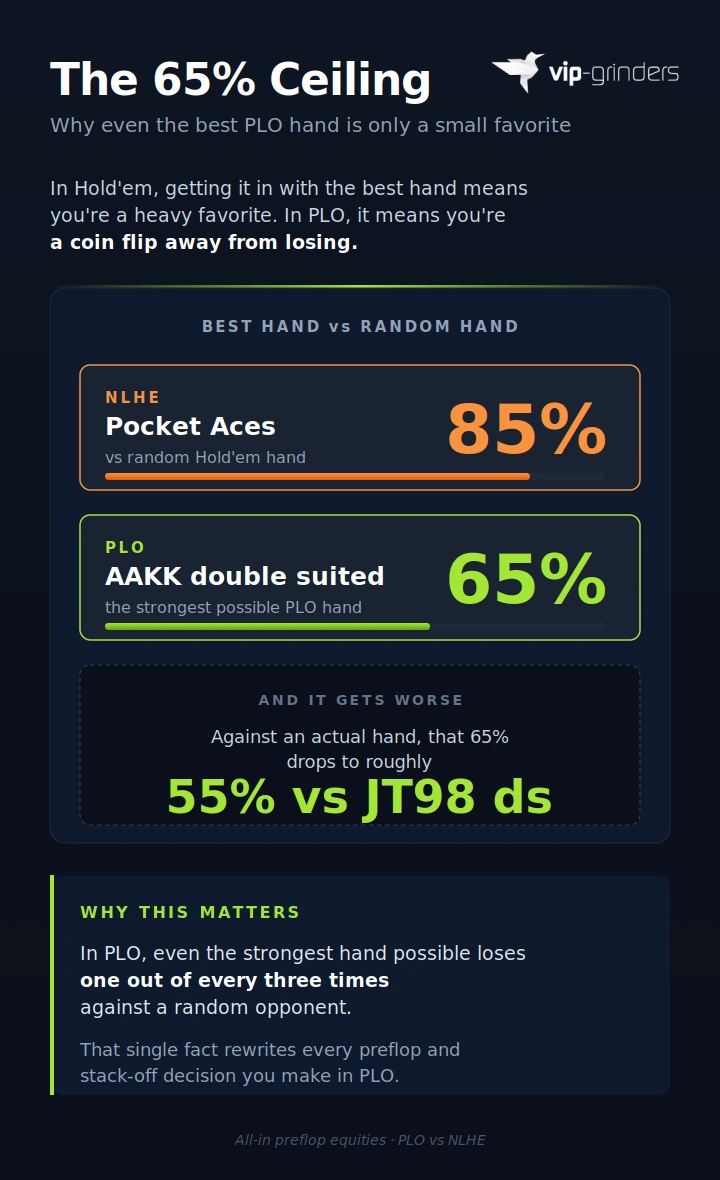
The 65% versus 80% gap is the single most important number for an NLHE convert to internalize. In Hold’em, getting it in with the best hand preflop usually means you are a heavy favorite. In PLO, getting it in with the best hand preflop often means you are a coin flip away from losing the pot. That changes everything about how you size pots, build stacks, and protect equity.
The other factor is the pot-limit betting cap. You cannot overbet the pot like you can in NLHE. Maximum bet equals the size of the pot after you call, which means stacks build through layered betting rather than single big shoves. Pots get bigger faster because every street has more dead money, and the math of pot odds shifts because of the constraint.
Put together: more combinations, closer equities, capped betting, and higher variance. These four traits are why PLO requires its own strategy framework, and why the rest of this guide focuses almost entirely on the PLO-specific patterns rather than rehashing Hold’em fundamentals you already have.
PLO vs NLHE: The Numbers That Matter
The table below summarizes why PLO and NLHE play so differently, even though they share the same hand rankings and betting flow.
| Feature | NLHE | PLO |
|---|---|---|
| Hole cards per player | 2 | 4 |
| Possible starting hand combinations | 1,326 | 270,725 |
| Cards required from your hand at showdown | Any (0 to 2) | Exactly 2 |
| Betting structure | No-Limit (any size up to all-in) | Pot-Limit (max bet = pot size) |
| Best hand vs random hand equity | ~85% (AA vs random) | ~65% (AAKKds vs random) |
| Typical standard deviation per 100 hands | 75 to 100 BB | 120 to 200 BB |
| Recommended cash game bankroll | 30 to 50 buy-ins | 80 to 120 buy-ins |
| Top pair top kicker, worth committing your stack? | Often yes | Almost never |
| Average winning hand at showdown | One pair / two pair | Straight or better |
The takeaway is simple: PLO uses Hold’em rules but plays by completely different math. Every row in this table is a reason your NLHE instincts will lose money in PLO until you retrain them.
PLO Starting Hand Construction and the Top 30 Hands
The biggest mistake NLHE players make in PLO is treating starting hands the same way. In Hold’em, you can roughly rank hands from AA down to 72o and play accordingly. In PLO, the ranking system breaks down because hand value depends on how the four cards work together, not just their individual strength.
A hand like A-A-7-2 rainbow looks strong on paper. It is not. The two low rags do not connect with anything, the suits do not double up, and you are essentially playing pocket Aces with two dead cards attached. Compare that to J-T-9-8 double suited, which has straight draws, two flush draws, and the ability to flop 17-out wraps. The second hand is structurally far better despite having no pair.
The four traits below are what separate playable PLO hands from trash, and the top 30 list at the end of this section is built entirely on these criteria.
The Four Traits That Make a PLO Hand Playable
Every strong PLO hand combines some mix of four characteristics. The more boxes a hand checks, the more situations it plays well in postflop, and the more equity it realizes when you reach showdown.
The strongest PLO hands hit all four traits: AAKKds (double suited), KQJTds, JT98ds, and similar holdings. These are rare and dominate the top of any starting hand list. The middle of the range is where most decisions get made, and that is where understanding the four traits becomes essential.
Danglers, Rainbow Hands, and What to Fold Immediately
The fastest way to plug a leak in your PLO preflop game is to start folding hands you would have played in your first hundred sessions. The biggest culprits are hands with danglers and rainbow hands from early position.
Examples of hands that look playable but should usually be folded:
Notice the pattern. It is not that these hands are unplayable in any spot. It is that they are structurally inferior to better-built PLO hands, so the small edge they have in raw card strength gets wiped out by their inability to flop coordinated draws or realize equity in multiway pots (pots with three or more players still in the hand on the flop).
In your first thousand hands of PLO, the discipline to fold these hands from early position is worth more than any advanced concept in this guide. Premium-looking trash is the most expensive habit an NLHE convert brings to the table.
The Top 30 PLO Starting Hands
The list below ranks the strongest 30 hands in PLO based on a combination of equity, playability, and nut potential. “ds” means double suited, “ss” means single suited, and “r” means rainbow. These rankings assume 6-max cash, deep stacks, and standard preflop dynamics.
| Rank | Hand | Category | Why It Plays Well |
|---|---|---|---|
| 1 | A-A-K-K ds | Premium Pair | Two top pairs, two flush draws, dominant high-card equity. |
| 2 | A-A-J-T ds | Premium Pair + Broadway | Aces with connected Broadway adds straight potential. |
| 3 | A-A-Q-Q ds | Premium Pair | Two strong pairs, double suited, blocks set-over-set scenarios. |
| 4 | A-A-J-J ds | Premium Pair | Aces with strong second pair and double suit. |
| 5 | A-A-T-T ds | Premium Pair | Same structure as AAJJds, slightly less Broadway potential. |
| 6 | A-A-9-9 ds | Premium Pair | Aces with mid-pair, set value plus flush draws. |
| 7 | A-A-K-Q ds | Premium Pair + Broadway | Best non-paired Broadway support for Aces. |
| 8 | A-A-K-J ds | Premium Pair + Broadway | Connected Broadway adds straight outs to Ace value. |
| 9 | K-K-Q-Q ds | Premium Pair | Strongest non-Aces double pair with Broadway support. |
| 10 | K-K-J-T ds | Premium Pair + Rundown | Kings with connected Broadway. Strong nut potential. |
| 11 | K-Q-J-T ds | Broadway Rundown | The strongest non-paired hand in PLO. Flops nut straight draws constantly. |
| 12 | Q-Q-J-J ds | Premium Pair | Two strong middle pairs with Broadway connectivity. |
| 13 | K-K-Q-J ds | Premium Pair + Broadway | Kings with Broadway support and double suit. |
| 14 | J-J-T-T ds | Connected Pairs | Two middling pairs that combine for set + straight potential. |
| 15 | A-K-Q-J ds | Broadway Rundown | Four Broadway cards working together. Premium nut potential. |
| 16 | Q-Q-T-T ds | Connected Pairs | Strong double-pair structure with set value. |
| 17 | A-K-J-T ds | Broadway Rundown | Connected Broadway with Ace blocker. |
| 18 | K-K-T-T ds | Premium Pair | Kings with mid-pair, multiple set + flush combos. |
| 19 | J-T-9-8 ds | Mid Rundown | Best non-Broadway rundown. Flops huge wrap draws on connected boards. |
| 20 | A-Q-J-T ds | Broadway Rundown | Four Broadway with Queen-high straight potential. |
| 21 | T-T-9-9 ds | Connected Pairs | Mid double-pair with set + straight value. |
| 22 | K-Q-J-9 ds | Broadway Rundown (gap) | One-gap Broadway. Slightly weaker than KQJT but still elite. |
| 23 | T-9-8-7 ds | Mid Rundown | Pure rundown that flops huge wrap draws. |
| 24 | 9-8-7-6 ds | Mid Rundown | Strong wrap potential, weaker high-end equity. |
| 25 | A-A-J-9 ds | Premium Pair | Aces with mid-Broadway connectivity and double suit. Strong nut potential. |
| 26 | K-Q-T-9 ds | Broadway Rundown (gap) | One-gap Broadway with strong straight potential. |
| 27 | Q-J-T-9 ds | Mid Rundown | Connected with one Broadway card. Plays well in position. |
| 28 | A-K-Q-T ds | Broadway Rundown (gap) | Broadway with one gap. Strong nut equity. |
| 29 | J-T-9-7 ds | Mid Rundown (gap) | One-gap rundown. Slightly less wrap potential than JT98ds. |
| 30 | A-J-T-9 ds | Broadway Rundown (gap) | Ace-high with connected mid-Broadway. Strong nut blocker. |
A few patterns jump out from the list. Double suited hands dominate the top 30 almost completely. Connected hands beat gappy hands at every tier. And Aces with garbage side cards do not even crack the list, while a non-paired hand like KQJT double suited ranks ahead of AAJJ rainbow because the combined connectivity and suit coverage produce more equity over a full session.
Use this list as a baseline, not a memorized rulebook. Stack depth, position, and opponent tendencies all shift the relative value of these hands, especially the bottom half. The point is not to play only these 30 hands. The point is to internalize the structural patterns so you can evaluate any four-card combination at the table without thinking.
Preflop Strategy by Position in 6-max PLO
Position matters more in PLO than in NLHE because postflop equities run closer and information is worth more. The player who acts last on every street can size pots, control SPR, and apply pressure with marginal hands that would be unplayable out of position. Most winning PLO regulars play twice as many hands from the button as from under the gun, and the gap between in-position and out-of-position win rates is wider than in any other format.
This section breaks down opening ranges by seat for 6-max cash games at 100bb depth. The exact frequencies shift based on opponent pool and stack depth, but the relative pattern (tight from early, wide from late, defend smart from the blinds) holds across every PLO game online.
UTG and Hijack: Tight, Nut-Heavy Opening Ranges
The first two seats after the blinds are called under the gun (UTG) and hijack. From UTG, you should open roughly 10% to 13% of hands. That sounds tight, and it is. With three or four players left to act behind you and zero positional advantage postflop, most hands are unprofitable to open here. The hands you do play need to be hands that flop nut equity often: premium pairs with side card support, Broadway rundowns, and connected high cards.
From the hijack, you can widen to roughly 14% to 17%. Still tight, but you can add a few more rundowns and one-gap hands because you have one fewer player behind you. The principle stays the same: you are not stealing blinds from these positions, you are entering pots with hands that play well postflop in 3 to 4 player situations.
Open from these positions only when:
- You have a premium pair with at least one supporting feature: double suited, Broadway support, or a connected side card. Bare Aces and bare Kings with rainbow rags can still be opened but with less enthusiasm.
- You have a Broadway rundown or double-Broadway hand: KQJTds, AKJTds, QJT9ds, and similar holdings open comfortably from any position because they flop nut draws on so many board textures.
- You have a strong rundown with nut potential: JT98ds, T987ds, and similar rundowns are openable from UTG when double suited, but fold rainbow versions from early position regardless of how connected they look.
The mistake most NLHE converts make is opening too many hands from early position because the cards “look pretty.” JT98 rainbow looks like a hand, but it loses money from UTG over thousands of trials. The single biggest preflop leak in low and mid stakes PLO is opening too wide from the first two seats. Tighten up and your win rate climbs without learning a single new postflop concept.
Cutoff and Button: Wider Ranges and Isolation Plays
From the cutoff, you can open roughly 22% to 26% of hands. From the button, push that to 32% to 38%. This is where most of your preflop volume should come from, and where positional advantage pays the biggest dividends.
The hands you add in late position are the speculative rundowns, suited Aces with weak side cards, and gappy Broadway hands that flop draws often enough to justify the open when you have position the whole way. A hand like 9-8-6-5 single suited is a fold from UTG and a clear open from the button.
Against weak openers, the button is also where you start isolating limpers. Casino crossover players limp far more in PLO than they should, and isolating them with a 3.5x to 4x raise lets you play heads-up in position with a hand that plays better postflop than their typical limping range.
Small Blind and Big Blind Defense Percentages
The blinds are where most preflop money is lost in PLO, and they are also where the biggest skill edge lives. The small blind is the worst seat at the table because you act first on every postflop street and have the worst pot odds to call. The big blind is more forgiving because you close the action and get a better price.
From the small blind facing a button open, you should re-raise (3-bet) with roughly 15% to 20% of hands, plus call with a small range of hands that play well in multiway pots. Most of the time, fold. Just calling a raise from the small blind is a long-term losing strategy because you play the rest of the hand out of position.
From the big blind facing a button open, the math changes. You are getting roughly 3.5:1 on a call, which means you only need about 22% equity to break even on the call alone. That price lets you defend much wider:
- vs Button open: defend roughly 40% to 50% of hands. This is wider than most players expect, but the pot odds justify it. Mix in 3-bets with your strongest hands and your best bluffing combos (Axxx with a suited Ace blocker).
- vs Cutoff open: defend roughly 30% to 38%. The cutoff’s range is stronger than the button's, so tighten accordingly.
- vs Hijack or UTG open: defend roughly 20% to 25%. Early position openers have strong ranges, so your defending range should be heavier on premium hands and lighter on speculative rundowns.
The Axxx blocker concept is one of the highest-value preflop adjustments in PLO. Holding an Ace in your 3-bet bluffing range reduces the combinations of Aces your opponent can have, making them less likely to 4-bet. It also gives you the nut flush draw on any Ace-high flop, which means even when your bluff gets called, you flop equity on a meaningful percentage of boards. Use suited Aces with weak supporting cards (A-7-3-2 single suited) as your primary 3-bet bluff candidates.
The underlying math is the same as in Hold’em: see our pot odds guide for the formulas. The PLO twist is that hands realize less raw equity than in NLHE because of multiway dynamics and pot-limit betting, so treat borderline calls more cautiously.
Pot-Limit Bet Sizing and How the Cap Changes Everything
In No-Limit Hold’em, you can bet any amount up to your full stack at any time. In PLO, the pot-limit structure caps your maximum bet at the current size of the pot. That one rule changes how stacks grow, how pressure builds across streets, and why PLO pots often reach all-in on the turn or river even though nobody ever makes a huge overbet.
Understanding the pot-limit math is not optional. If you do not know how to calculate the maximum legal raise, you will either leave value on the table or accidentally make illegal bets that get auto-corrected down to the cap.
The Pot-Size Formula Every PLO Player Must Know
The rule for the maximum raise in pot-limit is simple once you see it written out. Your maximum raise equals the total pot after you call the last bet.
Here is the formula in plain words:
- Step 1: figure out how much is currently in the pot (all chips bet on previous streets plus any bets on the current street).
- Step 2: add the amount you need to call the last bet.
- Step 3: the total from Step 2 is the size of your maximum raise on top of the call. Add your call amount plus your maximum raise to get the total chips you put in.
A concrete example makes it click. You are in a hand where the pot is $20. Your opponent bets $10, making the total on the table $30. You want to raise the maximum. Here is the math:
- Current pot: $30 (the $20 that was there plus your opponent's $10 bet).
- You call $10 first. Now the pot is $40.
- Your maximum raise on top of the call is $40, so you put in $10 (the call) plus $40 (the raise) for a total of $50.
- The pot is now $80 and your opponent faces a $40 call to stay in.
Most online clients calculate this automatically when you click the “pot” button, so you rarely have to do it manually. Knowing the math still matters because it explains why PLO pots grow so fast. Every pot-sized bet roughly triples the pot (the original pot plus the bet plus the call), so three pot-sized bets across the flop, turn, and river can get stacks in even when you start the hand at 100 big blinds deep.
Why Pot-Limit Changes Stack Dynamics
In NLHE, you can threaten a full-stack bet at any time, which lets you apply maximum pressure with a single action. In PLO, you have to build toward all-in across multiple streets. This creates two important consequences that shape every postflop decision you make.
- Pressure builds gradually: you cannot scare an opponent off a draw with a single massive shove the way you can in NLHE. Drawing hands get the right price more often in PLO because the maximum bet is capped. This is one reason draws are more valuable in PLO than in Hold'em.
- Street-by-street planning matters more: if you want to get stacks in by the river, you need to start building the pot on the flop. A small or medium flop bet often kills your ability to get all-in by the river because the pot-limit cap prevents you from catching up later.
This is why the most common PLO bet sizing on the flop is full pot, not half pot or two-thirds like in NLHE. A full-pot flop bet is not an “overbet” in PLO because the structure does not allow bigger. It is the standard sizing when you want to build a pot, protect equity, or set up a turn and river shove.
SPR and Why Preflop Sizing Matters More in PLO
SPR stands for stack-to-pot ratio, the size of the effective stack divided by the size of the pot on the flop. A 100 big blind stack with a 10 big blind pot on the flop creates an SPR of 10, which means there is a lot of room for postflop play. A 100 big blind stack with a 30 big blind pot on the flop creates an SPR of about 3, which means stacks are getting in quickly.
In NLHE, SPR matters. In PLO, SPR is a core part of your strategy because the pot-limit cap means you cannot adjust your bet sizing to change the SPR mid-hand. Whatever SPR you create preflop is the SPR you have to play with.
This has one major practical consequence for how you size your preflop raises and 3-bets:
- With premium hands you want to get all-in: size your 3-bet larger to create a low SPR flop. A 3-bet to 3.5x or 4x the open creates an SPR around 3 or 4, which is ideal for getting stacks in with hands like AAKK double suited.
- With speculative hands you want to play deep: either flat-call instead of 3-betting, or use a smaller 3-bet size. Hands like JT98ds want a high SPR so you can use implied odds to win big pots when you flop huge draws.
- In single-raised pots: the SPR is usually between 9 and 12, which is the deepest and most complex SPR range in PLO. This is where most postflop skill decisions happen.
The takeaway is that your preflop sizing is not just about building the pot or isolating opponents. It is about committing the right SPR for the type of hand you hold. Getting this wrong costs you money in two ways: too high an SPR with a premium pair means you miss value postflop, and too low an SPR with a speculative rundown means you cannot realize your implied odds when you flop a huge draw.
For a deeper dive into how hand ranges interact with sizing and position in poker generally, the underlying logic works the same in PLO. What changes is the constraint: the pot-limit cap means every sizing decision has more downstream consequences than it would in NLHE.
Postflop Play and Why the Nuts Matter More in PLO
If there is one sentence that captures PLO postflop strategy, it is this: you are almost always fighting for the nuts or a draw to the nuts, and second-best hands lose stacks. In NLHE, top pair with a good kicker wins plenty of pots. In PLO, that same hand is usually a bluff catcher at best and an expensive mistake at worst. The postflop decisions you make are built around one question: am I drawing to the best hand, or am I playing a hand that cannot improve to the nuts?
This section covers three things: how to read a board when every opponent has four hole cards, why draws are stronger than most made hands, and the specific second-best hand traps that will empty your stack if you do not learn to avoid them.
Board Texture Reads With Four-Card Ranges in Mind
Reading a PLO board is different from reading a Hold’em board because your opponents have six possible two-card combinations from their four hole cards, not just one. A flop that looks safe against a Hold’em range can be a disaster against a PLO range because the sheer number of possible hand combinations means someone almost always has something.
The most important concept is board connectedness. A PLO flop can be dry, medium, or wet, and the category determines how aggressively you can continue.
- Dry boards: boards with no possible flush draw, no connected cards, and no obvious straight draws, such as K-8-2 rainbow. These flops favor preflop raisers because the range that opened preflop connects with the high cards better than the range that called. You can continuation bet these aggressively.
- Medium boards: one flush draw possible or some straight connectivity, such as J-8-3 with two hearts. These flops are the most common and the most complex because both ranges can hit them in different ways. Your strategy depends on your specific hand and position.
- Wet boards: heavily connected boards with multiple draws possible, such as T-9-8 with two hearts. These flops favor the range that called preflop (usually the big blind or cold caller) because rundowns and connected hands smash them. Slow down with marginal holdings.
The practical rule is simple: the wetter the board, the more you need a hand that is either the nuts already or drawing to the nuts with a backup. Naked top pair on a wet board is a hand you can check, call a small bet with, and fold to serious pressure. On a dry board, that same hand might be strong enough to bet for value.
Wraps, Redraws, and Why Draws Are Stronger Than Made Hands
Wrap draws are the single biggest reason PLO draws are more valuable than NLHE draws. A wrap happens when your four hole cards connect with two board cards in a way that gives you many ways to make a straight. In Hold’em, the biggest open-ended straight draw has 8 outs. In PLO, a strong wrap can have 13, 17, or even 20 outs.
Here is a concrete example of a 20-out wrap:
- Your hand: J-T-9-7 (four cards that connect with the board).
- The board: Q-8-2 rainbow (two connected cards with your hand).
- Your outs: any King (4), any Jack (3), any Ten (3), any Nine (3), any Seven (3), and any Six (4) make you a straight. Total: 20 outs to make a straight by the river.
- What this means: on the flop, a 20-out wrap is about a 70% favorite to make a straight by the river. That is stronger than most made hands you could hold in the same spot.
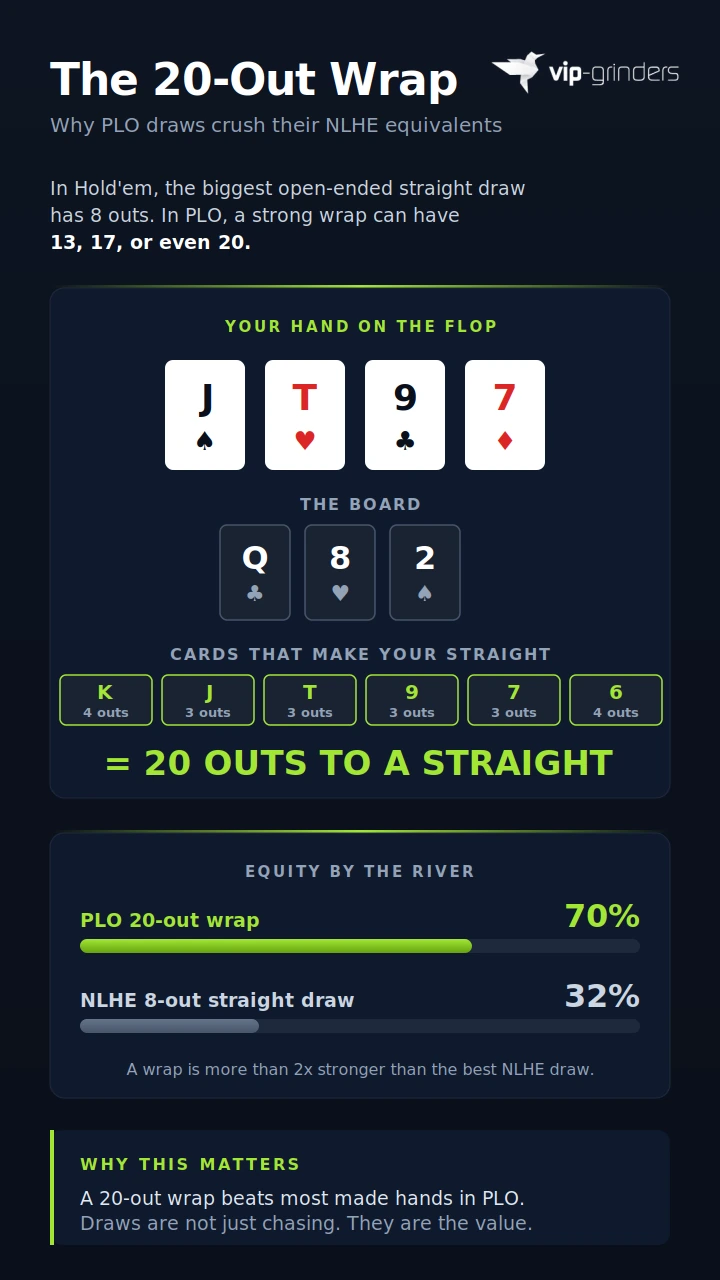
Big wraps are why you can play speculative rundowns aggressively even against overpairs. A player holding AAxx against a 20-out wrap is actually the mathematical underdog on most flops, which is the opposite of how Hold’em equities work. Understanding this changes everything about when you commit chips with draws versus made hands.
Redraws are the other half of the draw equation. A redraw is when your made hand also has outs to improve to a stronger hand. In PLO, the most valuable redraws are:
- Set plus a flush draw: you flopped three of a kind and also have a flush draw. On the turn you can improve to a full house or a flush, which protects you from being rivered by a straight.
- Straight plus a flush draw: you made a straight on the flop and also hold two cards of the flush suit. The flush redraw gives you a safety net if the board pairs or another flush card drops.
- Nut flush blocker plus a made hand: you hold the Ace of the flush suit as a blocker while also having a strong made hand. This lets you call down confidently because opponents cannot have the nut flush.
The lesson from wraps and redraws is that PLO rewards hands that can improve across multiple streets. A static made hand like bare top pair has very little upside. A hand like a set plus a flush draw can win the pot two or three different ways, which is why it plays for stacks much more comfortably than any single-component hand.
When the Second-Nut Flush Will Cost You a Stack
The most expensive mistake intermediate PLO players make is stacking off with the second-nut hand. In Hold’em, the second-nut flush is a monster. In PLO, it is a trap that drains bankrolls faster than any other common mistake.
The reason is simple: with four hole cards per player, someone in a multiway pot almost always has the nut combination when the board gets wet. If a flush comes in and you hold the King-high flush, someone is statistically likely to hold the Ace of that suit with a second card of the same suit. You have a strong hand that is drawing dead against the nuts.
The same logic applies to non-nut straights. If the board is 9-8-7 and you hold 6-5 for the idiot end of the straight, you might have the worst legal straight possible. Any player holding J-T has a higher straight, and any player holding Q-J has the nut straight. These are the pots where players who “knew they were beat” still put their stack in because the hand technically felt strong.
The fix is simple but emotionally difficult: fold second-best hands on the river. When the pot is building and your opponent is raising, ask yourself whether your hand beats the top of their range, not just their average hand. If the answer is no, folding is correct even when it feels like you are folding a strong hand. In PLO, folding strong hands is often the highest-EV play available.
Blockers, NBF, and RNIO: The Concepts That Separate Winners
This section covers three advanced concepts that almost no free PLO guide explains in plain language. Master them and you will make better decisions in the biggest pots you play, which is where most of your profit comes from. Skip them and you will leave EV on the table every time you face a river decision with a strong but non-nut hand.
How Four Hole Cards Turn Blockers Into a Weapon
A blocker is a card in your hand that makes it impossible (or less likely) for your opponent to hold a specific strong hand. In Hold’em, blockers exist but only weakly because you only have two hole cards. In PLO, you have four cards working as blockers simultaneously, which makes the concept exponentially more powerful.
The most valuable blocker in PLO is the Ace of the flush suit. When the board has three of one suit and you hold the Ace of that suit, you block every single combination of the nut flush. Your opponent can still have a King-high flush, but they cannot have the hand they most fear you holding. This lets you bluff rivers credibly and call down comfortably against ranges that would normally crush you.
Other high-value blockers include:
- High cards on straight boards: holding a King on a Q-J-T board blocks the nut straight (A-K). This lets you bluff into opponents who would otherwise be priced in to call with second-best straights.
- Pocket pairs on paired boards: holding pocket Kings on a K-8-2-2 board blocks the combinations where opponents have a second King for quads or a specific full house.
- Backdoor suit blockers: holding the Ace of a suit that is only on the board once still gives you bluff equity on turn and river cards that complete a flush.
Blockers are why Axxx hands (any hand containing an Ace) are the best 3-bet bluff candidates preflop. Holding an Ace reduces the combinations of strong aces your opponent can 4-bet you with, which makes your bluffs work more often.
Nut Blocking Frequency and When to Fold the River
Nut Blocking Frequency (NBF) is how often your hand blocks the combinations of your opponent’s strongest possible holding on a specific board. It sounds abstract, but the practical application is simple: before you call a big river bet, ask yourself whether your hand reduces the number of nut combinations your opponent could have.
If your hand blocks many nut combinations, your call is stronger than it looks because your opponent is less likely to actually have the nuts. If your hand blocks zero nut combinations, your call is weaker than it looks because every combination of the nuts is still live in their range.
Here is how to use NBF in practice on a river decision:
- Identify the nuts: what is the single strongest possible hand on the river board? Usually the nut straight, nut flush, or full house.
- Check your blockers: do your four hole cards reduce the number of combinations that make the nuts? If yes, your bluff catcher is stronger. If no, it is weaker.
- Adjust your call: against a big river bet, call with hands that block the nuts and fold hands that do not. The difference is often the difference between a winning and losing session.
This concept extends range advantage theory into the four-card world of PLO. The core logic is the same, but PLO gives you more blocker combinations per hand, which makes the concept stronger.
Reverse Nut Implied Odds: The Cost of Chasing Second-Best
Reverse Nut Implied Odds (RNIO) is the opposite of normal implied odds. Instead of being paid off when you make your hand, you lose a full stack when you make a hand that turns out to be second-best. It is the hidden cost of drawing to non-nut hands in PLO, and it is the single biggest leak in most mid-stakes grinders’ games.
Here is an example. You hold a hand with a King-high flush draw on a wet board. You have pot odds to call, so the call looks profitable. But if you hit your flush, the pot will usually get much bigger (someone else is likely holding the Ace-high flush draw), and you will either lose a stack or have to make a tough fold. The “implied” part of your odds is negative: you are not drawing to win bigger pots, you are drawing to lose bigger pots.
The rule that comes out of this is simple: draw to nut hands, not second-best hands. King-high flush draws, second-nut straight draws, and underset draws all carry negative implied odds in multiway PLO pots. Even when the immediate pot odds look fine, the long-term math is losing money because the pots you win are small and the pots you lose are huge.
Equity, Equity Realization, and Why Not All Draws Are Equal
Raw equity is the percentage chance your hand wins if you go all-in right now. Equity realization is the percentage of that raw equity you actually capture by the time the hand is over. In PLO, these two numbers can differ by a lot, and the gap is where intermediate players lose money without realizing it.
Raw Equity vs What You Actually Win in PLO
Two hands with the same raw equity can produce very different long-term results depending on how easily they can be played to showdown. A hand that flops well on most boards, keeps the initiative, and has position will realize close to 100% of its raw equity. A hand that flops poorly, plays out of position, and gets outdrawn on scary turns will realize 70% or less.
The hands that realize the most equity in PLO share three traits:
- Position: acting last on every street means you can control pot size, take free cards when your draw misses, and extract value when it hits. In-position hands realize significantly more equity than out-of-position hands, which is why button win rates are so much higher than UTG win rates.
- Nut potential: hands that can make the nuts win bigger pots when they hit and lose smaller pots when they miss. A nut flush draw realizes more equity than a King-high flush draw even though both have the same raw chance of making a flush.
- Playability: hands that connect with many board textures realize more equity than hands that connect with only a few. JT98 double suited hits something useful on most flops. KKQQ rainbow either hits a set or whiffs completely.
Why AAKK Double Suited Is Only a Small Favorite Over JT98 Double Suited
Run the numbers in an equity calculator and the result surprises most NLHE converts: AAKK double suited is only about a 55% favorite all-in preflop against JT98 double suited. The best hand in PLO is barely ahead of a well-built rundown.
The reason is that both hands realize equity extremely well. AAKK wins pots by hitting sets, top pair, and flushes. JT98 wins pots by hitting straights, wraps, and two flushes. On most flops, one of the two hands connects strongly, and the gap between their raw equities compresses as the board runs out.
This is why getting it in preflop with AAKK against a strong rundown is not the massive favorite it looks like on paper. It is also why experienced PLO players will often flat-call with premium pairs instead of 3-betting into a player they suspect holds a rundown. The equity edge is smaller than the variance they are inviting.
You can plug any two PLO hands into our poker equity calculator to see exactly how close your matchups really are. The first time you do it, the results will change how you think about which hands to stack off with preflop.
PLO Variance and the Bankroll Math You Cannot Ignore
PLO variance is the single biggest reason winning NLHE players quit PLO. The swings are bigger, the downswings last longer, and the same win rate in big blinds per 100 hands produces much deeper drawdowns than in Hold’em. If you bring an NLHE bankroll to a PLO game, you will go broke on a normal run of bad cards long before your edge shows up.
Why PLO Swings Are 1.5 to 2 Times Larger Than NLHE
The technical reason is that PLO has a higher standard deviation per 100 hands. A solid NLHE cash game regular has a standard deviation around 75 to 100 big blinds per 100 hands. A PLO regular at the same stake runs at 120 to 200 big blinds per 100 hands. The math is straightforward: higher variance means larger swings in both directions, and larger swings mean deeper downswings before your edge expresses itself.
One practical consequence is that a 50 buy-in downswing is normal in PLO, not a disaster. Players who would never see a 50 buy-in drop in NLHE hit them regularly in PLO, and the biggest reason they quit the format is that they confuse normal variance for strategic failure. Our variance guide covers the underlying math in detail, and you can model your own PLO downswings in the poker variance simulator.
Stake-by-Stake Bankroll Requirements for PLO
Our bankroll management guide covers the general rules across every format. PLO specifically needs a larger cushion than NLHE because of the variance multiplier. Here is what your bankroll should look like at each stake.
| Stake | Conservative (120 BIs) | Standard (100 BIs) | Aggressive (80 BIs) |
|---|---|---|---|
| PLO10 ($0.05/$0.10) | $1,200 | $1,000 | $800 |
| PLO25 ($0.10/$0.25) | $3,000 | $2,500 | $2,000 |
| PLO50 ($0.25/$0.50) | $6,000 | $5,000 | $4,000 |
| PLO100 ($0.50/$1) | $12,000 | $10,000 | $8,000 |
| PLO200 ($1/$2) | $24,000 | $20,000 | $16,000 |
| PLO500 ($2.50/$5) | $60,000 | $50,000 | $40,000 |
The 100 buy-in standard is the starting point for most winning PLO regulars. Drop to 80 buy-ins only if you have income outside of poker to reload if needed. Stay at 120 or higher if PLO is your primary source of income, because a single bad month can wipe out 60 to 80 buy-ins and you need the cushion to keep playing at your current stake without moving down.
How Rakeback Changes Your Effective Bankroll
This is where most PLO strategy guides stop, but it is the section that matters most for your actual win rate. Rakeback is not just extra money at the end of the month, it is a direct addition to your effective big blinds per 100 hands, and it changes the math of which stakes are profitable for you.
Here is a concrete example. Poker win rates are measured in big blinds per 100 hands (bb/100), which is the number of big blinds you earn on average every 100 hands you play. At PLO100, a solid winning grinder might earn 3 bb/100 before rakeback. That same player generates roughly 5 bb/100 in rake paid to the room. A 30% rakeback deal returns 1.5 bb/100 to the player, pushing their effective win rate to 4.5 bb/100. That is a 50% increase in your hourly rate for no additional skill improvement, and it compounds across every session you play.
For grinders at breakeven or slight losses before rakeback, a strong deal can turn a losing month into a winning one. The rakeback and strategy guide covers how rakeback should influence your bankroll, game selection, and volume decisions. The short version: when you are running bad, rakeback is still paying you for every hand you play, which means every session has a floor even on your worst days.
Ten Mistakes NLHE Players Make When Switching to PLO
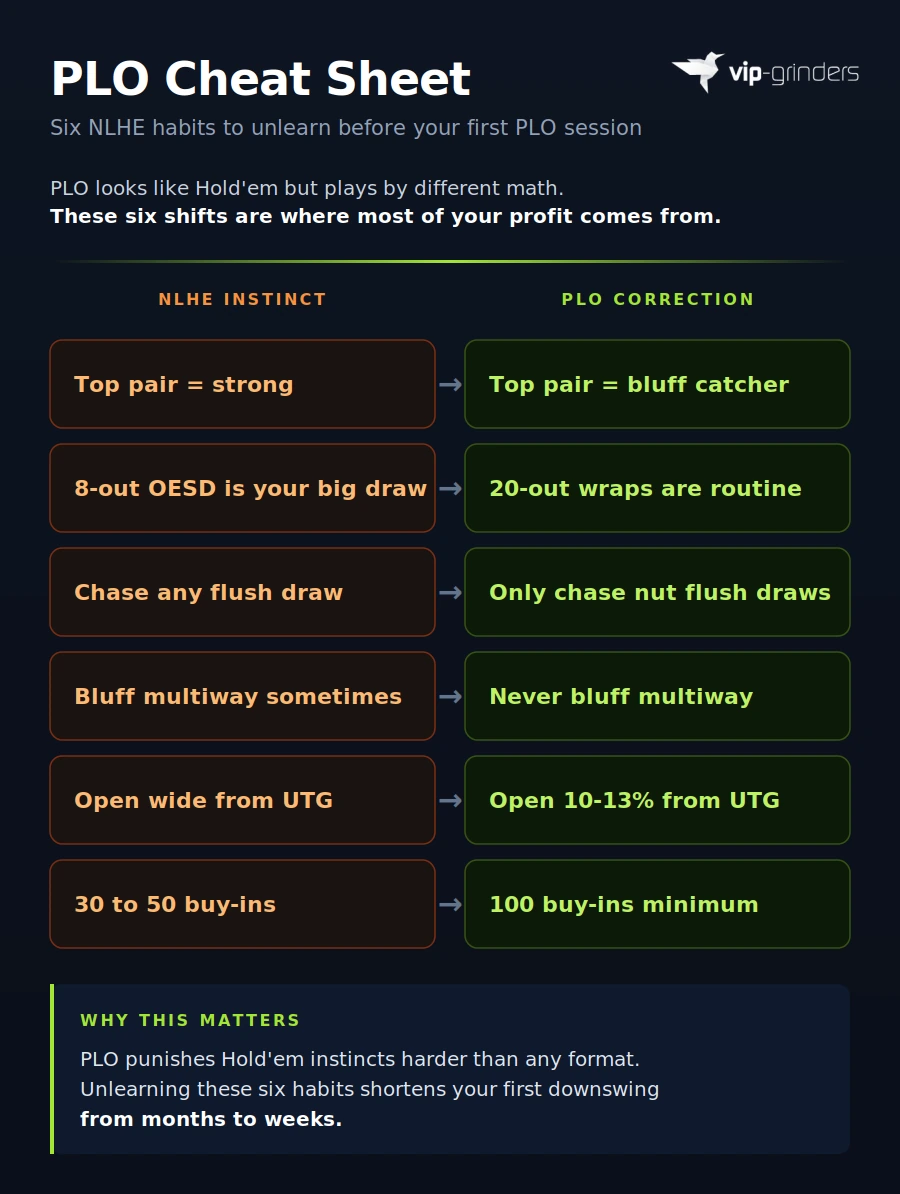
Every Hold’em player who tries PLO makes the same handful of mistakes in their first few thousand hands. The mistakes are predictable, expensive, and completely avoidable once you know what to watch for. Reading this list will not fix the habits instantly, but it will shorten the learning curve from months to weeks.
Work through each one honestly and mark the ones that describe your own game. Those are the leaks to patch first.
- 1Overvaluing bare Aces. AA72 rainbow is not a hand to get excited about. It is a hand to play cautiously and fold on most coordinated boards. Your Aces are not special in PLO.
- 2Ignoring the two-card rule. Convinced you have the nut flush with one Ace in your hand and four to a flush on the board. You do not. Every PLO player makes this mistake at least once.
- 3Calling big bets with second-best hands. The King-high flush, the idiot-end straight, the bottom set on a wet board. All three are hands that feel strong but lose stacks in multiway pots. Folding them is the highest-EV play most nights.
- 4Bluffing into multiway pots. In NLHE, a good bluff spot against one opponent is often still a good spot against two. In PLO, multiway pots almost always have someone with the nuts or a huge draw. Bluffs burn money in these spots.
- 5Underestimating variance. Bringing a Hold'em bankroll to a PLO game and getting wiped out during normal variance. PLO needs 100 buy-ins minimum, not the 30 to 50 that works for NLHE.
- 6Playing too many rainbow hands. Four different suits means zero flush potential, which gives up a massive chunk of your equity on every playable board. Rainbow hands should be rare opens from any position.
- 7Chasing non-nut draws. Second-nut flush draws, low-end straight draws, and weak sets with no backup all carry negative implied odds. You are drawing to lose bigger pots, not win them.
- 8Opening too wide from early position. JT98 rainbow looks pretty but loses money from UTG. The single biggest preflop leak at low and mid stakes is opening marginal hands from the first two seats.
- 9Forgetting that position matters more in PLO. Playing the same hand out of position that you would play in position is a huge leak. The equity realization gap between in-position and out-of-position hands is wider in PLO than in any other format.
- 10Not studying PLO-specific material. Standard NLHE solvers do not work for PLO, and Hold'em training content does not teach you four-card equity. For dedicated PLO software and training tools, see our dedicated poker tools section.
The common thread across all ten is the same: PLO looks enough like Hold’em that NLHE instincts feel correct, but the math underneath is different enough that those instincts cost you money. Fixing these mistakes does not require learning advanced theory. It requires unlearning the parts of your Hold’em game that do not transfer.
The good news is that mental game skills do transfer. The discipline you built to fold marginal NLHE hands in tough spots is exactly the discipline you need to avoid the second-best trap in PLO. If you already know how to stop yourself from making bad calls in Hold’em, you have most of what you need to stop making them in PLO.
Pot-Limit Omaha Strategy FAQ
The questions below cover the most common things beginner and intermediate PLO players ask after their first few sessions. If your question is not here, the rest of this guide probably answers it in more detail.
What is the best starting hand in PLO?
The strongest PLO starting hand is A-A-K-K double suited. It combines the two highest pairs in the game with two flush draws and strong Broadway connectivity, which means it flops well on almost every board texture. Against a random PLO hand, AAKK double suited is roughly a 65% favorite. Against a strong rundown like JT98 double suited, that edge shrinks to about 55%.
How many buy-ins do I need for PLO?
For cash games, start with 100 buy-ins as the standard. Drop to 80 buy-ins only if you have outside income to reload. Move up to 120 buy-ins or more if PLO is your primary source of income. The reason PLO needs more than NLHE is variance: standard deviation runs 1.5 to 2 times higher, which means 50 buy-in downswings are normal rather than catastrophic.
Is PLO more profitable than NLHE?
For most winning players, yes. PLO player pools are softer than NLHE at almost every stake because casino crossover players gravitate to PLO for the action. The tradeoff is higher variance, which means your hourly can swing wildly session to session even when your win rate is solid. If you can handle the swings emotionally and have the bankroll to absorb them, PLO typically offers a better EV opportunity than NLHE at the same stake.
What is the two-card rule in PLO?
At showdown, you must use exactly two of your four hole cards plus exactly three of the five community cards. Not one, not three, not four. Exactly two. This is why holding the Ace of hearts does not give you the nut flush when four hearts come on the board, and why you cannot make a straight using only one card from your hand.
How do blockers work in PLO?
A blocker is a card in your hand that reduces the combinations of strong hands your opponent can have. In PLO, blockers are more powerful than in NLHE because you have four hole cards working simultaneously. The most valuable blocker is the Ace of a flush suit when the board is three-flush, because it eliminates every combination of the nut flush from your opponent’s range.
What is a dangler in PLO?
A dangler is a card in your four-card hand that does not connect with the other three. A hand like KQJ2 has a dangler (the deuce) because the deuce never participates in a strong made hand alongside the Broadway cards. Danglers effectively turn your four-card hand into a three-card hand, which destroys equity in most postflop situations. Avoid opening hands with danglers from early position.
How does pot-limit betting work?
The maximum bet in pot-limit is equal to the current size of the pot after you call. The formula is: take the pot size, add the amount you need to call, and that total is your maximum raise on top of the call. Most online clients calculate this automatically when you click the “pot” button, so you rarely have to do it manually.
Why does PLO have higher variance than NLHE?
Because PLO equities run closer. The strongest PLO hand is only a 65% favorite against a random hand, compared to 85% for pocket Aces in Hold’em. That means even when you get it in ahead, you lose much more often than you would in NLHE. Combine that with bigger pots (because of the pot-limit structure building pots faster) and you get swings that are 1.5 to 2 times larger than Hold’em at the same stake.
Can I use NLHE solvers for PLO?
No. Standard NLHE solvers like PioSolver do not work for PLO because the four-card structure creates too many possible hand combinations to solve with Hold’em tooling. PLO-specific solvers exist as separate software. For dedicated PLO training tools, see our poker tools section.
What is the difference between PLO and Omaha Hi-Lo?
Standard PLO is a high-only game: the best five-card hand wins the entire pot. Omaha Hi-Lo (also called Omaha/8 or Eight-or-Better) is a split-pot variant where the pot is divided between the best high hand and the best qualifying low hand (five unpaired cards eight or lower). The strategies are completely different because Omaha Hi-Lo rewards low-card combinations that are trash in standard PLO.
What does double suited mean in PLO?
A double suited hand has two cards of one suit and two cards of another suit. For example, A♠K♠J♥T♥ is double suited. This gives you two separate flush draw possibilities instead of one, which substantially boosts the hand’s equity compared to a single-suited or rainbow version of the same four cards. Double suited hands dominate the top of every PLO starting hand ranking.
Should I play PLO6 or standard PLO4?
Standard PLO uses four hole cards, which is the version this guide covers and the version spread at most online rooms. PLO5 (five hole cards) and PLO6 (six hole cards) are action variants found mostly on high-stakes tables and select rooms. The strategy overlaps heavily with four-card PLO, but equities run even closer and the variance is higher. Start with standard PLO4 before experimenting with larger-card variants.