


How to Bluff in Poker: Spots, Sizing & Mistakes to Avoid in 2026
Most poker content treats bluffing as a personality trait. Aggressive players bluff, tight players don’t, and the advice stops there. That framing is wrong, and it costs you money.
Every bluff is a math problem with a specific number attached. If you bet $50 into a $100 pot, your opponent needs to fold 33.3% of the time for the bluff to break even. Above that number you make money, below it you burn chips.
This guide is built around that math. You’ll see exactly when the numbers support firing, which four spots print money in modern online poker, how to size bluffs so they match your value bets, and the five most expensive mistakes that turn profitable bluff attempts into pure losses. VIP-Grinders has been covering poker strategy since 2013, and the framework below is calibrated for how the game plays right now, not how it played a decade ago.
The Math: When a Bluff Makes Money
A pure bluff is a bet with a hand that has almost no chance of winning at showdown. A semi bluff is a bet with a hand that is currently behind but has equity to improve if called. A value bet is a bet with a hand you expect to be ahead of villain’s calling range.
The same board shows the difference in action. On Kc 8c 4h, betting 7s 6d is a pure bluff: no pair, no draw, no realistic path to winning. Betting Ac 5c is a semi bluff because the nut flush draw has roughly 36% equity against almost any made hand, while betting Kh Qs is a value bet because top pair with a strong kicker is ahead of most hands villain continues with.
Each bet type has a different EV equation, but they all start from the same place: fold equity. For a pure bluff to break even, villain has to fold often enough to cover the money you’re risking.
The Break Even Bluff Formula
Required fold frequency = bet size / (bet size + pot)
A $50 bet into a $100 pot needs villain to fold 33.3% of the time to break even ($50 divided by $150). If villain folds more often than that, the bluff prints money. If villain folds less, you lose money on every attempt, even when you occasionally take down the pot.
This is the bluffer’s side of the same math you’ll find in our pot odds guide, which covers the caller’s perspective in full. Here’s the quick reference from the bluffer’s side:
| Your Bet Size | Required Fold Frequency |
|---|---|
| 50% pot | 33.3% |
| 75% pot | 42.9% |
| 100% pot (pot sized) | 50.0% |
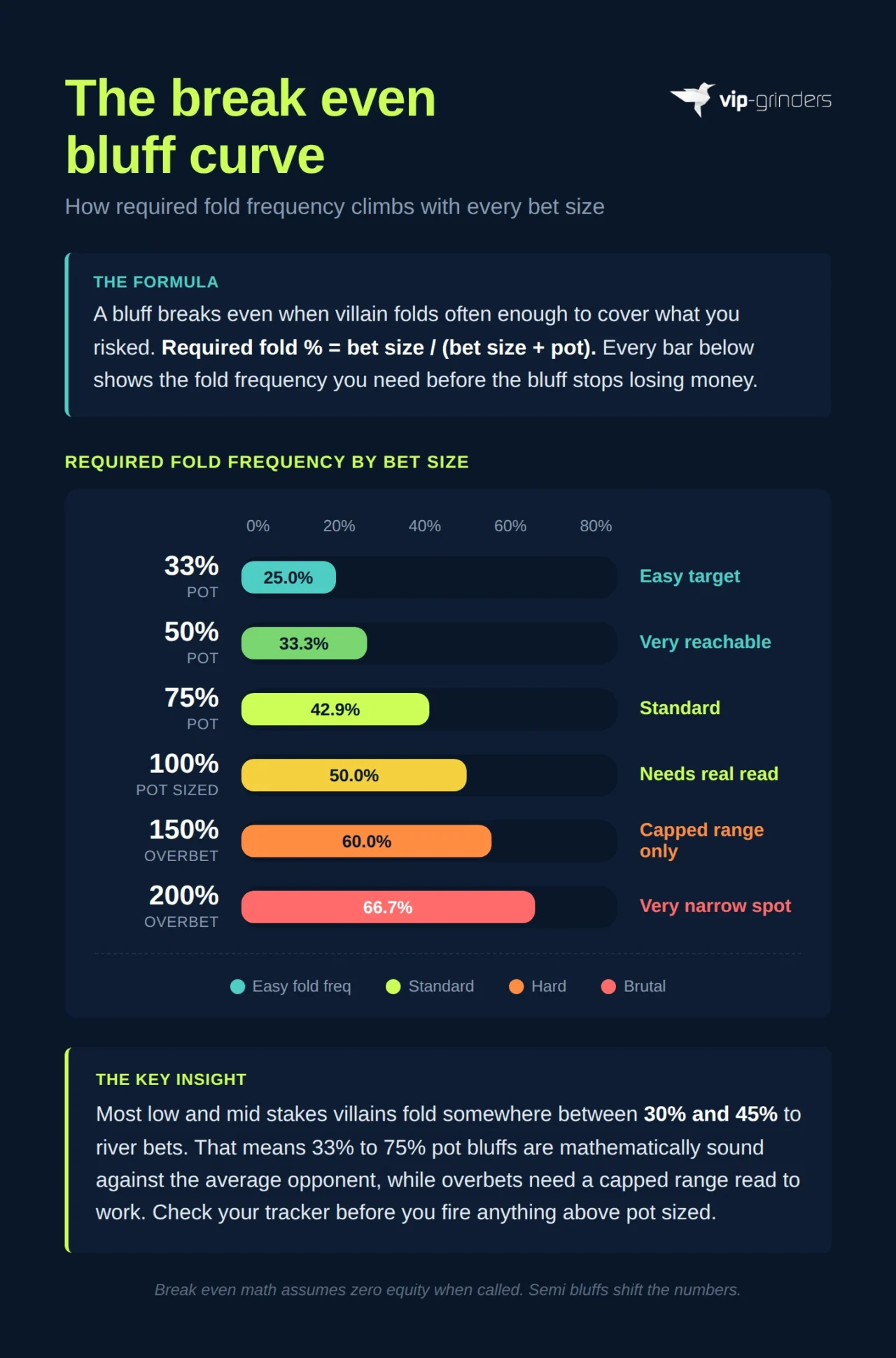
Smaller bluffs need fewer folds to break even, but they give villain a cheap call with marginal hands. Larger bluffs need more folds, but they deny profitable calls from draws and weak pairs. Choosing between them depends on what villain’s range looks like, which is the subject of the next section.
The math tells you what villain needs to fold for a bluff to break even, but it doesn’t tell you whether villain will actually fold that often. That’s where fold equity comes in: the practical estimate of how often a specific opponent folds to a specific bet in a specific spot. The next section covers the five conditions that make fold equity real.
When to Bluff: The Five Conditions
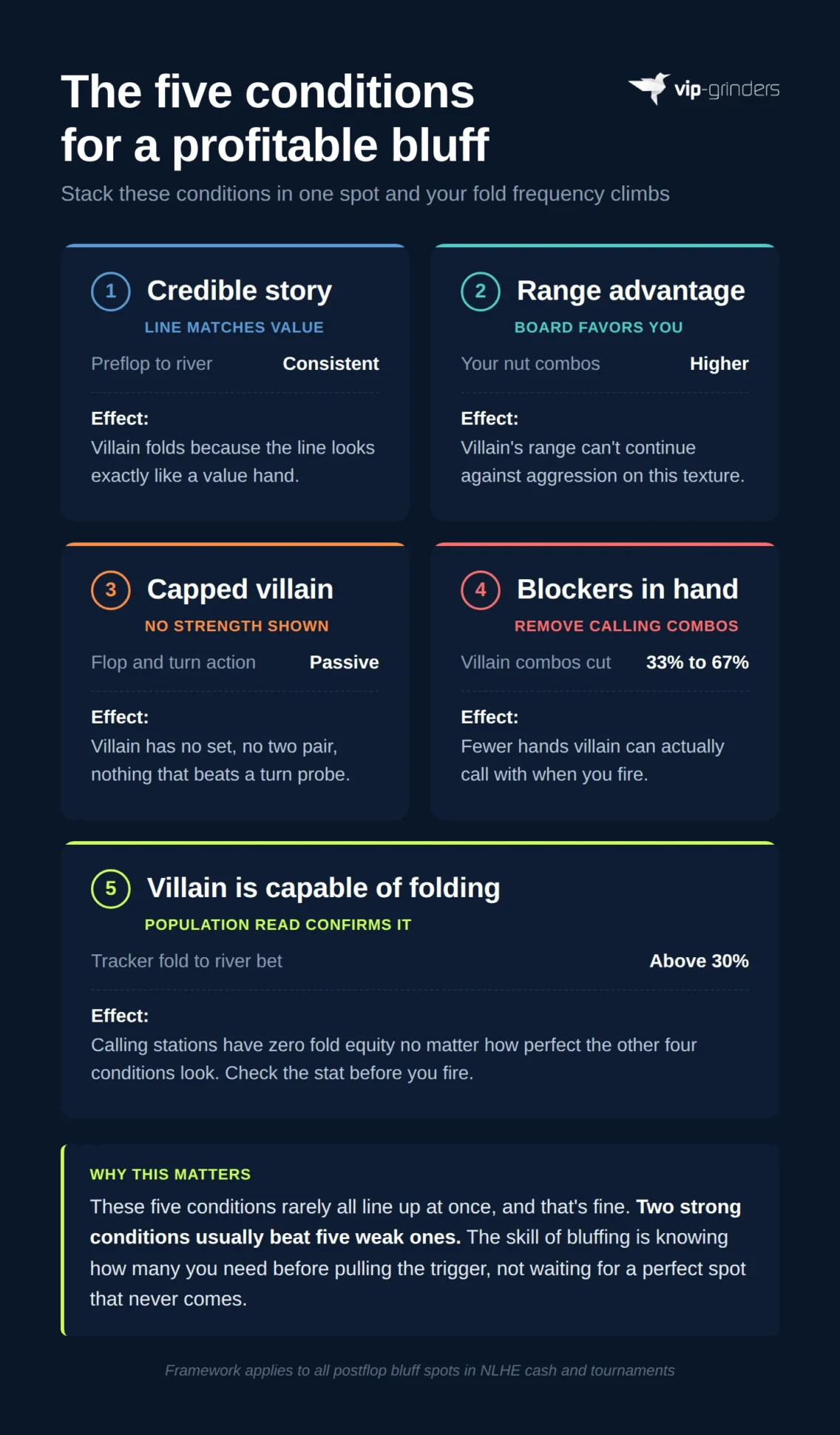
Fold equity has to be earned through the situation, the board, and your read on villain. Five conditions drive almost every profitable bluff, and the more of them you stack in one spot, the higher your actual fold frequency climbs.
1. Your Story Tells a Credible Value Hand
A bluff only works if villain believes you could have a strong hand, and that belief comes from your preflop action, flop bet, and turn barrel adding up to a credible value line. A 3 bet preflop followed by a continuation bet on A K 4 represents the full AK, AQ, KK, AA range, and villain folds weaker aces and pocket pairs because your line matches a value hand exactly. Bluffs fail when the story doesn’t exist: a flop check followed by a turn bet and river shove from out of position represents almost nothing villain respects.
2. The Board Favors Your Range
Some boards favor the preflop raiser’s range and others favor the caller’s. This is called range advantage, and it’s one of the strongest indicators of whether a bluff will get through. On A K 4 rainbow you have every strong ace and king in your range while the caller rarely has AA, KK, or AK after just calling, so bluffs fold out everything except second pair type hands.
3. Villain’s Range Is Capped or Weak
A capped range means villain has shown no strength through his actions. If he checks the flop and checks the turn, he almost never has a set or two pair because those hands bet for protection or value. Against a capped range, turn probes and river overbets fold out everything except the narrow top of his check call range.
Reading and narrowing ranges is the core skill behind this condition, and our poker ranges guide covers the full framework for capping villains across streets.
4. You Hold Blockers to Villain’s Value Hands
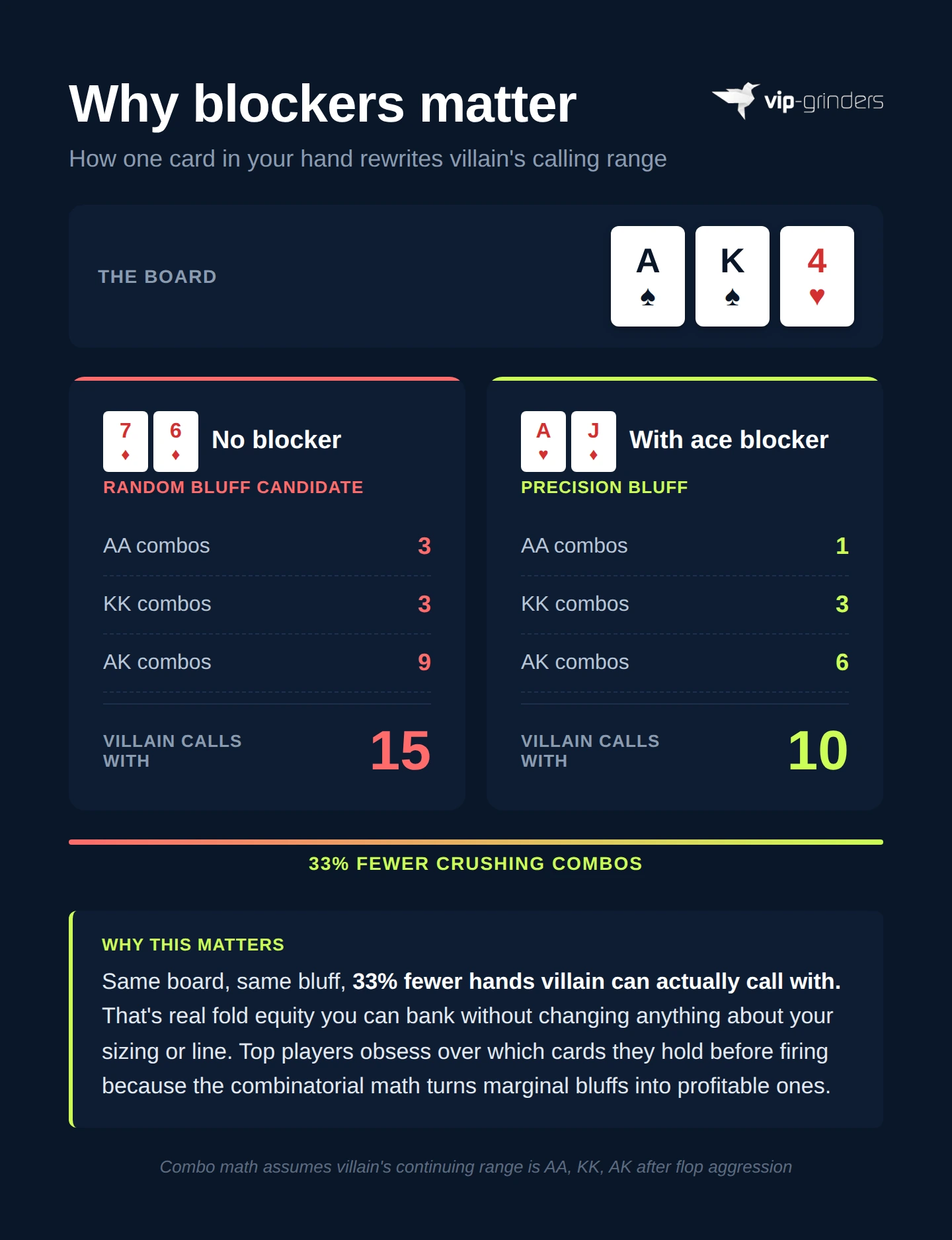
Blockers are cards in your hand that remove villain’s strongest combinations from the deck. Holding the Ace of spades on a board with three spades removes the nut flush from villain’s range entirely. Holding one Ace on an A K 4 flop cuts villain’s AK, AQ, and AJ combos by roughly 33% each, which shrinks the part of his range that will actually call a bluff.
Every combo you block is a combo villain can’t have when you fire. Blocker driven bluffs have measurably higher success rates than random bluffs, which is why top players constantly think about which cards they hold relative to villain’s calling range.
5. Villain Is Actually Capable of Folding
None of the math above works against a player who refuses to fold. Calling stations have effectively zero fold equity regardless of board texture or sizing, which turns every spot into a value only game against them.
Before firing, look at villain’s past hands: has he folded to turn or river aggression in this session, or made disciplined folds with marginal pairs? Population reads matter too, because most recreational players at low stakes fold less often than the math assumes.
These five conditions rarely all line up at once. The skill of bluffing is knowing how many you need before pulling the trigger, and the answer depends on how strongly each condition is stacked. Two strong conditions usually beat five weak ones, so don’t wait for a perfect spot that never comes.
Where to Bluff: The Highest EV Spots
The conditions above tell you what to look for. Four spots show up more often than any others in modern online poker, and each one has a clear structural reason it works. None of them depend on specific stack depths or stakes, so they apply whether you’re playing low stakes cash or a middle stage MTT.
- Cold 4 bet bluff (preflop): Fire against a 3 better whose range is polarized to AA, KK, and AK. Suited aces like A5s and A4s work best because they block villain's value combos, with full preflop range construction covered in our 3 bet strategy guide.
- Turn probe after a flop check back: Fire when villain checks back the flop out of position, because that action caps his range. Probe sizes of 50% to 66% pot match the lead you'd make with a real value hand.
- River bluff on a capped board: Fire when villain's flop and turn line caps him at one pair or worse. Sizing runs 75% to 150% pot, and the right blockers are mandatory for this spot to work.
- Delayed c bet on a favorable turn: Fire after checking back the flop in position when the turn card favors your perceived range. Size 50% to 66% pot representing slowplayed overpairs that picked up equity.
The River Bluff Deserves Special Attention
The river bluff with blockers is the highest EV spot in the list and the one worth studying in depth. By the river, villain’s range is defined by every flop and turn action, and many of his strongest hands have already revealed themselves. If his line caps him at one pair or worse, a large river bet targets the exact part of his range that can’t call.
Blocker selection is everything in this spot. On a board of Kh 9h 4c 2h 5s where villain has called flop and turn, holding Ah Jc gives you only ace high but completely blocks villain’s nut flush, making a large river bet credible as the exact value hand villain is afraid of. Compare that to bluffing the same spot with 6c 6d: no flush blocker, no story, and villain’s thin calls become much easier.
Tournament ICM pressure and short stack dynamics shift the profitability of all four spots, especially near the money bubble and at final tables. Our tournament strategy guide covers the format specific adjustments. For cash game grinders, these spots translate directly at the stakes most readers play.
How Big to Bluff: Sizing by Spot
The single most important rule of bluff sizing: your bluffs should match the size you would bet for value in the same spot. If you value bet 66% pot on the river with top pair, your river bluffs should also use 66%. If you overbet with the nuts on a polarized board, your bluffs on the same board should overbet too.
This is what balance means in practice. When your bluff and value sizings match, villain can’t fold when you’re bluffing and call when you’re valuing because the bet size tells him nothing. The moment you size differently, thinking opponents exploit you on sight.
Recommended Sizings by Spot
| Spot Type | Recommended Sizing | Why |
|---|---|---|
| Small probe (turn or river, capped range) | 33% to 50% pot | Cheap price to deny equity, realistic pairing with thin value |
| Standard polarized river | 66% to 75% pot | Matches the most common value sizing, maximum credibility |
| Overbet on dynamic boards | 120% to 150% pot | Target capped ranges that can’t call large sizings |
| All in river shove | When SPR allows | Maximum pressure when villain’s range is narrow enough |
Overbets are the most exploitative bluff sizing in modern poker. Used correctly on capped ranges they generate fold frequencies well above the 55% to 60% break even required at those sizes, but used poorly they burn stacks fast. Our overbetting guide covers when large sizings print money and when they’re a leak.
When Sizing Gives Your Bluff Away
Population reads at low and mid stakes often reveal sizing tells: small bets mean weak hands, large bets mean strong hands, and the reverse also holds. If your tracker shows villain folds 70% to small bets and 20% to large bets, bluff small. If he folds 60% to large bets and calls small bets with anything, bluff large.
The balanced default (matching value sizings) works against thinking regs. The exploit override (picking the size villain folds to most) works against straightforward opponents. Knowing which one to use on which villain is half the skill.
The Five Most Expensive Bluffing Mistakes
Every bluff that fails the math tests from earlier sections costs you money on a specific schedule. These five mistakes show up in tracker databases more than any others, and each one has a concrete EV cost attached. Cut them from your game and your bluff win rate climbs without you learning anything new.
- 1Bluffing into multiple opponents. Required folds compound: two villains each folding 60% of the time fold together only 36%, three villains just 21.6%. Multi way pots are value only unless you have a genuine semi bluff with real equity.
- 2Bluffing players who refuse to fold. A villain who folds 5% turns a $50 bluff into a $100 pot into negative $42.50 per attempt, or a $4,250 leak over 100 attempts. Calling stations are value targets, not bluff targets.
- 3Sizing that tells villain you're bluffing. Value bets averaging 66% pot while bluffs average 33% is a tell observant regs exploit on sight. Run the same size for both ranges and let villain guess.
- 4Bluffing without the relevant blocker. On a three flush board without the Ace of the flush suit, villain still holds all 9 nut flush combos. Wait for the blocker card before firing large sizings on dynamic textures.
- 5Triple barreling without a plan. Firing the turn with no river plan forces you to either give up or punt the rest of your stack. Multi street bluffs need specific turn and river cards planned from the flop. See our double barreling guide.
The Two Most Damaging Leaks, Explained
Two of these mistakes deserve extra attention because they quietly destroy win rates at low and mid stakes. The calling station leak is hidden by design: each individual bluff attempt looks small, so the losses don’t feel painful in the moment. Run a tracker filter for your river bluffs against villains you know fold less than 25%, and the aggregate damage appears fast.
The fix isn’t bluffing less overall, it’s bluffing less against the specific villains who don’t fold. Calling stations are value targets: fire your entire value range against them and cut the bluffs entirely.
The sizing tell leak is even simpler to diagnose. Pull your last 1,000 river bets, sort by bet size, and compare the average bluff size to the average value size. If there’s a gap of more than 10% pot between the two, observant regs are exploiting you on sight.
Running the same sizes for both ranges costs you nothing against calling stations and eliminates the leak entirely against thinking opponents.
How to Practice Bluffing Off the Table
Bluffing is the single hardest part of poker to study because every spot looks different and the feedback loop is slow. Most players improve by trial and error, but the players who improve fastest have a structured off table study routine that builds pattern recognition.
Start with your tracker database. Every tracker (Holdem Manager, PokerTracker, Hand2Note) lets you filter for specific bluff spots like river bets with bottom of range, turn probes after a flop check back, or cold 4 bets. Pull 20 to 50 hands from each filter, tag them as winning or losing bluffs, and run the results through the semi bluff EV calculator referenced earlier to spot the leaks fast.
Next, use solvers for river decisions. Rivers are where bluffing gets most complex and where solvers add the most value, so set up common spots in GTO Wizard or PioSolver and study which combos the solver bluffs, which sizings it prefers, and when it checks back. Our GTO and solvers guide covers the workflow for turning solver output into usable heuristics.
Finally, review your last 1,000 hands. Filter every river bet you made with a hand weaker than one pair, then sort by result. The bluffs that got called tell you which spots your opponents don’t fold, and the bluffs that worked tell you which spots your reads were right.
Thirty minutes a week on this kind of review improves bluff win rate faster than any amount of hand history videos.
Frequently Asked Questions About Bluffing
What is a bluff in poker?
A bluff is a bet made with a hand that is either currently losing or unlikely to win at showdown, with the goal of making opponents fold better hands. Bluffs work because every bet forces opponents to make a decision: call with their current hand strength or fold. When the math of that decision favors folding, the bluff prints money regardless of what cards you hold.
How often should you bluff in poker?
Frequency depends on bet size, tied directly to pot odds: pot sized bets should bluff roughly 1 in 3 times (33%), half pot bets should bluff roughly 1 in 4 times (25%), and overbets should bluff slightly more than 1 in 3. These numbers come from the break even math, where your bluff frequency should match the price you’re giving villain to call. Exploit adjustments apply against specific player types who fold more or less than the math expects.
What is a semi bluff and how is it different from a pure bluff?
A semi bluff is a bet with a hand that is currently behind but has equity to improve on later streets (like a flush draw or open ended straight draw), while a pure bluff has almost no equity when called. Semi bluffs are more profitable because you can win two ways: villain folds, or villain calls and you hit your draw. The semi bluff EV calculator linked earlier handles the combined math.
What's the rule of thumb for bluffing frequency?
Your bluff to value ratio on the river should roughly match the pot odds you’re giving villain. A pot sized bet gives villain 2 to 1, so the ratio should be 1 bluff for every 2 value hands, while a half pot bet gives 3 to 1 and the ratio shifts to 1 bluff for every 3 value hands. This keeps your range balanced enough that villain can’t profitably call or fold as a default.
Should beginners bluff?
Yes, but selectively: focus on spots where the five conditions (credible story, range advantage, capped villain, blockers, capable folder) stack heavily in your favor. Avoid multi way pots, calling stations, and triple barrel bluffs until you can read ranges reliably. Start with small bluffs in clear spots and build from there.
How big should a bluff be?
Match the size you would value bet in the same spot. If your value bets on a given board use 66% pot, your bluffs on that board should also use 66% pot. The only exception is exploit sizing against opponents who fold to specific sizes more than others, in which case pick the size that generates the most folds.
How do you know when someone is bluffing you?
Look at the story first: a bet with no credible value line behind it is more likely to be a bluff than a bet that matches a believable value range. Also check blocker patterns, because if the river bet represents a narrow value range and you hold cards that block most of those combinations, the bluff frequency goes up. Bluff catching is its own skill and deserves its own study time.
Can you bluff effectively in online poker?
Yes. Online bluffing works because betting patterns and timing tells still reveal range information, and at mid and high stakes population reads are available in trackers. At low stakes online, fold equity is often lower than expected because recreational players call too much.