


Poker Bankroll Management: Rules, Tables & Real Examples 2026
Your bankroll is the only thing standing between you and going broke. It does not matter how well you play. A winning player with 10 buy-ins for their stake will go bust before their edge has time to show up. A mediocre player with 50 buy-ins and a solid rakeback deal can grind through the same downswing and come out profitable on the other side.
Bankroll management is the set of rules that tells you which stakes you can afford, when to move up, and when to drop down. The math is straightforward, but the discipline is where most players fail. This guide covers bankroll management rules for every format (cash games, MTTs, SNGs, and Spins), the risk of ruin math that explains why those numbers exist, and how rakeback changes the equation in your favour.
What Is a Poker Bankroll (and What It Is Not)
Your bankroll is the money you have set aside exclusively for playing poker. It is not your savings account, not your rent money, and not the balance on your debit card. It is a separate fund that exists only to absorb the swings of the game and let you keep playing through losing stretches.
This distinction matters more than most beginners realize. If your poker money and your living expenses sit in the same account, every downswing feels like a personal financial crisis. You start playing scared, making tight folds in spots where aggression is correct, or worse, you chase losses with money you cannot afford to lose.
- Your bankroll includes: all deposits made specifically for poker, winnings left on site, pending rakeback payments, and any funds across multiple poker rooms that you use for play.
- Your bankroll does not include: money in your bank account earmarked for bills, credit card balances, casino bonuses with uncleared wagering requirements, or money you plan to withdraw for personal spending.
- If you have outside income: your bankroll requirements are less strict because you can reload from your salary if you go bust. If poker is your only income, your bankroll is your entire business capital and you must protect it accordingly.
The simplest way to enforce the separation is to keep your poker funds in your poker room accounts and treat withdrawals as a deliberate decision, not a habit. Players who withdraw after every winning session never build enough of a cushion to move up in stakes.
Why Bankroll Management Matters
Even winning players go broke. A solid cash game grinder beating NL50 at 5bb/100 can still lose 15 to 20 buy-ins in a single week without making a single mistake. A tournament player with a 15% ROI can go 50+ events without a cash. These are not worst-case scenarios. They are normal variance that every regular experiences multiple times per year.
Without enough buy-ins behind you, one standard downswing ends your poker career at that stake. You either go bust or drop to a lower level with a damaged roll and a tilted mindset. Bankroll management exists to make sure that never happens.
| Bankroll Size | What Happens During a 20 Buy-in Downswing | Can You Keep Playing? |
|---|---|---|
| 10 buy-ins | You go broke before the downswing is over. | No. You need to reload or drop stakes. |
| 20 buy-ins | Your entire bankroll is gone. Zero margin for error. | Technically possible, but one more loss and you are done. |
| 30 buy-ins | You lose two thirds of your roll. You are likely playing scared. | Yes, but under heavy psychological pressure. |
| 50 buy-ins | You lose 40% of your roll. Uncomfortable but manageable. | Yes. You have room to recover without changing your game. |
| 100 buy-ins | You lose 20% of your roll. A normal dip in the graph. | Yes. You barely notice it in your session planning. |
The table makes the point clearly: the same downswing that destroys a 10 buy-in bankroll is a minor bump for a 100 buy-in bankroll. Bankroll management is not about being conservative. It is about staying in the game long enough for your edge to generate profit.
Bankroll Rules by Format
The number of buy-ins you need depends on the format you play. Cash games have the lowest variance, so the bankroll requirement is smallest. Tournaments and Spins carry higher variance, which means you need more buy-ins to survive the swings.
The tables below show three tiers: conservative (for players who depend on poker income or are still developing), standard (the most common guideline for regular grinders), and aggressive (for experienced winners with outside income who can reload if needed).
Cash Games (No-Limit Hold’em)
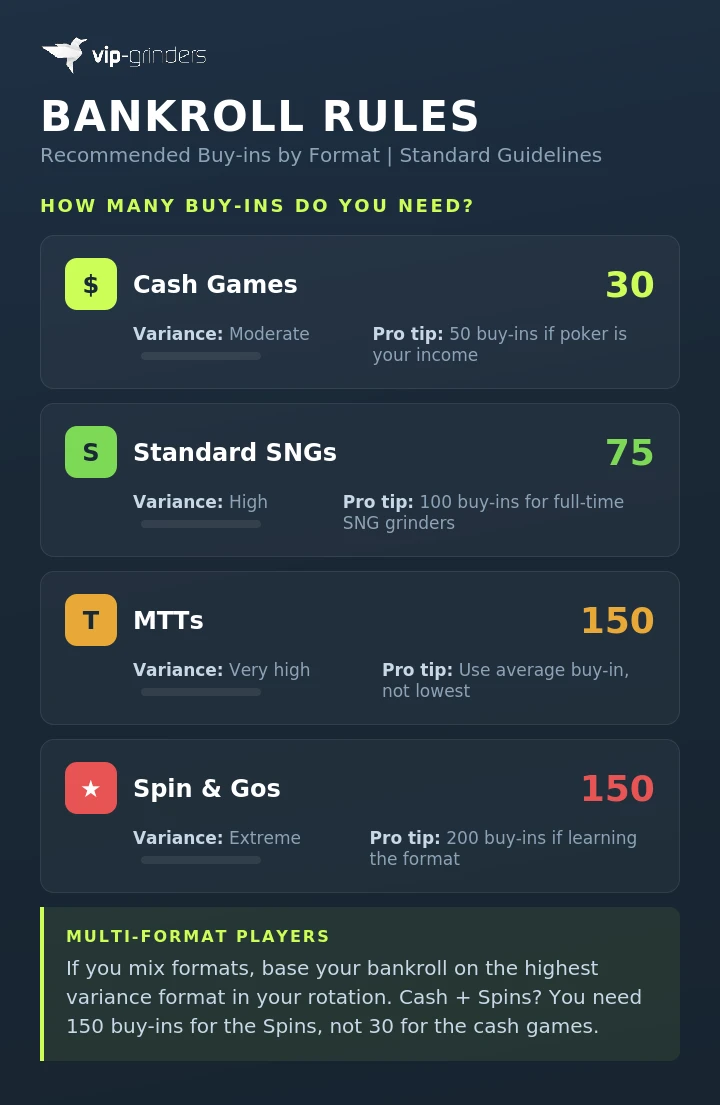
Cash games are the most stable format because you play hundreds of hands per session and your edge compounds steadily. A standard bankroll of 30 buy-ins is enough for most winning players at low and mid stakes. Professionals and full-time grinders should target 50 buy-ins to handle extended downswings without pressure.
| Stake | Max Buy-in | Aggressive (20 buy-ins) | Standard (30 buy-ins) | Conservative (50 buy-ins) |
|---|---|---|---|---|
| NL2 ($0.01/$0.02) | $2 | $40 | $60 | $100 |
| NL5 ($0.02/$0.05) | $5 | $100 | $150 | $250 |
| NL10 ($0.05/$0.10) | $10 | $200 | $300 | $500 |
| NL25 ($0.10/$0.25) | $25 | $500 | $750 | $1,250 |
| NL50 ($0.25/$0.50) | $50 | $1,000 | $1,500 | $2,500 |
| NL100 ($0.50/$1.00) | $100 | $2,000 | $3,000 | $5,000 |
| NL200 ($1/$2) | $200 | $4,000 | $6,000 | $10,000 |
These numbers assume 100bb max buy-in tables, which is standard at most online rooms. If you play short-stack (40bb to 50bb buy-in), you can reduce the bankroll proportionally.
Multi-Table Tournaments (MTTs)
MTTs carry the highest variance of any poker format. You can go 100+ tournaments without a significant cash, and even strong players with 20%+ ROI experience losing stretches that last weeks. The standard recommendation is 150 buy-ins, with professionals targeting 200 to 300.
| Average Buy-in | Aggressive (100 buy-ins) | Standard (150 buy-ins) | Conservative (200 buy-ins) |
|---|---|---|---|
| $2 | $200 | $300 | $400 |
| $5 | $500 | $750 | $1,000 |
| $11 | $1,100 | $1,650 | $2,200 |
| $22 | $2,200 | $3,300 | $4,400 |
| $55 | $5,500 | $8,250 | $11,000 |
| $109 | $10,900 | $16,350 | $21,800 |
Sit & Gos (Standard SNGs)
Standard 6-max and 9-max SNGs sit between cash games and MTTs in terms of variance. The field is small enough that your skill shows up faster than in large MTTs, but the payout structure still creates swings. A standard bankroll of 75 buy-ins works for most regulars.
| Buy-in | Aggressive (50 buy-ins) | Standard (75 buy-ins) | Conservative (100 buy-ins) |
|---|---|---|---|
| $1 | $50 | $75 | $100 |
| $3.50 | $175 | $263 | $350 |
| $7 | $350 | $525 | $700 |
| $15 | $750 | $1,125 | $1,500 |
| $30 | $1,500 | $2,250 | $3,000 |
| $60 | $3,000 | $4,500 | $6,000 |
Spin & Gos (Jackpot SNGs)
Spins require the largest bankroll relative to buy-in because the 3-max hyper-turbo structure and random multiplier create extreme variance. The standard recommendation is 100 to 200 buy-ins. A winning player can lose 100+ buy-ins over a few thousand games purely from normal variance.
| Buy-in | Aggressive (100 buy-ins) | Standard (150 buy-ins) | Conservative (200 buy-ins) |
|---|---|---|---|
| $1 | $100 | $150 | $200 |
| $3 | $300 | $450 | $600 |
| $5 | $500 | $750 | $1,000 |
| $10 | $1,000 | $1,500 | $2,000 |
| $25 | $2,500 | $3,750 | $5,000 |
For a complete breakdown of Spin & Go bankroll management including move-up rules, shot-taking, and why Spins need more buy-ins than MTTs, see our Spin & Go strategy guide.
Format Comparison at a Glance
| Format | Variance Level | Recommended Buy-ins (Standard) | Why |
|---|---|---|---|
| Cash Games | Moderate | 30 | High hand volume per session. Your edge shows up fastest here. |
| Standard SNGs | High | 75 | Small fields but payout-heavy structure creates swings. |
| MTTs | Very high | 150 | Large fields, top-heavy payouts, long stretches between cashes. |
| Spin & Gos | Extreme | 150 | 3-max hyper-turbo + random multiplier = highest variance in poker. |
If you play multiple formats (which many grinders do), base your bankroll on the highest variance format in your rotation. A player who mixes NL50 cash and $10 Spins should maintain at least 150 buy-ins for the Spins, not 30 buy-ins for the cash games.
Risk of Ruin: The Math Behind the Rules
The buy-in recommendations above are not arbitrary. They come from risk of ruin calculations: the probability that a player with a given win rate will lose their entire bankroll before recovering from a downswing.
Risk of ruin depends on two variables: your win rate (how much you beat the game for) and your bankroll size (how many buy-ins you have). A higher win rate lowers your risk. A larger bankroll lowers your risk. The table below shows how these interact for a cash game player.
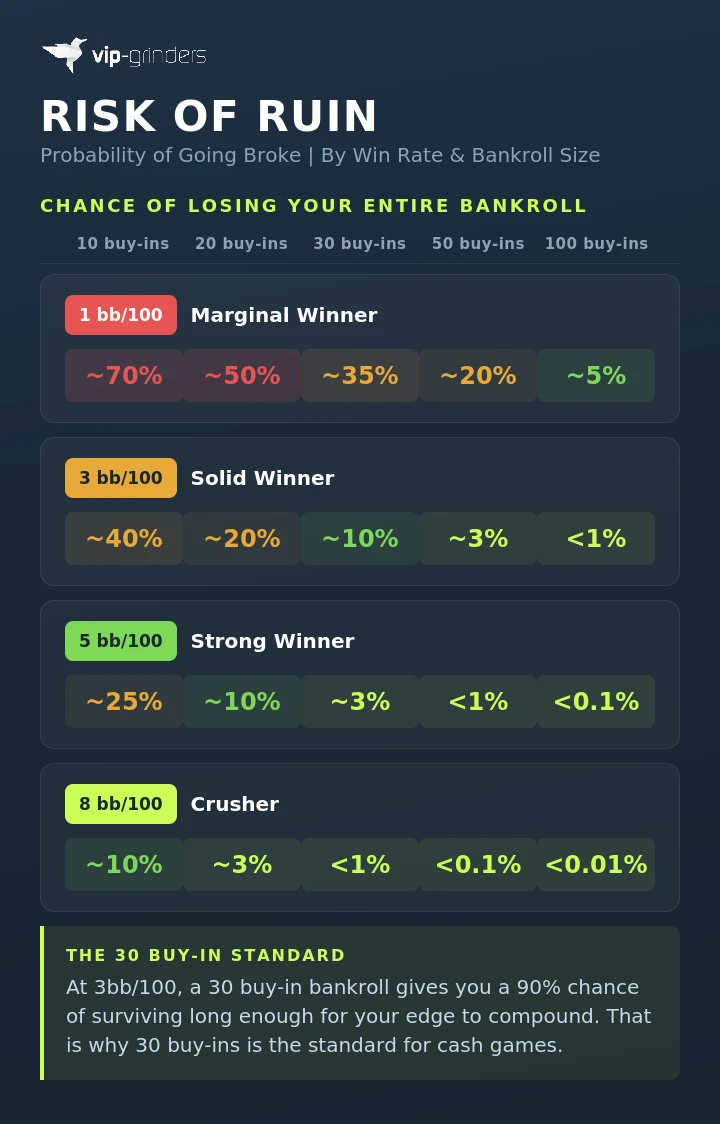
The exact percentages for each win rate and bankroll combination are in the reference table below. Find your approximate win rate in the left column, then read across to see your risk at different bankroll sizes.
| Win Rate (bb/100) | 10 buy-ins | 20 buy-ins | 30 buy-ins | 50 buy-ins | 100 buy-ins |
|---|---|---|---|---|---|
| 1 bb/100 (marginal winner) | ~70% | ~50% | ~35% | ~20% | ~5% |
| 3 bb/100 (solid winner) | ~40% | ~20% | ~10% | ~3% | <1% |
| 5 bb/100 (strong winner) | ~25% | ~10% | ~3% | <1% | <0.1% |
| 8 bb/100 (crusher) | ~10% | ~3% | <1% | <0.1% | <0.01% |
Read this table carefully. A solid 3bb/100 winner with only 20 buy-ins has a 20% chance of going broke. That is a one in five probability of losing everything, not because they play badly, but because variance runs its course before the bankroll can absorb it. The same player with 50 buy-ins drops that risk to 3%.
This is exactly why the standard guideline for cash games is 30 buy-ins. At 3bb/100, a 30 buy-in bankroll gives you roughly a 90% chance of surviving long enough for your edge to compound. Professionals want 50+ buy-ins because they need that risk closer to 1%.
- If you are a marginal winner (1bb/100): you need at least 50 buy-ins to bring your risk of ruin below 20%. At this win rate, playing with 20 buy-ins is a coin flip on whether you go broke.
- If you are a solid winner (3bb/100): 30 buy-ins gives you a 90% survival rate. This is the standard guideline and works for most grinders at low and mid stakes.
- If you are a strong winner (5bb/100+): you can get away with 20 buy-ins and still have a 90% survival rate. But most players overestimate their win rate, so err on the side of more buy-ins unless you have a 50,000+ hand sample confirming your edge.
These numbers are approximations based on standard variance models. Your actual risk depends on your exact win rate, the standard deviation of your format, and whether you are playing one table or multi-tabling. You can model your specific scenario using a poker variance simulator to see how different bankroll sizes affect your probability of going broke over any sample size.
Moving Up, Moving Down, and Shot-Taking
The hardest part of bankroll management is not knowing the rules. It is following them when your emotions want something different. After a 20 buy-in upswing, it feels obvious that you should take a shot at the next stake. After a 15 buy-in downswing, dropping down feels like admitting defeat. Both instincts are wrong. The rules should be set before you start a session, not decided in the moment.
When to Move Up
Moving up requires two conditions, not one. Having enough buy-ins is necessary but not sufficient.
- Condition 1: Bankroll threshold. You have the standard number of buy-ins for the next stake in your format. For example, 30 buy-ins for the next cash game level or 150 buy-ins for the next MTT level.
- Condition 2: Proven win rate. You have a positive win rate over a meaningful sample at your current stake. For cash games, that means at least 30,000 to 50,000 hands. For MTTs, at least 500 tournaments. For Spins, at least 3,000 games.
A player who runs hot for 10,000 hands and accumulates enough for the next stake has met condition 1 but not condition 2. Their sample is too small to confirm a real edge. Moving up on a heater is one of the most common ways grinders lose bankrolls they spent months building.
When to Move Down
This rule is simpler and should be treated as non-negotiable.
If your bankroll drops below 20 buy-ins for your current stake, move down immediately. Do not wait to see if the downswing reverses. Do not try to win it back at the same level. The lower stake is softer, the buy-ins are cheaper, and rebuilding happens faster there.
For example, if you play NL50 and your roll drops from $1,500 to $900, you now have 18 buy-ins for NL50 but 90 buy-ins for NL10. Drop to NL10 or NL25 and rebuild. The math works in your favour at the lower level, and you eliminate the risk of going broke entirely.
Shot-Taking
Shot-taking is a controlled way to test the next stake before your bankroll fully qualifies. The key word is controlled. Without a plan, shot-taking turns into gambling.
| Rule | How to Apply It |
|---|---|
| Budget the shot | Set aside 3 to 5 buy-ins for the higher stake. That money comes from your bankroll, not from a separate deposit. |
| Set a stop-loss | If you lose the budgeted buy-ins, the shot is over. Move back down with zero hesitation. |
| Set a time limit | Give the shot 1 to 2 sessions maximum. If you are not comfortable at the new level after two sessions, you need more time at the current stake. |
| Evaluate honestly | Did you lose because of bad luck or because the players are better? If the games felt significantly tougher, your current win rate may not carry to the next level. |
How Rakeback Extends Your Bankroll
Most bankroll management guides ignore rakeback entirely. That is a mistake, because for many grinders, rakeback is the difference between a bankroll that slowly bleeds out and one that grows month over month.
Rake is a fixed cost on every hand you play and every tournament you enter. At low and mid stakes, it eats a significant percentage of your win rate. Rakeback returns part of that cost to you, effectively boosting your win rate and lowering your risk of ruin at every bankroll size.
For a full breakdown of how your deal should influence format choice, table count, and volume planning, see the rakeback and strategy guide.
How Rakeback Changes the Math
Consider a NL25 cash game grinder who generates $300 in rake per month across 30,000 hands. Without rakeback, that $300 is gone. With a 25% rakeback deal, $75 comes back. With a 40% deal, $120 comes back.
| Scenario (NL25, 30,000 hands/month) | Table Win Rate | Rake Paid | Rakeback (25%) | Effective Monthly Profit |
|---|---|---|---|---|
| Break-even player (0 bb/100) | $0 | $300 | $75 | $75 |
| Marginal winner (2 bb/100) | $150 | $300 | $75 | $225 |
| Solid winner (4 bb/100) | $300 | $300 | $75 | $375 |
The break-even player turns profitable purely from their deal. The marginal winner increases their monthly income by 50%. For players grinding low and mid stakes where edges are thin, rakeback is not a bonus. It is a core part of their win rate.
Why Your Deal Matters for BRM
A stronger rakeback deal does not just put more money in your pocket. It also changes which stakes are sustainable for your bankroll. The hourly rate guide breaks down the exact dollar per hour difference between a 15% and 40% deal at every stake.
A player with a $1,500 bankroll and no rakeback deal needs to beat NL50 at a meaningful rate to justify playing there. The same player with a 30% rakeback deal can break even at the tables and still grow their bankroll by $90 to $120 per month from rakeback alone. That monthly inflow acts as a safety net, reducing the effective risk of ruin at every bankroll size.
- Rakeback lowers your effective rake: a 5% rake with 30% rakeback means you are effectively paying 3.5%. That difference compounds across thousands of hands.
- Rakeback smooths out downswings: during a losing stretch, you are still generating rake and still receiving rakeback. That passive income slows the rate at which your bankroll shrinks.
- Rakeback speeds up recovery: after a downswing, the rakeback payments that accumulate while you grind back help you rebuild faster than your table results alone.
This is exactly why signing up through a tracked affiliate matters. Players who register directly at a poker room without an affiliate code receive the room’s default rewards, which are often lower than what is available through a deal. Signing up through VIP-Grinders rakeback deals locks in the best available rate at each room, plus access to exclusive freerolls and personal support for tracking and promo optimization.
The difference between a 15% and a 35% rakeback deal across 12 months of regular play at NL25 can be over $1,000 in extra value. That is money that goes directly into your bankroll and accelerates every move-up decision.
Common Bankroll Management Mistakes
Going broke rarely happens because of bad poker. It happens because a player breaks one of the rules above in a moment of frustration, overconfidence, or impatience. These are the mistakes that show up most often.
- Moving up after a heater: you win 15 buy-ins in a week and decide you are ready for the next stake. Your bankroll qualifies, but your sample size does not. A 10,000 hand upswing proves nothing about your long-term edge. Wait for 30,000+ hands before moving up.
- Refusing to move down: your roll drops from 30 buy-ins to 12, and you keep playing the same stake because dropping feels like failure. This is ego, not strategy. Moving down protects what you have left and gives you a softer field to rebuild in.
- Treating poker money as spending money: withdrawing after every winning session keeps your bankroll permanently small. You never accumulate enough to move up, and one bad week puts you back at zero. Set a withdrawal schedule (monthly, not daily) and only take profits above your bankroll target.
- Using one bankroll rule for every format: 30 buy-ins is correct for cash games but dangerously low for MTTs or Spins. Each format has a different variance profile, and the tables in this guide exist for exactly that reason.
- Not tracking results: if you do not know your win rate, you cannot calculate risk of ruin or decide when to move up. You are guessing instead of managing. Even a simple spreadsheet that logs your sessions, buy-ins, and results is enough to make informed bankroll decisions.
Every one of these mistakes is recoverable if you catch it early. The players who do not recover are the ones who stack two or three mistakes on top of each other: they move up too early, refuse to move down, and then start withdrawing from a shrinking bankroll to cover personal expenses. That sequence is how most poker careers end.
Tools for Tracking Your Bankroll
You cannot manage what you do not measure. Tracking your results is what turns bankroll management from a vague intention into a system that actually works. You need to know your win rate, your monthly rake generated, and your current bankroll size at all times.
The simplest approach is a spreadsheet. Log every session with the date, format, stake, hands or games played, and profit or loss. After a few months, you have enough data to calculate your win rate, identify your most profitable format, and confirm whether your bankroll can support a move up.
For players who want more precision, our poker bankroll calculator lets you input your current roll, win rate, and format to see exactly which stakes you can sustain and how long it takes to reach your next target.
- Poker tracking software: tools like PokerTracker and Hold'em Manager import your hand histories automatically and calculate win rate, standard deviation, and session results for you. These are the standard for serious online grinders.
- Mobile tracking apps: apps like Poker Bankroll Tracker let you log live and online sessions from your phone. Good for players who mix live and online play or prefer manual logging.
- Spreadsheets: a basic Google Sheet with columns for date, format, stake, buy-in, result, and running bankroll total is free and effective. Most players who track consistently started with a spreadsheet before upgrading to dedicated software.
The specific tool matters less than the habit. Players who track their results make better bankroll decisions because they have data instead of feelings. If you do nothing else after reading this guide, start logging your sessions today.
Frequently Asked Questions
How many buy-ins do I need for online cash games?
The standard recommendation is 30 buy-ins for the stake you want to play. That means $300 for NL10, $1,500 for NL50, or $3,000 for NL100. Players who depend on poker income should target 50 buy-ins. Players with a steady job who can reload if needed can operate at 20 buy-ins, but this leaves very little room for normal downswings.
How many buy-ins do I need for poker tournaments?
For MTTs, the standard is 150 buy-ins based on your average buy-in. If you mainly play $11 events, that means roughly $1,650. Tournament variance is much higher than cash games because you can go 50 to 100 events without a significant cash even with a strong ROI. Professionals typically keep 200 to 300 buy-ins.
How many buy-ins do I need for Spin & Gos?
The standard guideline is 100 to 200 buy-ins. Spins have the highest variance of any poker format because of the 3-max hyper-turbo structure and random multiplier. A winning player can lose 100+ buy-ins over a few thousand games. Most grinders target 150 buy-ins as a working number.
Can I start playing poker with a $100 bankroll?
Yes, but it limits you to micro stakes. With $100, you have 50 buy-ins for NL2 ($0.01/$0.02) cash games, which is a perfectly comfortable starting point. You could also play $1 Spins or $1 SNGs. The key is to stay at stakes where your bankroll supports the standard number of buy-ins for that format, then move up as your roll grows.
When should I move up in stakes?
Move up when you meet two conditions: you have the standard number of buy-ins for the next stake and you have a proven positive win rate over a meaningful sample at your current stake. For cash games, that means at least 30,000 to 50,000 hands. Having the money alone is not enough. A short-term heater does not prove you can beat the next level.
Does rakeback count as part of my bankroll?
Yes. Pending and received rakeback payments are part of your poker bankroll. Rakeback is money you earned by playing, and it should be factored into your total roll when deciding which stakes you can afford. A player with $1,200 on site plus $150 in pending rakeback has a $1,350 bankroll.
Is bankroll management different for live poker?
The principles are the same, but the numbers can be slightly more aggressive. Live games tend to be softer than online games at the same stake, and you play far fewer hands per hour (25 to 30 live versus 60 to 75 online per table). Many live players operate comfortably at 20 buy-ins for their stake. The bigger practical concern for live players is tracking results manually, since there is no automatic hand history.
What should I do during a long downswing?
First, check that you are still playing well. Review your sessions for tilt-induced mistakes or strategic leaks. If your play is solid, trust the math: downswings of 15 to 20 buy-ins happen to every winning player. If your bankroll drops below 20 buy-ins for your current stake, move down. Do not try to win it back at the same level. Rebuilding at a lower stake is faster and carries almost no risk of going broke.
Should I keep my entire bankroll on one poker site?
Not necessarily. If you play on multiple rooms to access different games, softer fields, or better rakeback deals, it makes sense to split your bankroll across sites. Just make sure you count all your balances when calculating your total bankroll. A player with $500 on GGPoker and $400 on CoinPoker has a $900 bankroll, not two separate $500 and $400 bankrolls.
How do I rebuild my bankroll after going broke?
Start fresh at the lowest micro stakes your deposit allows. Even $50 gives you 25 buy-ins for NL2. Focus on playing solid poker, tracking every session, and following the bankroll rules from this guide. Do not rush back to the stake where you went broke. Many players rebuild successfully in 2 to 3 months by grinding micros with discipline and letting rakeback supplement their table results.