

GTO Poker & Solvers: How to Study, Apply & Improve 2026
GTO is the most talked about idea in modern poker. It’s also the most misunderstood. Most players who say they study GTO couldn’t tell you what their solver output actually means once they’re staring at it.

That gap matters because GTO knowledge is worthless if you can’t apply it at the table. Reading a solver output is one skill. Turning it into a profitable decision under pressure is a completely different one.
GTO (Game Theory Optimal) is a strategy nobody can beat in the long run, and a poker solver is the software that calculates it by simulating millions of hand outcomes. But GTO is not the goal: it is the benchmark you study so you know when, where, and how to deviate from it for profit.
This guide assumes you already understand basic preflop concepts and how to build and read poker ranges, since ranges are the foundation every solver simulation is built on. Here is what it covers:
- How to set up and read solver simulations with correct inputs, aggregate analysis, and board texture patterns
- Building heuristics that compress solver output into one-sentence rules you can execute under pressure
- Node locking to study how your actual opponents play, not just perfectly balanced opponents
- When to deviate from GTO and the three signals that tell you exploitation beats balance
When to Deviate from GTO at the Table
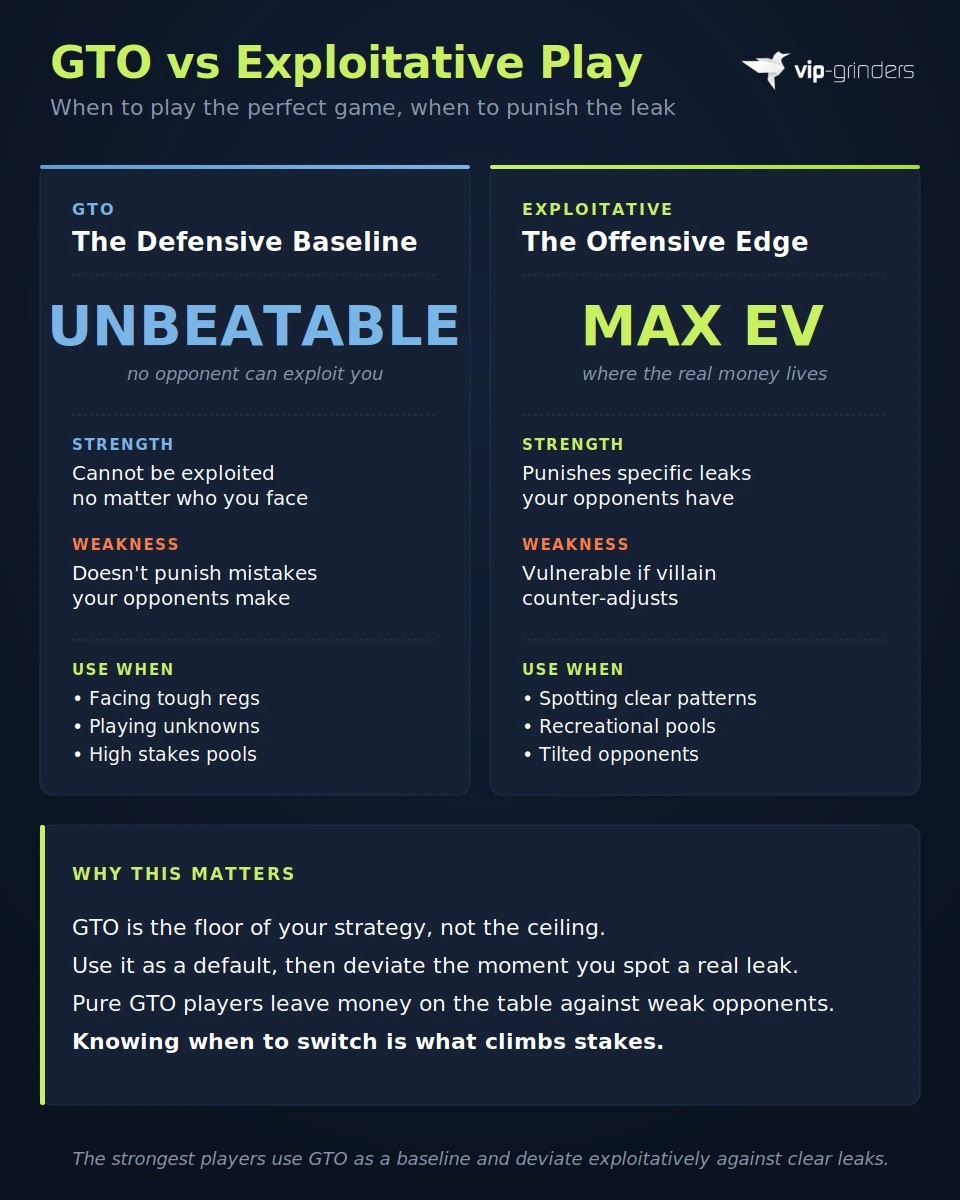
GTO is not the goal of poker. It is the floor. If you played a perfect GTO strategy against every opponent, you would never lose money over the long run, but you would also never win as much as a player who reads the table and adjusts correctly.
Knowing when to leave GTO behind is the single biggest skill jump intermediate players make. The logic behind that deviation, also called exploitative play, is what most articles on GTO versus exploitative play never bother to give you.
GTO as Your Defensive Baseline
Think of GTO as a strategy that cannot be exploited no matter what your opponent does. It mixes bluffs and value bets at frequencies designed to make every line break even for the player on the other side. The reward is invulnerability, but the cost is that you are not actively punishing anyone for their mistakes.
That trade is worth it in two specific situations. The first is against opponents who study you over a long sample, where GTO protects you from being exploited back. The second is against opponents you have no read on yet, where GTO gives you a sound default until you gather information.
Outside those two situations, pure GTO leaves money on the table. Every recreational player you face is making a specific mistake that you could profit from if you adjusted to it directly.
The Three Signals to Deviate
You do not need a solver running in the background to spot when GTO stops being optimal. Three signals tell you it is time to shift toward exploiting, and none of them require math. They require attention.
- Opponent type: when a specific player makes a clear, repeatable mistake, exploit it directly instead of playing balanced against them
- Stack depth: at very short or very deep stacks, standard solver outputs no longer reflect the right strategy and other models take over
- Game flow: short-term table dynamics like recent aggression, tilt, or steal patterns that GTO cannot track but you can
The first signal is opponent type. A player who folds too often gets bluffed more, and a player who calls everything gets value bet thinner. GTO does not care about these tendencies, but your win rate does.
The second signal is stack depth. Solvers calculate balanced strategies for specific stack sizes, and shorter or deeper stacks change the math significantly. At 15bb in a tournament, push-fold ranges replace nuanced GTO play, and at 200bb in a cash game, implied odds dominate decisions in ways most solver outputs do not capture.
The third signal is game flow. If the table has been folding to your aggression all session, keep firing, and if a single opponent has tilted after a bad beat, attack their range.
These are short-term reads that change every orbit, and GTO has no mechanism for tracking them.
Why Most Players Get This Wrong
The mistake intermediate players make is treating GTO as a destination. They study solver outputs, memorize frequencies, and try to play balanced poker against opponents who would happily fold to a small bet 70% of the time.
The result is a player who knows the technically correct answer but earns less than the player who simply notices the obvious leak.
GTO is the foundation. Deviation is where the money lives.
How to Read What Your Solver Is Showing You
Once you’ve run your first simulation, you’re looking at a wall of numbers, percentages, and color-coded hands. The instinct is to study every cell looking for the perfect answer. That instinct is what makes most beginners give up on solver study within a week.
Solver output is not a list of correct answers. It is a description of how a perfectly balanced player would distribute their actions across thousands of similar spots. Once you understand what the numbers actually represent, the wall of data turns into a small set of patterns you can actually use.
Frequencies, Hand-by-Hand Strategy, and EVs Decoded
Every solver output contains three core data types you’ll see right away. Each one tells you something different, and confusing them is the fastest way to misread a sim.
Frequencies show how often the solver takes a given action with its entire range. When a flop output says “bet 33% pot at 70% frequency,” it means the solver is betting 70% of all the hands it could have in that spot, not 70% of the time with a specific hand.
Hand-by-hand strategy shows what each individual combination is doing inside that frequency. AKs might bet 100% of the time while T9s mixes between betting and checking. The aggregate frequency is the average across all combinations in your range.
EVs show the expected value of each action in chips or big blinds. If checking has an EV of 1.8bb and betting has an EV of 1.7bb, the solver will check more often even when both actions are technically profitable. The math behind these decisions ties directly to pot odds and equity, which the solver uses internally to assign value to every action.
| Hand | Bet 33% Pot | Check | Bet 75% Pot |
|---|---|---|---|
| AKs | 100% | 0% | 0% |
| AQs | 70% | 30% | 0% |
| KQs | 40% | 60% | 0% |
| T9s | 0% | 80% | 20% |
| 22 | 0% | 100% | 0% |
This is what hand-by-hand output looks like in practice. The aggregate frequency for “bet 33% pot” across this range averages out to roughly 42%, but no single hand bets at exactly 42%. Each combination has its own answer.
Why Solvers Output Mixed Strategies (and What That Means for Humans)
The most confusing part of any solver output is the mixed strategy. The sim tells you to bet AJo here 60% of the time and check it 40% of the time. No human can roll dice at the table, so what is this actually telling you?
Mixed strategies exist because in many spots, two different actions have nearly identical EV. The solver is indifferent between them, so it splits the action to stay unexploitable against a perfectly balanced opponent. For you, the practical takeaway is the opposite of what most players think.
The Difference Between a Solution and a Strategy
A solution is what the solver gives you. A strategy is what you take to the table. They are not the same thing, and treating them as if they were is the single biggest reason solver study fails for most players.
The solution is mathematically optimal against another perfect player. The strategy is a simplified, executable version that captures most of the EV without requiring you to memorize hundreds of mixed-frequency decisions. Translating one into the other is the actual work of solver study, and it is what the next sections cover.
How to Set Up and Read a Solver Simulation
Most solver study fails before the sim even runs. The problem is not the software or the hands you choose. It’s that the inputs you feed the solver are wrong, and wrong inputs produce confident answers to questions that have nothing to do with the spots you actually face.
A useful simulation starts with three decisions:
- Which spot to study
- Which inputs to define
- How to validate whether your assumptions match reality
Get those right and the output teaches you something. Get them wrong and you’re memorizing answers to a different game.
Choosing the Right Spot to Study
The fastest way to waste a study session is to fire up your solver and analyze the most interesting hand from your last session. Interesting hands are usually rare, and rare spots don’t move your win rate. The spots that matter are the ones you face fifty times a week.
Start with high-frequency, high-impact spots: single-raised pots out of position from the big blind, continuation betting on dry boards as the preflop raiser, defending against a 3-bet from the button. These are the situations where small improvements compound across thousands of hands.
Skip the rare and the bizarre. A 4-bet pot on a four-flush board is a fun puzzle, but you’ll see it twice a month and solving it teaches you nothing you can apply consistently. Save creative analysis for spots that show up often enough to matter.
Defining Inputs: Stacks, Ranges, Bet Sizes, and Board Texture
A solver needs four things before it can run: starting stacks, the preflop ranges of both players, the available bet sizes on each street, and a specific board (or board texture). Each input changes the output, and each one needs to match the population you actually play against.
- Stacks: set the effective stack depth that matches your typical sessions, not the default 100bb if you play deeper or shallower
- Ranges: input opponent ranges based on the actual pool you face, not textbook ranges from a training site
- Bet sizes: limit the available sizes to what you and your opponents actually use, not the full range from 10% to 200% pot
- Board: pick a board representative of the spot you're studying, or run an aggregate over similar textures
The biggest mistake is using default inputs without checking them. Most solver setups ship with cash game ranges that assume perfectly balanced opponents at standard 100bb depths. If you play 50bb cash games against passive recreational players, those defaults give you answers to a game you’re not playing.
Why Your Input Assumptions Shape Everything
Solvers don’t know what your opponents actually do; they only know what you tell them. Input a tight 3-bet calling range for the big blind, and the solver produces an aggressive c-betting strategy because it assumes the weak hands have folded. Feed it a loose calling range, and the c-betting frequency drops fast.
This is why solver output should never feel like absolute truth. It is the answer to a specific question you asked, with specific assumptions you defined. Change the assumptions and the answer changes too.
The practical fix is to run the same spot twice with different opponent ranges: one tight, one loose. The differences between the two outputs tell you which decisions are stable across opponent types and which are highly sensitive to your input assumptions. The stable ones become rules you can trust, and the sensitive ones stay flexible until you have a read.
Start with the Aggregate, Not the Individual Hand
Every modern solver lets you view aggregate reports across dozens or hundreds of boards at once. This is the fastest path to insight, and almost no free content teaches it. Instead of asking “what does the solver do with AKs on this exact board,” you ask “what does the solver do with my entire range across every board where I’m the preflop raiser in this position.”
The aggregate answer comes back as a small set of numbers: average c-bet frequency, average bet size, average check frequency. Those numbers are easier to remember and easier to apply than fifty hand-by-hand decisions, and they hold across many more spots than a single-board analysis ever could.
A good rule is to spend 80% of your study time in the aggregate view and only 20% drilling specific hands. Most players do the opposite and learn far less.
Spotting Patterns Across Board Textures
Boards group into categories: dry vs wet, paired vs unpaired, ace-high vs broadway vs middling vs low, monotone vs rainbow. Solvers treat each category very differently, and the patterns are remarkably consistent once you know to look for them.
- Dry, paired boards: small cbets at high frequency, because neither player's range connects strongly
- Wet, coordinated boards: bigger bets at lower frequency, because the preflop raiser wants to protect equity and charge draws
- Ace-high boards: very high cbet frequency, because the preflop raiser has a natural range advantage
- Low and middling boards: mixed strategies with more checks, because the defender's range has caught up
These patterns aren’t trivia. They’re the entire payoff of aggregate analysis. Once you’ve internalized that ace-high boards favor the preflop raiser and middling boards favor the defender, you can make correct decisions on dozens of new boards you’ve never explicitly studied.
The Numbers That Matter Most
When you’re staring at an aggregate report, three numbers carry most of the strategic weight. Everything else is detail you can drill into later if needed.
The first is overall action frequency: how often the solver bets, checks, or raises with its full range. The second is sizing distribution: which bet sizes appear most often and which never appear. The third is defense frequency: how often the out-of-position player calls or raises against any given bet.
That third number ties directly to a specific math concept called minimum defense frequency, which tells you the percentage of your range you must defend to stop your opponent from profiting with any two cards. You can calculate minimum defense frequency against any bet size to sanity-check whether the solver’s defense numbers match what the math actually demands. When the solver defends well above MDF on a given board, it usually means the defender has a strong range advantage that the simple math misses.
Focus on those three numbers first. The rest of the output exists to support them, not the other way around.
How to Build Heuristics from Solver Output
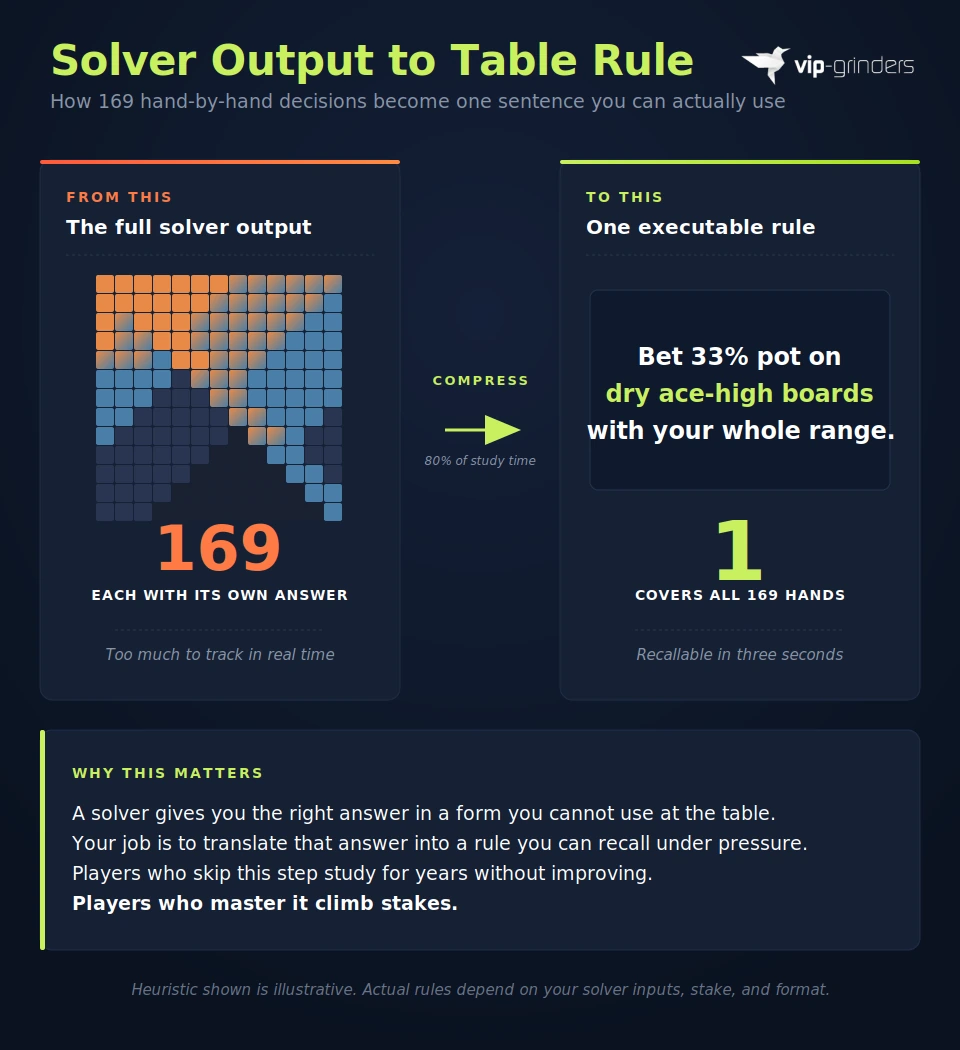
A heuristic is a rule of thumb you can execute at the table without thinking. Solver output is full of them, but they’re buried inside frequencies and EVs that most players never learn to decode. The players who climb stakes are the ones who translate the raw output into three or four rules they never forget.
This is the highest-value skill in solver study. Run it right and one study session produces a rule you use thousands of times. Run it wrong and you walk away from the same session with nothing you can actually apply.
From Solver Frequencies to Table-Ready Rules
The method for extracting a heuristic has three steps. Start with a spot you face often, find the pattern that holds across many variations of that spot, then compress the pattern into one sentence you can say out loud.
The compression step is the one most players skip. If you can’t say the rule in one sentence, you don’t have a heuristic yet. You have a collection of frequencies you’ll forget by next session.
A good heuristic survives pressure. When you’re 90 minutes into a session and your stack is down, you should still be able to remember the rule without opening your notes. That’s the test: if you can’t recall it under fatigue, simplify it further.
Three Heuristics You Can Use Today
These three rules apply to almost every sim you’ll run, regardless of format or stake. They’re useful on their own, and they’re examples of what it looks like when you turn raw solver output into an executable rule.
- 1Round any mixed frequency below 15% to zero. If the solver says 'bet 88%, check 12%', just always bet. You lose almost no EV and gain a strategy you can actually execute under table pressure.
- 2Your minimum defense frequency equals pot divided by (pot plus bet). A pot-sized bet means defending 50% of your range. A half-pot bet means defending about 67%. Defend below these numbers and your opponent profits with any two cards.
- 3Treat EV differences under 0.1bb as meaningless. When two actions are within 0.1bb of each other, the solver is telling you either choice is fine. Pick whichever fits your simplified strategy and commit without guilt.
The first rule saves you from the biggest trap in solver study: memorizing mixed frequencies you can’t actually execute. The second is the pure math behind why equity denial is a core concept solvers solve for on every street. The third frees you from false precision and keeps your decisions fast.
Notice what each heuristic does and doesn’t tell you. It gives you a default action for a common spot, not a full strategy for every variation of that spot.
That’s the point: a heuristic handles the 80% case, and your active thinking handles the remaining 20%.
Testing Your Heuristics Against New Board Textures
A heuristic is only useful if it holds up. Before you commit a rule to memory, run it against three or four boards you didn’t study during the original simulation.
If the rule still produces good results, you have something worth using. If the rule breaks on half of the new boards, you’ve found the edges of your pattern and need to narrow the rule.
The test is simple. Pull up a new board in your solver, apply your heuristic without checking the solution first, then compare your decision to the solver’s output.
If the EV loss is less than 0.2bb, your rule is close enough to correct. If the gap is bigger, you’re oversimplifying and need to add a condition or a carve-out before trusting the rule in real games.
Node Locking: Teaching the Solver How Your Opponents Actually Play
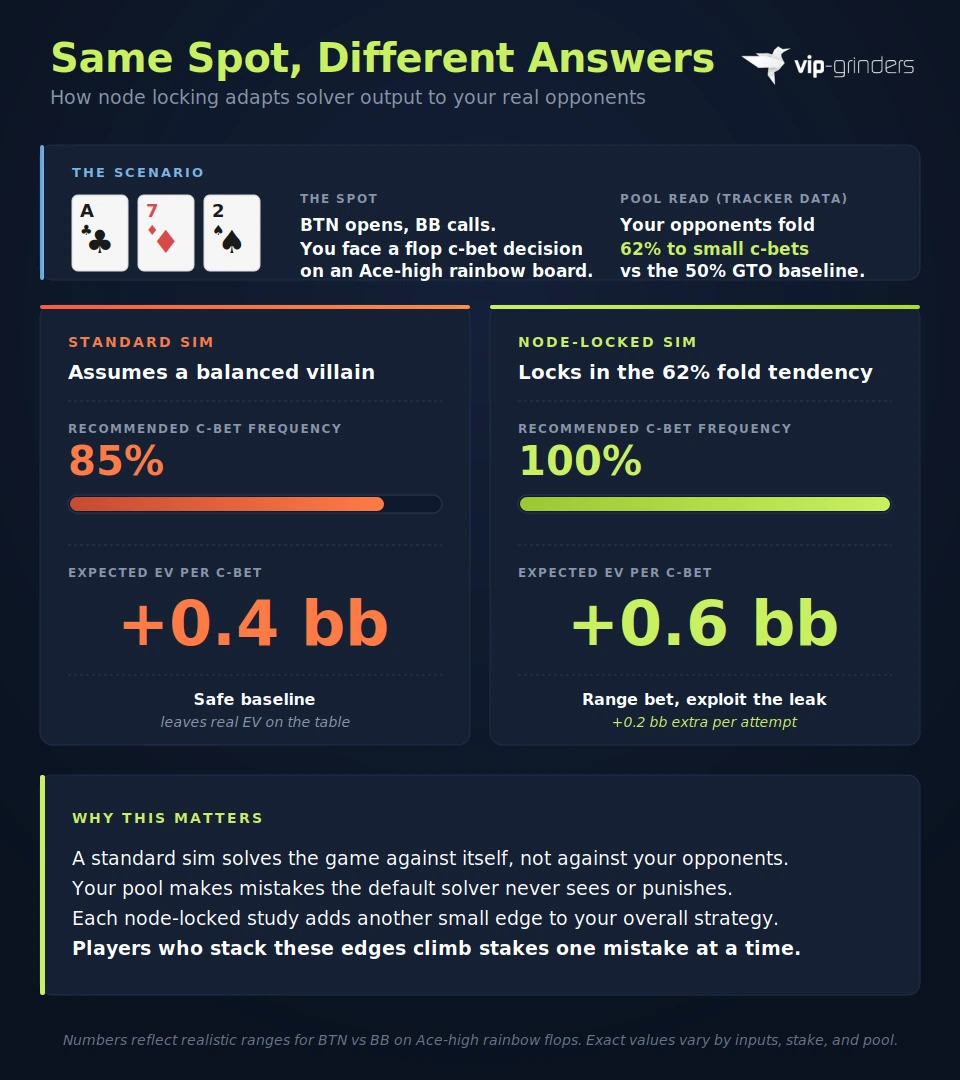
The biggest limitation of a standard solver sim is that it assumes your opponent plays perfectly balanced poker. Real opponents don’t: they overfold, over-bluff, call too wide, or never 3-bet without a premium hand. Node locking is the feature that closes that gap.
When you node lock, you override the solver’s default assumption about what your opponent does in a specific spot. You tell the sim “this player folds 80% of the time to a river bet” or “this player never raises the turn without the nuts,” and the solver recalculates the best strategy against that exact tendency.
What Happens When You Override the Solver’s Assumptions
A standard sim produces an unexploitable baseline. Node locking produces a maximally exploitative response to a specific opponent flaw. The first answers how to stay safe against a perfect player, while the second answers how to punish the specific mistake you’re seeing.
Everything downstream of the locked decision gets recalculated automatically. If you tell the solver your opponent overfolds to overbets on blank rivers, the sim will show you a wider bluffing range on those same rivers, because the math on the new best response has changed.
Using Node Locking to Find Real Exploits
The workflow is simple once you know what you’re looking for. The goal is to find a tendency in your pool, lock it into the sim, and let the solver tell you how to punish it.
- 1Identify one clear leak in your player pool (example: big blinds folding too often to small cbets on low boards)
- 2Lock that tendency into the solver at the specific decision point
- 3Run the sim and read the new exploitative output
- 4Extract a heuristic from the output and bring it to the table
A Solver Study Routine That Fits a Real Schedule
Most solver study fails because the routine is wrong, not because the effort is wrong. Players sit down for a three-hour marathon, get overwhelmed by the output, and walk away having learned nothing they can use. Then they skip the next session because it felt pointless.
The fix is structure. A study routine that respects how your brain actually works will teach you more in three 45-minute sessions per week than ten hours of unfocused grinding through sims.
The Study Session Structure
A productive session has three phases: warm-up, deep work, and review. Each phase has a job, and skipping any of them drops the value of the whole session.
| Phase | Duration | What to Do |
|---|---|---|
| Warm-up | 5 minutes | Pick one spot, write down what you think the correct play is before checking |
| Deep work | 30 minutes | Run the sim in GTO Wizard or PioSolver, extract at least one usable rule |
| Review | 10 minutes | Write the heuristic in one sentence, note how it differs from your prediction |
Committing to a prediction before checking forces the solver’s answer to stick in your memory. The gap between what you expected and what the solver shows is where the learning lives.
How Often to Study and What to Prioritize
Three 45-minute sessions per week beats one three-hour session every time. Consistency matters more than duration because your brain needs time between sessions to consolidate what it learned.
Prioritize spots by frequency, not by difficulty. The spots you face 50 times a week are worth more study time than the spots you face once a month, even if the rare spots feel more interesting. A sample weekly schedule looks like this:
| Day | Duration | Focus |
|---|---|---|
| Monday | 45 minutes | Preflop spots (3-bet defense, cold call ranges) |
| Wednesday | 45 minutes | Flop play (cbet frequencies across board textures) |
| Friday | 45 minutes | Turn and river decisions (barrel selection, bluff catching) |
Rotate the focus weekly so every major decision point gets covered roughly once a month. If you notice a specific leak in your own play, swap that week’s topic to address it directly.
The Study-to-Table Feedback Loop
Study without play wastes the study. Play without review wastes the play. The loop that turns both into improvement is: study a spot, play sessions watching for that spot, review hands where it came up, refine the heuristic, repeat.
The refine step is the one most players skip. After a session, pull up the three or four hands where your studied spot actually appeared and ask whether your heuristic produced a good decision.
If yes, keep it. If no, you’ve found a boundary case your rule doesn’t cover, and that boundary is your next study topic.
Five Mistakes That Make Solver Study a Waste of Time
Most players don’t fail at solver study because they lack effort. They fail because they make one of five specific mistakes that waste the time they do put in. Every one of these is fixable once you can see it in your own routine.
The list below is ordered by severity. Fix the top mistakes first.
- 1Cramming too many spots into one session. Trying to analyze five different decisions in 45 minutes means you leave with five shallow answers and zero heuristics. Pick one spot per session and go deep.
- 2Memorizing solutions instead of patterns. If you're trying to remember what AJo does on K♠7♠3♠, you're studying wrong. Look for the pattern across similar boards and learn the rule, not the hand.
- 3Running pure GTO sims without ever node-locking. If every sim you run assumes perfectly balanced opponents, you're studying a game your pool doesn't actually play. Lock in one real tendency from your pool every few sessions.
- 4Treating solver output as gospel. Every output is the answer to a specific question you asked with specific assumptions you defined. Change either one and the answer changes. Solvers are advisors, not oracles.
- 5Never studying from the other side. If you only ever study spots from the preflop raiser's perspective, you're missing half the game. The spots where you're defending are the ones where bad habits cost you the most.
If you recognize yourself in any of these, the fix is usually smaller than it feels. The first three are fixed by changing what you do in a single session. The last two require changing how you think about the solver’s role in your study, which takes a few sessions to sink in but pays off for the rest of your career.
The common thread across all five is false productivity. Each mistake feels like work because you’re spending time with the solver, but the output doesn’t translate into better decisions at the table. Real progress shows up as table results, not as hours logged in the study tool.
Simplify Before You Sit Down
The biggest mistake players make in live application is trying to do the compression work in real time. By the time the flop comes and the clock starts running, the window for thinking through solver output has closed. Your in-session thinking should be read-based, not math-based.
Do the simplification before the session starts. Pick the three or four heuristics you’ve studied most recently and keep them available on a note card you can glance at between hands. When the decision arrives, you’re not calculating, you’re recognizing.
Board Texture Categories That Reduce Cognitive Load
Instead of treating every flop as a unique problem, sort boards into categories you’ve studied in advance. These six buckets cover almost every flop you’ll see:
- Dry ace-high: the preflop raiser has a clear range advantage
- Wet connected: equity shifts fast across streets, draws dominate
- Paired low: neither range connects strongly and pots stay small
- Broadway heavy: the caller's range catches up more than it looks
- Monotone: the flush draw reshapes every equity calculation
- Low middling: the defender's range has real equity on most cards
Each category has a default action already loaded in your head from study time. When a continuation betting decision comes up, you recognize which bucket the board falls into and execute the corresponding default without rerunning solver logic. The heavy thinking happened during study, and the live version is pure pattern recognition.
The “Close Enough” Principle in Real-Time Decisions
Live decisions don’t need to match your study perfectly. They need to match closely enough to capture most of the EV without eating your mental reserves. That tradeoff is the difference between a grinder who holds their win rate across a long session and one who fades badly in the back half.
Perfect is the enemy of profitable. A decision that captures 95% of the EV in three seconds is worth more than a decision that captures 99% of the EV but takes 45 seconds and burns your mental reserves for the rest of the session.
Accept that your live play will always be slightly worse than your study. When a bluffing spot comes up that your heuristic doesn’t cover perfectly, trust the rule, take the line, and move on. Second-guessing costs more than small errors, every single time.
The players who get real value from solvers treat every session as a search for one more rule they can take to the table, not a search for the perfect answer to a specific hand. Set up your sims with inputs that match your real pool, read the output at the aggregate level first, and compress what you see into heuristics you can say out loud. The players who run this loop consistently climb stakes.
For a full comparison of which solver fits your budget and skill level, see our poker tools guide.
Frequently Asked Questions
Do I need a solver to play winning poker?
No, thousands of winning players have never opened a solver. But if you want to climb beyond low stakes, solvers give you access to strategic insights that are nearly impossible to discover on your own. Think of them as accelerators, not requirements.
What does a poker solver actually do?
A poker solver simulates millions of hand outcomes to calculate the mathematically optimal strategy for a specific situation. You define the inputs (stacks, ranges, bet sizes, and board texture), and the solver outputs action frequencies, EV values, and hand-by-hand strategies. The output shows what a perfectly balanced player would do against another perfectly balanced player.
How long does it take to learn GTO?
You can grasp the basic concepts in a single focused session. Extracting usable heuristics from solver output takes several weeks of consistent study. Becoming genuinely GTO-informed in your decision-making is an ongoing process that most serious players treat as part of their weekly routine for years.
Is GTO better than exploitative play?
Neither is strictly better. GTO protects you from being exploited but doesn’t actively punish opponent mistakes, while exploitative play punishes mistakes but leaves you vulnerable to counter-adjustments. The strongest players use GTO as a baseline and deviate exploitatively when they spot clear opponent leaks.
Why do solvers output mixed strategies?
When two actions have nearly identical EV, the solver splits between them to stay unexploitable against a perfectly balanced opponent. A pure strategy would be exploitable if the opponent figured out the pattern, so the solver mixes to deny them that edge. Humans can’t execute mixed strategies reliably, so for practical play you should pick whichever pure action fits your read and commit to it.
Is GTO overkill for low stakes?
GTO study is rarely overkill, but pure GTO play at low stakes usually is. Low-stakes pools are full of exploitable mistakes, and a balanced baseline leaves most of that value on the table. Study GTO to build the foundation, then deviate exploitatively once you spot the pool’s specific leaks.
How do I know if my solver study is working?
Results show up at the table, not in hours logged in the software. After a few weeks of focused study, you should notice yourself recognizing studied spots mid-hand and executing the heuristic without hesitation. If you’re still uncertain in the exact spots you’ve drilled, your rules are too complex and need more compression.
Can I play GTO at the table without memorizing charts?
Yes, and you should, because memorizing charts fails under time pressure when the cognitive load is too high for live play. Extract three to five simple heuristics from each study session and play those rules at the table. Heuristics you can recall under fatigue will outperform charts you can’t retrieve in real time every single session.