

The search warrant behind the Lodge Card Club raid is now public, and the allegations are far more serious than early speculation suggested. A 22-page affidavit authored by TABC Agent Douglas Bell details five criminal violations and $1.35 million in flagged cash deposits.
The document also reveals an undercover investigation that ran for nearly two years before agents walked through the door on March 10.
No arrests had been made and no charges had been filed. But the warrant painted a picture of sustained financial scrutiny that went well beyond the routine compliance check many in the poker community initially assumed.
Doug Polk denied any knowledge of money laundering on March 16. That statement was issued before the affidavit's contents became public.
For the full timeline of the March 10 raid, agencies involved, and Texas legal context, see our original Lodge Card Club raid coverage.
Five Criminal Violations Under Investigation
The affidavit lists five Texas Penal Code violations that Agent Bell is investigating in connection with the Lodge Card Club's operations:
- Engaging in organized criminal activity (Texas Penal Code 71.02(a)): a first-degree felony when linked to money laundering. Carries a potential sentence of 5 to 99 years.
- Money laundering (Texas Penal Code 34.02).
- Promotion of gambling (Texas Penal Code 47.03).
- Keeping a gambling place (Texas Penal Code 47.04).
- Possession of gambling device, equipment, or paraphernalia (Texas Penal Code 47.06).
The organised criminal activity allegation was the headline. It was the most serious item on the list and moved the investigation from a regulatory dispute into potential felony territory. The state dropped it in April, along with every other felony allegation.
The Lodge ownership group had faced a similar accusation in 2023, when Illinois lawyer Mark Lavery filed civil lawsuits alleging organised criminal activity against Polk, Owen, and Neeme. That was a private civil claim. This time, the accusation came from a state law enforcement agency backed by a judge-signed warrant.
$1.35 Million in Flagged Cash Deposits
The financial core of the affidavit centres on cash flow through Tempus Holdings, Inc., the Lodge's corporate investment entity. During January and February 2025 alone, approximately $1.35 million was deposited from the Lodge through a Loomis cash vault located inside the club into a Tempus Holdings bank account.
A further $808,000 was transferred from a Tempus Holdings account to a separate “sweeps” business bank account during the same two-month window. The affidavit states these transactions constitute evidence of illegal activity at the Lodge.
The Loomis vault is a commercial cash management service typically used by businesses handling high volumes of physical currency. Its presence inside the Lodge suggests the club was processing enough cash to justify industrial-grade cash handling infrastructure.
Who Controls Tempus Holdings
The warrant names three majority stakeholders who collectively own 63.3% of Tempus Holdings and are signers on the sweeps bank account: Doug Polk, Jake Abdalla, and Jason Levin.
It also names 18 minority investors, each holding under 7%, including Brad Owen, Andrew Neeme, Jamie Kerstetter, Nick Petrangelo, Ryan Fee, Jaman Burton, and Thomas “SrslySirius” Keeling. None of the minority shareholders appear to be investigation targets based on the affidavit's language.
The financial picture mattered because the Lodge's assets and bank accounts were frozen on March 15. At the time, staff were without pay and players could not cash out chips or collect tournament winnings.
As the Lodge's highest-profile owner, Polk was named in the affidavit as a majority stakeholder and signatory on the accounts in question. He was never charged.
Two Years of Undercover Operations
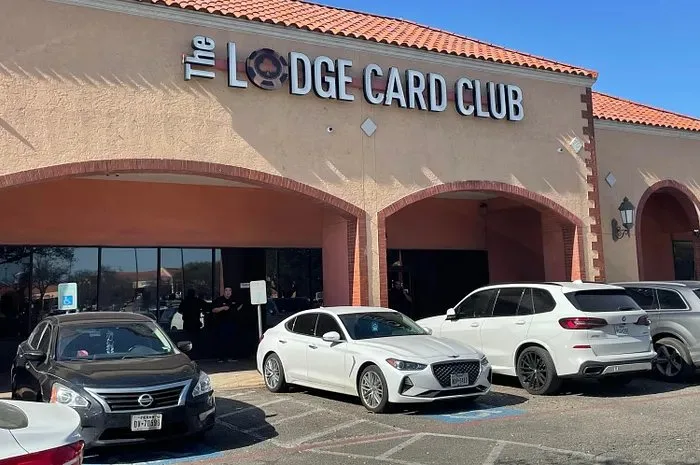
The investigation did not begin with the March 10 raid. According to the affidavit, Agent Bell received a confidential report of questionable financial activity at the Lodge in June 2024. He began exterior surveillance on June 13, 2024, and by August had obtained the club's bank records.
Starting April 17, 2025, TABC agents went undercover inside the Lodge. They visited the club on six separate occasions through January 30, 2026, spanning roughly nine months of on-the-ground intelligence gathering.
What the Undercover Agents Did
Each agent was given $600 and bought into $1/$2 no-limit hold'em cash games. They documented everything: chips purchased, beverages ordered, security presence, session results, and how the club handled membership verification.
On the final visit, Agent Teague asked a Lodge manager about hosting a private poker game at the facility. That question appears designed to test whether the club would facilitate arrangements outside its standard operating model.
The nine-month undercover timeline also explains something that puzzled the poker community: how the TABC knew exactly when to strike. The raid came roughly 16 hours after the Lodge Championship Series Main Event concluded.
Agents were likely monitoring the tournament schedule. They chose a moment when the room would be transitioning between its biggest event and normal operations.
What This Means for the Lodge and Texas Poker
The warrant details shifted the narrative significantly from the first week of coverage. Here is where things stood as of March 17, 2026:
- No arrests, no charges: the investigation was ongoing. A search warrant is an early-stage tool, and charges might or might not follow.
- Polk's denial met the affidavit: Polk stated on March 16 that he had no knowledge of money laundering and that the affidavit had not been made public. It was now public, and it named him as a majority stakeholder and signatory on the accounts under scrutiny.
- IRS involvement: the IRS participated alongside TABC and the Williamson County Sheriff's Office. Federal participation suggested the financial scrutiny extended beyond state-level alcohol and gambling enforcement.
- No reopening timeline: the Lodge had been told not to reopen until the investigation concluded, and its staff remained out of work.
- No legislative fix coming: the Texas legislature meets biennially in odd-numbered years. The next session does not start until January 2027.
Every Texas poker room operating under the same private-club membership model was watching this case. Charges and a conviction on the organised criminal activity count would have set a precedent that threatened the legal model the state's private clubs rely on.
Instead, the case ended much like the 2019 Houston raids: no charges, and the seized assets released after a grand jury declined to indict. Our later reports cover the closure and staff layoffs, the April 9 forfeiture deadline and the civil forfeiture filing. For more poker news, follow our latest poker news.
