


Instant payments are reshaping the online poker industry by slashing withdrawal times to seconds, enhancing player satisfaction, and diversifying payment methods across global markets. The shift from traditional cards to real-time rails like SEPA Instant and PIX drives higher retention while boosting operational efficiency in 2026.
The Rise of Instant Poker Payouts
Speed defines modern poker play. Traditional bank transfers and card refunds take 3-5 days, frustrating players eager to redeposit or cash out wins. Instant poker payouts via real-time payment rails deliver funds in under 10 seconds, available 24/7 even on weekends.
This innovation stems from fintech advancements. Open banking APIs connect player accounts directly to poker platforms, enabling seamless account-to-account (A2A) transfers without intermediaries. Surveys show 28% of iGaming users would deposit more with instant withdrawals, underscoring their retention power while immediate access builds trust during critical post-win moments.
Industry-wide adoption surges. In Europe, SEPA Instant processes billions of transactions yearly as iGaming captures growing share. The global online poker market, valued at $3.86 billion in 2024, is projected to reach $6.90 billion by 2030, with instant payments accelerating this 10.2% annual growth.
Key Technologies Powering the Shift
Several rails dominate instant poker payouts:
- SEPA Instant (Europe): Processes transactions up to €100,000 in seconds. Default limits hit €15,000 for individuals in 2025. Over 70% of EU banks participate, cutting costs 60% compared to cards.
- PIX (Brazil/LATAM): Commands 81-90% of iGaming transactions. It's instant and fee-free for users. 160 million registered users drive Brazil toward €1.8 billion by 2024.
- Faster Payments/UPI (UK/Asia): Enable push payments up to £1 million. They use automatic name and IBAN verification through open banking.
These outperform e-wallets and crypto in reliability and speed. While e-wallets offer instant deposits, withdrawals take 24-48 hours. Traditional cards need 1-5 days. Operators integrate via unified APIs blending multiple rails, reducing failed transactions by verifying deposit accounts match payout destinations—a critical fraud prevention measure.
If you’re comparing rails, fees, and withdrawal speeds across operators, our guide to the best poker payment methods breaks down the most reliable options for poker players.
Transforming Poker Paymix and Retention
Paymix evolves rapidly as cards, once dominating 50%+ of transactions, decline while A2A rises. Players favor direct bank links for security, speed, and lower fees. In Brazil, PIX displaced rivals in two years; Europe follows with PSD2 mandates pushing open banking adoption.
Retention jumps measurably. Players with instant access show higher lifetime value and engagement rates. Mobile users play 30% more hands weekly than desktop players, and instant withdrawals make that loop even smoother by letting players redeposit or re-enter without delays. That’s why the best-performing operators pair fast payouts with strong mobile UX — here are our picks for the top poker sites with fast mobile poker apps.
Fraud prevention improves too. Confirmation of Payee (CoP) systems verify account holders while behavioral analytics flag unusual patterns without disrupting legitimate players. Payment fraud rates decrease as A2A eliminates card theft risks and reduces chargeback exposure.
Cost and Operational Benefits
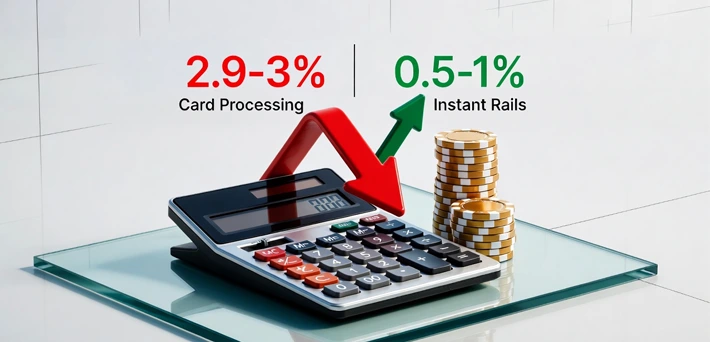
Transaction economics favor instant rails. Cards cost operators 2.9-3% plus fixed fees while digital wallets charge similar rates. SEPA Instant and PIX reduce this to 0.5-1%, with some rails offering near-zero consumer fees.
For sites processing millions monthly, savings are substantial enough to fund player rewards or marketing. Support tickets drop as instant confirmations eliminate “where's my money” inquiries. Automated reconciliation tracks real-time payments, reducing manual work while speeding financial reporting for compliance. Operators report fewer disputes and faster regulatory audits thanks to transparent instant trails.
Challenges and Regulatory Landscape
Implementation isn't seamless. Verification delays hit if KYC is incomplete, and peak-hour volumes during tournaments strain capacity. Fees vary—rails are cheap but PSP markups apply based on risk and volume.
Regulations accelerate adoption. EU mandates instant processing for all banks by 2025, dramatically expanding infrastructure. Brazil's Central Bank ensures PIX compliance while fostering innovation. AI fraud detection pairs with rails, analyzing patterns in milliseconds to approve legitimate payouts fast while flagging suspicious activity.
Future Outlook for Poker Industry
By late 2026, instant poker payouts become table stakes rather than competitive advantages. Industry analysis predicts 50%+ paymix shift to A2A globally as card dependency fades.
Peer-to-peer models expand, enabling player-to-player transfers for home games and private tournaments. Micro-transactions emerge as instant processing removes minimum barriers—players withdraw €10 wins as easily as €10,000. Crypto hybrids serve niches combining blockchain transparency with rail speed via stablecoins.
Players gain frictionless experiences matching digital expectations. Operators cut costs, reduce disputes, and build loyalty through reliability. This fintech wave redefines poker as instant-gratification gaming — and it’s increasingly tied to exclusive poker promos designed for quick redeposit cycles, reloads, and frequent cashouts.
